Midstream

river trees

In the past ten days, two friends have died. Not unexpectedly, no shocks. A couple of weeks ago, when they were both still alive, everyone and everything around me seemed painfully mortal, and this poem is what I wrote then.

I cross the bridge, but
Midstream, I stop.
So much water, passing under.
I cannot hold it back.

Midstream – upstream – a dipper,
Mischievous, concealed among stones and ripples,
Bobs, and waits.
Midstream – downstream – a fisherman
Casts and retrieves, over and over,
Silent, focused, amid swirling water.

I, too, have cast,
Over and over.
But now my line diffuses and is lost in movement
And what, now, is left to retrieve?

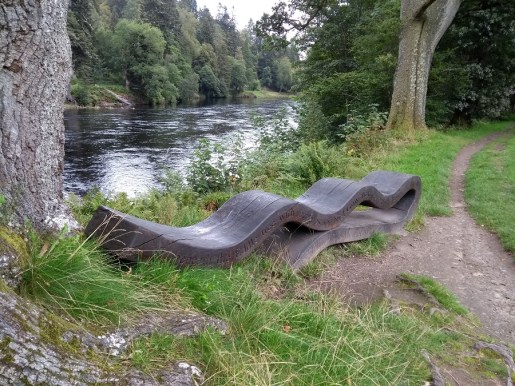
fiddle treeBy this great river I sit
Beneath the fiddle-tree,
A gnarled and feathered oak, gashed
By storm, decay and distant ghosts of song.
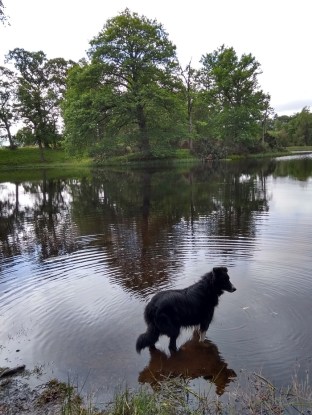
Riverbank trees, like frozen statues, arch and crane,
Their token reflections broken
Like dreams in the midstream of sleep.

On dark ripples, tiny sounds of water on water,
Midstream, the undercurrent
Chases the rain from highland to lowland
Into deeper water yet.

Midstream, unseen fish bestir
And battle homeward. But I
Am snagged, log-jammed, midstream
Watching lives flow on and vanish into river,
Slippery, elusive as salmon, impossible to hold,
Passing, on unfathomed journeys, beyond my sight

While I stand helpless and wait
Midstream.

The Blood of the Ploughman

bloodyploughman1

Have you ever been seduced by those advertisements in colour supplements for NEW! UNIQUE! varieties of fruit or vegetables accompanied by dazzling photos of their technicolor extra-ordinariness? The exciting modernity of red-fleshed apples is one example of excitable marketing – and many fall for it.

But rosy-fleshed apples are not new. Discovery, an early-ripening apple bred in 1950, is one example, and deservedly popular. But this is a story of a much older apple, first recorded in 1883 – but who knows when it first appeared….

Once upon a time, when the Carse of Gowrie – that rolling, flat and fertile plain of drained marshland on the north side of the River Tay that stretches from Perth to Dundee – was famous for its orchards, a weary ploughman was plodding home after a long day in the field. It was September, and an Indian summer, the sun had been blazing all day and the ploughman had finished his drink early and was very thirsty. To get home more quickly, he decided to take a short cut through the orchard of Megginch Castle – one of the finest orchards in the Carse.

As ever, the productive trees of Megginch were laden with fruit; apples of every type and colour, small, golden Scottish pears, plums and damsons. Many were ripe and even falling into the long grass. The tired ploughman thought how handsomely a ripe apple would quench his thirst and assuage his growing hunger – it was past suppertime.

Well,there was nobody about, and surely no-one would begrudge a hard-working labourer a windfall, so the ploughman helped himself. So delicious was the apple that the ploughman was struck by the idea that to leave these windfalls would be an awful waste, when his wife could make good use of them in the kitchen. The gardeners had all gone home for the evening, so who would notice? The ploughman began to fill his smock with ripe fruit, as the light began to fade from the day.

A warning shot rang out, and a furious cry: “STOP THERE, THIEF!” The ploughman swung round, and recognised the loping gait of the estate gamekeeper coming toward him. He began to run, apples held tightly in his smock. “I’m warning you man!” called the gamekeeper, but the ploughman blundered on. There was the sound of another shot……

At this point the story grows different arms and legs and embellishments depending on the audience and who’s telling the story. I confess to my part in encouraging flights of imagination. For genteel adults and those of a sensitive disposition, the story goes that the ploughman was wounded but escaped, managing to get home with at least some of his “stolen” apples. For children, the gorier version suits, and if you can throw in a ghost, so much the better.

So, either the ploughman fell, shot dead, in the orchard, his apples scattered, or his disgusted wife patched him up, but threw the apples on the midden to teach him a lesson. Either way, one of those blood-streaked fruits set seed to become a  tree the following spring. And when that tree was grown, it bore dark red, deeply ribbed apples that ripened on the anniversary of that day in September when the ploughman was shot. And when the crisp, thirst-quenching flesh was sliced, the flesh of the apple was streaked and stained with the ploughman’s blood.
bloodyploughman2

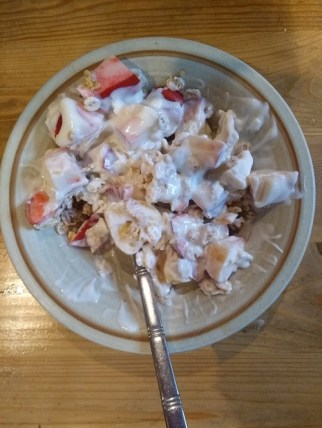
Thus was born the famous Scottish dessert apple, the Bloody Ploughman. From the dwarf tree in my garden came this exquisitely juicy, neither sickly sweet nor yet sour, apple for my breakfast, with cereal and yoghurt.

As for Megginch orchard, it’s still there, not just surviving but thriving. After all, it’s practically next door to the Cairn O’Mhor cider makers. Many of the old trees from the age of Victoria remain, and still bear excellent crops, but also there is a new orchard of modern, productive varieties, and a new heritage orchard, containing all the Scottish apple varieties that can be found.

You can be sure the bloody ploughman found his way home safely.

Magic Moments, New Toys and the Bread of Heaven


breadofheaven

I continue my obsession with the micro-organisms that make bread. The sourdough starter got filed in the fridge for a while when I became enthused with spelt. Spelt flour is made from a grain that is like wheat, but not a variety of wheat. It’s engagingly described by marketing types as an “ancient grain”. It makes, really, really nice chewy, flavoursome bread with yeast and honey and olive oil, and it’s very quick to rise and do its thing (unlike sourdough, for which, I now know, you need patience, planning and much mindfulness.) One supplier calls spelt bread made this way Roman Army Bread. No wonder the Roman army was a conquering one (except in Scotland, of course!). I noticed that even with this easy bread, my technique has improved through slaving over the sourdough. I am no longer tempted to flour the worktop.

Anyway, this week I go back to the sourdough, and duly refresh (or feed, though apparently that’s the wrong word) my dead-looking starter. I pour away most of the black oily liquid on top of the jar, stir the rest in, and add roughly equal amounts of warm water and wholemeal Rouge d’Ecosse flour from Fife. Same again next morning, except for the black liquid, which has vanished. Being besotted enough to sit and watch, I can scarcely tear myself away when small whirlpools, bubbles and movement began.

That magic moment when your sourdough starter says thank you for breakfast!

Now I’m looking forward to using all the new toys I got for my birthday – a baking stone you heat in the oven that I’m told will make all the difference to my spreading, cow-pat like bloomers, the scraper that will preserve the kitchen sink from becoming a nursery for yeasts and lactobacteria to proliferate because I can’t get all the sloppy dough off surfaces, bowls and hands; a magic kneading implement to which the dough mysteriously doesn’t stick, a slashing knife, and a Very Deep Tin.

Thanks to the confining nature of the Very Deep Tin, dough has no choice but to go Up. Thus I produce the above Bread of Heaven, with a chewy salt and pepper crust under which lies a cavernous hole – because I forgot the slashing bit to let out gas while it was baking.

(Three days later, I completely wreck a freestanding loaf by cavalierly forgetting to weigh the right amount of production starter I put in, and using nearly double the appropriate quantity…. The dough refuses to leave the proving basket and I create a 2cm high pancake, baking stone or no baking stone. It made a good savoury bread and butter pudding mind.) 

I’m still learning… !

The Morning After

unicorn mushrooms

The morning after the march I went mushrooming again. There were no mushrooms of any kind left in the fridge. I nearly didn’t bother, because I was dog tired, and, after all, I would pass at least three supermarkets in the afternoon.

But something about the air that morning was irresistible. Cool, zinging with the promise of sunshine; light, ethereal and just a little autumnal; dust motes and electrons dancing a jig. The dam and the woods and clearings energised and soothed simultaneously – an antidote to the adrenaline that had kept me up and awake till gone 2am, head birling with ideas and reflections and hope no anxiety could dampen.

Every secret hollow, bank and bog in my regular itinerary yielded something edible. Shaggy Inkcaps standing like soldiers, Hedgehog Mushrooms like tiny undercooked loaves, spiny as urchins beneath, chunky Orange Birch Boletes that go alarmingly black when you cut the flesh but taste divine. And a few late Saffron Milk Caps, only slightly infested.

jed Rohallion

The sunny gold of Chanterelles glistened like the yolk of a happy hen’s egg. Deer came skipping coquettishly out from the wood and crossed in front of me, one of them practically pirouetting in her glee – anticipating perhaps, the rutting season nearly upon us.

From my dog gazing lovingly at his stick floating away on the loch to the shafts of sudden sun on the ripples he makes, from the happy brown collie and his owner to the mute swans and their big grey babies – the morning after, all of Scotland seems to be smiling at me.

A Big Hoose and its Carriage Drive

airleywight drive

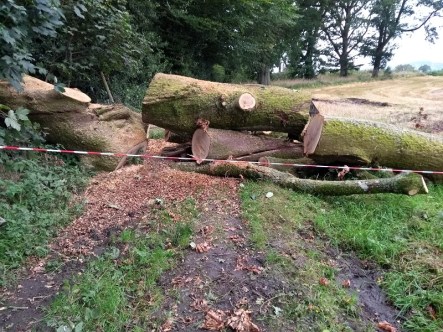
Another giant tree that was part of the avenue lining the old carriage drive has come down. Every year, one at least succumbs. They are mostly beech, monumental now, out of scale with the straggle of the village and the low fields that sulk under the weight of rain and ripe barley.

airleywight4

The carriage drive is a ghost of former times, looping importantly around the grounds of the big hoose that now peeps sheepishly out from behind its deer fences and the remnants of redwood trees, the choice rarities, status symbols prized by landowners two centuries ago. Then, it all belonged – carriage drive, trees, big hoose and all – to the Wylies of Airleywight. To be honest, James Wylie probably owned most of the village, and built a fair whack of it too. He owned my house, and, though long dead, may well still own the rough road on which it lies. (Nobody else claims it, despite rumours that it might be the property of the Bankfoot Light Railway, also long dead.)

A footpath follows the line of the carriage drive, side-stepping the remaining beeches. Here and there, minor land grabs seep into it. A corner of field here, children’s dens there, new tracks, sheds and barbecues. A shady allotment of raised beds fingers into it, created by someone in the adjacent scheme with access to Heras fencing and a tendency to self-sufficiency. In the woods beyond the house, where the Garry Burn streams by, a squarish, sunken, shallow bog is still called The Curly by successive generations of schoolchildren, out on bikes and skateboards, building jumps. If you hunt among the rank vegetation, you’ll find the metalwork that filled or drained the pond for icy games enjoyed by residents and visitors to the big hoose at Christmas.airleywight2


Where the carriage drive seems to end, the footpaths continue, past what’s left of the huge walled garden. Now a forest of self-seeded trees occupies the space where fruit, flowers and vegetables once were expertly raised on the south-facing slope. They tower above what’s left of the crumbling, ruptured walls. Who knows what horticultural sleeping beauties may still lie dormant at the heart of the garden?


The cottage near it lay abandoned save by the swallows for many years, still graced by bursts of surviving garden flowers among the thistles in summer. The butterflies loved both. Was it the gardener’s house? Or perhaps the coachman for whom the drive was made? The village architect has renovated it to picture postcard perfection. It looks content, roofed, aired, cultivated – but not extended. Nearby he built himself a house of traditional, solid materials, that so fits the landscape in style it has become part of it. Already there are lichens on the roof and leaves in the gutters. The swallows and martins nest easily in the eaves and outbuildings.airleywight3


You get to the big house now by a difference entrance, made significant by statuary, but no carriage drive. Of the latest owner, and what they plan for their gardens, curling ponds and steadily declining avenue, there is no word.