
The other day, a friend told me that my second-favourite star might be dying. Betelgeuse is already a pensioner as stars go; possibly over nine million years old. Age is a bit meaningless when you’re talking about stars though. The Sun, our nearest star, we think of as present, alive, omnipresent. But light from Betelgeuse takes about 600 years to reach us on Earth, as we prance around our own star, and that means that, if the signs are being read aright, Betelgeuse is already gone. We are just observing its decline 600 years later.
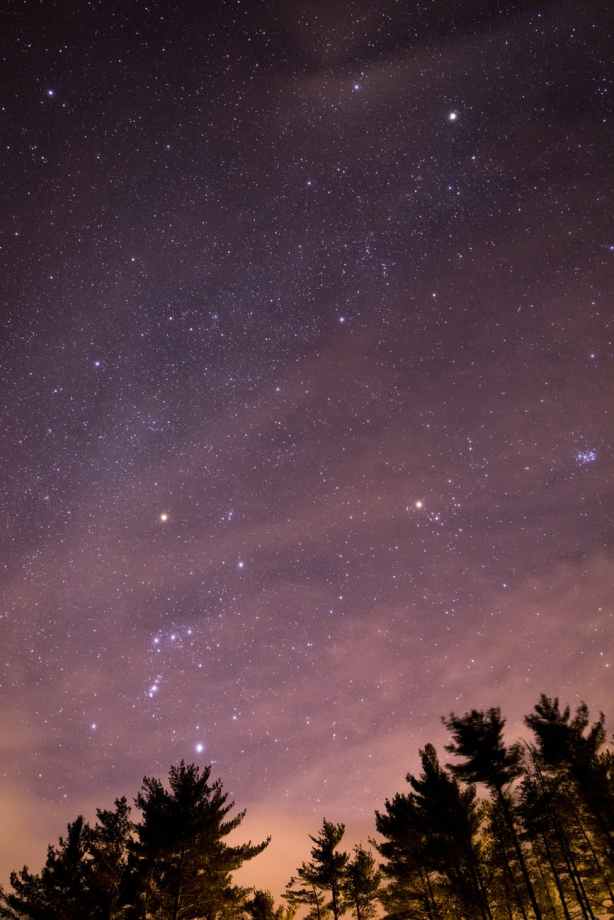
It was Christmas night, on the way back from the midnight service in Dunkeld, that I last saw Betelgeuse. The night was clear and frosty. We pulled off the back-road, switched off the car lights and walked into the icy air. A fox barked in the distance; we were silent, awestruck. The Milky Way strode across the sky, Sirius, the Dog Star, was blue indeed. I began pointing out the names of constellations I knew, and making up the ones I wasn’t sure of, because I can never do enough stargazing for all the names to stick. Betelgeuse is easy, because of its reddish hue and its position as the right shoulder of Orion the Great Hunter. I was a bit nonplussed, because it wasn’t as obvious as usual, but thought no more of it till my friend told me the news.
It’s red because it is something called a Red Supergiant (a sign of ageing in stars). And it’s getting dimmer and dimmer, a state which is said to indicate a loss of mass. With twenty times the mass of the Sun, Betelgeuse has a way to go, but the eventual pattern is an expulsion of dust leading to the star’s explosion as a supernova. If that happens (and it might not, yet, at any rate, because Betelgeuse is a “variable” star, whose brightness goes up and down in cycles), it will create a show of light brighter than the moon, capable of casting shadows on Earth. It might even be visible by day. And then it will be gone.

On many levels, I’d miss Betelgeuse. The physics of supernovae is going on constantly all over the universe, and one day it will happen to our Sun as well. Stars die. But Betelgeuse is a vividly recognisable part of a much-loved constellation I associate with the depths of winter (as well as being the star around which the home planet of Ford Prefect orbits*). Constellations may be unscientific and artificial, but they paint pictures through which we navigate our ignorant way through a universe too fabulous to designate merely with letters, numbers and formulae. Michel Serres, in The Five Senses, says that if we abandon the naming of stars and constellations “night has lost its giants and animals.”**
What will Orion, the Great Hunter, do without a right shoulder?
“The thing once called a star is classified, distinguished and divided into new families…..designated by a corpus of codes and categories, by a collection of calculations and theories……things simply called stars hardly exist any more.”**
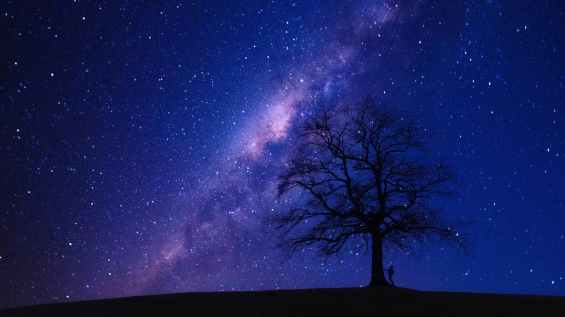
I love the science of the universe, but I also love its art, its language and its inspiration. Much as I’d like to see a supernova, personally I hope Betelgeuse is just being variable and brightens up again the starry nights of winter.
*Adams, Douglas: The Hitchhiker’s Guide to the Galaxy (Heinemann, 1986)
** Serres, Michel: The Five Senses: A Philosophy of Mingled Bodies (in English: Bloomsbury Academic, 1985)
 Comments on The Nature of the Universe
It would appear, now, that Betelgeuse is back; probably only temporarily obscured by some gas and dust which it threw off, and instead, we hear in the science news of two huge black holes having collided seven billion years ago, so far away that all we detected was a few small gravity waves, which made a short, unimpressive thud in a loudspeaker. This, nevertheless, was the biggest bang detected by us since the Big Bang. I am inclined to wonder what other beings detected that thud, the point being that those scientists didn’t detect it yesterday, but perhaps many millions of our years ago, if they lived far closer to the original event. And some may detect it far into our future. The universe is truly vast.
https://www.nbcnews.com/science/space/biggest-bang-big-bang-scientists-detect-collision-huge-black-holes-rcna106
LikeLike
My goodness, yes. I heard about that. I’m glad Orion’s right shoulder star is still firing. Even though it probably isn’t. As it were.
LikeLike
“Right shoulder star”… I suppose we do tend to think of Orion as facing us. Two good clues there; the lowest star of his belt is Alnitak, to our left. This is downward because it bears the weight of his sword. Alnitak and Mintaka stay higher on his waist. Statistically, he is likely to be right-handed. Also, his dog, Sirius (the Dog Star) is to our left. He’d keep his companion on his right hand side, surely… But then, demi-gods perhaps like to be different, so perhaps he’s walking off into the sunset 🙂
LikeLike
Goodness I hadn’t reckoned with the possibility he was walking away from us! Now there’s a can of worms……never make assumptions about demigods!
LikeLike