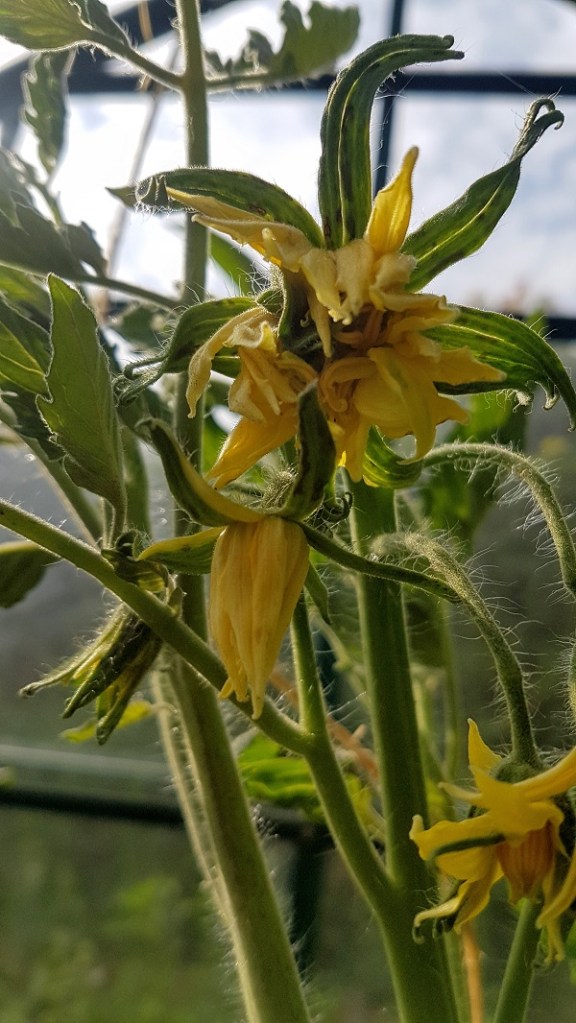
Fresh back from holiday and the torture that was the M6 from Junction 17 onwards, I fairly skittered through the unread emails, merely scanning those of interest. One from the writers’ group: a meeting I’d missed, and a writers’ prompt that had me immediately dashing back to the greenhouse to inspect the Gkousiari tomatoes. Before we left, they had been showing distinct signs of fasciation – had it become more apparent in my absence?
Fasciation is an odd thing that happens to plants, usually affecting stems or flowers. You see a daisy or a dandelion, and it looks like two or more flowers have been fused together….. daaandeellioon…. A mutant! you think, and you’d not be wrong, because it’s a genetic mess going on. Stems look suspiciously chunky or double, shoots flatten and spread instead of actually shooting. It’s like bits of the plant have welded together.
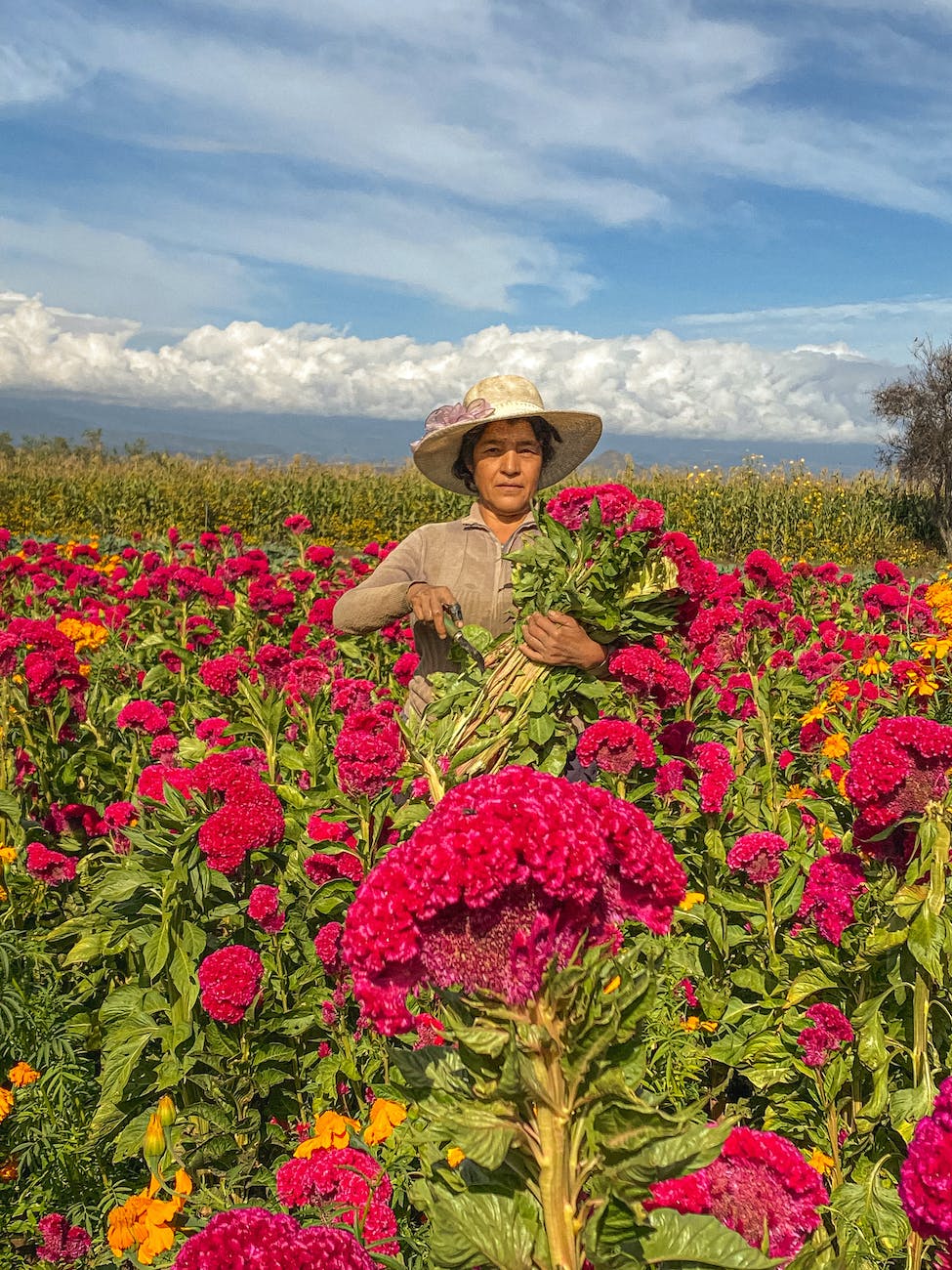
Because fasciation is a trait that can be carried genetically, small fortunes have been made by encouraging it, producing house plants like Celosia, the Cock’s Comb flower (above), or flat-stemmed willows from cuttings.
Anyway. The fasciated look is also adopted by plants that are triploid (having an extra set of chromosomes in their genes) or tetraploid (four sets instead of two). Celosia is tetraploid, and the fasciation is carried in the seed. Back to tomatoes.
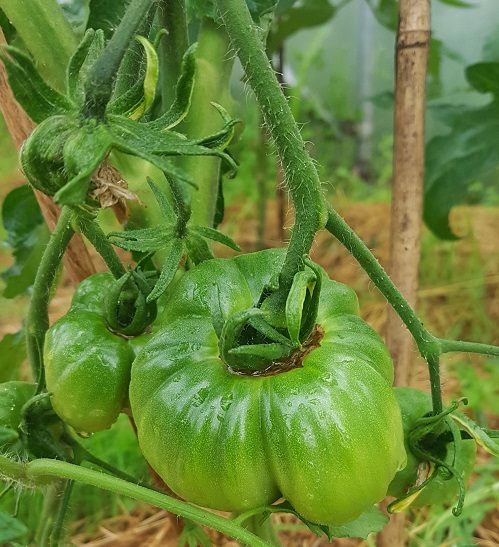
You know the massive “beefsteak” varieties like Marmande or Brandywine? The monstrous, flat-bottomed, often split or distorted fruits begin as equally confusing and enormous flowers. They are usually triploid and have way too many chromosomes! ‘Gkousiari’ is an unknown variety, Gkousiari being merely the name of the Greek market gardeners who bred it. It’s one I’m growing out for Perthshire Seed Library to get a locally-adapted strain, so I didn’t know what to expect. When we left for Devon, stocky, slightly flattened stems were leading to suspiciously large and over-stuffed flowers. Now I can confirm a superabundance of chromosomes, and big, beefy tomatoes forming.
I also re-checked the email. Oh. Ah well, that’ll teach me to read properly. Anyway, fasciation IS fascinating. Isn’t it?
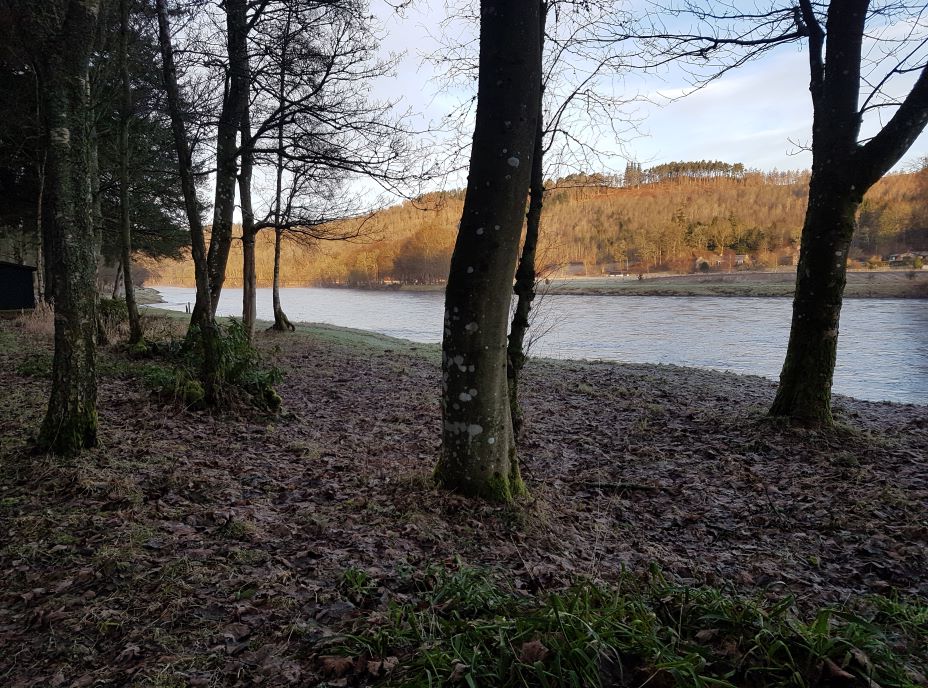
Early morning, sunny and dry. Silence, save for the mutterings of a river almost out of its banks and racing to reach the sea. Ground solid, unyielding – the type of hardness where you trip up on embedded clods and frazzles of vegetation hiding in the whiteness of a fourth consecutive deep frost – on ground already frozen solid by over a week of snow-half-thaw-freeze again.
Walking along the south shore of the Tay on a winter’s morning kind of ensures you won’t be in the sun very much, no matter how it dazzles the eye. In any case, the river has merrily engulfed the lower fishermen’s path that hugs its margin, so we walk, me and the dog, on the higher ground beneath the limes of the castle drive. Where are all the birds? I wonder. Not even the ubiquitous wood pigeons are out braving the cold. We pass an eroded river gulley and went down the steepish bank to the lower riverside path, joining at the point where it rises above water level and becomes what must once have been an elegant stroll for visitors to the castle. Fishing on the Tay is big business, and not affordable by ordinary people (unless you live in Perth and have the right to fish the stretch within the city boundary). We pass fishing huts on both banks that would make acceptable homes for small families. All locked up, today. No one but me and the dog.
Now I’m closer to the water, I start to notice a large number of white birds swimming rapidly downriver. What are they escaping from? Then I realise the white birds are actually lumps of ice, breaking away from the frozen banks and joining the ice and snowmelt that, with extended periods of rain, has made the river so massive today. A couple of gritty black-and-white ducks obstinately battle upriver, against the flow. What strong legs they must have! They veer off into a little eddying backwater on the opposite bank, and I see other water birds lurking there, taking a break from morning chores.
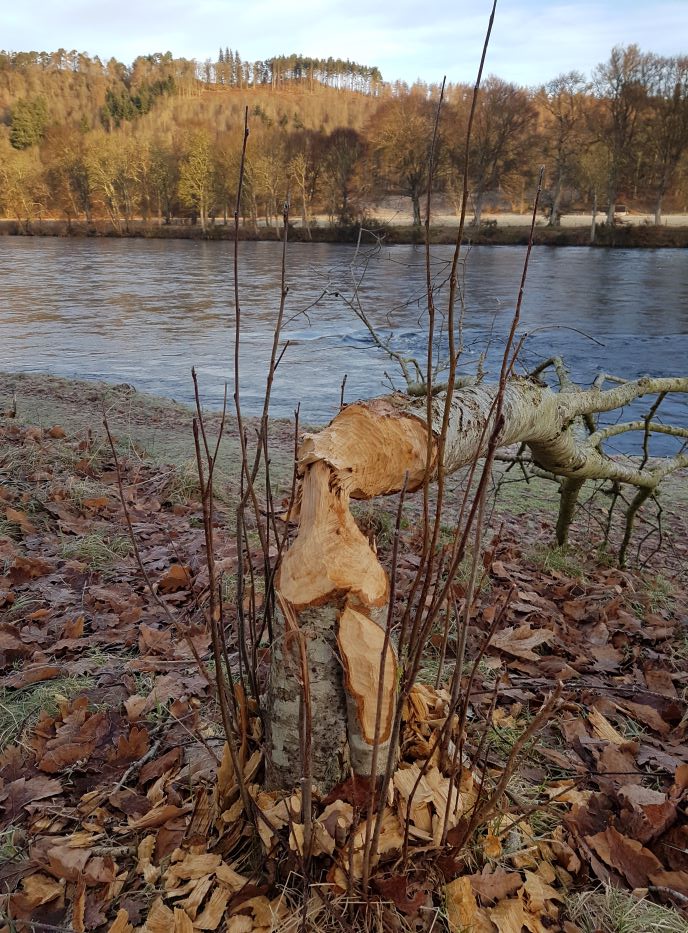
Beaver have been along here recently, but I struggle to fathom their purpose in felling one solitary tree, up the beach from the tumbling water. Maybe just hungry, or doing a bit of coppicing for future regrowth food supplies. I think the water birds could use a few more beavers to create respite backwaters.
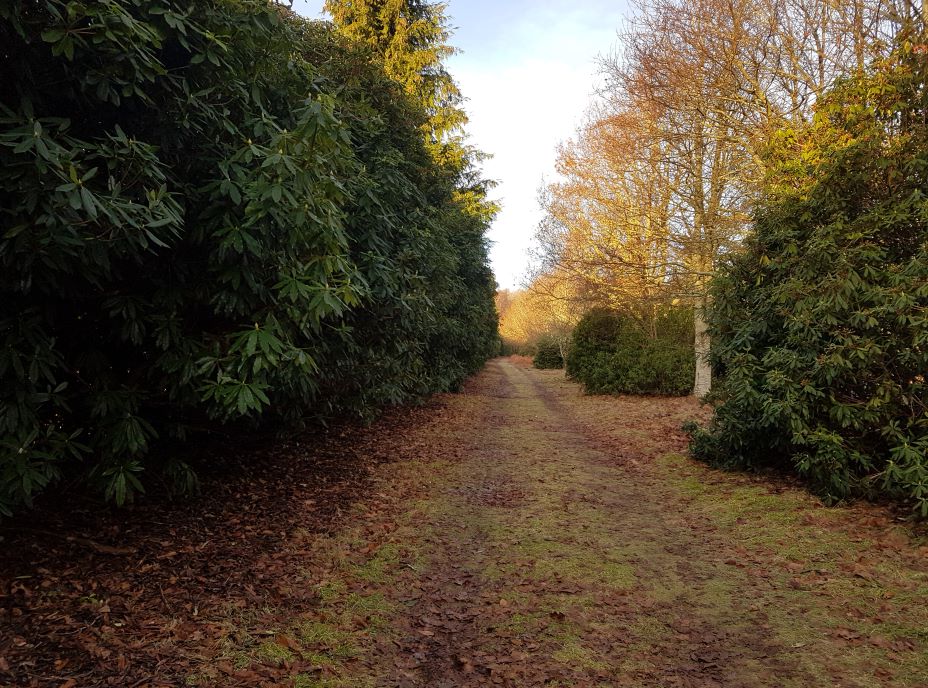
Skirting a long curve round the back of the castle, I pass between forbidding walls of rhododendron bushes. Although they provide some shelter and a small stretch of unfrozen path. they block the view. I spend too much time trying to eliminate them from an ancient oak wood to appreciate their aesthetics. I guess they may provide good roosts for birds, though I still don’t see any.
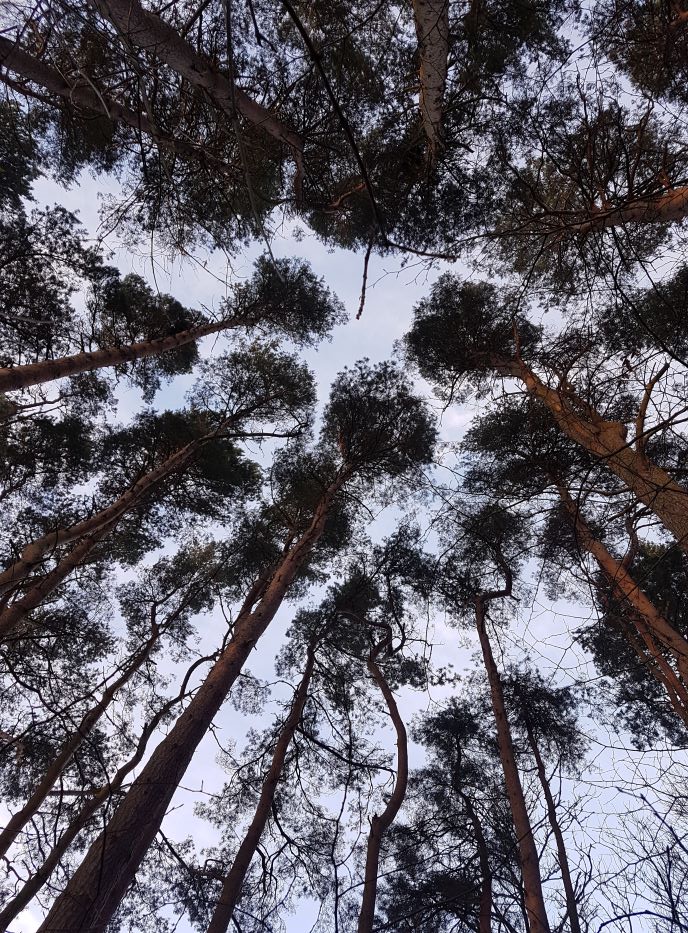
The core path takes a long, curving route by a bend in the Tay, high above the river and nearly to Birnam before it joins the castle main drive which will take me back to the start if I go left. Closer to the castle, the trees are less scrubby and include many spectacular examples of exotic species, such as Noble Firs, Coast Redwoods and towering Pines. It becomes a landscape of avenues – tottering rows of limb-dropping beeches, stately Sequoias in orderly, sentry-like placings, frowning yew trees in sombre ranks, new avenues planted in recent decades to replace older ones that refuse to lie down and die. Best of all, to me, are the ridiculously shaggy and spreading avenues of old lime trees – each hiding in its own twiggy skirt of epicormic growth. In spring, they provide me with juicy, tender leaves for salad, and intoxicatingly sweet-smelling flowers in summer to dry and make into a sleep-inducing tisane.
As I walk between and under these vibrant specimen trees, I suddenly realise birds have started to chatter, and mixed flocks of finches, secretive tree-creepers and purposeful, hopping blackbirds are awake and accompanying me. Gazing up through the close pine trees, I can just see avian silhouettes flitting busily.
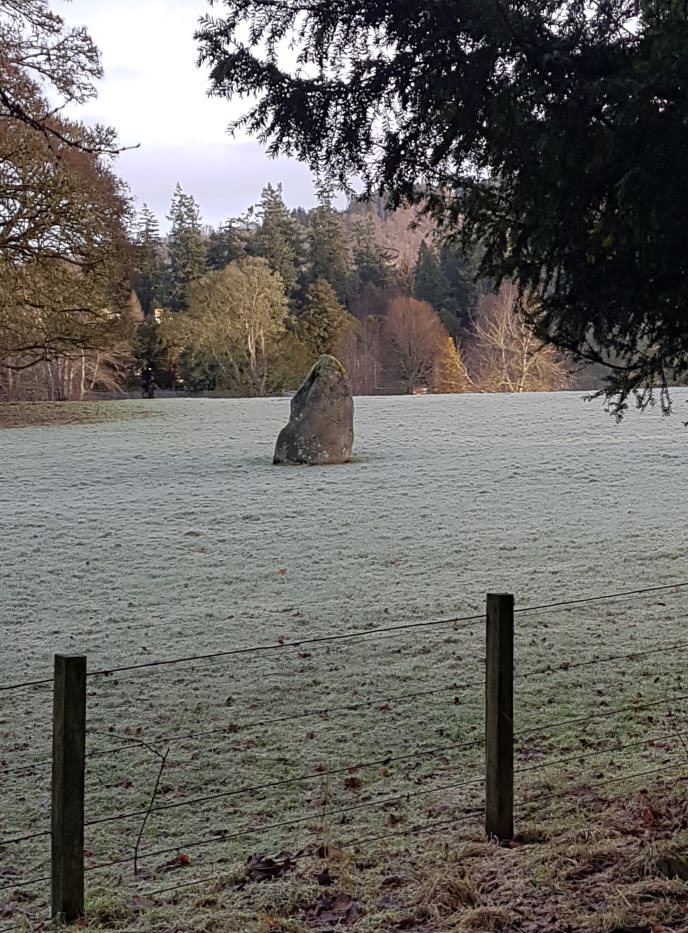
There are paths that could be taken to make a short-cut through the castle garden. Scottish access laws, some would say, give walkers a perfect right to take them, and no doubt some do. I’ve lived in a tied house on an estate where summer visitors frequently asserted this right to take a short cut to a beach through our garden, where we had small children playing and hens free-ranging – and on at least one occasion, hens were killed by loose, uncontrolled dogs. So personally, while I’m proud of our access laws, I think we should respect the privacy of residents and remember those laws also require the walker or cyclist to act responsibly. I’m fine with taking a long way round. The core path eventually passes in front of the castle at a distance (more avenues!), and I note the large, standing stone nearby, like an iceberg itself in an open, frost-enveloped field. It has no name. Does it link with other, less ancient perhaps but curiously-named stones in the area? One day I’ll hunt down the Witches’ Stone (well, this is Macbeth country!) and the Cloven stone….. but not today.
Today, I dawdle back under the limes to the gate, salute the mighty Tay with its miniature ice-packs, and begin to think about breakfast.
Regular readers will know I often write about my garden, or the wildlife that inhabits and manages it better than I could ever do. I know a lot of people would have the screaming ab-dabs if their gardens got into half the state that mine does… but for me the need to support the widest biodiversity and my personal love for every other species trumps the sensitivities of the bug-killing, grass-shaving, patio-manicuring brigade. And I’d like to make some converts rather than just be rude about them!
So I decided to create a new blog of short sketches and ideas dedicated to the joys of not being in control of your garden and the fascinating more-than-human friends you might meet in it. Here’s a taster of WHOSE GARDEN IS IT ANYWAY? which you can find at theuncontrolledgarden.wordpress.com
“I started gardening with a notion that what grew in it belonged to me, or to my family. I believed that I was the person who got to choose what grew in my garden. Carrots here, poppies there, grass in between. I welcomed wildlife though – birds could come to the bird table. Frogs could come to the pond. Of course!
But pigeons, snails, mice….. er, no. And the multiplicity of insects and invertebrates just worried me. Were they Good, or Bad for “my” garden? I didn’t know. When I decided to study horticulture professionally, my tutors taught me “Plant Protection” which meant the Pests and How to Destroy Them. A nodding glance to predators and nothing about pollinators. The soil science tutor had a more holistic perspective, but was a bit of a lone voice.
I always preferred the wild flowers to most of the garden ones – although I liked both. So “weeds” got away with a lot in my garden, even though it made me feel slightly guilty. In between lectures, though, I read about companion planting, and comfrey, and composting, and met Lawrence Hills of the Henry Doubleday Research Institute (now Garden Organic), which was nearby. Over time, my perspective changed, and so did my garden!
Now I have a rambling wilderness which I love from January to August and then feel defeated and stressed out by, until calm is resumed around the middle of October. No chemicals, no dig as far as I can stretch the compost, which is the powerhouse of the garden. I still struggle at times and backslide into nervous control-freakery.
But I have one certainty: This is not my Garden. And I am not in control.”
(I will continue to write on the nature of the universe here too. And adjust both sites, especially getting rid of the annoying ads once I’m convinced I’ve got it set up right!)
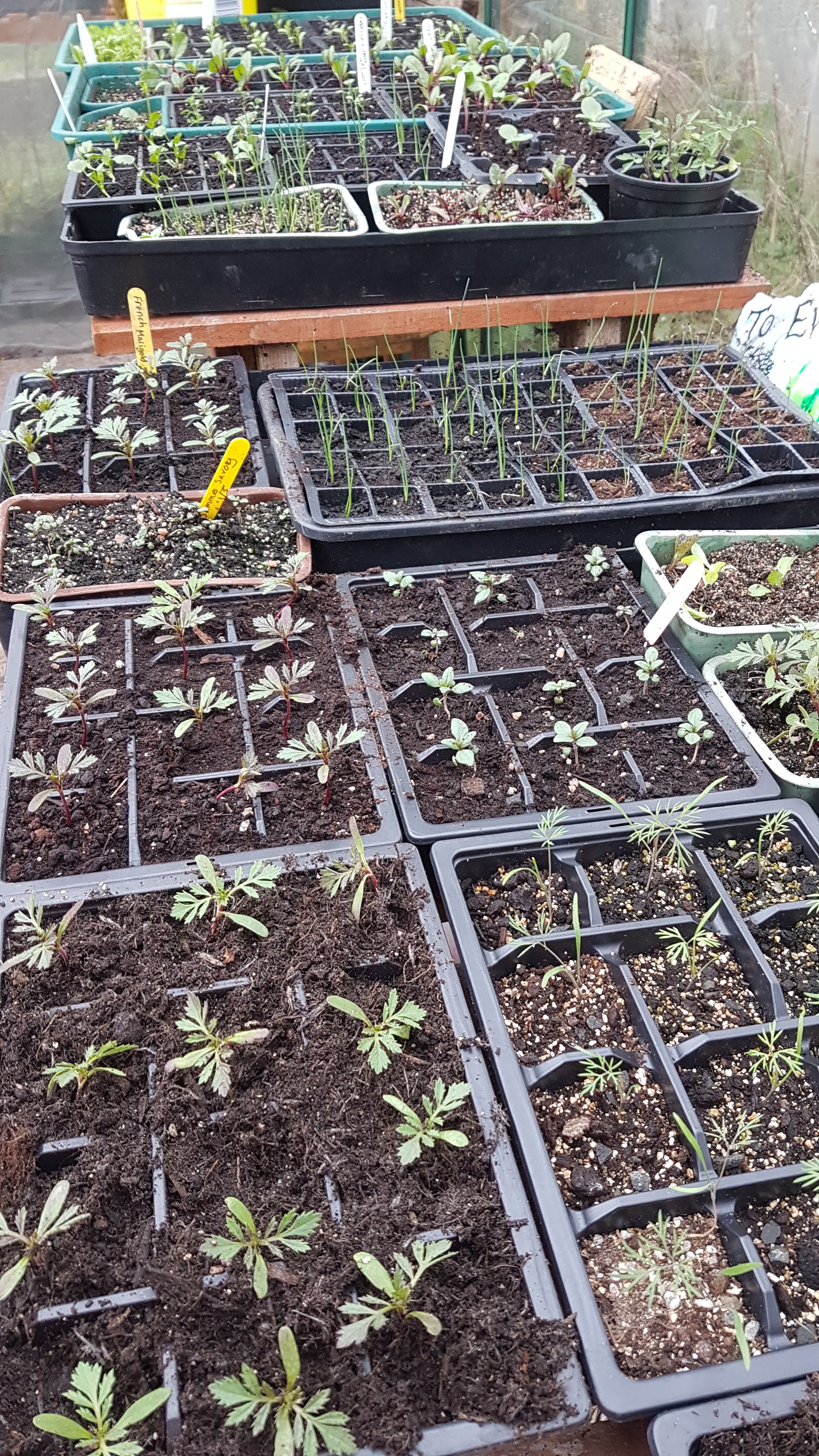
I’ve neglected my blog this past month. Not because I’ve missed out on inspiring walks, or failed to observe the nature of the universe, but because the weather’s been good, and garden or seed-sowing overtake me as soon as I get back from walking. “I’ll write it when it start’s raining…”, except it doesn’t, and I don’t. The walks will come, but in the meantime, all this seed-work did produce these (mainly) happy memories. I’ve changed the names of my colleagues in the unlikely event any may read this and feel affronted.
I never find myself fussing over seedlings in the green house without thinking of Roland, and his dad, Will, Nurserymen, of Woodham Ferrers. That’s where my horticultural career began, back in the weird 1980s, when men were men (or so they believed) and women had inexplicably curly hair.
I had decided to leave my comfortable, promising career in teaching to start again at the bottom, and become a horticulturist. I’d been accepted on a 3 year HND at Writtle College, but conditionally. Because I’d never worked in a land-based industry I had to find a job for a year to make sure I was up to it. The college had just rejected the first job I’d found (and which I was dearly looking forward to) because it wasn’t “proper” commercial horticulture. This job was working with Lawrence Hills at the Henry Doubleday Research Institute at Bocking – the organisation that came to front the whole UK organic growing movement as Garden Organic. But in the 1980s, as I said, men were men, and horticulture was about pesticides, power tools and paving slabs. Time was running short if I wanted to start my course in September 1984, so I walked into the nearest of a string of bedding and pot plant nurseries close to home, and proceeded to explain to Roland why he would like to take me on as a trainee for a year.
Roland heard me out, a twinkle in his eye and fingering his moustache to hide (I imagine) the urge to burst out laughing. “And why on earth,” he asked, “should I want to do that?”
So I explained. I was confident, I was clever, I nearly had an OU degree, I’d run a school garden and sure I knew lots and lots about gardening already? And I was enthusiastic. Little did I know that being clever and knowledgeable were useless skills in the job I was telling Roland he had available, and confidence and enthusiasm were about to take a beating! Yet Roland too had been sent to college by his dad back in the day, and maybe he was just feeling sympathetic. “Let me think,” he said, “but there’s no money in it. Nothing like you’ll be earning as a teacher.” Later that day he rang and offered me a job as nursery worker, and the wages were actually better than I expected, so I was thrilled to accept.
It was baptism by fire. First job, alone in a huge greenhouse cleaning mouldy leaves off a sea of potted cyclamen. I thought it might take me all year. There was the clocking on and off – a factory action which underlined the fact that I was no longer someone with authority, responsibility or respect, but just the lowest of the workers. Bells rang to signal the beginning and end of short tea breaks. The day started at 8am sharp. The work was physical, sometimes very repetitive, frequently boring and there was a workplace ethic that derided anyone sitting down even for a second. I was then married to a white-collar office worker who couldn’t understand why I was prepared to give up a well-paid job with prospects and considerable autonomy (this was teaching as it was 40 odd years ago, remember) to arrive home daily “tired out and covered in mud”. But if this was what it took…. I gritted my teeth through a winter of miserable work in freezing cold polytunnels, trying to learn something of plants, but learning more of chilblains.
My colleagues were not sympathetic towards me, at least, not to begin with. There were three other female full-time workers, and all were looked down on by the men, who mostly had large egos which stated that they ruled the roost. A couple of the guys were possibly not the sharpest knives in the drawer, and were also looked down on by the alpha males (the ones who drove the lorries of course). Poor, tormented Jim and Mikey were at least considerate and polite to the women. Then there was Billy, with his Boy George haircut and that camp air that made him the butt of every insult and brutal homophobic joke. I had never encountered homophobia before and couldn’t understand how Billy bore it. But he was made of stern stuff, didn’t waste his time talking to the rest or fighting back, and just got on with his job. In the end, they let him do so without too much baiting. I was the new target of course, because of my lack of experience in physical work, because I had a posher accent than the rest, and mostly because I was clever – but not in ways that mattered.
In late winter, a small army of women appeared. The big shed was set up with office chairs and high- level desks or tables, a radio, and heaters. The women brought cushions, snacks, hot drinks and sat comfy on their thrones, demanding that poor Jim supply them with endless pallets of compost-filled bedding plant modules, and trays of seedlings. Then they cussed and muttered about poor Mikey, who wasn’t shifting the finished work away quick enough. These women’s sole job was to prick out the seedlings into the modules, and they were on piece rates. The more modules they turned out, the more they got paid. We permanents knew for a fact that some of the women weren’t too worried about whether a seedling had roots, because we would have to go and fill the gaps a week or so later – rarely, unfortunately, on comfy seats. Oh no, we had to stand or crouch! When the bedding production season was at its height, we occasionally got pricking off to do as well, which was considered a cushy job by the men and indeed, it did beat hours at the potting machine or dragging laden trolleys up and down the nursery by hand to lay out filled pots on the floor of the polytunnel. But we didn’t get the bonus. I never learned to sow seed – a job reserved for only the most senior alpha male.
Gradually, I got used to the sheer physical effort, and became good friends with Ruth, with whom I was often partnered for work. She taught me a lot and we had huge fun. I think it was Ruth’s acceptance of me that changed everyone’s attitude in the end. Then Kate, one of the other women, left, leaving Colin, the most arrogant and bullying of the lorry drivers, without a mate to load his lorry. He wasn’t at all keen to have me thrust on him, because Colin HAD to be the first loaded every day and beat his chest about it, and he refused to believe I was up to the task. Loading up involved not just physical lifting and moving, but selecting out the best plant material for the customer, and racing to and fro to hand them up to the driver, who stood on the back of the lorry bellowing out instructions. Loading Colin was a personal challenge for me…. and he lost. Because lo, I COULD run up and down quickly, I DID remember exactly where every variety was to be found, I was shit-hot on getting the quality right and, best of all, with only a little practice I could handle 5 bedding trays at once without dropping any of them. Somehow, the bedding season became an exhausting but hilarious laugh, as Colin and I teamed up to get finished before Len and Ruth.
So, by the end of my year, I was indeed fitter, stronger, impervious to monotony, cold-hardy, heat-resistant – and far more tolerant of my fellow woman. Or even man. As proof, I opted during college holidays to go back to Roland’s to earn some money – and was always warmly welcomed. I’ve had my career in horticulture now, and part of it involved me in much pricking out of seedlings for my own small nursery. I brought to it the skills learned that year, and it’s always brought to me the image of Roland’s twinkling eyes as he made up his mind to take a gamble on the idealistic and misinformed schoolteacher and gave me that first chance.
So, the other day, I rounded up all the dirty washing to go in the machine with care and began the long walk to the kitchen, head full of a million jobs needing done and a million things I’d rather be doing. As I turned into the kitchen, a sock and a hankie fell to the floor. So what? Just that doing chores while encased in what I grumpily call leg-irons to heal a busted knee takes five times as long as it should, and any unsought-for bending and lifting caused by careless dropping of items is somewhat unwelcome.
“God’s…..” I began to bellow, but instead of one of my usual mildly blasphemous oaths such as Godstrewth! or God Almighty! or even Ye Gods it doth amaze me! – out of my mouth came the word ”pockets!”
Crisis over, washing in, I began to ponder where in heaven or earth “pockets” had come from. I wasn’t thinking about pockets. I’m not aware of any alliterative alternative which I might have been intending to cuss with. But, somehow, I liked the sound of God’s Pockets, and fancied that if there were such a thing, they would be something quite nice.
Several nicknames for places and things have their ownership attributed to God. God’s Acre, for the churchyard. God’s own County, for Yorkshire (in England) or Perthshire (in Scotland), much squabbled over. Rather more are named for the Devil. What could God’s Pockets be a nickname for? And then again, which god? I mithered on, through the morning chores.
Pockets, to begin with, contain things that are useful, important, or maybe precious. The word implies a fairly enclosed, secret place, so sometimes, but not necessarily, the pockets of a garment. A source of riches, perhaps? Gold?
“What has it got in its pocketses?” asked Gollum of Bilbo Baggins. A cursed golden ring of power?
Human gods have been many, and varied, and presumably, their pockets would also have very varied things in them….. If it were the wandering Norse god Woden, the pockets might be literal, and contain a water bottle, a tinder box, spare pants… the things essential to survival as a tramp with an ashen staff. If it were one of the deified Roman emperors, God’s pockets could contain anything from vials of poison (Nero) to a tablet of half inscribed meditations (Marcus Aurelius). If the god in question was non-human – the sun perhaps – God’s Pockets would surely be all the secret and calculated places where rays of sunlight lit up the secrets of the seasons. Maes Howe in Orkney would be the archetypal God’s Pocket to the human sun-worshipper.
But wasn’t this getting a bit too human-centric? What about the gods of other species? For my kittens, God’s Pockets would be those irresistible-to-cats snacks which hide intoxicating and addictive catnip inside a crunchy coat. The god in question would be me, dishing them out frugally. For the goldfinches in my garden, they would be the outer casings of seed heads that had to be penetrated to find the golden seeds. The image of something golden and of great worth kept repeating in my head, and led me to honey, which led me to bees…..
And then I had it. What was precious to bees? What was usually (if not always) golden? Pollen, the baby bees’ protein source, found in flowers. What flowers are like pockets, golden themselves, and a radiant blessing from the god of the bees in January and February, when the queen bee starts to lay eggs, young larvae need to be fed, and sources of pollen are thin on the ground?
I wandered out into the garden. It was a mild day, and the sun was shining. The sun is the measure and compass of the life of a bee. It rules their time of waking, by caressing the hive entrance with light. It spurs them to life and flight, by warming their thoracic muscles. The sun guides them to sources of food. Bees communicate the distance and direction of a good pollen or nectar source to the rest of the colony by a dance which reveals an accurate angle from the sun along which to head when leaving the hive. All their foraging time they will be engaged with where the sun is. Fly this way, says the sun, for that many metres, and you will be rewarded with gold from my pockets!
On this day, some of the overwintered bees in my hive were flying, tentatively. And sure enough, I found Winter Aconites – Eranthus hyemalis – coming up above ground and uncurling their flower stalks, powered by and dependent on energy from that same sun. Bright golden balls of flowers, opening shyly to reveal the treasure inside – yellow pollen, a magnet for the early bees and their growing sisters, hungry in the comb and waiting for spring.
For surely, if I were a honeybee, the sun would be an omnipotent god, whose greatest gifts would be the nurturing flowers of late winter, and which I’d be pleased to call God’s Pockets.
Photo: Kate Jewell / Comfrey (Symphytum officinale)
Comfrey is in the Borage family of plants. There are various species, strains, and cultivars, which all have similar properties. The one which spreads unrelentingly in my garden is the Tuberous Comfrey (Symphytum tuberosum), which is low growing, spreading (via its knobbly, tuberous roots), and has dingy off-white to cream flowers. I am in negotiations currently with Tuberous Comfrey to spread unrelentingly where it can out-compete the ground elder, rather than among the potatoes. This species, along with Common Comfrey (S. officinale) is a native of Britain. A number of imports and acquisitions by Henry Doubleday in the 1870s led to an important cross between Common Comfrey and a Russian species, S. asperum. The hybrid became known here as Russian Comfrey (S. x uplandicum).
Common Comfrey has other common names: Knitbone and Boneset. The generic name Symphytum means “to join together”. The specific name “officinale” indicates medicinal value. (Readers of my last post may see where I’m going here!). Comfrey roots and leaves have been used for many, many centuries in poultices (mainly) to treat sprains, bruises, inflammation, cuts and sores. Comfrey contains allantoin, a chemical which is crucial to cell regeneration and healing. In my garden, the unruly Tuberous Comfrey disappears during winter, but I also have two Russian Comfreys which don’t. One of them used to be variegated, but soon reverted to green and vigorous.
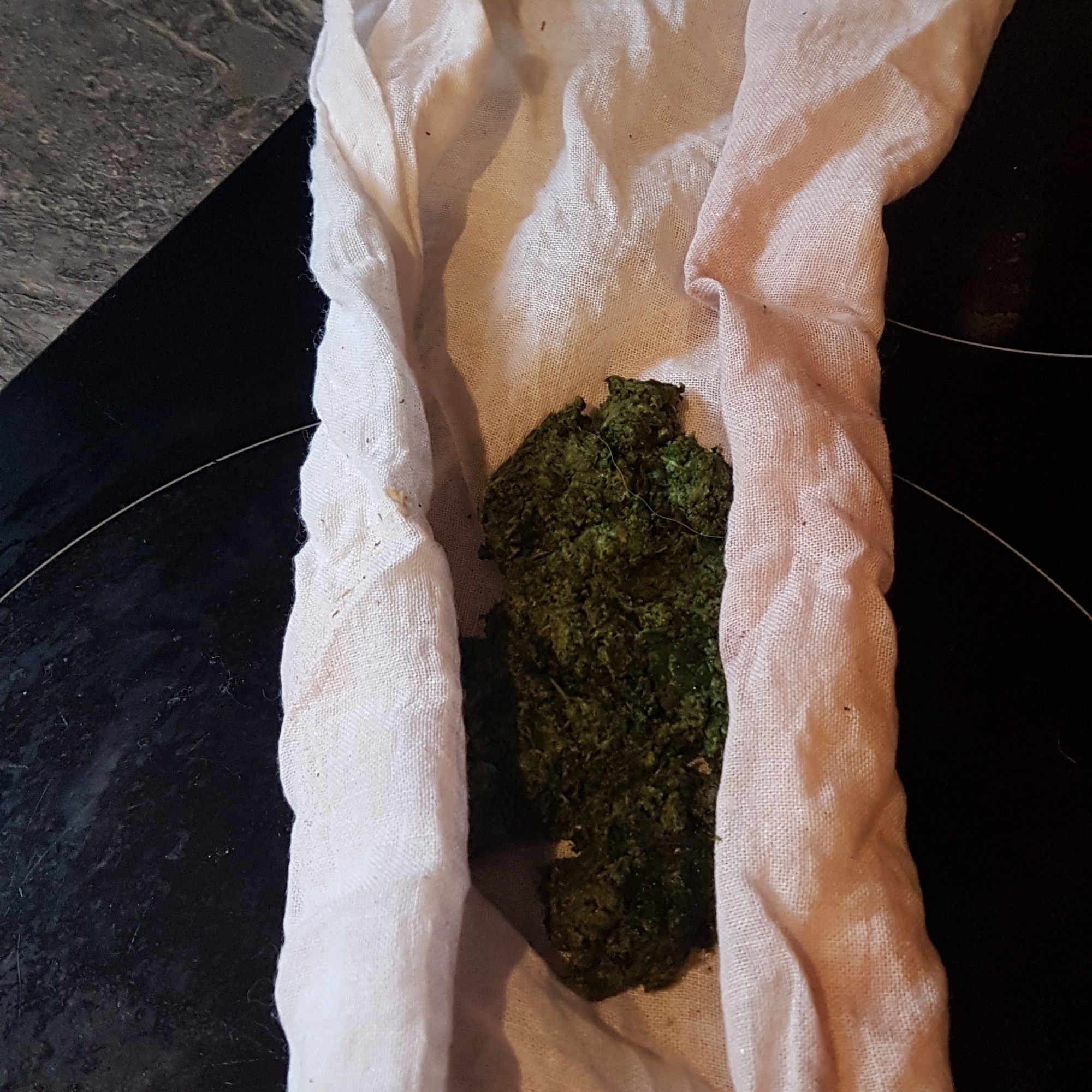
Therefore, in the mild weather between Hogmanay and the end of last week, I manoeuvred myself laboriously up the garden on my crutches, to pick the freshest leaves (yes, there were some!) from the plants. Roots may have been better, but digging isn’t in my current skill-set. A knee with anonymous sprains and tissue damage and a minor fracture of the tibia was going to get the comfrey treatment. I made the poultice very easily, by zapping the fresh leaves to a dark green liquid and mixing it with flour. A square of muslin, folded at the edges to stop the poultice oozing down to my ankles, held the comfrey against the affected bits of knee. An elastic tubular bandage kept it in place, over which went trousers and the leg brace. I did this for 4 days consecutively, but removed it from sight when I went for the fracture clinic appointment. (Self-treat? Who, me??)
On the X-rays, it was very hard to see where the fracture is now, but the doctor pronounced everything was well placed to heal completely, given time. Leg brace for at least another month! Then the weather turned snowy, followed by the customary January freeze, so the Comfrey pharmacy is temporarily closed. I’ll never know for sure how far it is contributing to healing, but that’s no problem, I am happy to be my own experiment in this.
Now to the other uses of Comfrey, including compost. The extravagant growth of the various comfreys which Henry Doubleday imported and which interbred led the organic movement pioneer Lawrence D. Hills to found a field station in Bocking, Essex, dedicated initially to research and breeding of comfrey strains for agricultural and horticultural use, named the Henry Doubleday Research Association. The best-known strain is probably “Bocking 14”. Later, HDRA became the influential Garden Organic charity, with thousands of members. I met Lawrence Hills a couple of times, when I switched from teaching to horticulture and was looking for a year’s work placement as prerequisite to starting a course at Writtle Agricultual College. He was so charming, so enthusiastic, so hard-working – and I was so looking forward to working and learning in an organic garden and taking part in field research. But organic was still considered the domain of hippies and weirdos as far as Writtle was concerned. I was told that HDRA was NOT ACCEPTABLE as a PROPER horticultural placement, and I ended up on a bedding plant nursery. Learned a lot, but you know how I just adore bedding schemes……!
A Much-thumbed Reference for Improper Horticulturists
But I grow Comfrey. I would never be without it in the garden. The lovely purple, red and white flowers attract every kind of bee in the district, it suppresses weeds, and is so vigorous I cut both the Russian and Tuberous back several times during the year. Most of the green material goes into the Comfrey bin (joined by excess nettle tops). The bin has a lid but no bottom, and it stands on a perforated metal square (actually a redundant queen excluder from beekeeping), which is balanced on an old washing-up bowl. Into the bowl collects a dark, viscous, evil-smelling liquid – Comfrey tea! NOT for drinking, but for use, diluted, as a liquid feed for tomatoes, vegetables and any plant looking under par, just as Lawrence Hills told me all those years ago. Many gardeners believe Comfrey tea confers disease resistance to plants as well as a nitrogen boost. I don’t add any water to the bin, and the dry material left goes onto the adjacent compost heap. Sometimes I add fresh Comfrey to the heap if it’s being a bit tardy in decomposing – it acts as an activator. Another great thing to do is liberally cover the ground between developing plants such as courgettes with fresh Comfrey leaves as a mulch. Not only will they decompose happily in situ and directly feed the plants, they help to warm the soil and stop weed seeds germinating. (TIP: Don’t accidentally mulch with tubers still attached!)
Fresh Comfrey Boost for Peely-Wally Sweet Corn!
I also eat Comfrey leaves. Now, my herbalist friends will tut-tut, because Comfrey also contains alkaloids which can damage the liver, to a point where cancerous tumours may develop. I can understand reluctance to prescribe it for internal use. Most of the alkaloids accumulate in the roots and the older leaves, and laboratory trials on unfortunate rats indicate that you’d really need to eat or be injected with an impossible amount of Comfrey to have such a reaction. Nevertheless, I stick to young leaves, in moderation, as a delicious vegetable in combination with nettles and other spring greens. They fill the so-called hungry gap abundantly well, and are a tasty substitute in any recipe involving spinach. Covered in beer batter and deep fried, individual leaves are a really, really bad-for-you treat!
But whether you eat it or not, Comfrey is for life – in more ways than one.
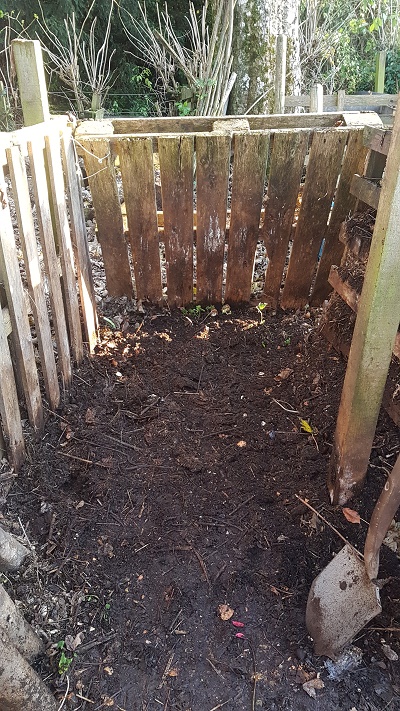
This week my Google Tasks told me I had to turn the compost heap. I assume I told it to tell me that at some point. I have two largish compost bays (minute in comparison to some, such as the magnificent compost-heaps-from-heaven at the community garden at Hospitalfield in Arbroath – you could bury a small house in each of their bays). I also have several bays and bins for leaves, imports of dung, and bulk biodegradeable materials in waiting, but it is the management of these two main piles that coincides with that moment when summer and autumn are subtly but surely dissolving into winter. For many reasons, I see winter as the start of a new year, and turning the compost always signals new beginnings, new plantings.
The first stage, actually, is barrowing and spreading all the finished compost in bay 2 onto beds and borders around the garden. This has been going on in stages for a couple of months, with sticks and undigested material being thrown back into bay 1. Bay 1 is starting to groan under the weight of future compost, as annual vegetable plants, bean and pea debris and a mountain of weeds from tidying up raise the height to almost unreachable. Once bay 2 is empty, everything in bay 1 can be moved over, introducing oxygen and stimulating breakdown. The topmost material is pitchfork stuff – or even just grabbing arms-full of dry debris and chucking it into bay 2. I try to put the most fibrous material in the middle, where the heat will be highest, making it in theory the best place to break everything down. If I can clean out the chickens just after all this top layer has gone on the bottom, the aromatic stew of chicken poo and wood shavings works as an activator.
The middle layer next, and it becomes more interesting. Here the brandling worms that thrive in the warm centre are busy at work, oodles of them, squirming voraciously in the decomposing mire. They are the visible agents of change, but unseen workers include many kinds of fungus and bacterium, at least as important. The middle layer is a seething mass of activity, and I make sure that on transfer to bay 2, the “working layer” maintains most of its integrity. Composter organisms are forgiving, though, and will migrate to the part with the right temperature if they find themselves compromised. Meanwhile, the garden robin and blackbird perch nearby, popping down for a feast of something whenever I pause to straighten and stretch.
Now the two piles are roughly the same height and I get into a rhythm with the pitchfork. The work is easier. I reflect once more how well yoga practice fits me for gardening – turning compost means twisting without injuring your back, and balancing on wobbly compost to reach the stuff at the back and sides of the bay. I work away getting the compost from the cooler edges into the middle and am left standing on a small pinnacle in the middle of bay 1.
Delving down the pinnacle, the number of compost worms decreases, and the ability to combine a twist with a forward bend comes into play…..work is getting harder again and I don’t want to suffer later! I start to turn out large numbers of wonderful centipedes. Centipedes are carnivores, not detrivores – they are not adding to the composting process, but hunting smaller creatures who live on bits of decomposing plant and humus. In the garden they are generally really good news, as they also eat the invertebrates who want to steal our crops. I try to catch one or two for a photo, but they are camera shy, and very, very fast on all those legs – as true hunters should be.
Photo by u0413u043bu0435u0431 u041au043eu0440u043eu0432u043au043e on Pexels.com
So, near the bottom of bay 1, the compost is as complete as it will be, and ready to use without being turned. I start to fill barrows of the good stuff, rejecting some unprocessed bits and pieces but not worrying too much – any unfinished business should happen in situ, over the course of winter. I dump and spread the compost on beds and borders. I don’t dig it in – no need. I have earthworms for that. It isn’t perfect, my compost. Eggshells hang about for ages, for example, and every autumn I dredge up a few well-rooted avocado plants which have grown from stones that never seem to decompose. (Neither do the skins). The heat given off by decomposition enables them to germinate. This year is no exception, and as usual I take pity on one, pot it up and take it into the warm greenhouse, where it will grow into an untidy, straggly, leaf-spotted pot plant with no hope of bearing fruit, and I will start trying to give it away to unsuspecting friends with more optimism than I have about its value.
The last few shovelfuls, the final pitchfork-loads, and lo! I discover that the sticks I placed at the base of bay 1 last autumn because in a whole year they had failed to become compost are still there, barely altered….. I spread them across the base, along with the 3 year old thick cardboard tubes from inside the new polytunnel cover… they ARE biodegradeable, and I WILL win this battle….one day! On the plus side, after years of running a nursery here when thanks to lack of time and the vagaries of some of our volunteers, my compost heaps produced more plastic than a supermarket, this year my accidental plastic input and retrieval is minimal – and I can re-use the two ties and labels. And only one unreconstructed plastic-reinforced tea bag, right at the bottom, since we have found plastic-free brands.
Plastic pollution in decline!
I level the top of bay 2, and cover it with carpet. I know that within weeks, heat will build up and by spring it will be less than half the height it is now.All is done, and so am I, yoga or no yoga. And yet I’m incredibly happy with today’s work. Compost-making is the heart of my gardening life, the most satisfying, the most compulsive work, returning to the earth the things of the earth. I hope I have a good few years of compost-turning left!
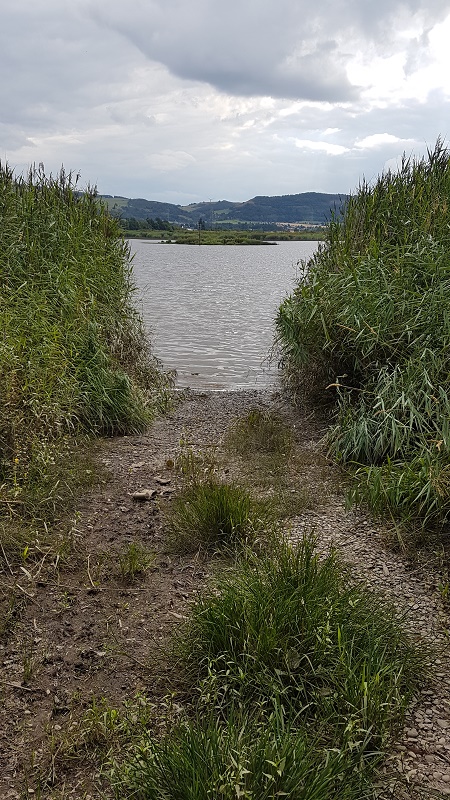
I wanted to walk from Cairnie Pier near St. Madoes west to Inchyra on the Tay estuary. My old map (old being the operative word) said there was a path, but it says that about a lot of stretches of the Tay along the Carse of Gowrie that it would be nice to walk, and it’s often mistaken. Google Maps hinted that if you got really, really close to the ground, there might even be two paths, but it wasn’t committing itself. At Cairnie, the existence of a small car park looked promising, and I found the great river hiding among its own reedbeds as usual, lapping quietly at a little inlet whose stones oozed mud. Fishermen’s paths trailed off in both directions.
Cairnie Pier
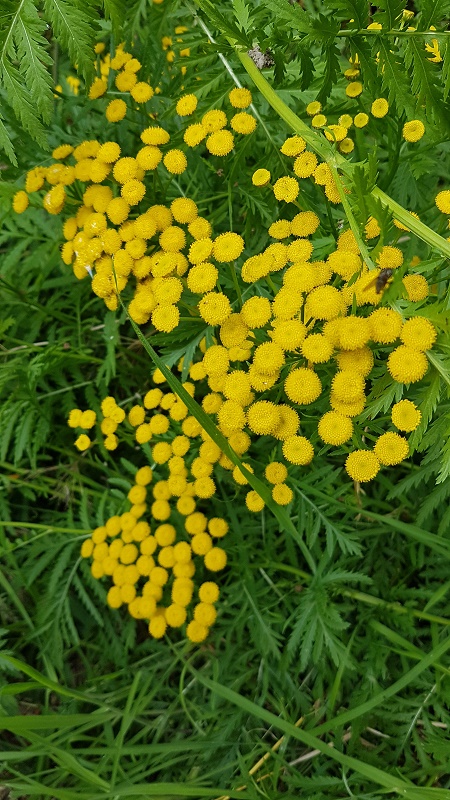
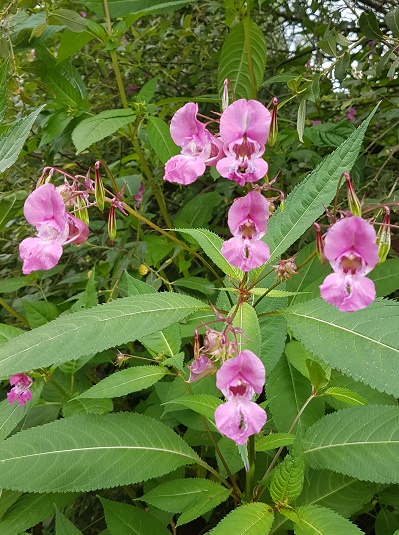
It was drowsy-hot, an afternoon of hoverflies and docile wasps, intent on the many flowers that lined the path. The river is a conduit for all kinds of unexpected vegetation, which thrive in the tidal mud and lovely untidy, unsanitised, hedgebanks and verges. The yellow buttons of Tansy pop up everywhere along the Tay, together with the silvery Mugwort, a long-ago Roman introduction, allegedly a cure for sore feet. Warm and spicy, the scent of Himalayan Balsam over-rode the scents of native flowers, and its spectacular flowers trumpeted a welcome to pollinating insects. This “alien invader” has been around a good while, anywhere near to water, and it’s a Marmite plant. Speak to any beekeeper and she will wax lyrical about the “ghost bees” who return somnolent and satisfied to the hive, covered in its dense white pollen. Speak to most mainstream ecologists and they will say it’s invasive, outcompetes “our” native flora and has no place in “our” countryside. I love its other name – Policemen’s Helmets – does anyone remember when policemen wore helmets? The top and bottom lips of the flower are encased in a helmet-like fusion of the other petals. I’ve happily pulled it out of ancient oak bluebell woodland, but I can’t say it bothers me too much today. I munch a couple of the peppery-pea tasting unripe seedheads, out of duty.
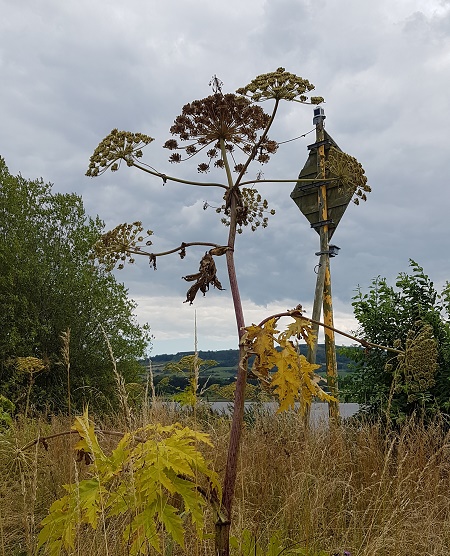
But then arise the forbidding, towering structures of a harder-to-love alien. Giant Hogweed, introduced by gullible and novelty-obsessed Victorians to adorn their fancy gardens. Apart from its spectacular, H.G. Wellsian-Martian structure (still being extolled by lecturers when I learned garden design), it is low on redeeming features. It is truly rampant, flowers and seeds everywhere and delivers serious burns to anyone brushing against it in sunny weather. It’s a property called phytotoxicity, and today the sun was shining and I passed gingerly.
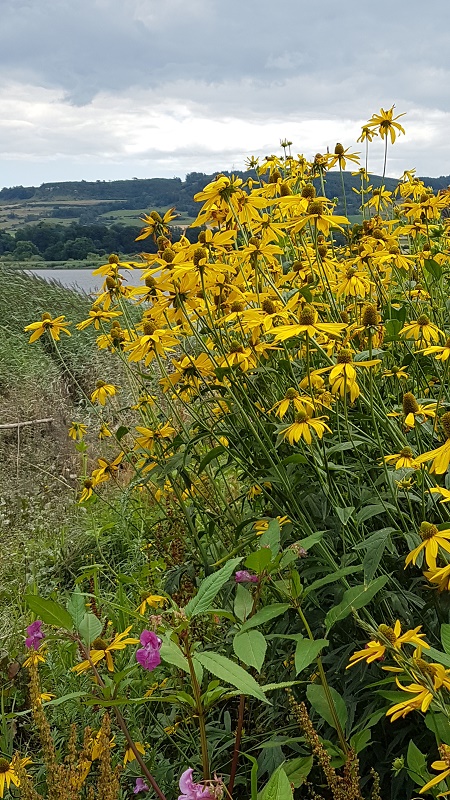
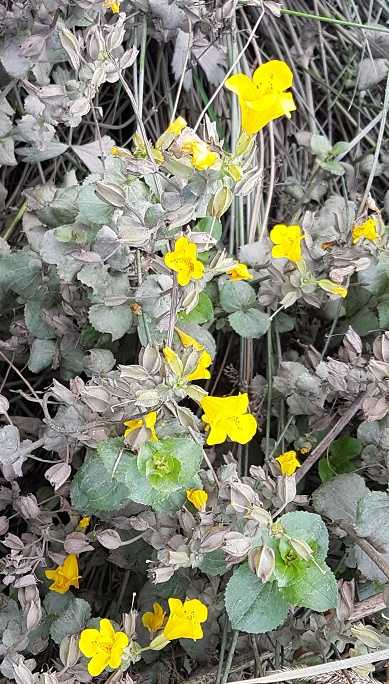
Far more attractive, and indeed glorious were the bright yellow, sunny Monkey Flowers, coated in tidal mud, and the clumps of tall Rudbeckia, both garden escapes, that sway gently in the breeze up the river. They are dotted all along this stretch of the Tay. I remembered another sunny day talking with David Clark of Seggieden – a great botanist and a man who so loved this river – about whether they “should” be there and what exactly was native anyway, since both of us could be labelled aliens ourselves. We agreed that neither of us were fanatical about racial purity in plants or anything else, but weren’t fond of Giant Hogweed, nor the next invasive alien to show its face on my walk, the Japanese Knotweed. This monster would out-compete the miles and miles of Norfolk Reeds themselves…..oh wait, did I say Norfolk Reed?
Yes that’s right, the incredible Tay Reedbeds, home to rare marshland bird species and a complex, life-affirming ecology, are the result themselves of the introduction of a “non-native”.
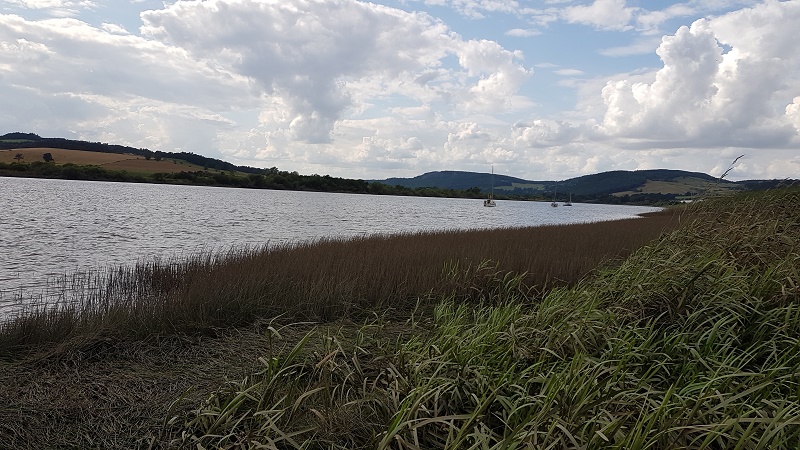
My fishermen’s path had petered out, and an attempt to reach Inchyra along the edge of a field also met with failure, so I drove back towards St. Madoes and took a side road left. Thus I reached Inchyra, a beautiful little village of low houses, pretty gardens and derelict farm buildings looking, as they always do, as if a quick afternoon’s work would put them back into service. From this hamlet, crouching among tidal lands as if in terror of sea-level rise, I found a wild garden overlooking the estuary and across to Rhynd, and small moored sailing boats bobbing in the rising tide.
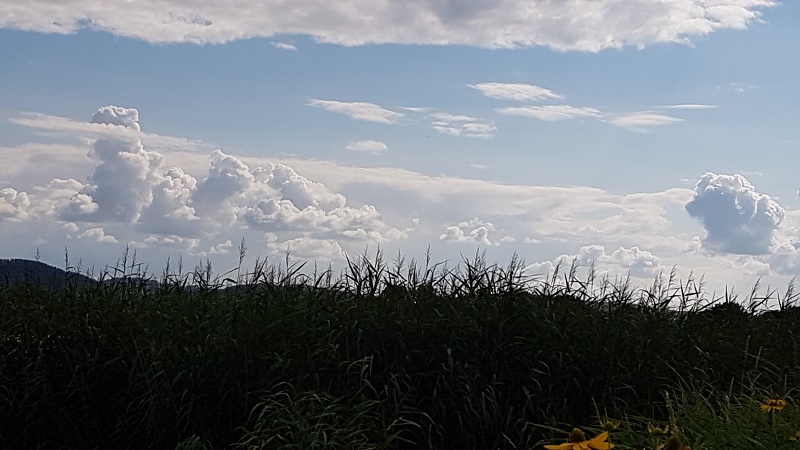
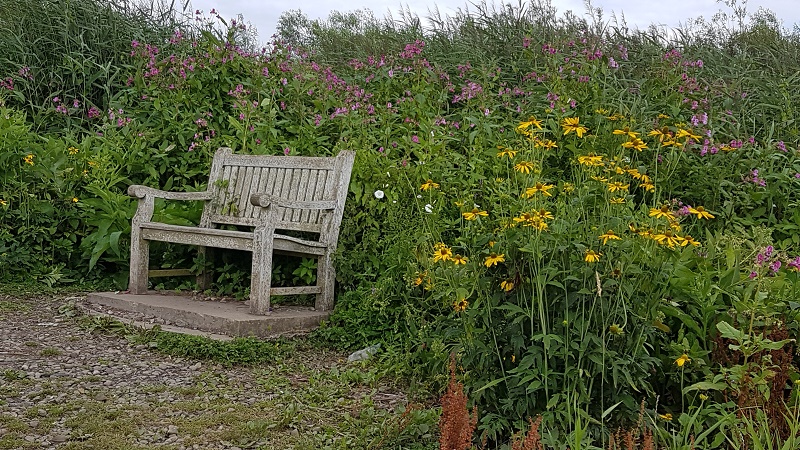
Here was a seat, to the memory of a daughter of a local family, and I sat in complete peace among the reeds, with flowers – native, non-native and all the gradations in between – blessing the air with scent and colour. Even the busy tractor across the water hummed to itself. Rain was forecast; I watched silver-lined thunderclouds pile up on themselves, shift and mutate, and then dissolve again into the blue sky. It was so good to be here.
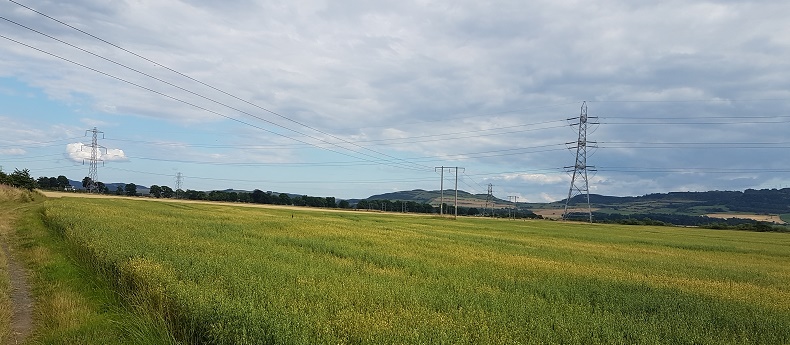
When it seemed the clouds were getting serious, I found a path that ran beside Cairnie Pow, giving me a good circular walk back to the village. The pow is a local name for a drainage channel, often of ancient origin, that was created to free the fertile soils of the Carse of Gowrie from being marshland. They litter the Carse, and give a sense of being neither quite on dry land nor in water. This one tracked parallel to the path I didn’t find earlier from Cairnie Pier, and then swung left at the point I’d almost got to, where a host of overhead power lines had got together for a gathering. They sky darkened, and the air, hot and still full of the damp scents of flowers, smothered the senses. Young trees, planted by the nearby farm, gave welcome shade. A big, old house rose out of the marsh with no obvious gateway or entrance. It looked dark, empty, full of tales and secrets. I wondered, made up stories in my head, began hearing things and holding imaginary conversations with people who did not exist. Perhaps it was as well that heavy, ponderous raindrops deterred me from more exploration that day.
It has always puzzled me how anyone spends devoted hours to their gardens unless they also practice yoga. I got into yoga well before I actually owned a garden, and when I did get going with the growing, I quickly realised the advantages of being bendable, stretchable, twistable and, most of the time, reasonably balanced. My first proper job in horticulture was in a large Essex nursery producing pot plants and bedding; automation wasn’t a thing then, and heavy, laden barrows of trays of pots had to be pulled to tunnels and glasshouses and the pots set down in neat rows on the floor, precisely spaced for optimum growth. Here the WIDE-LEGGED FORWARD BEND was invaluable. Wide as possible, straight back, good reach – I could set down all the plants in a tray easily without having to get up, move and bend down again. And, unlike some, I didn’t have an aching back by coffee time.
The wide-legged forward bend is the posture I adopt in the garden for jobs like seed sowing in rows, planting potatoes and harvesting strawberries. If I need further reach, it can be extended, via a WARRIOR into a LUNGE – very handy also for annihilating that far-flung weed climbing the beanpoles. When you then find there are more weeds needing removed, or hidden fruits to pick, the lunge can morph into the GECKO. From any position, being able to go into a suitable TWIST again give you more reach. I confess, I usually accidentally forget I’m in these positions and stay too long, so I hear the voice of my yoga teacher in my head warning me to come out carefully! (By which time, it’s too late…)
For the garden, the great advantage of carrying out tasks in one position is that you minimise treading on the soil and compacting it. You also need to be flexible in where you tread, and occasionally move backwards one leg in the air, to avoid squishing your spinach. Various yoga balances, which I’m fairly hopeless at, nevertheless enhance my ability to cope with a jam-packed bed or border without creating too much destruction. It’s also helpful for pruning trees and shrubs, or picking fruit. (No, however appropriate it sounds, I don’t stand in the garden doing TREE pose. My neighbours would get worried. I do it in the kitchen while cooking to keep in practice.)
In confined spaces (of which my garden has many), or for the impulsive weed-blitz as you pass by another small jungle that arose overnight with the moon, it’s very handy to be able to SQUAT and much better for your spine. Very handy for wholesale removal of sawfly larvae from a goosberry bush. too. Coming up from the squat (with an armful of weeds) is a much bigger challenge for me, or for my knees at least, so it’s good that gardening gives me the chance to practice. Even if I don’t appreciate it at the time.
“Old Adam was a Gardener, and the Lord who made him sees That half a proper gardener’s work is done upon his knees”
Thus spake Rudyard Kipling in his poem The Glory of the Garden.. Well, not half your time, perhaps, if you employ wide-legged forward bends and lunges. But some, of course, and sometimes, quite a lot. I’ve been lucky to largely avoid the “gardener’s knee” up till now and although I do get twinges these days, I still spend a lot of weeding or planting time on a kneeling mat – often one knee, the other breaking out into a GATE pose. While kneeling, I deliberately or inadvertently find myself doing the odd CAT and when I’m done, I’ll come to stand by doing DOG, if there’s space (By summer, there generally isn’t).
If you separated out the time I spend “doing” yoga and the time I spend gardening, gardening would win big time, even in winter. I’m not the most disciplined at making myself practice regularly outwith the class, and there’s far too much weeding, picking and planting to be done to attend too many classes. So my answer is to keep gardening, and stay mindful of every horticultural opportunity to utilise a yoga posture and the flexibility, stamina and good lungs yoga gives me. I’d advise any yogis like me lacking self discipline to take up gardening!
Of course, you need to finish your practice with SAVASANA, or CORPSE, the pose of relaxation. No, that’s not a dead body sprawled over the lawn clutching a trowel in one hand and a bouquet of ground elder in the other. But do take it a cup of tea in ten minutes time!








 Comments on The Nature of the Universe