A Dear, Green Place

qpcampsies1

I wake up under the ridiculously high ceiling of my daughter’s flat in Govanhill (honestly, you could fit a whole other floor between me and that ceiling), and it’s that not unheard-of, but always slightly surprising thing: a Fine Day. In January. In Glasgow.

So I go down to Queen’s Park under the low sun, and join all the people, taking shortcuts to Shawlands or Battlefield, grimly jogging, exercising a cacophony of canines, or gathering to hold deep discussions on the slithery paths where the morning’s frost has turned to melting ice.

I look for wildlife. There’s plenty, but until you tune in, you’d think it was all rainbow-hued, pouting pigeons intent on fornication and the many opportunist members of the crow family. Magpies bustle under municipal shrubs and into rampant ivy (arguably the park’s most significant contribution to wildlife habitat), and busy themselves with piles of beech leaves, pretending to have a purpose.

qpivytrees    qpcrows1

Crows loiter in trees with intent, fingering – or beaking – sticks and twigs, considering their suitability for Lovenest 2020.

I skirt the wildlife pond, where coots, moorhens, mallard and the remaining cygnets of the Mute Swans entertain small children. Up a green slope, and a sunken track, so deep in mud and the soggy consequences of the previous weekend’s torrential rain that had some of us dancing in puddles, it could double as a Devonshire hollow road. Fallen trees accrue fungi and insects; Queen’s Park here has shed its Paxton municipality.

qpgreenlane      qpgreenlane2

In the wilder, scarcely managed woodland, I hear birdsong – the noisy robin, the piping and sawing of blue and great tits. I know there are long-tailed tits – they visit my son’s bird feeders – but they taunt me shrilly, staying out of sight. A treecreeper works her way up a lime tree trunk. Dunnocks and wrens flit, silent and absorbed. Huddled among the trees on the Camp Hill slopes, the Queen’s Park Allotments make a city within a city, a shanty town of sheds and frames and variously glazed or translucent edifices where lush crops are started early by proper gardeners, and foxes – I can smell them -.find food and sanctuary.

qpfort camp

Higher, and I reach the Iron Age fort that crowns the hill, where grey squirrels scamper among the beech-mast, and humans have lived for centuries. The big stones in the middle of the ramparts may be what’s left of the Camp that named the Hill – during the Battle of Langside in 1568, famously lost by Mary Queen of Scots’ army and which sent her to to seek, and not find, refuge in England. But Glasgow named the park for her.

qpwassailed3

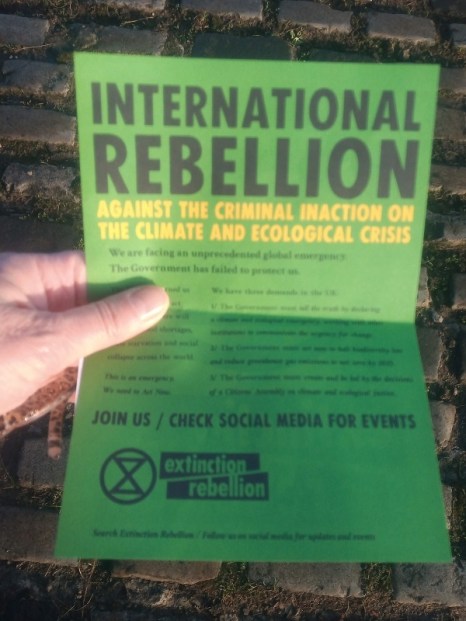
A grove of young fruit trees just below the viewpoint with its flagpole are decorated with dark tartan ribbons, the remnants of last year’s wassailing. I wonder if they will get wassailed this year. The Philosophists of the Flagpole converse earnestly, perched on the backs of the frost-wet seats. Someone hands me a leaflet. It is from Extinction Rebellion.
qpXR

The day before, Glasgow City Council had announced its intention to be carbon-neutral by 2030, despite the challenges of its transport system and heating those high-ceilinged, big-windowed tenements. That’s 15 years before the target set by the Scottish Government. Will they do it? They will give it their best shot, and count the benefits before the costs. XR will say there’s no choice.

qpchimney

We look out over this beautiful city, this dear, green place, bounded and made human-scale by its surrounding hills, dotted with parks and humming with energy that comes from its people. Smoke gushes from a single factory – I think its the brewery opposite Glasgow Green – and a motorway crashes through. They’ll need to sort that. I think, that if anywhere can do it, Glasgow will.

qp1


The Gorse Tenement Spiders of Perthshire

“When gorse is out of flowers, kissing’s out of season,” so the saying goes.

That’s one use for this for this furiously jaggy native shrub, also known as whin, or furze. Since flowers can be found on a gorse bush in every month of the year, it’s a license for affection. A light tea from the deliciously coconut-scented flowers is another purpose; the same flowers are an ingredient in natural dyes. Sounds highly unlikely, given that horses have sensitive mouths, but allegedly the dry branches of gorse, thorns and all, are a nutritious feed for these beasts. The plant’s tendency to seed, spread and steam all over any unsuspecting tract of slightly open ground might be off-putting to the gardener, but there’s little doubt it makes a good deterrent for invaders and intruders.

Do we reckon the value of a plant only in terms of its uses to humans? Too often! A hillside bright with gorse will not only gladden the human eye, but it will provide pollen and nectar for a range of bees and other insects. A gorse bush is an ecosystem owing nothing to our interference.gorsespiders2

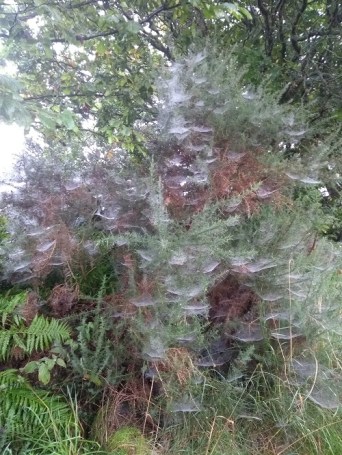
One autumn morning – the kind where damp mists hang low and the sun is watery and out of sight, I came upon the Spider Tenements. I did not see a single arachnid – nor yet a gorse flower! – but the fog condensing on the gossamer revealed each web on these gorse bushes in elaborate detail. It also revealed the happiness of spiders to rub shoulders (knees?) with one another in close proximity. If one web equals one spider, there must be hundreds on every bush. They don’t mind the jagginess; obviously it gives them lots of points for attachment of their superficially haphazard cobwebs!

gorsespiders1


I wonder how many small insects were caught on this bush today. How many webs do you think there are?

And does anyone know what kind of spider my gorse-loving, tenement-dwelling pals might be?


The Blood of the Ploughman

bloodyploughman1

Have you ever been seduced by those advertisements in colour supplements for NEW! UNIQUE! varieties of fruit or vegetables accompanied by dazzling photos of their technicolor extra-ordinariness? The exciting modernity of red-fleshed apples is one example of excitable marketing – and many fall for it.

But rosy-fleshed apples are not new. Discovery, an early-ripening apple bred in 1950, is one example, and deservedly popular. But this is a story of a much older apple, first recorded in 1883 – but who knows when it first appeared….

Once upon a time, when the Carse of Gowrie – that rolling, flat and fertile plain of drained marshland on the north side of the River Tay that stretches from Perth to Dundee – was famous for its orchards, a weary ploughman was plodding home after a long day in the field. It was September, and an Indian summer, the sun had been blazing all day and the ploughman had finished his drink early and was very thirsty. To get home more quickly, he decided to take a short cut through the orchard of Megginch Castle – one of the finest orchards in the Carse.

As ever, the productive trees of Megginch were laden with fruit; apples of every type and colour, small, golden Scottish pears, plums and damsons. Many were ripe and even falling into the long grass. The tired ploughman thought how handsomely a ripe apple would quench his thirst and assuage his growing hunger – it was past suppertime.

Well,there was nobody about, and surely no-one would begrudge a hard-working labourer a windfall, so the ploughman helped himself. So delicious was the apple that the ploughman was struck by the idea that to leave these windfalls would be an awful waste, when his wife could make good use of them in the kitchen. The gardeners had all gone home for the evening, so who would notice? The ploughman began to fill his smock with ripe fruit, as the light began to fade from the day.

A warning shot rang out, and a furious cry: “STOP THERE, THIEF!” The ploughman swung round, and recognised the loping gait of the estate gamekeeper coming toward him. He began to run, apples held tightly in his smock. “I’m warning you man!” called the gamekeeper, but the ploughman blundered on. There was the sound of another shot……

At this point the story grows different arms and legs and embellishments depending on the audience and who’s telling the story. I confess to my part in encouraging flights of imagination. For genteel adults and those of a sensitive disposition, the story goes that the ploughman was wounded but escaped, managing to get home with at least some of his “stolen” apples. For children, the gorier version suits, and if you can throw in a ghost, so much the better.

So, either the ploughman fell, shot dead, in the orchard, his apples scattered, or his disgusted wife patched him up, but threw the apples on the midden to teach him a lesson. Either way, one of those blood-streaked fruits set seed to become a  tree the following spring. And when that tree was grown, it bore dark red, deeply ribbed apples that ripened on the anniversary of that day in September when the ploughman was shot. And when the crisp, thirst-quenching flesh was sliced, the flesh of the apple was streaked and stained with the ploughman’s blood.

bloodyploughman2

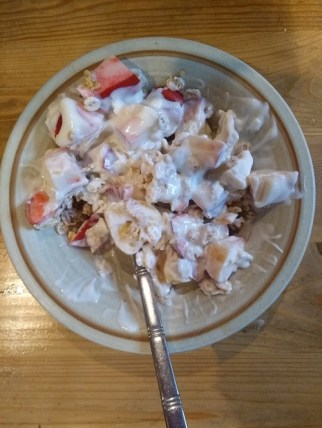
Thus was born the famous Scottish dessert apple, the Bloody Ploughman. From the dwarf tree in my garden came this exquisitely juicy, neither sickly sweet nor yet sour, apple for my breakfast, with cereal and yoghurt.

As for Megginch orchard, it’s still there, not just surviving but thriving. After all, it’s practically next door to the Cairn O’Mhor cider makers. Many of the old trees from the age of Victoria remain, and still bear excellent crops, but also there is a new orchard of modern, productive varieties, and a new heritage orchard, containing all the Scottish apple varieties that can be found.

You can be sure the bloody ploughman found his way home safely.

A Big Hoose and its Carriage Drive

airleywight drive

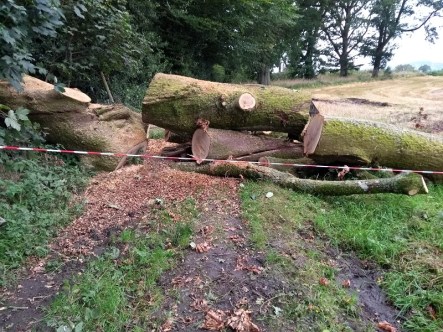
Another giant tree that was part of the avenue lining the old carriage drive has come down. Every year, one at least succumbs. They are mostly beech, monumental now, out of scale with the straggle of the village and the low fields that sulk under the weight of rain and ripe barley.

airleywight4

The carriage drive is a ghost of former times, looping importantly around the grounds of the big hoose that now peeps sheepishly out from behind its deer fences and the remnants of redwood trees, the choice rarities, status symbols prized by landowners two centuries ago. Then, it all belonged – carriage drive, trees, big hoose and all – to the Wylies of Airleywight. To be honest, James Wylie probably owned most of the village, and built a fair whack of it too. He owned my house, and, though long dead, may well still own the rough road on which it lies. (Nobody else claims it, despite rumours that it might be the property of the Bankfoot Light Railway, also long dead.)

A footpath follows the line of the carriage drive, side-stepping the remaining beeches. Here and there, minor land grabs seep into it. A corner of field here, children’s dens there, new tracks, sheds and barbecues. A shady allotment of raised beds fingers into it, created by someone in the adjacent scheme with access to Heras fencing and a tendency to self-sufficiency. In the woods beyond the house, where the Garry Burn streams by, a squarish, sunken, shallow bog is still called The Curly by successive generations of schoolchildren, out on bikes and skateboards, building jumps. If you hunt among the rank vegetation, you’ll find the metalwork that filled or drained the pond for icy games enjoyed by residents and visitors to the big hoose at Christmas.airleywight2


Where the carriage drive seems to end, the footpaths continue, past what’s left of the huge walled garden. Now a forest of self-seeded trees occupies the space where fruit, flowers and vegetables once were expertly raised on the south-facing slope. They tower above what’s left of the crumbling, ruptured walls. Who knows what horticultural sleeping beauties may still lie dormant at the heart of the garden?


The cottage near it lay abandoned save by the swallows for many years, still graced by bursts of surviving garden flowers among the thistles in summer. The butterflies loved both. Was it the gardener’s house? Or perhaps the coachman for whom the drive was made? The village architect has renovated it to picture postcard perfection. It looks content, roofed, aired, cultivated – but not extended. Nearby he built himself a house of traditional, solid materials, that so fits the landscape in style it has become part of it. Already there are lichens on the roof and leaves in the gutters. The swallows and martins nest easily in the eaves and outbuildings.airleywight3


You get to the big house now by a difference entrance, made significant by statuary, but no carriage drive. Of the latest owner, and what they plan for their gardens, curling ponds and steadily declining avenue, there is no word.


Earth Apples

IMG-20190819-WA0003 (2)

So up they come, the Second Earlies,
Along with a cable tie, three plant labels,
The remains of a scouring pad that’s been through the compost heap
And limpet, oyster and mussel shells
That went in with the seaweed
(of which there’s little trace now),
And a wealth of sand, in spring.

Apples of the Earth, buried treasure!

Lift them all, if you can find them all,
Even the tiny ones destined for the hens, but know
Volunteers will still mysteriously spring up next year.

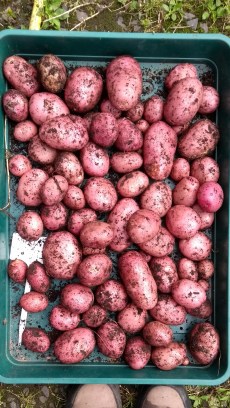
And there they are, washed and waxy.
The few speared by the graip’s narrow tines
(So infuriating!) will be dinner tonight.
Creamy Marfona; yellow and red-mottled Inca Belle;IMG_20190819_134228596
Shocking pink Maxine; improbable Shetland (not-quite) Blacks,
Who’ll burst apart at a mere puff of steam.

Still to come: red Desiree and the Redoubtable Pink Fir Apple,
September’s treasure trove.

Buried treasure, apples of the Earth!