
My secondary school was very traditional, with a “good reputation”. Uniforms were strictly proscribed, right down to underwear and swimming costume, for use in the unheated, outdoor pool. Order was maintained by authoritarian teachers who had been there for decades, and prefects, who monitored behavior and whether we were still wearing our boaters and berets all the way home on the school bus. Our first homework was to take home our jotters and cover them, using brown paper – nothing else – to a strict pattern. On the front, using a ruler at all times, we wrote our names, class and the subject. Nothing else.
I became best friends with the second-in-command art teacher’s daughter. The art department was bright and modern, with lots of materials and media for us to use, and foot-operated potter’s wheels. I joined the lunchtime art club and loved making lopsided, fall-apart pots, which never came up to the scratch of being selected for glazing and firing.
Some time around the Summer of Love, our rarely seen, distant headmaster retired, and was replaced by a younger model that you kept bumping into in the corridors. The senior art master also left and a climate of staff changes, hitherto unknown, began. My friend’s dad became head of art, and the potter’s wheels were taken away overnight. Apparently, they cramped our creative style. Uniform code was relaxed – and ultimately “banned” by the headteacher. Most of the petty rules we loved to get angry about were dumped. Prefects were pensioned off. Some giddy-eyed young teachers encouraged us to address them by their first names.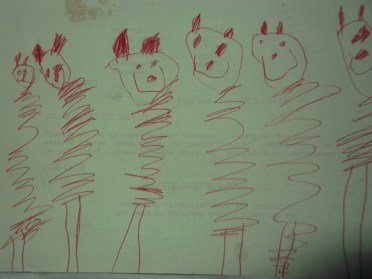
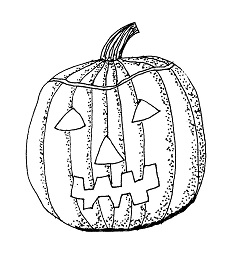
Our new head of art, wings unclipped, sought recognition for his progressive, avant-garde department. It was he that first suggested we doodled on the covers and in the margins of our jotters. There had always been teachers who turned a blind eye to a smattering of doodle on the inside cover – like the thoroughly modern teacher of Russian, and the lazy history teacher who was only entrusted with the first years. Others, of the old school, would reward even a full stop after the subject name with detention. But there came an edict: doodling on and in jotters was no longer a punishable offence. It was to be encouraged in order to bring out our inner artists. Awkwardly, sanctioned doodling began. Pupils became competitive about their flower-power designs. Some gained a talent for cartoons. There was no punishment when my French jotter carried an unflattering but cruelly recognisable caricature of Mademoiselle C, the teacher.
Doodling, whatever the excuse, became a habit.
Doodling expanded onto the pristine walls of corridors and classrooms. Not spontaneous graffiti, however. On the Russian teacher’s classroom wall, we painted St. Basil’s Cathedral in Moscow, with all its onion domes. The windows of the art department became opaque with rainbows of paint. Discarding the conventional, embracing “new” art in its broadest sense, rewarded our teacher with a visit from the Secretary of State for Education. His arrival was carefully contrived to coincide with a doodling-type dance display by two of us girls – of course – to a projected slide containing ink and fairy liquid, swirling and boiling in the projector lamp’s heat, accompanied by drumbeats from a couple of the boys – of course. The Minister glanced in, got the picture, and left rapidly.
The shelving of rules, the constant changes, the abandonment of distance and discipline left those pupils who had started under a very different ethos confused and sometimes angry. So were many of the staff. What do you do with a teenager, programmed to rebel, when you take away all the small stuff that’s been joyfully resisted by generations of adolescents? Some turned to bigger and more dangerous stuff to prove they were different. Sometimes, we took direct action against the new liberal order – such as holding an “illegal” Christmas carol concert when the traditional one was axed.
I left school early. The progressive trend lurched on, at least until the headmaster ran off with one of his sixth-year pupils. The art teacher left to be creative in Devon. About six years later, I found myself teaching in the same local authority, and had cause to visit the school for some event or other. I noted the blank, crisply-painted walls in the corridors. Clear glass sparkled in the windows of the art block. Uniforms, I observed, had returned. The backlash was in progress. It would have been a relief for my generation of rebels in need of tiny causes. I’m not sure if that still holds true – today’s young students have so many big causes to fight and need all the help they can get.
I never lost the doodling habit, though. It helps me concentrate, focus, relax – and learn.
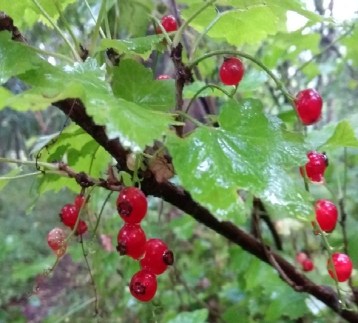 In the dense shade of a triumphant elder spinney, a smattering of redcurrant bushes blooms and fruits, scant rich redness catching the eye as the berries ripen. They are small and sour, yet somehow incandescently flavoursome. Where the track narrows to a muddy path, wild gooseberries make a wee thicket. Their fruits are also tiny, and round. Are they genuinely wild?
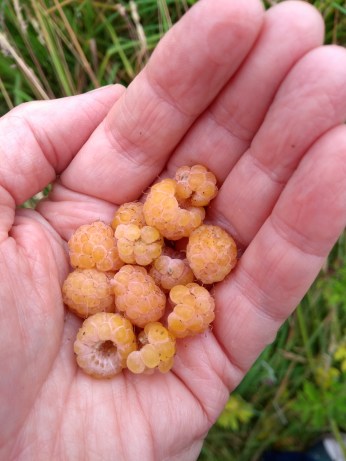 diminutive rasps are a pale golden yellow. They hide behind fiercely protective stands of nettle, and amid the jaggy stems of the hawthorn. These are the sweetest, most succulent of the feral berries. They melt in the mouth and almost dissolve in the hand. Any attempts to gather a large quantity fail; they are nought but juice by the time they get home. Those who know about them keep a close eye, and say nothing, then give the game away when it’s picking time by beating narrow paths through the grass and nettles to get at this choice fruit.
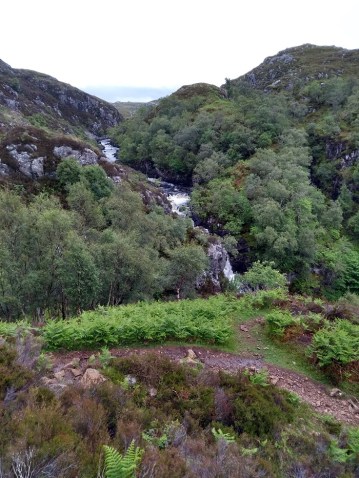 But last week I was in Assynt again, and if there were many changes, it was the trees I noticed first. It’s nearly 26 years since the first ever community buy-out of land in the area by the Assynt Crofters Trust, and there have been others in the area since. The first trees I found myself looking at were less than 25 years old. I walked in vibrant young woodland at Little Assynt, above the shores of the great loch. Deer fencing surrounded large tracts of land. Birch, rowan, hazel, Scots pine…… willows, elders, hollies and even aspen…… planted by Culag Community Woodland Trust or regenerated naturally within the fences. Outwith the fences, though, trees were also regenerating, especially birch and willow. Sheep, ironically, seem to have been cleared to the coasts. Deer pose for tourists around townships, but their numbers are controlled. Bluebells and primroses are appearing under the bracken.
 midgies to produce more trees, all from seed they’ve gathered locally. They’re pretty excited that after last summer, the aspens have flowered – a rare event in a species that prefers to clone itself vegetatively – bringing welcome genetic diversity into the local tree stock. At the Falls of Kirkaig, we bumped into a naturalist friend from near home in Perthshire (Scotland being such a gloriously small country), who had observed the same phenomenon. So, there we were, all getting excited about the future of a tree species in a place I’d remembered as treeless.
 Comments on The Nature of the Universe