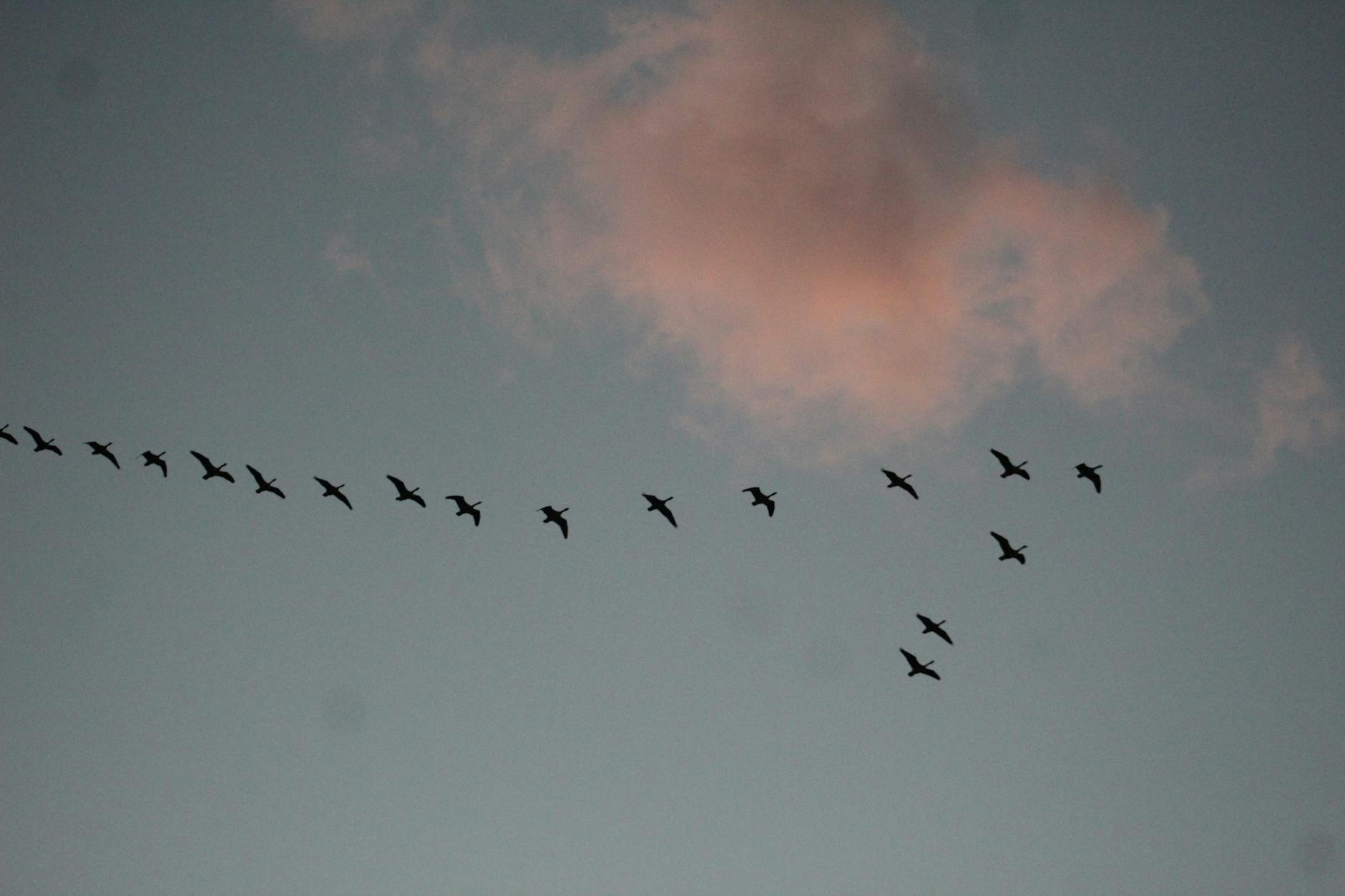
They will be here soon flying through the night piercing the muffled silence as stars punctuate darkness’s depths. They are coming, converging, greeting each other, flying alongside and ahead.
Battalions with no borders to defend no wars to fight no points to score.
To the stirring fields of autumn to the flat black water to the margins, they approach.
Let’s meet them there.
I was on a bus between Perth and Edinburgh last week. As it swung into Kinross to pick up passengers, I glanced up at the amazing Kinross Gateway sculpture of three pink-footed geese alighting (David F. Wilson, https://dfwilson.co.uk/1371-2/). I thought, ah yes, the pink-foots. They’ll be on their way now. In my mind I could see them sweeping the skies, could hear their incessant babbling on the wind. The poem above got written before the bus had even got to Kelty. By the time I go to the end of it, I wasn’t only writing about geese. The last line references a famous poem by the 12th century Persian Sufi poet, Rumi, which goes like this:
“Out beyond ideas of wrongdoing and rightdoing there is a field. I’ll meet you there.
When the soul lies down in that grass, the world is too full to talk about. Ideas, language, even the phase “each other” doesn’t make any sense.”
The little wood has become tangled, and the paths vague and meandering in the past few years, since Jed our collie died. Few people walk them, and even when it was a regular walk for me and Jed, they tended to shift and change, as blackthorn grew to block one route, or trees, felled by the wind or growing with vigour, made another way more attractive.
But always, there have been certain way-markers:- the overgrown guerrilla-planted Christmas tree, the gap in the field boundary where the wire’s trampled down, a patch of brambles, the fallen birch that still produces shoots…. Today, alone, I beat the path out again, lost in thickets of gorse and thorn, disoriented by the sound of traffic, unsure of distances among an understory of fern and broom. As so many times before, when coming from diverse directions, my brain unconsciously looks for you to reset my compass. I know I must pass you on my left to regain the path downhill and out of the wood.
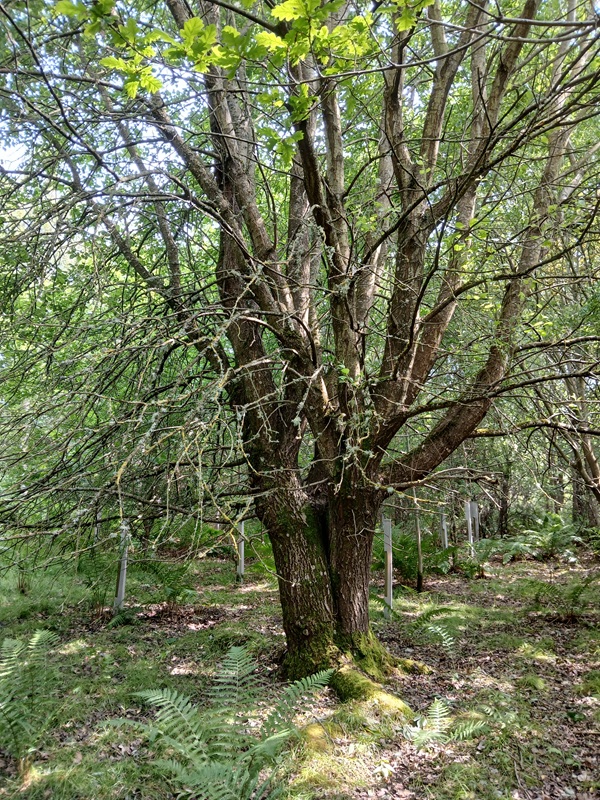
You are the biggest, broadest, in the wood, though perhaps not the tallest or the oldest, and certainly not as old as me. With two feet firmly planted, you stand fast and firm among the rest who bend and break in the wind, and you spread your many solid arms in all directions, and to the sky.
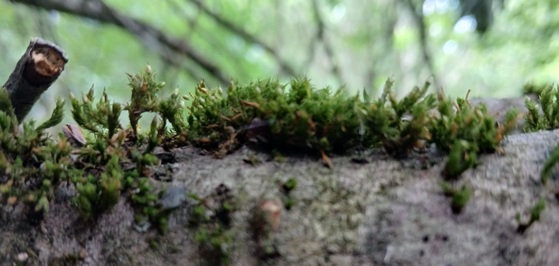
Here you are. Now I know my way way. But wait – have we ever truly met? Have I ever really seen you, Mr. Standfast? Today I approach with awareness, pausing in stages, taking you in. A rush of warmth, of joy… joy or recognition, joy at being recognised. When I reach close enough to touch, my gardener’s – my orchardist’s – eye notes dead, stiff and black lower branches and itches, for a second, for loppers. But then I watch the beetle’s progress through the moss and lichen upon them; the moist droplets of old rain sustaining the beings on the branch, and recognise, it’s none of my damned business.
We are together for a good while, without words, unified by our alikeness, as your very own warbler comes to join us, bursting into that fitful exhuberance of song that wears itself out in a twittering, grumpy-sounding mutter, then kicks off a few minutes later to try again. I feel the healing nature of your skin, the questing stability and strength of your roots, the air you breathe, I breathe, we breathe. For a moment, I know we are one, with the lichens and beetles and warblers and the things unseen.
I know my way now. As I rejoin the ghost of a path, my palms carry the imprint of willow bark, like a memory, like a gift.
I haven’t written this blog for ages, and what follows is a comment neither on nature nor the universe. It’s an account of a vivid dream from which I’ve just awoken, and it might be a comment on the human part of this small dot in the universe today. Or it might not. See what you think.
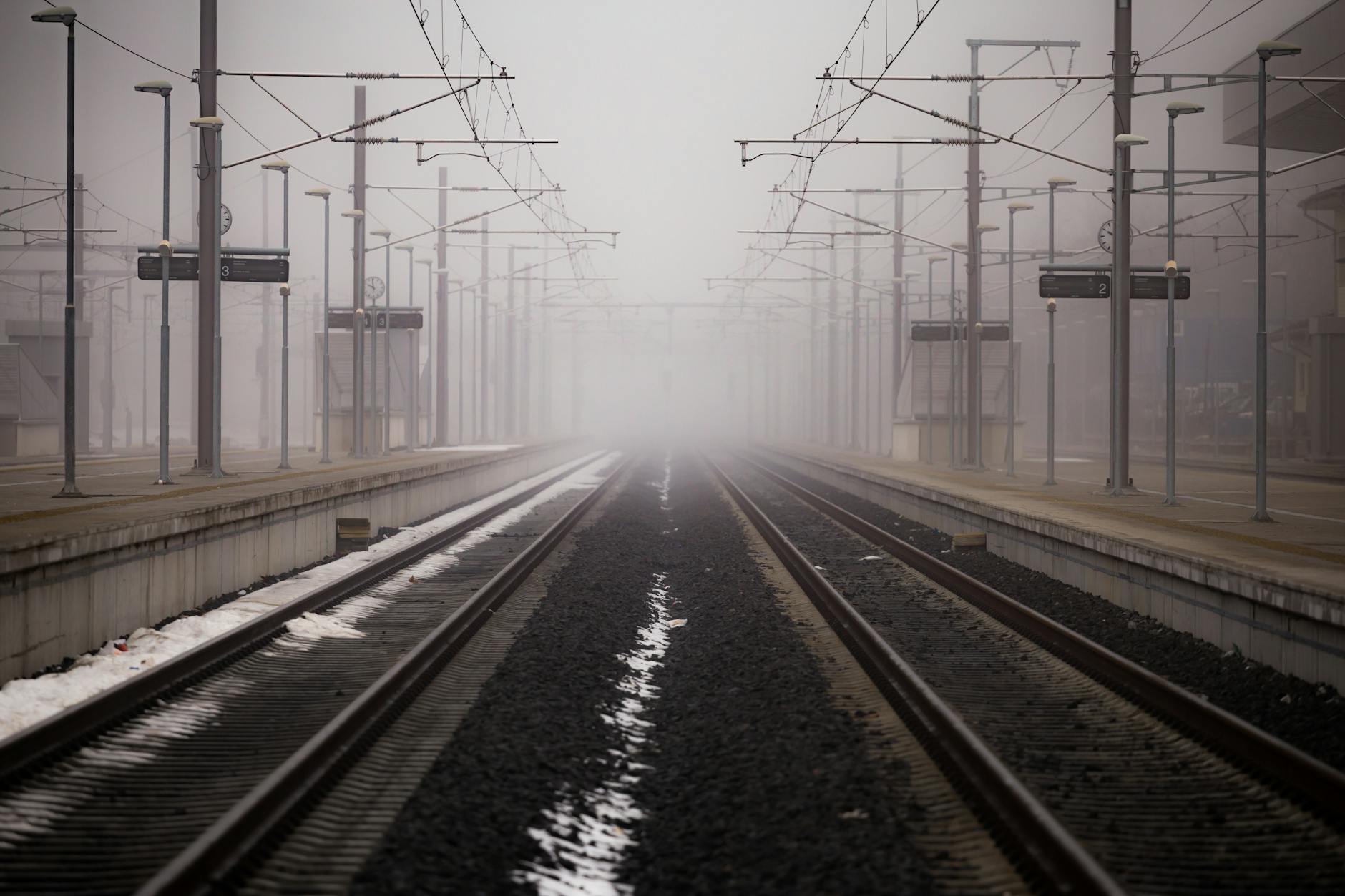
Somewhere in the industrial north of England, I was running to catch an underground train. I couldn’t quite keep up with my partner and when I arrived on the platform, he was just pressing a button to get on a single huge, black, open carriage – which was all the train consisted of. The doors slid open, he got on, I went to follow and the doors closed in front of me. So I waited a while and got on the next, identical, “train”. It resembled an old-fashioned coach without a horse – with a roof, but no glass in the windows. There were quite a few passengers sprawled around inside, on seats, the floor, or couches.
I didn’t know where we were, and wasn’t sure what my partner would do – go on to our destination and wait for me there, or get off at the next station and come back to find me? I also couldn’t remember, or had never bothered to find out, our destination. No matter, I thought, I’ll look at Google maps….. Only, I seemed to have lost my phone. We had bought a cheap sort of “toy” version for emergencies, which we hadn’t got out of its box yet. Of course, there were no Google apps, or else I couldn’t find them. In fact, I couldn’t find anything useful. Well, never mind, I could just ring him and he could tell me where we were, why we were there and where we were going.
But I couldn’t fathom how to make a simple phone call on the device. There seemed to be lots of games, but no means of communication. Station after station went by as I struggled with it, and endless vistas of industrial wasteland and dark satanic mills – and networks of grimy canals – were the only clues I could see as to where we were. One passenger, a middle-aged man, offered some help and advice, but none of his tips and instructions seemed to make any sense, or they didn’t work, and soon he fell asleep. The train hit the barrier which marked the end of the line, but without a pause reversed and set off back on the same track. This happened repeatedly; it got dark – and I had another problem.
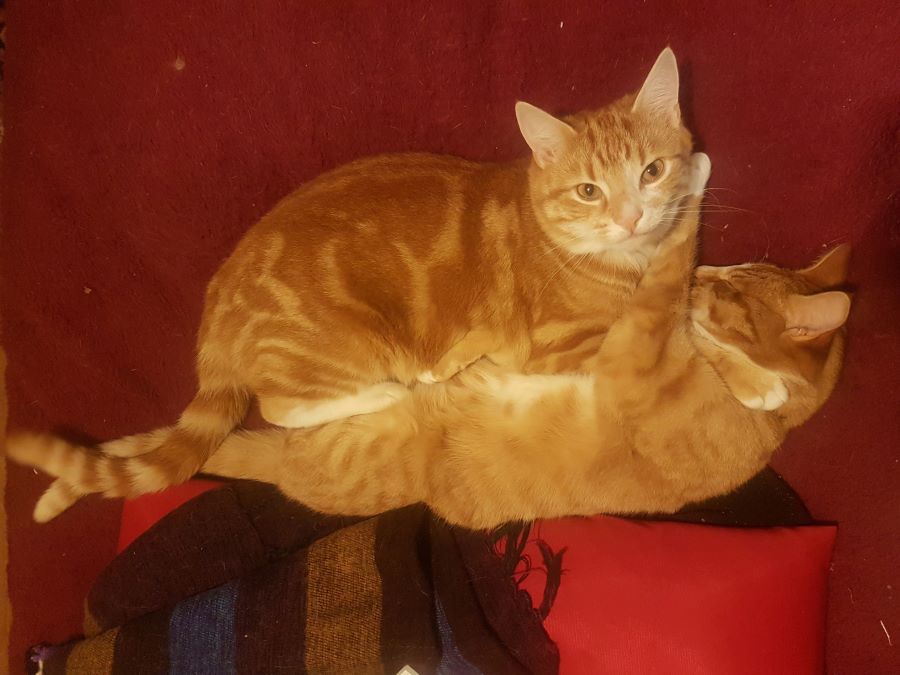
For some reason, I was carrying the smaller of my ginger cats, Jeoffry, in my arms. A very biddable and lazy animal, Jeoffry was finally showing signs of annoyance and wanting to get off the train. Fearful he would jump out of the open window, and desperate not to lose him as well, I clung on to cat with one arm while trying to get some sense out of the phone with the other hand. It dawned on me that all I had to do was read the instructions, which, after a struggle I prised out of the base of the box. This thick wad of paper, as I supposed, must have the answer to how to use a phone to phone someone.
But as I opened each layer, out jumped some cheap plastic toy or game or cartoon show, which expanded with the air to make a growing heap of unwanted junk on my lap (with the cat), and nowhere in all these gimmicks could I find any decipherable instructions. I noted that a disproportionate number of my fellow passengers were children, all busy playing with games and toys already. I tried to offload a set of plastic animals the phone had disgorged onto one of them. He wasn’t interested – he had loads of plastic toys already, surrounding him on the floor. If they weren’t so distracted, mightn’t one of these (presumably) tech-savvy infants be able to get my “phone” to work?
Getting desperate, I appealed loudly for help. The man who’d first advised me woke up. “Are you still looking for people to help you?” he sneered. “What is it it now?”
“For a start,” I replied, “where are we? What is this place?”
He tutted. “Great Yorrington”, he said, and proceeded to lecture me on then history of the murky waste we were passing through. By the time he finished we were somewhere else entirely, but equally murky.
So there I was. Left behind, not understanding where I was and ignorant of where I was going, unable to communicate with anyone who could tell me. Confounded by crappy technology which delivered only junk and gimmicks and no truthful information, while surrounded by people so completely engrossed in their own junk and toys they were totally unaware of anyone else’s difficulties, and had no apparent interest in where they were going. And all the time, desperately trying to hold on to the living, breathing, warm thing that was all I had of value on that train.
I’m glad to say I woke up.
One other thing. Of course, the train was driverless, and completely unsupervised.
In the weak, blinking sunshine, wind-chilled and watery, The top fields swarm with detectorists from West Lothian, Thinly spread, rigorously spaced, slowly they move, like cautious extra-terrestrials, each has a rigid, but fluidly-swaying trunk, held just above the ground, all wear rucksacks or cloth bags that sport spade-shaped antennae.
Every so often, a detectorist drops to his knees and starts to dig, carefully refilling each hole before moving on. I greet a smiling pair of them at the gate. “I only get Sunday off, but I wouldn’t be anywhere else,” says one. Do they find treasure? Laughter rings – “be better off buying a lottery ticket for that!” But…. each has a tale to tell, of tobacco tins and Victorian pennies; last weekend, a Bronze Age spearhead – “in this very field!” And anyway, “it’s this I enjoy best,” – throwing an arm towards the hills, the grazing geese, the spruced-up-for-spring yellowhammers in the hedge – “being outside. The scenery. And the people are all lovely.”
They are. I admire their hi-tech gear, wish them luck…. And off they go again. Watching their measured tread, I know (whether they do or not) detecting’s a walking meditation, just as anglers sit and meditate on water, fish or no fish.
With implacably good timing, I finished my coffee to arrive at the Holiday Inn on the edge of Perth, seven minutes before the hourly bus home. Bang on time, I saw a bus crawling up Dunkeld Road. I slid to the edge of the pavement. But wait – was it a bus? No Stagecoach livery, a plain white coach, beetling along rather fast. I screwed up my eyes: nothing on the front to say what number – or any number – or destination. The tinted windows didn’t allow me to see if it carried passengers. A private coach, then? I sighed and stepped back.
As it hurtled past, driver not even glancing at the bus stop, I saw, on the side, “23 – Bankfoot”. The air turned blue outside the Holiday Inn, as I gawped in disbelief and watched it sail off without me. What to do? No, I wasn’t going to go for another coffee. I certainly wasn’t going to sit staring at a petrol garage while inhaling the noxious air of Perth’s god-awful motor mile for an hour. One does not get a “pleasant stroll” down Dunkeld Road, but eventually I began to walk towards town, undecidedly, seeking equanimity.
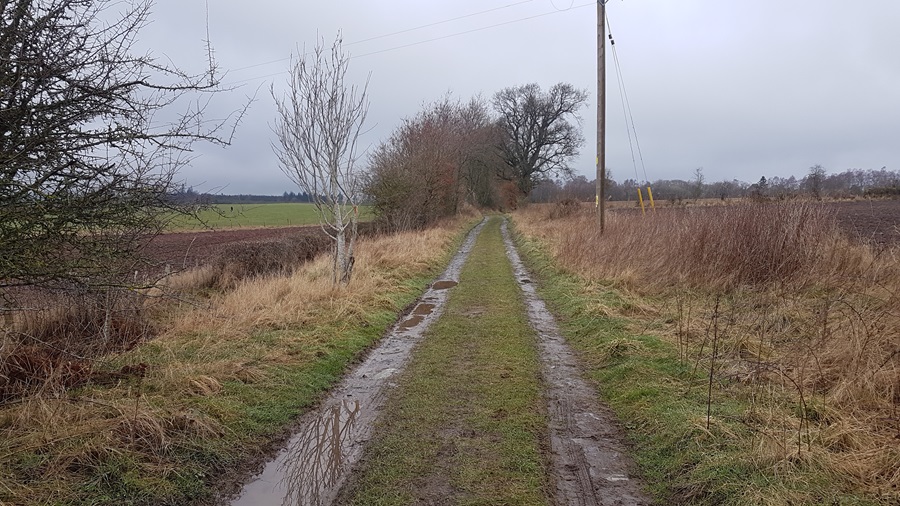
A couple of minutes later, just before the rail bridge, I noticed a tucked-away footpath sign: Lade Walk to Perth/Tulloch. Perth Lade is an historic man-made waterway which fed into the town’s mills. I knew the Tulloch bit, and the bit from the retail park to the City Mills, but this stretch – I never knew it existed. The Lade is grotesquely polluted for much of its length these days, but I know people who have spotted kingfishers hunting there, and the incredibly tolerant mallards of Perth make the best of it, and eat discarded chips. I ducked along a narrow path between the railway and the fenced car park of some tedious car dealer, with little optimism. Surely all I had in store were industrial lots and housing estates? The narrow path broadened as it reached the Lade, curving round from the west, and I heard flowing water and the busy furking-about of moorhens in the thick undergrowth on either side. The irritating groan of the Dunkeld Road traffic had completely disappeared, yet surely I must be not far from, and parallel to, it? To my left, a thick bank of mature trees, mostly self-sown and densely overgrown, had shed small branches and twigs in profusion during the winter storms. Accumulations of litter, initially like glue in the conglomerate of nature’s own debris, were slightly fewer than at the start, though one spot behind the ugly chainlink fence was a veritable carpet of empty beer bottles – either decades’ worth of boozing or the emptying of an accumulation someone didn’t want on their own doorstep.
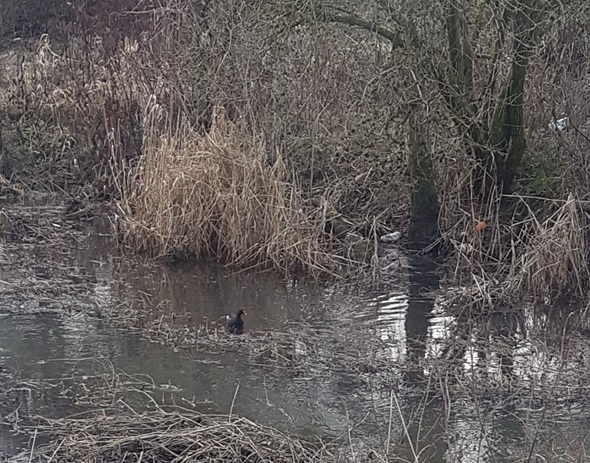
Five sleeping mallards sat camouflaged on the far bank, not moving, until I got my phone out to take their photo, when they all silently uncurled sleepy heads and glided off downstream. Moorhens, in vibrant plumage ready for spring, hung about, quite tame, crossing the path and ferreting in the reeds on their spindly legs. The larger trees thinned to a narrow belt and behind the fence was a huge expanse of derelict industrial land, half-concreted or tarmac in places, but being rapidly colonised by pioneer birch. elder and other young trees. In January, all looked grey, but from the lying vegetation of last summer I could guess at the wealth of wildness that would spring up, laughing at human arrogance, when the season turned again. Bare young trees may look like a delicate screen, but never doubt their power and ability to exploit a vacuum. Nor that of the dandelions, dockens and bombsite weed, all bringing seeds and nectar to wildlife. On cue, a terrible high-pitched squeaking started up in one of the older sycamores – a flock of long-tailed tits on the rampage. I stopped and birdwatched for a while – coal tits and blue tits were weaving between the branches and a cheeping of chaffinches held forth from some bushes by the lade. On the path, first a male bullfinch, then his duller mate, landed and had a good look around before returning to the other side of the lade. Blackbirds and a thrush hopped out and eyed me beadily.
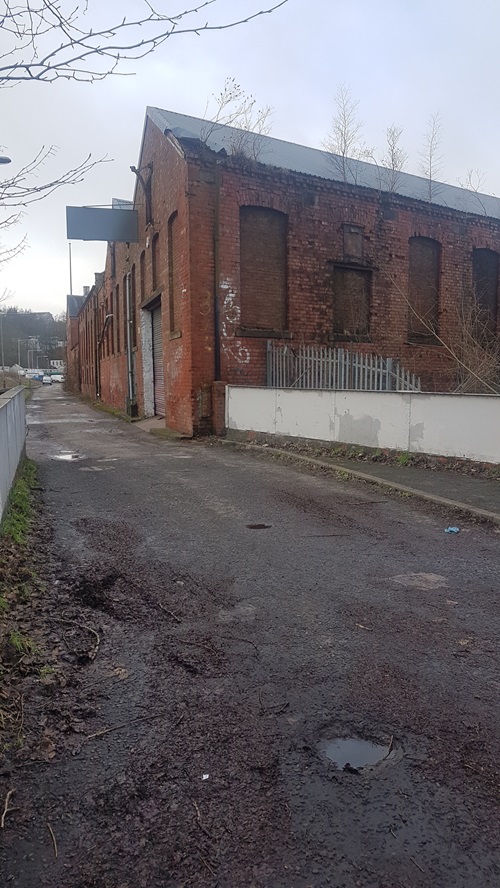
I came to a junction – a path crossed the Lade by bridge, past an old brick building – possibly a former mill but now another garage. It was attractive though, and full of potential nesting sites. Here, there was a sign on the fence – all this derelict land, stretching into infinite distance with no trace of the motor mile, belonged to the railway, which was nowhere to be seen but must be in there somewhere. I hoped it would stay their property, and they would never try to tidy it up or sell it to developers.
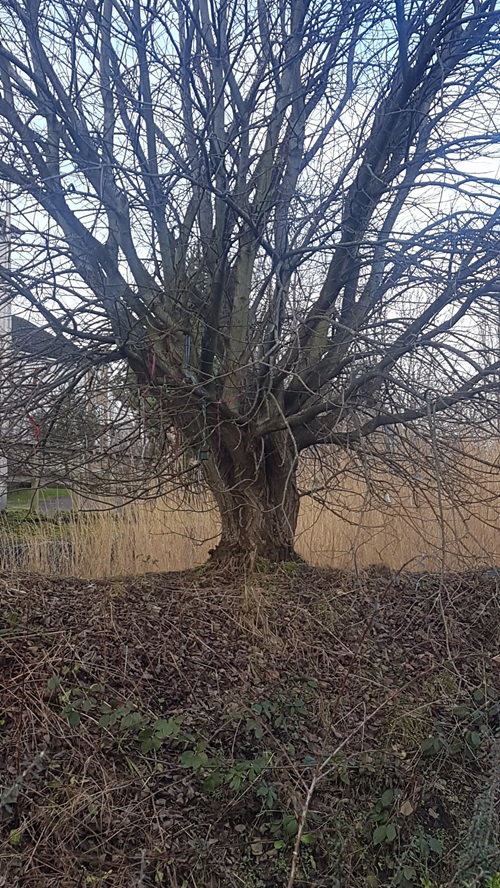
There were houses and flats now on the other side of the Lade, so near, yet curiously far and separated from this unexpectedly lovely and interesting walk. A large willow on the far bank was decorated with ribbons, toys and ornaments, like a wishing tree of old. I wondered who came out of their homes to celebrate or remember there. The ground on my left opened out, seeming endlessly wide. Lade and path swung eastwards and I saw an iron bridge, unmistakably a railway footbridge, just like the one I used to play under as a child in east London.
And over the bridge, where teenaged girls stood discussing the wicked-looking, monstrous-headed dog they thankfully had on a tight lead, Dunkeld Road reappeared. I swerved away from it, passed through some houses and across Crieff Road, where I joined the Lade stretch I knew well, skirting old tenements and road ends, bits of gardens and the ubiquitous smell of cannabis. Passing Stagecoach Headquarters, I surreptitiously made a rude sign. No time to march in and complain, if I wasn’t to miss the next bus as well! But thanks to their rubbish driver, I had discovered a stretch of unofficial countryside that I’ll revisit in summer, I’d enjoyed an unexpected daunder, found equanimity – and, moreover, escaped Dunkeld Road.
(It’s taken me a while to write this walk. I did it the day the clocks went forward, end of March, and today they went back again. My 14 year old collie died in early summer, and this was the first walk I decided it would be unfair to take him on, so it was a bit poignant; and weird not to have him beside me all the way.)
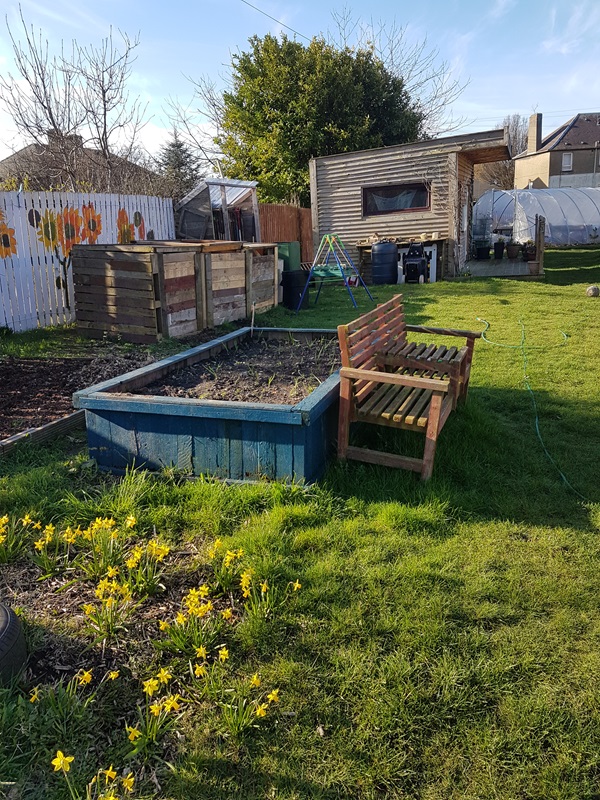
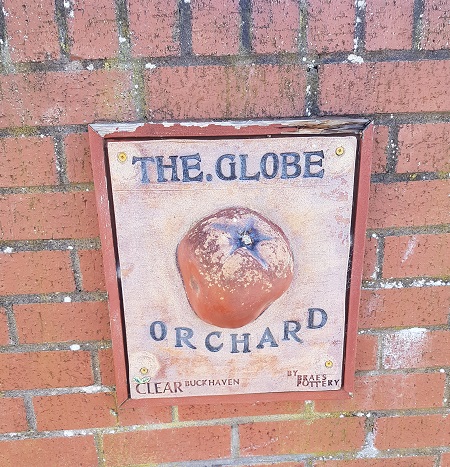
It began at the CLEAR Community Garden in Methil where I left Andrew to deliver a workshop. CLEAR stands for Community-Led Environmental Action for Regeneration, and is a very active charity whose stamp is all over the former mining towns of Methil and Buckhaven in Fife. We’ve worked with them a lot over the years – their compulsion to fill every available space whether roadside or cliff-top with fruit trees was one of the inspirations that got us into orchards in the first place. The Methil garden was pretty stunning; I had a good look round to admire the recycled materials, the superb compost bays (I do love a good compost heap) and pear trees about to blossom, before heading off into the cold, breezy sunshine.
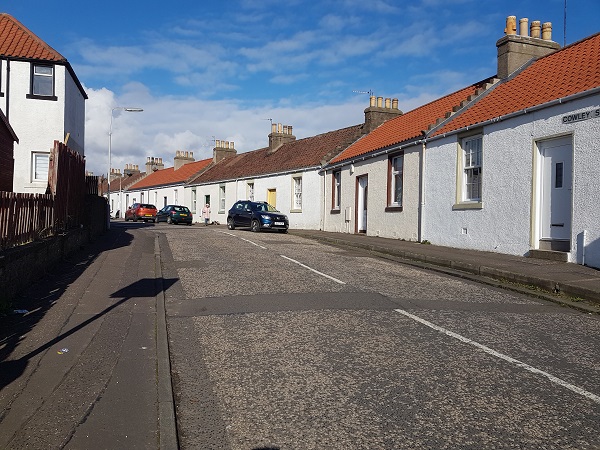
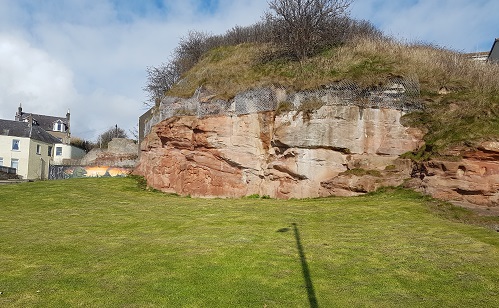
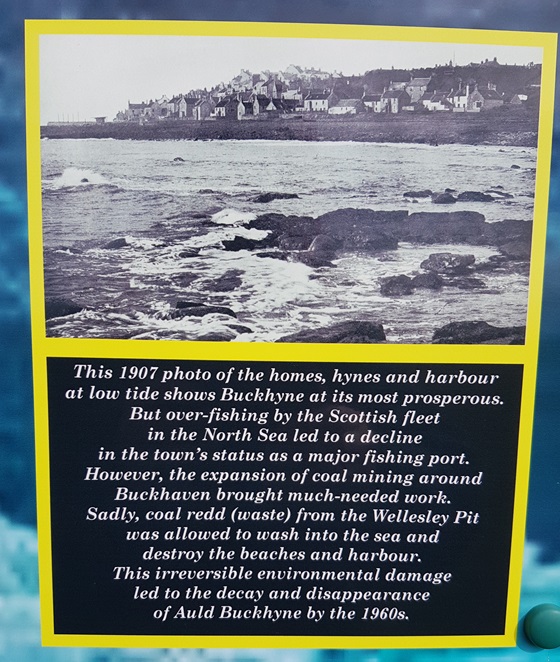
Zig-zagging through Methil, side-stepping CLEAR plantings on the edges of parks and in vacant plots, till the town had morphed into Buckhaven, or Buckhyne if you like, the place of superlative pies and hidden histories, from the extravagant exposure of Fife coast geology, the sturdy cottages of Cowley Street and relics of the long-disused mine railway – all explained in panels erected by CLEAR and Fife Council.
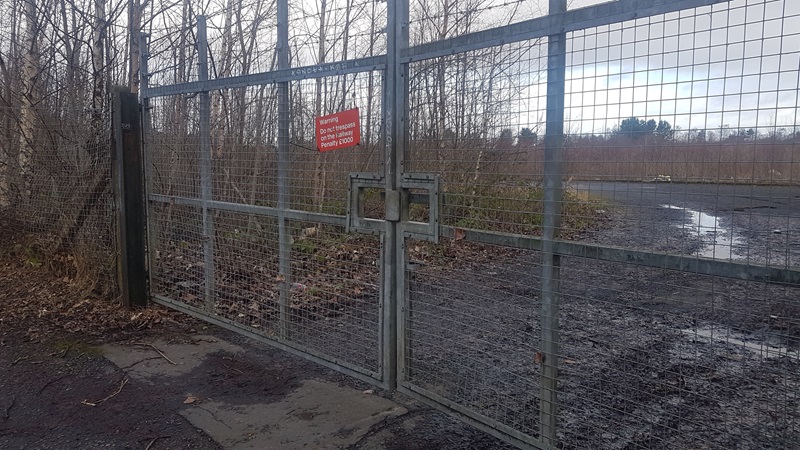
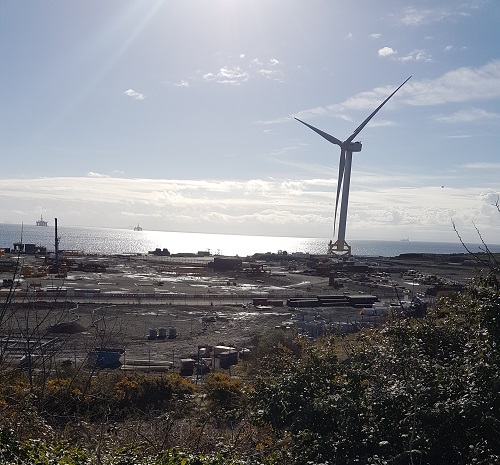
I’ve become rather fond of urban walking lately, for the unexpected quirks of history, and opportunities to see the extraordinary hiding behind the mundane. Here, I learned of the “lost village” of Buckhaven Links, which grew, mushroom-like, on the shore when the Church of Scotland had one of its fallings-out and mislaid a large part of its congregation. Buckhaven Links did not survive too long, and is now buried under the Buckhaven Energy Park, a darkly towering set of anonymous edifices over the wall from the street.
Buckhaven Energy Park
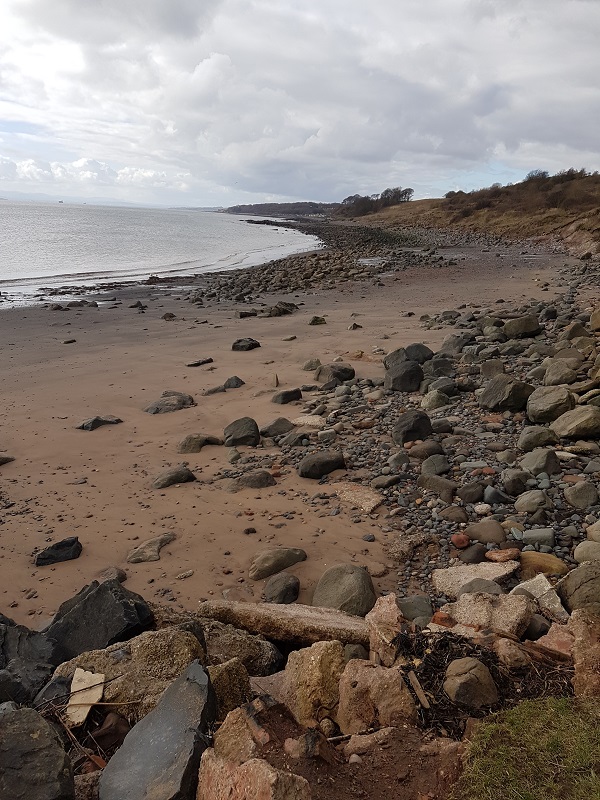
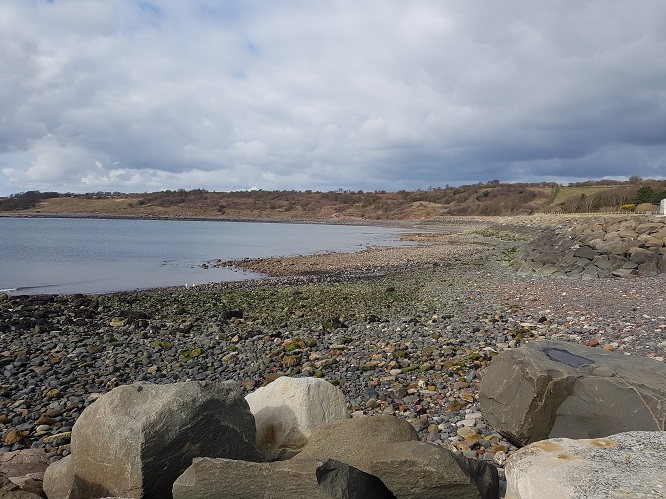
That road took me past rows of houses with signature Fife/East coast crow-stepped gables to where Buckhyne Harbour once was, until it was abandoned due to over-fishing and used as a repository for mining spoil. Beyond the harbour site, a scramble through rocks and there was the beach, for a while and pre-pollution a popular holiday and day trip destination for Fifers and those beyond the kingdom.
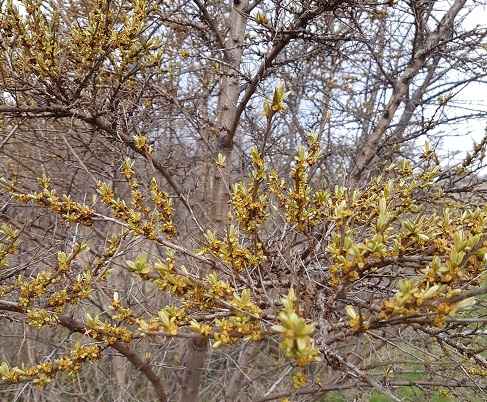
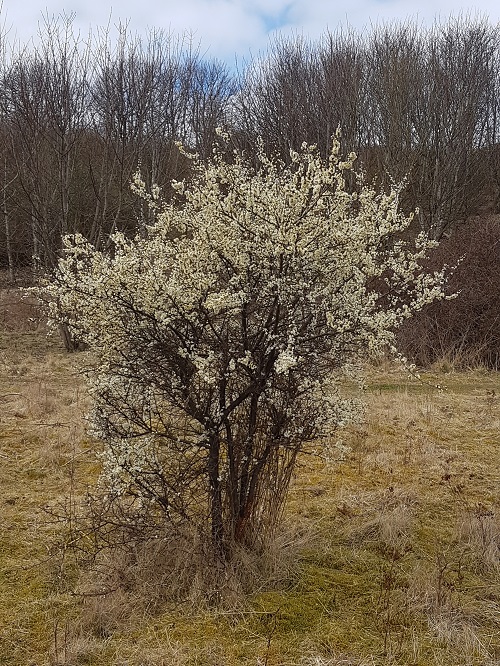
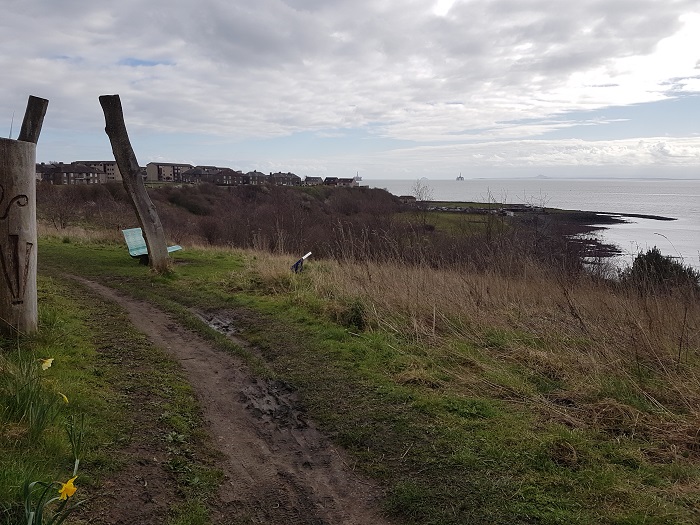
Up, then, climbing skyward the Buckhaven Braes, lit by the silver of blackthorn blossom and the gold of Sea Buckthorn, peppered with orchard trees, all labelled, all immaculately pruned and protected, the coast path lined with daffodils in flower, until this extraordinary little town was behind me and I marched along westwards towards East Wemyss.
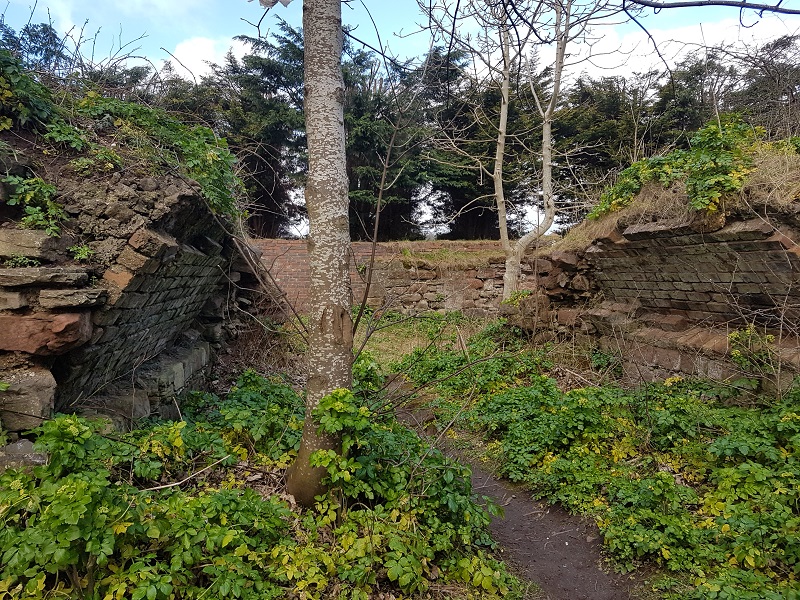
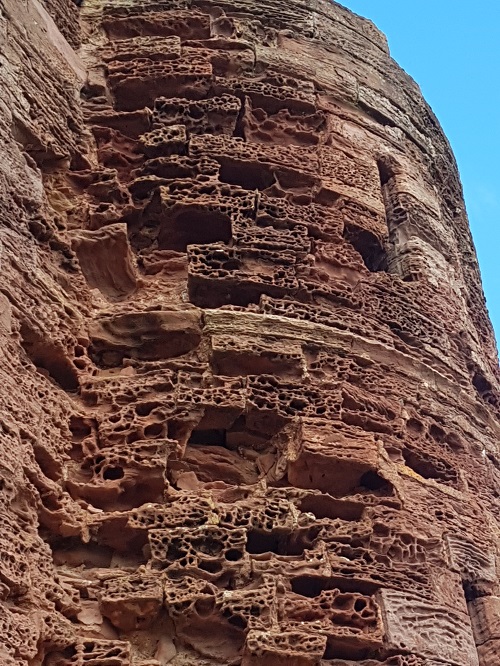
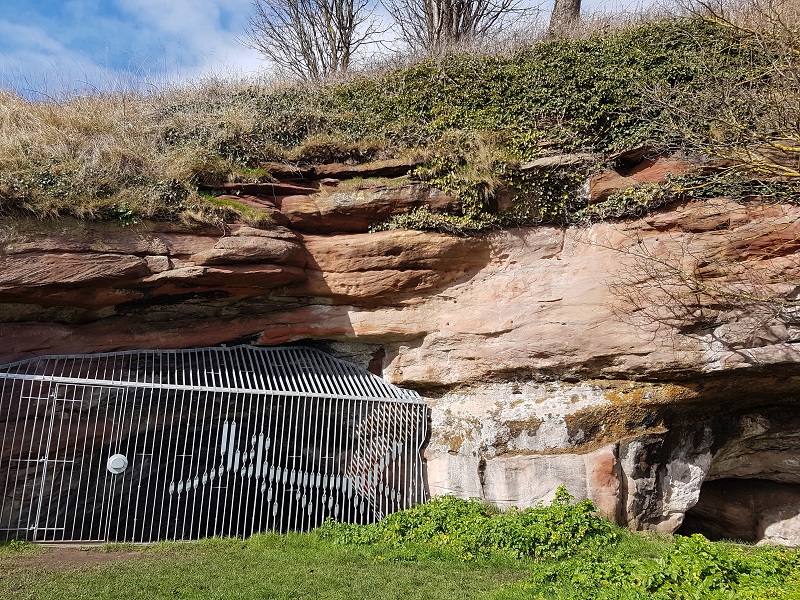
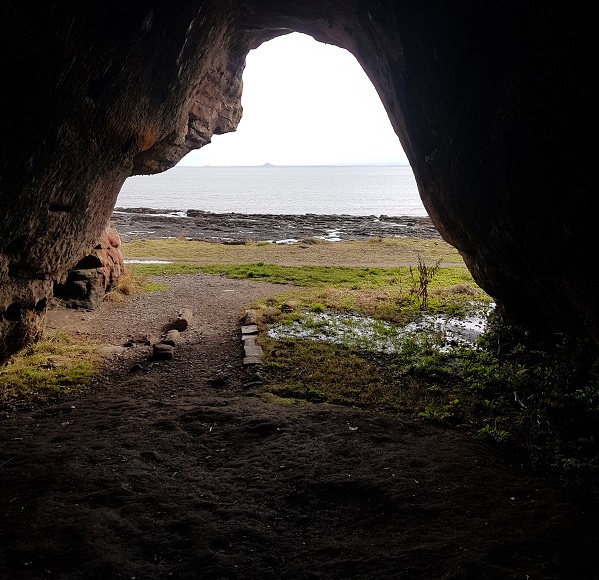
It was the East Wemyss caves that had been bothering me ever since reading that Val McDermid novel; not just to imagine fictional murders, but to see where Picts had carved strange images in bygone centuries, where people had dwelt, sheltered, hidden, picnicked and stored precious things. But first, when I passed through the woods, I came upon Macduff’s Castle – an impressive ruin whose stonework exhibited all the artistry of a carving, it is so tastefully eroded. All around its roofless vaults grew great clumps of Alexanders, a shiny-leafed, celery-like edible plant not native to these parts, but where it takes off, it does so with enthusiasm. I circumnavigated the castle before heading down the cliff to the caves.
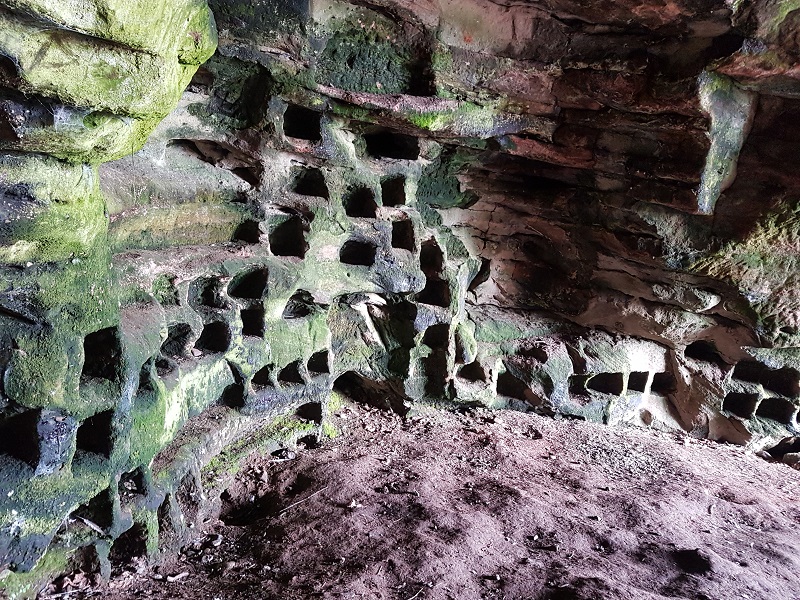
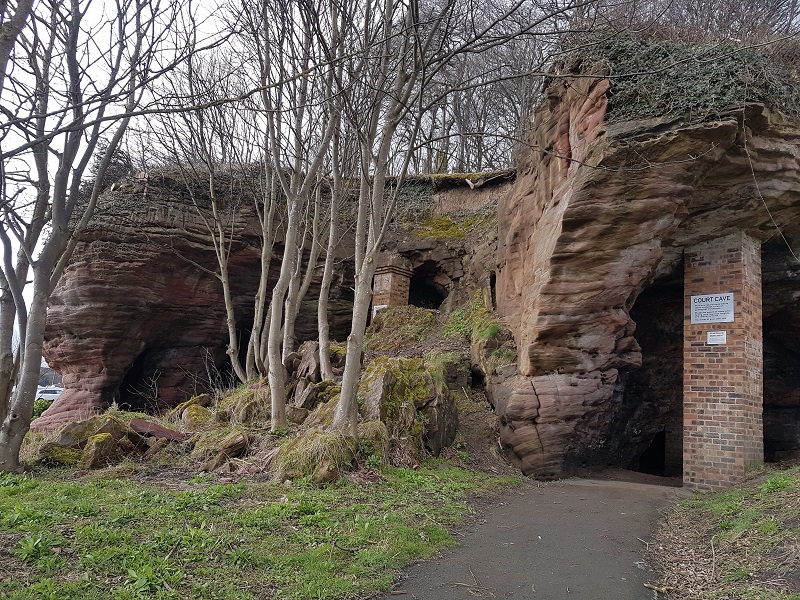
I had been warned that the best bits of the caves were gated off by substantial railings, in order to protect the ancient carvings. You can get a guided tour of them if you go to the museum in East Wemyss, but I didn’t want that today. So I stood outside Jonathan’s Cave and used my imagination instead, then stood inside the Doo Cave, where dozens of little cubicle nest holes have been carved out of the soft red sandstone to accommodate the doos, kept for meat and eggs in years gone by. At the large Court Cave, I did my exploring along with other visitors until my excitement subsided.
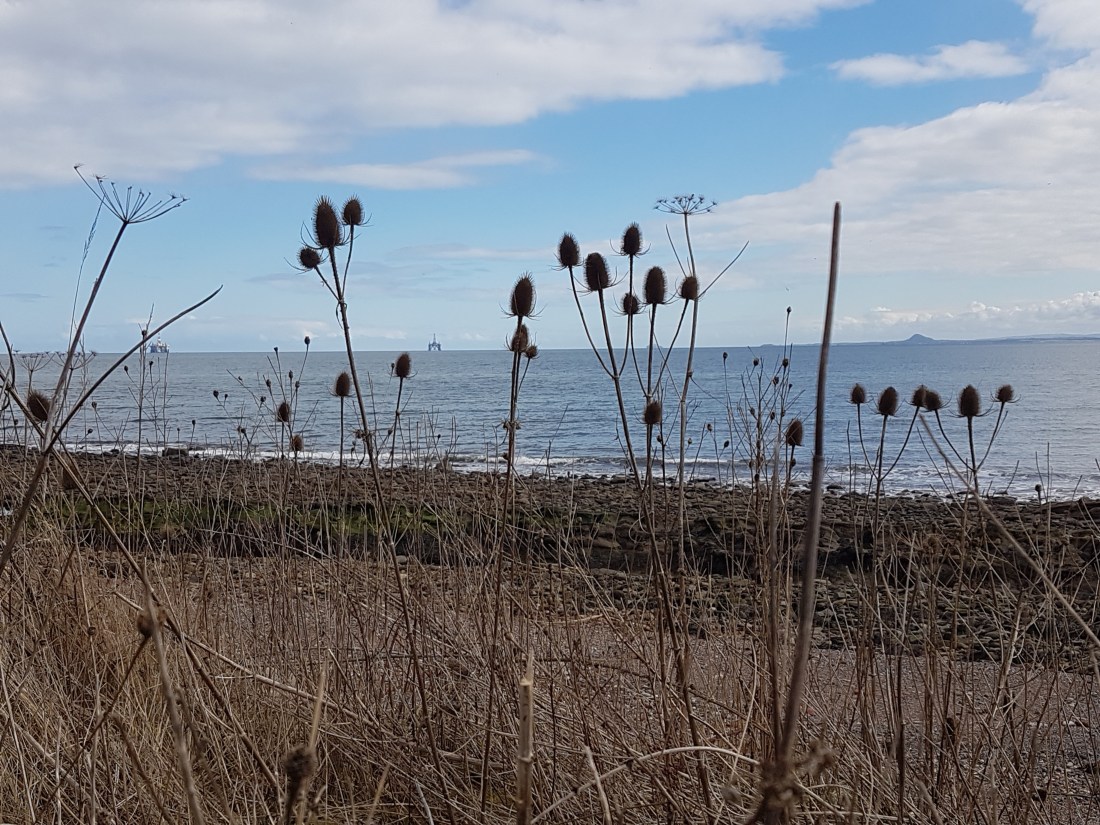
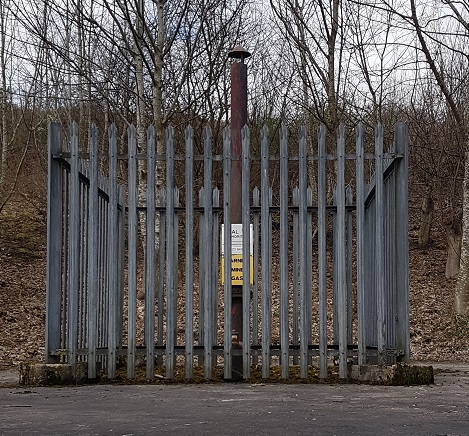
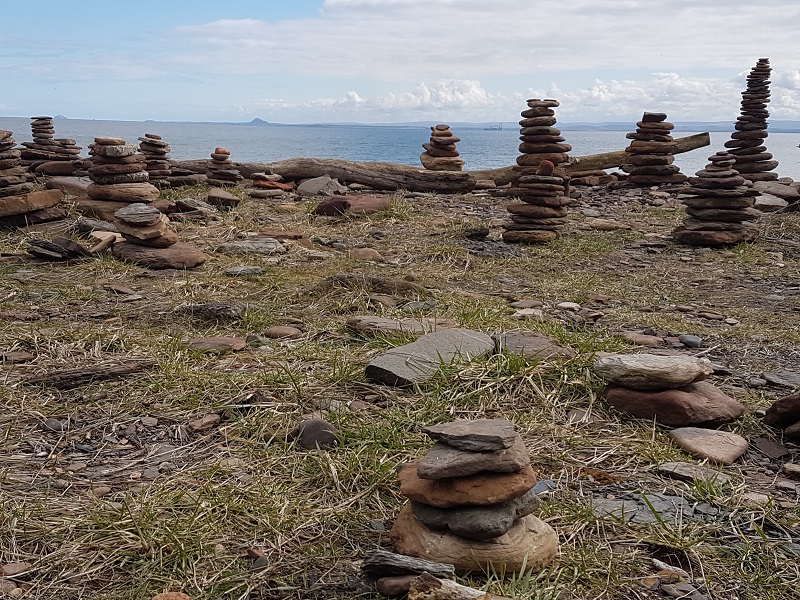
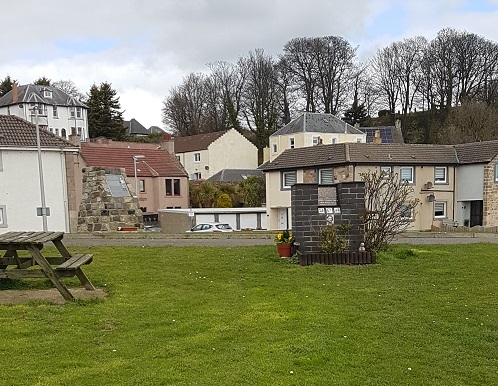
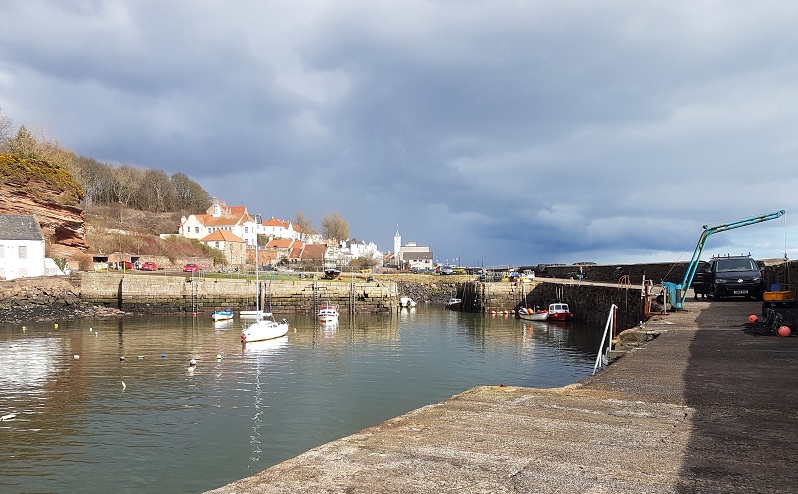
Then I walked on, the sunshine now spring-warm, past a gaggle of East Wemyss monuments and memorials, side-stepping mine ventilation shafts, to re-join the path by the sea. Rafts of eider ducks sailed by, making their weird, cooing, gossipy calls, and cormorants lined up on rocks. Strange but recent sculptures in stone arose against the skyline like sentinels; I added to them, noticing how the stiff uprightness of last year’s teasel seedheads mirrored their form. Under the precipice on which the relatively modern Wemyss Castle teeters, and I was into happy little West Wemyss, basking, and its lovely cafe for tea and a well-earned salad.
Looking forward to the next Fife coast exploration!
The track we follow is purposeful. It has the directness and air not just of going somewhere, but of having been going there for a long, long, time. We get to it from another determined little track, that rises up from the calm waters of Galmisdale Bay, through woodland to the uplands of a hill farm. Side-stepping the sheep and their copious leavings, ignoring the bull who is also ignoring us as he lounges among his harem, we skirt the farmhouse and its hollyhocks, and turn onto the Grulin track.
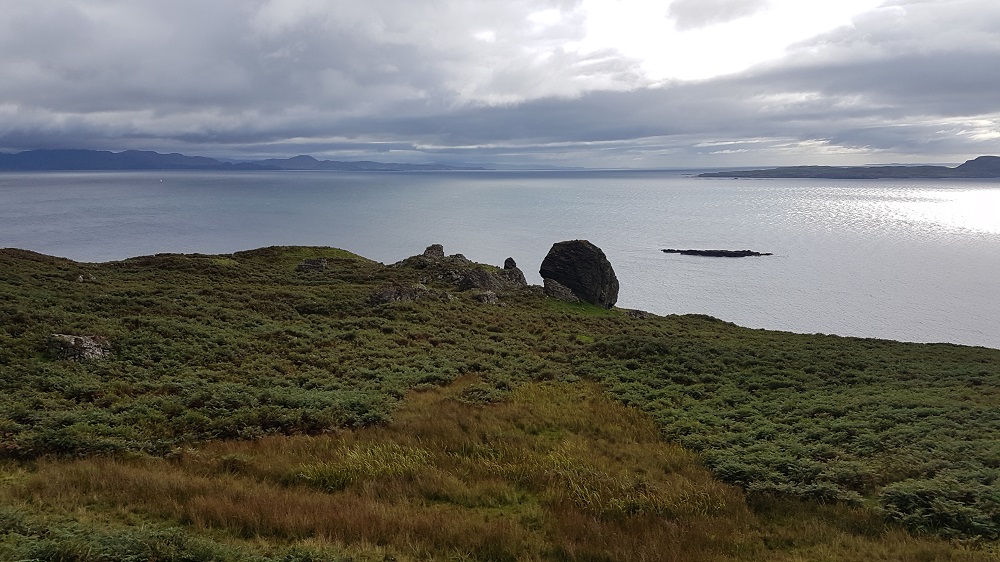
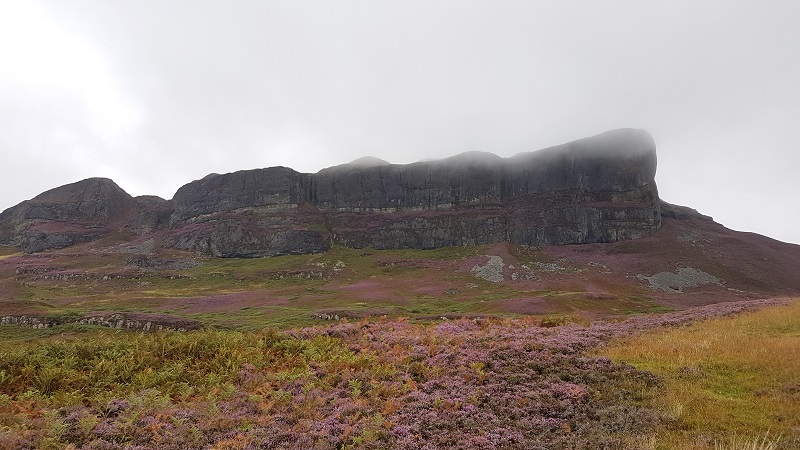
Straight, easy, well-founded with centuries of stone and tamped by more recent ATVs seeking sheep, the track passes the remains of a fort on the left; hut circles lurk in the grass and bracken between track and cliff edge – we know they’re there but cannot discern them. To our right looms the monstrous tower of An Sgurr, the dramatic reminder of an outpouring of volcanic pitchstone that dominates the Island of Eigg.
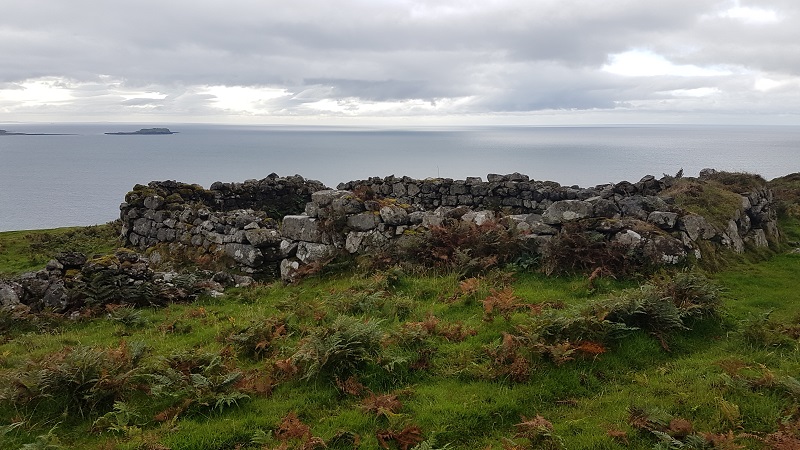
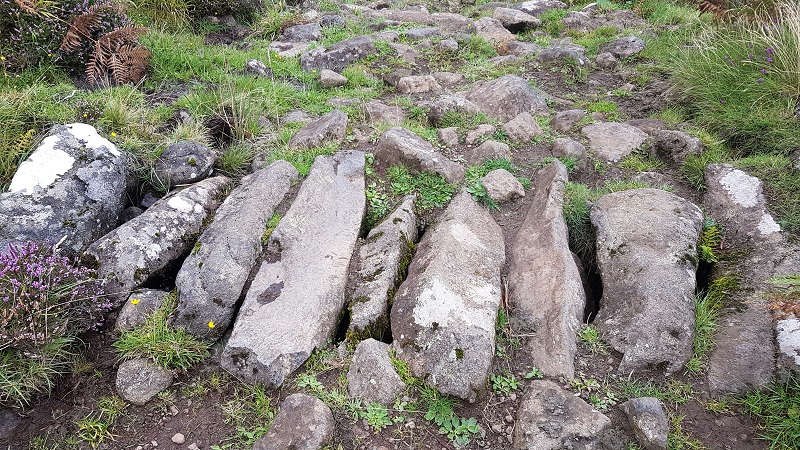
The track becomes a path; there are a few boggy bits, and lots of ups and downs, but it is still clear, still purposeful. So many feet have imbued it with purpose. The first thing we notice that hints we are approaching Grulin Uachdrach or Upper Grulin are some angled, straight lines of raised turf. They are buried dry stone walls, created long ago from the stony, rubble-laden landscape we traverse. They mark irregular fields and enclosures that would outlie and tangle with the settlement itself. Bracken and heather, with snatches of rush and bog cotton form the matrix of vegetation, but suddenly I am arrested by an open, grassy mound to my right.
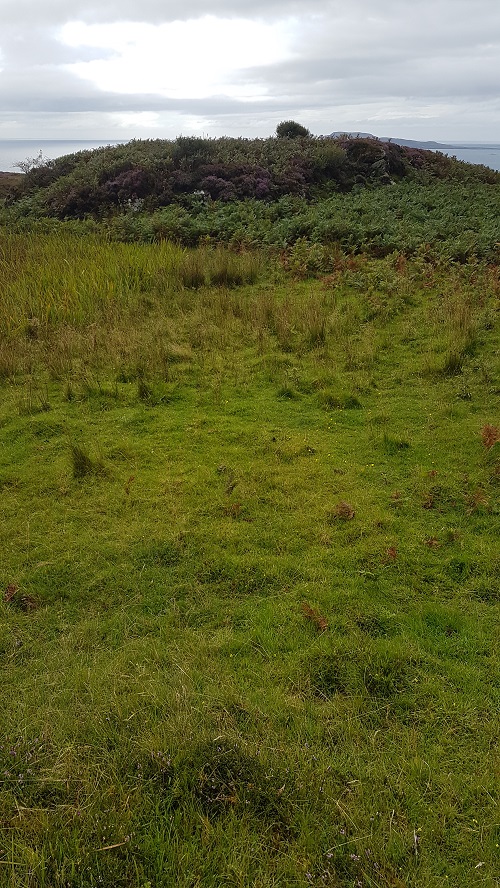
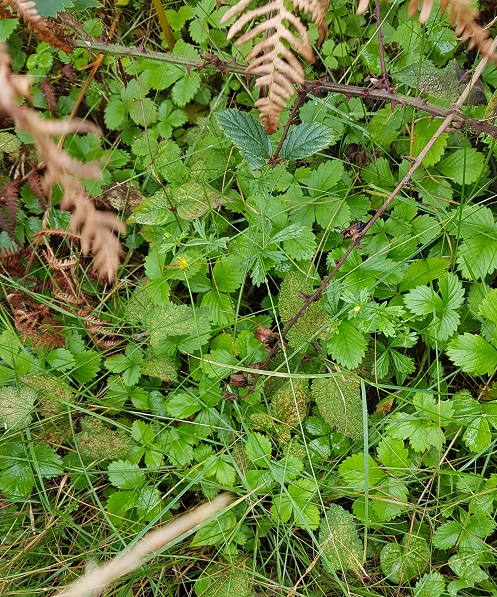
I know from the map we are not quite at Upper Grulin. But I head off for that mound, and feel a prickle in my spine, a sudden silence in my head. On the edge of that sunny clearing, I stop. The wind is stilled. Are there walls beneath me or not? I walk through – or is it over? – the softly waving pale green grass, and step – is it outside? – into the tufts of fern and heath. I think, am I walking someone else’s path, or one created by my imagination? And then there it is – a small patch of stinging nettle, the signature of the midden. Someone lived here once. So I follow their path, and it leads around the cnoc to a south-facing rocky bank covered in wild strawberries. I get it. I, too, would have passed the midden to get fruit for my porridge every summer morning.
Most of the ruins are more visible, and soon they come into view. Indeed, the first is roofed and is in good repair, with new windows and fresh white paint. It was the one house left for the shepherd when the whole village (which had held 103 people) was forced to leave – “cleared” is the unsavoury term they used for it – by the landowner in 1853 to make way for Cheviot sheep to graze the rich pastures.
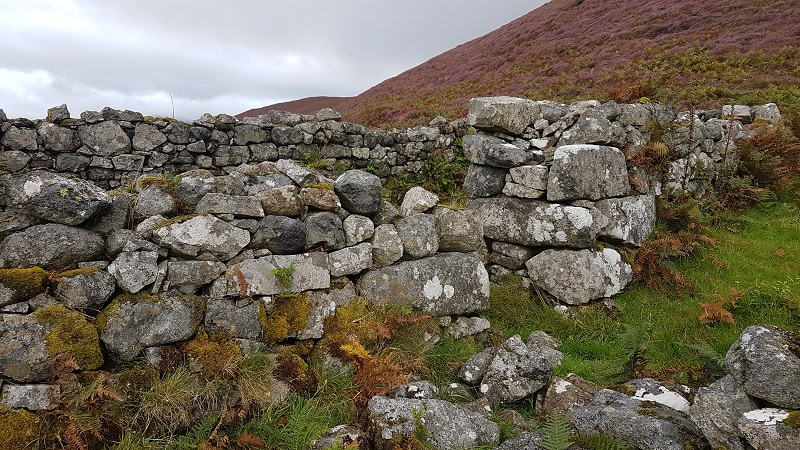
The rest of the buildings are dunts in the bracken, crumbling walls, the hint of a doorway, nothing above lintel height. We continue on the track, now more rocky and difficult, to Grulin Iachdrach (Lower Grulin). Springs gush from the rocks near the path; we cross one by a rough bridge of massive unhewn rocks lain long ago. Later, we founder in a bog – the sort you hop quickly without stopping and your fingers crossed. A kestrel hovers above the ruins, claiming it as territory. Some houses of Lower Grulin are easy to access. All retain their tell-tale nettle patch after 160 years. I stop at a doorway and wonder, can I enter? Eventually I quietly ask permission, and apologise, and go through. Again, the silence, within and without. The questions, the unknown answers; long sea journeys to Nova Scotia; what is left? What is lost? What remains?
The “18 unroofed buildings, 6 enclosures and a field system” drily described in the notes on the 1880 Ordnance Survey map of Eigg to sum up Grulin are not all that’s there. A fort, probably Iron Age, sits perched on a rocky outcrop. Shielings, shelters, kilns and other buildings have been identified. And what remains is that silence – a telling scream of silence. Whatever the end story for the 14 families who were given no choice, that screaming stillness can almost be tasted, bitter and lingering.
But, on this island which has taken control of its fate, this crime can never be committed again.
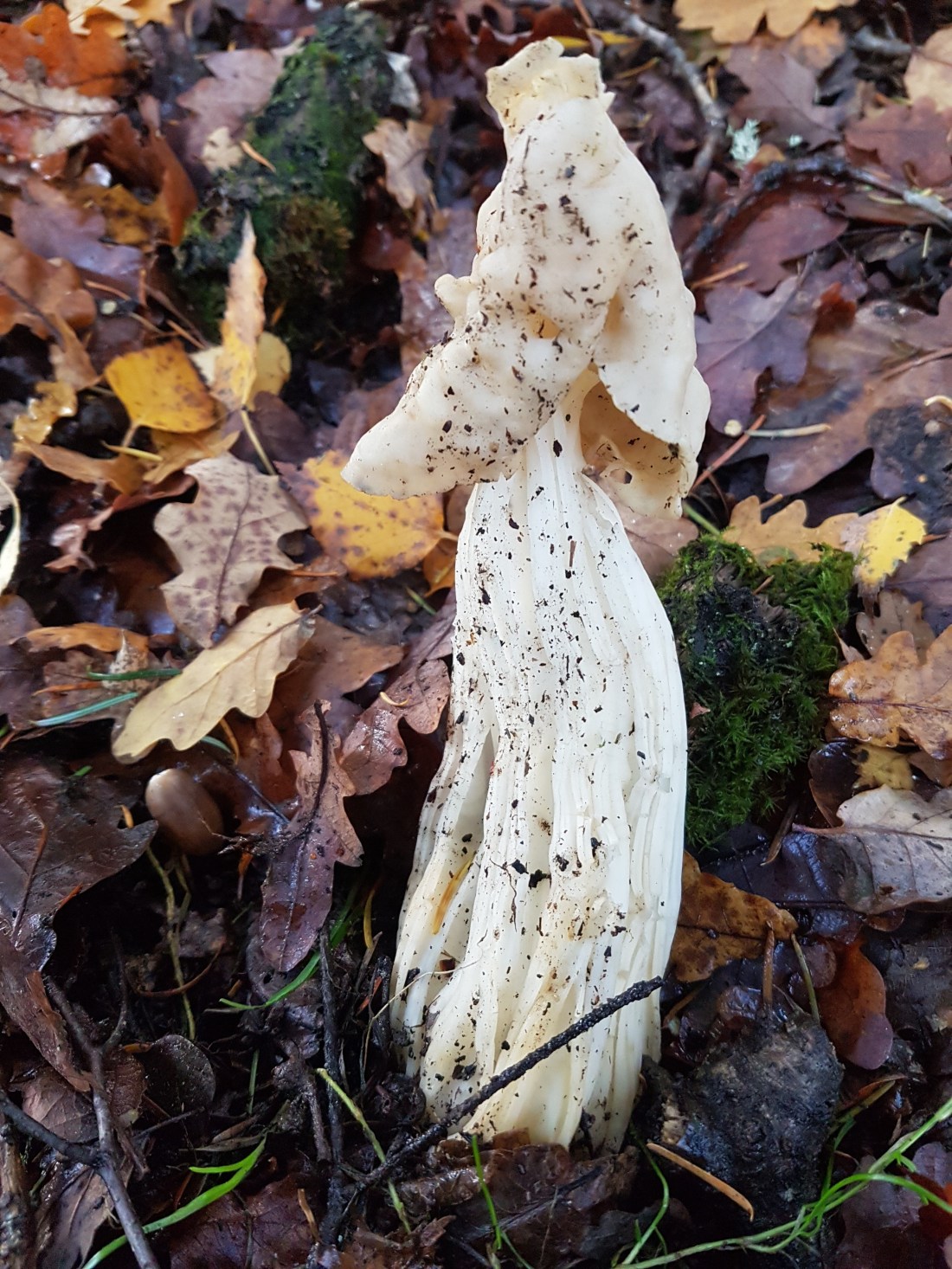
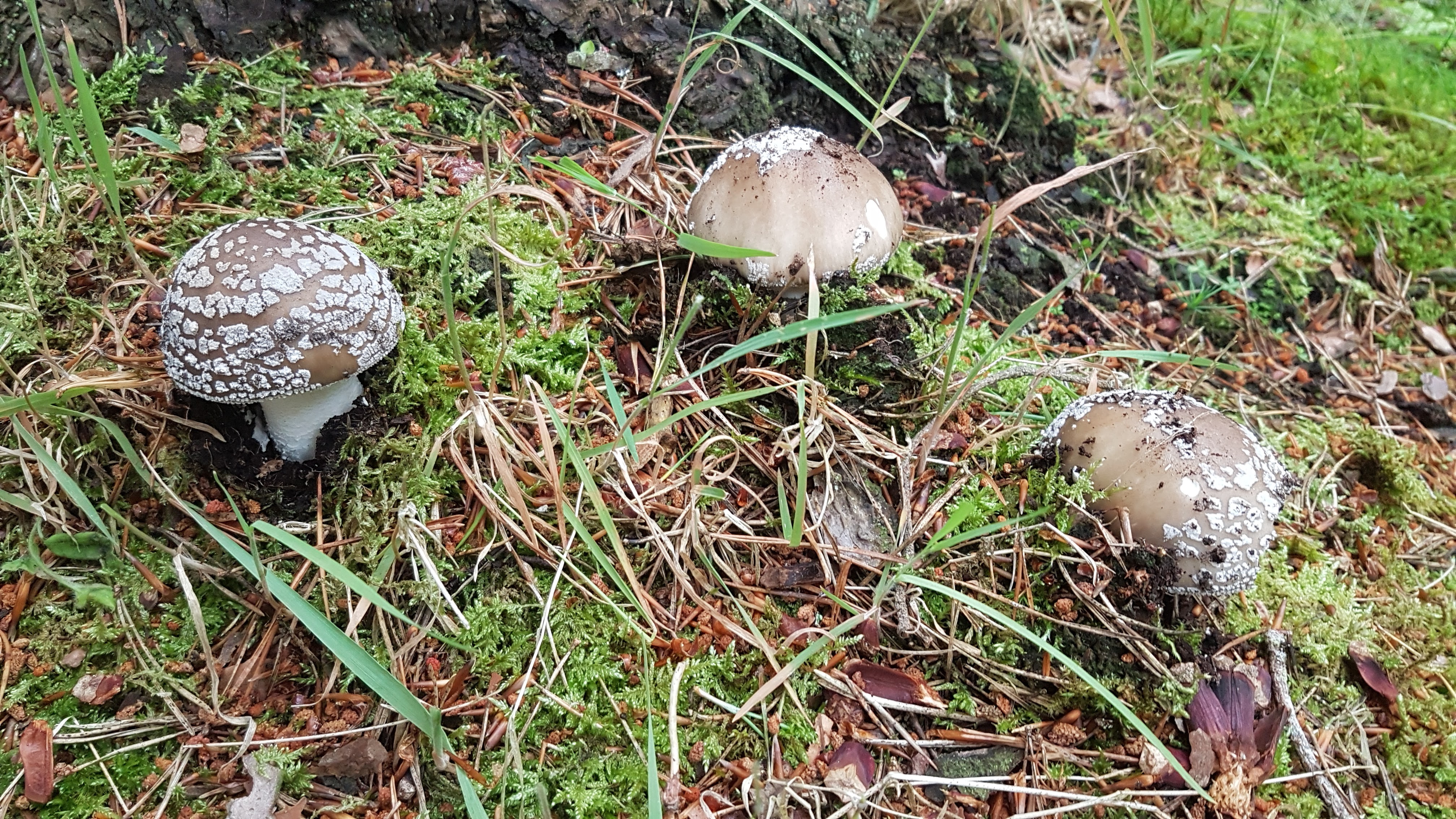
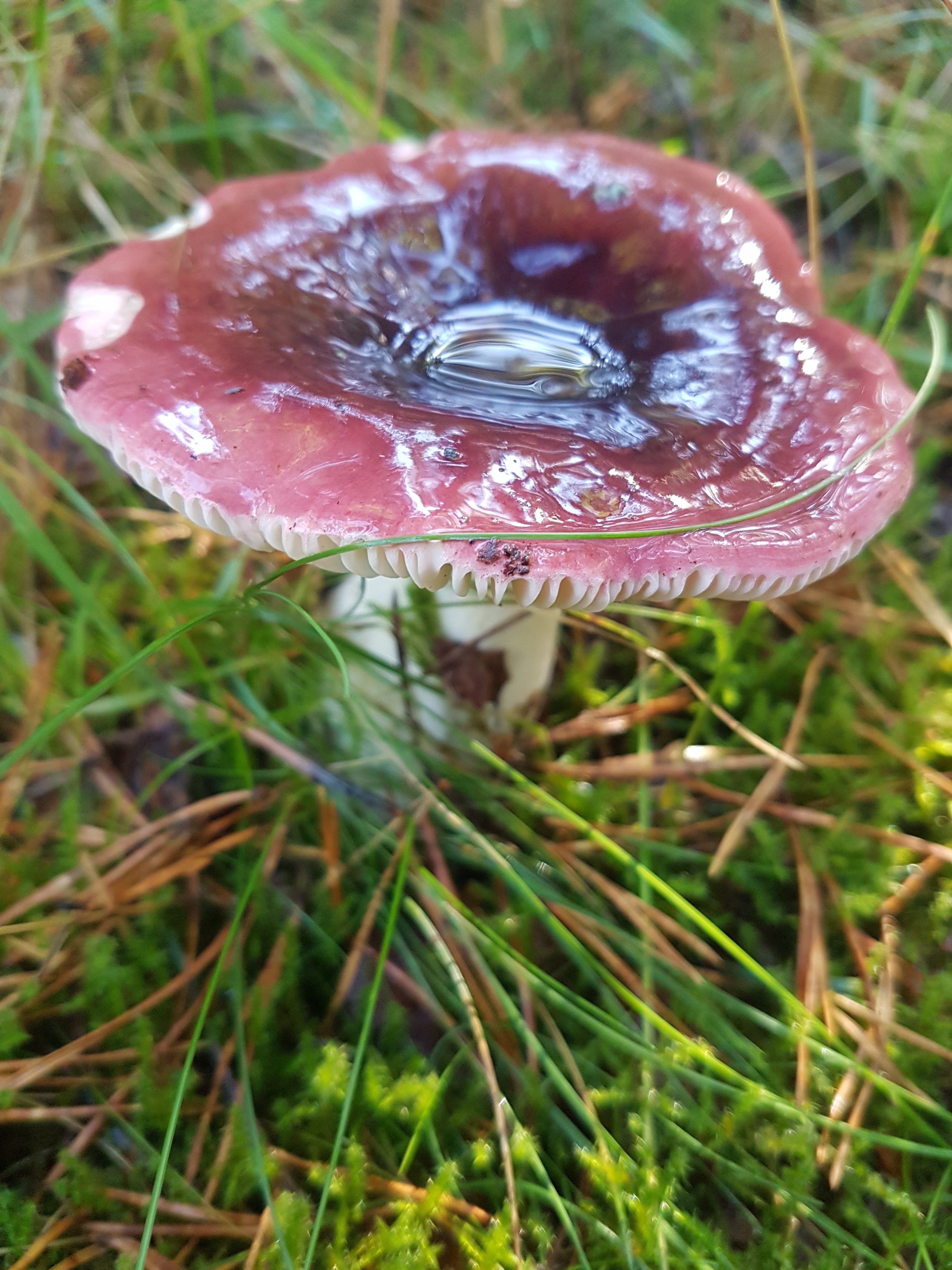
If you are out in the countryside and find a mushroom you think is poisonous, do not panic and trample or kick it to ****. It cannot kill you unless you eat it. It doesn’t even want to kill you and it cannot chase after you either. It is a beautiful organism trying to reproduce itself. Leave it alone. (Oh – and do not eat it) (Photo above is an example – isn’t it lovely!)
If you find a mushroom and you don’t know what it is or if you can eat it or not, see 1. The same applies. If you want to identify it, take a photo and maybe one specimen.
If you find a mushroom, that you 100% know you can eat and you want to, pick – but adhere to these sub-directives: * Don’t pick the whole blooming lot – never more than your personal needs That includes large mushrooms like Chicken of the Woods growing on trees – never take it all * Always leave plenty of young and old (reproducing) specimens behind * If there’s only one or very few, leave them for others to enjoy, including other fungus-eating species such as deer * Keep your big feet from trampling the site and all the ecosystem it holds to bits. Tread lightly and avoid damaging vegetation * If you carry an open-weave basket, your dinner will arrive home in better shape and may even shed some spores along the way
With particular reference to Giant Puffballs: these are not footballs – they are not spherical. Nor are they rugby balls, golf balls, cricket balls or any other species of ball. Therefore, do not treat them as one. If you would like to eat one, pick it carefully, take it home, and share it with like-minded friends before cooking it. This is because if you try to eat a full-sized Giant Puffball on your own, you will be feeling nauseous by day three. They are way too big for one forager.
If you have children, take them foraging and teach them why fungi are so important to life on earth. Let them learn what’s safe to pick and what to leave alone as you do. Introduce them to this appendix to the Countryside Code.
(If you don’t know yet why fungi are so important, Entangled Life by Merlyn Sheldrake is a good read.)
Once again, Jeoffry the ginger cat was determined to help walk Jed the old collie. He has thought for a while that this is his job, and that Jed needs a one year old cat to make sure he is okay. When Jed dawdles and sniffs too much, Jeoffry stops and waits, runs to him to coax more speed, and won’t return home without his dog. Coming out of the little wood on Friday evening as it was getting dark, we met Sam, our neighbour’s bouncy, lolloping pointer, filled with enthusiasm for a snowy evening sledging expedition and wearing a flashing green collar.
Maybe it was the flashing lights that spooked Jeoffry. He leapt back off the track into the little wood – followed by Sammy, who proved he could move with astonishing speed. Sam is trained strictly to point at wild birds and not chase things – his master is a wildlife ecologist and that’s Sam’s job. Quite soon, Sam lolloped back out and continued his evening. Jeoffry didn’t emerge, but he was close to home, with multiple route home options, in familiar territory.
When he didn’t appear for his tea by 9pm, Jed and I went back to the wood with a torch. No sight, no sound, no cat in this wood, I thought. Next morning he still wasn’t home. I should say at this point that Jeoffry is a silly little cat, prone to adventures and worrying people. His twin brother, Lucretius, is a measured stoic, with a kitten face but a wise head, who is more inclined to stay close to home. Nevertheless, I had a strong feeling Jeoffry was in trouble. So Andrew and I spent all morning searching. We both independently searched the little wood again, calling, looking up into the trees the kittens loved to climb and romp in. Then, all the adjacent and nearby fields and the other woods. It was slightly milder than the previous week, but still bitter; all the tracks were frozen solid and stumbling through the snow-buried ruts of old potato fields wasn’t pleasant. When it became clear that old Jed had had enough, and we’d raked the verges of the fast and furious A9 from the bridge through binoculars, I turned to take the dog home. I bumped into Simon and Sarah, friends from the village, who were full of sympathy, having lost two beloved pets this year, and said they’d look out for Jeoffry. Andrew went on to the tangled wood over the dual carriageway.
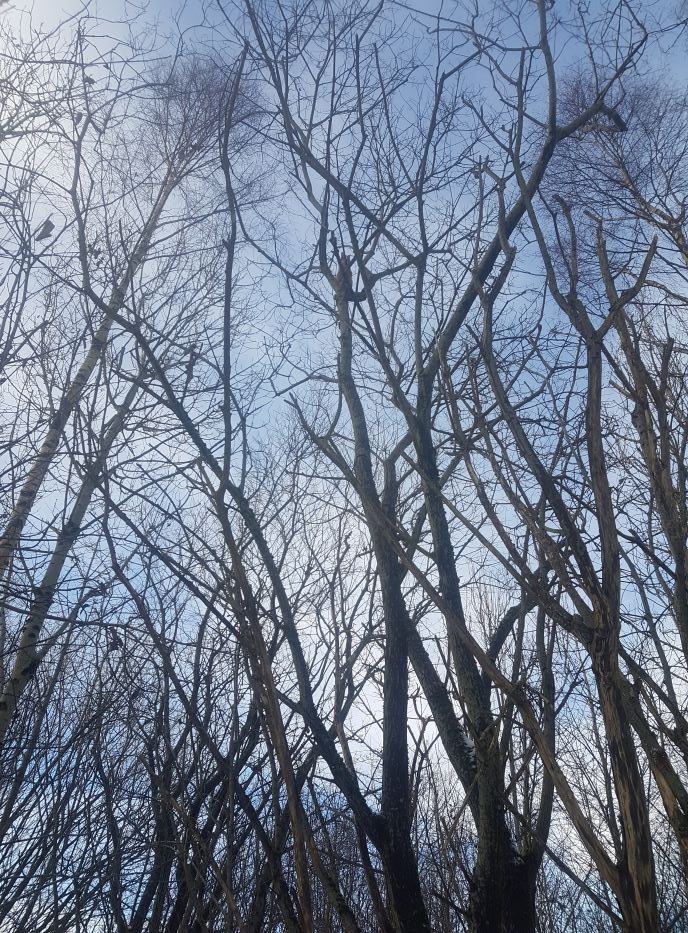
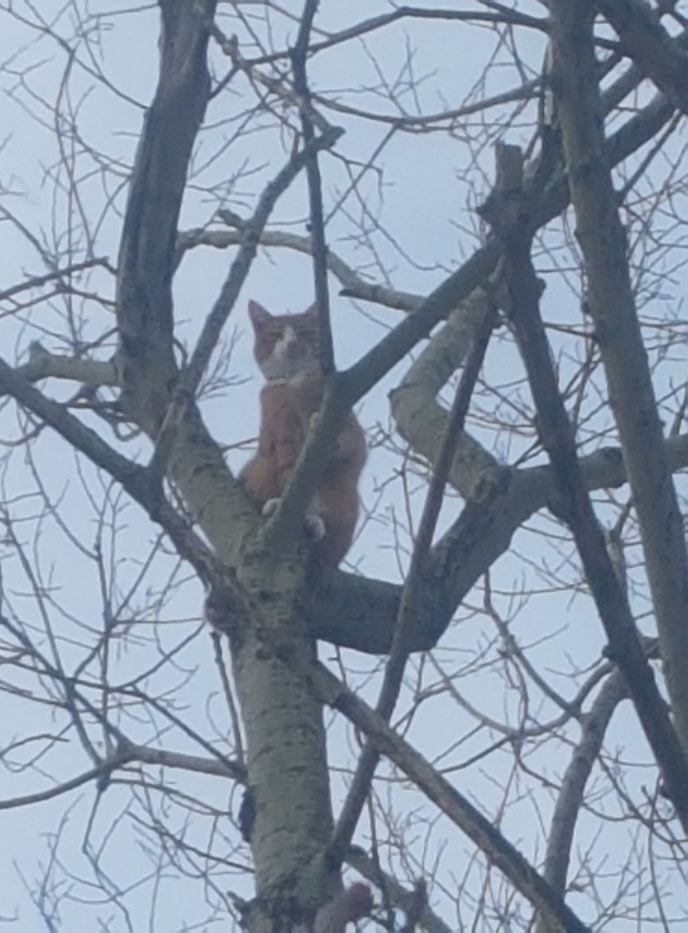
Passing the little wood, I scanned the trees from the track – for the fourth time. And high up – 15 metres up – a spindly tree not far from where he was last seen, was something ginger.
He was watching me, making silent (thus useless) miaows, lifting one paw at a time to relieve the cold. He had been there all night, and was not able or confident enough to find his way down. I called, he looked at me, didn’t move. What to do? The fire brigade tore through my head…. but not only was I uncertain they would respond anyway, the road and weather conditions were bad, and drivers on the A9 can be even sillier than ginger cats. How could I risk diverting the fire service from potential life-endangering incidents? I phoned Andrew. I phoned the vets, who said try the fire brigade. I googled, not an action that often ends in reassurance. I learned that, contrary to widely-held beliefs, cats cannot come down vertically from great heights. Their claws are designed only to take them up. Which Jeoffry’s had so spectacularly done. They can sometimes survive a fall, but cannot remain up a tree indefinitely without food, water or warmth. They grow weak and fall badly, and don’t survive.
That is why you don’t see cat skeletons in trees. They are on the ground.
Andrew returned. Although an ex-tree surgeon, he suffers mild vertigo and doesn’t climb these days. I googled tree surgeons. None of them were local, nor did they offer cat rescues as a sideline. I raked my brains. All I could think of was a long ladder. Our next door neighbours live in a tall, Victorian villa, and have a long extending ladder for maintenance. I trotted home to see if they were in, and if we could borrow it.
John – who I later recalled is very allergic to cats – immediately said, “Oh right, where is he? Give me a moment, I’ll get the ladder and be up there.” There was no hesitation, no question. Help was needed, it would be given. Soon, both John and Catriona joined us gazing up a tree and calling a distressed but immobile cat. John had brought 2 sections of the ladder, but had to go back for the third. The tree had several narrow trunks, some dead branches, and was slippery. Even with the third section, Jeoffry was out of reach, and (being a silly little cat), did not have much of an opinion of jumping down onto the top rung and using the ladder as a human might. “Who knows a tree surgeon?” I asked the air. “Mmm, Simon might know someone,” mumbled John.
I phoned Simon, still out walking, and asked him. Again, there wasn’t a second’s hesitation when I explained the situation. “We’ll just swing by that way, and see what we can do. No, not a problem, be there in a bit.” And in due course, we became six humans and a cat, for Sarah came as well. But in my fixation that we needed a tree climber I had forgotten something. Catriona, John, Simon and Sarah are expert rock climbers (Simon is particularly accustomed to mind-rottingly scary frozen Himalayan precipices. I’ve been to one of his talks and was scared to open my eyes to look at the pictures). Simon and Sarah came with all their lightweight climbing gear, and John went back to the house for his. Politely, all four rejected Andrew’s ancient and long disused heavy tree climbing rope that he’d fetched in case it was useful!
After much testing of surfaces, discussion and planning, a plan was laid. Andrew cut away some dead wood and branches which were in the way, providing the now fully extended ladder with a more secure base. Simon went up and tied-in the ladder itself so that it could not slip away from the tree. Then he went up again, with John on the ground with the rope, and secured himself to the least spindly junctions of the tree. From the very top of the ladder, he could just reach Jeoffry and talk softly to him. Jeoffry began to purr encouragingly. My sole usefulness was to provide a large IKEA type bag with a soft light blanket in, together with a sprinkling of Jeoffry’s favourite cat treats, and to hold Andrew’s tarpaulin with Catriona to catch him if – when – the cat fell. The bag was carabiner-ed to Simon’s belt.
By now, the light was already fading and Jeoffry had been up the tree for nearly 22 hours. I was disturbed by the thought that this operation was putting Simon at risk, and the longer it went on, the greater the risk would be. If this didn’t work, I couldn’t let this go on. In my mind, I formed the final plan – for Andrew to go for the chainsaw and part-saw through the trunk. hoping it would come down slowly enough for the cat to jump clear. There was a strong risk to Jeoffry, but not to my friends – and I was pretty sure from my googling that with temperatures set to go well below freezing again, the cat would not survive a second night anyway.
However, Simon relishes a challenge, and wasn’t to be beaten, even when his first attempt to persuade Jeoffry (normally the most placid and gentle of cats) into the bag was rewarded by a nasty scratch on the cheek. I was horrified by the blood dripping on the snow, but Simon shrugged it off. “I always bleed a lot!” More coaxing, more careful reaching and nudging. Then:
“The cat is in the bag!”
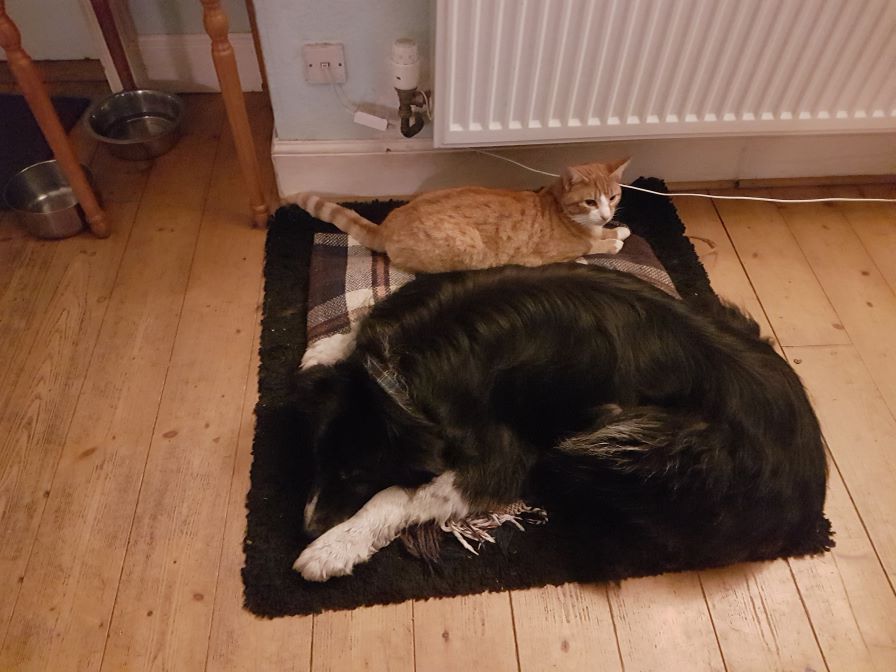
What came next was a careful descent, me hustling a bag of still, silent cat along the frozen track, trying not to slip at this late stage, offering thanks I scarcely knew how to articulate (though bottles of single malt whisky hopefully helped), and the fall off in adrenalin that preceded a long sleep – for Jeoffry and for me. No damage to him – and his big brother Luca soon took charge of sorting the wee ginger so and so out! Jed may or may not have been pleased to have his kitten back – but is very tolerant…..
For me, I am humbled, and set to wondering. It is the season of goodwill, but that doesn’t account for that fantastic, immediate, humane response, unasked for but so, so appreciated, from my neighbours and friends. It made me think that, actually, humans can be pretty wonderful animals themselves sometimes. That there is great goodness to be found, that gratitude is a feeling we should acknowledge and that love should be the tune that plays throughout our days, not just at Christmas.
May all beings – including humans – be well and filled with loving-kindness this festive season.
So today is Samhain. A Celtic festival to mark the end of summer, and the important transition between two parts of nature’s cycle. Because it is a cycle, it’s hard to know if its an ending or a beginning, both, or neither. But it’s a turning. mentally and physically, seen in the falling leaves and the settling of seed, heard in the song of the robin and the wild geese, smelt in the richness of fungal mould and felt in the night chilling of the air. We move with the season, from one place to another.
It’s also called Hallowe’en, or All Hallows Eve, and marks another transition, between the world of matter and the world of spirit. Some corners of the Earth are known as “thin” places. Some of the Hebridean islands are very thin. You go there, and time slows, the present meets past and future, you see things you’d never notice usually. You react in a different way. Hard to describe, but it’s like another world is almost tangible, separated from this by a filmy veil. Go there. You’ll get it. Well, at Samhain, that veil allegedly gets thinner everywhere, and people see things they didn’t know were there.
I’m not talking about plastic skeletons and vampire costumes and all that crap. The only vampires at Hallowe’en are the retail gluttons out to make a killing out of gullible, competitive parents intimidated by their offspring. Neither am I talking either about the demonisation and demeaning of innocent wise people (women mostly) into caricatures to hang in your window. Jamie Sixt of Scotland (James I of England) has a lot to answer for. And I’m certainly not interested in who has the biggest pumpkin! But yes, I am up for a good ghost story…..
Not, thanks very much, those overblown, ludicrous, gory “horror” stories that just make me laugh or go back to a good book. I like the kind which are incomplete, lack a dénouement, are based on real experience, and for which it’s perfectly possible to find a rational explanation…. And yet…. There was the “haunted house” in Cornwall my family rented when I was 4 years old. All I truly remember was being terrified by strange noises coming from behind the wall, and not being able to sleep. A damp, underheated holiday home is highly likely to house rats, bats or other beasties in its cavities, who moved about at night. The tapping on the bedroom window my sister heard could be explained by an overactive teenaged imagination. The footsteps approaching the back door when no-one was there may have had something to do with my mother’s penchant for telling a good story. And we’ll never know now if, that morning when we came downstairs to find all the furniture moved about, my father had been up in the night playing a never-admitted scary joke on us. And yet….
And there’s our “ghost” here at the cottage we’ve lived in for over 22 years. I used to see it a lot, but it’s been quiet the last couple of years. Avoiding Covid, no doubt. Just a figure, quickly scuttling along past the kitchen window, glimpsed out of the corner of your eye. Never does anything else, never knocks or makes any sound and never inside the house. It isn’t remotely scary. I never mentioned it to anyone for years, and then one day I started as usual as it went by and Andrew, sat in the kitchen with me, said, “Oh, was that her again?” Andrew is the most resistant and sceptical person I know who scoffs at anything remotely “supernatural” (while being secretly scared!), but he “sees” the figure as distinctly female, head covered in a shawl. “Like the Scottish Widows advert”, he says.
Easily explained! any one of a number of “tricks of the light”. I tried to pin it to our reflection in the glass when the kitchen light is on, and yet it appears in broad daylight when there’s no reflection as well. Anyway, we have missed it/her in this period of absence, though we both saw her one afternoon last week. Maybe tonight, when the veil thins, and the world turns……?

 Comments on The Nature of the Universe