Here be Dragons

If you take the road from Perth to Dundee, you skirt the edges of an explosion of geological delight known as Kinnoull Hill. Sheer cliffs soar up from sea level on your left. In autumn they are swaddled in the glorious golds and browns of beech woodland at the base; in spring and summer studded with the gold of gorse and broom. Dilapidated towers seem to teeter on the edge of the cliffs looking like something Germanic from a Grimm fairy tale (they were put there fore that very purpose).

These dramatic cliffs are the result of volcanic activity some 400 million years ago when a monstrous intrusion of magma elbowed its way through the older rocks in an enormous seam and solidified. Much later, the Kinnoull Hill geological intrusion was part of other monster-scale earth movements – the folding which left us with the Sidlaws on the north side of the Tay and the Ochil hills on the other (it’s called an anticline; think of a rainbow….). Subsequent faultlines and erosion removed the top of a rainbow and created the deep valley through which the Tay now marches triumphantly to the sea.

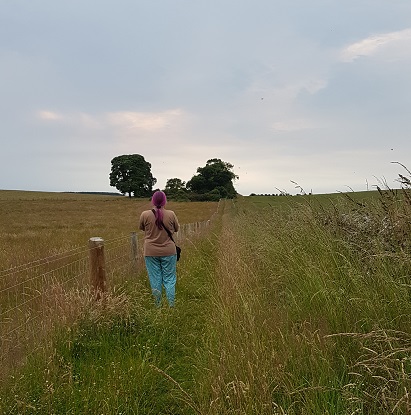
If, however, you approach these cliffs from the other side, the ascent is appreciable, but mild and steady, the slow, back-door rise of the escarpment. I went that way in April, and parked in the Corsie quarry, where volcanic dolerite and basalt is exposed, and from which it was taken for building for centuries. Up a steep bank, and a variety of paths are on offer, taking me first to the trig. point on Corsie Hill and fine views north over the small city of Perth and the vast breadbasket of Strathmore, to the mountains of the Angus glens to the east and the Obneys, marker-hills of the Highland Boundary Fault, slightly west. Up through roads and sheltered by woodland I went on winding tracks. Oak and birch dominate in places, in others, beech and non-native conifers stake a much-contested claim. Areas of heath and rough grassland house woodland sculpture in this popular spot.

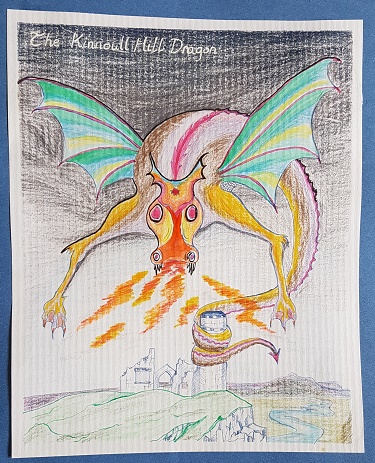
Sometime between all that geology and now, we are told, a dragon arrived on Kinnoull Hill. It glided along the unassailable cliff edges until it found a crevice, leading into a large enough cave for a small dragon to set up shop. This cave, called the Dragon Hole, is high on the cliff and allegedly could hold a dozen adult persons, so it wasn’t luxury accommodation for a dragon. What the dragon got up to, to upset the people of St. Johnstoun (as Perth was then known), I have no idea, but as is the way with relationships between human animals and animals either good to eat or a tad scary, someone was said to have “slain” it. It could have been St. Serf (what IS it with saints and dragons??), commemorated as a dragon slayer in the old church at nearby Dunning.

But my bet is Serf made it up, and the dragon’s still about, somewhere. There is a record that in the late 13th century (first) wars of independence, none other than William Wallace “pressed by the foe, occasionally betook himself to the retreat of the Dragon’s Hole.” In the 16th century, it was the local custom for a procession of youngsters from the town to clamber up to the Dragon Hole on May 1st (the pagan feast-day of Beltane), with garlands of flowers, musical instruments, and what may have been a Green Man. Or was it a dragon, representing the sun god, Bel? Whichever, it certainly cheesed off the local minister. In 1580, the congregation of the Kirk were forbidden to “resort or repair” to the Dragon Hole, on pain of a £20 fine (quite a fortune in those days) and repentance in the presence of the people.

You might think that was the end of it, and the Dragon Hole, together with its occupant, faded and disappeared from local knowledge. I used to teach about landscape character and interpretation, among other things, to Countryside Management students at the local college, and used Kinnoull Hill as a case study. One year, a couple of the lads got quite excited about dragons (can’t think where they got that from), and vowed to find the Dragon Hole. But here’s the thing: their colleague Arlene, a local girl, told us she used to go there as a child and had been let into the secret of its location by an older relative. She also had the good advice that they should not attempt to climb up to it, but abseil down. They went off in cahoots. Term ended before I ever heard if Ryan and Hamish were successful. Knowing them, I wouldn’t be surprised.
That’s Dundee in the distance…

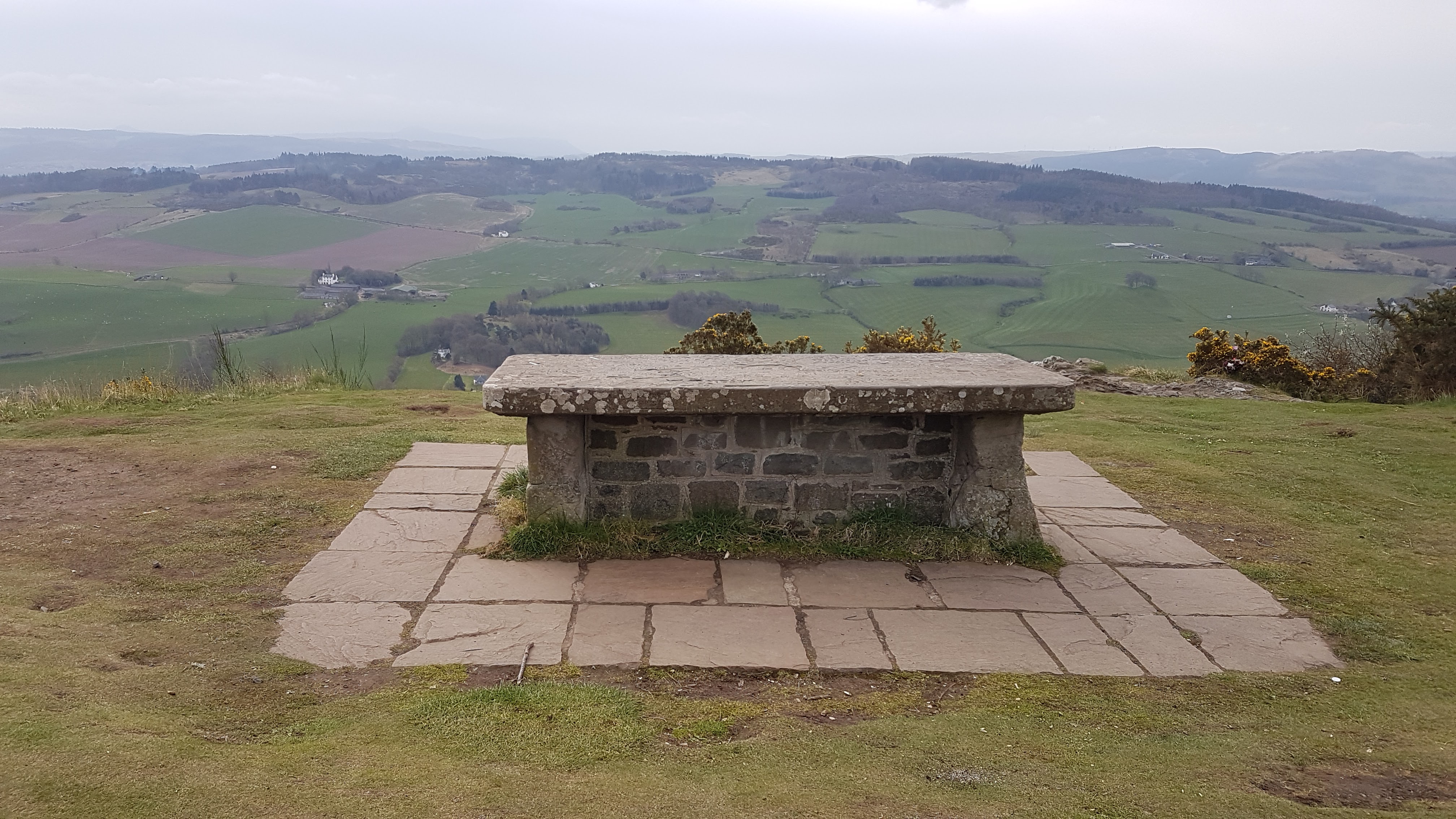
Back to my walk. I came out to the viewpoint on the edge of Kinnoull Hill cliffs, where the ground suddenly ends, and bunches of flowers tell sad stories and remind us of human misery. The views downriver, with Dundee sparkling in the distance, and across to the greens and golds of Fife, with it’s own matching quarries and volcanoes, were more than worth the uphill slog. Everything, especially life, seemed precious to me then. I remembered the tales of the dragon’s hoard of treasure, the enchanted “dragon-stone” which James Keddie found in the Dragon Hole in 1600, the “Kinnoull Diamonds” that are said to sparkle by night. And I came right back to geology. Around volcanic intrusions, mineral-rich deposits hold many semi-precious and maybe precious stones – on Kinnoull Hill, it’s garnets and agates that are best known.

Back down to Earth, in every sense!

Nursery Work

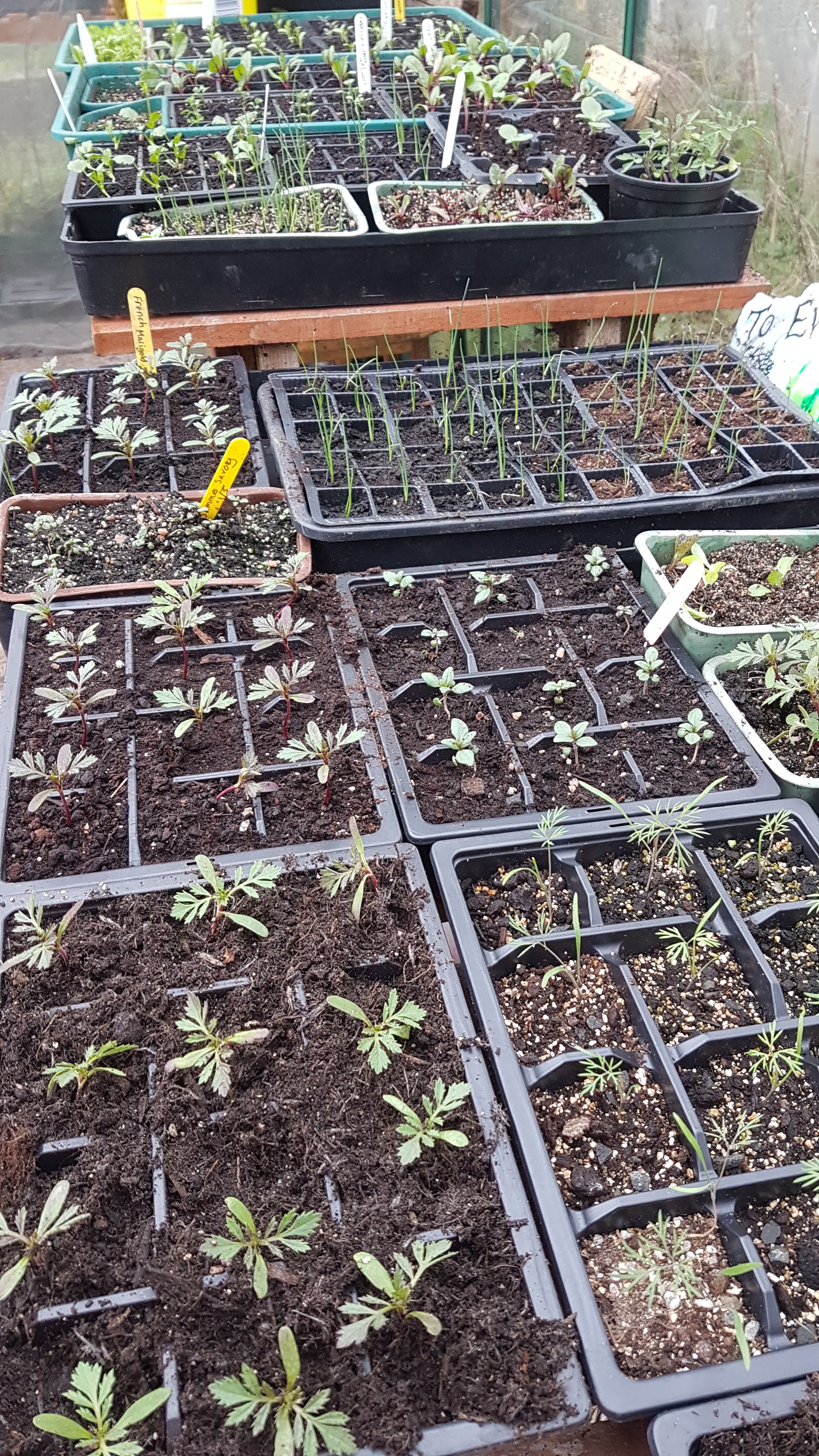
I’ve neglected my blog this past month. Not because I’ve missed out on inspiring walks, or failed to observe the nature of the universe, but because the weather’s been good, and garden or seed-sowing overtake me as soon as I get back from walking. “I’ll write it when it start’s raining…”, except it doesn’t, and I don’t. The walks will come, but in the meantime, all this seed-work did produce these (mainly) happy memories. I’ve changed the names of my colleagues in the unlikely event any may read this and feel affronted.

I never find myself fussing over seedlings in the green house without thinking of Roland, and his dad, Will, Nurserymen, of Woodham Ferrers. That’s where my horticultural career began, back in the weird 1980s, when men were men (or so they believed) and women had inexplicably curly hair.

I had decided to leave my comfortable, promising career in teaching to start again at the bottom, and become a horticulturist. I’d been accepted on a 3 year HND at Writtle College, but conditionally. Because I’d never worked in a land-based industry I had to find a job for a year to make sure I was up to it. The college had just rejected the first job I’d found (and which I was dearly looking forward to) because it wasn’t “proper” commercial horticulture. This job was working with Lawrence Hills at the Henry Doubleday Research Institute at Bocking – the organisation that came to front the whole UK organic growing movement as Garden Organic. But in the 1980s, as I said, men were men, and horticulture was about pesticides, power tools and paving slabs. Time was running short if I wanted to start my course in September 1984, so I walked into the nearest of a string of bedding and pot plant nurseries close to home, and proceeded to explain to Roland why he would like to take me on as a trainee for a year.

Roland heard me out, a twinkle in his eye and fingering his moustache to hide (I imagine) the urge to burst out laughing. “And why on earth,” he asked, “should I want to do that?”

So I explained. I was confident, I was clever, I nearly had an OU degree, I’d run a school garden and sure I knew lots and lots about gardening already? And I was enthusiastic. Little did I know that being clever and knowledgeable were useless skills in the job I was telling Roland he had available, and confidence and enthusiasm were about to take a beating! Yet Roland too had been sent to college by his dad back in the day, and maybe he was just feeling sympathetic. “Let me think,” he said, “but there’s no money in it. Nothing like you’ll be earning as a teacher.” Later that day he rang and offered me a job as nursery worker, and the wages were actually better than I expected, so I was thrilled to accept.

It was baptism by fire. First job, alone in a huge greenhouse cleaning mouldy leaves off a sea of potted cyclamen. I thought it might take me all year. There was the clocking on and off – a factory action which underlined the fact that I was no longer someone with authority, responsibility or respect, but just the lowest of the workers. Bells rang to signal the beginning and end of short tea breaks. The day started at 8am sharp. The work was physical, sometimes very repetitive, frequently boring and there was a workplace ethic that derided anyone sitting down even for a second. I was then married to a white-collar office worker who couldn’t understand why I was prepared to give up a well-paid job with prospects and considerable autonomy (this was teaching as it was 40 odd years ago, remember) to arrive home daily “tired out and covered in mud”. But if this was what it took…. I gritted my teeth through a winter of miserable work in freezing cold polytunnels, trying to learn something of plants, but learning more of chilblains.

My colleagues were not sympathetic towards me, at least, not to begin with. There were three other female full-time workers, and all were looked down on by the men, who mostly had large egos which stated that they ruled the roost. A couple of the guys were possibly not the sharpest knives in the drawer, and were also looked down on by the alpha males (the ones who drove the lorries of course). Poor, tormented Jim and Mikey were at least considerate and polite to the women. Then there was Billy, with his Boy George haircut and that camp air that made him the butt of every insult and brutal homophobic joke. I had never encountered homophobia before and couldn’t understand how Billy bore it. But he was made of stern stuff, didn’t waste his time talking to the rest or fighting back, and just got on with his job. In the end, they let him do so without too much baiting. I was the new target of course, because of my lack of experience in physical work, because I had a posher accent than the rest, and mostly because I was clever – but not in ways that mattered.

In late winter, a small army of women appeared. The big shed was set up with office chairs and high- level desks or tables, a radio, and heaters. The women brought cushions, snacks, hot drinks and sat comfy on their thrones, demanding that poor Jim supply them with endless pallets of compost-filled bedding plant modules, and trays of seedlings. Then they cussed and muttered about poor Mikey, who wasn’t shifting the finished work away quick enough. These women’s sole job was to prick out the seedlings into the modules, and they were on piece rates. The more modules they turned out, the more they got paid. We permanents knew for a fact that some of the women weren’t too worried about whether a seedling had roots, because we would have to go and fill the gaps a week or so later – rarely, unfortunately, on comfy seats. Oh no, we had to stand or crouch! When the bedding production season was at its height, we occasionally got pricking off to do as well, which was considered a cushy job by the men and indeed, it did beat hours at the potting machine or dragging laden trolleys up and down the nursery by hand to lay out filled pots on the floor of the polytunnel. But we didn’t get the bonus. I never learned to sow seed – a job reserved for only the most senior alpha male.

Gradually, I got used to the sheer physical effort, and became good friends with Ruth, with whom I was often partnered for work. She taught me a lot and we had huge fun. I think it was Ruth’s acceptance of me that changed everyone’s attitude in the end. Then Kate, one of the other women, left, leaving Colin, the most arrogant and bullying of the lorry drivers, without a mate to load his lorry. He wasn’t at all keen to have me thrust on him, because Colin HAD to be the first loaded every day and beat his chest about it, and he refused to believe I was up to the task. Loading up involved not just physical lifting and moving, but selecting out the best plant material for the customer, and racing to and fro to hand them up to the driver, who stood on the back of the lorry bellowing out instructions. Loading Colin was a personal challenge for me…. and he lost. Because lo, I COULD run up and down quickly, I DID remember exactly where every variety was to be found, I was shit-hot on getting the quality right and, best of all, with only a little practice I could handle 5 bedding trays at once without dropping any of them. Somehow, the bedding season became an exhausting but hilarious laugh, as Colin and I teamed up to get finished before Len and Ruth.

So, by the end of my year, I was indeed fitter, stronger, impervious to monotony, cold-hardy, heat-resistant – and far more tolerant of my fellow woman. Or even man. As proof, I opted during college holidays to go back to Roland’s to earn some money – and was always warmly welcomed. I’ve had my career in horticulture now, and part of it involved me in much pricking out of seedlings for my own small nursery. I brought to it the skills learned that year, and it’s always brought to me the image of Roland’s twinkling eyes as he made up his mind to take a gamble on the idealistic and misinformed schoolteacher and gave me that first chance.

Thanks Roland!

Small (scale) is Beautiful!

God’s Pockets!

So, the other day, I rounded up all the dirty washing to go in the machine with care and began the long walk to the kitchen, head full of a million jobs needing done and a million things I’d rather be doing. As I turned into the kitchen, a sock and a hankie fell to the floor. So what? Just that doing chores while encased in what I grumpily call leg-irons to heal a busted knee takes five times as long as it should, and any unsought-for bending and lifting caused by careless dropping of items is somewhat unwelcome.

“God’s…..” I began to bellow, but instead of one of my usual mildly blasphemous oaths such as Godstrewth! or God Almighty! or even Ye Gods it doth amaze me! – out of my mouth came the word ”pockets!”

Crisis over, washing in, I began to ponder where in heaven or earth “pockets” had come from. I wasn’t thinking about pockets. I’m not aware of any alliterative alternative which I might have been intending to cuss with. But, somehow, I liked the sound of God’s Pockets, and fancied that if there were such a thing, they would be something quite nice.

Several nicknames for places and things have their ownership attributed to God. God’s Acre, for the churchyard. God’s own County, for Yorkshire (in England) or Perthshire (in Scotland), much squabbled over. Rather more are named for the Devil. What could God’s Pockets be a nickname for? And then again, which god? I mithered on, through the morning chores.

Pockets, to begin with, contain things that are useful, important, or maybe precious. The word implies a fairly enclosed, secret place, so sometimes, but not necessarily, the pockets of a garment. A source of riches, perhaps? Gold?

 “What has it got in its pocketses?” asked Gollum of Bilbo Baggins. A cursed golden ring of power?

Human gods have been many, and varied, and presumably, their pockets would also have very varied things in them….. If it were the wandering Norse god Woden, the pockets might be literal, and contain a water bottle, a tinder box, spare pants… the things essential to survival as a tramp with an ashen staff.  If it were one of the deified Roman emperors, God’s pockets could contain anything from vials of poison (Nero) to a tablet of half inscribed meditations (Marcus Aurelius). If the god in question was non-human – the sun perhaps – God’s Pockets would surely be all the secret and calculated places where rays of sunlight lit up the secrets of the seasons. Maes Howe in Orkney would be the archetypal God’s Pocket to the human sun-worshipper.

But wasn’t this getting a bit too human-centric? What about the gods of other species? For my kittens, God’s Pockets would be those irresistible-to-cats snacks which hide intoxicating and addictive catnip inside a crunchy coat. The god in question would be me, dishing them out frugally.  For the goldfinches in my garden, they would be the outer casings of seed heads that had to be penetrated to find the golden seeds. The image of something golden and of great worth kept repeating in my head, and led me to honey, which led me to bees…..

And then I had it. What was precious to bees? What was usually (if not always) golden? Pollen, the baby bees’ protein source, found in flowers. What flowers are like pockets, golden themselves, and a radiant blessing from the god of the bees in January and February, when the queen bee starts to lay eggs, young larvae need to be fed, and sources of pollen are thin on the ground?

I wandered out into the garden. It was a mild day, and the sun was shining. The sun is the measure and compass of the life of a bee. It rules their time of waking, by caressing the hive entrance with light. It spurs them to life and flight, by warming their thoracic muscles. The sun guides them to sources of food. Bees communicate the distance and direction of a good pollen or nectar source to the rest of the colony by a dance which reveals an accurate angle from the sun along which to head when leaving the hive. All their foraging time they will be engaged with where the sun is. Fly this way, says the sun, for that many metres, and you will be rewarded with gold from my pockets!

On this day, some of the overwintered bees in my hive were flying, tentatively. And sure enough, I found Winter Aconites – Eranthus hyemalis – coming up above ground and uncurling their flower stalks, powered by and dependent on energy from that same sun. Bright golden balls of flowers, opening shyly to reveal the treasure inside – yellow pollen, a magnet for the early bees and their growing sisters, hungry in the comb and waiting for spring.

For surely, if I were a honeybee, the sun would be an omnipotent god, whose greatest gifts would be the nurturing flowers of late winter, and which I’d be pleased to call God’s Pockets.

Comfrey is Not Just for Compost

Photo: Kate Jewell / Comfrey (Symphytum officinale)

Comfrey is in the Borage family of plants. There are various species, strains, and cultivars, which all have similar properties. The one which spreads unrelentingly in my garden is the Tuberous Comfrey (Symphytum tuberosum), which is low growing, spreading (via its knobbly, tuberous roots), and has dingy off-white to cream flowers. I am in negotiations currently with Tuberous Comfrey to spread unrelentingly where it can out-compete the ground elder, rather than among the potatoes. This species, along with Common Comfrey (S. officinale) is a native of Britain. A number of imports and acquisitions by Henry Doubleday in the 1870s led to an important cross between Common Comfrey and a Russian species, S. asperum. The hybrid became known here as Russian Comfrey (S. x uplandicum).

Common Comfrey has other common names: Knitbone and Boneset. The generic name Symphytum means “to join together”. The specific name “officinale” indicates medicinal value. (Readers of my last post may see where I’m going here!). Comfrey roots and leaves have been used for many, many centuries in poultices (mainly) to treat sprains, bruises, inflammation, cuts and sores. Comfrey contains allantoin, a chemical which is crucial to cell regeneration and healing. In my garden, the unruly Tuberous Comfrey disappears during winter, but I also have two Russian Comfreys which don’t. One of them used to be variegated, but soon reverted to green and vigorous.

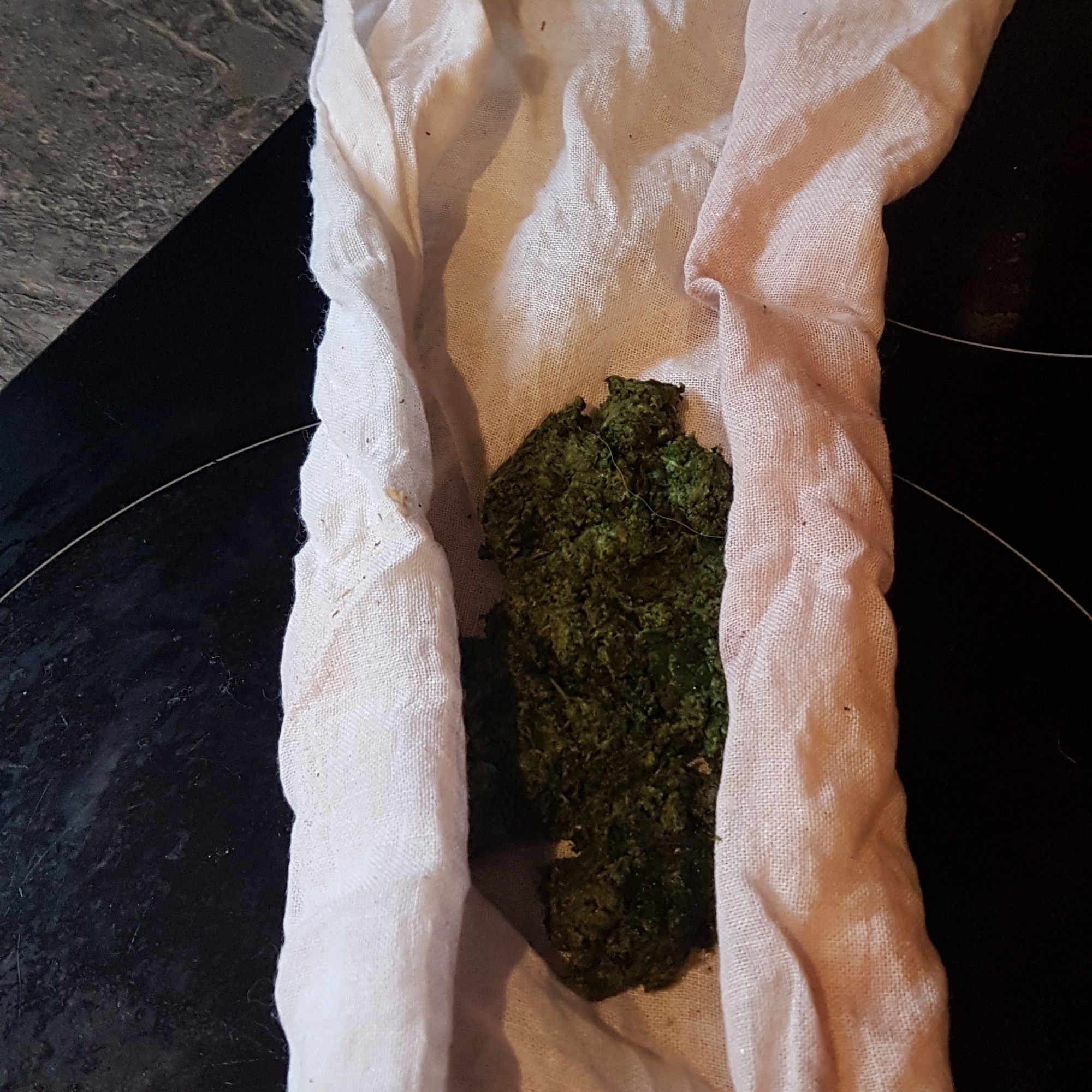
Therefore, in the mild weather between Hogmanay and the end of last week, I manoeuvred myself laboriously up the garden on my crutches, to pick the freshest leaves (yes, there were some!) from the plants. Roots may have been better, but digging isn’t in my current skill-set. A knee with anonymous sprains and tissue damage and a minor fracture of the tibia was going to get the comfrey treatment. I made the poultice very easily, by zapping the fresh leaves to a dark green liquid and mixing it with flour. A square of muslin, folded at the edges to stop the poultice oozing down to my ankles, held the comfrey against the affected bits of knee. An elastic tubular bandage kept it in place, over which went trousers and the leg brace. I did this for 4 days consecutively, but removed it from sight when I went for the fracture clinic appointment. (Self-treat? Who, me??)

On the X-rays, it was very hard to see where the fracture is now, but the doctor pronounced everything was well placed to heal completely, given time. Leg brace for at least another month! Then the weather turned snowy, followed by the customary January freeze, so the Comfrey pharmacy is temporarily closed. I’ll never know for sure how far it is contributing to healing, but that’s no problem, I am happy to be my own experiment in this.

Now to the other uses of Comfrey, including compost. The extravagant growth of the various comfreys which Henry Doubleday imported and which interbred led the organic movement pioneer Lawrence D. Hills to found a field station in Bocking, Essex, dedicated initially to research and breeding of comfrey strains for agricultural and horticultural use, named the Henry Doubleday Research Association. The best-known strain is probably “Bocking 14”. Later, HDRA became the influential Garden Organic charity, with thousands of members. I met Lawrence Hills a couple of times, when I switched from teaching to horticulture and was looking for a year’s work placement as prerequisite to starting a course at Writtle Agricultual College. He was so charming, so enthusiastic, so hard-working – and I was so looking forward to working and learning in an organic garden and taking part in field research. But organic was still considered the domain of hippies and weirdos as far as Writtle was concerned. I was told that HDRA was NOT ACCEPTABLE as a PROPER horticultural placement, and I ended up on a bedding plant nursery. Learned a lot, but you know how I just adore bedding schemes……!

A Much-thumbed Reference for Improper Horticulturists

But I grow Comfrey. I would never be without it in the garden. The lovely purple, red and white flowers attract every kind of bee in the district, it suppresses weeds, and is so vigorous I cut both the Russian and Tuberous back several times during the year. Most of the green material goes into the Comfrey bin (joined by excess nettle tops). The bin has a lid but no bottom, and it stands on a perforated metal square (actually a redundant queen excluder from beekeeping), which is balanced on an old washing-up bowl. Into the bowl collects a dark, viscous, evil-smelling liquid – Comfrey tea! NOT for drinking, but for use, diluted, as a liquid feed for tomatoes, vegetables and any plant looking under par, just as Lawrence Hills told me all those years ago. Many gardeners believe Comfrey tea confers disease resistance to plants as well as a nitrogen boost. I don’t add any water to the bin, and the dry material left goes onto the adjacent compost heap. Sometimes I add fresh Comfrey to the heap if it’s being a bit tardy in decomposing – it acts as an activator. Another great thing to do is liberally cover the ground between developing plants such as courgettes with fresh Comfrey leaves as a mulch. Not only will they decompose happily in situ and directly feed the plants, they help to warm the soil and stop weed seeds germinating.  (TIP: Don’t accidentally mulch with tubers still attached!)

Fresh Comfrey Boost for Peely-Wally Sweet Corn!

I also eat Comfrey leaves. Now, my herbalist friends will tut-tut, because Comfrey also contains alkaloids which can damage the liver, to a point where cancerous tumours may develop. I can understand reluctance to prescribe it for internal use. Most of the alkaloids accumulate in the roots and the older leaves, and laboratory trials on unfortunate rats indicate that you’d really need to eat or be injected with an impossible amount of Comfrey to have such a reaction. Nevertheless, I stick to young leaves, in moderation, as a delicious vegetable in combination with nettles and other spring greens. They fill the so-called hungry gap abundantly well, and are a tasty substitute in any recipe involving spinach. Covered in beer batter and deep fried, individual leaves are a really, really bad-for-you treat!

But whether you eat it or not, Comfrey is for life – in more ways than one.

Aliens invade Tayside?

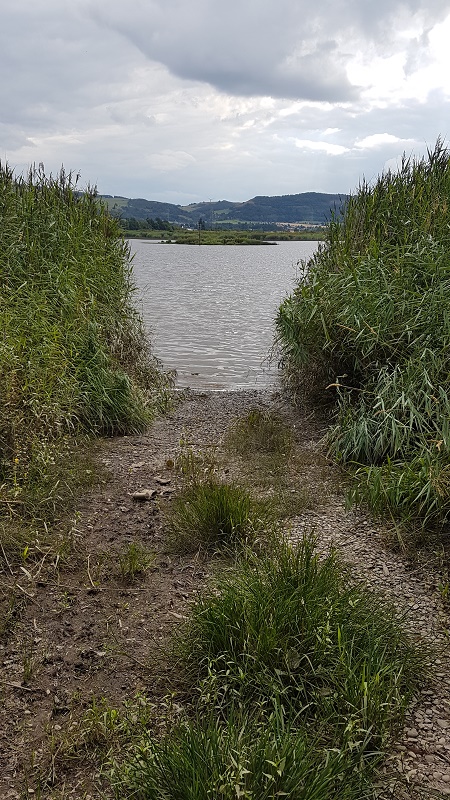
I wanted to walk from Cairnie Pier near St. Madoes west to Inchyra on the Tay estuary. My old map (old being the operative word) said there was a path, but it says that about a lot of stretches of the Tay along the Carse of Gowrie that it would be nice to walk, and it’s often mistaken. Google Maps hinted that if you got really, really close to the ground, there might even be two paths, but it wasn’t committing itself. At Cairnie, the existence of a small car park looked promising, and I found the great river hiding among its own reedbeds as usual, lapping quietly at a little inlet whose stones oozed mud. Fishermen’s paths trailed off in both directions.

Cairnie Pier

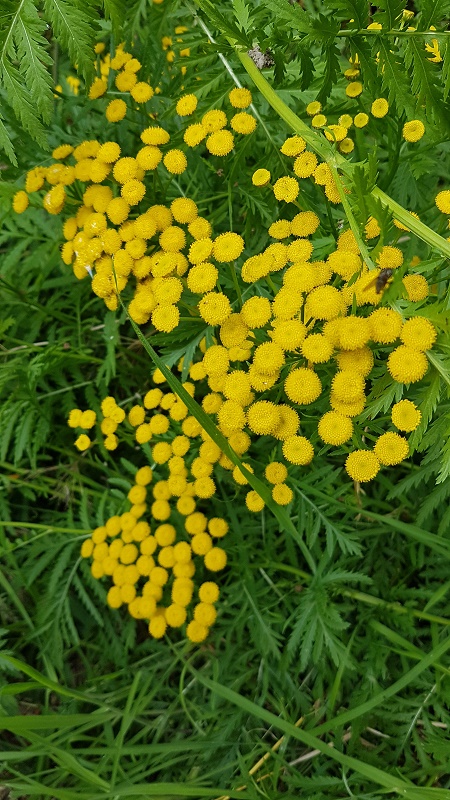
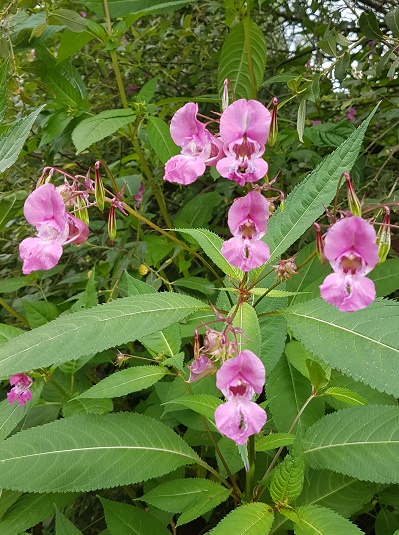
It was drowsy-hot, an afternoon of hoverflies and docile wasps, intent on the many flowers that lined the path. The river is a conduit for all kinds of unexpected vegetation, which thrive in the tidal mud and lovely untidy, unsanitised, hedgebanks and verges. The yellow buttons of Tansy pop up everywhere along the Tay, together with the silvery Mugwort, a long-ago Roman introduction, allegedly a cure for sore feet. Warm and spicy, the scent of Himalayan Balsam over-rode the scents of native flowers, and its spectacular flowers trumpeted a welcome to pollinating insects. This “alien invader” has been around a good while, anywhere near to water, and it’s a Marmite plant. Speak to any beekeeper and she will wax lyrical about the “ghost bees” who return somnolent and satisfied to the hive, covered in its dense white pollen. Speak to most mainstream ecologists and they will say it’s invasive, outcompetes “our” native flora and has no place in “our” countryside. I love its other name – Policemen’s Helmets – does anyone remember when policemen wore helmets? The top and bottom lips of the flower are encased in a helmet-like fusion of the other petals. I’ve happily pulled it out of ancient oak bluebell woodland, but I can’t say it bothers me too much today. I munch a couple of the peppery-pea tasting unripe seedheads, out of duty.

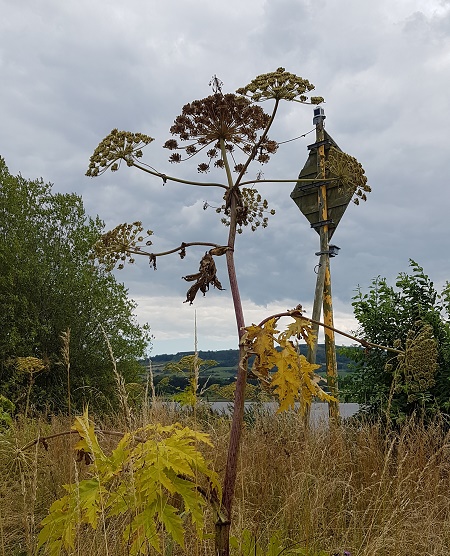
But then arise the forbidding, towering structures of a harder-to-love alien. Giant Hogweed, introduced by gullible and novelty-obsessed Victorians to adorn their fancy gardens. Apart from its spectacular, H.G. Wellsian-Martian structure (still being extolled by lecturers when I learned garden design), it is low on redeeming features. It is truly rampant, flowers and seeds everywhere and delivers serious burns to anyone brushing against it in sunny weather. It’s a property called phytotoxicity, and today the sun was shining and I passed gingerly.

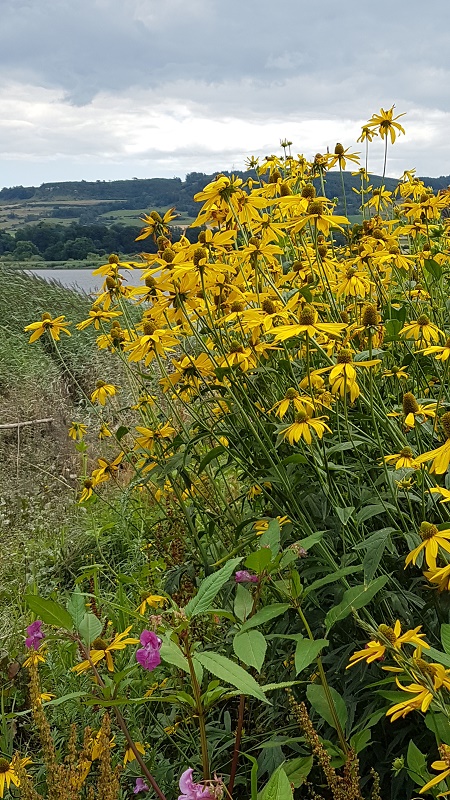
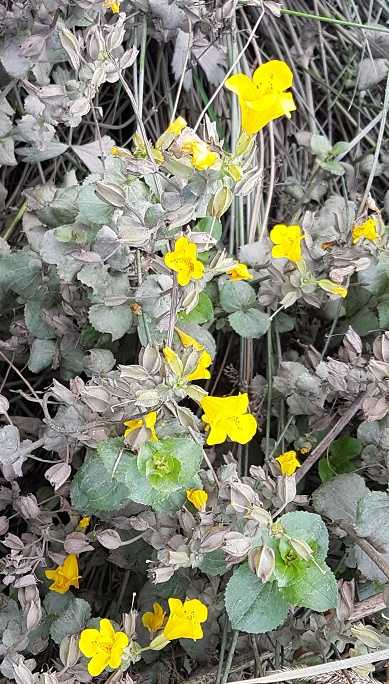
Far more attractive, and indeed glorious were the bright yellow, sunny Monkey Flowers, coated in tidal mud, and the clumps of tall Rudbeckia, both garden escapes, that sway gently in the breeze up the river. They are dotted all along this stretch of the Tay. I remembered another sunny day talking with David Clark of Seggieden – a great botanist and a man who so loved this river – about whether they “should” be there and what exactly was native anyway, since both of us could be labelled aliens ourselves. We agreed that neither of us were fanatical about racial purity in plants or anything else, but weren’t fond of Giant Hogweed, nor the next invasive alien to show its face on my walk, the Japanese Knotweed. This monster would out-compete the miles and miles of Norfolk Reeds themselves…..oh wait, did I say Norfolk Reed?

Yes that’s right, the incredible Tay Reedbeds, home to rare marshland bird species and a complex, life-affirming ecology, are the result themselves of the introduction of a “non-native”.

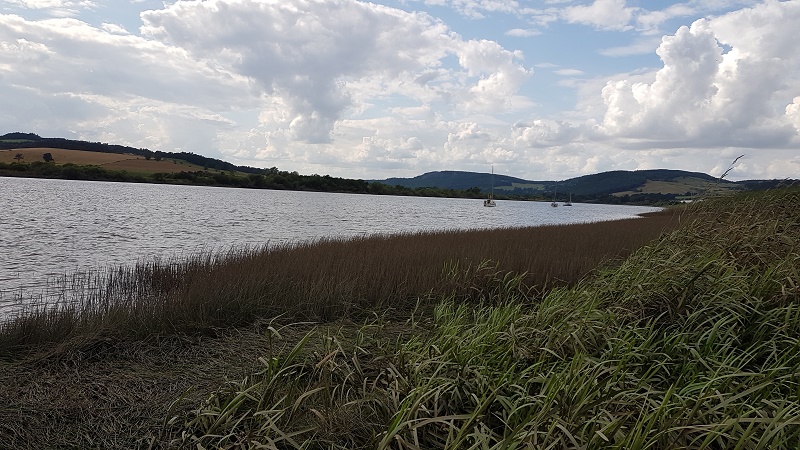
My fishermen’s path had petered out, and an attempt to reach Inchyra along the edge of a field also met with failure, so I drove back towards St. Madoes and took a side road left. Thus I reached Inchyra, a beautiful little village of low houses, pretty gardens and derelict farm buildings looking, as they always do, as if a quick afternoon’s work would put them back into service. From this hamlet, crouching among tidal lands as if in terror of sea-level rise, I found a wild garden overlooking the estuary and across to Rhynd, and small moored sailing boats bobbing in the rising tide.

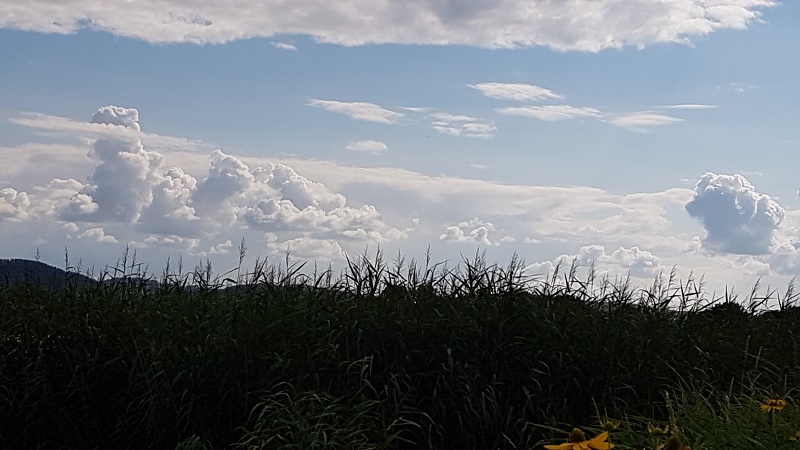
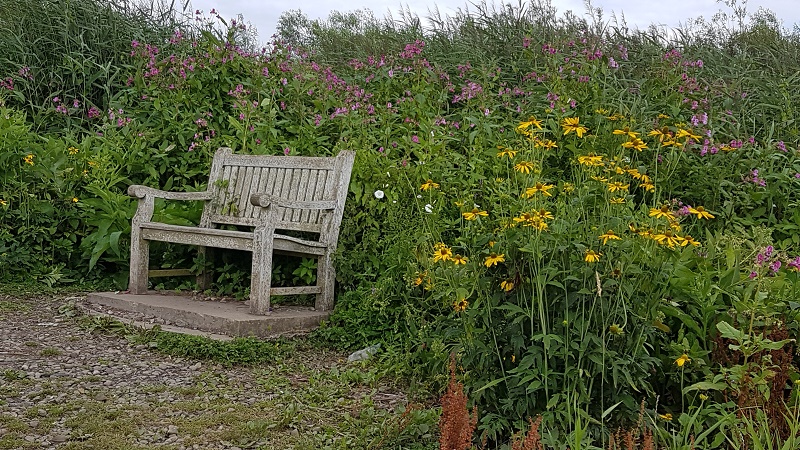
Here was a seat, to the memory of a daughter of a local family, and I sat in complete peace among the reeds, with flowers – native, non-native and all the gradations in between – blessing the air with scent and colour. Even the busy tractor across the water hummed to itself. Rain was forecast; I watched silver-lined thunderclouds pile up on themselves, shift and mutate, and then dissolve again into the blue sky. It was so good to be here.

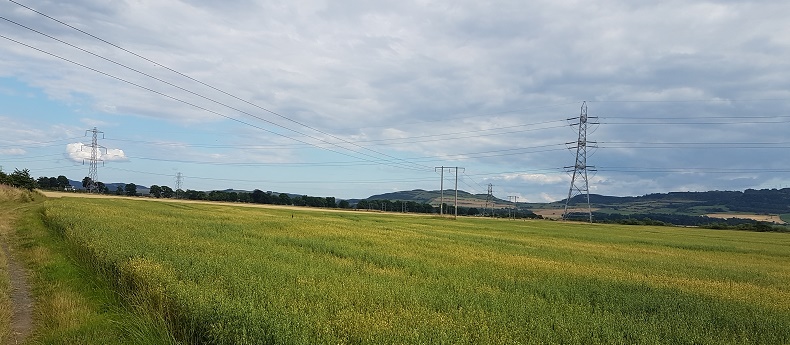
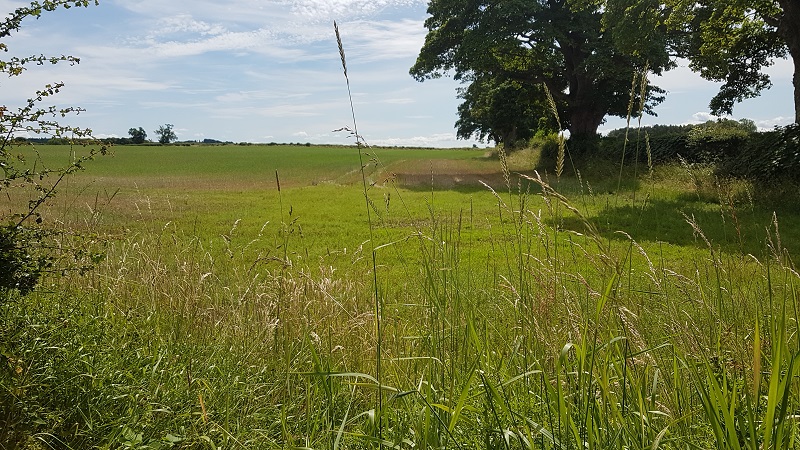
When it seemed the clouds were getting serious, I found a path that ran beside Cairnie Pow, giving me a good circular walk back to the village. The pow is a local name for a drainage channel, often of ancient origin, that was created to free the fertile soils of the Carse of Gowrie from being marshland. They litter the Carse, and give a sense of being neither quite on dry land nor in water. This one tracked parallel to the path I didn’t find earlier from Cairnie Pier, and then swung left at the point I’d almost got to, where a host of overhead power lines had got together for a gathering. They sky darkened, and the air, hot and still full of the damp scents of flowers, smothered the senses. Young trees, planted by the nearby farm, gave welcome shade. A big, old house rose out of the marsh with no obvious gateway or entrance. It looked dark, empty, full of tales and secrets. I wondered, made up stories in my head, began hearing things and holding imaginary conversations with people who did not exist. Perhaps it was as well that heavy, ponderous raindrops deterred me from more exploration that day.

Then ‘Twas the Roman….

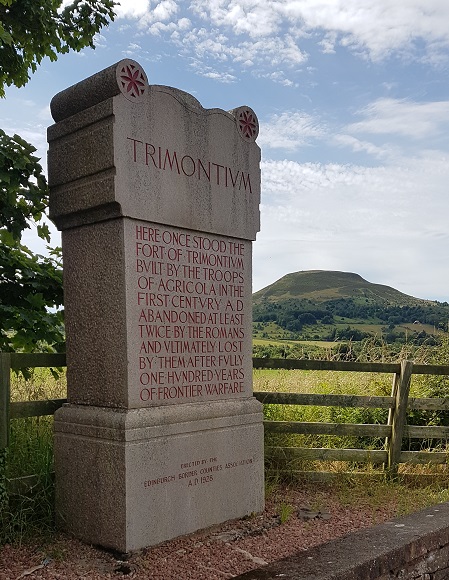
Trimontium – the Three Hills

I will pursue enthusiastically all traces of the Roman and her/his associated allies, foot soldiers and settlers across a British landscape, quite regardless of whether there is actually anything to see when I get there. It used to annoy my partner, trudging miles up hills and across dubious bogs and anonymous fields, only to have me announce, triumphantly “It was here!”, gesturing at a field of wheat. He is more intrigued these days, and even suggests Roman tracking expeditions of his own volition.

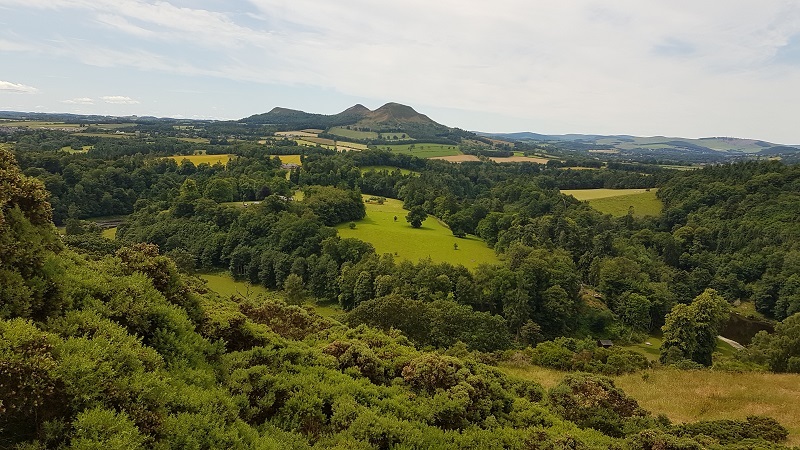
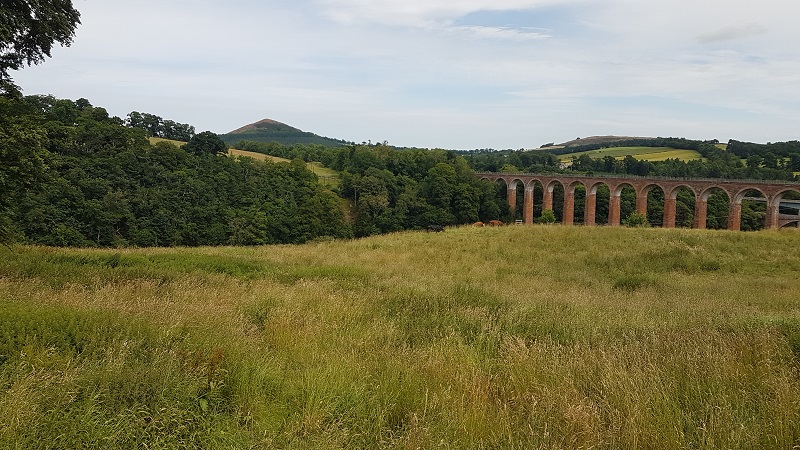
So it was that, once again, we wound up at Trimontium (known more generally as the district around Melrose). The three hills of the name are the Eildons; the Romans didn’t put forts on the tops – someone had already done that – but in this low rolling landscape, the hills must have shouted “home!” to returning soldiers at first sight, and assisted in sighting the meticulous straightness of their military roads. No, the Romans built their camps nearby in the valley of the Tweed, settled, traded, and called it Trimontium.

We cycled the length of the old road that cuts through the fringes of the camps, admired the crops in the fields where they allegedly lie buried, passed the site of a Roman circus where nothing could be seen, read the interpretative signs, and felt the whispering ghosts of legions march by. When we reached the site of the Roman bridge over the Tweed, we crossed on the newer one and cycled on to Dryburgh.

A Roman camp (site of!)
A Roman Circus was Here (Honest!)

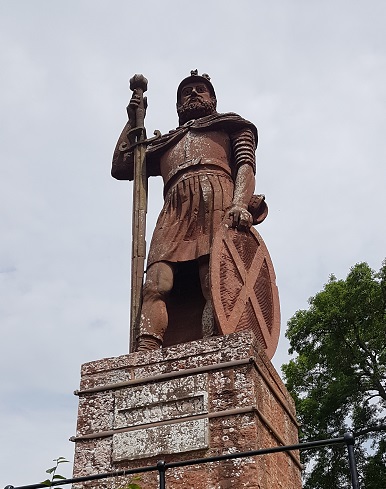
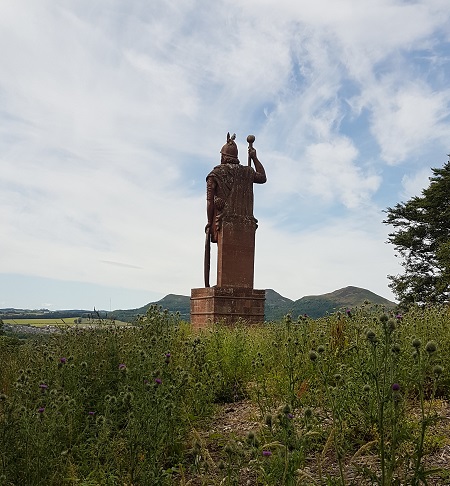
On the way we detoured to see the magnificent statue of William Wallace, a later and better known hero than Gnaeus Julius Agricola. He looks at home, gazing out forever across the valley to Trimontium, the three hills of Roman Scotland, every inch the warrior, rising from a sea of thistles. You could imagine perturbed, defiant, indomitable Caledonian thoughts – the thoughts that once challenged Agricola, and still challenge today. Or don’t imagine; you could think them yourself.

“There, like the wind through woods in riot,
Through him the gale of life blew high;
The tree of man was never quiet:
Then ’twas the Roman, now ’tis I” *

We went on to search for what remained of Dere Street, the road the Romans made from York to end at Trimontium, but which kept on growing to the Antonine Wall in Scotland’s central belt. Tell-tale straight lines jump out of maps; footpaths and tracks link bits of road seperated by farmland or forest. Here and there, we drove along it; the A68 out of St. Boswells was built on top of it. Near Jedburgh, we found a road that crossed it; a long straight footpath bore its way north-west; littered by large stones and rocks – way-markers? – and changes in level we dreamed into being the remains of the vallum, the rampart and ditch that lined important roads, as we marched up it into the dusk and crows took off from dark clumps of trees. In the foothills of the Cheviots, only a few kilometres from the border with England, Dere Street emerged once again, passing close by a set of Roman camps whose earthworks were, in places, still just visible.

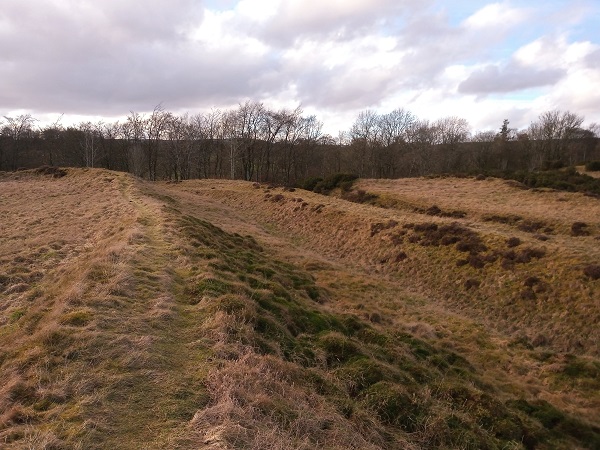
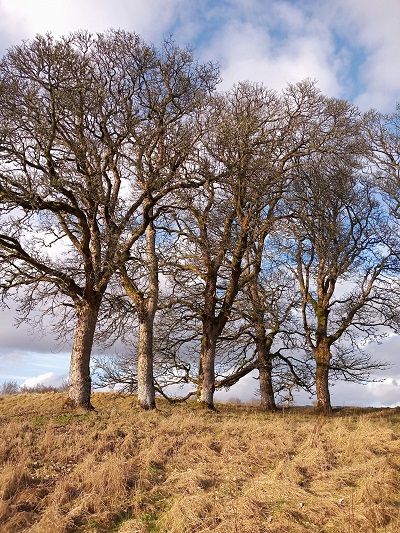
Back home, we reminisce over our last visit to Ardoch, the Roman fort near Braco, in spring, and compare how wonderfully well preserved it is, in comparison with Trimontium and these Border camps. Clear are its neat square corners, it’s easy to count and follow the ramparts and ditches, and you can walk into the fort by the original entrances. Luck or design have conspired for Ardoch not be put under the plough too much; no roads have been constructed over it. Trees have grown, that’s all, and even they seem to follow Roman straight lines and military discipline. They tower, wide-spaced, vigorous, energetic.

Then twas the Roman, now ’tis trees.

*from “A Shropshire Lad” by A.E. Housman

Not Ugly.

Midsummer, June, and roadside verges, hedgerows and path edges are brimming with life and good things to eat. Well, they should be, if you’re lucky, and some fusser hasn’t gone forth with strimmer or spray gun to transform the riot of green and gold, the effusion of flowers, seedheads and shoots to bare brown, sad-looking blankness or close-mown, stressed-out grass. I can never comprehend the small suburban minds of householders who would rather gaze out on monochrome than the living proof of life on earth. It’s one thing to keep your own verge tidy, and occasional cutting can increase the range of flowers, but it’s galling when people attack verges opposite or near their houses but which they don’t actually own. I confess, I get quite bitter about it.

During the 2020 lockdown, I embarrassed my family by taking to task a poor, misguided woman who was wielding herbicide along the route of a long-distance footpath. Granted, it was a stretch bordering her own property, and right enough, as she protested, she wasn’t killing everything…..

No, she was only killing what she called “the ugly, untidy species” that she had no use for. These were Dockens (have you ever looked at the intricacy of the flower structure in the Dock family?), and Hogweed. That’s where I really saw red.

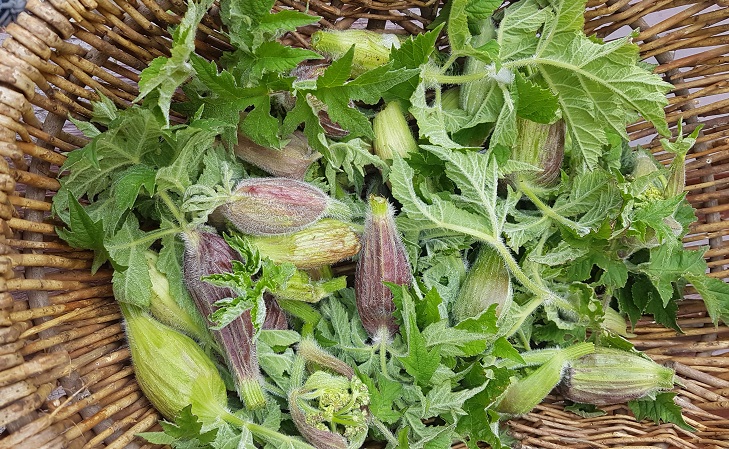
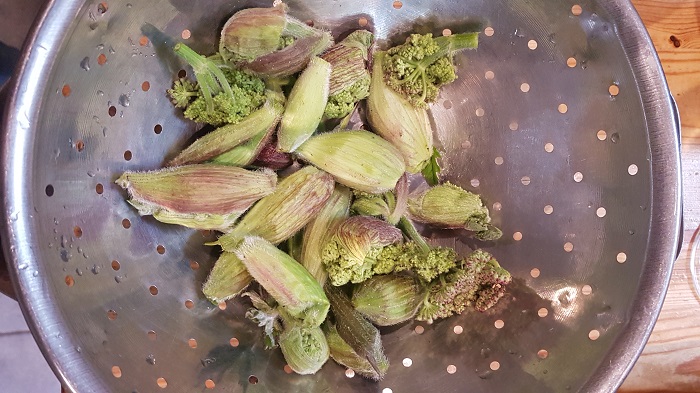
NO!!!! I don’t mean “Giant Hogweed” (Heracleum mantegazzianum), an invasive non-native plant known to cause serious skin burns and out-compete other plant species. Even I acknowledge that’s a nightmare, albeit a spectacular one. I mean Common Hogweed (Heracleum sphondylium ) a soft-leaved, far smaller native plant, with edible leafstalks and, at this time of year, the most delectable “broccoli” or unopened flower heads. Very few people have a skin reaction to this plant (far fewer than do to tomato plants for example), and I look forward to eating the broccoli every June.

“But it’s too tall, too big, too ugly and the bees and butterflies don’t visit it!” I was told. So then, we eradicate all the living things that we personally don’t like the look of, do we? What is ugly, anyway? Do we have to apply our personal prejudices to plants, other animals… humans? Sadly, many people do…..labelling leading to intolerance leading to hate crime leading to… genocide? And if a flower is constructed to be pollinated, not by the human species’ cosy favourites of bee and butterfly, but by beetles, flies or (perish the thought) wasps, does that make them useless, unworthy or ugly?

No, it darned well doesn’t. If Hogweed, Dockens or any other species becomes a weed in your carrots or undermines your potatoes, fair enough. It’s not because they’re ugly, they’re just doing what they are supposed to do. But leave them in the waysides that are their habitat. Before anyone gets horticulturally imperialistic ideas locally, I’m gathering hogweed broccoli. Just trim away the leafy shoots to prepare. Sauteed in butter with a little water and sprinkled with lemon juice and salt, they are a summer treat.

All prepared for braising or battering…..

Last night I made hogweed pakoras – coated in spicy chickpea flour batter and deep-fried – to go with the curry. I meant to take a photo for the blog, but suddenly, they were all gone. I need to get some more. Long live hedgerow delicacies!

Bankfoot Church is Falling Down

In February 2004, workmen were burning rubbish on a demolition site. It was a day of gusty winds, when safety procedures should have never allowed a bonfire to be considered. At some point, sparks whirled viciously into a neighbouring building, caught hold, and within minutes a blaze ensued that could not be extinguished before the building was lost.

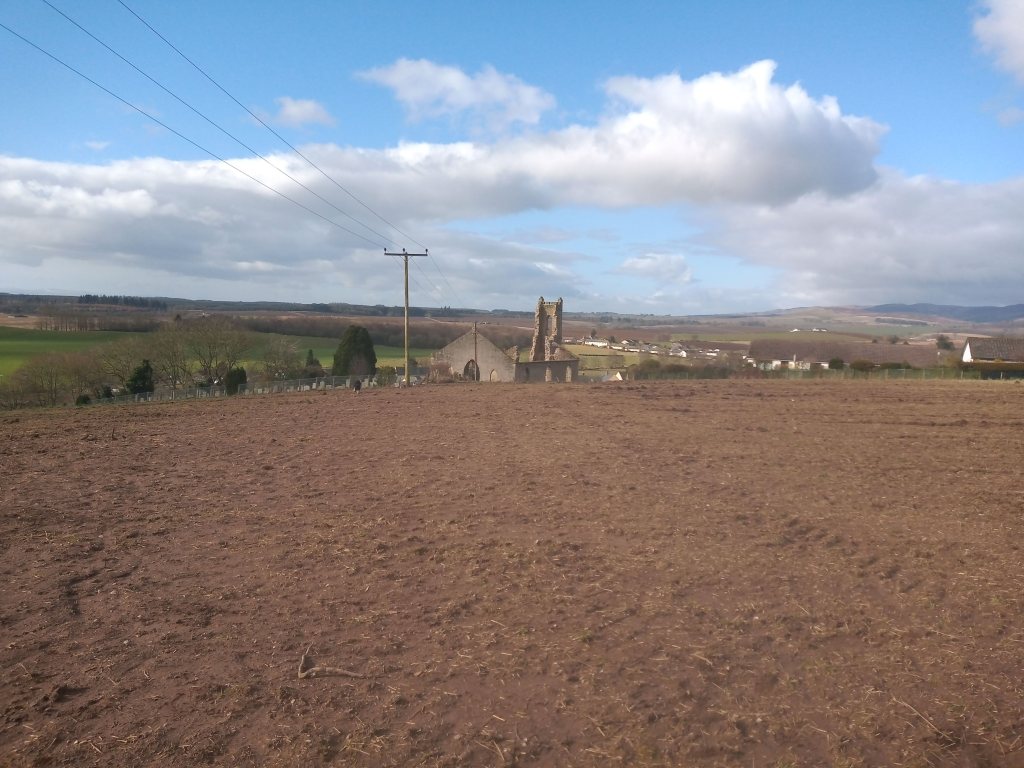
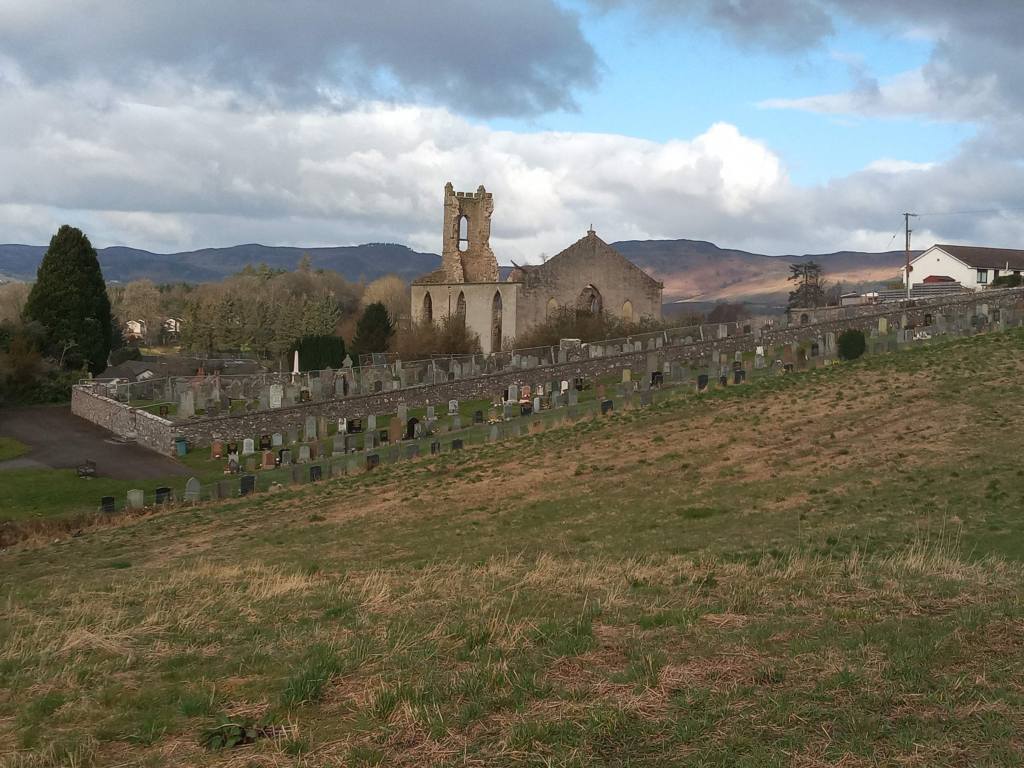
The building was Auchtergaven & Moneydie Parish Church, sited on almost the highest point in the Perthshire village of Bankfoot. It had stood, glowering over the village, for 207 years, its timbers dry, warm and perfect for burning. Not a regular churchgoer, I’d nontheless been there a few times in the seven years I’d lived in Bankfoot, panting my way up the steep path to the entrance, and I’d enjoyed the simple, uncluttered warmth of the wood-lined interior and the sincerity of the congregation. It was a bonnie church, and a landmark for miles around. That day, horrified drivers on the nearby A9 slowed to a crawl, as flames shot to the sky.

In the aftermath, the old church was not “burnt to the ground” – but it was certainly gutted. From a distance, there were many years when at first glance, you’d never know it was a ruin. The tower still stood, majestic – maybe more so than before – defiant, presiding over a landscape of haphazard hamlets congealed into one village, farmland, people and beasts. After considerable deliberation and assessment of the building’s condition and fitness for purpose, the Church of Scotland, advised by the will of the congregation, opted to build a new church on flat land it owned in the centre of Bankfoot, complete with community facilities and a low carbon footprint. It was a brave and right decision, I think, which offered accessibility and possibilities the old church never could. The original bell, cracked by fire to tonelessness, was rescued and installed as the new font.

But it left little in the coffers to do anything with the remaining structure. Disputes and debates went to and fro for years, between the culprit building firm, insurers, the Kirk, local residents, fundraisers, historians and those with an interest in the surrounding graveyard. Meanwhile, safety fencing went up around the site, the grass grew, and saplings appeared in the smoke-blackened walls. Stone crumbled unnoticed. Blocks occasionally fell; still the tower stood, indomitable. Saplings grew into trees; buddleia, that great exploiter of devastation and demolition, proliferated in the nave and drew in butterflies. Wild flowers and ferns took hold of crevices in outer and inner walls, solitary bees visited and maybe nested in crumbling mortar. Jackdaws and pigeons were regular inhabitants in spring. A garden began to grow in the sanctuary. Who knows what wild creatures found refuge among the piles of fallen rubble? No-one could get in to disturb or identify them.

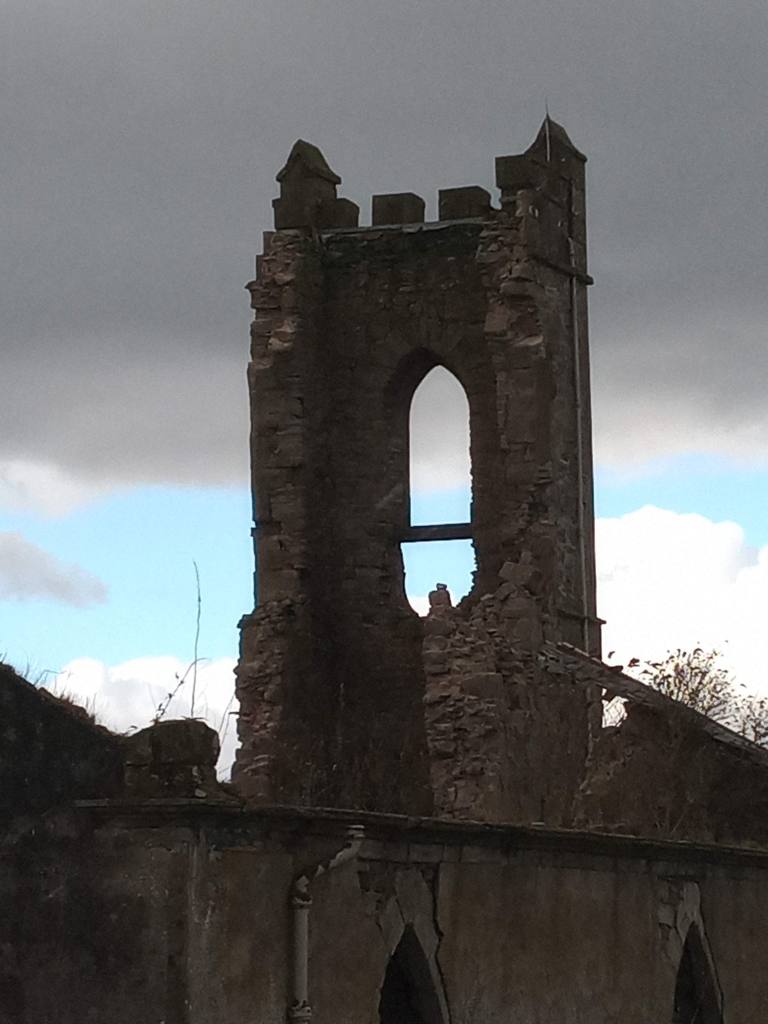
I know many people found it heart-wrenchingly sad. For me, with an ambivalent attitude to organised religion at best, it was more a change in emphasis. I felt the human-centred heart of the building died with the fall of the final clock-face, never to chime again and remind us of the days and hours. One day, out walking in early spring 2020, I noticed that the tower looked a bit odd. I went closer to see if I was imagining things, and discovered that although the front facade still held fairly intact, most of the sides of the tower had fallen in. What was left looked more precarious than ever, but it hadn’t stopped the jackdaws from building warring nests on each remaining pinnacle, or the collared doves gossiping lovingly in hollowed alcoves. Chaffinches and sparrows bustled about purposefully, hopping between the seed heads, roosting on bits of masonry.

I wondered what God – by any name or none – would make of it all. Inevitably St. Francis came to mind, who would surely be quite at ease to see wildlife frequenting a religious building. I thought of the early saints who taught that Celtic version of Christianity which reveres all life, not just the human kind. Jesus himself (despite an unfortunate show of spite to a certain fig tree) counselled his followers on the great value of seeds and sparrows, and the lilies of the field.

Well, I’m no theologian. Who knows? But now the rest of the tower has finally gone, with a crash in the night that woke up the residents of Cairneyhill. The skyline will never be quite the same. I hope the jackdaws and all the other members of Auchtergaven’s wild congregation hadn’t started to build their nests.

Diamonds and Opals and Precious Sparkly Things

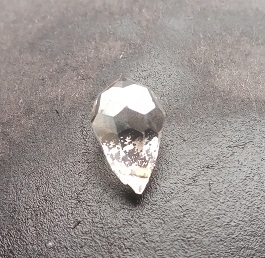
When I was at primary school, the all-consuming craze among the girls was collecting beads. Everyone had a collection, and everyone brought their bead stash to school for swapping and gloating over in the playground. Beads were sometimes acquired from the broken necklaces of aunts, older sisters’ discarded best dresses (sequins were in vogue), theft from mothers and through swapping. Crystals and glass beads were everyone’s favourite, which we called diamonds (or rubies, emeralds or amber, depending on the colour of the glass). I had (oh my god, I still have) a “diamond” dropped by the Queen. Well, I found it in the Mall, when my sister Barbara took me to see Buckingham Palace. She assured me the queen must have dropped it from her coach when waving from an open window. To avoid being hustled for it by the Bead Bullies, I left it at home on schooldays. Most usually, beads were collected by going round the streets and playgrounds picking up those dropped by others. There seemed to be no shortage, but some girls made certain of it. My best friend Pamela (who had a nasty, vicious streak) would run about, “accidentally” barging into gaggles of girls peering into their open bags or boxes of beads. She’d even help to pick them up – but pocketed the choicest, and there were always plenty no-one spotted rolling away. Keep your eyes to the ground long enough, you’d soon build a collection.

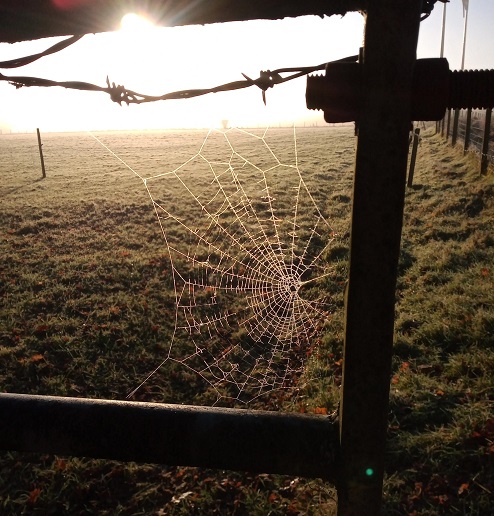
I don’t know at what point I decided to look up at the stars rather than down at my feet, but when I did, I realised the most precious jewels were the intangible ones that faded or shape-shifted before your eyes. Recent falls of snow, melting, re-freezing and glittering in cold, rare sunlight have reminded me of the times as a child when I ran across dew-covered lawns, chasing the rainbows in the water drops. If I stopped running, and swayed gently from side to side, the colours of these so-precious gems changed. But if I touched them or moved toward them, they vanished. Then there were the frosty mornings when my mother got me up early to go round the garden with her, finding exquisite frost patterns on leaf and glass and stone, shimmering in the early sun. Or the first foggy morning of autumn, when every spider’s web was be-jewelled and bewildering in its complexity and simplicity.

Diamonds are famously said to be “forever”. What a nonsense. They’re fairly nice to look at, and they collect rainbows in the same way glass or water does, but I wouldn’t pay money for them.

Collecting snowflakes and making mental snapshots of them before they melted. The fractal patterns of ice creeping over a cold surface. The world viewed through a dripping icicle. The vanishing, slippery uncertainty of the Merrie Dancers, green and rose, across northern skies. Sun on a breaking wave. These precious sparkly things, along with the now-you-see-me-now-you-don’t twinkling of stars as they emerge at dusk or retreat into cloud, these are the jewels of value, the real pearls-beyond price. Ephemeral, transient, temporary. I can’t buy them, own them, hoard them, swap them or sell them, and I never want to try.

Photo by Visit Greenland on Pexels.com

I still have most of my schoolgirl hoard! I am sure one day I’ll find a use for them. I’ve strung some onto the Christmas tree or hung them round the garden before now, and forgotten about them. Maybe they’ll be archaeology for someone, some day. Me, I’ll stick to rainbows in the dew. If you see me swaying about in a meadow on a spring morning, you’ll know what I’m doing!

“Diamond” cast my way by QE1 (of Scotland) aka QE2 (of England etc), circa 1964

Whose Woods are These? I think I know….*

(This is the first in a new series of posts for West Stormont Woodland Group. From fear or repeating myself, I thought I’d write about the fact that each month, the woods have a Gift for us. And every month, there is at least one challenge that faces us – whether physical, philosophical or organisational – in contemplation of owning woodland as a community.)

FEBRUARY’S GIFT: GORSE FLOWER TEA

Of course, there are gorse bushes in flower in February in Five Mile Wood. There are gorse bushes in flower in the woods every month of the year, providing pollen and nectar for insects out too early or too late in the season. Some ancient lecher noticed this and spawned the saying “When gorse is not in flower, then kissing’s out of season.”

Gorse in flower in a cold and clenching winter such as this of 2021 is a real gift. It’s too cold to detect the rich coconut smell from them which can be almost overpowering in high summer, but the gold dazzles against the grey landscape of February or keeks through the smothering snow. Gorse has been used for many purposes, from feeding tough-mouthed horses in winter to sweeping chimneys. It’s a nitrogen fixing plant, like all the pea family, and imparts fertility to the soil. Burn it, and the alkaline ash is good for cleaning soiled linen.

The flowers themselves are used to make a yellow dye, and whether it worked or not, some dairies insisted that feeding gorse to milking cows made for a rich yellow butter. I don’t use gorse for any of these, but I do make gorse flower tea. It looks wonderful swirling around a glass teapot and you might catch a breath of that coconut smell. Don’t expect to taste it; it’s a very subtle (or absent!) taste. If you look hard you may find early shoots of nettle in the woods to give the tea some substance.

But don’t pass the gorse on to anyone else – allegedly, making a gift of gorse guarantees you’ll end up fighting. It’s the woods’ gift to me in February, and I will have no quarrel with the woods.

A CHALLENGE FOR FEBRUARY: WHOSE WOODS ARE THESE?

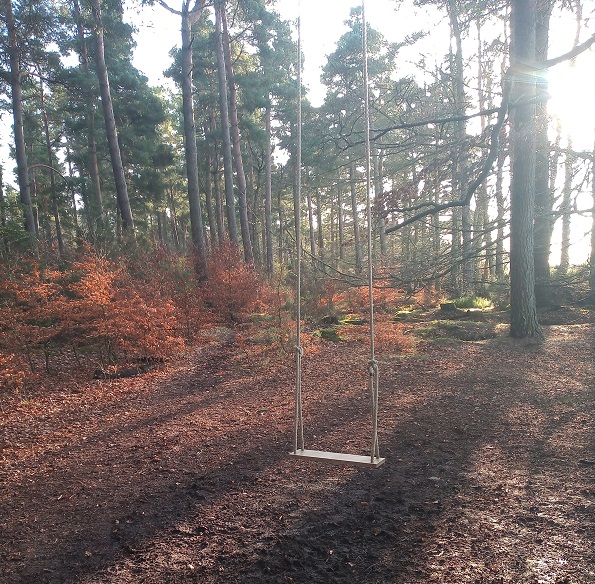
I think the woods are used more now than I remember in over twenty years, Evidence for that lies not just in who you meet, but in new tracks veering off, in small acts of clearance, in scattered pieces of art, in well-maintained articles of recreation like the new swing in the picture. Using the woods implies a sense of ownership, a vested interest, a certainty of relationship. A future.

But are we all buying into this? And will that feeling of belonging translate into an actual belonging? If Five Mile and Taymount Woods are to be taken into community ownership, it’s essential that community identifies itself, makes itself heard and provides the evidence of its existence that will count.

This month, West Stormont Woodland Group will begin a Community Consultation on the proposals the group has been working on for the two woods (or, as it’s widely seen, the one wood with a gap in the middle). Of course, Covid restrictions have forced the consultation to be mostly online, but this shouldn’t be seen as a problem – taking an event online in my recent experience amplifies and multiplies its reach and scope. There is a new website dedicated to the consultation, which launches on 22nd February; details can be found at http://www.weststormontwoodlandgroup.scot ,on Facebook, or by emailing contact@weststormontwoodlandgroup.scot

The challenge is to get you, me, all members, all non-members local to the communities around the woods, all of us starting to think these woods might be ours, to contribute to the consultation. Spread the word!

*Quoted from the opening lines of “Stopping by Woods on a Snowy Evening” by Robert Frost.