Observed from an Exeter bus

music black money entertainment
Photo by Pixabay on Pexels.com

In the cacophony of the high street precinct, there’s a busker. But the appellation doesn’t quite fit. More like a troubadour, a wandering minstrel, shouting out songs, quite badly it seems from inside a bus, to the twang of an inaudible guitar. Notes and words are screened and distorted by the glass and metal of vehicles, the kaleidoscope movement of body-swerving passers by, few of whom give him as much as a glance. Sound waves get corrupted, diffracted, curve away.

He is dressed in quiet brown; muddy, understated. Tweed and corduroy, flat cap and curly brown hair. Behind his pitch a pony cart, jumbled with boxes and sacks, by which presumably he traveled here. Harnessed and patient, the grey dappled pony waits, blinkered, still, at ease. On the back of the cart, a scruffy lurcher rises and turns, to fall back resignedly onto a blanket of indeterminate colour and fabric.

Just as I am being pixie-led into the Wessex of Hardy or the allures of Widdecombe Fair, the troubadour whips his phone from a corduroy pocket, ditches the guitar and embarks on an animated conversation, striding up and down.

While he is thus distracted, people pause, children approach to pat the horse, photos are taken of the photogenic lurcher on the cart.

No-one places coins in the inviting guitar case.


Unforgiving Minutes and the Tyranny of Time


think2

My mother liked to recite aloud the poems she learned at elementary school in the 1920s. These poems were generally heroic, patriotic, moralistic, meant to be uplifting in a time of post-war depression. Rupert Brooke, then, not Wilfred Owen. And lots of Rudyard Kipling. His famous poem “If” was one of her favourites. The last lines begin:

“If you can fill the unforgiving minute
With sixty seconds’ worth of distance run…..”

The Unforgiving Minute has dogged me like the grim reaper ever since. What if I don’t fill it? What if I waste a minute – an hour – days – years? What if Things Don’t Get Done? Over the years, I have felt guilty when I’ve been unwell. I’ve developed elaborate “multi-tasking” strategies like typing up party minutes while chatting on the phone AND watching an improving TV documentary; reading books on cosmology while watching less challenging stuff like Midsomer Murders; affecting to meditate while gardening AND working out what’s for dinner. Trying to bake bread while cleaning out the shed and answering emails is why my sourdough is such rubbish. I’ve had “holidays” where each day is planned and packed with minutes full enough to be righteously forgiven. I’ve created endless, bewilderingly enormous to-do lists, for a day, a week, a year. When I’ve finished everything on the list, I tell myself, I’ll have a rest and choose for myself. That never happens. I just start on the next list.

The fashion for having “bucket lists” doesn’t help. Ticking boxes, like bagging Munros, can be fun, but distracts from living and relishing an actual experience. Sure, there are things I’d like to do before I die (Ben Lawers, talking of Munros, to see the alpine flora, if I can find someone prepared to go at my glacial pace and not make me feel like a decrepit numpty for wanting to take all day about it). But I’ve had it with compulsive list-making.

Another much-loved poem at home was A.E.Housman’s “Loveliest of Trees”.

“Now of my four-score years and ten
Twenty will not come again
And take from seventy springs a score
It only leaves me fifty more

And since to look at things in bloom
Fifty springs is little room
About the woodlands I will go
To see the cherry hung with snow.”

However, as I’ve watched the balance of my years passed to years conceivably still to come tip, and now that I’m well on the light side of time, I observe that each of my remaining springs affords more each year than a tick-box opportunity to enjoy the blossoming of the gean, and all the other flowers in the woods. Savouring the intensity of each moment more than compensates for lack of time.

And what is time anyway? Not what you think it is. At the speed of light, time freezes altogether. I’ve read enough Stephen Hawking to dimly grasp that if I could fire myself way up into space, my unforgiving minutes would get longer, become hours even, to someone watching me through a giant telescope from Earth. But not to me; up there they’d still be minutes, because time only operates from the point of view of the observer. (Or something like that.)

So, as time is not fixed, but wavers around according to the laws of relativity and probably does something completely different on the quantum level anyway, let’s not be tyrannised by it. Let’s have more minutes with no guilt attached when we don’t fill them. More watching the clouds, less time trying to re-create them on canvas. Less grubbing around in borders and beds that will never be weed-free, more lying in the hammock watching the dandelion clocks expand and blow. More love and laughter, less – or no – time spent trying to prove it exists in our lives by frenetically posting the evidence on facebook.

More randomness – more random writing, perhaps, without fretting to meet self imposed blogging deadlines?

Loch Maree

Kipling finishes:

“…yours is the Earth, and everything that’s in it,
And, which is more, you’ll be a man my son.”

Really?? The Earth is not mine, or yours, or Kipling’s. It does not belong to the human species at all. I don’t want to own or master it and nor should any of us – we’re already proving we’re not much cop at that.

And let’s not even get started on Edwardian gender balance!

Winter Geese

geese

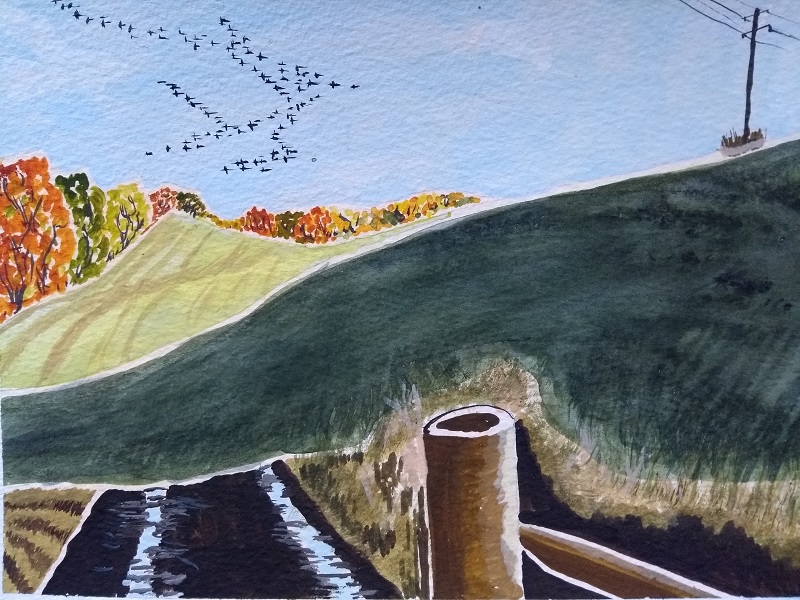
Breathing in, the air is clean and cold, that sharp tang
That preludes winter, edging around frost and ice
But not there yet.
Horizon endless, sky that translucent pale blue – a trail of smoke
Distant, wavering,
Moves towards the watcher in the field.

Earthbound, crows prod lugubriously at the stubble,
Clumsy pigeons clatter from tree to tree, voracious,
After each other. High above, the smoke separates,
Cries out exultant, forms streamers and ribbons,
Waves in and out of formation, as the winter geese pass.

In the marshes and seawalls of Essex, long ago,
I watched through binoculars the arrival of the little Brent geese,
Who stayed with us all winter, sweeping up and down the estuaries,
Squabbling and crying for joy in multitudes in reclaimed fields.
Here, Greylags and Pink-foots (I can never tell which) mark the season:
The harvest-home, the burning leaves, the smell of turned soil.

Once a Pink-foot landed, exhausted in my garden, left behind,
Confused maybe by the demands of Goose and Gander for their breakfast.
We fed and watered her, marveled
how small she was
Against our farmyard geese. The next day she was gone,
As the morning skeins’ urgent calls measured her pace and purpose.

Solid yet ephemeral; never to be held;
An instant of joy in an ever-changing and darkening sky;
Winter geese, this moment, here and now.

Midstream

river trees

In the past ten days, two friends have died. Not unexpectedly, no shocks. A couple of weeks ago, when they were both still alive, everyone and everything around me seemed painfully mortal, and this poem is what I wrote then.

I cross the bridge, but
Midstream, I stop.
So much water, passing under.
I cannot hold it back.

Midstream – upstream – a dipper,
Mischievous, concealed among stones and ripples,
Bobs, and waits.
Midstream – downstream – a fisherman
Casts and retrieves, over and over,
Silent, focused, amid swirling water.

I, too, have cast,
Over and over.
But now my line diffuses and is lost in movement
And what, now, is left to retrieve?

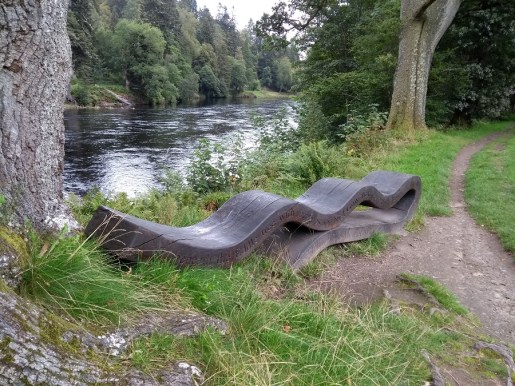
fiddle treeBy this great river I sit
Beneath the fiddle-tree,
A gnarled and feathered oak, gashed
By storm, decay and distant ghosts of song.
Riverbank trees, like frozen statues, arch and crane,
Their token reflections broken
Like dreams in the midstream of sleep.

On dark ripples, tiny sounds of water on water,
Midstream, the undercurrent
Chases the rain from highland to lowland
Into deeper water yet.

Midstream, unseen fish bestir
And battle homeward. But I
Am snagged, log-jammed, midstream
Watching lives flow on and vanish into river,
Slippery, elusive as salmon, impossible to hold,
Passing, on unfathomed journeys, beyond my sight

While I stand helpless and wait
Midstream.

Magic Moments, New Toys and the Bread of Heaven


breadofheaven

I continue my obsession with the micro-organisms that make bread. The sourdough starter got filed in the fridge for a while when I became enthused with spelt. Spelt flour is made from a grain that is like wheat, but not a variety of wheat. It’s engagingly described by marketing types as an “ancient grain”. It makes, really, really nice chewy, flavoursome bread with yeast and honey and olive oil, and it’s very quick to rise and do its thing (unlike sourdough, for which, I now know, you need patience, planning and much mindfulness.) One supplier calls spelt bread made this way Roman Army Bread. No wonder the Roman army was a conquering one (except in Scotland, of course!). I noticed that even with this easy bread, my technique has improved through slaving over the sourdough. I am no longer tempted to flour the worktop.

Anyway, this week I go back to the sourdough, and duly refresh (or feed, though apparently that’s the wrong word) my dead-looking starter. I pour away most of the black oily liquid on top of the jar, stir the rest in, and add roughly equal amounts of warm water and wholemeal Rouge d’Ecosse flour from Fife. Same again next morning, except for the black liquid, which has vanished. Being besotted enough to sit and watch, I can scarcely tear myself away when small whirlpools, bubbles and movement began.

That magic moment when your sourdough starter says thank you for breakfast!

Now I’m looking forward to using all the new toys I got for my birthday – a baking stone you heat in the oven that I’m told will make all the difference to my spreading, cow-pat like bloomers, the scraper that will preserve the kitchen sink from becoming a nursery for yeasts and lactobacteria to proliferate because I can’t get all the sloppy dough off surfaces, bowls and hands; a magic kneading implement to which the dough mysteriously doesn’t stick, a slashing knife, and a Very Deep Tin.

Thanks to the confining nature of the Very Deep Tin, dough has no choice but to go Up. Thus I produce the above Bread of Heaven, with a chewy salt and pepper crust under which lies a cavernous hole – because I forgot the slashing bit to let out gas while it was baking.

(Three days later, I completely wreck a freestanding loaf by cavalierly forgetting to weigh the right amount of production starter I put in, and using nearly double the appropriate quantity…. The dough refuses to leave the proving basket and I create a 2cm high pancake, baking stone or no baking stone. It made a good savoury bread and butter pudding mind.) 

I’m still learning… !

The Morning After

unicorn mushrooms

The morning after the march I went mushrooming again. There were no mushrooms of any kind left in the fridge. I nearly didn’t bother, because I was dog tired, and, after all, I would pass at least three supermarkets in the afternoon.

But something about the air that morning was irresistible. Cool, zinging with the promise of sunshine; light, ethereal and just a little autumnal; dust motes and electrons dancing a jig. The dam and the woods and clearings energised and soothed simultaneously – an antidote to the adrenaline that had kept me up and awake till gone 2am, head birling with ideas and reflections and hope no anxiety could dampen.

Every secret hollow, bank and bog in my regular itinerary yielded something edible. Shaggy Inkcaps standing like soldiers, Hedgehog Mushrooms like tiny undercooked loaves, spiny as urchins beneath, chunky Orange Birch Boletes that go alarmingly black when you cut the flesh but taste divine. And a few late Saffron Milk Caps, only slightly infested.

jed Rohallion

The sunny gold of Chanterelles glistened like the yolk of a happy hen’s egg. Deer came skipping coquettishly out from the wood and crossed in front of me, one of them practically pirouetting in her glee – anticipating perhaps, the rutting season nearly upon us.

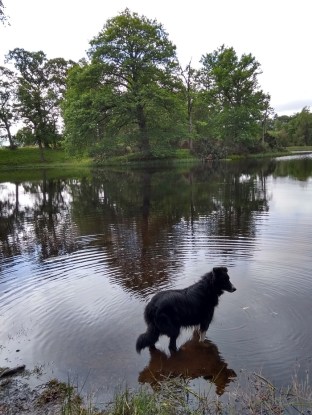
From my dog gazing lovingly at his stick floating away on the loch to the shafts of sudden sun on the ripples he makes, from the happy brown collie and his owner to the mute swans and their big grey babies – the morning after, all of Scotland seems to be smiling at me.

Earth Apples

IMG-20190819-WA0003 (2)

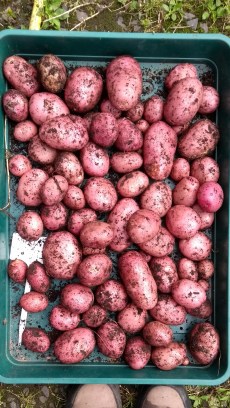
So up they come, the Second Earlies,
Along with a cable tie, three plant labels,
The remains of a scouring pad that’s been through the compost heap
And limpet, oyster and mussel shells
That went in with the seaweed
(of which there’s little trace now),
And a wealth of sand, in spring.

Apples of the Earth, buried treasure!

Lift them all, if you can find them all,
Even the tiny ones destined for the hens, but know
Volunteers will still mysteriously spring up next year.

And there they are, washed and waxy.
The few speared by the graip’s narrow tines
(So infuriating!) will be dinner tonight.
Creamy Marfona; yellow and red-mottled Inca Belle;IMG_20190819_134228596
Shocking pink Maxine; improbable Shetland (not-quite) Blacks,
Who’ll burst apart at a mere puff of steam.

Still to come: red Desiree and the Redoubtable Pink Fir Apple,
September’s treasure trove.

Buried treasure, apples of the Earth!

Hope, Fear, Pride and Rabbie Burns

burns and zebs
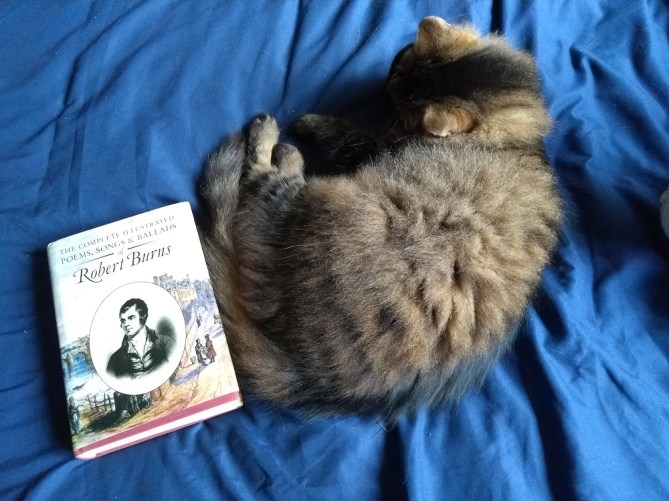
When you wake up literally singing line one of a Burns poem
“Is there for honest poverty….”
and you can’t remember what you were dreaming
and you open the curtains on another dreich day
but look, the rain has paused
and the news is as horrible as yesterday, maybe more so,
but Out of Doors is on Radio Scotland
and all your pets seem to be arthritic or spewing megalithic fur-balls on the bed
but it’s your partner’s side of the bed
and the weeds have grown a foot overnight
but the wren’s firking about in the compost heap
and swallows are lining up on the wires, considering Africa
but they’re still here and chattering
and there’s bread to be made and flour sacrificed to the god of sourdough
and after all, Rabbie Burns was young and might be cut some slack for his faults,
and Ian McKellen is coming to Perth for a Pride rally
and might he not just cast a spell or two?
and a mediaeval fayre will be filling the town
but you’ve got a bus pass
and things might get worse but

this is Scotland and

“for a’ that, and a’ that, it’s coming yet, for a’ that,
that man to man, the world o’er shall brithers be, for a’ that”

statue

HOW DID YOU WAKE UP THIS MORNING?


On Doodling

pumpkin

My secondary school was very traditional, with a “good reputation”. Uniforms were strictly proscribed, right down to underwear and swimming costume, for use in the unheated, outdoor pool. Order was maintained by authoritarian teachers who had been there for decades, and prefects, who monitored behavior and whether we were still wearing our boaters and berets all the way home on the school bus. Our first homework was to take home our jotters and cover them, using brown paper – nothing else – to a strict pattern. On the front, using a ruler at all times, we wrote our names, class and the subject. Nothing else.

I became best friends with the second-in-command art teacher’s daughter. The art department was bright and modern, with lots of materials and media for us to use, and  foot-operated potter’s wheels. I joined the lunchtime art club and loved making lopsided, fall-apart pots, which never came up to the scratch of being selected for glazing and firing.

Some time around the Summer of Love, our rarely seen, distant headmaster retired, and was replaced by a younger model that you kept bumping into in the corridors. The senior art master also left and a climate of staff changes, hitherto unknown, began. My friend’s dad became head of art, and the potter’s wheels were taken away overnight. Apparently, they cramped our creative style. Uniform code was relaxed – and ultimately “banned” by the headteacher. Most of the petty rules we loved to get angry about were dumped. Prefects were pensioned off. Some giddy-eyed young teachers encouraged us to address them by their first names.woollies1

Our new head of art, wings unclipped, sought recognition for his progressive, avant-garde department. It was he that first suggested we doodled on the covers and in the margins of our jotters. There had always been teachers who turned a blind eye to a smattering of doodle on the inside cover – like the thoroughly modern teacher of Russian, and the lazy history teacher who was only entrusted with the first years. Others, of the old school, would reward even a full stop after the subject name with detention. But there came an edict: doodling on and in jotters was no longer a punishable offence. It was to be encouraged in order to bring out our inner artists. Awkwardly, sanctioned doodling began. Pupils became competitive about their flower-power designs. Some gained a talent for cartoons. There was no punishment when my French jotter carried an unflattering but cruelly recognisable caricature of Mademoiselle C, the teacher.

Doodling, whatever the excuse, became a habit.

Doodling expanded onto the pristine walls of corridors and classrooms. Not spontaneous graffiti, however. On the Russian teacher’s classroom wall, we painted St. Basil’s Cathedral in Moscow, with all its onion domes. The windows of the art department became opaque with rainbows of paint. Discarding the conventional, embracing “new” art in its broadest sense, rewarded our teacher with a visit from the Secretary of State for Education. His arrival was carefully contrived to coincide with a doodling-type dance display by two of us girls – of course – to a projected slide containing ink and fairy liquid, swirling and boiling in the projector lamp’s heat, accompanied by drumbeats from a couple of the boys – of course. The Minister glanced in, got the picture, and left rapidly.

The shelving of rules, the constant changes, the abandonment of distance and discipline left those pupils who had started under a very different ethos confused and sometimes angry. So were many of the staff. What do you do with a teenager, programmed to rebel, when you take away all the small stuff that’s been joyfully resisted by generations of adolescents? Some turned to bigger and more dangerous stuff to prove they were different. Sometimes, we took direct action against the new liberal order – such as holding an “illegal” Christmas carol concert when the traditional one was axed.

I left school early. The progressive trend lurched on, at least until the headmaster ran off with one of his sixth-year pupils. The art teacher left to be creative in Devon. About six years later, I found myself teaching in the same local authority, and had cause to visit the school for some event or other. I noted the blank, crisply-painted walls in the corridors. Clear glass sparkled in the windows of the art block. Uniforms, I observed, had returned. The backlash was in progress. It would have been a relief for my generation of rebels in need of tiny causes. I’m not sure if that still holds true – today’s young students have so many big causes to fight and need all the help they can get.

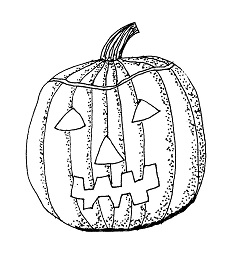
I never lost the doodling habit, though. It helps me concentrate, focus, relax – and learn.

The Beach, Summer Weekend

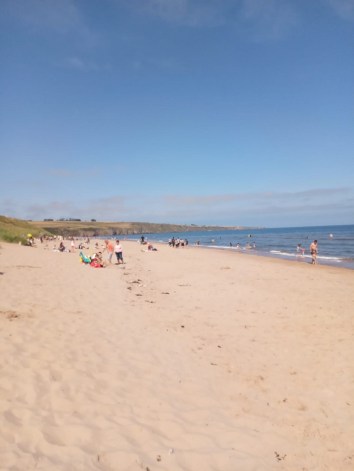
beach 1First seen in early spring, nearly twenty years ago, the beach stretched endlessly around the curve of the bay, a shimmering cream expanse of sand uninterrupted by not much more than a man and a dog, idly kicking at the silvery waves. No sound but those waves, breaking, gathering energy, re-forming, breaking again – and the gulls, plovers and oystercatchers worrying at the interface between water and land. The red stones of a ruined castle tottered in the dunes, crumbling, threatening to fall. Where the river splayed lazily, yet with energy, into the sea, flat, smooth stones in many colours could be harvested for an optical feast, to be drawn and painted, rearranged, and consigned to garden corners.

Today the summer sun is hot, but the breeze is cool from the sea. The car park has been extended, a café predictably offers burgers, ice cream, soothing teas and toilets. The waves still break, but the birds have gone elsewhere, or fly over the sea waiting for humans to depart and their time to come. Chattering voices, laughter, cries of anger or delight dominate the soundscape. Dogs bark and race from one human party to another in confused joy. The tide of visitors troops through the dunes on the new boardwalks, and dissipates like the outflow of the river onto the sand. Small parcels of beach are claimed by towels, windbreaks and throw-away barbecues. As more people arrive, the parcels become smaller and smaller, and new claims are struck in between those established an hour earlier.

Hardy men and women swim and lay gasping in the cold, but glorious, water. Someone turns on a small music centre. The breaking waves are silenced by it. Children, many cossetted in protective wetsuits, others bare-skinned and incautious, run in and out of the sea. Their enjoyment – or fear – is lovingly recorded on a dozen mobile phones and instantly broadcast and archived on Facebook. They do little harm, these day-tripping hordes, few leave litter, they pick up their dogs’ excrement. They are out of doors and they are enjoying it. Most look up from their phones from time to time, and see the beach, the waves, the dazzling horizon. Some don’t. Their loss.

Follow the river up from the beach and behind the dunes, and human sounds recede. The wind still lives in the reedbed; the water warbles with life. Crickets grate away in the dry grass, birds can once more be heard calling and chattering in the scrubby pines. All along the riverbank, great sweeps of purple thistle, white yarrow, pink campion and yellow sowthistle dance and shout their presence to the quiet hoverflies and bumblebees. Harebells – the Scottish bluebell – sprawl untidily over sandy banks, lifting their china-blue trumpets to a sun that suddenly feels gentle and kind.

Clouds fly and form and merge and stream away in an endless sky.

One human walks alone.