
Six months after making a resolution that 2019 would be the year I’d get to grips with sourdough baking, I boarded a train in Exeter clutching a heavy duty carrier bag. Inside the bag was another bag, wrapped around itself, loose ends tucked tightly. Inside that bag were a number of jars and cartons.
Fermenting.
11 hours on hot trains lay ahead. Intensely aware, despite assumed nonchalance, of the seething activity taking place out of sight, in the overhead luggage rack. Occasional checks, surreptitious lifting of lids, burping of bottles. It’s a wonder no one called for the transport police.
How had it come to this?
Cavalier assumptions over several months that I knew enough about cooking and had baked enough yeasted bread to never need instructions or a recipe had resulted in the failure of several sourdough starters to even bubble, the refusal of all loaves to rise, the creation of some worthy bricks and, finally, to acknowledgement that I needed to consult. Guru number 1, Andrew Whitley of Bread Matters and Scotland the Bread (www.breadmatters.com and http://scotlandthebread.org/) told me to go back and read the book properly, especially the bit about balancing acid lactobacteria (which make the sour taste) and acid-intolerant wild yeasts (which make the bubbles), and sent me away with some amazing heritage Scottish wheat flour.
To mastermind the magic of a fermented dough, I needed to get the basic chemistry into my skull. Suddenly, I wasn’t making bread, but collaborating with a population of unknown, busy micro-organisms, intent on feeding and reproducing in the flour and water I was supplying. Once the penny dropped about refreshing the starter to reduce acidity and give the yeasts a chance to breed, my starter began to work.
 But was it really meant to look like this? Was dough meant to get all over the walls and floor? Why was I reduced to scraping and pouring the wet, sticky mess into bread tins? And when the book said “knead”, was it some kind of a joke, when “stir” or “whisk” might have been more appropriate verbs?
Now I had to find out if the disaster area of my kitchen on a baking day was common to real sourdough bakers. I suspected it wasn’t, and that I had more to learn. Enter Guru number 2, Jon Denley of BAKED Cookery school (www.bakedcookeryschool.co.uk) in Plymouth, and a chance to attend a course on Sourdough, Hydration and other Ferments, while on a family visit south.
Amid vast buckets of bubbling starters, in the heat and humidity of a training kitchen with several ovens going, I watched unbelieving as Jon transformed an unruly slop into a polished, gleaming and perfectly manageable loaf. I began to understand how to detect the changes in the feel and behavior of wheat and rye dough mixes as they are worked, that mean you stand a chance of shaping them into loaves. I became aware of the gluten forming – and of it breaking down when, literally, pushed too far. We made – and ate – delectably light and crusty pizzas for dinner, 100% rye loaves, white sourdough bloomers, nutty loaves with wheat and rye and seeds. We played with pre-ferments – pate fermentee or “old dough” u sed to kick-start a sourdough flavour and texture in a yeasted loaf, and the excitable “poolish”, a pre-ferment I was advised to leave in Devon for fear it would get out and derail the Cross Country train before I got it home. We mixed honey, sugar and water and fed it to raisins…. No, get it right: we fed it to the yeasts that live on the surface of the dried fruit.
I got all my loaves, starters, pre-ferments and raisin brew home safely, and they’re all doing fine. Well, the bread’s been digested. The raisin brew has gone to create a spelt flour starter. I still can’t shape or adequately fold a white sourdough bloomer and I’m scared of using a proving basket. I’ve a long way to go, and I’m enjoying the journey.
Working with ferments overturns the received wisdom of 21st century food hygiene. Antibacterial cleansers are banished. Windows are open. Refined ingredients are shunned. Sterilised containers are bad news, and for goodness’ sake leave the lids off so stuff can get in. You can wash your hands, but if you must use soap make sure you rinse it off. The micro-organisms that we so desire don’t come put of a bottle or can. They are living in the organic flour, on your hands, in the air, on the surface of raisins and apples.
And although we can place them into rough groups, we never know exactly what the microbial make-up of a batch of dough is. My mother would have called them germs, and been deeply distrustful of processes that encouraged them, not to mention the product of those processes. Even in the fermentation of cider, beer and wine, which I’ve done a lot, you’re advised to use sterile containers and prevent “contamination” by “the wrong” fungi or bacteria. Just like the fastidious gardener trying to control nature, we like to think we’re in control of our alcohol production.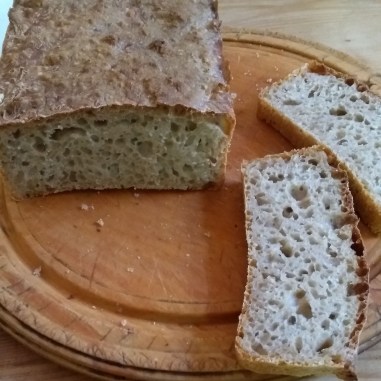
Baking with mysterious, unidentified, unknown quantities makes for unpredictability, surprise, delight, disappointment. We are not in control. Our ferments frequently are.
It’s wonderful.
 Broad-crowned and rooted like mountains, they are the very epitome of strength. In the minds of humans, they are usually labelled “he” and associated with male-ness. Strong, protective, enduring, courageous …. dominant, powerful, overbearing, masterful? Strange to note (if not surprising) that trees thought of as “she” (such as the Silver Birch, Devon’s “Lady of the Woods”) are graceful, delicate, drooping and indecisive in form. And is it only Devon Men who have “hearts of oak”?
 Comments on The Nature of the Universe