
The last time I was in Assynt I was nine or ten, on my first visit to Scotland. My big sister and her boyfriend took me camping on a road trip that began in Glasgow and ended at Cape Wrath. For a child from the suburbs of East London, it was nothing short of life-changing. As we returned to their flat in Glasgow, my sister asked me which places I liked best.
“Wester Ross,” I said.
“Not Sutherland?”
I thought for a bit. “I liked it. But I liked Wester Ross more.”
“Was Sutherland too harsh and wild for you?”
I sensed a trick question. My sister always wanted to toughen me up. She reveled in wild and empty open spaces, the complete absence of people. I wanted her approval. But something in her question rang true. It wasn’t that Wester Ross was softer, meeker, but somehow – I couldn’t explain – somehow there were more….
“Trees,” I announced. “I like trees. There were no trees in Sutherland.”
I’ve had decades since to reflect on my response. At that time, the North-west Highlands were remote, empty of people. Settlements were sparse, inhabitants few, and tourists virtually non-existent. But I could see where people had been. The ruins of dry-stonewalled houses and whole villages stood everywhere, a testimony to clearance, plague, poverty and emigration. Crumbled walls, sometimes just foundations, a gable or a chimney pointing here and there to the sky. You couldn’t miss them. Our wild campsites were up the remains of old tracks that led to derelict hamlets. I remember one that I would walk around every morning. A little way from the ruined houses I saw a weird cairn-like structure of four or five strategically placed, flattish stones. I lifted them. Below a deep, dark hole blinked at me. There was a melancholy, metallic splash when I dropped in a stone. I’d discovered the well, and it stared back at me, naked and accusing. The cover stones might have been placed just yesterday. Feeling a sickness and strange fear in my stomach, I tried to replace them exactly as I’d found them – in case someone came back.
I don’t think I’m just speaking with informed hindsight when I say that I sensed there was something wrong about the bleak emptiness and the ruins. The further north we got, the more pronounced it became, perhaps because of the lack of tree cover. Maybe there were trees in Sutherland back then, but I didn’t see them. My guardians preferred walks on bare hills, peat-bogs and wind-blasted coasts.
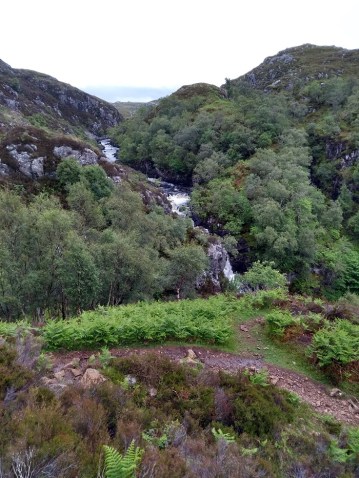 But last week I was in Assynt again, and if there were many changes, it was the trees I noticed first. It’s nearly 26 years since the first ever community buy-out of land in the area by the Assynt Crofters Trust, and there have been others in the area since. The first trees I found myself looking at were less than 25 years old. I walked in vibrant young woodland at Little Assynt, above the shores of the great loch. Deer fencing surrounded large tracts of land. Birch, rowan, hazel, Scots pine…… willows, elders, hollies and even aspen…… planted by Culag Community Woodland Trust or regenerated naturally within the fences. Outwith the fences, though, trees were also regenerating, especially birch and willow. Sheep, ironically, seem to have been cleared to the coasts. Deer pose for tourists around townships, but their numbers are controlled. Bluebells and primroses are appearing under the bracken.
So, there were woods here before, then.
The Assynt downy birches are wonderful stunted specimens, all arms and legs as they branch and branch again and gesticulate over a landscape of ferns and mosses and blueberries. I saw very old birches in woods up a river valley – huge, shaggy trunks breaking into wiry, angular limbs about three feet from the base, and still sending up new wood. It seemed pretty clear they’d been pollarded for their timber a long, long time ago.
There were woods here before, and they were valued and sustainably harvested.
There’s a native tree nursery at Little Assynt, whose owners work tirelessly among the  midgies to produce more trees, all from seed they’ve gathered locally. They’re pretty excited that after last summer, the aspens have flowered – a rare event in a species that prefers to clone itself vegetatively – bringing welcome genetic diversity into the local tree stock. At the Falls of Kirkaig, we bumped into a naturalist friend from near home in Perthshire (Scotland being such a gloriously small country), who had observed the same phenomenon. So, there we were, all getting excited about the future of a tree species in a place I’d remembered as treeless.
Of course, there are other changes. You have to look hard to find any old townships from pre-clearance times. The earth has swallowed them up. The roads are more solid, with no grass through the middle, so there are more motor vehicles and far more people. Mostly (but not all) tourists. A few whizz about, thinking it some kind of achievement to “do” the North Coast 500 in a day, or delude themselves that they can capture the essence of Sutherland from the inside of some huge, self-contained box-on-wheels that couldn’t fit into a passing place even if the driver recognised one. Sutherland could perhaps use fewer of these. But many linger, fall in love with the mountains and the deep valleys, accept the weather, and engage with the landscape – and come back. Sutherland has become accessible to tourists. It has learned to cater for them, and yes, it is busier, less remote, less empty.
But there are trees in Sutherland.
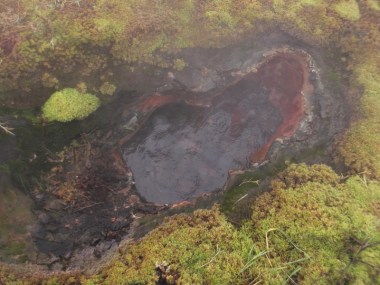 Everyone should leave their comfort zone behind from time to time, though, and if you venture into The Moss there are rewards. It’s called “moss”, because in most cases that’s what makes it – sphagnum mosses of breathtaking colour and beauty, slowly expanding and dying away to leave peat. Mosses are primitive plants dependent on water for reproduction, and you can be sure the brightest patches will be the wettest. Sphagnum holds an incredible quantity of water. Its uses range from wound dressings (it is naturally antiseptic) and hanging baskets to impromptu disposable nappies when walking with babies! Rushes, too, are useful – think matting, cattle bedding and rushlights – and if you can balance on the clumps as stepping stones, they will see you across a wet patch of moor.
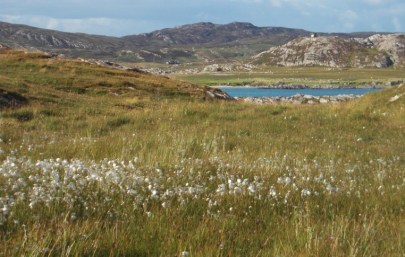 Finally, there is the alluring bog cotton-grass – a guarantee of treacherous wetland just waiting to suck you down – but such an unusual flower and how beautiful waving massed in a moorland wind – white woolly standards raised to announce a weird, wonderful and ominously wet world of plants!

