
 A full evening, two nights and two days of rain. Humidity hangs in the air, the soil beneath my feet pulses damply, the mosses are full and green. Raindrops still coat every flower of grass and frond of bracken, but the sun is shining. The timing is right.
I go for mushrooms in the place where the Highlands meet the Lowlands, where the land is rent by fault-lines and rainbow-coloured slate out-crops and erupts. I pass the court hill where outlaws were tried and hung from the oak trees of Birnam Wood, three hundred years after Macbeth was king of this nation. I stalk through the devastation where the larches were, before they got phytophthera and were felled. There is nothing there now. But in the crowded wood beside the path, one big larch has been missed, and the sun shines in tawny patches upon last year’s fallen needles. It catches on a small group of Larch Boletes, glistening and tawny themselves in their cosy cohabitation with the tree. I take one. A deadly Panther Cap smirks nearby and I ignore it.
Broken and battered, an old sweet chestnut tree is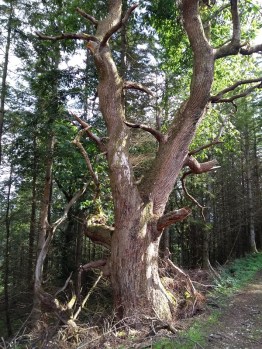 surviving the metallic blundering of the foresters’ vehicles, harvesters and forwarders, along the track. How did it get here? Not a native tree, so planted a long time ago, when this haphazard forest was occupied in a different way. Who planted it? Did they hope for chestnuts to roast on autumn fires?
I follow the hint of a track down a slope towards the thicket where rhododendron is making its usual bid for world domination. No more than a wisp of trodden grass and bent fern, my path diverges and peters out at a crop of the biggest chanterelles I’ve  ever seen, tucked into the side of a rugged bank that oozes water. Was this path made by a human who knew where to look, or by another animal? Someone told me yesterday that the best chanterelles are on banks and slopes because the deer can’t graze them there.
I’m always competing with other animals for my dinner. But I’ve had lots of chanterelles this summer and there is still a dish at home in the fridge. I take a couple. I have rules when I’m foraging. Never take more than I need, only take a percentage of whatever I find, leave old mushrooms to sporulate, leave young ones for tomorrow, for the next predator or none, for others just to see and love.
Under birch, I acquire some young Brown Birch Boletes and a single Cep. Ploughing through forest, I note the tiny horsehair mushrooms are up and about, trooping on twigs and the needles of conifers. I ignore, too, the many “wee brown jobs” of mushrooms that once I diligently took home as single specimens to try to identify with hand lens and spore print. Some I succeeded in pinning down, too, only to forget them altogether until I came across them again in another wood, another year. Life’s too short now, I am focused on my prey.
Huge shaggy mushrooms shout out to me as I pass another grove of conifers and I am lured in. But they are the uneaten halves of massive fir cones – red squirrels have eaten the succulent tops from every one, and laugh at me from the tree tops.
They cluster in the fallen forest by the dam, the new flush of Saffron Milk Caps, just where I thought they’d be, and just at the right stage before the fungus gnats lay their eggs. They are sound, and plentiful and could make a wonderful painting, with their improbable colours of orange, cream and khaki-green. But they won’t, for I take my portion and weave them into a spell of dinner.

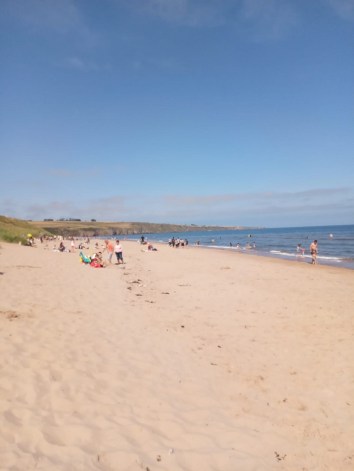 First seen in early spring, nearly twenty years ago, the beach stretched endlessly around the curve of the bay, a shimmering cream expanse of sand uninterrupted by not much more than a man and a dog, idly kicking at the silvery waves. No sound but those waves, breaking, gathering energy, re-forming, breaking again – and the gulls, plovers and oystercatchers worrying at the interface between water and land. The red stones of a ruined castle tottered in the dunes, crumbling, threatening to fall. Where the river splayed lazily, yet with energy, into the sea, flat, smooth stones in many colours could be harvested for an optical feast, to be drawn and painted, rearranged, and consigned to garden corners.
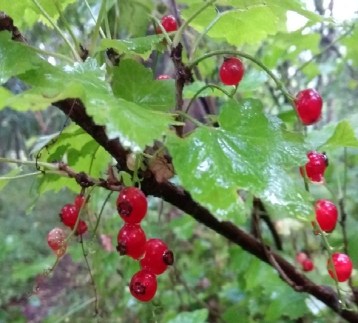 In the dense shade of a triumphant elder spinney, a smattering of redcurrant bushes blooms and fruits, scant rich redness catching the eye as the berries ripen. They are small and sour, yet somehow incandescently flavoursome. Where the track narrows to a muddy path, wild gooseberries make a wee thicket. Their fruits are also tiny, and round. Are they genuinely wild?
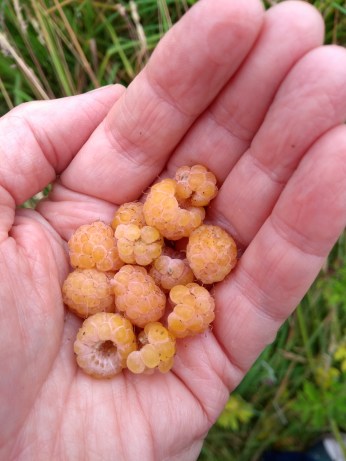 diminutive rasps are a pale golden yellow. They hide behind fiercely protective stands of nettle, and amid the jaggy stems of the hawthorn. These are the sweetest, most succulent of the feral berries. They melt in the mouth and almost dissolve in the hand. Any attempts to gather a large quantity fail; they are nought but juice by the time they get home. Those who know about them keep a close eye, and say nothing, then give the game away when it’s picking time by beating narrow paths through the grass and nettles to get at this choice fruit.
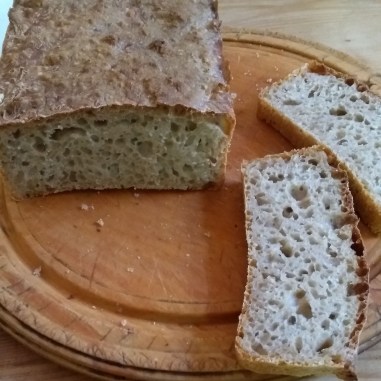
 But was it really meant to look like this? Was dough meant to get all over the walls and floor? Why was I reduced to scraping and pouring the wet, sticky mess into bread tins? And when the book said “knead”, was it some kind of a joke, when “stir” or “whisk” might have been more appropriate verbs?
 Broad-crowned and rooted like mountains, they are the very epitome of strength. In the minds of humans, they are usually labelled “he” and associated with male-ness. Strong, protective, enduring, courageous …. dominant, powerful, overbearing, masterful? Strange to note (if not surprising) that trees thought of as “she” (such as the Silver Birch, Devon’s “Lady of the Woods”) are graceful, delicate, drooping and indecisive in form. And is it only Devon Men who have “hearts of oak”?


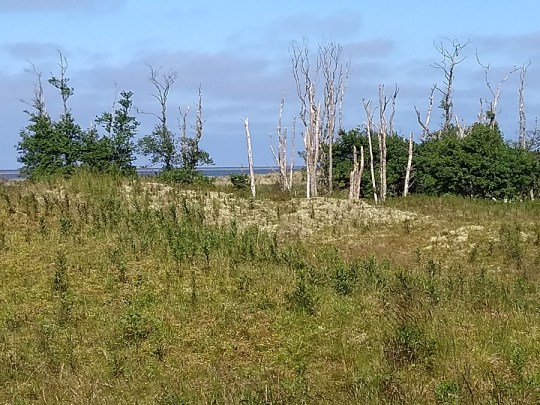
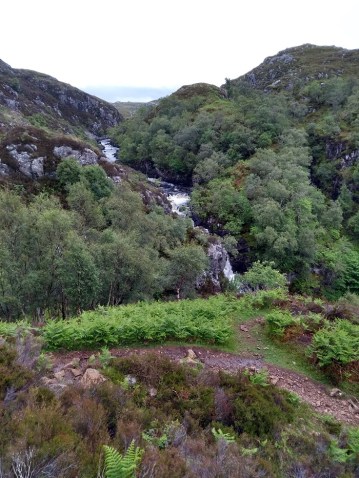 But last week I was in Assynt again, and if there were many changes, it was the trees I noticed first. It’s nearly 26 years since the first ever community buy-out of land in the area by the Assynt Crofters Trust, and there have been others in the area since. The first trees I found myself looking at were less than 25 years old. I walked in vibrant young woodland at Little Assynt, above the shores of the great loch. Deer fencing surrounded large tracts of land. Birch, rowan, hazel, Scots pine…… willows, elders, hollies and even aspen…… planted by Culag Community Woodland Trust or regenerated naturally within the fences. Outwith the fences, though, trees were also regenerating, especially birch and willow. Sheep, ironically, seem to have been cleared to the coasts. Deer pose for tourists around townships, but their numbers are controlled. Bluebells and primroses are appearing under the bracken.
 midgies to produce more trees, all from seed they’ve gathered locally. They’re pretty excited that after last summer, the aspens have flowered – a rare event in a species that prefers to clone itself vegetatively – bringing welcome genetic diversity into the local tree stock. At the Falls of Kirkaig, we bumped into a naturalist friend from near home in Perthshire (Scotland being such a gloriously small country), who had observed the same phenomenon. So, there we were, all getting excited about the future of a tree species in a place I’d remembered as treeless.
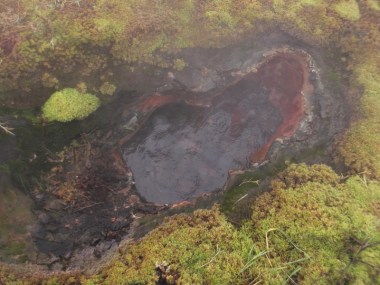 Everyone should leave their comfort zone behind from time to time, though, and if you venture into The Moss there are rewards. It’s called “moss”, because in most cases that’s what makes it – sphagnum mosses of breathtaking colour and beauty, slowly expanding and dying away to leave peat. Mosses are primitive plants dependent on water for reproduction, and you can be sure the brightest patches will be the wettest. Sphagnum holds an incredible quantity of water. Its uses range from wound dressings (it is naturally antiseptic) and hanging baskets to impromptu disposable nappies when walking with babies! Rushes, too, are useful – think matting, cattle bedding and rushlights – and if you can balance on the clumps as stepping stones, they will see you across a wet patch of moor.
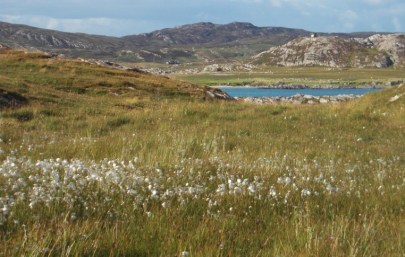 Finally, there is the alluring bog cotton-grass – a guarantee of treacherous wetland just waiting to suck you down – but such an unusual flower and how beautiful waving massed in a moorland wind – white woolly standards raised to announce a weird, wonderful and ominously wet world of plants!
 Comments on The Nature of the Universe