February: Five Mile Wood


beech saplings

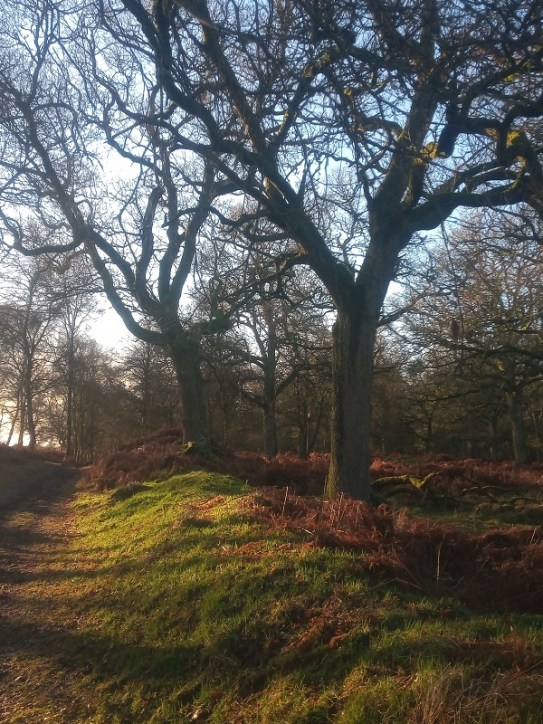
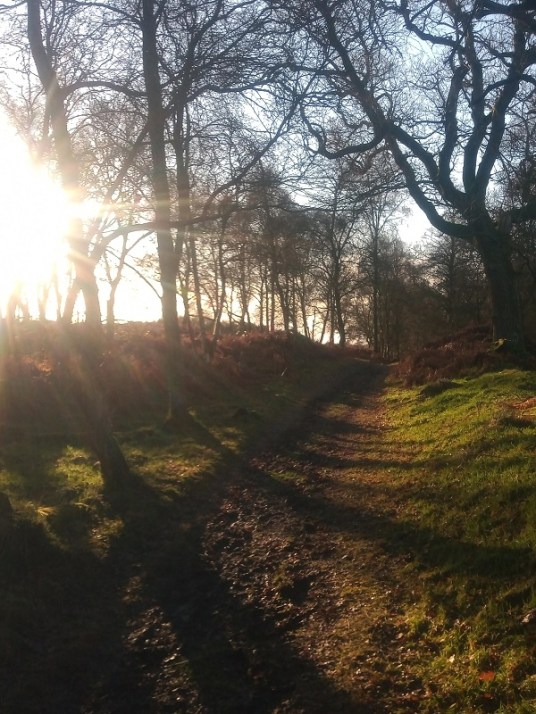
Dreich doesn’t begin to cover it. Weeks of rain, sleet or snow, and the wood is wet, dank, chilly. One storm has passed, another is forecast, and a group of multi-stemmed birches, green with lichen and algae, droop and wait despondently.

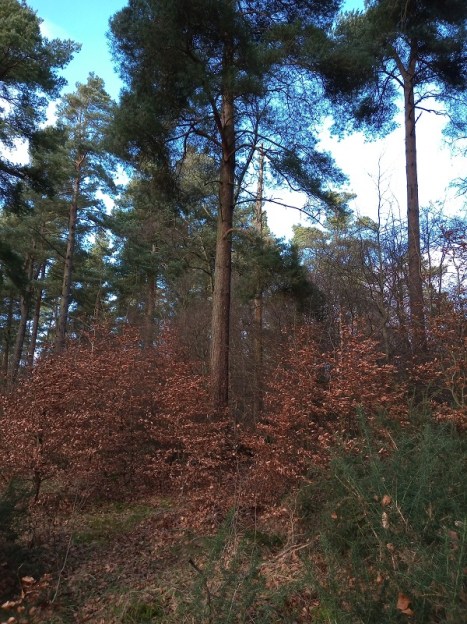
I take the rutted cycling path that skirts the woodland edge. Under the tall, fiendishly straight Scots Pines, many scattered beech saplings nestle in their winter boleros of retained leaves. Beech mast is everywhere, but I do not see the older tree from which it has fallen. Beech seedlings tend not to come up near a parent tree, but somewhere there must be a Mother.

Snow lingers crystalline along the clay-bottomed ditches where black, cold water lurks and trickles. There’s a pond under the pines which so looks like it was formed by an explosion I call it the bomb crater. No signs of frog spawn yet. Several tracks and paths meander where animals come down to drink. Duckweed covers a third of the surface; in the increasing rain thousands of ripples intersect and make diffraction patterns over the other two thirds.

bomb crater

Birds – except for a robin – are silent and glum. A flock of pigeons clatters off towards the field; freshly ploughed, it offers them nothing but the stones that lie heaped in the field corner. How many decades or centuries of cultivation have contributed to this pile? This side of the fence, someone a long time ago arranged stones round a favourite tree, where they remain, moss-covered and half-buried. Larger rocks with wavy patterns etched onto their surface erupt in groups from the forest floor, scarcely distinguishable from the stumps of felled trees. Moss, lichens, algae democratically envelop all.

blackening russula

There are charred-looking remains of mushrooms by the path. I think they were Blackening Russulas, an abundance of them. I follow their orbital trail and suddenly find myself under a towering old beech tree, with many spreading branches and a hollowing trunk that makes a chimney of dead wood and fungal rots. Swings hang from two branches; insects and other invertebrates burrow into the soft core of the tree and make their homes. The woodpecker will soon come calling for her dinner, other birds will nest and shout from the canopy. I have found the Mother of Beeches, and of much else besides.
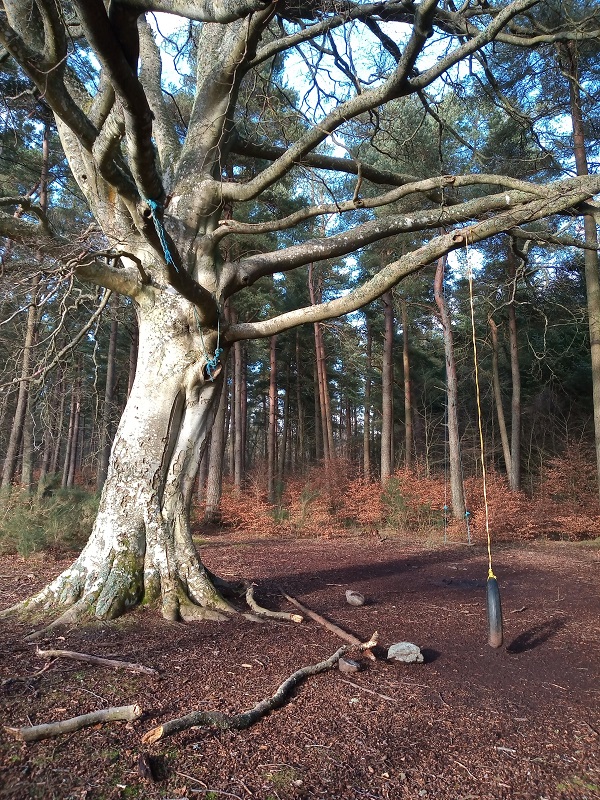
mother of beeches

Five Mile Wood and Taymount Wood are former Forestry Commission plantations just north of Perth. They have for a while been transitioning from industrial timber production to a subtle integration with the wild, and people are part of that wild change. The Commission have put them up for sale, and local people have formed West Stormont Woodlands Group. We are hoping to implement a community buy-out. You can find out more about the plans and group activities at http://www.weststormontwoodlandgroup.org.uk Over the coming year, I intend to write a monthly blog post “Words for Our Woods”about the wildness of the woods, in support of WSWG. This is the first.
Transient

For days now, maybe weeks,
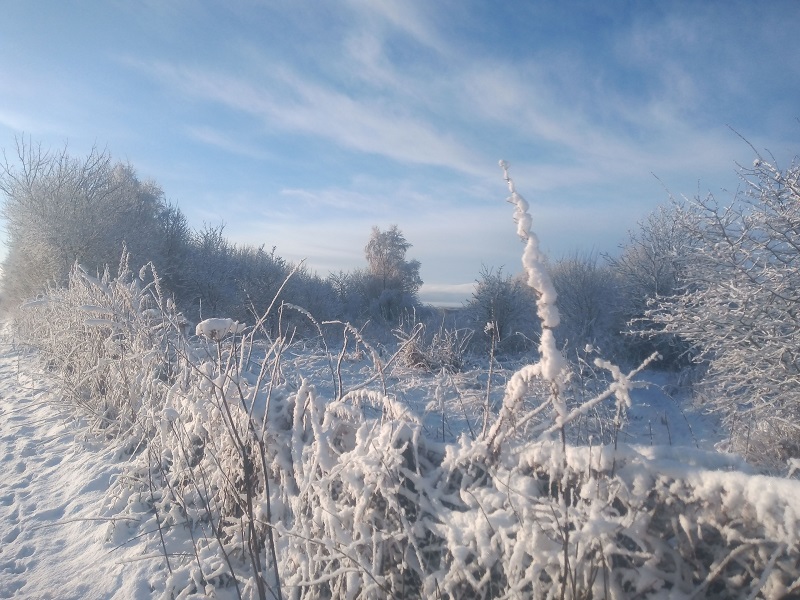
Snow has been coming and going.
Not letting go, not quite in control,
Like the viruses keeping us all on edge.
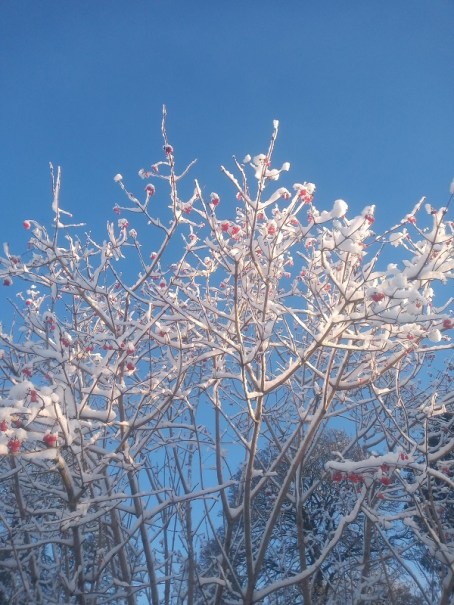
It lies poised on grasses and winter berries,
Between water and ice, catching rainbows,
Sliding off roofs, dissolving under footfall.

snow3

If this were January, we say,
We’d know what we were in for.
The snow would lie, intransigent,
Till we’re sick of it and grow bitter-eyed,
Nonchalant in our cars on frozen roads.

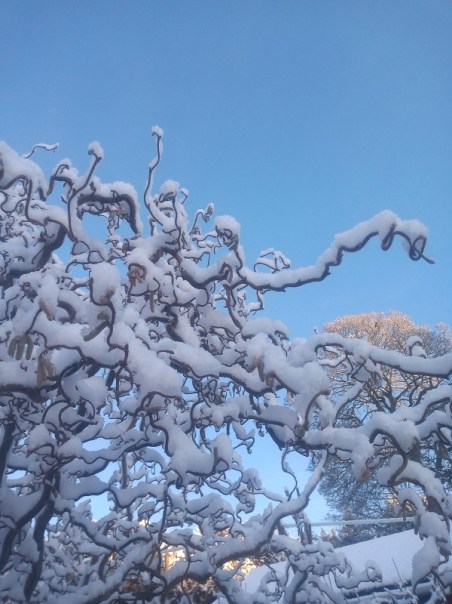
snowhazel

We don’t know what to expect, now,
Of weather. Of self-styled leaders, we expect the worst.
They rarely disappoint.
We, in stone houses with no ambient warmth,
Switch off the odd light,
Turn down the sinful boiler,
Shiver in extra jumpers, even though
We know we’re alone, while off they fly
In chartered jets: to gorge and gabble and guzzle,
And trade in carbon neutral bullshit.

snow guelderrose

Snow melts,
But rides in again on wild winds
To lie, and freeze, and then trickle away
In the unforgiving sun. And we
Must rise, and gather storms around us
Like blankets. Walk out, speak out
And keep on, and on, regardless.

A Dear, Green Place

qpcampsies1

I wake up under the ridiculously high ceiling of my daughter’s flat in Govanhill (honestly, you could fit a whole other floor between me and that ceiling), and it’s that not unheard-of, but always slightly surprising thing: a Fine Day. In January. In Glasgow.

So I go down to Queen’s Park under the low sun, and join all the people, taking shortcuts to Shawlands or Battlefield, grimly jogging, exercising a cacophony of canines, or gathering to hold deep discussions on the slithery paths where the morning’s frost has turned to melting ice.

I look for wildlife. There’s plenty, but until you tune in, you’d think it was all rainbow-hued, pouting pigeons intent on fornication and the many opportunist members of the crow family. Magpies bustle under municipal shrubs and into rampant ivy (arguably the park’s most significant contribution to wildlife habitat), and busy themselves with piles of beech leaves, pretending to have a purpose.

qpivytrees    qpcrows1

Crows loiter in trees with intent, fingering – or beaking – sticks and twigs, considering their suitability for Lovenest 2020.

I skirt the wildlife pond, where coots, moorhens, mallard and the remaining cygnets of the Mute Swans entertain small children. Up a green slope, and a sunken track, so deep in mud and the soggy consequences of the previous weekend’s torrential rain that had some of us dancing in puddles, it could double as a Devonshire hollow road. Fallen trees accrue fungi and insects; Queen’s Park here has shed its Paxton municipality.

qpgreenlane      qpgreenlane2

In the wilder, scarcely managed woodland, I hear birdsong – the noisy robin, the piping and sawing of blue and great tits. I know there are long-tailed tits – they visit my son’s bird feeders – but they taunt me shrilly, staying out of sight. A treecreeper works her way up a lime tree trunk. Dunnocks and wrens flit, silent and absorbed. Huddled among the trees on the Camp Hill slopes, the Queen’s Park Allotments make a city within a city, a shanty town of sheds and frames and variously glazed or translucent edifices where lush crops are started early by proper gardeners, and foxes – I can smell them -.find food and sanctuary.

qpfort camp

Higher, and I reach the Iron Age fort that crowns the hill, where grey squirrels scamper among the beech-mast, and humans have lived for centuries. The big stones in the middle of the ramparts may be what’s left of the Camp that named the Hill – during the Battle of Langside in 1568, famously lost by Mary Queen of Scots’ army and which sent her to to seek, and not find, refuge in England. But Glasgow named the park for her.

qpwassailed3

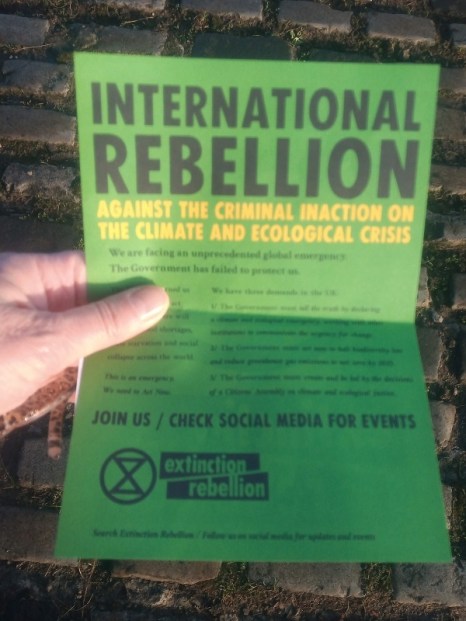
A grove of young fruit trees just below the viewpoint with its flagpole are decorated with dark tartan ribbons, the remnants of last year’s wassailing. I wonder if they will get wassailed this year. The Philosophists of the Flagpole converse earnestly, perched on the backs of the frost-wet seats. Someone hands me a leaflet. It is from Extinction Rebellion.

qpXR

The day before, Glasgow City Council had announced its intention to be carbon-neutral by 2030, despite the challenges of its transport system and heating those high-ceilinged, big-windowed tenements. That’s 15 years before the target set by the Scottish Government. Will they do it? They will give it their best shot, and count the benefits before the costs. XR will say there’s no choice.

qpchimney

We look out over this beautiful city, this dear, green place, bounded and made human-scale by its surrounding hills, dotted with parks and humming with energy that comes from its people. Smoke gushes from a single factory – I think its the brewery opposite Glasgow Green – and a motorway crashes through. They’ll need to sort that. I think, that if anywhere can do it, Glasgow will.

qp1


The Bluebell Wood in Winter

bluebell8

We’ve always felt a sense of ownership of our local bluebell wood. It’s the place we take visitors, a secret to share with loved friends and relations. Over the years, it’s become quite renowned, at least in May, when the ancient oak woodland is carpeted with bluebells. People have always flocked to it then, to capture images on camera, to bring children and grandchildren, or just to stare in amazement, breathing in the scent of bluebells that stretch far and wide.

bluebell4

Maybe not so picturesque, but it’s equally magical in other seasons: when the bracken grows up fresh and green, or in its autumn gold, and in winter, when the silence is tangible, the bracken is tawny-brown and the shoots of bluebells lie just below the soil.

bluebell1
The sun is low and carries no warmth; it pierces the sweet sculpture of bare branches and paints the carpet of mosses under the fir trees with iridescent green and gold. It lights up the crumpled and disordered fern fronds as if with fire.

bluebell5

Every oak tree is adamantine and statuesque, posing in naked dignity. The scattered ancient, crumbling beeches also look invulnerable – but that’s an illusion. Every so often, one of them keels over or dumps half a split trunk. Dark, ponderous yew trees here and there are enigmatic about life and death.

bluebell6

At the top of the rise, my favourite tree is a multi-stemmed silver birch, which stands against the sky as if it were painted there. For me, this is Stephen Hawking’s tree. I was on my way up that hill in March 2018 when I heard that he’d died. I sat by the tree and digested the news, sad, but making a mental salute to a brilliant mind. I don’t have many heroes, but Professor Hawking was probably one.

bluebell7

A few years ago, the landowners put the bluebell wood up for sale. That’s when all the folk who’d felt ownership and connection came out of the woodwork. Suppose it was bought by someone who respected neither its status as ancient woodland, nor the long-established right of access? In the end, although a community buy-out would have seemed fitting,  it was bought by the Woodland Trust, thanks to a fortuitous legacy. Sighs of relief were followed by the formation of an enthusiastic volunteer group.

bluebell3

There have been changes, of course. Re-routing of paths to avoid visitors being knocked out by a falling beech branch, a hard line on invasive non-native species that threatened to engulf the bluebells themselves, the eviction of the deer from inside the deer fences to permit oak tree regeneration are just some examples. A car park – inevitable, perhaps, but no ornament… but at least it’s been surrounded by fruit trees.

And a massive planting project of new trees in the adjacent fields that formed part of the sale – thousand of trees, safely behind new deer fencing but accessible via solid gates. Work in spades for the volunteers, for years to come.

bluebell2

It’s rhododendron-bashing day tomorrow.

Death Of A Star

The other day, a friend told me that my second-favourite star might be dying. Betelgeuse is already a pensioner as stars go; possibly over nine million years old. Age is a bit meaningless when you’re talking about stars though. The Sun, our nearest star, we think of as present, alive, omnipresent. But light from Betelgeuse takes about 600 years to reach us on Earth, as we prance around our own star, and that means that, if the signs are being read aright, Betelgeuse is already gone. We are just observing its decline 600 years later.

silhouette of trees during night time
Photo by Free Nature Stock on Pexels.com

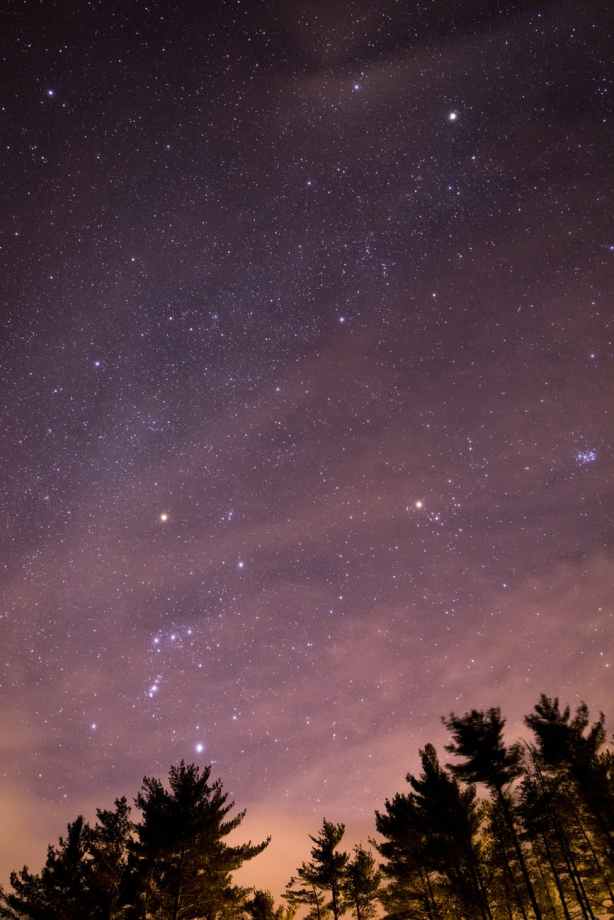
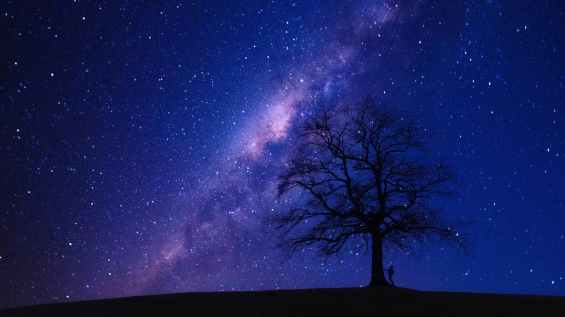
It was Christmas night, on the way back from the midnight service in Dunkeld, that I last saw Betelgeuse. The night was clear and frosty. We pulled off the back-road, switched off the car lights and walked into the icy air. A fox barked in the distance; we were silent, awestruck. The Milky Way strode across the sky, Sirius, the Dog Star, was blue indeed. I began pointing out the names of constellations I knew, and making up the ones I wasn’t sure of, because I can never do enough stargazing for all the names to stick. Betelgeuse is easy, because of its reddish hue and its position as the right shoulder of Orion the Great Hunter. I was a bit nonplussed, because it wasn’t as obvious as usual, but thought no more of it till my friend told me the news.

It’s red because it is something called a Red Supergiant (a sign of ageing in stars). And it’s getting dimmer and dimmer, a state which is said to indicate a loss of mass. With twenty times the mass of the Sun, Betelgeuse has a way to go, but the eventual pattern is an expulsion of dust leading to the star’s explosion as a supernova. If that happens (and it might not, yet, at any rate, because Betelgeuse is a “variable” star, whose brightness goes up and down in cycles), it will create a show of light brighter than the moon, capable of casting shadows on Earth. It might even be visible by day. And then it will be gone.

sky space dark galaxy
Photo by Pixabay on Pexels.com

On many levels, I’d miss Betelgeuse. The physics of supernovae is going on constantly all over the universe, and one day it will happen to our Sun as well. Stars die. But Betelgeuse is a vividly recognisable part of a much-loved constellation I associate with the depths of winter (as well as being the star around which the home planet of Ford Prefect orbits*). Constellations may be unscientific and artificial, but they paint pictures through which we navigate our ignorant way through a universe too fabulous to designate merely with letters, numbers and formulae. Michel Serres, in  The Five Senses, says that if we abandon the naming of stars and constellations “night has lost its giants and animals.”**

What will Orion, the Great Hunter, do without a right shoulder?

“The thing once called a star is classified, distinguished and divided into new families…..designated by a corpus of codes and categories, by a collection of calculations and theories……things simply called stars hardly exist any more.”**

person beside bare tree at night
Photo by Johannes Plenio on Pexels.com

I love the science of the universe, but I also love its art, its language and its inspiration. Much as I’d like to see a supernova, personally I hope Betelgeuse is just being variable and brightens up again the starry nights of winter.

*Adams, Douglas: The Hitchhiker’s Guide to the Galaxy (Heinemann, 1986)
** Serres, Michel: The Five Senses: A Philosophy of Mingled Bodies (in English: Bloomsbury Academic, 1985)

A Conversation with Winter

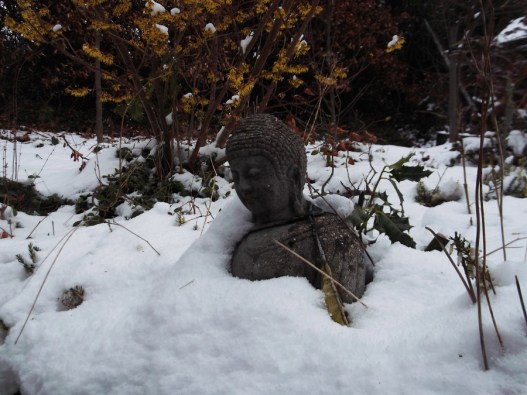
snowbuddha1

What happens now? I asked of Winter.
There is no heat in the sun’s rays. Trees are naked.
Fierce winds carry shards of ice. The voices I strain to hear
Are silent forever now. What’s the script?
What am I meant to do?

Winter, with a scarce-felt fracturing of frost,
Smiles a chill smile, whispers in the wind:
There is nothing you are meant to do. Who knows
How things will be? Be still. Wait.

But I am cold to the bone.
Silence echoes around me.
I chase cold sunbeams,
Look for gold in rainbows and find none.
How will I out-run the freezing of my heart?

I do not know, says Winter,
But I’ll be with you when
You go down to those cold corners
Where under snow and frozen soil
Quiet fermenting and slow gestation
Tick by unperceived;
Where in water beneath the ice, life softens,
Grows drowsy,
Where transformation is incremental
(Too slow to see, too distant to hear)
And seeds swell, shape-shift and shrug off
Chains of dormancy, shattered by cold,
And all is movement in stillness.

See the fire igniting in the ice?
This is not the time of dying.
It is un-reckoned with beginnings.
What happens now? I cannot tell you.
But I will warm you while we wait.

winter1


The Passing of Winter

The winter solstice bonfire wouldn’t light, at first. fire1

Days of heavy rain had soaked the pile, even though it had been cut months ago and the wood was dry enough inside. And much of it was elder, cut back from the hedge and reluctant to catch.

It smouldered, there was smoke, a few sparks, a sad crackle. More paper, more matches, noises of discontent and futility: “it’s too wet, it’s the wrong wood, there’s too much air, there’s not enough air, it’s too late, it’s too dark….”

Three fire witches emerge, with a lighter and boards of something rigid and corrugated. After a judicious dissection and re-formation of a corner of the giant smoky tepee of lank vegetation, and the application of a lighter, the fire-witches address the heap with repeated sweeping bowing gestures, wielding the boards to fan the fire.

fire2The fire catches. It spreads through the pile. Over the tracery of sycamore against the night sky, the smoke billows white and tenuous into the dank, chilly air of midwinter. Brilliant flames shoot skyward. The year, this year which promised and gave so much loss and so much gain, turns slowly, creaking out its bewildering, blistering, beguiling existence through the night, as the fire burns steadily, in spite of the wet, unsuitable fuel.

fire3It burned on through the following  day as well. I tended its last hour as dusk fell, turning in the straggling twigs and prodding the embers buried in the ash back to life. I watched the light fade, and soft rain start to fall, suppressing anxiety as I waited for children to arrive for Christmas, heart aching. And though no returning light is yet discernable in these misty, damp days and nights, for sure the year has turned.

Yule, Christmas, Solstice, New Year…….here’s wishing you all the best. May all beings be happy and at peace.

fire4

Last Flight

pexels-photo-210172.jpeg
Photo by Pixabay on Pexels.com

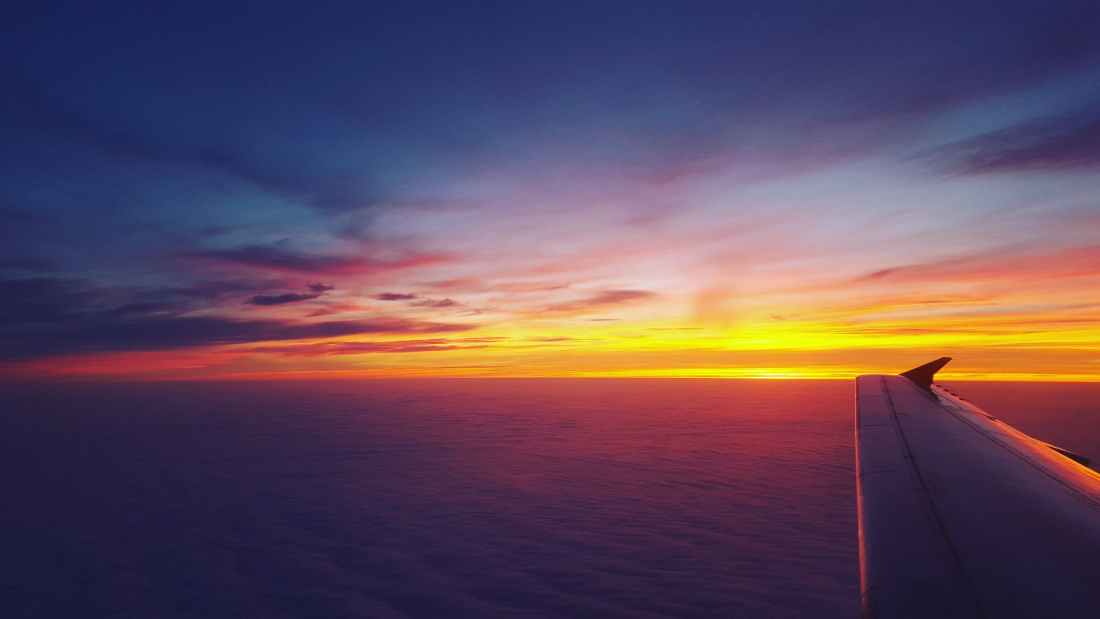
I said I chose not to fly again , except in an emergency. This race to see and speak seems to be emergency enough. I look for the quickest way south. I choose to fly. As the little propellor-plane taxis along, I suppress thoughts of Indiana Jones films and think, this may be my last flight.

It turns out to be a flight like none I’ve had before, a child’s magical birds-eye flight, skimming over a clear, unusually cloud-free landscape at a height where details can readily be identified, and anything not visible is imaginable. I note the snow on the Stirlingshire hills as they retreat behind me. Snow puffs and scrapes across the highest hills of Galloway, and streaks the mountains of England’s lakeland.

I watch the strange, human patterns of fields and settlements. It all looks so much older from the air, like something that has grown organically; haphazard, unplanned. It is the random cracked glaze made by fire on an ancient cauldron, imprinted on glacial landscapes by millenia of human occupation.

I see how nearly bare native trees and unplanned woods snake along river valleys, and cluster beside routes that connect only in a roundabout way; wandering paths and roads that go round things. By contrast, the dark plantation forests of Sitka spruce are bald and angular and the reparations of modern forestry design have done little to alleviate their awkwardness. They still do not fit.

When I next look out, we are passing over Wales. Snowdon and its consort peaks are proud, triumphal, dazzling white and icy, but dark hills lie all around. An extinct Welsh volcano, crimped with snow, broods over a green plain of farms and fields. Its crater hides a cache of snow from all bar those who fly over it. On the Black Mountains, the snow seems to trace the contour lines. It’s like looking at a giant 3D map or one of these models you find in landscape interpretation centres.

Here is an Iron Age landscape, a Celtic domain. Hillforts rise above farmland, the timeless strongholds of Arthur, Merlyn, Caractacus and those who went before. This one has six ditches and ramparts, etched in snow. Its neighbour has only three. And there, quarries and open-cast mines with their working terraces create an optical illusion of hillforts turned inside out.

How green are the valleys, with their wandering rivers and the streams of towns and villages that run along them, made silver by the sun shining on roofs and streets, their buildings,  estates and conurbations making swirling patterns of dots and squares. Way off, Swansea nestles in hard among its cockles and laverbread and all its lovely words, and below lies the black, coal-rippled sand of the South Wales coast.

Crossing the Severn Estuary, the bird’s-eye landscape fades. Features become shadows, obscured, hazy. Cloud lies over Devon and Somerset, a ponderous, doubtful fog. But beyond the unknown, to the west, another landscape beckons. I cannot tell if it is sea or sky, dark streams of cloud or a distant land; lost Lyonesse or the islands of the blest.

aircraft airplane aviation dawn
Photo by Christine Renard on Pexels.com

(I didn’t take any photos on the flight. Even if I had, they’d not be of any use, since I’ve left my phone on a bus!)


Observed from an Exeter bus

music black money entertainment
Photo by Pixabay on Pexels.com

In the cacophony of the high street precinct, there’s a busker. But the appellation doesn’t quite fit. More like a troubadour, a wandering minstrel, shouting out songs, quite badly it seems from inside a bus, to the twang of an inaudible guitar. Notes and words are screened and distorted by the glass and metal of vehicles, the kaleidoscope movement of body-swerving passers by, few of whom give him as much as a glance. Sound waves get corrupted, diffracted, curve away.

He is dressed in quiet brown; muddy, understated. Tweed and corduroy, flat cap and curly brown hair. Behind his pitch a pony cart, jumbled with boxes and sacks, by which presumably he traveled here. Harnessed and patient, the grey dappled pony waits, blinkered, still, at ease. On the back of the cart, a scruffy lurcher rises and turns, to fall back resignedly onto a blanket of indeterminate colour and fabric.

Just as I am being pixie-led into the Wessex of Hardy or the allures of Widdecombe Fair, the troubadour whips his phone from a corduroy pocket, ditches the guitar and embarks on an animated conversation, striding up and down.

While he is thus distracted, people pause, children approach to pat the horse, photos are taken of the photogenic lurcher on the cart.

No-one places coins in the inviting guitar case.


Among the Caledonian Pines

IMG_20191020_153320607

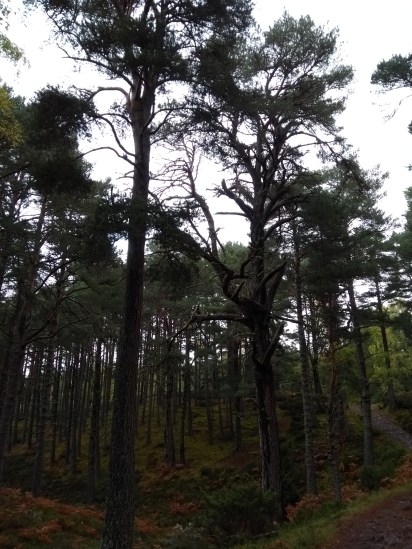
These are free-range pine trees, the Scots Pine, Pinus sylvatica. Not the heavy, lowering plantation evergreens erroneously referred to as pine forest, but which are more likely to be spruce, fir or sometimes the non-native black pine, Pinus nigra nigra. Recognise the Scots Pine by the gingery red of the bark on the upper trunk. Black pines stay grey.

IMG_20191020_102144753.jpg

These pines do not grow in battery-cage rows. They give themselves space to expand, to stretch out to unseen horizons; they live with dignity and grandeur; they are splendid and heroic in their dying. The Caledonian Pine Forest is multi-aged, thanks to decades of careful management to reduce deer predation and facilitate natural regeneration – seed from local trees giving rise to progeny that fits the landscape that made it like a glove. Because of age diversity in the trees, there’s also diversity in height, spread, form and density. That means greater biodiversity. And beauty.

IMG_20191020_102836016.jpg


The forests made by the spreading Caledonian pine are light and airy. The ground is soft with layers of needles, kind to the dog’s arthritic paws, so he bounces puppy like full-tilt along meandering paths and up and down banks and ridges, grinning like a mad thing to encourage his slow, plodding humans.

Look up.

The overground network of branches, which look too heavy for the boles to support, whispers with  the quicksilver flow of red squirrels. Titmice flicker from bough to bough – coaltits in pairs, long-tailed ones in squeaky flocks. There may be crested tits in pursuit of pine nuts, for the Caledonian pinewoods are home to species rarely seen elsewhere. Shy and secretive, many of them, like the Pine Marten; or striking like the Scottish Crossbill -possibly the closest we have to a native parrot. Or the Horse of the Woods,  the iconic, pied Capercaillie, whose shyness vanishes embarrassingly during the mating season, when you really, really don’t want to bump into a male bird.

IMG_20191020_103754987.jpg

Look down.

Roots lie just below the surface; barely visible but easy to trip over. Mosses cover them; the translucent yellows, greens and pinks of sphagnum are almost luminous in the wetter areas. The smell of peaty soil mingles with the soft fragrance of resin and bark. Fringing the shallow bogs are ling and heaths, the former still in flower, blaeberries and ferns. Throughout, fallen twigs and branches, last year’s needles and crackling debris of fern make a thousand homes for maybe a thousand life forms; plant, animal,  invertebrate, bird, fungus and bacterium.

Onto these worlds within worlds, light rain emerges; rain so light, so like to air the raindrops are quantum particles which move and spin, randomly, beyond the realms of gravity. This is light-rain, on a world shrunk to infinitesimally small or seen from afar, from where the Scots pine woods become mere fractal patterns on the margins of time.

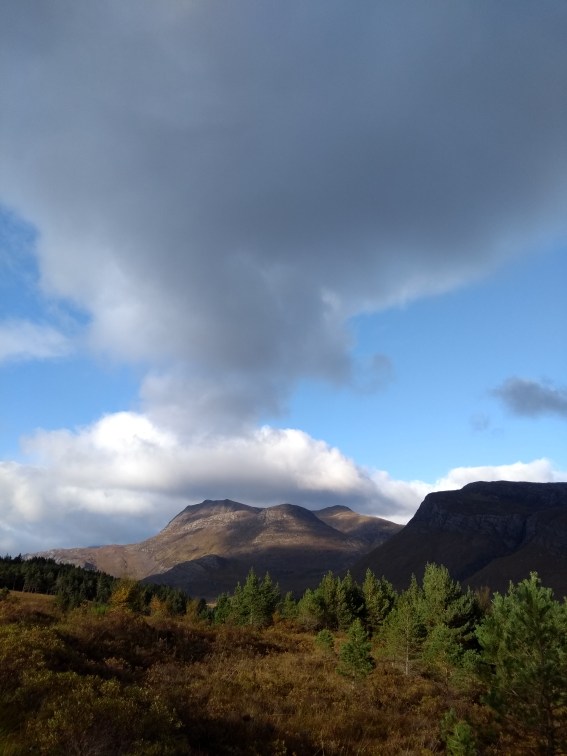
Once the Caledonian Pine Forest was the dominant vegetation type of much of Highland Scotland. It lightly brushed the sides of tall mountains; it thrived on islands in linear lochs, it swept through the glens. Farmers and crofters cleared some of it, but also made homes among the trees, for shelter and because it was a lovely land. Then came the changes, borne of greed, fear and hatred, that nearly pushed the Caledonian Forest and all it nurtured to extinction. Both sheep and the deer on the “sporting” estates which displaced poor or powerless people ate the succulent young trees, preventing regeneration – the story’s well known. Then there was the snatching of the big trees for the war effort. They were cut down to make boxes to store ammunition. Doubtless someone made a lot of money from that.

Now, thanks to hard work, vision and the dedication of many unsung heroes and heroines, the all-embracing arms of old Caledonian Pines are spread wide, young trees erupt vertically, baby trees get underfoot and choose odd places to grow. The trees are back on the  mountainsides. Long may they flourish and grow.

IMG_20191020_151639342