When Leaves Fall

leaffall3

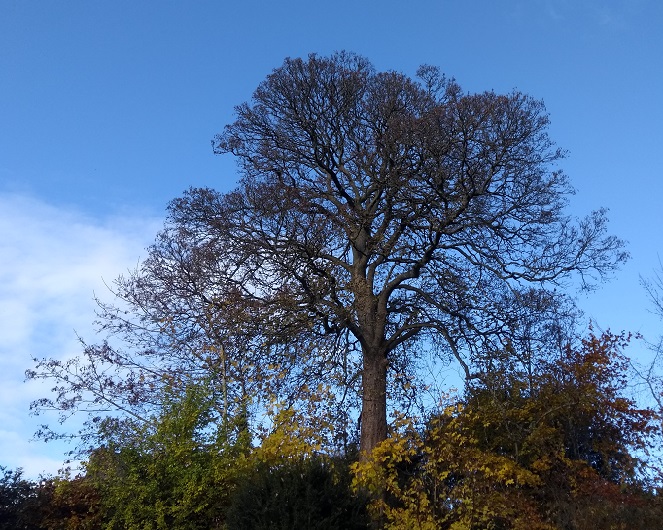
New pictures are drawn on hillside and in hedgerow; the leaves
now start to drop away.

Trees emerge naked
– shy, hesitant, proud, unafraid, with dignity –
sculpt riots against steely skies.

Finely etched tracery of birch; yellow clouds of leaves
flutter, discarded, on winds grown icy.

leaffall1

Brown-cloaked oaks, stubbornly clinging to summer
angular knees and elbows showing through threadbare fabric.

Sombre sycamores statuesque on the skyline,
Leaves already shed, yet fuzzy with progeny:
Seeds in clusters wait the November storms.

leaffall2

Needles of larch whisper away on water
Lie silent and still on forest paths.

When leaves fall
Tiny buds of spring curl dormant in leaf axils, and wait.

Glacial Loch: a Tale of Horizons

Loch Leven in Kinross-shire, along with Clunie Loch and Loch of the Lowes (and the ospreys) in Perthshire, and Scotland’s only Lake, the Lake of Menteith in Stirlingshire, was scraped out by glaciers in the Ice Age, then filled with sand and gravel as the glacier retreated – and hence is shallow, broad, wreathed in strange mists, and horizontal in tone. Wide enough to be a honeypot for thousands of wildfowl in winter, secret enough for a Queen to be imprisoned on one of its islands, shape-shifting and elusive enough for ghosts and rare species.

lochleven1

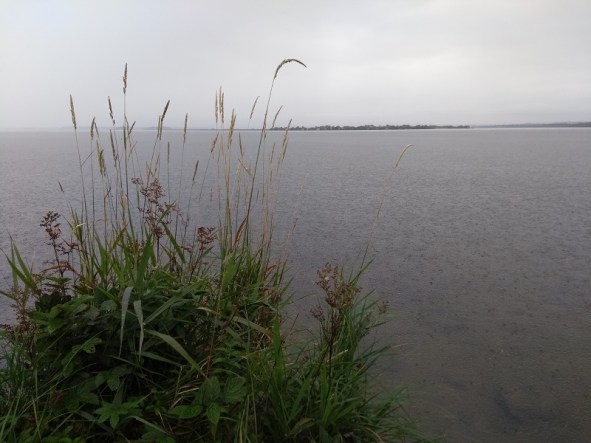
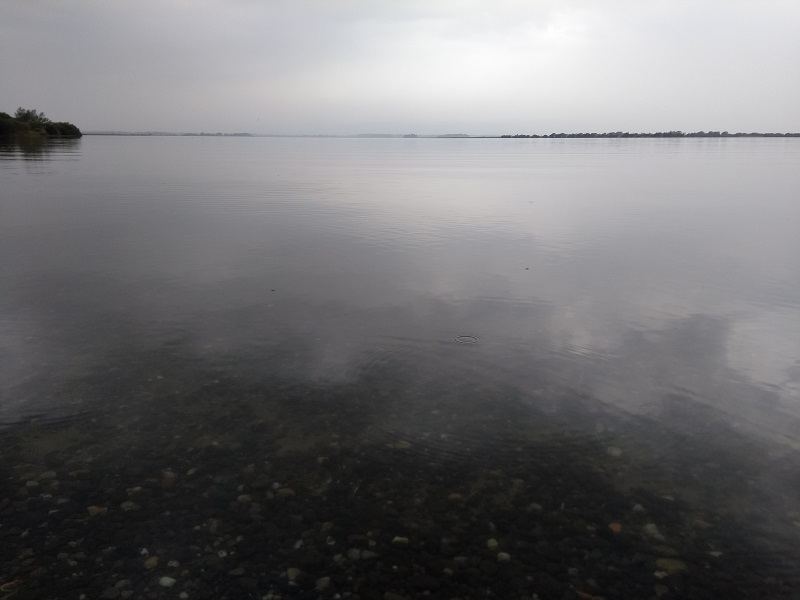
Walk around its margins; there will be places from which the opposite shore can barely be discerned. Go on a grey autumn day when the rain in the air seems suspended in horizontal bands, and upsurging clumps of grass and reeds appear discordant, almost angry in their violation of the horizontal.

lochleven4

Here and there you’ll find beaches, sandy from the glacier’s retreat; the wind makes small glacial waves that smell of no sea but fool the dog – and then it becomes still. Bands of horizontal clouds are reflected in the mirror surface of the water; subtle stripes of cream and grey and black and white, settling on the horizontal tops of the surrounding hills.

grassofparnassusPockets of peaty marshland, studded in autumn by vivid blue sheeps’ scabious and emphatically solitary flowers of the Grass of Parnassus, spiral around flat pools of oily water, reflecting snatches of sky. Larger raised bogs, pillaged in previous centuries for their peat, lie flat and sullen. When the peat was no longer wanted, they grew conifers on the “useless” land. lochleven5Now the conifers are retreating after the long-forgotten glaciers; the water returns; dragonflies, amphibians and sphagnum once more fill the horizontal expanse between the forest.  Heaths and ling guide the trespasser to the dryer paths, and felled branches bridge the bog where water maintains its horizontal sovereignty.

lochleven6In fields by the loch, the damp rises in horizontal layers, coating logs and stumps and gate-posts with moist, green mosses and algae. In one field a whole tree fell, years ago. In this damp environment it has not died, but adapted to its horizontal status and continued to grow; a miniature forest of shoots, epiphytes and primitive plants along its horizontal trunk.

lochleven2

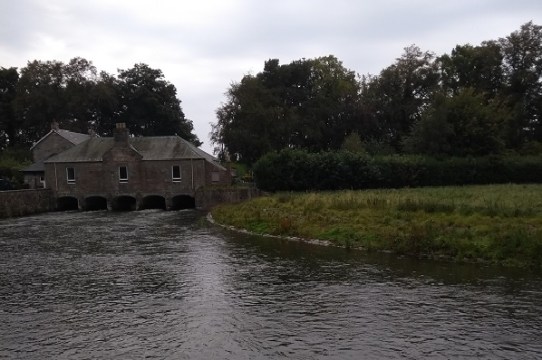
The old river, the Leven, first to score a path through the glaciated landscape, tears out of the loch at the Sluice House, which straddles it, flat and low, and flows out to feed Fife, rural and industrial. Its lines are also straight and keenly defined; kingfishers dart horizontally beneath overhanging branches. Ripples march in military formation downriver.

Quiet, grey, the glacial loch behind you retreats into its bands of mist, its unseen wild occupants, its secrets and loveliness.

lochleven3


The Unseen World beneath Troops and Rings

First off, let’s be clear. There is no such thing as “mushrooms and toadstools”. Really. They are all just different species of a particular group of fungi. The “mushrooms” you buy are developed from a species called Agaricus bisporus. There are lots of other “mushrooms” in the genus Agaricus, including the tasty Field Mushroom, Horse Mushroom and The Prince of the Woods. There’s at least one poisonous “mushroom” in the Agaricus group – the Yellow Staining Mushroom.

They could all just as easily have been labelled toadstools.

Resemblance, or relationship, to a nice safe shop mushroom is no guarantee of edibility. I’m going to call all of them mushrooms in this post. That doesn’t mean you should eat them if you find them. That’s the public health warning over.

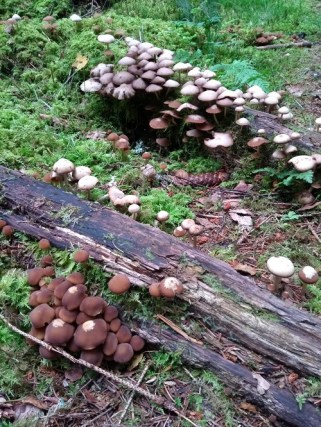
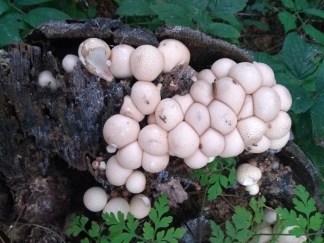
Whichever species or type of fungus you have spotted and admired in woods and fields this autumn, you’ll have noticed that many of them appear to like being in a crowd. A nicely-rotting stump (that’s another fungus, by the way, assisting with the rotting process), may be festooned with troops of mushrooms, all of the same species. They can be mushroom-shaped:

troops3 troops4

Or completely bizarre:

troops1


But it is obvious they are “growing on” the stump.

troops2

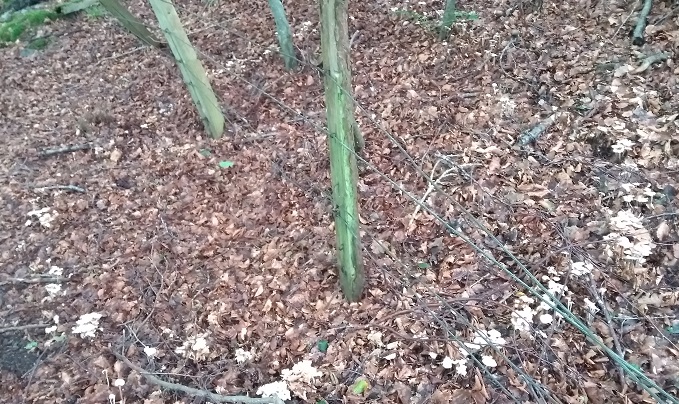
Often a troop of mushrooms appears to be just coming from the soil, and you wonder, if that’s the case, why they have all congregated together in a wavy line, like an army on the march. If you were to dig them up (please don’t!), you’d probably find a buried root of a tree, living or dead. What appears to be lots of different mushrooms of the same type is actually all one organism. Inside the wood, fine, tangled threads called hyphae join to make the main “body” of the organism (the mycelium). And the mycelium naturally runs up or down the host – in many cases a root or buried stump, or dead branch. When the conditions are right for reproduction, the mycelium sends up the fruiting bodies (the mushrooms!), to form and shed spores. (Roots, flowers and seeds is the usual analogy).

Fungal mycelium can grow through all sorts of media, not just wood. Dead leaves and grasses, straw, manure of all kinds. Some are bizarre: ripening grain (Ergot of Rye), human skin (ringworm and athlete’s foot), bread (penicillin), caterpillars (long Latin name I’ve forgotten), potatoes (blight), other mushrooms (Boletus parasiticus, related to the gourmet delight Cep or Penny Bun).  Toilet rolls and paperback books – oh you haven’t lived unless you’ve harvested your breakfast Oyster Mushrooms off a toilet roll! (unused, of course). In the course of its life, fungal mycelium also forms mutually beneficial associations with the roots of trees and other plants. Without fungi, it’s unlikely that our planet would support vegetation – and thus animal life – in the way that it does. You may have heard of these associations. They’re called Mycorrhizae (fungus-root), and gardeners can even buy them in bottles to get their favourite trees off to a good start.

fairy ring

The other thing the mycelium does, or appears to do, is grow in rings. All fungi grow like this, I think. Well, most of them anyway. Why do you think ringworm got its name? Think of the lovely (well, to a mycologist) concentric rings of Brown Rot on apples or plums. There’s huge variation in size and scale of course, but they all start as some kind of joined up patch, and grow outward, making a bigger and bigger circle. The fruiting bodies appear on the edges of the circle. With mushrooms, this gives you a “fairy ring”. Where the mycelium is decomposing on the inside part of the ring, nitrogen is given off. Nitrogen is really good for green plants; and if we’re talking a lawn, you’ll find that the grass just inside the ring of mushrooms will be lush and dark green. Once the organism has grown out the way, the centre dies off. (Sometimes the grass does, too, which is why fairy ring mushrooms are not viewed with approval by greenkeepers and the likes of folk who treasure lawns of even and controlled green-ness and height.)

Fairy rings will just keep on growing outwards, unless something happens to kill off the entire organism, and push up mushrooms on an annual basis. Each year, they’ll be further apart. Some can stretch across the landscape for miles (though it gets harder to track the ring of mushrooms) – but it is still all one organism.

Always look – or think – below the surface!


Unforgiving Minutes and the Tyranny of Time


think2

My mother liked to recite aloud the poems she learned at elementary school in the 1920s. These poems were generally heroic, patriotic, moralistic, meant to be uplifting in a time of post-war depression. Rupert Brooke, then, not Wilfred Owen. And lots of Rudyard Kipling. His famous poem “If” was one of her favourites. The last lines begin:

“If you can fill the unforgiving minute
With sixty seconds’ worth of distance run…..”

The Unforgiving Minute has dogged me like the grim reaper ever since. What if I don’t fill it? What if I waste a minute – an hour – days – years? What if Things Don’t Get Done? Over the years, I have felt guilty when I’ve been unwell. I’ve developed elaborate “multi-tasking” strategies like typing up party minutes while chatting on the phone AND watching an improving TV documentary; reading books on cosmology while watching less challenging stuff like Midsomer Murders; affecting to meditate while gardening AND working out what’s for dinner. Trying to bake bread while cleaning out the shed and answering emails is why my sourdough is such rubbish. I’ve had “holidays” where each day is planned and packed with minutes full enough to be righteously forgiven. I’ve created endless, bewilderingly enormous to-do lists, for a day, a week, a year. When I’ve finished everything on the list, I tell myself, I’ll have a rest and choose for myself. That never happens. I just start on the next list.

The fashion for having “bucket lists” doesn’t help. Ticking boxes, like bagging Munros, can be fun, but distracts from living and relishing an actual experience. Sure, there are things I’d like to do before I die (Ben Lawers, talking of Munros, to see the alpine flora, if I can find someone prepared to go at my glacial pace and not make me feel like a decrepit numpty for wanting to take all day about it). But I’ve had it with compulsive list-making.

Another much-loved poem at home was A.E.Housman’s “Loveliest of Trees”.

“Now of my four-score years and ten
Twenty will not come again
And take from seventy springs a score
It only leaves me fifty more

And since to look at things in bloom
Fifty springs is little room
About the woodlands I will go
To see the cherry hung with snow.”

However, as I’ve watched the balance of my years passed to years conceivably still to come tip, and now that I’m well on the light side of time, I observe that each of my remaining springs affords more each year than a tick-box opportunity to enjoy the blossoming of the gean, and all the other flowers in the woods. Savouring the intensity of each moment more than compensates for lack of time.

And what is time anyway? Not what you think it is. At the speed of light, time freezes altogether. I’ve read enough Stephen Hawking to dimly grasp that if I could fire myself way up into space, my unforgiving minutes would get longer, become hours even, to someone watching me through a giant telescope from Earth. But not to me; up there they’d still be minutes, because time only operates from the point of view of the observer. (Or something like that.)

So, as time is not fixed, but wavers around according to the laws of relativity and probably does something completely different on the quantum level anyway, let’s not be tyrannised by it. Let’s have more minutes with no guilt attached when we don’t fill them. More watching the clouds, less time trying to re-create them on canvas. Less grubbing around in borders and beds that will never be weed-free, more lying in the hammock watching the dandelion clocks expand and blow. More love and laughter, less – or no – time spent trying to prove it exists in our lives by frenetically posting the evidence on facebook.

More randomness – more random writing, perhaps, without fretting to meet self imposed blogging deadlines?

Loch Maree

Kipling finishes:

“…yours is the Earth, and everything that’s in it,
And, which is more, you’ll be a man my son.”

Really?? The Earth is not mine, or yours, or Kipling’s. It does not belong to the human species at all. I don’t want to own or master it and nor should any of us – we’re already proving we’re not much cop at that.

And let’s not even get started on Edwardian gender balance!

Winter Geese

geese

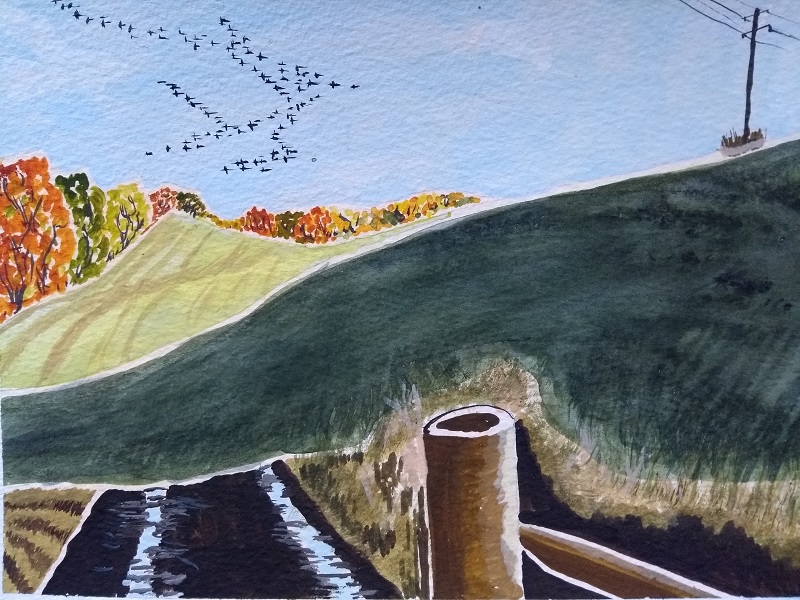
Breathing in, the air is clean and cold, that sharp tang
That preludes winter, edging around frost and ice
But not there yet.
Horizon endless, sky that translucent pale blue – a trail of smoke
Distant, wavering,
Moves towards the watcher in the field.

Earthbound, crows prod lugubriously at the stubble,
Clumsy pigeons clatter from tree to tree, voracious,
After each other. High above, the smoke separates,
Cries out exultant, forms streamers and ribbons,
Waves in and out of formation, as the winter geese pass.

In the marshes and seawalls of Essex, long ago,
I watched through binoculars the arrival of the little Brent geese,
Who stayed with us all winter, sweeping up and down the estuaries,
Squabbling and crying for joy in multitudes in reclaimed fields.
Here, Greylags and Pink-foots (I can never tell which) mark the season:
The harvest-home, the burning leaves, the smell of turned soil.

Once a Pink-foot landed, exhausted in my garden, left behind,
Confused maybe by the demands of Goose and Gander for their breakfast.
We fed and watered her, marveled
how small she was
Against our farmyard geese. The next day she was gone,
As the morning skeins’ urgent calls measured her pace and purpose.

Solid yet ephemeral; never to be held;
An instant of joy in an ever-changing and darkening sky;
Winter geese, this moment, here and now.

The Gorse Tenement Spiders of Perthshire

“When gorse is out of flowers, kissing’s out of season,” so the saying goes.

That’s one use for this for this furiously jaggy native shrub, also known as whin, or furze. Since flowers can be found on a gorse bush in every month of the year, it’s a license for affection. A light tea from the deliciously coconut-scented flowers is another purpose; the same flowers are an ingredient in natural dyes. Sounds highly unlikely, given that horses have sensitive mouths, but allegedly the dry branches of gorse, thorns and all, are a nutritious feed for these beasts. The plant’s tendency to seed, spread and steam all over any unsuspecting tract of slightly open ground might be off-putting to the gardener, but there’s little doubt it makes a good deterrent for invaders and intruders.

Do we reckon the value of a plant only in terms of its uses to humans? Too often! A hillside bright with gorse will not only gladden the human eye, but it will provide pollen and nectar for a range of bees and other insects. A gorse bush is an ecosystem owing nothing to our interference.gorsespiders2

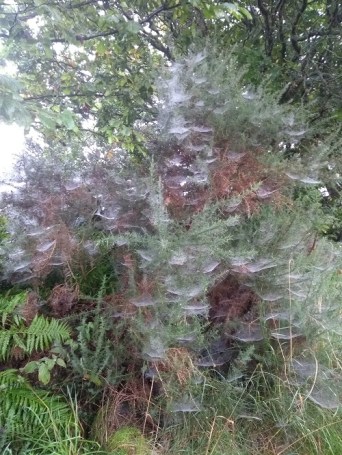
One autumn morning – the kind where damp mists hang low and the sun is watery and out of sight, I came upon the Spider Tenements. I did not see a single arachnid – nor yet a gorse flower! – but the fog condensing on the gossamer revealed each web on these gorse bushes in elaborate detail. It also revealed the happiness of spiders to rub shoulders (knees?) with one another in close proximity. If one web equals one spider, there must be hundreds on every bush. They don’t mind the jagginess; obviously it gives them lots of points for attachment of their superficially haphazard cobwebs!

gorsespiders1


I wonder how many small insects were caught on this bush today. How many webs do you think there are?

And does anyone know what kind of spider my gorse-loving, tenement-dwelling pals might be?


Not a Tay Bridge Disaster


taybridge1In a fright of frustration and indecision you stream from the house. Too much time alone, too many choices, too many restrictions, too much procrastination – poring over maps in search of something new, too much squinting at Google Satellite to find new paths, no decisions made, no enthusiasm kindled.

Just the need to get out, though the day is grey with bubbling clouds and the threat of rain.

Aimlessly through Perth, getting a few messages on the way. Drifting, still without destination, towards Dundee. Missing the road to the towering volcanic hill where the dragon (probably) still resides in his Hole, squatting on his bed of garnets and Perth May maidens. That would have been a good walk. Too late.

Abruptly turning off the dual carriageway to Errol and the Carse – but let’s not repeat the same old paths twisting in and out of the reed beds. Look out for a new sign, somewhere different, something – anything – new. Oh, missed one, wonder where that went, too late, never mind. Suddenly, you’re skirting the edges of Dundee – how about Riverside Park? What all this way for a semi-urban park? Maybe… oh, too late, you missed the turn-off. Guess what, the sun is out – that’s Dundee for you, Sun City, Yes City, smiling streets and sparkling water, and the V&A looking glassy and coolly remote as it strains toward the ocean.

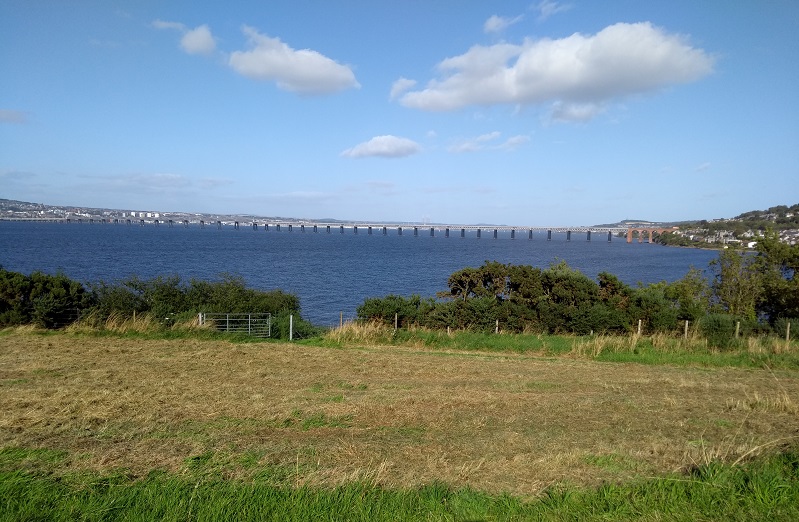
Woops – and you’re on the Tay Road Bridge, heading for Fife. Desperate to walk and you’ve been driving for an hour, so you stop trying to choose and roll up in Wormit, under the shadow of the rail bridge, that eternal prompt for disaster. It’s mid-afternoon, and you skirt the narrow estuarine beach and climb onto the breezy, sunny cliffs of a hitherto unexplored stretch of the Fife coastal path towards Balmerino.

taybridgetrees
And the rushing, crossness, dissatisfaction and sense of time wasted starts to recede. You slow down. You breathe more deeply. The dog potters. Through twisted, moss-covered trees, tangled with ivy, ruined boathouses and animal tracks are glimpsed. The city twinkles at you from across the Firth, as wide and blue as the clamoring, exulting East-coast sky.


taybridgeseal

A mysteriously stranded and petrified seal basks on the grass, making a seat for warm and heady contemplation of how beautiful the world is, how long the day, even in September, and how fortunate the indecision that led you here.  Steep coast-path steps, down and up; a hedgerow heady with honeysuckle; crackling of dry grass and the twang of boot on stone. Trickling burns through the undergrowth, ferns and moss and fungi in the gloom, then out, out again into the laughing sunshine, up through meadows, down to the lucky houses clutching at the shore.

Later, a forest, a young woodland of oak, rowan and sorry-looking ash, nudging the older trees, and the pines and firs of previous plantings. Shadows flicker between them; dogs explore, accompanied by knowing locals on paths uncharted by Google maps; Kirkton and Balmerino are near.

You circle the village, fine and high above the Firth, and now as you return the sun is cooler, the air relaxed, the forest empty, chilly and very slightly intimidating. You pick up pace. After all, you started late and the nights are drawing in, and the sun is being sucked back west of Dundee.
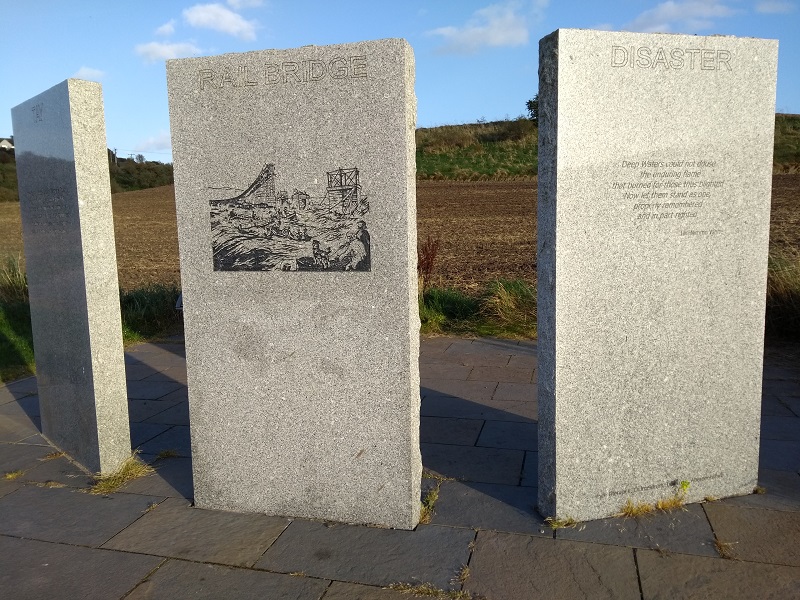
taybridgememorialBack at the estuarine beach, nearly under the bridge, you notice the memorial to those killed in the  Rail Bridge Disaster. You were in too much of a hurry to see it before. And you stop, and rock to and fro on the tiny jetty, as the dog paddles and sniffs at stones and seaweed.

There was no disaster here today.

Midstream

river trees

In the past ten days, two friends have died. Not unexpectedly, no shocks. A couple of weeks ago, when they were both still alive, everyone and everything around me seemed painfully mortal, and this poem is what I wrote then.

I cross the bridge, but
Midstream, I stop.
So much water, passing under.
I cannot hold it back.

Midstream – upstream – a dipper,
Mischievous, concealed among stones and ripples,
Bobs, and waits.
Midstream – downstream – a fisherman
Casts and retrieves, over and over,
Silent, focused, amid swirling water.

I, too, have cast,
Over and over.
But now my line diffuses and is lost in movement
And what, now, is left to retrieve?

fiddle treeBy this great river I sit
Beneath the fiddle-tree,
A gnarled and feathered oak, gashed
By storm, decay and distant ghosts of song.
Riverbank trees, like frozen statues, arch and crane,
Their token reflections broken
Like dreams in the midstream of sleep.

On dark ripples, tiny sounds of water on water,
Midstream, the undercurrent
Chases the rain from highland to lowland
Into deeper water yet.

Midstream, unseen fish bestir
And battle homeward. But I
Am snagged, log-jammed, midstream
Watching lives flow on and vanish into river,
Slippery, elusive as salmon, impossible to hold,
Passing, on unfathomed journeys, beyond my sight

While I stand helpless and wait
Midstream.

The Blood of the Ploughman

bloodyploughman1

Have you ever been seduced by those advertisements in colour supplements for NEW! UNIQUE! varieties of fruit or vegetables accompanied by dazzling photos of their technicolor extra-ordinariness? The exciting modernity of red-fleshed apples is one example of excitable marketing – and many fall for it.

But rosy-fleshed apples are not new. Discovery, an early-ripening apple bred in 1950, is one example, and deservedly popular. But this is a story of a much older apple, first recorded in 1883 – but who knows when it first appeared….

Once upon a time, when the Carse of Gowrie – that rolling, flat and fertile plain of drained marshland on the north side of the River Tay that stretches from Perth to Dundee – was famous for its orchards, a weary ploughman was plodding home after a long day in the field. It was September, and an Indian summer, the sun had been blazing all day and the ploughman had finished his drink early and was very thirsty. To get home more quickly, he decided to take a short cut through the orchard of Megginch Castle – one of the finest orchards in the Carse.

As ever, the productive trees of Megginch were laden with fruit; apples of every type and colour, small, golden Scottish pears, plums and damsons. Many were ripe and even falling into the long grass. The tired ploughman thought how handsomely a ripe apple would quench his thirst and assuage his growing hunger – it was past suppertime.

Well,there was nobody about, and surely no-one would begrudge a hard-working labourer a windfall, so the ploughman helped himself. So delicious was the apple that the ploughman was struck by the idea that to leave these windfalls would be an awful waste, when his wife could make good use of them in the kitchen. The gardeners had all gone home for the evening, so who would notice? The ploughman began to fill his smock with ripe fruit, as the light began to fade from the day.

A warning shot rang out, and a furious cry: “STOP THERE, THIEF!” The ploughman swung round, and recognised the loping gait of the estate gamekeeper coming toward him. He began to run, apples held tightly in his smock. “I’m warning you man!” called the gamekeeper, but the ploughman blundered on. There was the sound of another shot……

At this point the story grows different arms and legs and embellishments depending on the audience and who’s telling the story. I confess to my part in encouraging flights of imagination. For genteel adults and those of a sensitive disposition, the story goes that the ploughman was wounded but escaped, managing to get home with at least some of his “stolen” apples. For children, the gorier version suits, and if you can throw in a ghost, so much the better.

So, either the ploughman fell, shot dead, in the orchard, his apples scattered, or his disgusted wife patched him up, but threw the apples on the midden to teach him a lesson. Either way, one of those blood-streaked fruits set seed to become a  tree the following spring. And when that tree was grown, it bore dark red, deeply ribbed apples that ripened on the anniversary of that day in September when the ploughman was shot. And when the crisp, thirst-quenching flesh was sliced, the flesh of the apple was streaked and stained with the ploughman’s blood.

bloodyploughman2

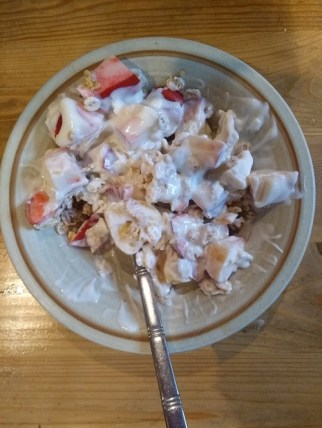
Thus was born the famous Scottish dessert apple, the Bloody Ploughman. From the dwarf tree in my garden came this exquisitely juicy, neither sickly sweet nor yet sour, apple for my breakfast, with cereal and yoghurt.

As for Megginch orchard, it’s still there, not just surviving but thriving. After all, it’s practically next door to the Cairn O’Mhor cider makers. Many of the old trees from the age of Victoria remain, and still bear excellent crops, but also there is a new orchard of modern, productive varieties, and a new heritage orchard, containing all the Scottish apple varieties that can be found.

You can be sure the bloody ploughman found his way home safely.

Magic Moments, New Toys and the Bread of Heaven


breadofheaven

I continue my obsession with the micro-organisms that make bread. The sourdough starter got filed in the fridge for a while when I became enthused with spelt. Spelt flour is made from a grain that is like wheat, but not a variety of wheat. It’s engagingly described by marketing types as an “ancient grain”. It makes, really, really nice chewy, flavoursome bread with yeast and honey and olive oil, and it’s very quick to rise and do its thing (unlike sourdough, for which, I now know, you need patience, planning and much mindfulness.) One supplier calls spelt bread made this way Roman Army Bread. No wonder the Roman army was a conquering one (except in Scotland, of course!). I noticed that even with this easy bread, my technique has improved through slaving over the sourdough. I am no longer tempted to flour the worktop.

Anyway, this week I go back to the sourdough, and duly refresh (or feed, though apparently that’s the wrong word) my dead-looking starter. I pour away most of the black oily liquid on top of the jar, stir the rest in, and add roughly equal amounts of warm water and wholemeal Rouge d’Ecosse flour from Fife. Same again next morning, except for the black liquid, which has vanished. Being besotted enough to sit and watch, I can scarcely tear myself away when small whirlpools, bubbles and movement began.

That magic moment when your sourdough starter says thank you for breakfast!

Now I’m looking forward to using all the new toys I got for my birthday – a baking stone you heat in the oven that I’m told will make all the difference to my spreading, cow-pat like bloomers, the scraper that will preserve the kitchen sink from becoming a nursery for yeasts and lactobacteria to proliferate because I can’t get all the sloppy dough off surfaces, bowls and hands; a magic kneading implement to which the dough mysteriously doesn’t stick, a slashing knife, and a Very Deep Tin.

Thanks to the confining nature of the Very Deep Tin, dough has no choice but to go Up. Thus I produce the above Bread of Heaven, with a chewy salt and pepper crust under which lies a cavernous hole – because I forgot the slashing bit to let out gas while it was baking.

(Three days later, I completely wreck a freestanding loaf by cavalierly forgetting to weigh the right amount of production starter I put in, and using nearly double the appropriate quantity…. The dough refuses to leave the proving basket and I create a 2cm high pancake, baking stone or no baking stone. It made a good savoury bread and butter pudding mind.) 

I’m still learning… !