The Morning After

unicorn mushrooms

The morning after the march I went mushrooming again. There were no mushrooms of any kind left in the fridge. I nearly didn’t bother, because I was dog tired, and, after all, I would pass at least three supermarkets in the afternoon.

But something about the air that morning was irresistible. Cool, zinging with the promise of sunshine; light, ethereal and just a little autumnal; dust motes and electrons dancing a jig. The dam and the woods and clearings energised and soothed simultaneously – an antidote to the adrenaline that had kept me up and awake till gone 2am, head birling with ideas and reflections and hope no anxiety could dampen.

Every secret hollow, bank and bog in my regular itinerary yielded something edible. Shaggy Inkcaps standing like soldiers, Hedgehog Mushrooms like tiny undercooked loaves, spiny as urchins beneath, chunky Orange Birch Boletes that go alarmingly black when you cut the flesh but taste divine. And a few late Saffron Milk Caps, only slightly infested.

jed Rohallion

The sunny gold of Chanterelles glistened like the yolk of a happy hen’s egg. Deer came skipping coquettishly out from the wood and crossed in front of me, one of them practically pirouetting in her glee – anticipating perhaps, the rutting season nearly upon us.

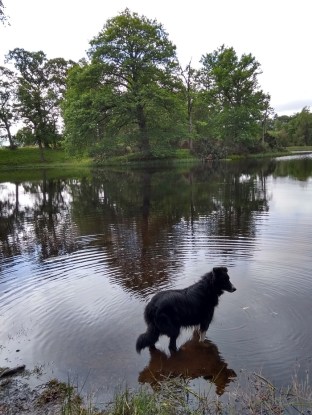
From my dog gazing lovingly at his stick floating away on the loch to the shafts of sudden sun on the ripples he makes, from the happy brown collie and his owner to the mute swans and their big grey babies – the morning after, all of Scotland seems to be smiling at me.

A Big Hoose and its Carriage Drive

airleywight drive

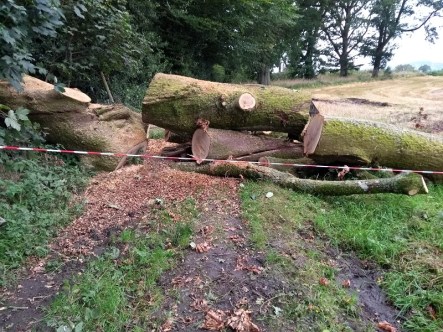
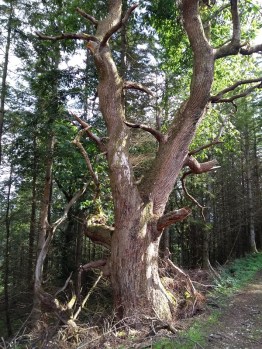
Another giant tree that was part of the avenue lining the old carriage drive has come down. Every year, one at least succumbs. They are mostly beech, monumental now, out of scale with the straggle of the village and the low fields that sulk under the weight of rain and ripe barley.

airleywight4

The carriage drive is a ghost of former times, looping importantly around the grounds of the big hoose that now peeps sheepishly out from behind its deer fences and the remnants of redwood trees, the choice rarities, status symbols prized by landowners two centuries ago. Then, it all belonged – carriage drive, trees, big hoose and all – to the Wylies of Airleywight. To be honest, James Wylie probably owned most of the village, and built a fair whack of it too. He owned my house, and, though long dead, may well still own the rough road on which it lies. (Nobody else claims it, despite rumours that it might be the property of the Bankfoot Light Railway, also long dead.)

A footpath follows the line of the carriage drive, side-stepping the remaining beeches. Here and there, minor land grabs seep into it. A corner of field here, children’s dens there, new tracks, sheds and barbecues. A shady allotment of raised beds fingers into it, created by someone in the adjacent scheme with access to Heras fencing and a tendency to self-sufficiency. In the woods beyond the house, where the Garry Burn streams by, a squarish, sunken, shallow bog is still called The Curly by successive generations of schoolchildren, out on bikes and skateboards, building jumps. If you hunt among the rank vegetation, you’ll find the metalwork that filled or drained the pond for icy games enjoyed by residents and visitors to the big hoose at Christmas.airleywight2


Where the carriage drive seems to end, the footpaths continue, past what’s left of the huge walled garden. Now a forest of self-seeded trees occupies the space where fruit, flowers and vegetables once were expertly raised on the south-facing slope. They tower above what’s left of the crumbling, ruptured walls. Who knows what horticultural sleeping beauties may still lie dormant at the heart of the garden?


The cottage near it lay abandoned save by the swallows for many years, still graced by bursts of surviving garden flowers among the thistles in summer. The butterflies loved both. Was it the gardener’s house? Or perhaps the coachman for whom the drive was made? The village architect has renovated it to picture postcard perfection. It looks content, roofed, aired, cultivated – but not extended. Nearby he built himself a house of traditional, solid materials, that so fits the landscape in style it has become part of it. Already there are lichens on the roof and leaves in the gutters. The swallows and martins nest easily in the eaves and outbuildings.airleywight3


You get to the big house now by a difference entrance, made significant by statuary, but no carriage drive. Of the latest owner, and what they plan for their gardens, curling ponds and steadily declining avenue, there is no word.


Earth Apples

IMG-20190819-WA0003 (2)

So up they come, the Second Earlies,
Along with a cable tie, three plant labels,
The remains of a scouring pad that’s been through the compost heap
And limpet, oyster and mussel shells
That went in with the seaweed
(of which there’s little trace now),
And a wealth of sand, in spring.

Apples of the Earth, buried treasure!

Lift them all, if you can find them all,
Even the tiny ones destined for the hens, but know
Volunteers will still mysteriously spring up next year.

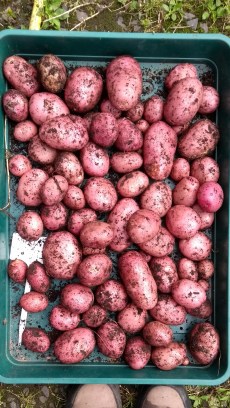
And there they are, washed and waxy.
The few speared by the graip’s narrow tines
(So infuriating!) will be dinner tonight.
Creamy Marfona; yellow and red-mottled Inca Belle;IMG_20190819_134228596
Shocking pink Maxine; improbable Shetland (not-quite) Blacks,
Who’ll burst apart at a mere puff of steam.

Still to come: red Desiree and the Redoubtable Pink Fir Apple,
September’s treasure trove.

Buried treasure, apples of the Earth!

Mushroom-hunting, between Lowlands and Highlands

mushrooms1A full evening, two nights and two days of rain. Humidity hangs in the air, the soil beneath my feet pulses damply, the mosses are full and green. Raindrops still coat every flower of grass and frond of bracken, but the sun is shining. The timing is right.

I go for mushrooms in the place where the Highlands meet the Lowlands, where the land is rent by fault-lines and rainbow-coloured slate out-crops and erupts. I pass the court hill where outlaws were tried and hung from the oak trees of Birnam Wood, three hundred years after Macbeth was king of this nation. I stalk through the devastation where the larches were, before they got phytophthera and were felled. There is nothing there now. But in the crowded wood beside the path, one big larch has been missed, and the sun shines in tawny patches upon last year’s fallen needles. It catches on a small group of Larch Boletes, glistening and tawny themselves in their cosy cohabitation with the tree. I take one. A deadly Panther Cap smirks nearby and I ignore it.

Broken and battered, an old sweet chestnut tree ismushrooms3 surviving the metallic blundering of the foresters’ vehicles, harvesters and forwarders, along the track. How did it get here? Not a native tree, so planted a long time ago, when this haphazard forest was occupied in a different way. Who planted it? Did they hope for chestnuts to roast on autumn fires?

I follow the hint of a track down a slope towards the thicket where rhododendron is making its usual bid for world domination. No more than a wisp of trodden grass and bent fern, my path diverges and peters out at a crop of the biggest chanterelles I’ve mushrooms2ever seen, tucked into the side of a rugged bank that oozes water. Was this path made by a human who knew where to look, or by another animal? Someone told me yesterday that the best chanterelles are on banks and slopes because the deer can’t graze them there.

I’m always competing with other animals for my dinner. But I’ve had lots of chanterelles this summer and there is still a dish at home in the fridge. I take a couple. I have rules when I’m foraging. Never take more than I need, only take a percentage of whatever I find, leave old mushrooms to sporulate, leave young ones for tomorrow, for the next predator or none, for others just to see and love.

Under birch, I acquire some young Brown Birch Boletes and a single Cep. Ploughing through forest, I note the tiny horsehair mushrooms are up and about, trooping on twigs and the needles of conifers. I ignore, too, the many “wee brown jobs” of mushrooms that once I diligently took home as single specimens to try to identify with hand lens and spore print. Some I succeeded in pinning down, too, only to forget them altogether until I came across them again in another wood, another year. Life’s too short now, I am focused on my prey.mushrooms4

Huge shaggy mushrooms shout out to me as I pass another grove of conifers and I am lured in. But they are the uneaten halves of massive fir cones – red squirrels have eaten the succulent tops from every one, and laugh at me from the tree tops.

They cluster in the fallen forest by the dam, the new flush of Saffron Milk Caps, just where I thought they’d be, and just at the right stage before the fungus gnats lay their eggs. They are sound, and plentiful and could make a wonderful painting, with their improbable colours of orange, cream and khaki-green. But they won’t, for I take my portion and weave them into a spell of dinner.

mushrooms 5

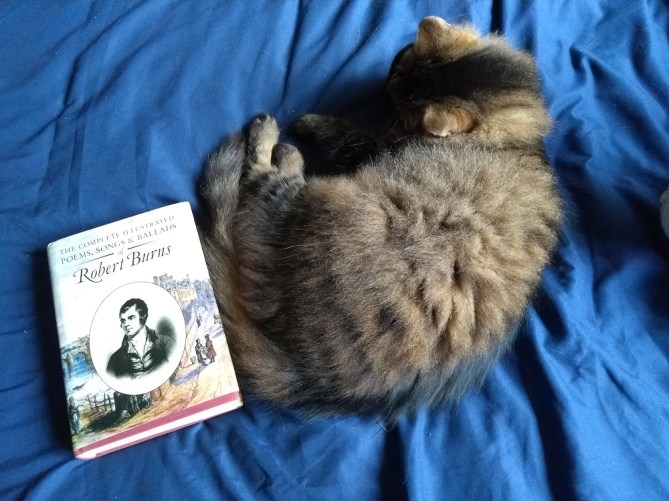
Hope, Fear, Pride and Rabbie Burns

burns and zebs
When you wake up literally singing line one of a Burns poem
“Is there for honest poverty….”
and you can’t remember what you were dreaming
and you open the curtains on another dreich day
but look, the rain has paused
and the news is as horrible as yesterday, maybe more so,
but Out of Doors is on Radio Scotland
and all your pets seem to be arthritic or spewing megalithic fur-balls on the bed
but it’s your partner’s side of the bed
and the weeds have grown a foot overnight
but the wren’s firking about in the compost heap
and swallows are lining up on the wires, considering Africa
but they’re still here and chattering
and there’s bread to be made and flour sacrificed to the god of sourdough
and after all, Rabbie Burns was young and might be cut some slack for his faults,
and Ian McKellen is coming to Perth for a Pride rally
and might he not just cast a spell or two?
and a mediaeval fayre will be filling the town
but you’ve got a bus pass
and things might get worse but

this is Scotland and

“for a’ that, and a’ that, it’s coming yet, for a’ that,
that man to man, the world o’er shall brithers be, for a’ that”

statue

HOW DID YOU WAKE UP THIS MORNING?


On Doodling

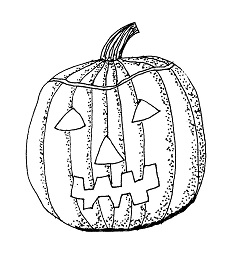
pumpkin

My secondary school was very traditional, with a “good reputation”. Uniforms were strictly proscribed, right down to underwear and swimming costume, for use in the unheated, outdoor pool. Order was maintained by authoritarian teachers who had been there for decades, and prefects, who monitored behavior and whether we were still wearing our boaters and berets all the way home on the school bus. Our first homework was to take home our jotters and cover them, using brown paper – nothing else – to a strict pattern. On the front, using a ruler at all times, we wrote our names, class and the subject. Nothing else.

I became best friends with the second-in-command art teacher’s daughter. The art department was bright and modern, with lots of materials and media for us to use, and  foot-operated potter’s wheels. I joined the lunchtime art club and loved making lopsided, fall-apart pots, which never came up to the scratch of being selected for glazing and firing.

Some time around the Summer of Love, our rarely seen, distant headmaster retired, and was replaced by a younger model that you kept bumping into in the corridors. The senior art master also left and a climate of staff changes, hitherto unknown, began. My friend’s dad became head of art, and the potter’s wheels were taken away overnight. Apparently, they cramped our creative style. Uniform code was relaxed – and ultimately “banned” by the headteacher. Most of the petty rules we loved to get angry about were dumped. Prefects were pensioned off. Some giddy-eyed young teachers encouraged us to address them by their first names.woollies1

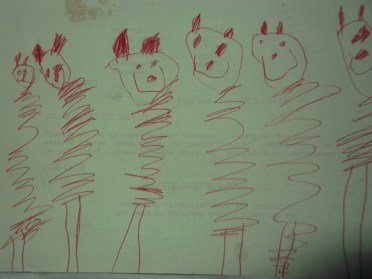
Our new head of art, wings unclipped, sought recognition for his progressive, avant-garde department. It was he that first suggested we doodled on the covers and in the margins of our jotters. There had always been teachers who turned a blind eye to a smattering of doodle on the inside cover – like the thoroughly modern teacher of Russian, and the lazy history teacher who was only entrusted with the first years. Others, of the old school, would reward even a full stop after the subject name with detention. But there came an edict: doodling on and in jotters was no longer a punishable offence. It was to be encouraged in order to bring out our inner artists. Awkwardly, sanctioned doodling began. Pupils became competitive about their flower-power designs. Some gained a talent for cartoons. There was no punishment when my French jotter carried an unflattering but cruelly recognisable caricature of Mademoiselle C, the teacher.

Doodling, whatever the excuse, became a habit.

Doodling expanded onto the pristine walls of corridors and classrooms. Not spontaneous graffiti, however. On the Russian teacher’s classroom wall, we painted St. Basil’s Cathedral in Moscow, with all its onion domes. The windows of the art department became opaque with rainbows of paint. Discarding the conventional, embracing “new” art in its broadest sense, rewarded our teacher with a visit from the Secretary of State for Education. His arrival was carefully contrived to coincide with a doodling-type dance display by two of us girls – of course – to a projected slide containing ink and fairy liquid, swirling and boiling in the projector lamp’s heat, accompanied by drumbeats from a couple of the boys – of course. The Minister glanced in, got the picture, and left rapidly.

The shelving of rules, the constant changes, the abandonment of distance and discipline left those pupils who had started under a very different ethos confused and sometimes angry. So were many of the staff. What do you do with a teenager, programmed to rebel, when you take away all the small stuff that’s been joyfully resisted by generations of adolescents? Some turned to bigger and more dangerous stuff to prove they were different. Sometimes, we took direct action against the new liberal order – such as holding an “illegal” Christmas carol concert when the traditional one was axed.

I left school early. The progressive trend lurched on, at least until the headmaster ran off with one of his sixth-year pupils. The art teacher left to be creative in Devon. About six years later, I found myself teaching in the same local authority, and had cause to visit the school for some event or other. I noted the blank, crisply-painted walls in the corridors. Clear glass sparkled in the windows of the art block. Uniforms, I observed, had returned. The backlash was in progress. It would have been a relief for my generation of rebels in need of tiny causes. I’m not sure if that still holds true – today’s young students have so many big causes to fight and need all the help they can get.

I never lost the doodling habit, though. It helps me concentrate, focus, relax – and learn.

The Beach, Summer Weekend

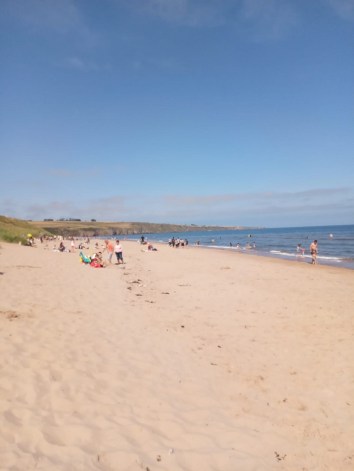
beach 1First seen in early spring, nearly twenty years ago, the beach stretched endlessly around the curve of the bay, a shimmering cream expanse of sand uninterrupted by not much more than a man and a dog, idly kicking at the silvery waves. No sound but those waves, breaking, gathering energy, re-forming, breaking again – and the gulls, plovers and oystercatchers worrying at the interface between water and land. The red stones of a ruined castle tottered in the dunes, crumbling, threatening to fall. Where the river splayed lazily, yet with energy, into the sea, flat, smooth stones in many colours could be harvested for an optical feast, to be drawn and painted, rearranged, and consigned to garden corners.

Today the summer sun is hot, but the breeze is cool from the sea. The car park has been extended, a café predictably offers burgers, ice cream, soothing teas and toilets. The waves still break, but the birds have gone elsewhere, or fly over the sea waiting for humans to depart and their time to come. Chattering voices, laughter, cries of anger or delight dominate the soundscape. Dogs bark and race from one human party to another in confused joy. The tide of visitors troops through the dunes on the new boardwalks, and dissipates like the outflow of the river onto the sand. Small parcels of beach are claimed by towels, windbreaks and throw-away barbecues. As more people arrive, the parcels become smaller and smaller, and new claims are struck in between those established an hour earlier.

Hardy men and women swim and lay gasping in the cold, but glorious, water. Someone turns on a small music centre. The breaking waves are silenced by it. Children, many cossetted in protective wetsuits, others bare-skinned and incautious, run in and out of the sea. Their enjoyment – or fear – is lovingly recorded on a dozen mobile phones and instantly broadcast and archived on Facebook. They do little harm, these day-tripping hordes, few leave litter, they pick up their dogs’ excrement. They are out of doors and they are enjoying it. Most look up from their phones from time to time, and see the beach, the waves, the dazzling horizon. Some don’t. Their loss.

Follow the river up from the beach and behind the dunes, and human sounds recede. The wind still lives in the reedbed; the water warbles with life. Crickets grate away in the dry grass, birds can once more be heard calling and chattering in the scrubby pines. All along the riverbank, great sweeps of purple thistle, white yarrow, pink campion and yellow sowthistle dance and shout their presence to the quiet hoverflies and bumblebees. Harebells – the Scottish bluebell – sprawl untidily over sandy banks, lifting their china-blue trumpets to a sun that suddenly feels gentle and kind.

Clouds fly and form and merge and stream away in an endless sky.

One human walks alone.

Feral Berries

These fields, which now yawn under the predictable rotation of wheat, barley, potatoes and the occasion excitement of peas or beans, were all berry fields once. It was the biggest and best-known of five plantations around here, where canvas tinker villages sprouted annually at harvest time, and the needs of the workforce were met in this now silent, gone-to-work, wee town by a wealth of grocers, bakers, butchers, innkeepers, tailors and shoemakers. At least five surgeons lived here in case of accident or emergency. The berries that weren’t eaten on the spot or smuggled home by the pickers all went south, on the new branch line connected to the village for the purpose, to become jam on well-to-do breakfast tables.

Now in the quiet forgetfulness of displaced industry and commuter inertia, tangled woods wrap themselves round the margins of large exposed fields. The old track takes you past the farmhouse that is no longer a farm, the steading that is no longer a steading, and wanders aimlessly north, between the remnants of its hedgerows. Long ago, it was the only road north, save for an older track across the moss.

Here and there, a narrow change in fencing or a wooden post marks where one of the many footpaths to and from the berry fields used to run. A curious right of way plummets through someone’s back garden and still has legal status. Patches of No Man’s Land persist, and where they do, the ghosts of the berry fields haunt and echo.

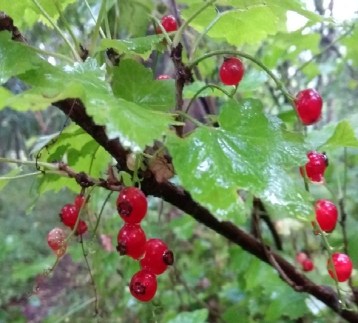
feral berries 1In the dense shade of a triumphant elder spinney, a smattering of redcurrant bushes blooms and fruits, scant rich redness catching the eye as the berries ripen. They are small and sour, yet somehow incandescently flavoursome. Where the track narrows to a muddy path, wild gooseberries make a wee thicket. Their fruits are also tiny, and round. Are they genuinely wild?

Or the depleted progeny of an old cultivar, maybe Scottish Chieftain or Lord Elcho, prized a century ago, now nearly forgotten?

But the raspberries, they are everywhere; an abundance that makes cultivation seem a frivolous and needless expenditure of time. They spring from lawns and borders in untidy local gardens, in numbers that cannot be put down to the activities of a large and hungry population of blackbirds. They line the hedges that border the track, they rise lushly above the willow herb and tall grasses of woodland clearings. They are bountiful enough to gather for the freezer, but, more often, they make a wayside breakfast for people out with their dogs on sunny summer mornings, staring vacantly into the trees, popping raspberries like pills.

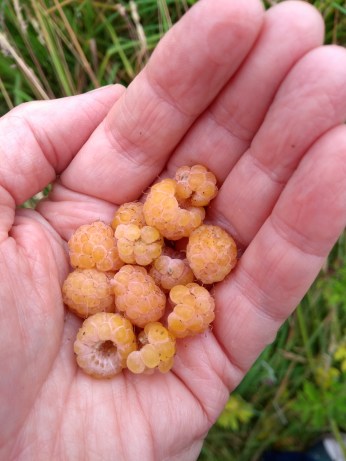
In one small hedge remnant, the raspberries go unseen and untried by strangers. TheseIMG_20190727_093257760 diminutive rasps are a pale golden yellow. They hide behind fiercely protective stands of nettle, and amid the jaggy stems of the hawthorn. These are the sweetest, most succulent of the feral berries. They melt in the mouth and almost dissolve in the hand. Any attempts to gather a large quantity fail; they are nought but juice by the time they get home. Those who know about them keep a close eye, and say nothing, then give the game away when it’s picking time by beating narrow paths through the grass and nettles to get at this choice fruit.

All in the past now, the Auchtergaven and Bankfoot berry fields. The history of a place often speaks through its plants, and may have something to say about its present..


Single-celled Sex

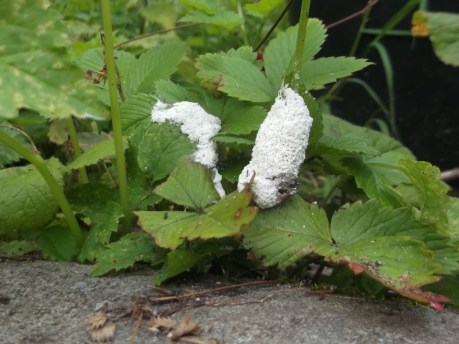
slime mould

Slime-moulds are on the move,
Bright yellow pinheads coating pine needles,
White jelly
Smeared on grass and stem,
Each a myriad host of one-celled genius
Looking like lichen, fallen from a tree.

They move, invisibly, together,
Drawn by an unheard, secret summons
Out of the the earth,
Out of isolated self-sufficiency.

Congregate, merge,
Conglomerate, collaborate,
All with one aim:

Swarm up the sweet stems of grass.
Sporulate.

Let the party begin.

DSCF1350

Ferments

Six months after making a resolution that 2019 would be the year I’d get to grips with sourdough baking, I boarded a train in Exeter clutching a heavy duty carrier bag. Inside the bag was another bag, wrapped around itself, loose ends tucked tightly. Inside that bag were a number of jars and cartons.

Fermenting.

11 hours on hot trains lay ahead. Intensely aware, despite assumed nonchalance, of the seething activity taking place out of sight, in the overhead luggage rack. Occasional checks, surreptitious lifting of lids, burping of bottles. It’s a wonder no one called for the transport police.

How had it come to this?

Cavalier assumptions over several months that I knew enough about cooking and had baked enough yeasted bread to never need instructions or a recipe had resulted in the failure of several sourdough starters to even bubble, the refusal of all loaves to rise, the creation of some worthy bricks and, finally, to acknowledgement that I needed to consult. Guru number 1, Andrew Whitley of Bread Matters and Scotland the Bread (www.breadmatters.com and http://scotlandthebread.org/) told me to go back and read the book properly, especially the bit about balancing acid lactobacteria (which make the sour taste) and acid-intolerant wild yeasts (which make the bubbles), and sent me away with some amazing heritage Scottish wheat flour.

To mastermind the magic of a fermented dough, I needed to get the basic chemistry into my skull. Suddenly, I wasn’t making bread, but collaborating with a population of unknown, busy micro-organisms, intent on feeding and reproducing in the flour and water I was supplying. Once the penny dropped about refreshing the starter to reduce acidity and give the yeasts a chance to breed, my starter began to work.

IMG_20190711_105237420But was it really meant to look like this? Was dough meant to get all over the walls and floor? Why was I reduced to scraping and pouring the wet, sticky mess into bread tins? And when the book said “knead”, was it some kind of a joke, when “stir” or “whisk” might have been more appropriate verbs?


Now I had to find out if the disaster area of my kitchen on a baking day was common to real sourdough bakers. I suspected it wasn’t, and that I had more to learn. Enter Guru number 2, Jon Denley of BAKED Cookery school (www.bakedcookeryschool.co.uk) in Plymouth, and a chance to attend a course on Sourdough, Hydration and other Ferments, while on a family visit south.

Amid vast buckets of bubbling starters, in the heat and humidity of a training kitchen with several ovens going, I watched unbelieving as Jon transformed an unruly slop into a polished, gleaming and perfectly manageable loaf. I began to understand how to detect the changes in the feel and behavior of wheat and rye dough mixes as they are worked, that mean you stand a chance of shaping them into loaves. I became aware of the gluten forming – and of it breaking down when, literally, pushed too far. We made – and ate – delectably light and crusty pizzas for dinner, 100% rye loaves, white sourdough bloomers, nutty loaves with wheat and rye and seeds. We played with pre-ferments – pate fermentee or “old dough” uIMG_20190719_192426204sed to kick-start a sourdough flavour and texture in a yeasted loaf, and the excitable “poolish”, a pre-ferment I was advised to leave in Devon for fear it would get out and derail the Cross Country train before I got it home. We mixed honey, sugar and water and fed it to raisins…. No, get it right: we fed it to the yeasts that live on the surface of the dried fruit.

I got all my loaves, starters, pre-ferments and raisin brew home safely, and they’re all doing fine. Well, the bread’s been digested. The raisin brew has gone to create a spelt flour starter. I still can’t shape or adequately fold a white sourdough bloomer and I’m scared of using a proving basket. I’ve a long way to go, and I’m enjoying the journey.

Working with ferments overturns the received wisdom of 21st century food hygiene. Antibacterial cleansers are banished. Windows are open. Refined ingredients are shunned. Sterilised containers are bad news, and for goodness’ sake leave the lids off so stuff can get in. You can wash your hands, but if you must use soap make sure you rinse it off. The micro-organisms that we so desire don’t come put of a bottle or can. They are living in the organic flour, on your hands, in the air, on the surface of raisins and apples.

And although we can place them into rough groups, we never know exactly what the microbial make-up of a batch of dough is. My mother would have called them germs, and been deeply distrustful of processes that encouraged them, not to mention the product of those processes. Even in the fermentation of cider, beer and wine, which I’ve done a lot, you’re advised to use sterile containers and prevent “contamination” by “the wrong” fungi or bacteria. Just like the fastidious gardener trying to control nature, we like to think we’re in control of our alcohol production.IMG-20190714-WA0003
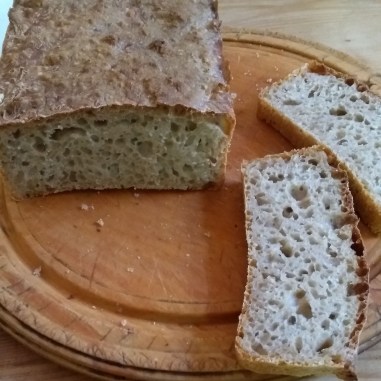
 

Baking with mysterious, unidentified, unknown quantities makes for unpredictability, surprise, delight, disappointment. We are not in control. Our ferments frequently are.

It’s wonderful.