Urban Landscapes, Seen from a Train

Cross country, passing from the north of England and through somewhere in the middle. I’m in a hot tin tube, heading south, and it’s getting hotter. South – somewhere that, for me, mentally ends at Durham, or York at its furthest – stretches ahead, dreary and unending. I pass rapidly through a despoiled English landscape that once I thought I understood, through English towns in ugly upheaval, all servants to the great ant-hill in the south-east; all outraged, all indifferent, all powerless.

Decayed industrial landscapes litter the outskirts of every conurbation and materialise even in approximations of “countryside”, in suppurating rashes of neglect and abandonment. Concrete culverts silencing streams, battered piles of broken cement, scaffolding, rusting pipes, dented and twisted Heras fencing (long since made functionless). Roofless warehouses, their guilty asbestos now removed and stashed god-knows-where.

Small, ornate, brick buildings, the decorated products of a former industrial age, stained with smoke and half-hearted graffiti, stand forlorn and forgotten in the middle of demolition sites, For Sale hoardings and ugly, cuboid sheds and hangars, all decked in strident colours and enormous marketing symbols. Roots of great trees poke out from under piles of rubble. All is change, all is directionless, all is outside anyone’s power to influence or care.

Everywhere are living trees, ungainly and wrathful, determinedly self-perpetuating in cracks in walls or paving. Nowhere are woods and forests. Everywhere are the ruderal wildflowers and gutter-shrubs, poking out of the tops of walls where the coping stones have crumbled or been knocked out, Bright poppies and ragwort seed furiously, despite the half-hearted scorching of the weed-killing brigade. Nowhere are there meadows. This is nature’s agenda, not that of humankind.

Now the tin tube is full; standing room only. Eyes averted from the landscape fleeting by, onto phones, laptops and tablets. The constant ping of notifications to a carriage-load of devices merges into one doleful knell, punctuated only by the loud complaints and criticisms as the angry, unhappy middle-aged blond without a phone castigates and abuses her 90 year-old mother, who closes her eyes and ears in weary despair.

Are we happy? Are we content? Perhaps we’re too busy to know or care.

man standing near ruined buildings
Photo by Free Creative Stuff on Pexels.com

Other Tree Species are Available

In Devon, they say they have hearts of oak. Here, in the sun-baked, heat-islanded south of the County, where the thick-hedged meadows run up and down hills like a lumpy quilt on a badly-made bed, you can see why. Oaks are everywhere, dominating the treescape. They surge out of the deep, dark lanes, they march along tangled, towering verges, and straddle the corners of the fertile fields.

oak1Broad-crowned and rooted like mountains, they are the very epitome of strength. In the minds of humans, they are usually labelled “he” and associated with male-ness. Strong, protective, enduring, courageous …. dominant, powerful, overbearing, masterful? Strange to note (if not surprising) that trees thought of as “she” (such as the Silver Birch, Devon’s “Lady of the Woods”) are graceful, delicate, drooping and indecisive in form. And is it only Devon Men who have “hearts of oak”?

Oak trees, Birch trees, most trees in the British Isles, are hermaphrodite anyway, both male and female. Oak trees are much more than a gender stereotype. They form worlds in themselves: roots, bark, branches, leaves, roots and fruits all playing host to a myriad of organisms, fulfilling many functions. They are home, food source, shelter, entertainment, nursery, recreation ground. Allegedly, but probably only mythically, oaks have even housed the occasional human wearing a silly crown. In their own right and as part of the natural world, they are extraordinary, important and awe-inspiring.

Even when they die, they will take centuries about it, growing steadily more stag-headed and gaunt, silver against the blue summer skies. From a distance, no sign of life is discernible. Get closer, and leaves spurt from odd branches below the hollow, woodpecker-mined, bark-less upper limbs where a solitary crow keeps an avid watch on the meadow. Dismissed as dead, and yet they survive.oak2

People pin not only their assumptions of gender onto indifferent trees, but also sometimes their anxieties and aspirations. They look for reflections of what they’d like to be, and how they’d like to portray others. In Scotland, we pin some of our national psyche on the Scots Pine – another giant of the landscape given to vast and spreading majesty when rooted in Caledonian soil. But also, beneath the surface of the obvious, on the subtle, fey Rowan, reverenced if not revered, the magic totem of croft and byre. What characteristics do we borrow from our trees?

Hearts of Oak– that Kiplingesque phrase so redolent of Drake in his hammock, Queen and Country, the ships that saw off the Armada. Do the men of Devon – and others – who identify with the oak tree incline, as a result, to certainty, strength of purpose and an assumption of their own inevitable survival? Are they made sure of their ability to go it alone, to forge their own paths, to take back control? Are they programmed never to doubt that to succeed against all odds without need for cooperation or compromise, is admirable and right?

What if the oak trees were to fall? What does it take to make people change, to reach out?

Just as assignments of gender onto trees only mean something to humans, so too is attributing nation status to any species. Oak, Pine, Birch or Rowan – none are English, Scottish, Welsh, Irish and neither do they “belong” to any other race. They are not the property of local government. None are even endemics; they are uncaring of borders and boundaries. They follow no human creed, political standpoint or philosophy. They are trees.

Oaks have wonderful heart-wood, but no hearts. Heart are muscles found in a wide range of animal species, including humans. Change of heart is a condition humans sometimes get, too.


Walking in Vectors

bristol2

A large, traditional primary school on the east side of London. Thirty-four eleven year olds, in their last year before going to the big school. Smart wee souls, most of them, and entranced with learning. Teacher, relaxed, confident, experienced but already thinking of a new career. We’d been talking about grid references, and maps, in preparation for a week-long field trip to the Isle of Wight. Our inspired and quirky maths specialist had entered this preoccupation by introducing them to vectors, what they were, how to define them. To facilitate understanding, I’d abandoned the classroom layout of loose groups and large desk-space and put the single desks, relics from the 1960s, back into rows, forming a grid, with my desk formally in the front by the blackboard. Technically off-grid. Of course. The class thought it was a great laugh.

Simon, in the back row, had some point in his creative writing he wanted my opinion on, so I called him over. We all stopped what we were doing and watched with interest as he took off his shoes, climbed onto his chair, then his desk, and proceeded to step precariously from desk-top to desk-top, preceding each move with a warning for the occupants to lift up their work. It took a while for him to reach my desk, and step off-grid too. Another time, another place, this behaviour might have alarmed both teacher and children. But this wasn’t that sort of class and I wasn’t that sort of teacher. Simon, brainy, cheeky, totally engaged and preposterous, certainly wasn’t that kind of pupil.

“What was that about, Simon?”

“I was walking in vectors. I had to use two different ones to get here because Keeley wouldn’t move her stuff.”

“I didn’t want his smelly feet on my desk!” protested Keeley.

We got Simon to tell us what vectors he’d used to define the straight lines via which he’d reached the front. It seemed a pretty good way to get your head around the subject, so we played about with it. Kids took turns to walk the vectors either I or their classmates suggested, starting from wherever they were.

“Your go, Miss!”

I turned a withering gaze on Simon, and joined in, “walking” to the vector destination he specified. Then they carried on with creative writing until lunchtime. Our maths specialist was very gratified to find the class’s understanding of vectors was now 100%.

**********************
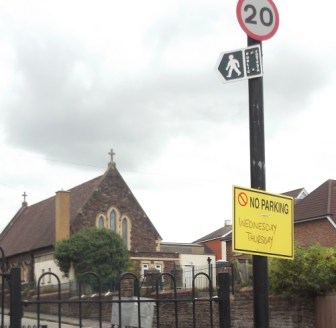
bristol1Decades later, I still “walk in vectors” – and remember Simon – in many situations. Getting across tracts of city is one such. Townscapes forbid, direct, coerce the pedestrian.

Who wants to be coerced?

Traffic willing, I take the shortest distance and move in a straight line as far as possible to where I want to be. Car parks are my favourite, the bigger the better, with cars more or less forming the grid that our classroom desks did back then. (I draw the line at climbing the bonnets and walking on the vehicles, though. Even I concede it’s not appropriate behaviour for old women.) The urban environment (with some exceptions) is not, for me, one that I wish to meander in. Walking in vectors is efficient, and gives me something to think about while I’m at it.

In open countryside, or hillwalking, I am reassured by well-defined paths, and fingerposts. I figure they reduce the risk of large bovines, bottomless bogs, and getting lost. I don’t mind if they meander. This is not the place for cutting across fields and fences and the corners of peoples’ gardens, nor those coastal rocks and beaches where deviation from a proscribed route might end with me being cut off by the tide.

But woods are different. They are one of my comfort zones. Paths go round trees and skirt the edges. I make paths. I go through the wood, from tree to tree, or glade to glade, with no final destination but what I may find on the way. About the same time that my primary school class were physically exploring vectors, I was having a relationship with an SAS-type survivalist. Going for a walk with him meant going straight through the bramble thicket, river bed or steep rocky incline that separated us from his destination (usually a choice edible plant, a secret beach or a prehistoric relic). David walked in vectors without noticing; I followed, protesting, and emerged covered in bruises, arms torn by brambles, feet wet and shins muddy and scratched, twenty minutes later.

I slowly got used to it, and began to enjoy the sense of power that came from the determination to arrive at a destination of which most people would remain forever unaware. My senses were heightened by the necessary awareness of the landscape through which my straight lines were taking me. I saw more, listened harder, breathed in scents. Today, when I push through clearings of grasses taller than me, I feel the soft brush of their flowerheads, catch my breath on clouds of pollen. I mind small frogs and mushrooms underfoot, and insects living in the bark of the trees. I hear where water trickles invisibly; I sense and hear the warning aura of the wasp byke. I emerge into sunlight or thunderstorm, on the other side of the wood.

Meandering paths or the allure of straight tracks, ley-lines, history and mystery? It doesn’t really matter, but it’s good to be willing to do both. It’s no coincidence that I am writing this on the Cross Country train between Edinburgh and Exeter. Going via London would not make sense to someone fixated on travelling by vectors.

The Forest on the Beach

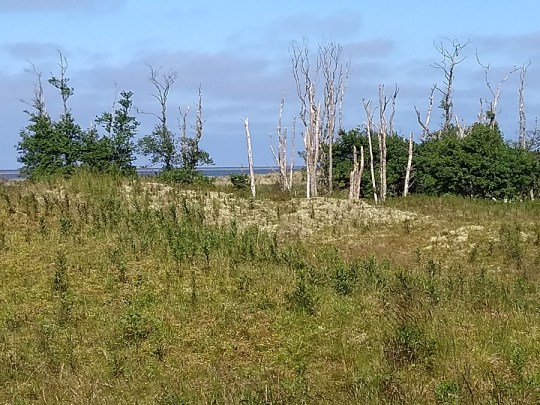
It’s a man-made entity, on the face of it, this forest merging with the shifting sands of a vast, energising chameleon of a beach. Planted once in an orderly and respectable fashion, tall pines rise obediently from thin, infertile soil and duly make timber. Deep inside, away from salt winds, they have done as they were asked. They have stabilised the soil, reached for water, made partnerships with their own particular fungi. They are the forest they were asked to be.tentsmuir3

But on the edge, where the horizontal reigns in the landscape, where the sands continue to shift and grow, retreat and fail, and merge into mud, they cannot sustain their sheer verticality. Bald-headed individuals hesitate, stagger, lean, tip and fall. Blasted by sand, they desiccate, warp. They become subjects of the horizontal, their limbs curl and contort, sculpted by vicious winds from the sea. Beautiful in their carved and etched simplicity of form, they lie frozen in the hot, drying sun.

The forest on the beach shrugs off its manufactured origins, and enters the wild.

tentsmuir2

The beach goes on for miles before the trickling waves are reached, even when the tide is high. At the point, it is a self-contained, secret world, traversed near the forest by tracks through the dunes made by a largely secretive population of animals, including domestic and human. The tracks join and separate, re-unite, diverge, vanish into long grass or an unexpected creek. They seem to make no sense.

Do shipwrecked sailors still dwell in tents among the dunes? Where are they hiding?

The dunes and butterfly-filled dune slacks, where wild thyme and cross-leaved heath celebrate summer, give way to wide, subtly merging, littoral zones of shimmering sand. Eventually, wave-patterned beach and tidal inlets signal that the old sea is near.

puffball

Curiously, between the two, right in the middle of the beach, there is a small wood, mainly made up of towering, stag-headed alder. Under it, stunted or dwarf willows (who knows which?), broom, tall grasses, flowers. Unlikely eruptions of puffballs appear where cows have grazed. There is quiet shade, a rustling of leaves louder than the still far-off sea.

How did this little wood get here, in the middle of a beach? How long has it been here, where once was ocean? Will it survive long enough to bear fruit?

Then, movement from the bushes below the alders; an indelible assertion of dark brown hide against sun-washed grass and striated shade. A deer is moving through the little wood on the beach.tentsmuir1


There are Trees in Sutherland

The last time I was in Assynt I was nine or ten, on my first visit to Scotland. My big sister and her boyfriend took me camping on a road trip that began in Glasgow and ended at Cape Wrath. For a child from the suburbs of East London, it was nothing short of life-changing. As we returned to their flat in Glasgow, my sister asked me which places I liked best.

“Wester Ross,” I said.

“Not Sutherland?”

I thought for a bit. “I liked it. But I liked Wester Ross more.”

“Was Sutherland too harsh and wild for you?”

I sensed a trick question. My sister always wanted to toughen me up. She reveled in wild and empty open spaces, the complete absence of people. I wanted her approval. But something in her question  rang true. It wasn’t that Wester Ross was softer, meeker, but somehow – I couldn’t explain – somehow there were more….

“Trees,” I announced. “I like trees. There were no trees in Sutherland.”

I’ve had decades since to reflect on my response. At that time, the North-west Highlands were remote, empty of people. Settlements were sparse, inhabitants few, and tourists virtually non-existent. But I could see where people had been. The ruins of dry-stonewalled houses and whole villages stood everywhere, a testimony to clearance, plague, poverty and emigration. Crumbled walls, sometimes just foundations, a gable or a chimney pointing here and there to the sky. You couldn’t miss them. Our wild campsites were up the remains of old tracks that led to derelict hamlets. I remember one that I would walk around every morning. A little way from the ruined houses I saw a weird cairn-like structure of four or five strategically placed, flattish stones. I lifted them. Below a deep, dark hole blinked at me. There was a melancholy, metallic splash when I dropped in a stone. I’d discovered the well, and it stared back at me, naked and accusing. The cover stones might have been placed just yesterday. Feeling a sickness and strange fear in my stomach, I tried to replace them exactly as I’d found them – in case someone came back.

I don’t think I’m just speaking with informed hindsight when I say that I sensed there was something wrong about the bleak emptiness and the ruins. The further north we got, the more pronounced it became, perhaps because of the lack of tree cover. Maybe there were trees in Sutherland back then, but I didn’t see them. My guardians preferred walks on bare hills, peat-bogs and wind-blasted coasts.

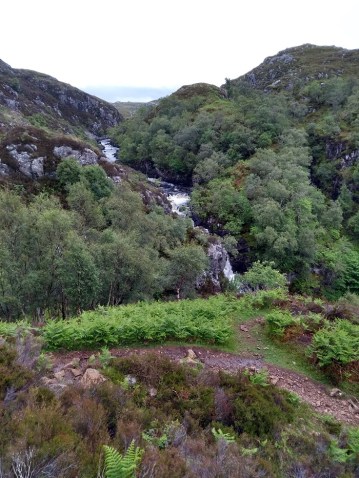
trees in sutherlandBut last week I was in Assynt again, and if there were many changes, it was the trees I noticed first. It’s nearly 26 years since the first ever community buy-out of land in the area by the Assynt Crofters Trust, and there have been others in the area since. The first trees I found myself looking at were less than 25 years old. I walked in vibrant young woodland at Little Assynt, above the shores of the great loch. Deer fencing surrounded large tracts of land. Birch, rowan, hazel, Scots pine…… willows, elders, hollies and even aspen…… planted by Culag Community Woodland Trust or regenerated naturally within the fences. Outwith the fences, though, trees were also regenerating, especially birch and willow. Sheep, ironically, seem to have been cleared to the coasts. Deer pose for tourists around townships, but their numbers are controlled. Bluebells and primroses are appearing under the bracken.

So, there were woods here before, then.

The Assynt downy birches are wonderful stunted specimens, all arms and legs as they branch and branch again and gesticulate over a landscape of ferns and mosses and blueberries. I saw very old birches in woods up a river valley – huge, shaggy trunks breaking into wiry, angular limbs about three feet from the base, and still sending up new wood. It seemed pretty clear they’d been pollarded for their timber a long, long time ago.

There were woods here before, and they were valued and sustainably harvested.

There’s a native tree nursery at Little Assynt, whose owners work tirelessly among the little assyntmidgies to produce more trees, all from seed they’ve gathered locally. They’re pretty excited that after last summer, the aspens have flowered – a rare event in a species that prefers to clone itself vegetatively – bringing welcome genetic diversity into the local tree stock. At the Falls of Kirkaig, we bumped into a naturalist friend from near home in Perthshire (Scotland being such a gloriously small country), who had observed the same phenomenon. So, there we were, all getting excited about the future of a tree species in a place I’d remembered as treeless.
Of course, there are other changes. You have to look hard to find any old townships from pre-clearance times. The earth has swallowed them up. The roads are more solid, with no grass through the middle, so there are more motor vehicles and far more people. Mostly (but not all) tourists. A few whizz about, thinking it some kind of achievement to “do” the North Coast 500 in a day, or delude themselves that they can capture the essence of Sutherland from the inside of some huge, self-contained box-on-wheels that couldn’t fit into a passing place even if the driver recognised one. Sutherland could perhaps use fewer of these. But many linger, fall in love with the mountains and the deep valleys, accept the weather, and engage with the landscape – and come back. Sutherland has become accessible to tourists. It has learned to cater for them, and yes, it is busier, less remote, less empty.

But there are trees in Sutherland.

Plants in Wet Places: Moss, Bog and Myre

My favourite book age 9 was a slim volume called “Folk Tales of Devon”. Innumerable accounts peppered its pages of spirits, human and fey, being sucked into the bogs on a trackless Dartmoor. This, coupled with “The Hound of the Baskervilles” a couple of years later, and walking treks in Sutherland with my sister, left me with a deep certainty that if water ever gets over the top of my boots, it won’t stop till I am submerged forever.

Therefore, though I adore them on an intellectual level, and thrill to the spookiness and mystery of moss, bog or myre, it takes me ages – and I mean AGES – to get from one side of an expanse of rush or bog cotton to the other. During which time, I suffer feelings of vulnerability and exposure no normal walker would recognize, and fantasize about nice hard stone paths and causeways.

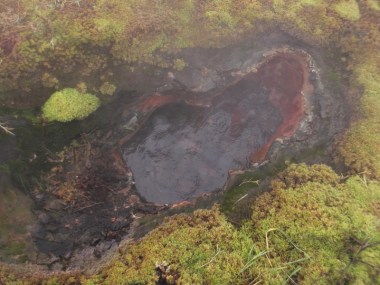
sphagnumEveryone should leave their comfort zone behind from time to time, though, and if you venture into The Moss there are rewards. It’s called “moss”, because in most cases that’s what makes it – sphagnum mosses of breathtaking colour and beauty, slowly expanding and dying away to leave peat. Mosses are primitive plants dependent on water for reproduction, and you can be sure the brightest patches will be the wettest. Sphagnum holds an incredible quantity of water. Its uses range from wound dressings (it is naturally antiseptic) and hanging baskets to impromptu disposable nappies when walking with babies! Rushes, too, are useful – think matting, cattle bedding and rushlights – and if you can balance on the clumps as stepping stones, they will see you across a wet patch of moor.
In the poor, acid soils of bog lands, you will find pretty, semi-parasitic flowers such as milkwort, lousewort and butterwort, and carnivores such as the tiny sundew, all striving to supplement the mineral content of the soil from other sources. Many orchids have their habitat here. Where you find blaeberries (aka bilberries) growing, it is safe to cross – this plant with its delicious fruits prefers drier slopes. Related species, cranberry and cowberry, will appear on higher moors and myres. Bog myrtle, although happy in the wet, will draw a lot of moisture up, so is also an indicator of safer ground. This is a very useful plant – its aromatic oils are a deterrent to insects – including midgies, allegedly. It’s also called sweet gale – and can be used to flavour Gale Beer. It has a lovely, spicy smell, worth risking wet feet for.

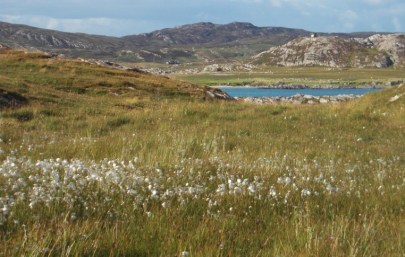
bog cottonFinally, there is the alluring bog cotton-grass – a guarantee of treacherous wetland just waiting to suck you down – but such an unusual flower and how beautiful waving massed in a moorland wind – white woolly standards raised to announce a weird, wonderful and ominously wet world of plants!


Before the Chanterelles

In the misty dampness of a cool May morning, the tangled and decaying woodland holds its breath. Falling trees prop up shattered branches and each other, precariously leaning, hanging on by brittle twigs to some semblance of the vertical. Elsewhere, the long archaeology of those that have already succumbed to gravity make the woodland floor uneven, precarious, unpredictable. Some are half-sunken: indistinct mounds of mosses and soft, cushion-like wood, sprouting ferns and small plants – wood sorrel, purslane, chickweed wintergreen – from every crevice. Others, newly crashed in last week’s gale, still carry their leaves, shrivelling, poignant. Between the two extremes, lie trees and logs in every stage of decomposition.

The walker in this wood must learn these stages, and recognise which logs will still make good rafts to lay across the boggy places and ditches she would cross, and which will just crumble when stepped on. She must be aware of what lies overhead and if it would be wiser to go around, rather than under, the hung-up branches. Familiar paths are blocked every month and must be re-routed. New ground is created, explored, and lost again.

Out of the decomposition, new worlds are also born. What is decomposition if not the beginning of opportunity? Spiders re-align their webs in the remaining dead branches of a leaning tree. The breakdown of bark releases nutrients; tree becomes soil, soil claims tree. Single-celled organisms work their way through a sea of bacteria, laying the foundation for others to thrive.

Opportunities are made for beetles that feast on the rot in wood and bark, and the birds and small mammals that home in on the beetles. Shelter, food source, songpost, tunnel, bridge – the creatures of the wood utilise the fallen and falling trees in many ways. On their bodies they bring more soil, seeds, and the elements of fertility to this garden of decay.

And oh, how the garden grows.

It is not death that the walker witnesses, but birth and life. Is this decomposition, or composition? Is it both?  Is this the end of the wood, or the beginning of a new landscape? No human cares much for this wood. Children sometimes come and make fires, camp or build twiggy shelters, but you never see them. There is an old tyre swing, hanging neglected. Someone – no-one knew who – used to make sculptures out of stones in the heart of the wood, but not anymore. Dogs are walked, but usually led straight past the wood now that access is trickier. No-one “manages” it. Change, then, seems rapid. Whole trees crash down, leaving soggy craters and towering cliffs of root-ball, but transformation in nature is incremental, and constant. Each year, the populations dwelling on those bare root-cliffs are slightly different. Ground living fungi give way to aerial brackets, rabbits exploit entrances to potential burrows, liverworts, lichens and ferns take hold.

And underground, fungal mycelia move like whispers within subtle, shape-shifting parameters. Today, a downpour of the night is percolating under the moss-covered banks and logs. Soft spring rain, scarcely visible except when the smirr catches a shard of sunshine, seeps into the soil cauldron, fermenting, bringing new elements, new conditions.

Things move unseen.

Everything waits.

The walker in the woods has seen no mushrooms yet. But even a human animal can smell the contents of the cauldron, the warm, damp changes happening unseen below the wreckage of an unmarked wood. When all the boxes have been ticked, the harvest will be rich and golden.