The Scent of Bracken

I was nine or ten when I first experienced both the smell of bracken and the nation that is Scotland. It was late July, the start of Glasgow Fair Fortnight, and therefore my parents must have taken me out of my London primary school for two weeks to pack me on a plane to Glasgow, for a fortnight’s camping holiday with my big sister Pat and her boyfriend. It was my first camping trip, too. It took me all the way up the west coast to Cape Wrath and literally changed my life.

My first evening in Scotland was memorable for sitting on a wall eating fish suppers. My first full day began with a curious morning at Pat’s work, where little was done beyond desk-tidying and paper aeroplane competitions. Then, the hooter went, tools were downed, and everybody went on holiday. Northwards first, in the Mini, me surrounded by camping gear in the back seat. We stopped by Loch Garry the first night, off a dead-end tiny road, and camped in a clearing in the bracken by the loch.
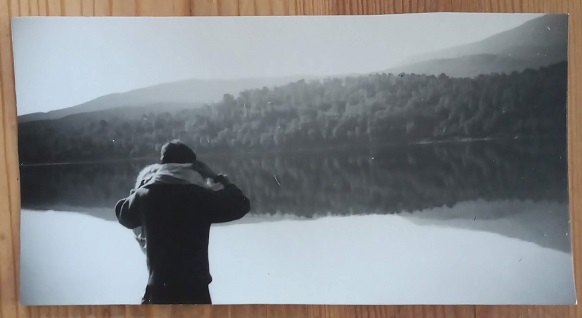
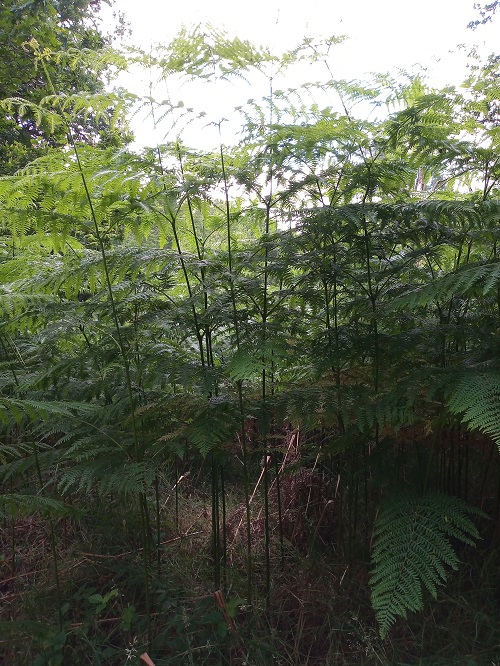
Loch Garry was my introduction to midgies. Naively, I thought they were all part of the adventure. I chattered away in excitement behind the mosquito coils, breathing in the strange, new scent from the bracken that for me would ever more be the scent of Scotland. Eventually, Pat interrupted me.

“Margaret, what time do you think it is?”

“Umm, maybe half past eight?” I replied hopefully, knowing my bedtime was at nine during holidays. I wanted to stay up a little longer.

Pat showed me her watch. It was twenty past eleven. Summer in Scotland, long days, even in July. I was persuaded into my all-too-exciting sleeping bag, and eventually fell asleep, though I never saw it get dark. And woke, next morning, to the smell of bracken once again.
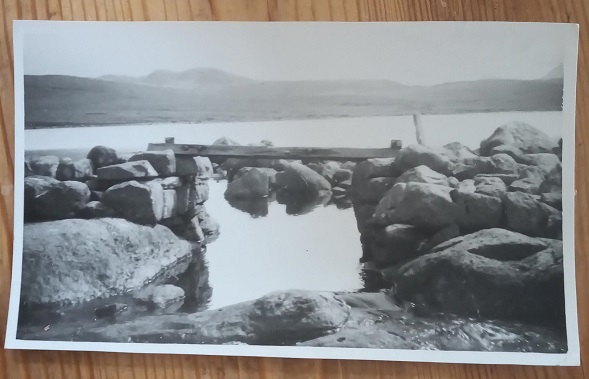
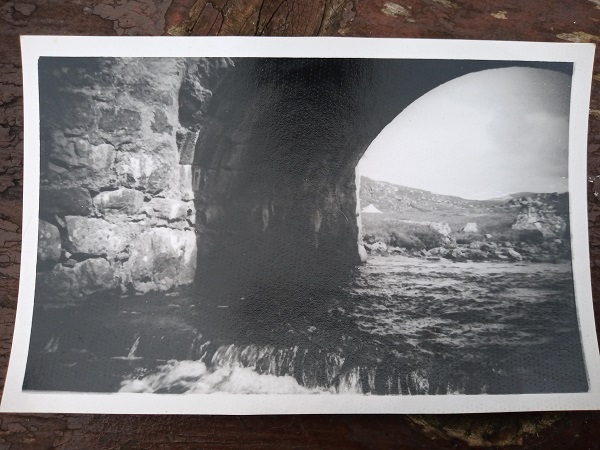
We meandered north and west for nearly two weeks, camping wild up tracks that led from narrow, grass-centred, barely-surfaced roads to the ruins of long depopulated clachans and farmsteads. Sometimes we stayed under bridges, or on beach-paths up which seaweed was once hauled for fields now buried in bracken, their stone walls mere crumbling ridges in the grass. Once, we asked permission from an isolated farm, where the farmer’s wife took the cow for an evening walk each day. We filled our water bottles there, and tried to buy, but were always given, raw milk from the cow.

I trailed after my sister by burns and over cliffs, taking bad photos with my precious box camera, looking for eagles, dizzied by sea-stacks, drinking in a world I couldn’t have imagined from my London suburb. Ullapool, Mellon Udrigle, Achiltibuie, Lochinver, Stoer, Kinlochbervie, Oldshoremore – place names which became indelible in my brain. And the magical mountains of Assynt: Stac Pollaidh the “petrified hedgehog”, Suilven, Canisp, Quinag…. I had not known there was this.
As I inhaled the scents of bracken, I discovered its practical uses. Pitch your tent over it, and it made for a comfortable sleep if your air-bed leaked its air out every night as mine did. Bracken was an indicator plant for dry ground when crossing terrifying bogs (as were heather and, to an extent, rushes. Bog cotton and moss was to be avoided). And being a small child, the bracken generally towered over me, yet I could find paths deep into it’s forest, to child-sized clearings, for private pees or just to hide.

I already knew, from my uniquely progressive and brilliant Scottish primary school teacher, more about Scotland than the average English adult does today. I knew of the Clearances, the Wars of Independence, Burns’ poems and (reluctantly) Scottish Country Dancing. What I learned that fortnight was not facts. It was the country itself, sights, sounds and weather, the star-filled nights and the mists that clung in the whispering air; the colour of the rain; the beauty, the sorrow and the joy. I was never the same again. Although I muttered crossly to myself about long walks with wet feet, and the sheer copiousness of uphill tracks, I was captured. Thereafter, holidays with my parents sitting on crowded beaches in southern England, driving out to bustling “beauty spots” and picnics on the side of the road, were never the same. To their credit, mum and dad realised it, and did their best to incorporate more “adventure” into our trips.

But it wasn’t adventure I craved. I’ve never been very adventurous. It was the scent of bracken.

It was the scent of Scotland.

Thank you.

On Doodling

pumpkin

My secondary school was very traditional, with a “good reputation”. Uniforms were strictly proscribed, right down to underwear and swimming costume, for use in the unheated, outdoor pool. Order was maintained by authoritarian teachers who had been there for decades, and prefects, who monitored behavior and whether we were still wearing our boaters and berets all the way home on the school bus. Our first homework was to take home our jotters and cover them, using brown paper – nothing else – to a strict pattern. On the front, using a ruler at all times, we wrote our names, class and the subject. Nothing else.

I became best friends with the second-in-command art teacher’s daughter. The art department was bright and modern, with lots of materials and media for us to use, and  foot-operated potter’s wheels. I joined the lunchtime art club and loved making lopsided, fall-apart pots, which never came up to the scratch of being selected for glazing and firing.

Some time around the Summer of Love, our rarely seen, distant headmaster retired, and was replaced by a younger model that you kept bumping into in the corridors. The senior art master also left and a climate of staff changes, hitherto unknown, began. My friend’s dad became head of art, and the potter’s wheels were taken away overnight. Apparently, they cramped our creative style. Uniform code was relaxed – and ultimately “banned” by the headteacher. Most of the petty rules we loved to get angry about were dumped. Prefects were pensioned off. Some giddy-eyed young teachers encouraged us to address them by their first names.woollies1

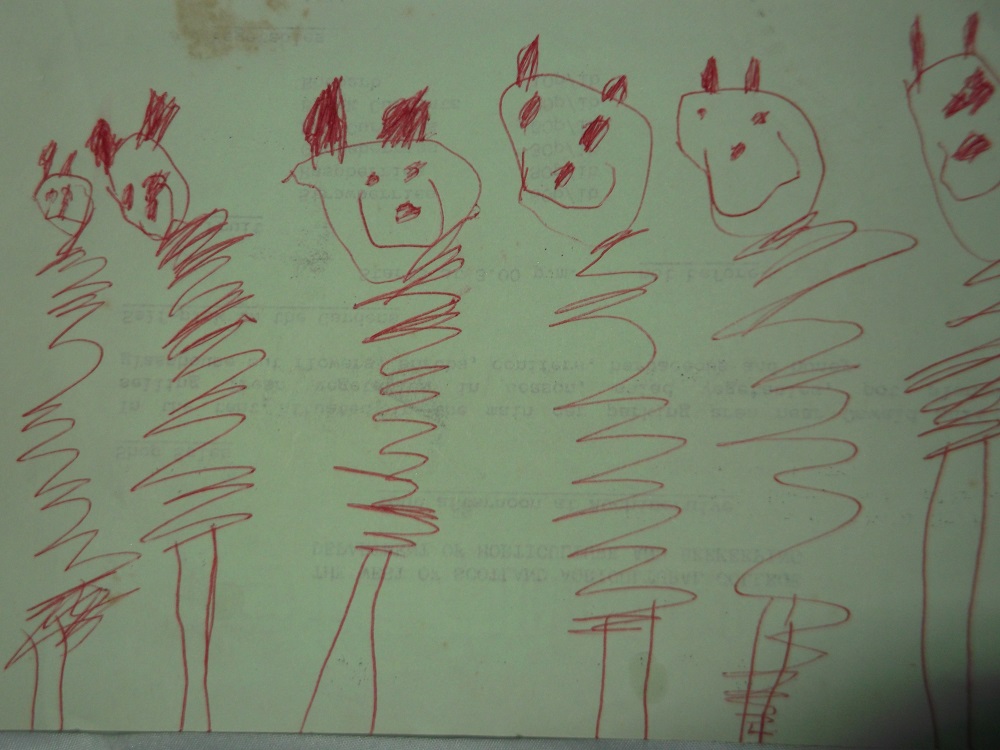
Our new head of art, wings unclipped, sought recognition for his progressive, avant-garde department. It was he that first suggested we doodled on the covers and in the margins of our jotters. There had always been teachers who turned a blind eye to a smattering of doodle on the inside cover – like the thoroughly modern teacher of Russian, and the lazy history teacher who was only entrusted with the first years. Others, of the old school, would reward even a full stop after the subject name with detention. But there came an edict: doodling on and in jotters was no longer a punishable offence. It was to be encouraged in order to bring out our inner artists. Awkwardly, sanctioned doodling began. Pupils became competitive about their flower-power designs. Some gained a talent for cartoons. There was no punishment when my French jotter carried an unflattering but cruelly recognisable caricature of Mademoiselle C, the teacher.

Doodling, whatever the excuse, became a habit.

Doodling expanded onto the pristine walls of corridors and classrooms. Not spontaneous graffiti, however. On the Russian teacher’s classroom wall, we painted St. Basil’s Cathedral in Moscow, with all its onion domes. The windows of the art department became opaque with rainbows of paint. Discarding the conventional, embracing “new” art in its broadest sense, rewarded our teacher with a visit from the Secretary of State for Education. His arrival was carefully contrived to coincide with a doodling-type dance display by two of us girls – of course – to a projected slide containing ink and fairy liquid, swirling and boiling in the projector lamp’s heat, accompanied by drumbeats from a couple of the boys – of course. The Minister glanced in, got the picture, and left rapidly.

The shelving of rules, the constant changes, the abandonment of distance and discipline left those pupils who had started under a very different ethos confused and sometimes angry. So were many of the staff. What do you do with a teenager, programmed to rebel, when you take away all the small stuff that’s been joyfully resisted by generations of adolescents? Some turned to bigger and more dangerous stuff to prove they were different. Sometimes, we took direct action against the new liberal order – such as holding an “illegal” Christmas carol concert when the traditional one was axed.

I left school early. The progressive trend lurched on, at least until the headmaster ran off with one of his sixth-year pupils. The art teacher left to be creative in Devon. About six years later, I found myself teaching in the same local authority, and had cause to visit the school for some event or other. I noted the blank, crisply-painted walls in the corridors. Clear glass sparkled in the windows of the art block. Uniforms, I observed, had returned. The backlash was in progress. It would have been a relief for my generation of rebels in need of tiny causes. I’m not sure if that still holds true – today’s young students have so many big causes to fight and need all the help they can get.

I never lost the doodling habit, though. It helps me concentrate, focus, relax – and learn.