
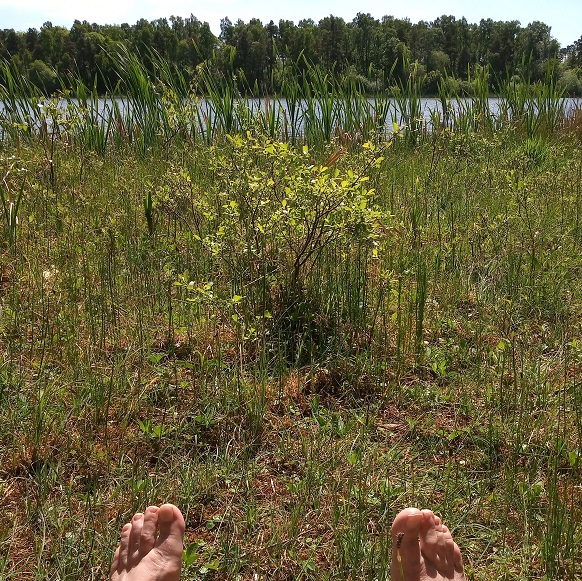
Hot, sunshine, slight breeze – a day to cycle to a cool and shady place. We’d often thought about walking into Taymount Wood by the core footpath from Airntully, but before lockdown hadn’t considered cycling all the way from Bankfoot. We left the village on the Stewart Dairy road, in normal times screeching with haring rat-runners with no conception of cyclists or passing places, and up the steep Barns Brae. This we accomplished without pause for breath, thanks to the electric bikes! We were caught out at the top by two “proper” cyclists who had stopped to recover, and who tried very hard, in a typical show of pandemic goodwill, not to look supercilious.
From the hamlet of Airntully, with its handy share-and-donate community phone box, we entered a shady tunnel of hedgerow elms, that enclosed our path. A shivering mosaic of sunlight hovered over the blue of speedwells, the pink of purslane. The path quickly led across a road and over the main line level crossing, straight to the fringes of Taymount wood.
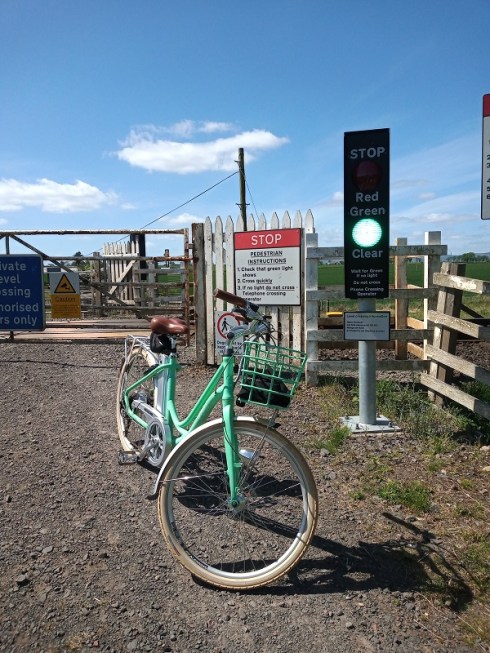
In contrast to our last visit in March, most trees were in full leaf. Violets flowered happily in the shade. It was now drowsy midday, and – again in contrast to March – the birds were silent, save for a welcoming chiff-chaff.
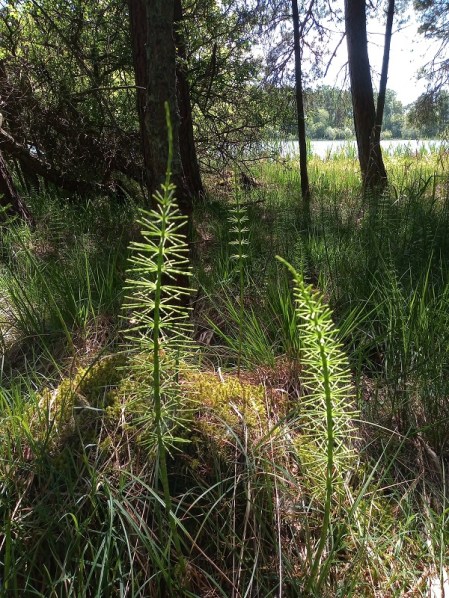
The silver line of King’s Myre appeared through the trees on our right. Parking the bikes, we took a small deer path between the trees towards the water. You cannot “go to” King’s Myre, nor can you arrive. There is no division in this habitat, between wet and dry, no shoreline, no edge. You have to creep up on it, with the stealth of an amphibian or a mudskipper. The ground underfoot grew softer, violets gave way to arching horsetails, until the trees petered out into scraggy bog willow and the soil became sphagnum moss. If I stood still, water came over my shoes.
Under the last tree, whose roots appeared to have made a spot dry enough for tormentil to grow, we sat down to picnic and observe. An osprey, also in search of lunch, circled the lochan. Fluffy seed of the reedmace bowled about the water margin like tumbleweed. Blue damselflies hovered, veering abruptly as if skating on air. Red damselflies were better camouflaged, except the one that alighted briefly on my knee!
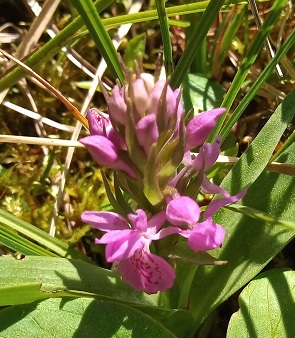
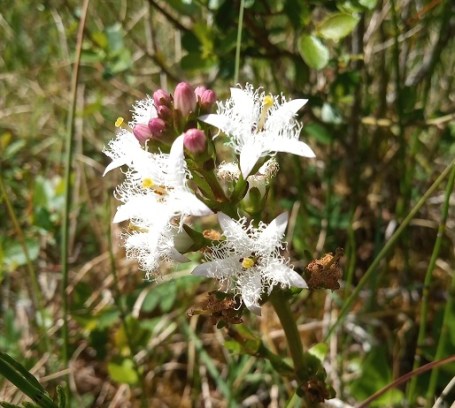
There were many small, dark solitary bees. Where they were foraging? They ignored the yellow tormentil, and I could see no other flowers. But a squelchy walk among the bog willows revealed several orchids, probably marsh but I’m hopeless on orchids, and the staggeringly lovely fringed flowers of the bogbean (Menyanthes trifoliata), just coming out.
Back to the bikes, and on through the wood to the main entrance on the KInclaven road, streaming away on downhill paths through heady clouds of coconut scented gorse. By the time we reached the birch trees, the birds were singing again. We returned via Airntully phone-box for a book to while away the rest of the afternoon.
This post was written for West Stormont Woodland Group, in support of the plan for community buy-out and wider community use of local woodland and landscape.

