
It’s a favourite cycle ride, a circuit of under an hour, with all the hills at the start and you can almost freewheel home, if you go clockwise. A bright, sunny Easter day and a chilly wind; dusty ploughed fields and the great pleasure of almost empty roads, as the pandemic lockdown disrupts the “joys” of motoring.
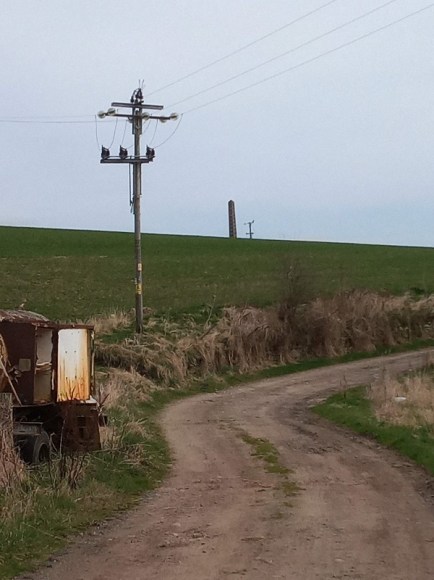
We cycle up through forest research sites and broad swathes of farmland towards Tullybelton, the hamlet whose name may derive from being the field where Beltane (May Day) fires were lit when older and more nebulous gods were remembered. We detour to Little Tullybeltane Farm, where a tall pillar points incongruously at the blue sky, and a buzzard mews and hovers. The track to the farm is neglected and lined with abandoned pieces of rusting metal; there is no plaque, no sign, no clue why it warrants such an imposing monument – and no invitation to explore.
Yet here – allegedly – the ruins of a turnip shed are all that’s left of the birthplace of one Robert Nicoll. From here he walked to school in Bankfoot, stopping to write poetry on the way. He was a peasant lad, a precocious child, the “boy poet” of Auchtergaven who died way too young, the one whose genius may have surpassed that other more famous bard, Robert Burns, with whom he had much in common – had he lived longer. But Nicoll was also a firebrand, a radical advocate for reform, a passionate speaker and fighter in the cause of human rights. Here is his monument, and not enough people know why it’s there.
He was 23 when he died.
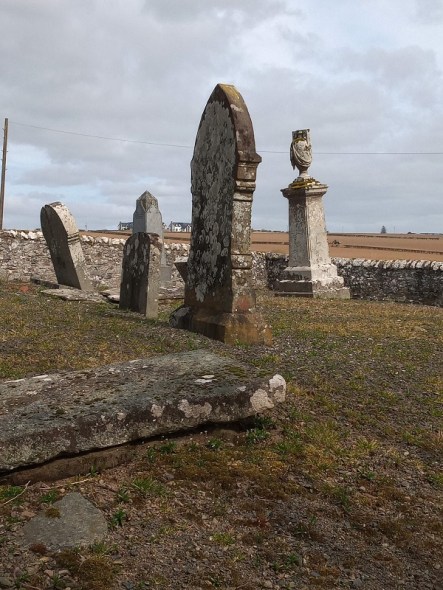
Leaving Tullybeltane behind, we coast along the Ordie Burn, where wood anemones shimmer in the sun and the wind’s behind us. Bumblebees career in and out of gorse flowers and dive between us. A determined walker out on her statutory exercise waves hello from the proscribed distance as we whizz by. We stop at the old graveyard at Kirkbride – though there is no kirk now and the headstones are in a sorry way. The names are all familiar, local ones: Nicolls and Fenwicks, Petries, Dows, Wylies and McFarlanes. I’m caught by the name Catherine Fenwick on a 19th century stone.
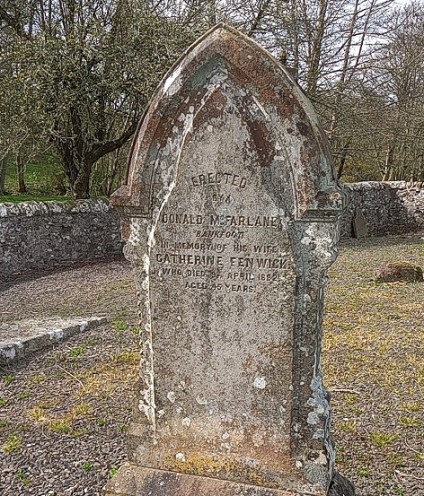
A Catherine Fenwick once lived in our house. She inherited or was gifted the feu from James Wylie of Airleywight (another reformer in his day – though did he “sell out” when he became a gentleman landowner?). Later, I check the deeds – we hold the parchment originals – and this Catherine Fenwick died seven years later than ours. Our Catherine lived longer…is it her shadow we constantly see flit by the kitchen window? Strange to think that both of them probably knew Robert Nicoll, whose mother was a Fenwick…. How intertwined we all are.
Kirkbride…. The church of St. Bridget, or just Bridget, or Bride, or Brigid…..Celtic Goddess of water. I can almost feel the Beltane fires. Nearby was St. Bride’s Well, said to have healing properties causing people to drink from it on the first Sunday in May (Beltane flames again) and “walk sunwise round it with joined hands, and lay down branches of rowan”.

We find no well, but up on a rise is the standing stone of Pitsundry, said to mark the place. There was within living memory a water trough under a hedge there, supposedly fed by the well. No hedge today, just barbed wire; it’s dry as dust and hard to imagine why there’d be a well on top of the hill. But when I check the maps later, I find a spring marked very close by.
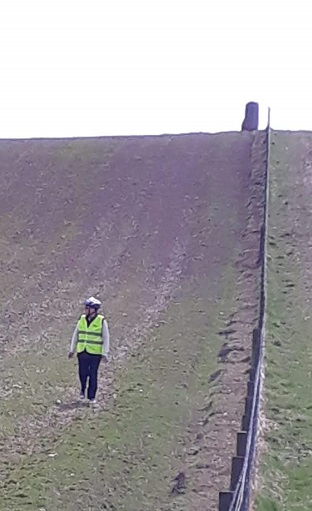
While I’m exploring, another lockdown cyclist tells Andrew (from a social distance of course) that the Pitsundry stone lines up with others on the Muir of Thorn, the other side of the A9. That checks out on the map too, more or less. When we freewheel back into the boundaries of our village, it feels like our journey was further, deeper, more entangled with ghosts, than the quick exercise circuit we set out upon.
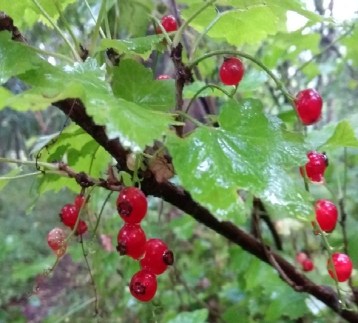 In the dense shade of a triumphant elder spinney, a smattering of redcurrant bushes blooms and fruits, scant rich redness catching the eye as the berries ripen. They are small and sour, yet somehow incandescently flavoursome. Where the track narrows to a muddy path, wild gooseberries make a wee thicket. Their fruits are also tiny, and round. Are they genuinely wild?
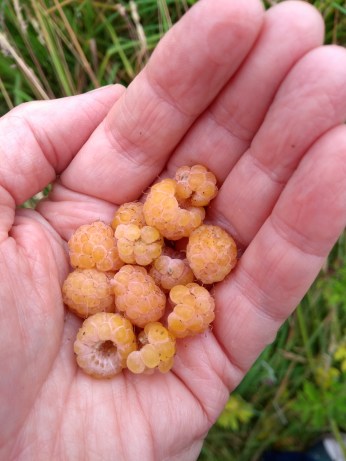 diminutive rasps are a pale golden yellow. They hide behind fiercely protective stands of nettle, and amid the jaggy stems of the hawthorn. These are the sweetest, most succulent of the feral berries. They melt in the mouth and almost dissolve in the hand. Any attempts to gather a large quantity fail; they are nought but juice by the time they get home. Those who know about them keep a close eye, and say nothing, then give the game away when it’s picking time by beating narrow paths through the grass and nettles to get at this choice fruit.
 Comments on The Nature of the Universe