Bankfoot Church is Falling Down

In February 2004, workmen were burning rubbish on a demolition site. It was a day of gusty winds, when safety procedures should have never allowed a bonfire to be considered. At some point, sparks whirled viciously into a neighbouring building, caught hold, and within minutes a blaze ensued that could not be extinguished before the building was lost.

The building was Auchtergaven & Moneydie Parish Church, sited on almost the highest point in the Perthshire village of Bankfoot. It had stood, glowering over the village, for 207 years, its timbers dry, warm and perfect for burning. Not a regular churchgoer, I’d nontheless been there a few times in the seven years I’d lived in Bankfoot, panting my way up the steep path to the entrance, and I’d enjoyed the simple, uncluttered warmth of the wood-lined interior and the sincerity of the congregation. It was a bonnie church, and a landmark for miles around. That day, horrified drivers on the nearby A9 slowed to a crawl, as flames shot to the sky.
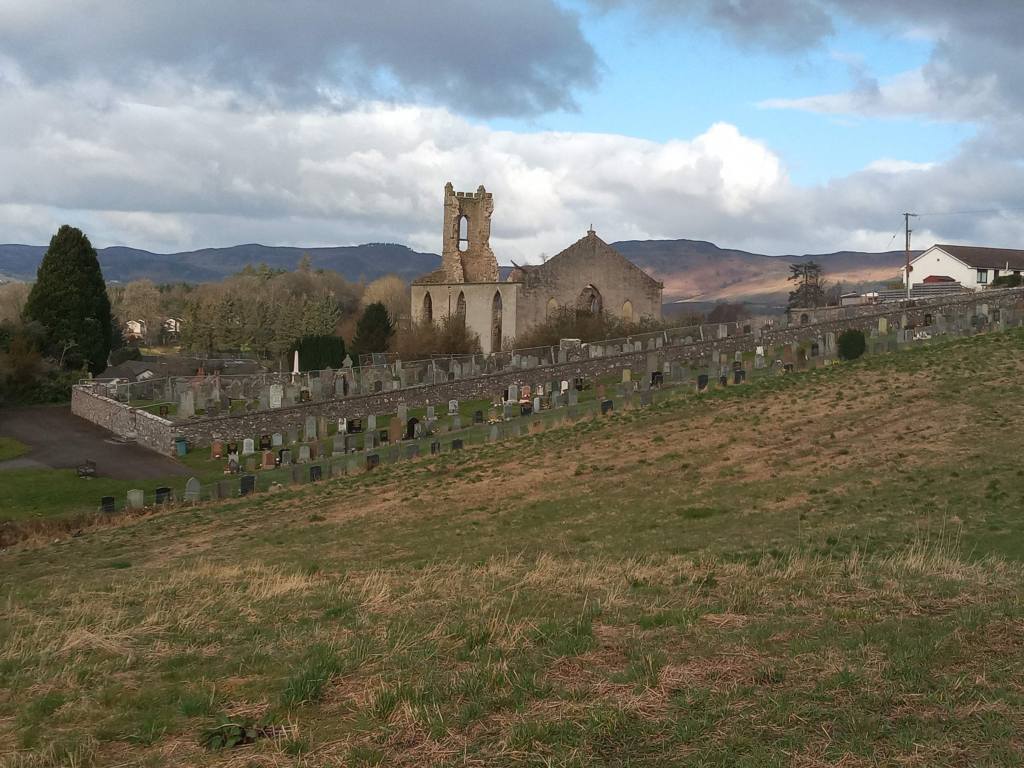
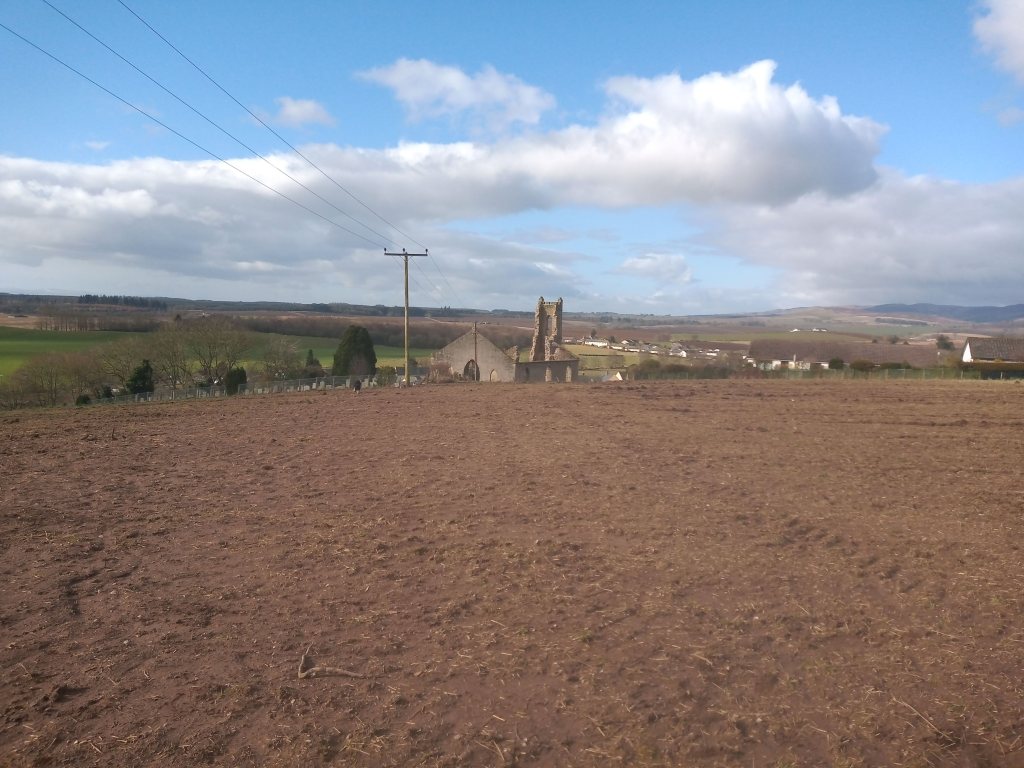
In the aftermath, the old church was not “burnt to the ground” – but it was certainly gutted. From a distance, there were many years when at first glance, you’d never know it was a ruin. The tower still stood, majestic – maybe more so than before – defiant, presiding over a landscape of haphazard hamlets congealed into one village, farmland, people and beasts. After considerable deliberation and assessment of the building’s condition and fitness for purpose, the Church of Scotland, advised by the will of the congregation, opted to build a new church on flat land it owned in the centre of Bankfoot, complete with community facilities and a low carbon footprint. It was a brave and right decision, I think, which offered accessibility and possibilities the old church never could. The original bell, cracked by fire to tonelessness, was rescued and installed as the new font.

But it left little in the coffers to do anything with the remaining structure. Disputes and debates went to and fro for years, between the culprit building firm, insurers, the Kirk, local residents, fundraisers, historians and those with an interest in the surrounding graveyard. Meanwhile, safety fencing went up around the site, the grass grew, and saplings appeared in the smoke-blackened walls. Stone crumbled unnoticed. Blocks occasionally fell; still the tower stood, indomitable. Saplings grew into trees; buddleia, that great exploiter of devastation and demolition, proliferated in the nave and drew in butterflies. Wild flowers and ferns took hold of crevices in outer and inner walls, solitary bees visited and maybe nested in crumbling mortar. Jackdaws and pigeons were regular inhabitants in spring. A garden began to grow in the sanctuary. Who knows what wild creatures found refuge among the piles of fallen rubble? No-one could get in to disturb or identify them.
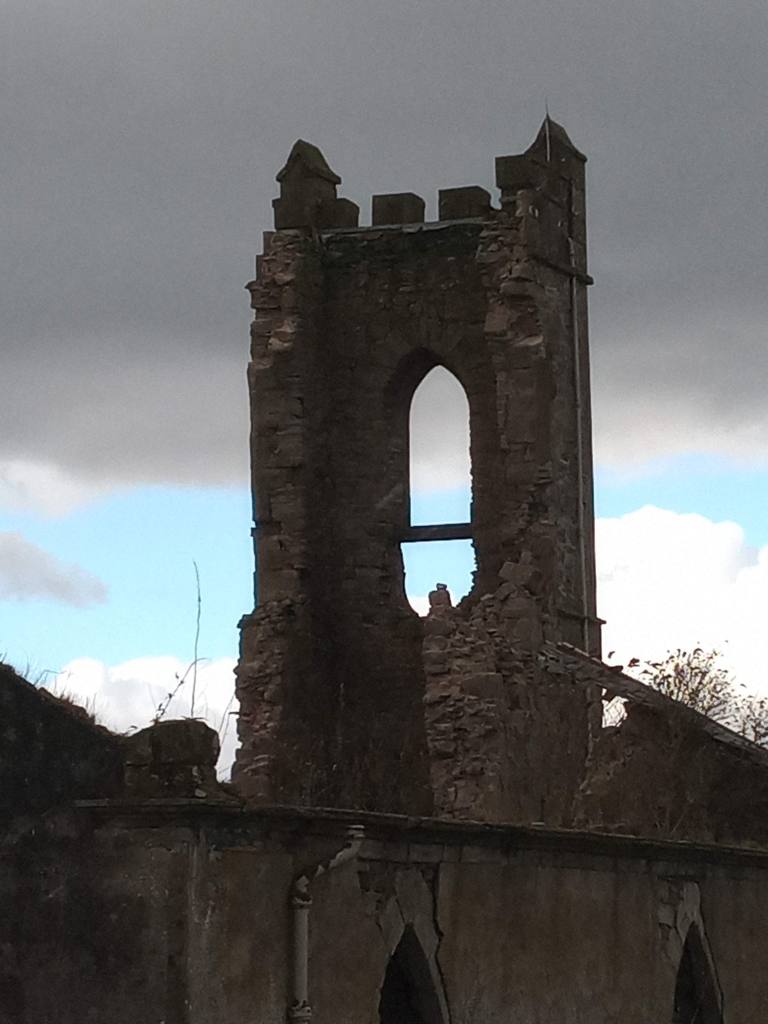
I know many people found it heart-wrenchingly sad. For me, with an ambivalent attitude to organised religion at best, it was more a change in emphasis. I felt the human-centred heart of the building died with the fall of the final clock-face, never to chime again and remind us of the days and hours. One day, out walking in early spring 2020, I noticed that the tower looked a bit odd. I went closer to see if I was imagining things, and discovered that although the front facade still held fairly intact, most of the sides of the tower had fallen in. What was left looked more precarious than ever, but it hadn’t stopped the jackdaws from building warring nests on each remaining pinnacle, or the collared doves gossiping lovingly in hollowed alcoves. Chaffinches and sparrows bustled about purposefully, hopping between the seed heads, roosting on bits of masonry.

I wondered what God – by any name or none – would make of it all. Inevitably St. Francis came to mind, who would surely be quite at ease to see wildlife frequenting a religious building. I thought of the early saints who taught that Celtic version of Christianity which reveres all life, not just the human kind. Jesus himself (despite an unfortunate show of spite to a certain fig tree) counselled his followers on the great value of seeds and sparrows, and the lilies of the field.
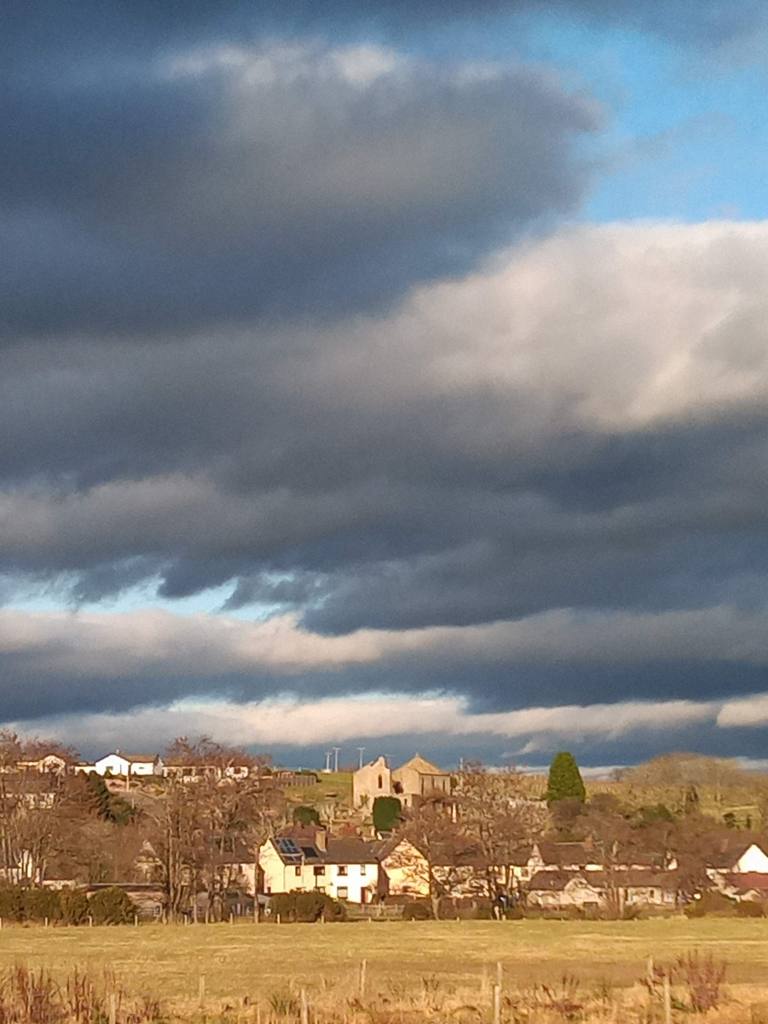
Well, I’m no theologian. Who knows? But now the rest of the tower has finally gone, with a crash in the night that woke up the residents of Cairneyhill. The skyline will never be quite the same. I hope the jackdaws and all the other members of Auchtergaven’s wild congregation hadn’t started to build their nests.

The Back Mill

backmill7

He’d dive in, dump his school bag, raid the fridge and be off.

“Where’re you going?”

“Dunno. Backmill probably.”

“Oh. Okay.”

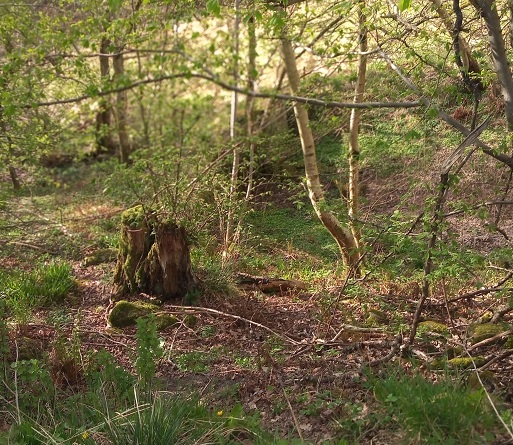
Backmill was what they called it, these prepubescent and young teenage schoolboys with more energy than sense. The little wood accessed by a rusting stock feeder converted to a bridge over the Garry Burn lies not far from the primary school. For me it was a place to find edible fungi in autumn and clouds of wood anemones in spring. For them, it was an open woodland opportunity for creating ever more ambitious bike jumps and mini skate parks, housing a roughly square, slightly sunken area they called the Curly, whose banks made a race track or skateboarding wall.

backmill1

As summer progressed, he’d pop home to borrow a spade, loppers, a bow saw. I railed, and refused the axe.

“You’re not to saw down any trees!” They did, though to be fair the old curling pond was thick with self-sown sycamores of suitable diameter for log ramps and bridges. The tracks and jumps became quite elaborate. My son and his pals were probably following a long tradition in which they were the current top dogs, and learning about engineering and practical skills in the process. Health and safety, too, I suspect.

Twenty years on, I never see a child in the woods, but the evidence indicates that to some extent the tradition continues. The burn is forded by new stepping stones, the soil is bare over the bumps and jumps, and someone’s parent has welded new metal onto the old stock feeder to keep safe-ish access going. There was a village campaign to build a “proper” skate park a few years ago. I kept quiet, but suspected an improper one would remain more attractive.

backmill2

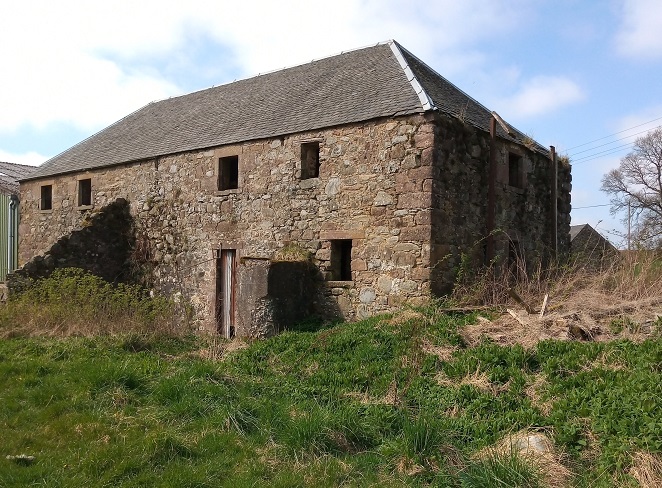
At the end of the wood and across the burn is a cluster of old buildings and a modern barn used to store straw bales. When you look closely, you can see where a water wheel once was attached to the wall of the biggest building, though nettles and rank vegetation choke the pit where it would have turned. This is the real Back Mill, after which the wood is locally miscalled. Once, it must have been a hugely important hub of activity for the village.

backmill6

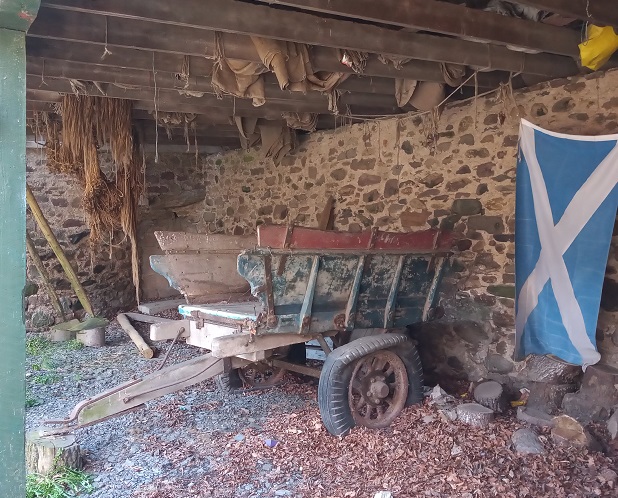
It’s a sizeable building, and across the road a second building of similar age was, I think, the granary. A door on the upper floor was probably where the grain was unloaded into wooden carts, perhaps like the one now parked in another outbuilding.

backmill4

The lower floor is crumbling, but suits the swallows and martins for nesting, and has been used for housing the beasts in winter – the old wooden manger is intact.

backmill5

But where is the water? The Garry Burn is much lower than the mill wheel, and the track into the ford now only leads to a field. Behind the mill, a stretch of level grass looks like it leads round the side to meet the wheel. Go several hundred metres up the road from the ford, looking carefully through the tangled vegetation, and you can discern a straight, broad channel. You soon come to a stone dam, and the remains of the mill-pond. From here the water would have been diverted on milling days via the lade at a slight incline to the wheel, which would start to turn and grind under its power.

backmill3

I’d love to find out more about Bankfoot’s Back Mill, and whether the wheel was an overshot or an undershot. It’ll have to wait now till the library re-opens, and I can delve again into the local history archives. Meanwhile, children of Bankfoot, keep building dens, jumps and bridges in the woods by the Curly!

Statutory Exercise into Prehistory

It’s a favourite cycle ride, a circuit of under an hour, with all the hills at the start and you can almost freewheel home, if you go clockwise. A bright, sunny Easter day and a chilly wind; dusty ploughed fields and the great pleasure of almost empty roads, as the pandemic lockdown disrupts the “joys” of motoring.

tullybeltane2

We cycle up through forest research sites and broad swathes of farmland towards Tullybelton, the hamlet whose name may derive from being the field where Beltane (May Day) fires were lit when older and more nebulous gods were remembered. We detour to Little Tullybeltane Farm, where a tall pillar points incongruously at the blue sky, and a buzzard mews and hovers. The track to the farm is neglected and lined with abandoned pieces of rusting metal; there is no plaque, no sign, no clue why it warrants such an imposing monument – and no invitation to explore.

Yet here – allegedly – the ruins of a turnip shed are all that’s left of the birthplace of one Robert Nicoll. From here he walked to school in Bankfoot, stopping to write poetry on the way. He was a peasant lad, a precocious child, the “boy poet” of Auchtergaven who died way too young, the one whose genius may have surpassed that other more famous bard, Robert Burns, with whom he had much in common – had he lived longer. But Nicoll was also a firebrand, a radical advocate for reform, a passionate speaker and fighter in the cause of human rights. Here is his monument, and not enough people know why it’s there.

He was 23 when he died.

tullybeltane3

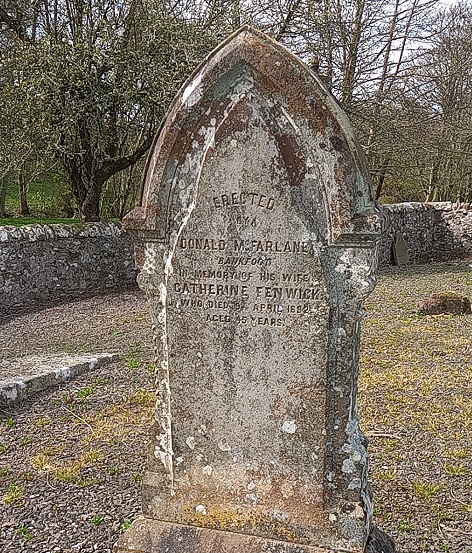
Leaving Tullybeltane behind, we coast along the Ordie Burn, where wood anemones shimmer in the sun and the wind’s behind us. Bumblebees career in and out of gorse flowers and dive between us. A determined walker out on her statutory exercise waves hello from the proscribed distance as we whizz by. We stop at the old graveyard at Kirkbride – though there is no kirk now and the headstones are in a sorry way. The names are all familiar, local ones: Nicolls and Fenwicks, Petries, Dows, Wylies and McFarlanes. I’m caught by the name Catherine Fenwick on a 19th century stone.

tullybeltane4

A Catherine Fenwick once lived in our house. She inherited or was gifted the feu from James Wylie of Airleywight (another reformer in his day – though did he “sell out” when he became a gentleman landowner?). Later, I check the deeds – we hold the parchment originals – and this Catherine Fenwick died seven years later than ours. Our Catherine lived longer…is it her shadow we constantly see flit by the kitchen window? Strange to think that both of them probably knew Robert Nicoll, whose mother was a Fenwick…. How intertwined we all are.

Kirkbride…. The church of St. Bridget, or just Bridget, or Bride, or Brigid…..Celtic Goddess of water. I can almost feel the Beltane fires. Nearby was St. Bride’s Well, said to have healing properties causing people to drink from it on the first Sunday in May (Beltane flames again) and “walk sunwise round it with joined hands, and lay down branches of rowan”.

tullybeltane5

We find no well, but up on a rise is the standing stone of Pitsundry, said to mark the place. There was within living memory a water trough under a hedge there, supposedly fed by the well. No hedge today, just barbed wire; it’s dry as dust and hard to imagine why there’d be a well on top of the hill. But when I check the maps later, I find a spring marked very close by.

tullybeltane 1

While I’m exploring, another lockdown cyclist tells Andrew (from a social distance of course) that the Pitsundry stone lines up with others on the Muir of Thorn, the other side of the A9. That checks out on the map too, more or less. When we freewheel back into the boundaries of our village, it feels like our journey was further, deeper, more entangled with ghosts, than the quick exercise circuit we set out upon.

A Big Hoose and its Carriage Drive

airleywight drive

Another giant tree that was part of the avenue lining the old carriage drive has come down. Every year, one at least succumbs. They are mostly beech, monumental now, out of scale with the straggle of the village and the low fields that sulk under the weight of rain and ripe barley.

airleywight4

The carriage drive is a ghost of former times, looping importantly around the grounds of the big hoose that now peeps sheepishly out from behind its deer fences and the remnants of redwood trees, the choice rarities, status symbols prized by landowners two centuries ago. Then, it all belonged – carriage drive, trees, big hoose and all – to the Wylies of Airleywight. To be honest, James Wylie probably owned most of the village, and built a fair whack of it too. He owned my house, and, though long dead, may well still own the rough road on which it lies. (Nobody else claims it, despite rumours that it might be the property of the Bankfoot Light Railway, also long dead.)

A footpath follows the line of the carriage drive, side-stepping the remaining beeches. Here and there, minor land grabs seep into it. A corner of field here, children’s dens there, new tracks, sheds and barbecues. A shady allotment of raised beds fingers into it, created by someone in the adjacent scheme with access to Heras fencing and a tendency to self-sufficiency. In the woods beyond the house, where the Garry Burn streams by, a squarish, sunken, shallow bog is still called The Curly by successive generations of schoolchildren, out on bikes and skateboards, building jumps. If you hunt among the rank vegetation, you’ll find the metalwork that filled or drained the pond for icy games enjoyed by residents and visitors to the big hoose at Christmas.airleywight2


Where the carriage drive seems to end, the footpaths continue, past what’s left of the huge walled garden. Now a forest of self-seeded trees occupies the space where fruit, flowers and vegetables once were expertly raised on the south-facing slope. They tower above what’s left of the crumbling, ruptured walls. Who knows what horticultural sleeping beauties may still lie dormant at the heart of the garden?


The cottage near it lay abandoned save by the swallows for many years, still graced by bursts of surviving garden flowers among the thistles in summer. The butterflies loved both. Was it the gardener’s house? Or perhaps the coachman for whom the drive was made? The village architect has renovated it to picture postcard perfection. It looks content, roofed, aired, cultivated – but not extended. Nearby he built himself a house of traditional, solid materials, that so fits the landscape in style it has become part of it. Already there are lichens on the roof and leaves in the gutters. The swallows and martins nest easily in the eaves and outbuildings.airleywight3


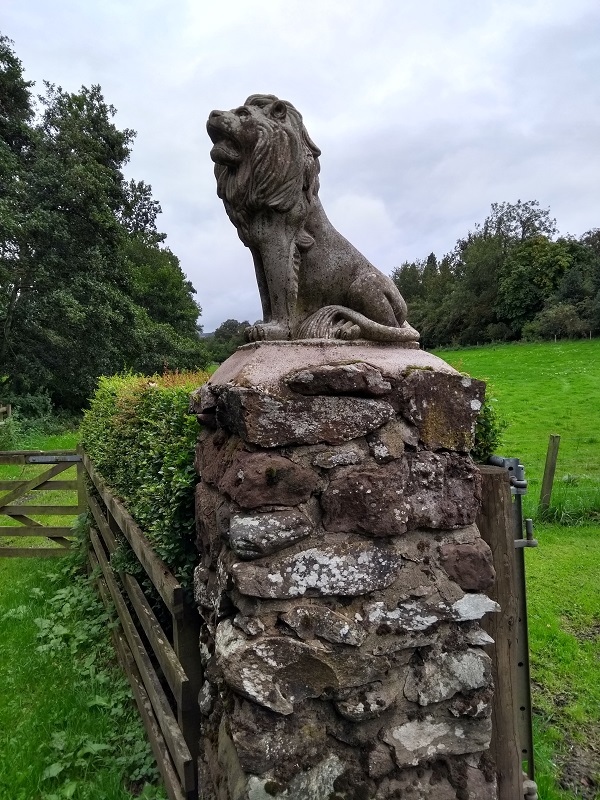
You get to the big house now by a difference entrance, made significant by statuary, but no carriage drive. Of the latest owner, and what they plan for their gardens, curling ponds and steadily declining avenue, there is no word.


Feral Berries

These fields, which now yawn under the predictable rotation of wheat, barley, potatoes and the occasion excitement of peas or beans, were all berry fields once. It was the biggest and best-known of five plantations around here, where canvas tinker villages sprouted annually at harvest time, and the needs of the workforce were met in this now silent, gone-to-work, wee town by a wealth of grocers, bakers, butchers, innkeepers, tailors and shoemakers. At least five surgeons lived here in case of accident or emergency. The berries that weren’t eaten on the spot or smuggled home by the pickers all went south, on the new branch line connected to the village for the purpose, to become jam on well-to-do breakfast tables.

Now in the quiet forgetfulness of displaced industry and commuter inertia, tangled woods wrap themselves round the margins of large exposed fields. The old track takes you past the farmhouse that is no longer a farm, the steading that is no longer a steading, and wanders aimlessly north, between the remnants of its hedgerows. Long ago, it was the only road north, save for an older track across the moss.

Here and there, a narrow change in fencing or a wooden post marks where one of the many footpaths to and from the berry fields used to run. A curious right of way plummets through someone’s back garden and still has legal status. Patches of No Man’s Land persist, and where they do, the ghosts of the berry fields haunt and echo.

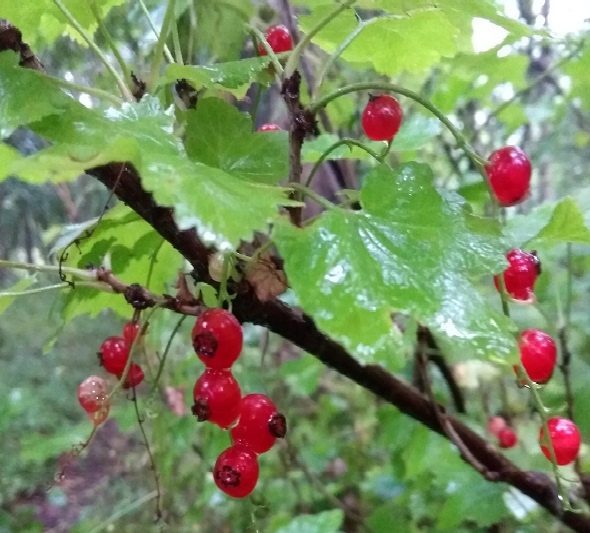
feral berries 1In the dense shade of a triumphant elder spinney, a smattering of redcurrant bushes blooms and fruits, scant rich redness catching the eye as the berries ripen. They are small and sour, yet somehow incandescently flavoursome. Where the track narrows to a muddy path, wild gooseberries make a wee thicket. Their fruits are also tiny, and round. Are they genuinely wild?

Or the depleted progeny of an old cultivar, maybe Scottish Chieftain or Lord Elcho, prized a century ago, now nearly forgotten?

But the raspberries, they are everywhere; an abundance that makes cultivation seem a frivolous and needless expenditure of time. They spring from lawns and borders in untidy local gardens, in numbers that cannot be put down to the activities of a large and hungry population of blackbirds. They line the hedges that border the track, they rise lushly above the willow herb and tall grasses of woodland clearings. They are bountiful enough to gather for the freezer, but, more often, they make a wayside breakfast for people out with their dogs on sunny summer mornings, staring vacantly into the trees, popping raspberries like pills.

In one small hedge remnant, the raspberries go unseen and untried by strangers. TheseIMG_20190727_093257760 diminutive rasps are a pale golden yellow. They hide behind fiercely protective stands of nettle, and amid the jaggy stems of the hawthorn. These are the sweetest, most succulent of the feral berries. They melt in the mouth and almost dissolve in the hand. Any attempts to gather a large quantity fail; they are nought but juice by the time they get home. Those who know about them keep a close eye, and say nothing, then give the game away when it’s picking time by beating narrow paths through the grass and nettles to get at this choice fruit.

All in the past now, the Auchtergaven and Bankfoot berry fields. The history of a place often speaks through its plants, and may have something to say about its present..