

First, let me make it understood: the narrow path at the back between our house and an unruly hedge of ghastly snowberries and virulent ivy is a no-go area we rarely check up on till the ivy taps on the one narrow window in that wall. This is how the bee boxes went un-noticed.
A hive of bees blocked off the entrance to that path for many years. It also made the lovely south-facing corner of the garden a bit of a no-go area for maintenance in summer, until we tired of the feeling that the woods were devouring the house, and moved the bees to the farm where we grow fruit trees, and the ministrations of better beekeepers. However, there have always been feral bees in Bankfoot (to which we may at times have contributed – but surely not), so we kept what’s known as a bait hive there, in case a swarm was looking for somewhere to take up residence. It’s basically an empty hive with some honey scented frames of ready-to-build honeycomb inside. If they did, and if all went well, they too would be moved to the farm.
This worked in 2019, and again in spring this year. A big, exuberant swarm arrived in May (clearly worth their load of hay). We left them to settle and establish, partly because we’re busy/lazy/unprepared, but also because whenever we interfere too much with bees, something seems to go wrong. Bees, in my experience, know what they’re doing far better than we do. I confess, I know all the theory, but am a terrible beekeeper. Sadly, on this occasion, we were all helpless in the face of pesticide poisoning. The bees started coming home in dribs and drabs, crawling around witless on the patio and unable to reach the hive, many dying with their probosces (tongues in the vernacular) protruding. The whole colony was killed; whether from agricultural blitzkrieg or over-enthusiastic wannabe gardeners in lockdown, I’ll never know. We put the boxes and frames on the bonfire in case the other honeybees that came to rob the undefended honey got poisoned by it, and cleared the site.
One day at the beginning of August, John and Linda called for a garden visit while we were out. When we got back, John said, “See your bees are doing well, very active today.”
“No, no, we don’t have bees, they were poisoned. That’ll just be robbers still smelling the old hive.” John looked very sceptical, but the matter was dropped. A few days later, in the warm sunny weather, we both thought, that’s odd, those robbing bees do seem to be very purposeful. That’s when we discovered the haphazard arrangement of two bee boxes, discarded gods know how long ago, in the dark, ivy-infested jungle at the side of the house.

We had bees. Again. Get the smoker out.
A late swarm like this is usually small, and doomed. But with our usual ineptitude, we hacked back the undergrowth and installed the colony in some sort of bee-order with a floor, varroa mesh (which we initially put on upside down, so had to dismantle and reassemble the whole structure), a opening restrictor to deter robbers (it was when we couldn’t get that in the entrance that we realised the varroa floor was upside down) and a roof. Still unsure how to tempt queen and colony from their wild comb into nice neat rectangular beekeepers’ wooden frames. Maybe we won’t. Gradually, a few inches at a time, we moved the bees forward out of the undergrowth so that they’re almost in the sun. Luckily, there’s been a lot of sun.
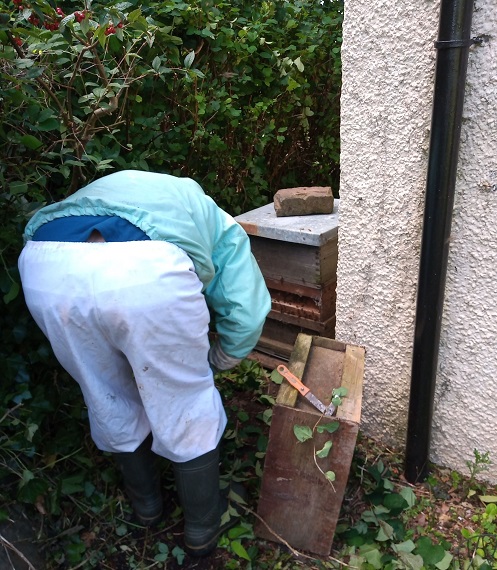
Now, at the start of October, they are still very active, feasting on late nectar flows from our Hemp Agrimony, Globe Thistles, Wild Bergamot, Sunflowers, Knapweeds and Michaelmas Daisies. Grudgingly, I note that the virulent ivy when it flowers will be just what they need before the winter. Who knows if they’ll come through the winter? These times are tough for our pollinators, tough for every species in fact. If they do, they’re going to the farm. Check for boxes in the undergrowth.


 Comments on The Nature of the Universe