Oh Bees, that will not let us go…

First, let me make it understood: the narrow path at the back between our house and an unruly hedge of ghastly snowberries and virulent ivy is a no-go area we rarely check up on till the ivy taps on the one narrow window in that wall. This is how the bee boxes went un-noticed.

A hive of bees blocked off the entrance to that path for many years. It also made the lovely south-facing corner of the garden a bit of a no-go area for maintenance in summer, until we tired of the feeling that the woods were devouring the house, and moved the bees to the farm where we grow fruit trees, and the ministrations of better beekeepers. However, there have always been feral bees in Bankfoot (to which we may at times have contributed – but surely not), so we kept what’s known as a bait hive there, in case a swarm was looking for somewhere to take up residence. It’s basically an empty hive with some honey scented frames of ready-to-build honeycomb inside. If they did, and if all went well, they too would be moved to the farm.

This worked in 2019, and again in spring this year. A big, exuberant swarm arrived in May (clearly worth their load of hay). We left them to settle and establish, partly because we’re busy/lazy/unprepared, but also because whenever we interfere too much with bees, something seems to go wrong. Bees, in my experience, know what they’re doing far better than we do. I confess, I know all the theory, but am a terrible beekeeper. Sadly, on this occasion, we were all helpless in the face of pesticide poisoning. The bees started coming home in dribs and drabs, crawling around witless on the patio and unable to reach the hive, many dying with their probosces (tongues in the vernacular) protruding. The whole colony was killed; whether from agricultural blitzkrieg or over-enthusiastic wannabe gardeners in lockdown, I’ll never know. We put the boxes and frames on the bonfire in case the other honeybees that came to rob the undefended honey got poisoned by it, and cleared the site.

One day at the beginning of August, John and Linda called for a garden visit while we were out. When we got back, John said, “See your bees are doing well, very active today.”

“No, no, we don’t have bees, they were poisoned. That’ll just be robbers still smelling the old hive.” John looked very sceptical, but the matter was dropped. A few days later, in the warm sunny weather, we both thought, that’s odd, those robbing bees do seem to be very purposeful. That’s when we discovered the haphazard arrangement of two bee boxes, discarded gods know how long ago, in the dark, ivy-infested jungle at the side of the house.

Clearing the undergrowth

We had bees. Again. Get the smoker out.

A late swarm like this is usually small, and doomed. But with our usual ineptitude, we hacked back the undergrowth and installed the colony in some sort of bee-order with a floor, varroa mesh (which we initially put on upside down, so had to dismantle and reassemble the whole structure), a opening restrictor to deter robbers (it was when we couldn’t get that in the entrance that we realised the varroa floor was upside down) and a roof. Still unsure how to tempt queen and colony from their wild comb into nice neat rectangular beekeepers’ wooden frames. Maybe we won’t. Gradually, a few inches at a time, we moved the bees forward out of the undergrowth so that they’re almost in the sun. Luckily, there’s been a lot of sun.
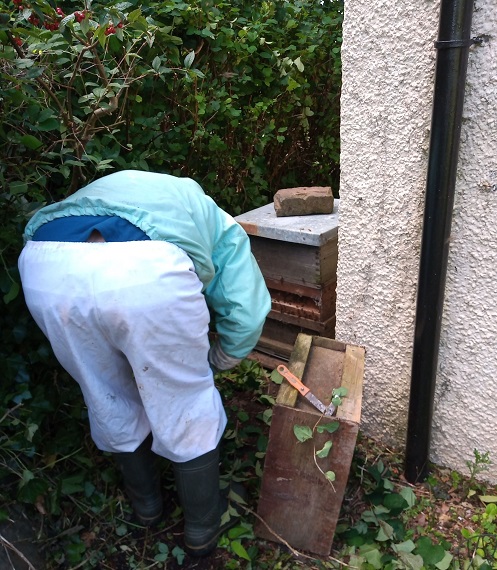
The thing about a bee suit is, it’s pointless unless everything’s tucked in

Now, at the start of October, they are still very active, feasting on late nectar flows from our Hemp Agrimony, Globe Thistles, Wild Bergamot, Sunflowers, Knapweeds and Michaelmas Daisies. Grudgingly, I note that the virulent ivy when it flowers will be just what they need before the winter. Who knows if they’ll come through the winter? These times are tough for our pollinators, tough for every species in fact. If they do, they’re going to the farm. Check for boxes in the undergrowth.

Bees, Butterflies and an Old Straight Track

5mile wood1

The things you do in a lockdown. I wouldn’t normally walk from the house to Five Mile Wood, I’d call in on my way to somewhere else, parking the car. It’s not an especially long walk, but since they felled most of the trees on the Bankfoot side, cavernous ditches and hollows have made the entrance to the wood treacherous, wet and debateable, and the track to get there goes on a bit and is not especially interesting.

Or so I thought.

I marched out from Bankfoot on one of those dazzling, sun-struck mornings of which we’ve seen so many this April. We crossed the pleasantly deserted A9 and the field to the edges of Cairnleith Moss and turned right along the track to North Barns. The path stretched ahead in a tediously straight line, the wood in the far distance looking nearer than it actually was. At some point, I turned round to let the dog catch up.

5mile track1

It was a VERY straight track. North, it pointed directly at Birnam Gap, the space between the hills where every Great North Road is forced to pass. Ahead of me, beyond Five Mile Wood, the conical East Lomond Hill in Fife lay in a direct line. Suddenly, it fell into place. With these landscape markers aligned, this was the ancient route north – preceding the drovers’ track above my house, which preceded the winding old A9 through Bankfoot village, which went before the current A9. They all run roughly parallel, and all have to go through Birnam Gap. (Later I consulted the maps: this old straight track seems to have continued beyond the wood to meet the Tay at Waulkmill, then probably followed the straight road through Stormontfield, and on to Perth or beyond).

5mile track2

On either side, vast, treeless fields stretched forever, brown, homogenous, dusty and devoid of hedges. In a hollow beside the track were a dozen beehives. I realised the field I’d just passed did contain a crop – oil seed rape, yet to flower. That’s why the bees were there. A farm vehicle traversed the horizon on the other side, trailing an enormous boom sprayer. Dust and chemicals billowed behind it. The smell in my nostrils was like an airport runway. How on earth, I thought, did the bees keep going, while waiting for the rape to flower? There were no wild flowers in this agricultural desert.

5mile entrance           5mile gorse

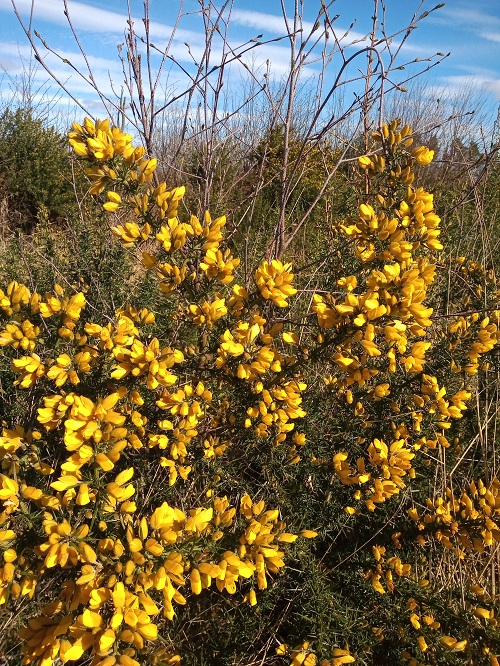
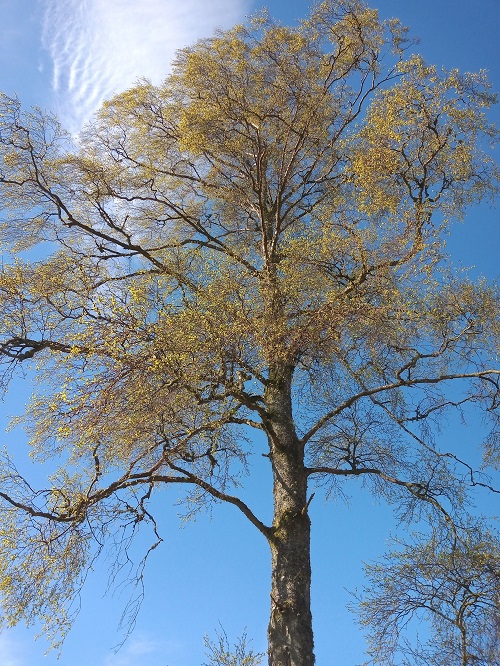
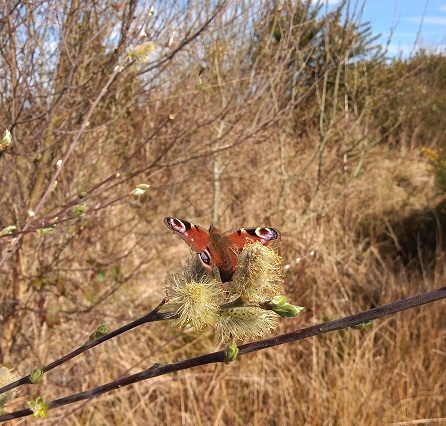
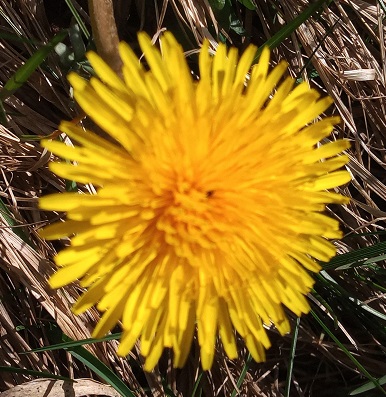
Reaching the edge of Five Mile Wood, I crossed the gate into the ravaged landscape of felled trees. The footpath sign directed me, and I could see where I needed to be, straight ahead on the old track, but a new route had to be picked to get there. Others had succeeded; makeshift log bridges across water-filled ditches, meandering paths that skirted the boggy areas. I reached the main path which circles the interior of the wood amid the heady coconut-scent of gorse – and there I found the bees, working the flowers sprung up in the new heathland created by felling. Beautiful birches, freed from forest, leaves just opening against a vivid sky. A border of dandelions edged the path, dancing golden and perfect in the sun of noon. Goat willows, pioneer trees of clearings, still in flower, had attracted a small swarm of peacock butterflies. In the new landscape of a one-time forest the bees and butterflies and all the creatures of the heath found sanctuary.

5mile birch     5mile peacock

Returning home, I thought about how important this chameleon landscape is, set against modern farming. I thought, too, about the old straight track that entered the woods, and how its purpose was muddied by activities that had made it so hard to follow. I thought how approach and access is so important, in any plans we may have for these woods in the future.

5mile dandelion

The Gorse Tenement Spiders of Perthshire

“When gorse is out of flowers, kissing’s out of season,” so the saying goes.

That’s one use for this for this furiously jaggy native shrub, also known as whin, or furze. Since flowers can be found on a gorse bush in every month of the year, it’s a license for affection. A light tea from the deliciously coconut-scented flowers is another purpose; the same flowers are an ingredient in natural dyes. Sounds highly unlikely, given that horses have sensitive mouths, but allegedly the dry branches of gorse, thorns and all, are a nutritious feed for these beasts. The plant’s tendency to seed, spread and steam all over any unsuspecting tract of slightly open ground might be off-putting to the gardener, but there’s little doubt it makes a good deterrent for invaders and intruders.

Do we reckon the value of a plant only in terms of its uses to humans? Too often! A hillside bright with gorse will not only gladden the human eye, but it will provide pollen and nectar for a range of bees and other insects. A gorse bush is an ecosystem owing nothing to our interference.gorsespiders2

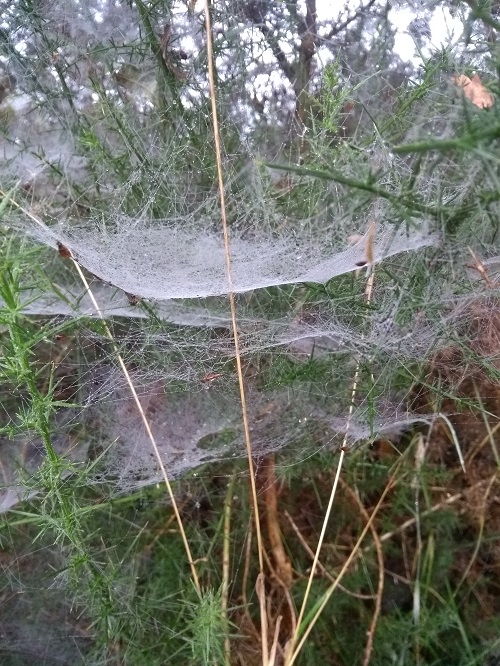
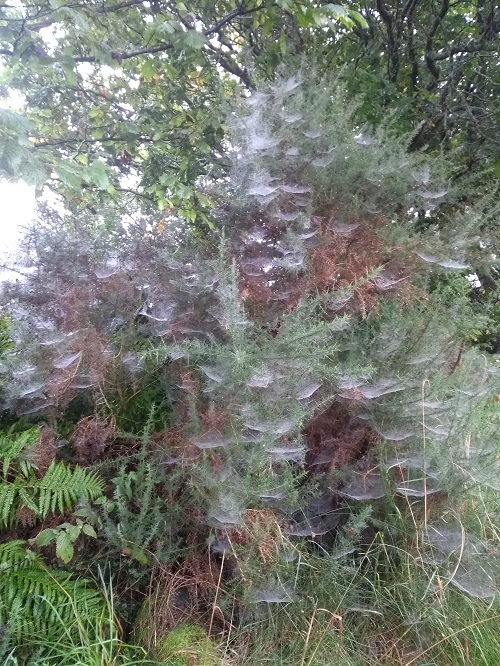
One autumn morning – the kind where damp mists hang low and the sun is watery and out of sight, I came upon the Spider Tenements. I did not see a single arachnid – nor yet a gorse flower! – but the fog condensing on the gossamer revealed each web on these gorse bushes in elaborate detail. It also revealed the happiness of spiders to rub shoulders (knees?) with one another in close proximity. If one web equals one spider, there must be hundreds on every bush. They don’t mind the jagginess; obviously it gives them lots of points for attachment of their superficially haphazard cobwebs!

gorsespiders1


I wonder how many small insects were caught on this bush today. How many webs do you think there are?

And does anyone know what kind of spider my gorse-loving, tenement-dwelling pals might be?