
 A full evening, two nights and two days of rain. Humidity hangs in the air, the soil beneath my feet pulses damply, the mosses are full and green. Raindrops still coat every flower of grass and frond of bracken, but the sun is shining. The timing is right.
I go for mushrooms in the place where the Highlands meet the Lowlands, where the land is rent by fault-lines and rainbow-coloured slate out-crops and erupts. I pass the court hill where outlaws were tried and hung from the oak trees of Birnam Wood, three hundred years after Macbeth was king of this nation. I stalk through the devastation where the larches were, before they got phytophthera and were felled. There is nothing there now. But in the crowded wood beside the path, one big larch has been missed, and the sun shines in tawny patches upon last year’s fallen needles. It catches on a small group of Larch Boletes, glistening and tawny themselves in their cosy cohabitation with the tree. I take one. A deadly Panther Cap smirks nearby and I ignore it.
Broken and battered, an old sweet chestnut tree is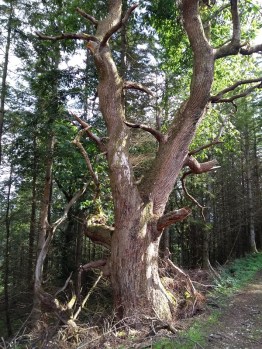 surviving the metallic blundering of the foresters’ vehicles, harvesters and forwarders, along the track. How did it get here? Not a native tree, so planted a long time ago, when this haphazard forest was occupied in a different way. Who planted it? Did they hope for chestnuts to roast on autumn fires?
I follow the hint of a track down a slope towards the thicket where rhododendron is making its usual bid for world domination. No more than a wisp of trodden grass and bent fern, my path diverges and peters out at a crop of the biggest chanterelles I’ve  ever seen, tucked into the side of a rugged bank that oozes water. Was this path made by a human who knew where to look, or by another animal? Someone told me yesterday that the best chanterelles are on banks and slopes because the deer can’t graze them there.
I’m always competing with other animals for my dinner. But I’ve had lots of chanterelles this summer and there is still a dish at home in the fridge. I take a couple. I have rules when I’m foraging. Never take more than I need, only take a percentage of whatever I find, leave old mushrooms to sporulate, leave young ones for tomorrow, for the next predator or none, for others just to see and love.
Under birch, I acquire some young Brown Birch Boletes and a single Cep. Ploughing through forest, I note the tiny horsehair mushrooms are up and about, trooping on twigs and the needles of conifers. I ignore, too, the many “wee brown jobs” of mushrooms that once I diligently took home as single specimens to try to identify with hand lens and spore print. Some I succeeded in pinning down, too, only to forget them altogether until I came across them again in another wood, another year. Life’s too short now, I am focused on my prey.
Huge shaggy mushrooms shout out to me as I pass another grove of conifers and I am lured in. But they are the uneaten halves of massive fir cones – red squirrels have eaten the succulent tops from every one, and laugh at me from the tree tops.
They cluster in the fallen forest by the dam, the new flush of Saffron Milk Caps, just where I thought they’d be, and just at the right stage before the fungus gnats lay their eggs. They are sound, and plentiful and could make a wonderful painting, with their improbable colours of orange, cream and khaki-green. But they won’t, for I take my portion and weave them into a spell of dinner.

 Comments on The Nature of the Universe