In the misty dampness of a cool May morning, the tangled and decaying woodland holds its breath. Falling trees prop up shattered branches and each other, precariously leaning, hanging on by brittle twigs to some semblance of the vertical. Elsewhere, the long archaeology of those that have already succumbed to gravity make the woodland floor uneven, precarious, unpredictable. Some are half-sunken: indistinct mounds of mosses and soft, cushion-like wood, sprouting ferns and small plants – wood sorrel, purslane, chickweed wintergreen – from every crevice. Others, newly crashed in last week’s gale, still carry their leaves, shrivelling, poignant. Between the two extremes, lie trees and logs in every stage of decomposition.
The walker in this wood must learn these stages, and recognise which logs will still make good rafts to lay across the boggy places and ditches she would cross, and which will just crumble when stepped on. She must be aware of what lies overhead and if it would be wiser to go around, rather than under, the hung-up branches. Familiar paths are blocked every month and must be re-routed. New ground is created, explored, and lost again.
Out of the decomposition, new worlds are also born. What is decomposition if not the beginning of opportunity? Spiders re-align their webs in the remaining dead branches of a leaning tree. The breakdown of bark releases nutrients; tree becomes soil, soil claims tree. Single-celled organisms work their way through a sea of bacteria, laying the foundation for others to thrive.
Opportunities are made for beetles that feast on the rot in wood and bark, and the birds and small mammals that home in on the beetles. Shelter, food source, songpost, tunnel, bridge – the creatures of the wood utilise the fallen and falling trees in many ways. On their bodies they bring more soil, seeds, and the elements of fertility to this garden of decay.
And oh, how the garden grows.
It is not death that the walker witnesses, but birth and life. Is this decomposition, or composition? Is it both? Is this the end of the wood, or the beginning of a new landscape? No human cares much for this wood. Children sometimes come and make fires, camp or build twiggy shelters, but you never see them. There is an old tyre swing, hanging neglected. Someone – no-one knew who – used to make sculptures out of stones in the heart of the wood, but not anymore. Dogs are walked, but usually led straight past the wood now that access is trickier. No-one “manages” it. Change, then, seems rapid. Whole trees crash down, leaving soggy craters and towering cliffs of root-ball, but transformation in nature is incremental, and constant. Each year, the populations dwelling on those bare root-cliffs are slightly different. Ground living fungi give way to aerial brackets, rabbits exploit entrances to potential burrows, liverworts, lichens and ferns take hold.
And underground, fungal mycelia move like whispers within subtle, shape-shifting parameters. Today, a downpour of the night is percolating under the moss-covered banks and logs. Soft spring rain, scarcely visible except when the smirr catches a shard of sunshine, seeps into the soil cauldron, fermenting, bringing new elements, new conditions.
Things move unseen.
Everything waits.
The walker in the woods has seen no mushrooms yet. But even a human animal can smell the contents of the cauldron, the warm, damp changes happening unseen below the wreckage of an unmarked wood. When all the boxes have been ticked, the harvest will be rich and golden.


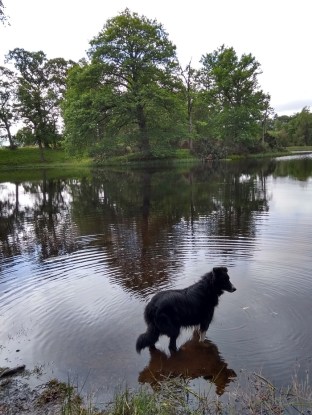
 A full evening, two nights and two days of rain. Humidity hangs in the air, the soil beneath my feet pulses damply, the mosses are full and green. Raindrops still coat every flower of grass and frond of bracken, but the sun is shining. The timing is right.
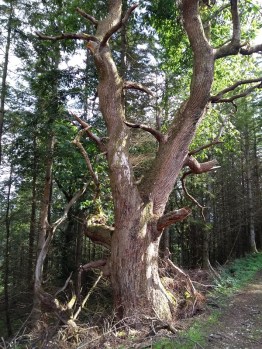 surviving the metallic blundering of the foresters’ vehicles, harvesters and forwarders, along the track. How did it get here? Not a native tree, so planted a long time ago, when this haphazard forest was occupied in a different way. Who planted it? Did they hope for chestnuts to roast on autumn fires?
 ever seen, tucked into the side of a rugged bank that oozes water. Was this path made by a human who knew where to look, or by another animal? Someone told me yesterday that the best chanterelles are on banks and slopes because the deer can’t graze them there.


 Comments on The Nature of the Universe