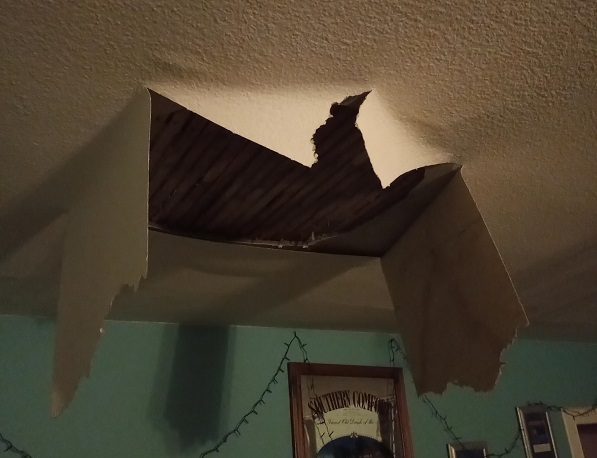
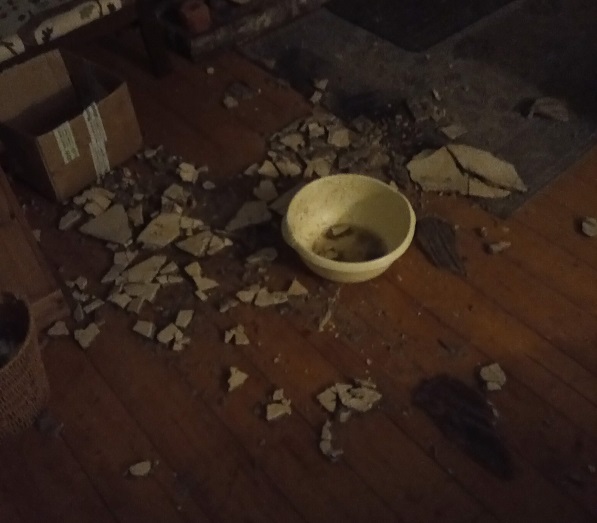
There’s a hole in my ceiling. It appeared in a shower of soggy plaster at two in the morning, thank you, the plumber who couldn’t see the pipework he was soldering. Now it gapes at me, streamers of ceiling paper ripped apart by weight of water from such a tiny drip. I do not know how it will get fixed. Or who will fix it. Already, I’m in danger of forgetting it’s there.
It’s amazing what you can get used to.
There’s a hole in my planet, a land-slipping crater, the stuff of nightmares. Into it falls species after species, scrabbling at the edge as the crater gets wider. Few get out. Few are rescued. They slip unseen. They fall. Out of sight at the core of the vortex, they join the bones jangling amid the soup of ruined soil and despoiled seas. Some measure the crater. They scream the edge is getting closer and closer to where this dysfunctional, bipedal, insensate species hovers. Most look away. The party must go on. We will not notice the crumbling quicksand.
It’s amazing what you can get used to.
There’s a hole in our lives. Our patterns and expectations slashed and cloven, our hopes pulverised. Into this fearful emptiness creeps something tiny and unseen. It carries fear. It divides us more than it unites us, provokes discord, brings us down. We look around to see where our thwarted plans, our comfortable habits, our dreams, have gone. Where are our friends? Where are our grandparents? The children we cannot see growing up? Where is tomorrow? Our bodies are under attack. Our minds turn backwards, inwards, away.
It’s amazing what you can get used to.
There’s a hole in my ceiling. I sweep up plaster dust. But it won’t go away.
How often in the past year have you heard someone say, “You never know what’s around the corner”? Or felt anxiety because you really, really don’t know what is happening or going to happen to you, and the future is obscure? We got caught in the Christmas Covid Car Crash, and are just mentally reeling from a close encounter with coronavirus. We emerge, cautiously and with reluctance from tests and self isolation, while our close family recover from the virus. We emerge into another lockdown, and feel relieved. Self-isolation, let me tell you, can be addictive when you’ve been scared, and realised how ill-prepared you are for dying.
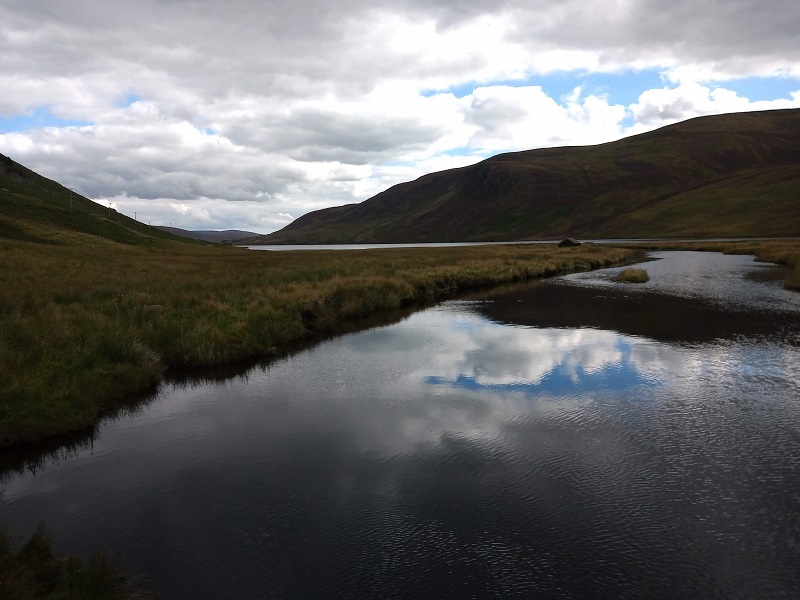
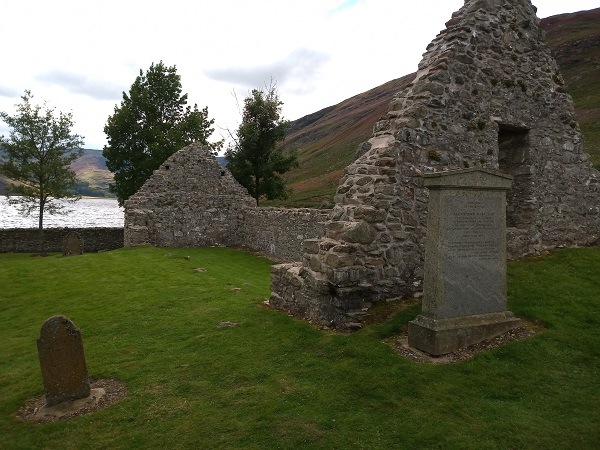
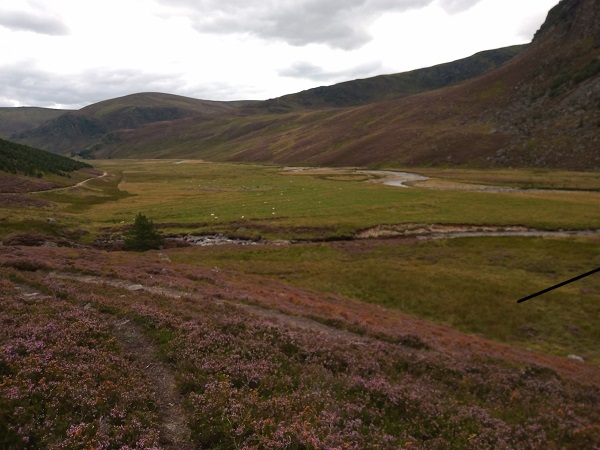
Back in late summer, when such things were still possible, we had a two day camping trip to Glen Esk. On the second day, we decided to take a short and easy walk up Glen Lee. Short, to give us plenty of time to enjoy a cycle down Glen Esk as well. At first, we decided, we’d just go to the start of Loch Lee and turn around. But just beyond the point where the Water of Lee calmly enters the loch, we could see the ruins of a church or chapel by the waterside. “We’ll just go to that and explore.”
The tiny old parish church of Glenesk had not been used in a good while, but the ancient gravestones, carved with faces and bones and what look like crossed spades, suggested a long history. In fact, a church of some kind is believed to have stood here since at least the 8th century. The sun on the well-tended grass invited a long dawdle and a picnic, and then we ambled along the track by the loch. The other end of the loch wasn’t quite visible, so we thought we’d “just go round the next corner” to see it.
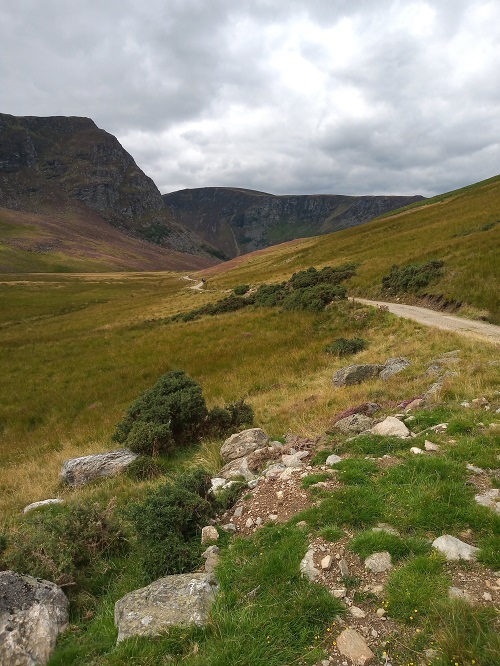
And so we began the inevitable daunder-of-curiosity which besets all walkers in new territory – the drive to see what’s round the corner, or over the next hill. Round and past the far end of the loch, skirting the flat plain where we looked for the signs of ancient habitation, past deserted farmsteads and into the steep-sided valley, up into the purple heather. Every crag we rounded gave us sight of another; we had to know what came next.
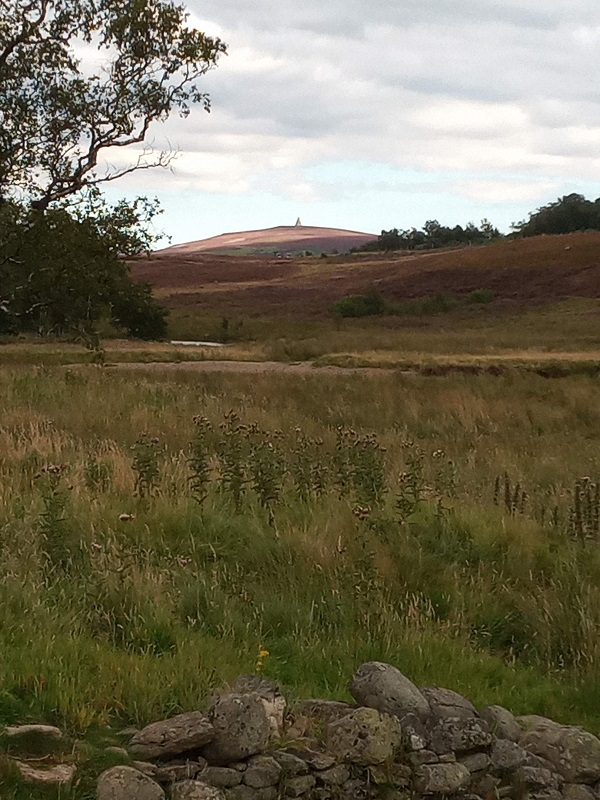
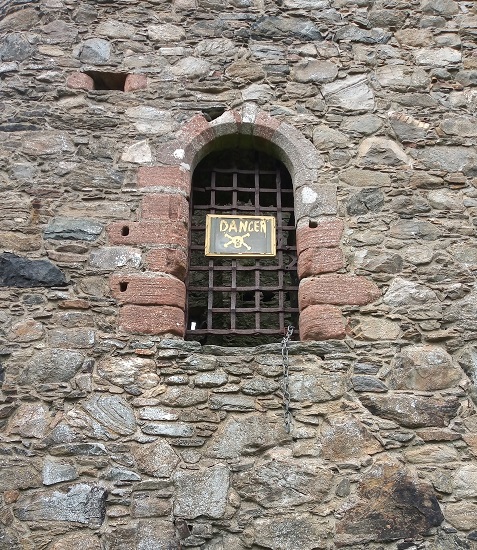
Eventually, we saw the Falls of Unich, where tracks to right and left might have given us a circular walk. But we didn’t have a good enough map, and still wanted a cycle. So we returned the way we came, marvelling lazily at the carnivorous sundews and butterworts in the ditch by the track, stopping to watch a hen harrier swooping low over the crags and rising again, while we, in turn, were closely observed by ravens, shouting harshly at our passing. Before we got the bikes out, we had time to admire the forbidding Invermark Castle and the tempting Hill of Rowan, surmounted by the imposing Fox Maule-Ramsay monument.
On this short walk, we left many corners not turned. Maybe we’ll go back. Maybe we won’t. Truth is, none of us knows, or ever has known, what’s around the corner, even when we succeed in deluding ourselves that we can plan ahead and things will always turn out as we planned. The future’s the un-turned corner, and we can only know for sure about the corner we’re standing at.
We are in strange times. Things are changing. People don’t like change. Many people will be yearning for everything to “go back to normal”. The media incessantly bleat that expression “back to normal”, interspersed cleverly with “business as usual.” People listening assume that’s what they – and everyone else – want to see. People won’t raise an eyebrow at this assumption, because people like to feel they are in the majority and agree with everyone else. They think there’s safety in numbers, even when the numbers are imaginary or made up.
Some of us – many of us – don’t. We want things to change. Some politicians even want change – or at least can see that it’s inevitable. But they sugar the pill by calling it a “new normal”. What do we want to change?
People to stop over-consuming the planet’s resources
The widening gap between rich and poor
Greed and Injustice – social and environmental
Air pollution, plastic, environmental degradation
Wars, bombs, threats, dictatorships
Governments that chip away at democracy
People thinking biodiversity loss is inevitable “progress”
What Tennyson called “the faithless coldness of the times”
….and so much more
We want, well, everything to change. It’s too much to ask. Where do we start?
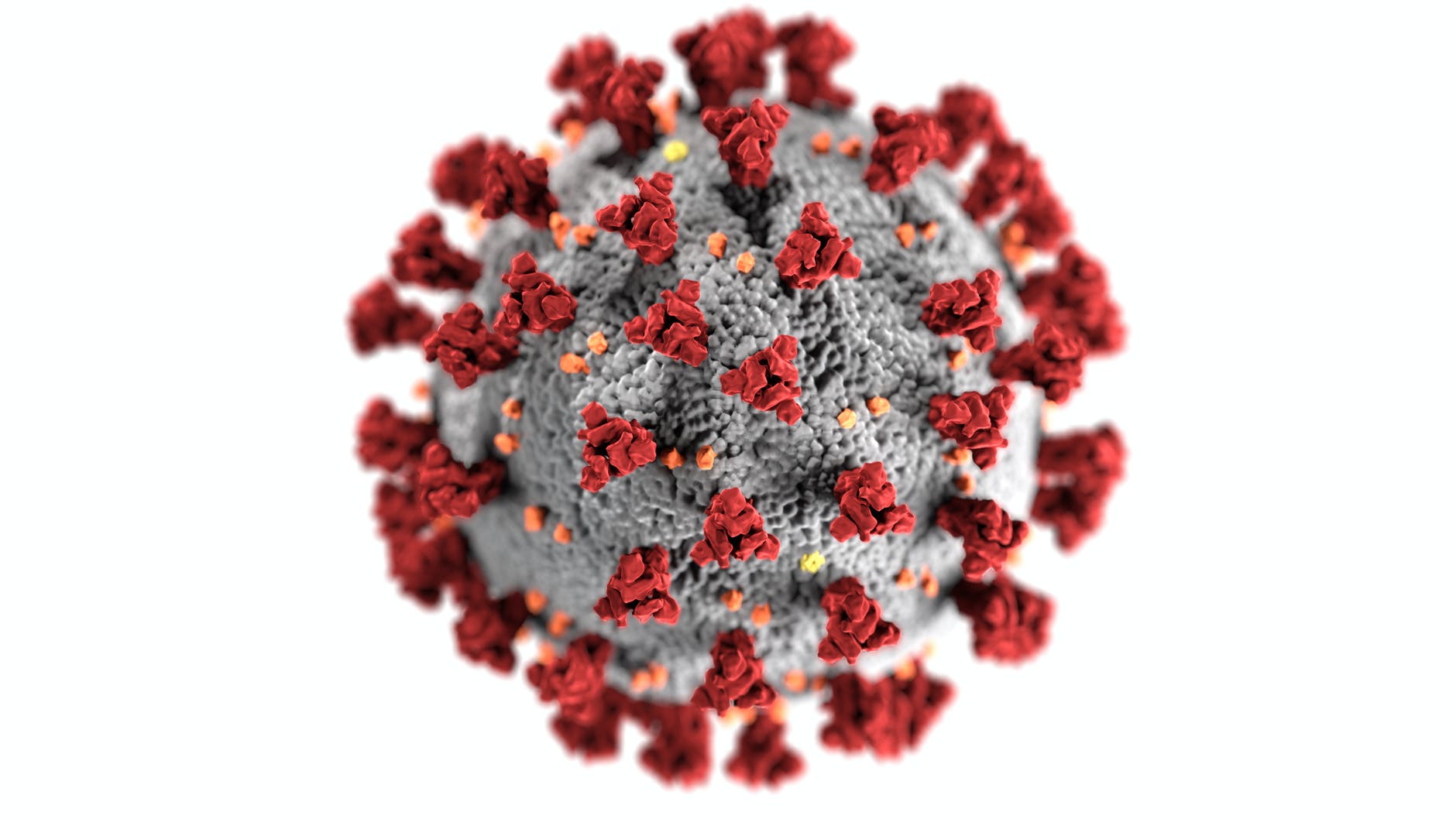
We are in a pandemic, caused, not by China, Johnson or even Trump, but by a virus. Viruses are funny things. Are they even a life-form? They have no life and no power to reproduce on their own. They can only do that by hijacking the DNA or RNA (the genetic element of a cell) of another species. Plant or animal, whatever the virus finds suits their need. Did you know that stripy tulips only got that way because of viruses? A virus made them worth a fortune in the 17th century.
Viruses are very small, smaller than bacteria. Indeed, they can even infect bacteria. Some of them – including the coronaviruses – are incredibly beautiful structures. We have learned, in recent decades, to applaud our “friendly” bacteria which protect our digestive system or power our sourdough fermentations. Bacteria aren’t being friendly or unfriendly, though, they’re just getting on with their lives, and we happen to benefit sometimes. Other times we don’t and we go all antibacterial and kill off the useful bacteria as well as the harmful ones, leaving ourselves open to more infection.
But no-one ever applauds a virus. Even though within the lining of the animal (including human) gut, live viruses called bacteriophages. Guess what, they eat up “unfriendly” bacteria. Other viruses help develop and support the human immune system. Just like the bacteria, they’re not doing it out of the goodness of their hearts, which of course they don’t have. They’re just being viruses. Viruses, bacteria, slime moulds, fungi, algae, tardigrades, invertebrates, mosses, insects, molluscs, fish, flowers, trees, amphibians, birds, reptiles, mammals (including people), and all the groups I’ve missed out – they’re all just organisms in a complex web, getting on with it as best they can.
Sometimes – but not very often – an organism will get above itself. It will be clever, but hellish stupid. It will decide that it’s superior to all the other entangled organisms and it will start acting in a way that’s detrimental to all of life on earth. Destructive, actually, and stupid enough to believe – no, to CHOOSE TO BELIEVE – that destruction won’t include them.
It might take something as small as a virus to bring them down with a bump.
If the sound of arrogance crashing around us is louder than the soothing noises of those with vested interests in “business as usual”, more people will start thinking everything must change. And here’s where to start: drop the conceit that you are apart from the rest of the natural world. You are as entangled and connected to every other living organism – and many which may not be living – as the Covid 19 virus. You are no better and no worse. You are part of nature. You will never, ever, be above it.
Come back down to Earth, and then together we might really hope to change everything.
Radio voices infiltrate Birdsong, and the low murmur of bees. They demand our patience, Promise clever plans, speak wistfully of Getting back to normal.
Cold winds Have blown the smog from the skies, Hushed the traffic, sombrely Slowed the world down. With neighbours and friends afar, We swap and share: seeds, favours, produce, Recipes, ideas and goodwill.
Oh, but, the radio voices cry, That won’t be forever. The economy Will erupt again amid chattering smokescreens, Rise and fill the air with busy-ness, Drown out birds and kindness. Don’t despair. The economy Will get back on its rotten track.
We’re not to worry. There’s no need For co-operation, self reliance or hope. They’ll feed us bread and circuses again. Meanwhile,
Have some crumbs From the great loaf of capitalism.
No need for questions, but they’ll give us answers, anyway; Answers we don’t need to understand, Data to depress, figures to make us fear Those cold winds of change.
Let’s not go back to that normal Of duped dependency, petrified inequality And the averted gaze. Swallows have returned. With eyes wide open We can see the season changing.







 Comments on The Nature of the Universe