The Unseen World beneath Troops and Rings

First off, let’s be clear. There is no such thing as “mushrooms and toadstools”. Really. They are all just different species of a particular group of fungi. The “mushrooms” you buy are developed from a species called Agaricus bisporus. There are lots of other “mushrooms” in the genus Agaricus, including the tasty Field Mushroom, Horse Mushroom and The Prince of the Woods. There’s at least one poisonous “mushroom” in the Agaricus group – the Yellow Staining Mushroom.

They could all just as easily have been labelled toadstools.

Resemblance, or relationship, to a nice safe shop mushroom is no guarantee of edibility. I’m going to call all of them mushrooms in this post. That doesn’t mean you should eat them if you find them. That’s the public health warning over.

Whichever species or type of fungus you have spotted and admired in woods and fields this autumn, you’ll have noticed that many of them appear to like being in a crowd. A nicely-rotting stump (that’s another fungus, by the way, assisting with the rotting process), may be festooned with troops of mushrooms, all of the same species. They can be mushroom-shaped:

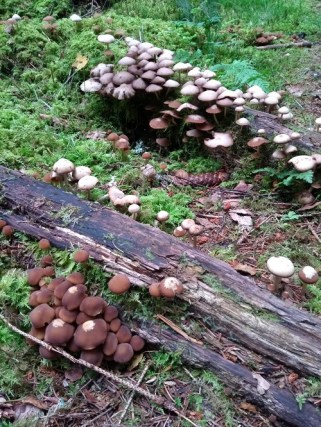
troops3 troops4

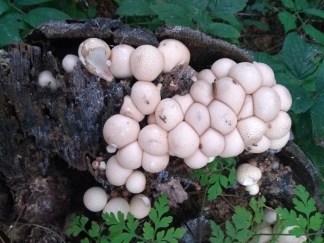
Or completely bizarre:

troops1


But it is obvious they are “growing on” the stump.
troops2

Often a troop of mushrooms appears to be just coming from the soil, and you wonder, if that’s the case, why they have all congregated together in a wavy line, like an army on the march. If you were to dig them up (please don’t!), you’d probably find a buried root of a tree, living or dead. What appears to be lots of different mushrooms of the same type is actually all one organism. Inside the wood, fine, tangled threads called hyphae join to make the main “body” of the organism (the mycelium). And the mycelium naturally runs up or down the host – in many cases a root or buried stump, or dead branch. When the conditions are right for reproduction, the mycelium sends up the fruiting bodies (the mushrooms!), to form and shed spores. (Roots, flowers and seeds is the usual analogy).

Fungal mycelium can grow through all sorts of media, not just wood. Dead leaves and grasses, straw, manure of all kinds. Some are bizarre: ripening grain (Ergot of Rye), human skin (ringworm and athlete’s foot), bread (penicillin), caterpillars (long Latin name I’ve forgotten), potatoes (blight), other mushrooms (Boletus parasiticus, related to the gourmet delight Cep or Penny Bun).  Toilet rolls and paperback books – oh you haven’t lived unless you’ve harvested your breakfast Oyster Mushrooms off a toilet roll! (unused, of course). In the course of its life, fungal mycelium also forms mutually beneficial associations with the roots of trees and other plants. Without fungi, it’s unlikely that our planet would support vegetation – and thus animal life – in the way that it does. You may have heard of these associations. They’re called Mycorrhizae (fungus-root), and gardeners can even buy them in bottles to get their favourite trees off to a good start.
fairy ring

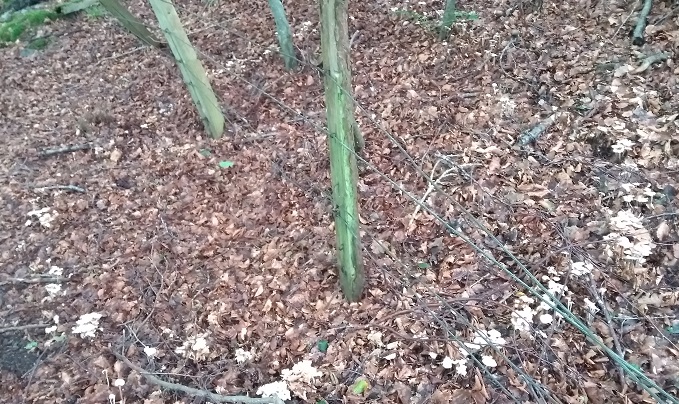
The other thing the mycelium does, or appears to do, is grow in rings. All fungi grow like this, I think. Well, most of them anyway. Why do you think ringworm got its name? Think of the lovely (well, to a mycologist) concentric rings of Brown Rot on apples or plums. There’s huge variation in size and scale of course, but they all start as some kind of joined up patch, and grow outward, making a bigger and bigger circle. The fruiting bodies appear on the edges of the circle. With mushrooms, this gives you a “fairy ring”. Where the mycelium is decomposing on the inside part of the ring, nitrogen is given off. Nitrogen is really good for green plants; and if we’re talking a lawn, you’ll find that the grass just inside the ring of mushrooms will be lush and dark green. Once the organism has grown out the way, the centre dies off. (Sometimes the grass does, too, which is why fairy ring mushrooms are not viewed with approval by greenkeepers and the likes of folk who treasure lawns of even and controlled green-ness and height.)

Fairy rings will just keep on growing outwards, unless something happens to kill off the entire organism, and push up mushrooms on an annual basis. Each year, they’ll be further apart. Some can stretch across the landscape for miles (though it gets harder to track the ring of mushrooms) – but it is still all one organism.

Always look – or think – below the surface!


Ferments

Six months after making a resolution that 2019 would be the year I’d get to grips with sourdough baking, I boarded a train in Exeter clutching a heavy duty carrier bag. Inside the bag was another bag, wrapped around itself, loose ends tucked tightly. Inside that bag were a number of jars and cartons.

Fermenting.

11 hours on hot trains lay ahead. Intensely aware, despite assumed nonchalance, of the seething activity taking place out of sight, in the overhead luggage rack. Occasional checks, surreptitious lifting of lids, burping of bottles. It’s a wonder no one called for the transport police.

How had it come to this?

Cavalier assumptions over several months that I knew enough about cooking and had baked enough yeasted bread to never need instructions or a recipe had resulted in the failure of several sourdough starters to even bubble, the refusal of all loaves to rise, the creation of some worthy bricks and, finally, to acknowledgement that I needed to consult. Guru number 1, Andrew Whitley of Bread Matters and Scotland the Bread (www.breadmatters.com and http://scotlandthebread.org/) told me to go back and read the book properly, especially the bit about balancing acid lactobacteria (which make the sour taste) and acid-intolerant wild yeasts (which make the bubbles), and sent me away with some amazing heritage Scottish wheat flour.

To mastermind the magic of a fermented dough, I needed to get the basic chemistry into my skull. Suddenly, I wasn’t making bread, but collaborating with a population of unknown, busy micro-organisms, intent on feeding and reproducing in the flour and water I was supplying. Once the penny dropped about refreshing the starter to reduce acidity and give the yeasts a chance to breed, my starter began to work.

IMG_20190711_105237420But was it really meant to look like this? Was dough meant to get all over the walls and floor? Why was I reduced to scraping and pouring the wet, sticky mess into bread tins? And when the book said “knead”, was it some kind of a joke, when “stir” or “whisk” might have been more appropriate verbs?
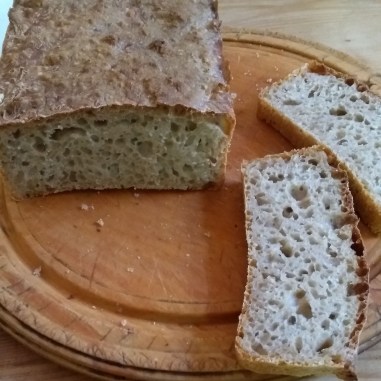
 

Now I had to find out if the disaster area of my kitchen on a baking day was common to real sourdough bakers. I suspected it wasn’t, and that I had more to learn. Enter Guru number 2, Jon Denley of BAKED Cookery school (www.bakedcookeryschool.co.uk) in Plymouth, and a chance to attend a course on Sourdough, Hydration and other Ferments, while on a family visit south.

Amid vast buckets of bubbling starters, in the heat and humidity of a training kitchen with several ovens going, I watched unbelieving as Jon transformed an unruly slop into a polished, gleaming and perfectly manageable loaf. I began to understand how to detect the changes in the feel and behavior of wheat and rye dough mixes as they are worked, that mean you stand a chance of shaping them into loaves. I became aware of the gluten forming – and of it breaking down when, literally, pushed too far. We made – and ate – delectably light and crusty pizzas for dinner, 100% rye loaves, white sourdough bloomers, nutty loaves with wheat and rye and seeds. We played with pre-ferments – pate fermentee or “old dough” uIMG_20190719_192426204sed to kick-start a sourdough flavour and texture in a yeasted loaf, and the excitable “poolish”, a pre-ferment I was advised to leave in Devon for fear it would get out and derail the Cross Country train before I got it home. We mixed honey, sugar and water and fed it to raisins…. No, get it right: we fed it to the yeasts that live on the surface of the dried fruit.

I got all my loaves, starters, pre-ferments and raisin brew home safely, and they’re all doing fine. Well, the bread’s been digested. The raisin brew has gone to create a spelt flour starter. I still can’t shape or adequately fold a white sourdough bloomer and I’m scared of using a proving basket. I’ve a long way to go, and I’m enjoying the journey.

Working with ferments overturns the received wisdom of 21st century food hygiene. Antibacterial cleansers are banished. Windows are open. Refined ingredients are shunned. Sterilised containers are bad news, and for goodness’ sake leave the lids off so stuff can get in. You can wash your hands, but if you must use soap make sure you rinse it off. The micro-organisms that we so desire don’t come put of a bottle or can. They are living in the organic flour, on your hands, in the air, on the surface of raisins and apples.

And although we can place them into rough groups, we never know exactly what the microbial make-up of a batch of dough is. My mother would have called them germs, and been deeply distrustful of processes that encouraged them, not to mention the product of those processes. Even in the fermentation of cider, beer and wine, which I’ve done a lot, you’re advised to use sterile containers and prevent “contamination” by “the wrong” fungi or bacteria. Just like the fastidious gardener trying to control nature, we like to think we’re in control of our alcohol production.IMG-20190714-WA0003


Baking with mysterious, unidentified, unknown quantities makes for unpredictability, surprise, delight, disappointment. We are not in control. Our ferments frequently are.

It’s wonderful.

The Forest on the Beach

It’s a man-made entity, on the face of it, this forest merging with the shifting sands of a vast, energising chameleon of a beach. Planted once in an orderly and respectable fashion, tall pines rise obediently from thin, infertile soil and duly make timber. Deep inside, away from salt winds, they have done as they were asked. They have stabilised the soil, reached for water, made partnerships with their own particular fungi. They are the forest they were asked to be.tentsmuir3

But on the edge, where the horizontal reigns in the landscape, where the sands continue to shift and grow, retreat and fail, and merge into mud, they cannot sustain their sheer verticality. Bald-headed individuals hesitate, stagger, lean, tip and fall. Blasted by sand, they desiccate, warp. They become subjects of the horizontal, their limbs curl and contort, sculpted by vicious winds from the sea. Beautiful in their carved and etched simplicity of form, they lie frozen in the hot, drying sun.

The forest on the beach shrugs off its manufactured origins, and enters the wild.

tentsmuir2

The beach goes on for miles before the trickling waves are reached, even when the tide is high. At the point, it is a self-contained, secret world, traversed near the forest by tracks through the dunes made by a largely secretive population of animals, including domestic and human. The tracks join and separate, re-unite, diverge, vanish into long grass or an unexpected creek. They seem to make no sense.

Do shipwrecked sailors still dwell in tents among the dunes? Where are they hiding?

The dunes and butterfly-filled dune slacks, where wild thyme and cross-leaved heath celebrate summer, give way to wide, subtly merging, littoral zones of shimmering sand. Eventually, wave-patterned beach and tidal inlets signal that the old sea is near.

puffball

Curiously, between the two, right in the middle of the beach, there is a small wood, mainly made up of towering, stag-headed alder. Under it, stunted or dwarf willows (who knows which?), broom, tall grasses, flowers. Unlikely eruptions of puffballs appear where cows have grazed. There is quiet shade, a rustling of leaves louder than the still far-off sea.

How did this little wood get here, in the middle of a beach? How long has it been here, where once was ocean? Will it survive long enough to bear fruit?

Then, movement from the bushes below the alders; an indelible assertion of dark brown hide against sun-washed grass and striated shade. A deer is moving through the little wood on the beach.tentsmuir1


Before the Chanterelles

In the misty dampness of a cool May morning, the tangled and decaying woodland holds its breath. Falling trees prop up shattered branches and each other, precariously leaning, hanging on by brittle twigs to some semblance of the vertical. Elsewhere, the long archaeology of those that have already succumbed to gravity make the woodland floor uneven, precarious, unpredictable. Some are half-sunken: indistinct mounds of mosses and soft, cushion-like wood, sprouting ferns and small plants – wood sorrel, purslane, chickweed wintergreen – from every crevice. Others, newly crashed in last week’s gale, still carry their leaves, shrivelling, poignant. Between the two extremes, lie trees and logs in every stage of decomposition.

The walker in this wood must learn these stages, and recognise which logs will still make good rafts to lay across the boggy places and ditches she would cross, and which will just crumble when stepped on. She must be aware of what lies overhead and if it would be wiser to go around, rather than under, the hung-up branches. Familiar paths are blocked every month and must be re-routed. New ground is created, explored, and lost again.

Out of the decomposition, new worlds are also born. What is decomposition if not the beginning of opportunity? Spiders re-align their webs in the remaining dead branches of a leaning tree. The breakdown of bark releases nutrients; tree becomes soil, soil claims tree. Single-celled organisms work their way through a sea of bacteria, laying the foundation for others to thrive.

Opportunities are made for beetles that feast on the rot in wood and bark, and the birds and small mammals that home in on the beetles. Shelter, food source, songpost, tunnel, bridge – the creatures of the wood utilise the fallen and falling trees in many ways. On their bodies they bring more soil, seeds, and the elements of fertility to this garden of decay.

And oh, how the garden grows.

It is not death that the walker witnesses, but birth and life. Is this decomposition, or composition? Is it both?  Is this the end of the wood, or the beginning of a new landscape? No human cares much for this wood. Children sometimes come and make fires, camp or build twiggy shelters, but you never see them. There is an old tyre swing, hanging neglected. Someone – no-one knew who – used to make sculptures out of stones in the heart of the wood, but not anymore. Dogs are walked, but usually led straight past the wood now that access is trickier. No-one “manages” it. Change, then, seems rapid. Whole trees crash down, leaving soggy craters and towering cliffs of root-ball, but transformation in nature is incremental, and constant. Each year, the populations dwelling on those bare root-cliffs are slightly different. Ground living fungi give way to aerial brackets, rabbits exploit entrances to potential burrows, liverworts, lichens and ferns take hold.

And underground, fungal mycelia move like whispers within subtle, shape-shifting parameters. Today, a downpour of the night is percolating under the moss-covered banks and logs. Soft spring rain, scarcely visible except when the smirr catches a shard of sunshine, seeps into the soil cauldron, fermenting, bringing new elements, new conditions.

Things move unseen.

Everything waits.

The walker in the woods has seen no mushrooms yet. But even a human animal can smell the contents of the cauldron, the warm, damp changes happening unseen below the wreckage of an unmarked wood. When all the boxes have been ticked, the harvest will be rich and golden.