Regular readers will know I often write about my garden, or the wildlife that inhabits and manages it better than I could ever do. I know a lot of people would have the screaming ab-dabs if their gardens got into half the state that mine does… but for me the need to support the widest biodiversity and my personal love for every other species trumps the sensitivities of the bug-killing, grass-shaving, patio-manicuring brigade. And I’d like to make some converts rather than just be rude about them!
So I decided to create a new blog of short sketches and ideas dedicated to the joys of not being in control of your garden and the fascinating more-than-human friends you might meet in it. Here’s a taster of WHOSE GARDEN IS IT ANYWAY? which you can find at theuncontrolledgarden.wordpress.com
“I started gardening with a notion that what grew in it belonged to me, or to my family. I believed that I was the person who got to choose what grew in my garden. Carrots here, poppies there, grass in between. I welcomed wildlife though – birds could come to the bird table. Frogs could come to the pond. Of course!
But pigeons, snails, mice….. er, no. And the multiplicity of insects and invertebrates just worried me. Were they Good, or Bad for “my” garden? I didn’t know. When I decided to study horticulture professionally, my tutors taught me “Plant Protection” which meant the Pests and How to Destroy Them. A nodding glance to predators and nothing about pollinators. The soil science tutor had a more holistic perspective, but was a bit of a lone voice.
I always preferred the wild flowers to most of the garden ones – although I liked both. So “weeds” got away with a lot in my garden, even though it made me feel slightly guilty. In between lectures, though, I read about companion planting, and comfrey, and composting, and met Lawrence Hills of the Henry Doubleday Research Institute (now Garden Organic), which was nearby. Over time, my perspective changed, and so did my garden!
Now I have a rambling wilderness which I love from January to August and then feel defeated and stressed out by, until calm is resumed around the middle of October. No chemicals, no dig as far as I can stretch the compost, which is the powerhouse of the garden. I still struggle at times and backslide into nervous control-freakery.
But I have one certainty: This is not my Garden. And I am not in control.”
(I will continue to write on the nature of the universe here too. And adjust both sites, especially getting rid of the annoying ads once I’m convinced I’ve got it set up right!)
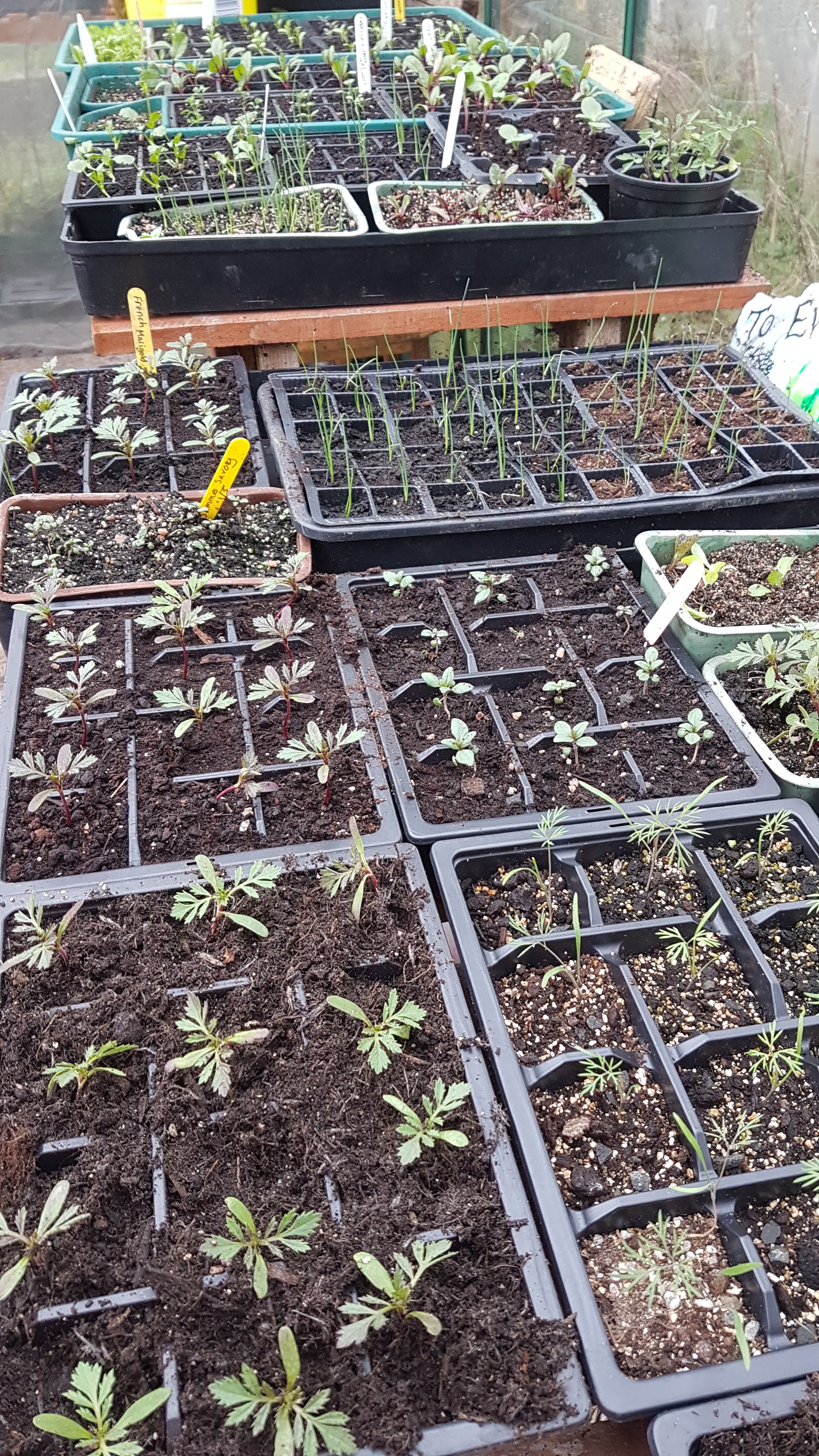
I’ve neglected my blog this past month. Not because I’ve missed out on inspiring walks, or failed to observe the nature of the universe, but because the weather’s been good, and garden or seed-sowing overtake me as soon as I get back from walking. “I’ll write it when it start’s raining…”, except it doesn’t, and I don’t. The walks will come, but in the meantime, all this seed-work did produce these (mainly) happy memories. I’ve changed the names of my colleagues in the unlikely event any may read this and feel affronted.
I never find myself fussing over seedlings in the green house without thinking of Roland, and his dad, Will, Nurserymen, of Woodham Ferrers. That’s where my horticultural career began, back in the weird 1980s, when men were men (or so they believed) and women had inexplicably curly hair.
I had decided to leave my comfortable, promising career in teaching to start again at the bottom, and become a horticulturist. I’d been accepted on a 3 year HND at Writtle College, but conditionally. Because I’d never worked in a land-based industry I had to find a job for a year to make sure I was up to it. The college had just rejected the first job I’d found (and which I was dearly looking forward to) because it wasn’t “proper” commercial horticulture. This job was working with Lawrence Hills at the Henry Doubleday Research Institute at Bocking – the organisation that came to front the whole UK organic growing movement as Garden Organic. But in the 1980s, as I said, men were men, and horticulture was about pesticides, power tools and paving slabs. Time was running short if I wanted to start my course in September 1984, so I walked into the nearest of a string of bedding and pot plant nurseries close to home, and proceeded to explain to Roland why he would like to take me on as a trainee for a year.
Roland heard me out, a twinkle in his eye and fingering his moustache to hide (I imagine) the urge to burst out laughing. “And why on earth,” he asked, “should I want to do that?”
So I explained. I was confident, I was clever, I nearly had an OU degree, I’d run a school garden and sure I knew lots and lots about gardening already? And I was enthusiastic. Little did I know that being clever and knowledgeable were useless skills in the job I was telling Roland he had available, and confidence and enthusiasm were about to take a beating! Yet Roland too had been sent to college by his dad back in the day, and maybe he was just feeling sympathetic. “Let me think,” he said, “but there’s no money in it. Nothing like you’ll be earning as a teacher.” Later that day he rang and offered me a job as nursery worker, and the wages were actually better than I expected, so I was thrilled to accept.
It was baptism by fire. First job, alone in a huge greenhouse cleaning mouldy leaves off a sea of potted cyclamen. I thought it might take me all year. There was the clocking on and off – a factory action which underlined the fact that I was no longer someone with authority, responsibility or respect, but just the lowest of the workers. Bells rang to signal the beginning and end of short tea breaks. The day started at 8am sharp. The work was physical, sometimes very repetitive, frequently boring and there was a workplace ethic that derided anyone sitting down even for a second. I was then married to a white-collar office worker who couldn’t understand why I was prepared to give up a well-paid job with prospects and considerable autonomy (this was teaching as it was 40 odd years ago, remember) to arrive home daily “tired out and covered in mud”. But if this was what it took…. I gritted my teeth through a winter of miserable work in freezing cold polytunnels, trying to learn something of plants, but learning more of chilblains.
My colleagues were not sympathetic towards me, at least, not to begin with. There were three other female full-time workers, and all were looked down on by the men, who mostly had large egos which stated that they ruled the roost. A couple of the guys were possibly not the sharpest knives in the drawer, and were also looked down on by the alpha males (the ones who drove the lorries of course). Poor, tormented Jim and Mikey were at least considerate and polite to the women. Then there was Billy, with his Boy George haircut and that camp air that made him the butt of every insult and brutal homophobic joke. I had never encountered homophobia before and couldn’t understand how Billy bore it. But he was made of stern stuff, didn’t waste his time talking to the rest or fighting back, and just got on with his job. In the end, they let him do so without too much baiting. I was the new target of course, because of my lack of experience in physical work, because I had a posher accent than the rest, and mostly because I was clever – but not in ways that mattered.
In late winter, a small army of women appeared. The big shed was set up with office chairs and high- level desks or tables, a radio, and heaters. The women brought cushions, snacks, hot drinks and sat comfy on their thrones, demanding that poor Jim supply them with endless pallets of compost-filled bedding plant modules, and trays of seedlings. Then they cussed and muttered about poor Mikey, who wasn’t shifting the finished work away quick enough. These women’s sole job was to prick out the seedlings into the modules, and they were on piece rates. The more modules they turned out, the more they got paid. We permanents knew for a fact that some of the women weren’t too worried about whether a seedling had roots, because we would have to go and fill the gaps a week or so later – rarely, unfortunately, on comfy seats. Oh no, we had to stand or crouch! When the bedding production season was at its height, we occasionally got pricking off to do as well, which was considered a cushy job by the men and indeed, it did beat hours at the potting machine or dragging laden trolleys up and down the nursery by hand to lay out filled pots on the floor of the polytunnel. But we didn’t get the bonus. I never learned to sow seed – a job reserved for only the most senior alpha male.
Gradually, I got used to the sheer physical effort, and became good friends with Ruth, with whom I was often partnered for work. She taught me a lot and we had huge fun. I think it was Ruth’s acceptance of me that changed everyone’s attitude in the end. Then Kate, one of the other women, left, leaving Colin, the most arrogant and bullying of the lorry drivers, without a mate to load his lorry. He wasn’t at all keen to have me thrust on him, because Colin HAD to be the first loaded every day and beat his chest about it, and he refused to believe I was up to the task. Loading up involved not just physical lifting and moving, but selecting out the best plant material for the customer, and racing to and fro to hand them up to the driver, who stood on the back of the lorry bellowing out instructions. Loading Colin was a personal challenge for me…. and he lost. Because lo, I COULD run up and down quickly, I DID remember exactly where every variety was to be found, I was shit-hot on getting the quality right and, best of all, with only a little practice I could handle 5 bedding trays at once without dropping any of them. Somehow, the bedding season became an exhausting but hilarious laugh, as Colin and I teamed up to get finished before Len and Ruth.
So, by the end of my year, I was indeed fitter, stronger, impervious to monotony, cold-hardy, heat-resistant – and far more tolerant of my fellow woman. Or even man. As proof, I opted during college holidays to go back to Roland’s to earn some money – and was always warmly welcomed. I’ve had my career in horticulture now, and part of it involved me in much pricking out of seedlings for my own small nursery. I brought to it the skills learned that year, and it’s always brought to me the image of Roland’s twinkling eyes as he made up his mind to take a gamble on the idealistic and misinformed schoolteacher and gave me that first chance.
Photo: Kate Jewell / Comfrey (Symphytum officinale)
Comfrey is in the Borage family of plants. There are various species, strains, and cultivars, which all have similar properties. The one which spreads unrelentingly in my garden is the Tuberous Comfrey (Symphytum tuberosum), which is low growing, spreading (via its knobbly, tuberous roots), and has dingy off-white to cream flowers. I am in negotiations currently with Tuberous Comfrey to spread unrelentingly where it can out-compete the ground elder, rather than among the potatoes. This species, along with Common Comfrey (S. officinale) is a native of Britain. A number of imports and acquisitions by Henry Doubleday in the 1870s led to an important cross between Common Comfrey and a Russian species, S. asperum. The hybrid became known here as Russian Comfrey (S. x uplandicum).
Common Comfrey has other common names: Knitbone and Boneset. The generic name Symphytum means “to join together”. The specific name “officinale” indicates medicinal value. (Readers of my last post may see where I’m going here!). Comfrey roots and leaves have been used for many, many centuries in poultices (mainly) to treat sprains, bruises, inflammation, cuts and sores. Comfrey contains allantoin, a chemical which is crucial to cell regeneration and healing. In my garden, the unruly Tuberous Comfrey disappears during winter, but I also have two Russian Comfreys which don’t. One of them used to be variegated, but soon reverted to green and vigorous.
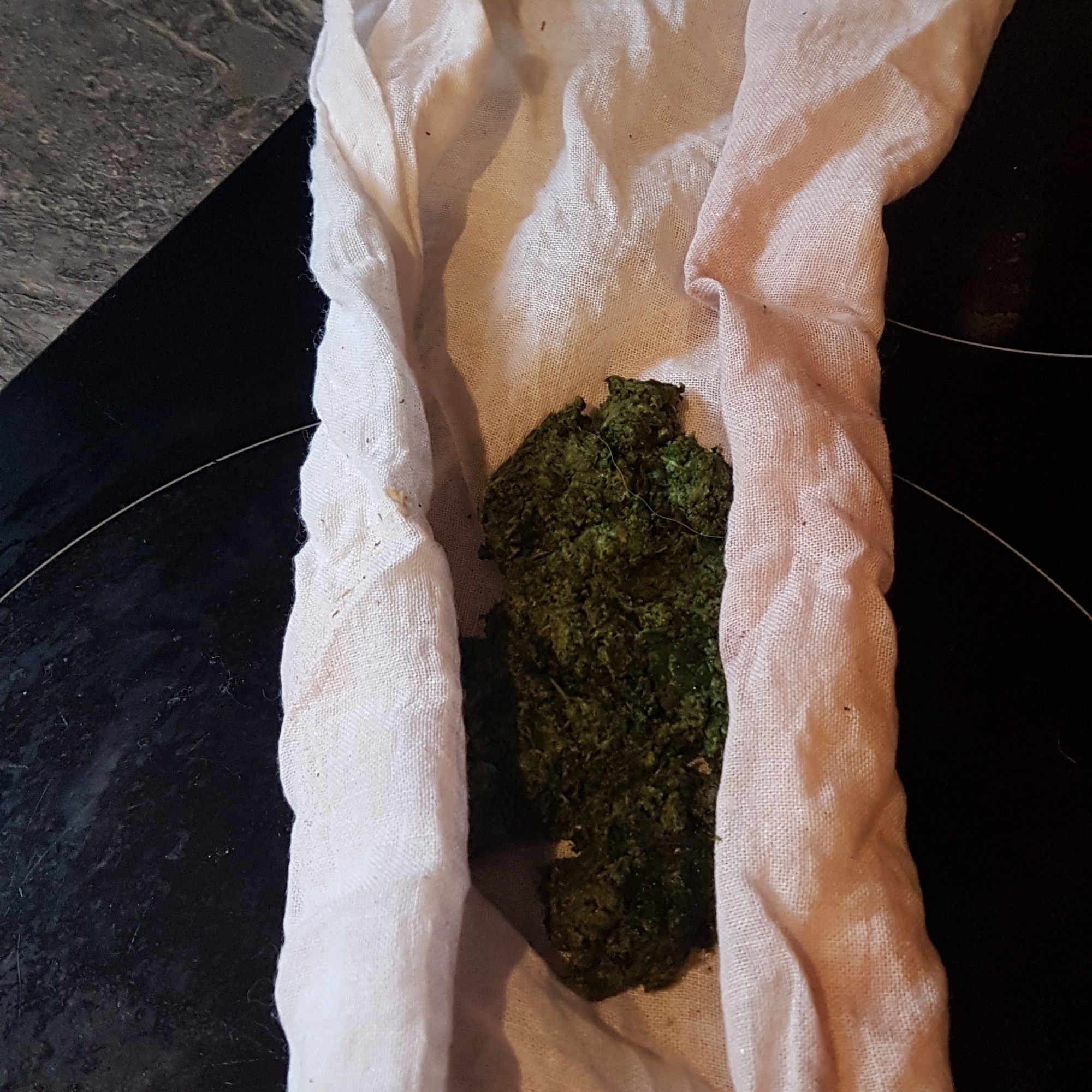
Therefore, in the mild weather between Hogmanay and the end of last week, I manoeuvred myself laboriously up the garden on my crutches, to pick the freshest leaves (yes, there were some!) from the plants. Roots may have been better, but digging isn’t in my current skill-set. A knee with anonymous sprains and tissue damage and a minor fracture of the tibia was going to get the comfrey treatment. I made the poultice very easily, by zapping the fresh leaves to a dark green liquid and mixing it with flour. A square of muslin, folded at the edges to stop the poultice oozing down to my ankles, held the comfrey against the affected bits of knee. An elastic tubular bandage kept it in place, over which went trousers and the leg brace. I did this for 4 days consecutively, but removed it from sight when I went for the fracture clinic appointment. (Self-treat? Who, me??)
On the X-rays, it was very hard to see where the fracture is now, but the doctor pronounced everything was well placed to heal completely, given time. Leg brace for at least another month! Then the weather turned snowy, followed by the customary January freeze, so the Comfrey pharmacy is temporarily closed. I’ll never know for sure how far it is contributing to healing, but that’s no problem, I am happy to be my own experiment in this.
Now to the other uses of Comfrey, including compost. The extravagant growth of the various comfreys which Henry Doubleday imported and which interbred led the organic movement pioneer Lawrence D. Hills to found a field station in Bocking, Essex, dedicated initially to research and breeding of comfrey strains for agricultural and horticultural use, named the Henry Doubleday Research Association. The best-known strain is probably “Bocking 14”. Later, HDRA became the influential Garden Organic charity, with thousands of members. I met Lawrence Hills a couple of times, when I switched from teaching to horticulture and was looking for a year’s work placement as prerequisite to starting a course at Writtle Agricultual College. He was so charming, so enthusiastic, so hard-working – and I was so looking forward to working and learning in an organic garden and taking part in field research. But organic was still considered the domain of hippies and weirdos as far as Writtle was concerned. I was told that HDRA was NOT ACCEPTABLE as a PROPER horticultural placement, and I ended up on a bedding plant nursery. Learned a lot, but you know how I just adore bedding schemes……!
A Much-thumbed Reference for Improper Horticulturists
But I grow Comfrey. I would never be without it in the garden. The lovely purple, red and white flowers attract every kind of bee in the district, it suppresses weeds, and is so vigorous I cut both the Russian and Tuberous back several times during the year. Most of the green material goes into the Comfrey bin (joined by excess nettle tops). The bin has a lid but no bottom, and it stands on a perforated metal square (actually a redundant queen excluder from beekeeping), which is balanced on an old washing-up bowl. Into the bowl collects a dark, viscous, evil-smelling liquid – Comfrey tea! NOT for drinking, but for use, diluted, as a liquid feed for tomatoes, vegetables and any plant looking under par, just as Lawrence Hills told me all those years ago. Many gardeners believe Comfrey tea confers disease resistance to plants as well as a nitrogen boost. I don’t add any water to the bin, and the dry material left goes onto the adjacent compost heap. Sometimes I add fresh Comfrey to the heap if it’s being a bit tardy in decomposing – it acts as an activator. Another great thing to do is liberally cover the ground between developing plants such as courgettes with fresh Comfrey leaves as a mulch. Not only will they decompose happily in situ and directly feed the plants, they help to warm the soil and stop weed seeds germinating. (TIP: Don’t accidentally mulch with tubers still attached!)
Fresh Comfrey Boost for Peely-Wally Sweet Corn!
I also eat Comfrey leaves. Now, my herbalist friends will tut-tut, because Comfrey also contains alkaloids which can damage the liver, to a point where cancerous tumours may develop. I can understand reluctance to prescribe it for internal use. Most of the alkaloids accumulate in the roots and the older leaves, and laboratory trials on unfortunate rats indicate that you’d really need to eat or be injected with an impossible amount of Comfrey to have such a reaction. Nevertheless, I stick to young leaves, in moderation, as a delicious vegetable in combination with nettles and other spring greens. They fill the so-called hungry gap abundantly well, and are a tasty substitute in any recipe involving spinach. Covered in beer batter and deep fried, individual leaves are a really, really bad-for-you treat!
But whether you eat it or not, Comfrey is for life – in more ways than one.





 Comments on The Nature of the Universe