
I’ve neglected my blog this past month. Not because I’ve missed out on inspiring walks, or failed to observe the nature of the universe, but because the weather’s been good, and garden or seed-sowing overtake me as soon as I get back from walking. “I’ll write it when it start’s raining…”, except it doesn’t, and I don’t. The walks will come, but in the meantime, all this seed-work did produce these (mainly) happy memories. I’ve changed the names of my colleagues in the unlikely event any may read this and feel affronted.

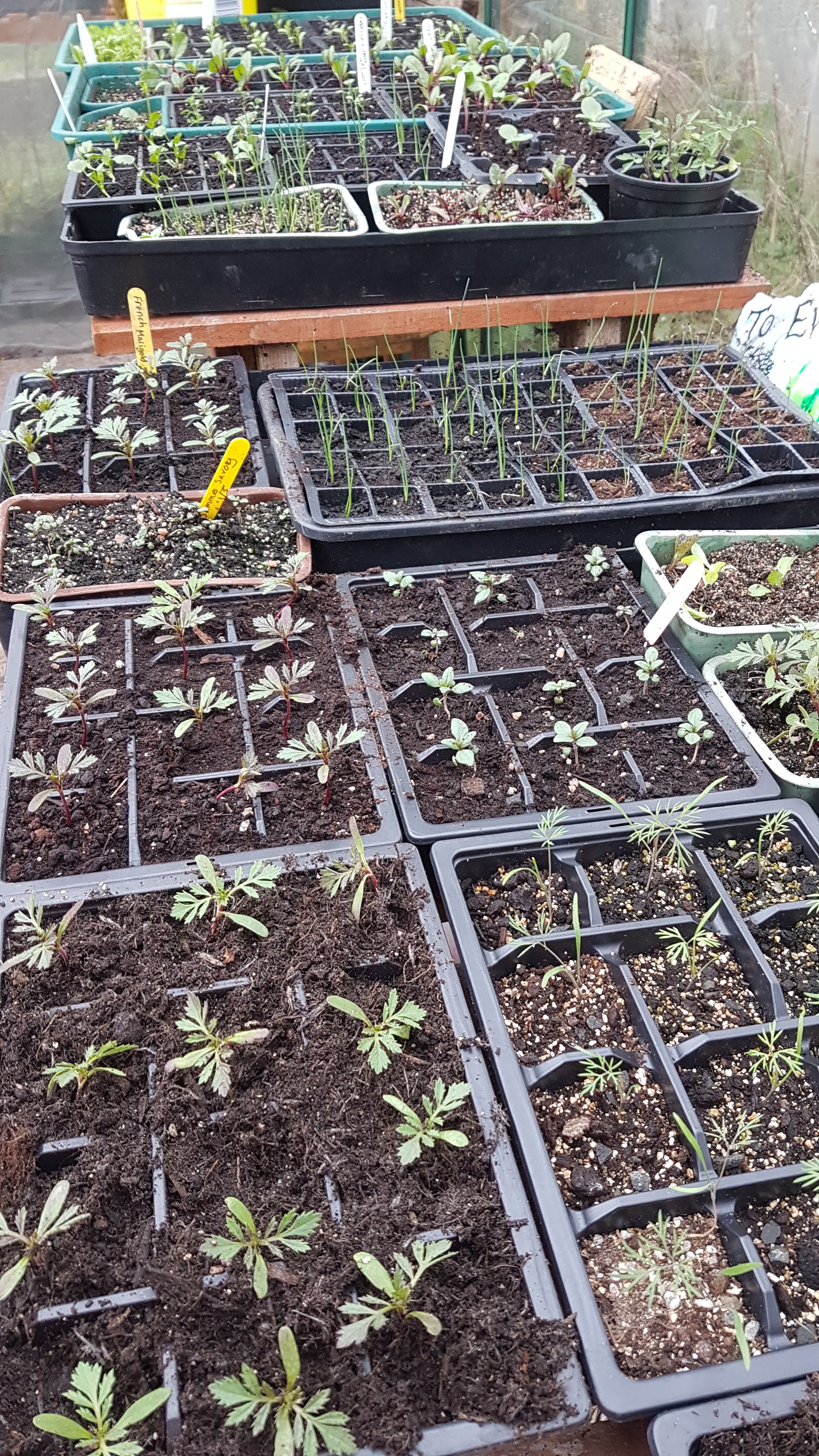
I never find myself fussing over seedlings in the green house without thinking of Roland, and his dad, Will, Nurserymen, of Woodham Ferrers. That’s where my horticultural career began, back in the weird 1980s, when men were men (or so they believed) and women had inexplicably curly hair.
I had decided to leave my comfortable, promising career in teaching to start again at the bottom, and become a horticulturist. I’d been accepted on a 3 year HND at Writtle College, but conditionally. Because I’d never worked in a land-based industry I had to find a job for a year to make sure I was up to it. The college had just rejected the first job I’d found (and which I was dearly looking forward to) because it wasn’t “proper” commercial horticulture. This job was working with Lawrence Hills at the Henry Doubleday Research Institute at Bocking – the organisation that came to front the whole UK organic growing movement as Garden Organic. But in the 1980s, as I said, men were men, and horticulture was about pesticides, power tools and paving slabs. Time was running short if I wanted to start my course in September 1984, so I walked into the nearest of a string of bedding and pot plant nurseries close to home, and proceeded to explain to Roland why he would like to take me on as a trainee for a year.
Roland heard me out, a twinkle in his eye and fingering his moustache to hide (I imagine) the urge to burst out laughing. “And why on earth,” he asked, “should I want to do that?”
So I explained. I was confident, I was clever, I nearly had an OU degree, I’d run a school garden and sure I knew lots and lots about gardening already? And I was enthusiastic. Little did I know that being clever and knowledgeable were useless skills in the job I was telling Roland he had available, and confidence and enthusiasm were about to take a beating! Yet Roland too had been sent to college by his dad back in the day, and maybe he was just feeling sympathetic. “Let me think,” he said, “but there’s no money in it. Nothing like you’ll be earning as a teacher.” Later that day he rang and offered me a job as nursery worker, and the wages were actually better than I expected, so I was thrilled to accept.
It was baptism by fire. First job, alone in a huge greenhouse cleaning mouldy leaves off a sea of potted cyclamen. I thought it might take me all year. There was the clocking on and off – a factory action which underlined the fact that I was no longer someone with authority, responsibility or respect, but just the lowest of the workers. Bells rang to signal the beginning and end of short tea breaks. The day started at 8am sharp. The work was physical, sometimes very repetitive, frequently boring and there was a workplace ethic that derided anyone sitting down even for a second. I was then married to a white-collar office worker who couldn’t understand why I was prepared to give up a well-paid job with prospects and considerable autonomy (this was teaching as it was 40 odd years ago, remember) to arrive home daily “tired out and covered in mud”. But if this was what it took…. I gritted my teeth through a winter of miserable work in freezing cold polytunnels, trying to learn something of plants, but learning more of chilblains.
My colleagues were not sympathetic towards me, at least, not to begin with. There were three other female full-time workers, and all were looked down on by the men, who mostly had large egos which stated that they ruled the roost. A couple of the guys were possibly not the sharpest knives in the drawer, and were also looked down on by the alpha males (the ones who drove the lorries of course). Poor, tormented Jim and Mikey were at least considerate and polite to the women. Then there was Billy, with his Boy George haircut and that camp air that made him the butt of every insult and brutal homophobic joke. I had never encountered homophobia before and couldn’t understand how Billy bore it. But he was made of stern stuff, didn’t waste his time talking to the rest or fighting back, and just got on with his job. In the end, they let him do so without too much baiting. I was the new target of course, because of my lack of experience in physical work, because I had a posher accent than the rest, and mostly because I was clever – but not in ways that mattered.
In late winter, a small army of women appeared. The big shed was set up with office chairs and high- level desks or tables, a radio, and heaters. The women brought cushions, snacks, hot drinks and sat comfy on their thrones, demanding that poor Jim supply them with endless pallets of compost-filled bedding plant modules, and trays of seedlings. Then they cussed and muttered about poor Mikey, who wasn’t shifting the finished work away quick enough. These women’s sole job was to prick out the seedlings into the modules, and they were on piece rates. The more modules they turned out, the more they got paid. We permanents knew for a fact that some of the women weren’t too worried about whether a seedling had roots, because we would have to go and fill the gaps a week or so later – rarely, unfortunately, on comfy seats. Oh no, we had to stand or crouch! When the bedding production season was at its height, we occasionally got pricking off to do as well, which was considered a cushy job by the men and indeed, it did beat hours at the potting machine or dragging laden trolleys up and down the nursery by hand to lay out filled pots on the floor of the polytunnel. But we didn’t get the bonus. I never learned to sow seed – a job reserved for only the most senior alpha male.
Gradually, I got used to the sheer physical effort, and became good friends with Ruth, with whom I was often partnered for work. She taught me a lot and we had huge fun. I think it was Ruth’s acceptance of me that changed everyone’s attitude in the end. Then Kate, one of the other women, left, leaving Colin, the most arrogant and bullying of the lorry drivers, without a mate to load his lorry. He wasn’t at all keen to have me thrust on him, because Colin HAD to be the first loaded every day and beat his chest about it, and he refused to believe I was up to the task. Loading up involved not just physical lifting and moving, but selecting out the best plant material for the customer, and racing to and fro to hand them up to the driver, who stood on the back of the lorry bellowing out instructions. Loading Colin was a personal challenge for me…. and he lost. Because lo, I COULD run up and down quickly, I DID remember exactly where every variety was to be found, I was shit-hot on getting the quality right and, best of all, with only a little practice I could handle 5 bedding trays at once without dropping any of them. Somehow, the bedding season became an exhausting but hilarious laugh, as Colin and I teamed up to get finished before Len and Ruth.
So, by the end of my year, I was indeed fitter, stronger, impervious to monotony, cold-hardy, heat-resistant – and far more tolerant of my fellow woman. Or even man. As proof, I opted during college holidays to go back to Roland’s to earn some money – and was always warmly welcomed. I’ve had my career in horticulture now, and part of it involved me in much pricking out of seedlings for my own small nursery. I brought to it the skills learned that year, and it’s always brought to me the image of Roland’s twinkling eyes as he made up his mind to take a gamble on the idealistic and misinformed schoolteacher and gave me that first chance.
Thanks Roland!


 Comments on The Nature of the Universe