
A Post for West Stormont Woodland Group
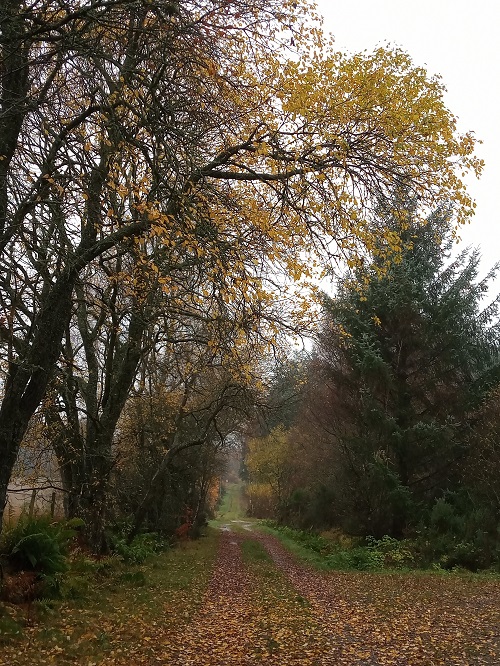
I pause on my way through the woods, quieting my breathing, keeping as still as I can. There is no sound, there is no wind. There should be no movement. Yet within the vascular systems of the broadleaved trees that bound the track, small enzyme changes are at work, invisible changes that lead to letting go, abscission, leaf-fall.
And down they come, silent, slow, like snowflakes in a still winter’s night. There is no flurry, no sound of wind through dry foliage, just the falling. Just the peace. Some trees are bare already. Birches are among the first to blaze golden and lose their leaves. Oaks keep hold of theirs till the last, but then they are usually the last to open in spring. Mature trees abscise before young ones. Young trees, and trees that have been pruned, will produce what’s known as juvenile growth, one feature of which being that the processes of leaf-fall are delayed. That’s why beech trees are so popular for hedges, the dry, crackly leaves slipping from gold to brown and staying in place till spring.
Young beeches, self-sown among the conifers at Taymount Wood’s dark heart, shine like tawny beacons.

They coat the ground, these last leaves, slick with last night’s rain and the condensing sweat of mist that loiters in motionless, tangled branches. Small sweeps of the already fallen lie around sedges and rushes, in hidden puddles and ditches. What else do they conceal?
A small brown toad lurks unmoving as the day, camouflaged among old birch leaves at the path edge. Then he moves, lopes distractedly into the grass, and is visible.

I like the emergence into visibility of the toad, and I enjoy the wood revealing its secrets as the leaves fall. The bizarre jutting side-branch of a fir tree, and the even more inexplicable branch that has fallen over it like a necktie, and somehow grown into an A shape. The filigree, waterfalling twigs of bare birch trees. The holes in trunks and large branches, the red squirrel’s aerial expressway from tree to tree. When leaves fall, I see that some trees are still richly clothed, decked in lichens and mosses so profusely you can’t see the wood, and decorated with the jewels of fruit and fungi. Food, forage and habitat here for small creatures that depend on the woods through the winter.

By the King’s Myre, the stillness of the day is magnified by the strange open vastness of this stretch of water. Reeds and trees and overhanging trees are reflected; birds are absent or silent. In the boats drawn up to the jetty, the leaves lie in rain that’s collected there, the sky bounces back, grey, metallic, motionless. There are no wafting clouds; it is all cloud, all greyness. And more leaves unhook themselves from life, drift down soberly against the small frictions of the early winter air.

On twigs and branches, wherever a leaf falls, a small tight bud, wrapped unnoticed in its winter coat, remains and waits.
 Comments on The Nature of the Universe