The Mushroom at the End of the Wood

A Post for West Stormont Woodland Group
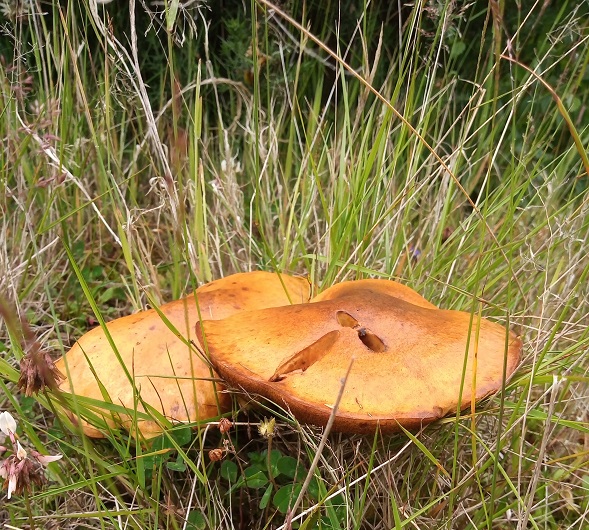
Larch Boletes in Five Mile Wood

In Anna Tsing’s book The Mushroom at the End of the World*, she tells the story of landscapes ruined – or seemingly ruined – by the greed of human activity. In particular, forests. In one unpromising forest in Oregon USA, where commercial forestry had stripped out all the trees of value and left an empty terrain of broken ground and scrubby volunteer pines, she met some mushroom hunters, refugees from Laos. They were gathering Matsutake, one of the most prized and valuable edible mushrooms in Japan and – allegedly – the first living organisms to appear from the wreckage of Hiroshima after the Bomb.

Matsutake mushrooms, like many fungi, only appear when they can be entangled with the roots of a suitable host tree in a mycorrhizal relationship. They got on very well with those scrubby pines. Tsing tells how the accidental introduction of the Pine Wilt Nematode on a shipment of American Pine into Japan had devastated the Matsutake’s natural host there, hence its rarity. It is not a serious pest of American Pine.

Incidentally, Scots Pine is a good host for Matsutake, too….
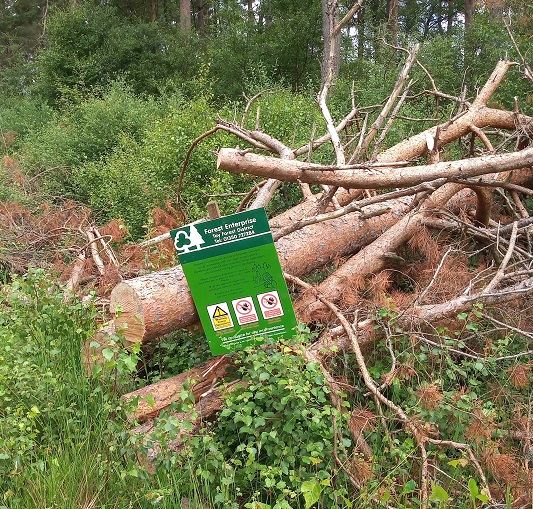
Abandoned remnants of the commercial forest

Mushrooms disappearing when a forest changes is familiar to me. All forests and woods are in the process of change, but our two ex-commercial forests, Five Mile and Taymount Woods, are forests in abrupt transition. Before the Commission took out the last valuable trees and wind-throw did for many more, Five Mile Wood was my happy mushroom-hunting ground, the place I’d take people to for foraging walks. I knew exactly where to find the biggest chanterelles, the white Angels’ Wings, the logs where real oyster mushrooms could often break out. The ditches beside the path were home to many fascinating species, including several edible Boletus including the Cep and the maggot-free Bay Bolete – and, of course plenty of highly poisonous examples too. Some years, the tantalisingly similar but inedible False Chanterelle outnumbered the real one – which is exactly what you need when teaching people not to harm themselves by misidentification. One damp corner was an emporium for the delicious Slippery Jack, which turned up in troops like clockwork, every year in late summer and autumn. I used to dry the ones we didn’t fry up right away, and store them in jars.
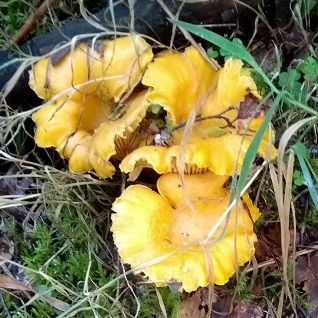
The biggest chanterelles

The fragile associations which had built up over the decades were shattered by felling. The self-sown birches that are colonising parts of both the woods now will eventually reel in their own, interconnected fungal friends, and the chanterelles will surely re-emerge one day, because birch is their main host tree. But from my experience, it takes at least a decade before mushrooms start to appear in a new wood, and the first arrivals are never the ones you want to eat! The precarity of a habitat for specific mushrooms is alarming – involving water tables, shade, parasitic plants, weather patterns, nematodes, beetles, animals – including mushroom pickers. Tsing’s book includes chapters on the equally precarious lives of the pickers – refugees, indigenous peoples, itinerants. Humans aren’t in control of what the mushrooms will do, because there are so many variables in play. Humans are just part of the landscape, and the landscape is changing because of and despite them.
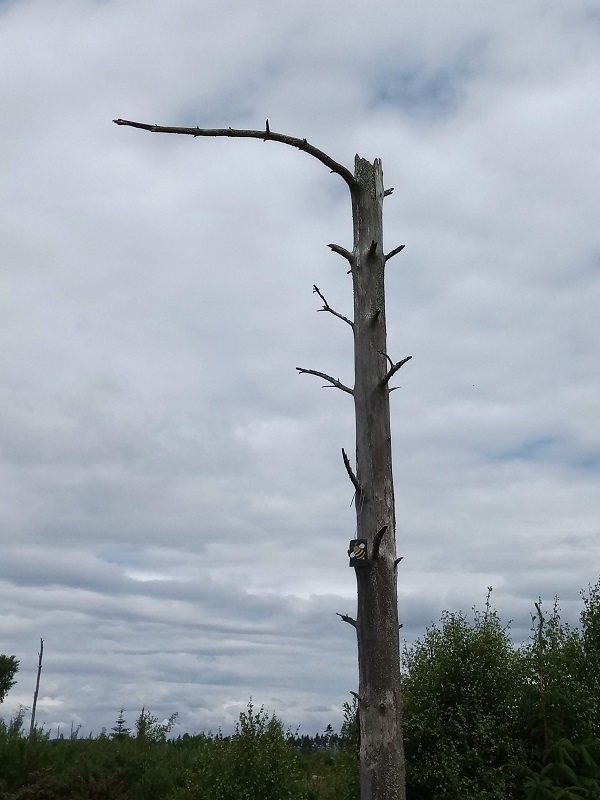
Another remnant….

So, I can only observe and enjoy the new but mushroom-free habitats in parts of our woods, note the changes, watch new worlds forming out of devastation and realise we are not in charge, not that clever, and maybe, not that important either. I scoured the ditches in Five Mile Wood for boletes recently, and right at the end, I did find a couple of lingering and determined specimens. I left them there.

But who knows what will be the mushroom at the end of the wood? And where is the end of the wood?

*Tsing, Anna Lowenhaupt: The Mushroom at the End of the World – On the Possibility of Life in Capitalist Ruins (Princetown University Press 2015)
The Unseen World beneath Troops and Rings

First off, let’s be clear. There is no such thing as “mushrooms and toadstools”. Really. They are all just different species of a particular group of fungi. The “mushrooms” you buy are developed from a species called Agaricus bisporus. There are lots of other “mushrooms” in the genus Agaricus, including the tasty Field Mushroom, Horse Mushroom and The Prince of the Woods. There’s at least one poisonous “mushroom” in the Agaricus group – the Yellow Staining Mushroom.

They could all just as easily have been labelled toadstools.

Resemblance, or relationship, to a nice safe shop mushroom is no guarantee of edibility. I’m going to call all of them mushrooms in this post. That doesn’t mean you should eat them if you find them. That’s the public health warning over.

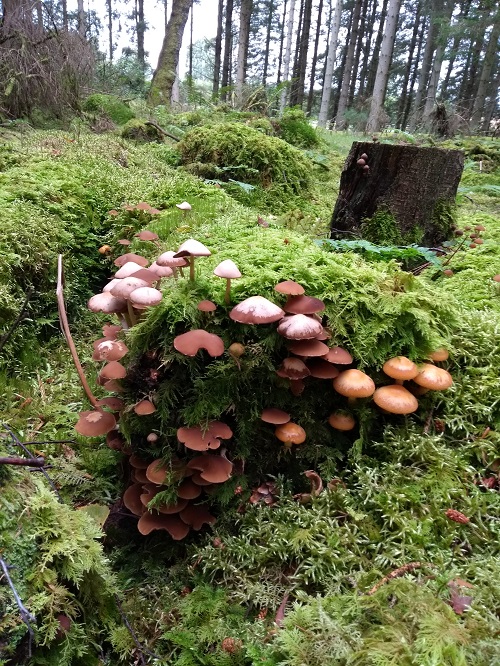
Whichever species or type of fungus you have spotted and admired in woods and fields this autumn, you’ll have noticed that many of them appear to like being in a crowd. A nicely-rotting stump (that’s another fungus, by the way, assisting with the rotting process), may be festooned with troops of mushrooms, all of the same species. They can be mushroom-shaped:

troops3 troops4

Or completely bizarre:

troops1


But it is obvious they are “growing on” the stump.

troops2

Often a troop of mushrooms appears to be just coming from the soil, and you wonder, if that’s the case, why they have all congregated together in a wavy line, like an army on the march. If you were to dig them up (please don’t!), you’d probably find a buried root of a tree, living or dead. What appears to be lots of different mushrooms of the same type is actually all one organism. Inside the wood, fine, tangled threads called hyphae join to make the main “body” of the organism (the mycelium). And the mycelium naturally runs up or down the host – in many cases a root or buried stump, or dead branch. When the conditions are right for reproduction, the mycelium sends up the fruiting bodies (the mushrooms!), to form and shed spores. (Roots, flowers and seeds is the usual analogy).

Fungal mycelium can grow through all sorts of media, not just wood. Dead leaves and grasses, straw, manure of all kinds. Some are bizarre: ripening grain (Ergot of Rye), human skin (ringworm and athlete’s foot), bread (penicillin), caterpillars (long Latin name I’ve forgotten), potatoes (blight), other mushrooms (Boletus parasiticus, related to the gourmet delight Cep or Penny Bun).  Toilet rolls and paperback books – oh you haven’t lived unless you’ve harvested your breakfast Oyster Mushrooms off a toilet roll! (unused, of course). In the course of its life, fungal mycelium also forms mutually beneficial associations with the roots of trees and other plants. Without fungi, it’s unlikely that our planet would support vegetation – and thus animal life – in the way that it does. You may have heard of these associations. They’re called Mycorrhizae (fungus-root), and gardeners can even buy them in bottles to get their favourite trees off to a good start.

fairy ring

The other thing the mycelium does, or appears to do, is grow in rings. All fungi grow like this, I think. Well, most of them anyway. Why do you think ringworm got its name? Think of the lovely (well, to a mycologist) concentric rings of Brown Rot on apples or plums. There’s huge variation in size and scale of course, but they all start as some kind of joined up patch, and grow outward, making a bigger and bigger circle. The fruiting bodies appear on the edges of the circle. With mushrooms, this gives you a “fairy ring”. Where the mycelium is decomposing on the inside part of the ring, nitrogen is given off. Nitrogen is really good for green plants; and if we’re talking a lawn, you’ll find that the grass just inside the ring of mushrooms will be lush and dark green. Once the organism has grown out the way, the centre dies off. (Sometimes the grass does, too, which is why fairy ring mushrooms are not viewed with approval by greenkeepers and the likes of folk who treasure lawns of even and controlled green-ness and height.)

Fairy rings will just keep on growing outwards, unless something happens to kill off the entire organism, and push up mushrooms on an annual basis. Each year, they’ll be further apart. Some can stretch across the landscape for miles (though it gets harder to track the ring of mushrooms) – but it is still all one organism.

Always look – or think – below the surface!