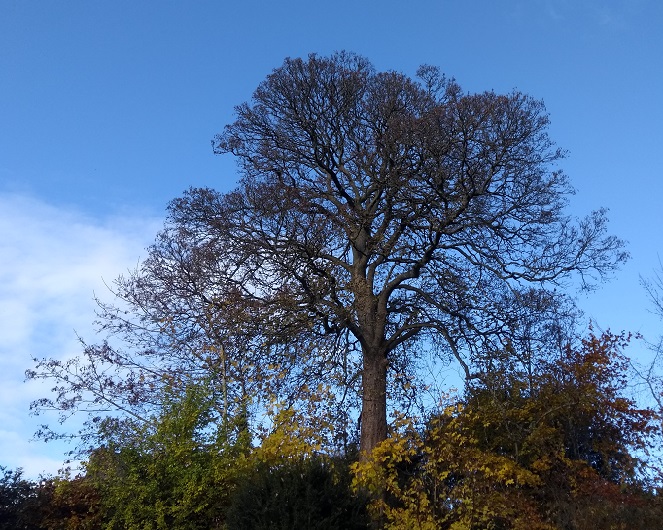
In Devon, they say they have hearts of oak. Here, in the sun-baked, heat-islanded south of the County, where the thick-hedged meadows run up and down hills like a lumpy quilt on a badly-made bed, you can see why. Oaks are everywhere, dominating the treescape. They surge out of the deep, dark lanes, they march along tangled, towering verges, and straddle the corners of the fertile fields.
 Broad-crowned and rooted like mountains, they are the very epitome of strength. In the minds of humans, they are usually labelled “he” and associated with male-ness. Strong, protective, enduring, courageous …. dominant, powerful, overbearing, masterful? Strange to note (if not surprising) that trees thought of as “she” (such as the Silver Birch, Devon’s “Lady of the Woods”) are graceful, delicate, drooping and indecisive in form. And is it only Devon Men who have “hearts of oak”?
Oak trees, Birch trees, most trees in the British Isles, are hermaphrodite anyway, both male and female. Oak trees are much more than a gender stereotype. They form worlds in themselves: roots, bark, branches, leaves, roots and fruits all playing host to a myriad of organisms, fulfilling many functions. They are home, food source, shelter, entertainment, nursery, recreation ground. Allegedly, but probably only mythically, oaks have even housed the occasional human wearing a silly crown. In their own right and as part of the natural world, they are extraordinary, important and awe-inspiring.
Even when they die, they will take centuries about it, growing steadily more stag-headed and gaunt, silver against the blue summer skies. From a distance, no sign of life is discernible. Get closer, and leaves spurt from odd branches below the hollow, woodpecker-mined, bark-less upper limbs where a solitary crow keeps an avid watch on the meadow. Dismissed as dead, and yet they survive.
People pin not only their assumptions of gender onto indifferent trees, but also sometimes their anxieties and aspirations. They look for reflections of what they’d like to be, and how they’d like to portray others. In Scotland, we pin some of our national psyche on the Scots Pine – another giant of the landscape given to vast and spreading majesty when rooted in Caledonian soil. But also, beneath the surface of the obvious, on the subtle, fey Rowan, reverenced if not revered, the magic totem of croft and byre. What characteristics do we borrow from our trees?
Hearts of Oak– that Kiplingesque phrase so redolent of Drake in his hammock, Queen and Country, the ships that saw off the Armada. Do the men of Devon – and others – who identify with the oak tree incline, as a result, to certainty, strength of purpose and an assumption of their own inevitable survival? Are they made sure of their ability to go it alone, to forge their own paths, to take back control? Are they programmed never to doubt that to succeed against all odds without need for cooperation or compromise, is admirable and right?
What if the oak trees were to fall? What does it take to make people change, to reach out?
Just as assignments of gender onto trees only mean something to humans, so too is attributing nation status to any species. Oak, Pine, Birch or Rowan – none are English, Scottish, Welsh, Irish and neither do they “belong” to any other race. They are not the property of local government. None are even endemics; they are uncaring of borders and boundaries. They follow no human creed, political standpoint or philosophy. They are trees.
Oaks have wonderful heart-wood, but no hearts. Heart are muscles found in a wide range of animal species, including humans. Change of heart is a condition humans sometimes get, too.



 Comments on The Nature of the Universe