Mr. Standfast

The little wood has become tangled, and the paths vague and meandering in the past few years, since Jed our collie died. Few people walk them, and even when it was a regular walk for me and Jed, they tended to shift and change, as blackthorn grew to block one route, or trees, felled by the wind or growing with vigour, made another way more attractive.

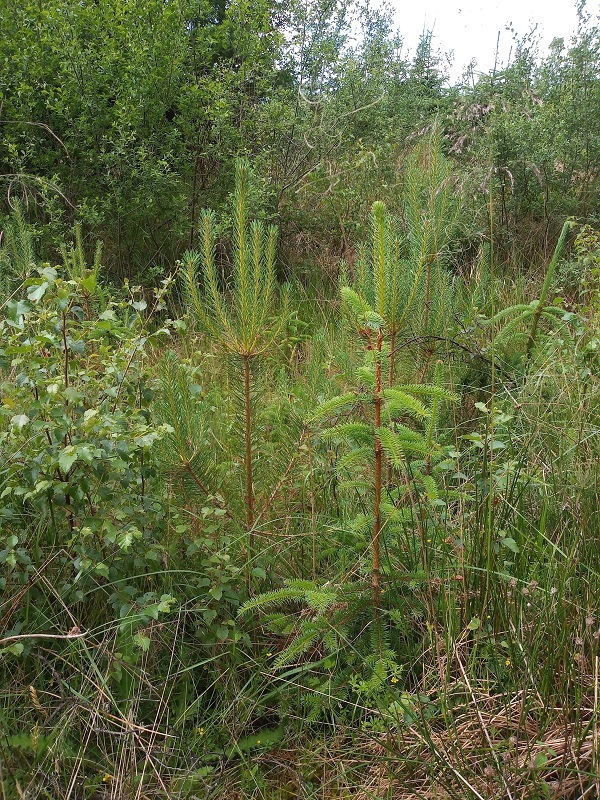
But always, there have been certain way-markers:- the overgrown guerrilla-planted Christmas tree, the gap in the field boundary where the wire’s trampled down, a patch of brambles, the fallen birch that still produces shoots…. Today, alone, I beat the path out again, lost in thickets of gorse and thorn, disoriented by the sound of traffic, unsure of distances among an understory of fern and broom. As so many times before, when coming from diverse directions, my brain unconsciously looks for you to reset my compass. I know I must pass you on my left to regain the path downhill and out of the wood.

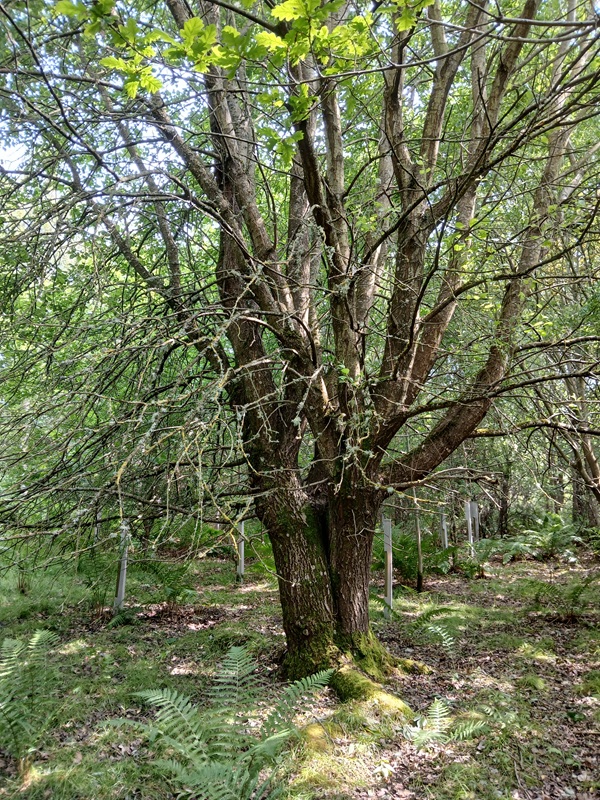
You are the biggest, broadest, in the wood, though perhaps not the tallest or the oldest, and certainly not as old as me. With two feet firmly planted, you stand fast and firm among the rest who bend and break in the wind, and you spread your many solid arms in all directions, and to the sky.

Here you are. Now I know my way way. But wait – have we ever truly met? Have I ever really seen you, Mr. Standfast? Today I approach with awareness, pausing in stages, taking you in. A rush of warmth, of joy… joy or recognition, joy at being recognised. When I reach close enough to touch, my gardener’s – my orchardist’s – eye notes dead, stiff and black lower branches and itches, for a second, for loppers. But then I watch the beetle’s progress through the moss and lichen upon them; the moist droplets of old rain sustaining the beings on the branch, and recognise, it’s none of my damned business.
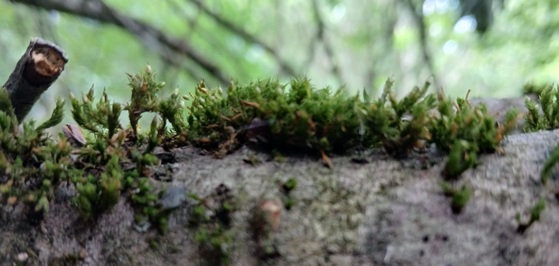
We are together for a good while, without words, unified by our alikeness, as your very own warbler comes to join us, bursting into that fitful exhuberance of song that wears itself out in a twittering, grumpy-sounding mutter, then kicks off a few minutes later to try again. I feel the healing nature of your skin, the questing stability and strength of your roots, the air you breathe, I breathe, we breathe. For a moment, I know we are one, with the lichens and beetles and warblers and the things unseen.

I know my way now. As I rejoin the ghost of a path, my palms carry the imprint of willow bark, like a memory, like a gift.
Exits, Entrances and Crossroads

A post for West Stormont Woodland Group

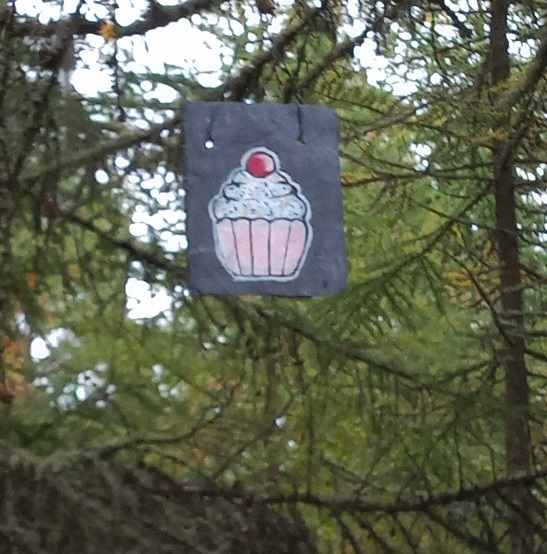
Is there an artist in the wood?

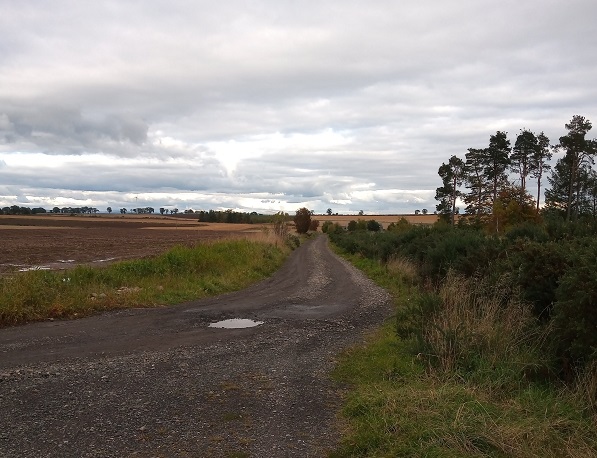
There is, really, only one easy way into and out of Five Mile Wood – at least in October. That’s from the south end on the Stanley to New Mill cottages road – currently a bit of a no man’s land thanks to the dualling of the A9. Here the track is clear, broad, made for forestry vehicles – and you can even park! At the north end, there is also the old straight track I’ve written about before, from South Barns and beyond that, with a diversion to Bankfoot. Follow the line of this track and it will take you to Dunkeld, once a mighty ecclesiastical seat. I learned last week that from Dunkeld to the wood it’s five miles – hence the name.

I wonder what happened to One, Two, Three and Four Mile Woods?

But once through the gate at the end of the straight track, the going is tricky. At this time of year, wellies are essential, thanks to the legacy of ditches, boggy ground and waterlogging that followed the felling of the trees here. When did it become the norm for forestry practice to leave such a mess? However, with care, agility and thanks to the enterprising actions of previous walkers using felled timber to ford the worst ditches, you can get to the main path that circles the wood.

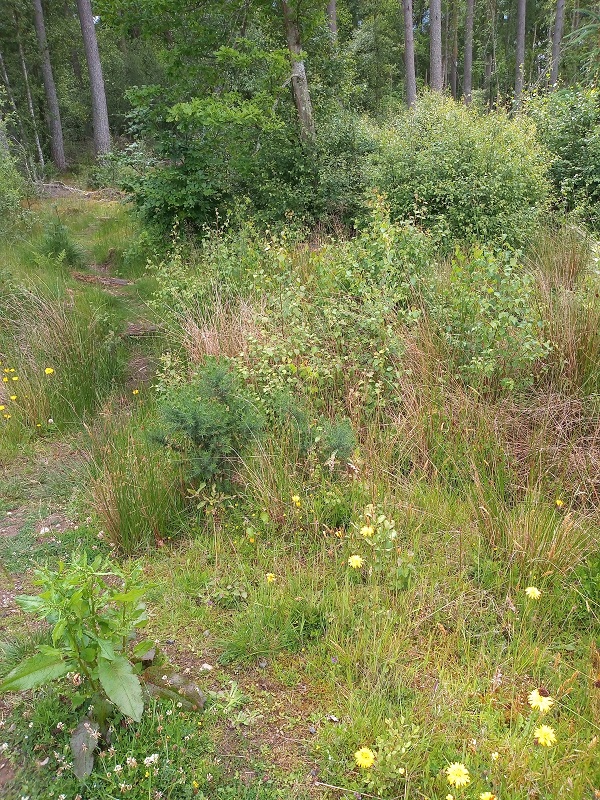
Deer, birds and other animals have their own paths off into the undergrowth, but for humans, the area where trees were felled before the Commission ceased to work are becoming impenetrable, Gorse crowds thickly on either side of the track, requiring constant maintenance to keep it from meeting in the middle. Self-seeded birch, larch, Scots pine and willow are all growing well, but there are no paths between them in this baby wood. Then there are the trackside deep ditches, another legacy of forest drainage operations, not impossible to cross but very off-putting.

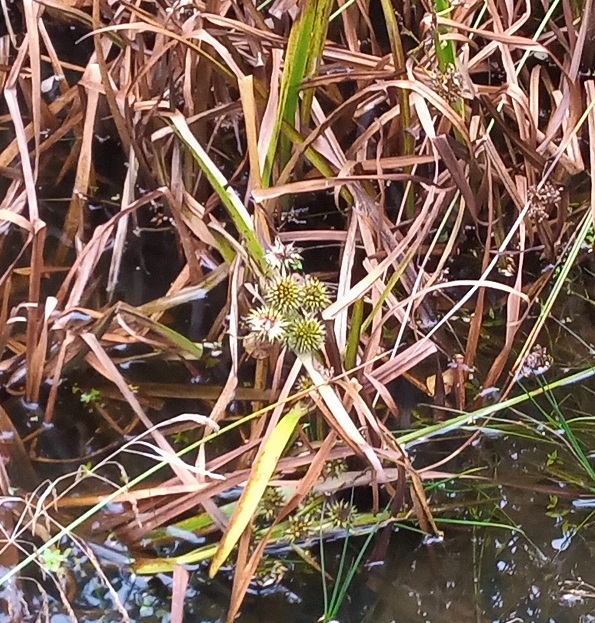
So walkers, joggers and cyclists stick to the circular path and leave the wood by the way they came. Someone on Trip Advisor found the wood disappointing, and the circular track through felled forest boring. But I wonder. We undervalue landscapes that aren’t “finished” – such as newly planted gardens and self-seeded woods at the start of succession. The prettiest part of Five Mile Wood may be the winding bike-track under mature trees which shoots off from the main path near the south entrance, but the burgeoning growth of pioneer vegetation in the centre – the “gap site” as some call it – is vibrant with hidden life, resounding with the flickering flight of small birds and bubbling with amphibians and aquatic life in the ponds and ditches created for drainage. Even the nuisance gorse is a rich nectar source for pollinators and home, each bush, to thousands of spiders and other invertebrates. It’s not what we are schooled to believe beautiful, but in terms of ecology and resilience, it is every bit as valid as ancient oak climax woodland. Not all landscapes can be measured in human terms – though the amount of carbon sequestered by rapidly-growing trees and shrubs will be enormous and far greater than that in a carefully-planned, gardenesque setting. And humans need carbon sinks as much as every other life form.

People like to have choices, though. Choices about where to enter the wood – entrance points close to all the settlements that lie within walking distance. New tracks to follow, new routes to explore, the chance to come out into the sunshine at a different point from where you went in. Paths that cross, diversions, sidetracks, viewpoints. I don’t think they should be the main focus of the wood, or dominate the richness of undisturbed wildlife in the centre. There must be places that are no-go areas for humans, where nature can get on with it, and prove, as ever, that she will make a better job of it than we can.

And then, let our tracks meet and link wood to wood, as we learn to walk more, and be more in nature and less apart from it. Then we will lose our expectations of park furniture and entertainment, and realise the woods aren’t, in the end, all about us.