
These fields, which now yawn under the predictable rotation of wheat, barley, potatoes and the occasion excitement of peas or beans, were all berry fields once. It was the biggest and best-known of five plantations around here, where canvas tinker villages sprouted annually at harvest time, and the needs of the workforce were met in this now silent, gone-to-work, wee town by a wealth of grocers, bakers, butchers, innkeepers, tailors and shoemakers. At least five surgeons lived here in case of accident or emergency. The berries that weren’t eaten on the spot or smuggled home by the pickers all went south, on the new branch line connected to the village for the purpose, to become jam on well-to-do breakfast tables.
Now in the quiet forgetfulness of displaced industry and commuter inertia, tangled woods wrap themselves round the margins of large exposed fields. The old track takes you past the farmhouse that is no longer a farm, the steading that is no longer a steading, and wanders aimlessly north, between the remnants of its hedgerows. Long ago, it was the only road north, save for an older track across the moss.
Here and there, a narrow change in fencing or a wooden post marks where one of the many footpaths to and from the berry fields used to run. A curious right of way plummets through someone’s back garden and still has legal status. Patches of No Man’s Land persist, and where they do, the ghosts of the berry fields haunt and echo.
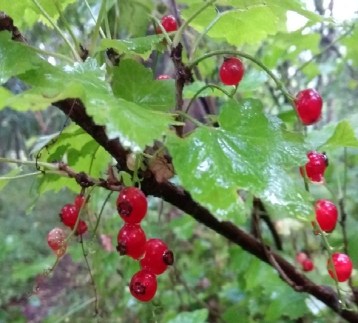 In the dense shade of a triumphant elder spinney, a smattering of redcurrant bushes blooms and fruits, scant rich redness catching the eye as the berries ripen. They are small and sour, yet somehow incandescently flavoursome. Where the track narrows to a muddy path, wild gooseberries make a wee thicket. Their fruits are also tiny, and round. Are they genuinely wild?
Or the depleted progeny of an old cultivar, maybe Scottish Chieftain or Lord Elcho, prized a century ago, now nearly forgotten?
But the raspberries, they are everywhere; an abundance that makes cultivation seem a frivolous and needless expenditure of time. They spring from lawns and borders in untidy local gardens, in numbers that cannot be put down to the activities of a large and hungry population of blackbirds. They line the hedges that border the track, they rise lushly above the willow herb and tall grasses of woodland clearings. They are bountiful enough to gather for the freezer, but, more often, they make a wayside breakfast for people out with their dogs on sunny summer mornings, staring vacantly into the trees, popping raspberries like pills.
In one small hedge remnant, the raspberries go unseen and untried by strangers. These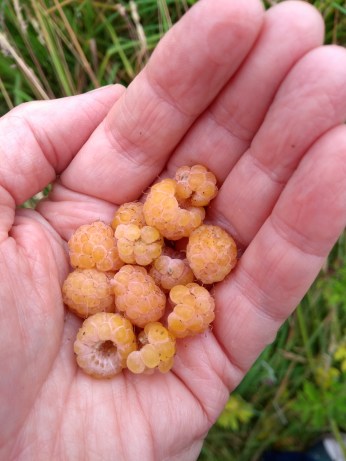 diminutive rasps are a pale golden yellow. They hide behind fiercely protective stands of nettle, and amid the jaggy stems of the hawthorn. These are the sweetest, most succulent of the feral berries. They melt in the mouth and almost dissolve in the hand. Any attempts to gather a large quantity fail; they are nought but juice by the time they get home. Those who know about them keep a close eye, and say nothing, then give the game away when it’s picking time by beating narrow paths through the grass and nettles to get at this choice fruit.
All in the past now, the Auchtergaven and Bankfoot berry fields. The history of a place often speaks through its plants, and may have something to say about its present..
 Comments on The Nature of the Universe