
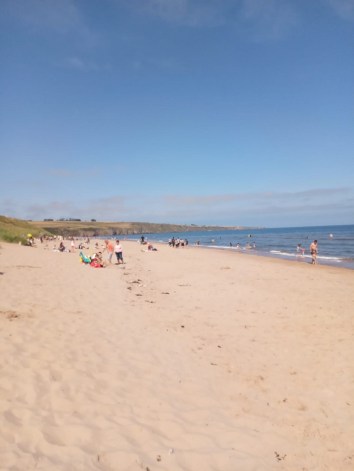
 First seen in early spring, nearly twenty years ago, the beach stretched endlessly around the curve of the bay, a shimmering cream expanse of sand uninterrupted by not much more than a man and a dog, idly kicking at the silvery waves. No sound but those waves, breaking, gathering energy, re-forming, breaking again – and the gulls, plovers and oystercatchers worrying at the interface between water and land. The red stones of a ruined castle tottered in the dunes, crumbling, threatening to fall. Where the river splayed lazily, yet with energy, into the sea, flat, smooth stones in many colours could be harvested for an optical feast, to be drawn and painted, rearranged, and consigned to garden corners.
Today the summer sun is hot, but the breeze is cool from the sea. The car park has been extended, a café predictably offers burgers, ice cream, soothing teas and toilets. The waves still break, but the birds have gone elsewhere, or fly over the sea waiting for humans to depart and their time to come. Chattering voices, laughter, cries of anger or delight dominate the soundscape. Dogs bark and race from one human party to another in confused joy. The tide of visitors troops through the dunes on the new boardwalks, and dissipates like the outflow of the river onto the sand. Small parcels of beach are claimed by towels, windbreaks and throw-away barbecues. As more people arrive, the parcels become smaller and smaller, and new claims are struck in between those established an hour earlier.
Hardy men and women swim and lay gasping in the cold, but glorious, water. Someone turns on a small music centre. The breaking waves are silenced by it. Children, many cossetted in protective wetsuits, others bare-skinned and incautious, run in and out of the sea. Their enjoyment – or fear – is lovingly recorded on a dozen mobile phones and instantly broadcast and archived on Facebook. They do little harm, these day-tripping hordes, few leave litter, they pick up their dogs’ excrement. They are out of doors and they are enjoying it. Most look up from their phones from time to time, and see the beach, the waves, the dazzling horizon. Some don’t. Their loss.
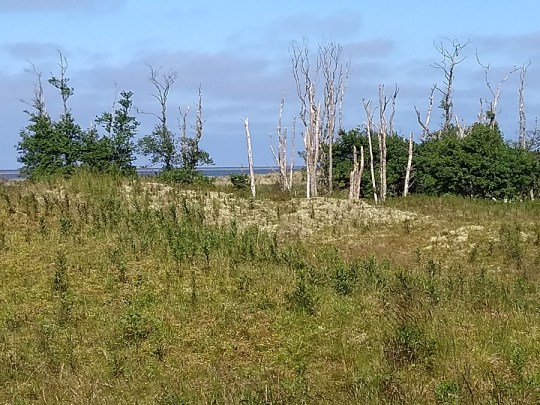
Follow the river up from the beach and behind the dunes, and human sounds recede. The wind still lives in the reedbed; the water warbles with life. Crickets grate away in the dry grass, birds can once more be heard calling and chattering in the scrubby pines. All along the riverbank, great sweeps of purple thistle, white yarrow, pink campion and yellow sowthistle dance and shout their presence to the quiet hoverflies and bumblebees. Harebells – the Scottish bluebell – sprawl untidily over sandy banks, lifting their china-blue trumpets to a sun that suddenly feels gentle and kind.
Clouds fly and form and merge and stream away in an endless sky.
One human walks alone.


 Comments on The Nature of the Universe