The Bluebell Wood in Winter

bluebell8

We’ve always felt a sense of ownership of our local bluebell wood. It’s the place we take visitors, a secret to share with loved friends and relations. Over the years, it’s become quite renowned, at least in May, when the ancient oak woodland is carpeted with bluebells. People have always flocked to it then, to capture images on camera, to bring children and grandchildren, or just to stare in amazement, breathing in the scent of bluebells that stretch far and wide.
bluebell4

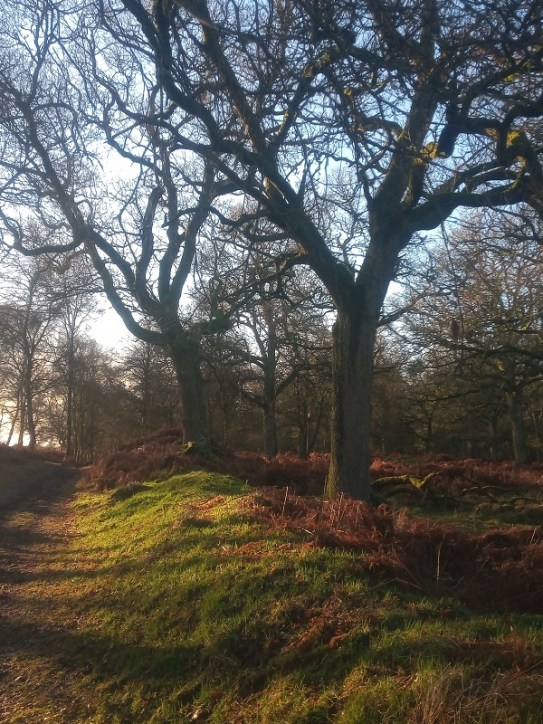
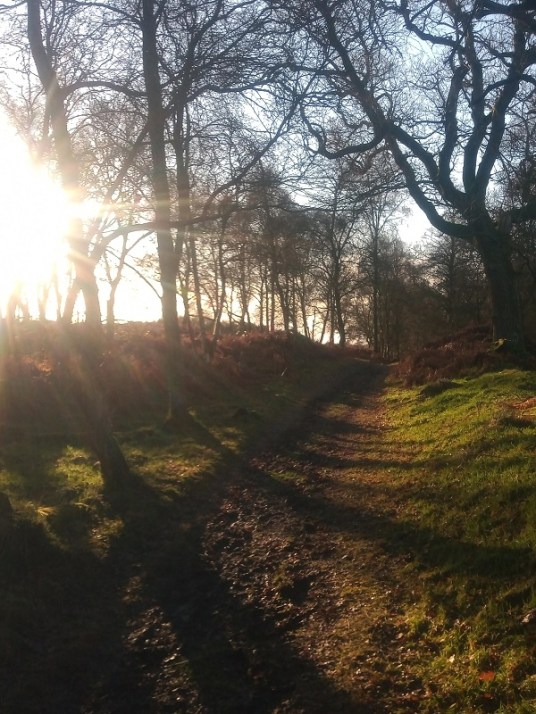
Maybe not so picturesque, but it’s equally magical in other seasons: when the bracken grows up fresh and green, or in its autumn gold, and in winter, when the silence is tangible, the bracken is tawny-brown and the shoots of bluebells lie just below the soil.

bluebell1
The sun is low and carries no warmth; it pierces the sweet sculpture of bare branches and paints the carpet of mosses under the fir trees with iridescent green and gold. It lights up the crumpled and disordered fern fronds as if with fire.

bluebell5

Every oak tree is adamantine and statuesque, posing in naked dignity. The scattered ancient, crumbling beeches also look invulnerable – but that’s an illusion. Every so often, one of them keels over or dumps half a split trunk. Dark, ponderous yew trees here and there are enigmatic about life and death.

bluebell6

At the top of the rise, my favourite tree is a multi-stemmed silver birch, which stands against the sky as if it were painted there. For me, this is Stephen Hawking’s tree. I was on my way up that hill in March 2018 when I heard that he’d died. I sat by the tree and digested the news, sad, but making a mental salute to a brilliant mind. I don’t have many heroes, but Professor Hawking was probably one.

bluebell7

A few years ago, the landowners put the bluebell wood up for sale. That’s when all the folk who’d felt ownership and connection came out of the woodwork. Suppose it was bought by someone who respected neither its status as ancient woodland, nor the long-established right of access? In the end, although a community buy-out would have seemed fitting,  it was bought by the Woodland Trust, thanks to a fortuitous legacy. Sighs of relief were followed by the formation of an enthusiastic volunteer group.
bluebell3

There have been changes, of course. Re-routing of paths to avoid visitors being knocked out by a falling beech branch, a hard line on invasive non-native species that threatened to engulf the bluebells themselves, the eviction of the deer from inside the deer fences to permit oak tree regeneration are just some examples. A car park – inevitable, perhaps, but no ornament… but at least it’s been surrounded by fruit trees.

And a massive planting project of new trees in the adjacent fields that formed part of the sale – thousand of trees, safely behind new deer fencing but accessible via solid gates. Work in spades for the volunteers, for years to come.

bluebell2

It’s rhododendron-bashing day tomorrow.

Unforgiving Minutes and the Tyranny of Time


think2

My mother liked to recite aloud the poems she learned at elementary school in the 1920s. These poems were generally heroic, patriotic, moralistic, meant to be uplifting in a time of post-war depression. Rupert Brooke, then, not Wilfred Owen. And lots of Rudyard Kipling. His famous poem “If” was one of her favourites. The last lines begin:

“If you can fill the unforgiving minute
With sixty seconds’ worth of distance run…..”

The Unforgiving Minute has dogged me like the grim reaper ever since. What if I don’t fill it? What if I waste a minute – an hour – days – years? What if Things Don’t Get Done? Over the years, I have felt guilty when I’ve been unwell. I’ve developed elaborate “multi-tasking” strategies like typing up party minutes while chatting on the phone AND watching an improving TV documentary; reading books on cosmology while watching less challenging stuff like Midsomer Murders; affecting to meditate while gardening AND working out what’s for dinner. Trying to bake bread while cleaning out the shed and answering emails is why my sourdough is such rubbish. I’ve had “holidays” where each day is planned and packed with minutes full enough to be righteously forgiven. I’ve created endless, bewilderingly enormous to-do lists, for a day, a week, a year. When I’ve finished everything on the list, I tell myself, I’ll have a rest and choose for myself. That never happens. I just start on the next list.

The fashion for having “bucket lists” doesn’t help. Ticking boxes, like bagging Munros, can be fun, but distracts from living and relishing an actual experience. Sure, there are things I’d like to do before I die (Ben Lawers, talking of Munros, to see the alpine flora, if I can find someone prepared to go at my glacial pace and not make me feel like a decrepit numpty for wanting to take all day about it). But I’ve had it with compulsive list-making.

Another much-loved poem at home was A.E.Housman’s “Loveliest of Trees”.

“Now of my four-score years and ten
Twenty will not come again
And take from seventy springs a score
It only leaves me fifty more

And since to look at things in bloom
Fifty springs is little room
About the woodlands I will go
To see the cherry hung with snow.”

However, as I’ve watched the balance of my years passed to years conceivably still to come tip, and now that I’m well on the light side of time, I observe that each of my remaining springs affords more each year than a tick-box opportunity to enjoy the blossoming of the gean, and all the other flowers in the woods. Savouring the intensity of each moment more than compensates for lack of time.

And what is time anyway? Not what you think it is. At the speed of light, time freezes altogether. I’ve read enough Stephen Hawking to dimly grasp that if I could fire myself way up into space, my unforgiving minutes would get longer, become hours even, to someone watching me through a giant telescope from Earth. But not to me; up there they’d still be minutes, because time only operates from the point of view of the observer. (Or something like that.)

So, as time is not fixed, but wavers around according to the laws of relativity and probably does something completely different on the quantum level anyway, let’s not be tyrannised by it. Let’s have more minutes with no guilt attached when we don’t fill them. More watching the clouds, less time trying to re-create them on canvas. Less grubbing around in borders and beds that will never be weed-free, more lying in the hammock watching the dandelion clocks expand and blow. More love and laughter, less – or no – time spent trying to prove it exists in our lives by frenetically posting the evidence on facebook.

More randomness – more random writing, perhaps, without fretting to meet self imposed blogging deadlines?

Loch Maree

Kipling finishes:

“…yours is the Earth, and everything that’s in it,
And, which is more, you’ll be a man my son.”

Really?? The Earth is not mine, or yours, or Kipling’s. It does not belong to the human species at all. I don’t want to own or master it and nor should any of us – we’re already proving we’re not much cop at that.

And let’s not even get started on Edwardian gender balance!