The little wood has become tangled, and the paths vague and meandering in the past few years, since Jed our collie died. Few people walk them, and even when it was a regular walk for me and Jed, they tended to shift and change, as blackthorn grew to block one route, or trees, felled by the wind or growing with vigour, made another way more attractive.
But always, there have been certain way-markers:- the overgrown guerrilla-planted Christmas tree, the gap in the field boundary where the wire’s trampled down, a patch of brambles, the fallen birch that still produces shoots…. Today, alone, I beat the path out again, lost in thickets of gorse and thorn, disoriented by the sound of traffic, unsure of distances among an understory of fern and broom. As so many times before, when coming from diverse directions, my brain unconsciously looks for you to reset my compass. I know I must pass you on my left to regain the path downhill and out of the wood.
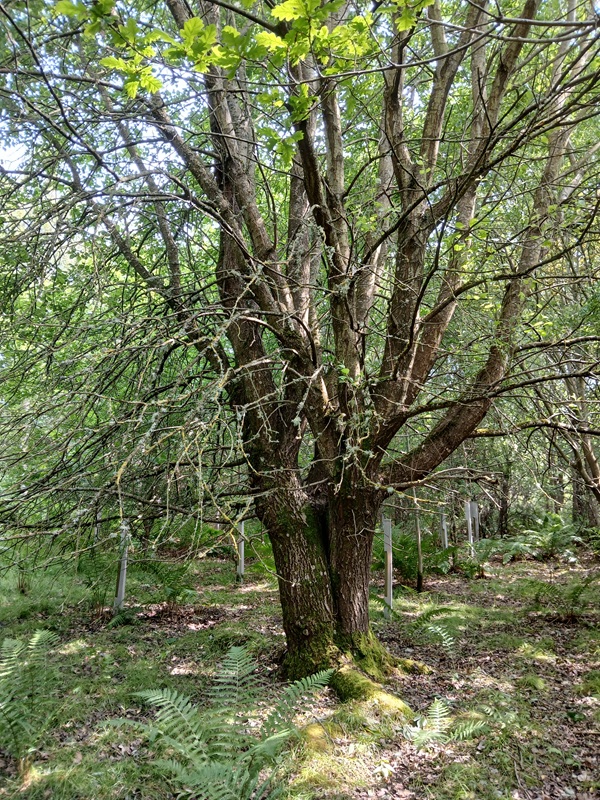
You are the biggest, broadest, in the wood, though perhaps not the tallest or the oldest, and certainly not as old as me. With two feet firmly planted, you stand fast and firm among the rest who bend and break in the wind, and you spread your many solid arms in all directions, and to the sky.
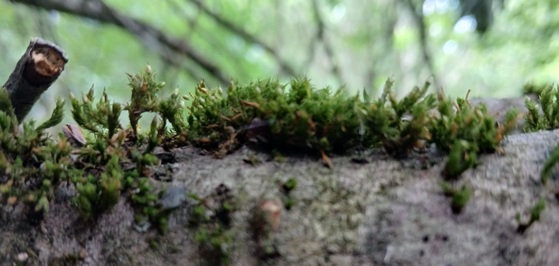
Here you are. Now I know my way way. But wait – have we ever truly met? Have I ever really seen you, Mr. Standfast? Today I approach with awareness, pausing in stages, taking you in. A rush of warmth, of joy… joy or recognition, joy at being recognised. When I reach close enough to touch, my gardener’s – my orchardist’s – eye notes dead, stiff and black lower branches and itches, for a second, for loppers. But then I watch the beetle’s progress through the moss and lichen upon them; the moist droplets of old rain sustaining the beings on the branch, and recognise, it’s none of my damned business.
We are together for a good while, without words, unified by our alikeness, as your very own warbler comes to join us, bursting into that fitful exhuberance of song that wears itself out in a twittering, grumpy-sounding mutter, then kicks off a few minutes later to try again. I feel the healing nature of your skin, the questing stability and strength of your roots, the air you breathe, I breathe, we breathe. For a moment, I know we are one, with the lichens and beetles and warblers and the things unseen.
I know my way now. As I rejoin the ghost of a path, my palms carry the imprint of willow bark, like a memory, like a gift.
Three days of Christmas torpor, punctuated by food, beer and Irish cream liqueurs, two days of damp murk – what happened to the pretty snow that began falling so seasonally on Dunkeld Cathedral at midnight Christmas Eve? – then Tuesday dawned with clear-ish skies and a watery sun. Finally, an opportunity for a decent walk, and a collective itching for sea air drew us like a magnet to Tentsmuir Forest.
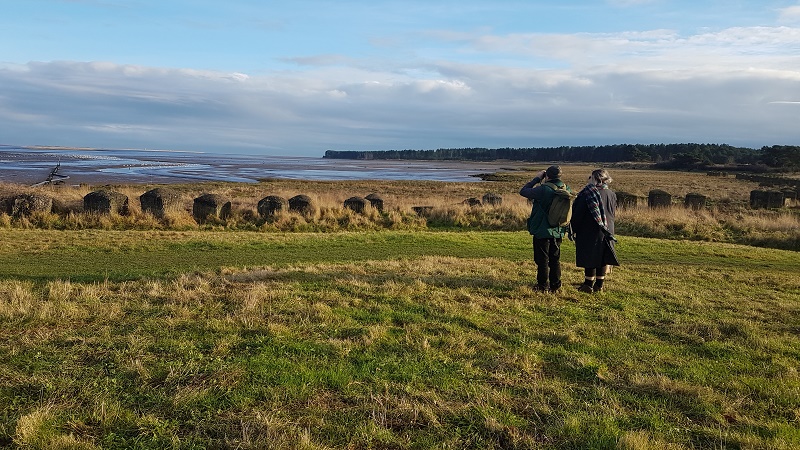
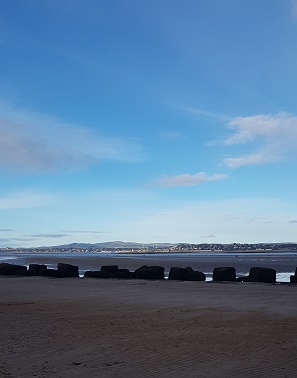
I consulted my knee, which has been challenged by non-specific pain since I fell onto it while raspberry pruning at the end of October. My knee said in no uncertain terms that those strong anti-inflammatories from the doctor had worked miracles in the preceding week, and it was quite sure any torn ligaments, lumps of cartilage etc. were virtually mended. It also said forget the looming possibility of the onset of osteoarthritis, let’s not even go there. The beach calls. So we drove – no, I drove, another possibly poor decision – to Tayport and marched across Tayport Heath with a head-clearing north easterly behind us, and the sun making Dundee all sparkly. Tide was out; wide sands, gleaming waters, massive blue skies splashed with the long brush-strokes of brazen clouds.
Sun always shines on Dundee…
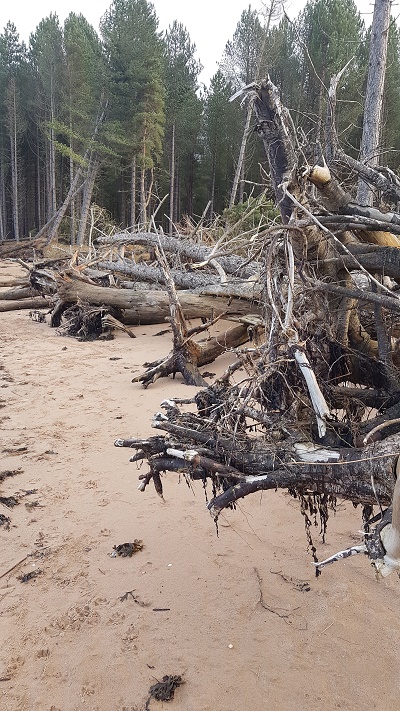
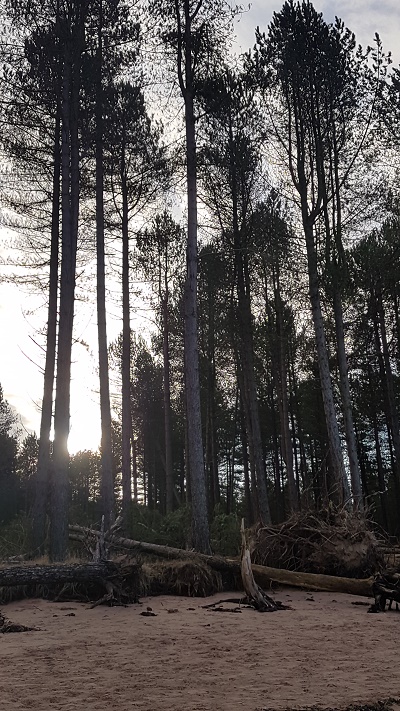
Getting to the forest, we saw many of the pines that cling to the edge of the sand had been toppled by recent storms. In a hollow of dunes, the trees had fallen in to the centre. The upended roots, with the sandy soil washed or blown off them, were a fierce tangle a-top the weathered trunks and skeletal remains of earlier storm victims. It became clear that the parallel forest track inland, which would have been our easy and shorter return route, was blocked.
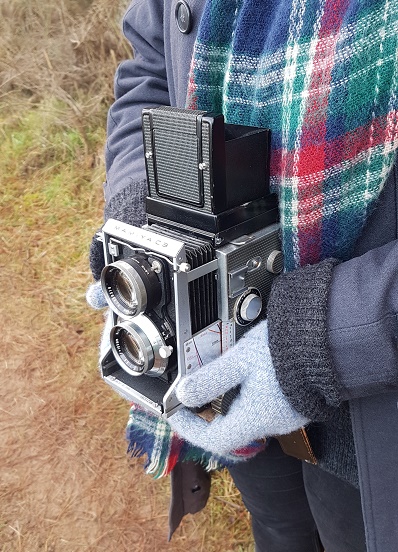
Rowan spent an age taking black and white photos with an antique film camera, unloading the film and loading a new one. I took photos of the camera on my phone in an instant, and was glad to wait and rest a slightly uncomfortable but not yet painful knee, while reflecting on the different mental input and rewards of each method.
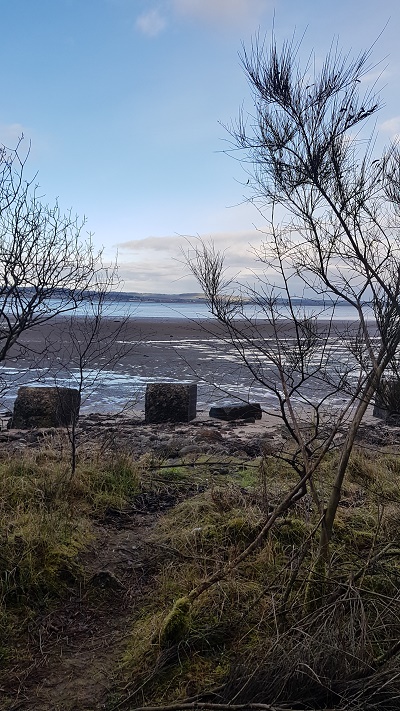
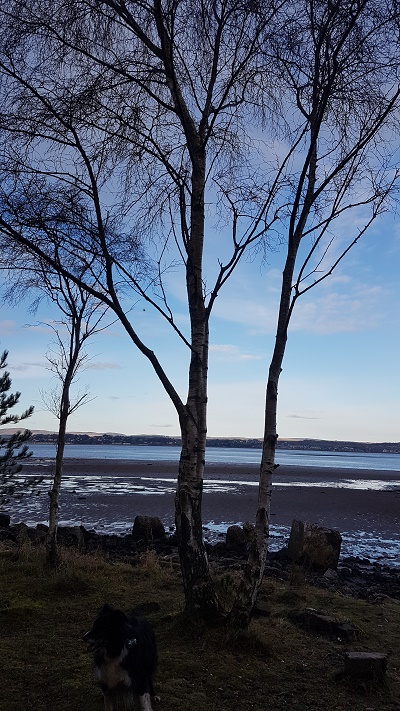
Afternoon light on the estuary emphasized the form and movement of the bare birches and broom in silhouette, as the tide turned. When we reached Tentsmuir Point, the knee was starting to think maybe it should not march on to Kinshaldy Beach as planned, but turn around now. After all, that would still be 5km of exercise and fresh air in total, though I dearly wanted to paddle in the distant, sparkling waves. Pausing to decide, I stepped down a 45cm bank, bad leg first.
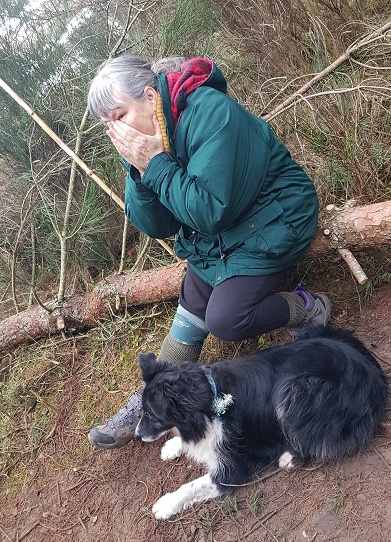
There was an audible explosion in the knee, and I was no longer standing up. Actually, I couldn’t. We sat for a while, till I felt the pain might just be away, but that I should definitely head back. When I tried to walk, that became “we should all head back”. Various efforts at walking supported by one or both of my familial companions were not very successful on the uneven, up-and-down path – someone was always either the wrong height or moved at the wrong time, and any sideways movement, flexing or bending of the knee was pretty agonising. We minimised such movement with my new Christmas walking socks and a filthy and disreputable Tay Landscape Partnership buff, belonging to Andrew. (I wash mine.)
Infinitely helpful collie dog
There were lots of folk out on that path (all others being closed off), and many of them were wonderful. Jolly Fifers and Dundonians with sympathy, but a strong sense of the ridiculous kept my spirits up with their black humour and all kinds of offered help and advice. To the lovely man who had collected a polished peeled pinewood stick and surrendered it to me before going off to see if there was any way he could get his car into the forest to pick me up, my grateful thanks. That stick (pictured above, behind) was a real help and enabled me to avoid the shifting sands of human support. People, so often, are just brilliant, something we forget too easily, confronted as we are by insensitive, heartless, mindless acts – not infrequently by politicians.
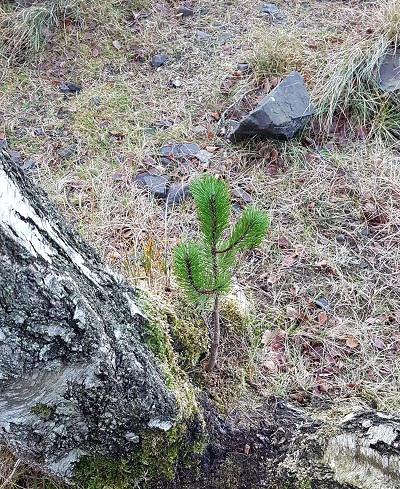
However, light was starting to fade, and progress was slow. I had to keep stopping to recover. One long stop was by a heart-searingly beautiful birch tree on which I leaned. Tucked between its twin trunks was a little pine seedling. I wished it every success, while Rowan rang 999 and Andrew marched off to meet the emergency services back at Tayport.
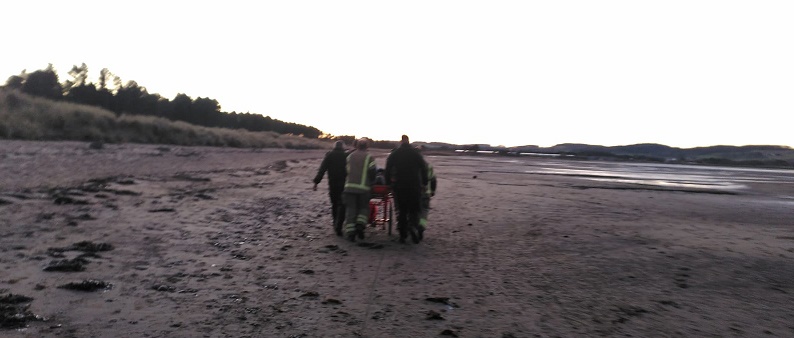
Getting an ambulance in to where I was proved impossible because of the windthrown trees. The ambulance people called on the fire service who have the keys to the gate at Lundin Bridge, and on their colleagues in Edinburgh to come up to Fife with an all-terrain vehicle to get me. Meanwhile, two paramedics and 4 fire-people set off with a narrow-wheeled stretcher trolley, while Rowan kept everyone updated with a brilliant App called Three Words which can pinpoint location accurately.
It took a long time. Wistfully, I dreamed of a helicopter air-lift (which was considered, I learned later, but they said it couldn’t land on the estuarine sands) or a Bond-style speedboat rescue. The tide was visibly rising and although still a way off I knew that at high tide the sea washes the track. And it was getting cold. So, when I could, I kept moving on, in the crab-walk sideways step I’d almost perfected, leaning on the stick for dear life in front of me, dragging the damaged right leg up to join the poor, put-upon left. (It was ever thus.) We noticed that the movement was in waltz time, and tried humming the Blue Danube by Strauss for encouragement. That was too corny, so Rowan found Iron Maiden on her phone and I crab-danced along quite the thing for a good while to Dance of Death…..
“Feeling scared I fell to my knees As something rushed me from the trees Took me to an unholy place That is where I fell from grace” (lyrics, Iron Maiden)
Appropriate, or what?
Getting carried away…
When we met the brilliant team of combined emergency service people (yes, I know, but they bloody were), I opted to be carried on the jolting trolley (apparently a wheel came off at one point) till we met the ATV. The ATV got lost (“Edinburgh folk” tutted a Dundee fireman, as if he’d not really expected anything better), so didn’t arrive till we were out, but I enjoyed passing under the overhanging pine branches, set against a darkening sky, and the vivid sunset over the flat and increasingly wet estuary. There are worse settings for being a casualty.
The two Edinburgh paramedics transported me to the car and thence off to A&E. Five hours later, and more hats off to the NHS, I left, with a pair of crutches, a fractured or chipped shinbone in the knee joint encased in a massive Velcro-assisted immobiliser, and a probable torn-asunder lump of cartilage called the medial meniscus. Which came first, and whether one caused the other, I hope to learn next Wednesday at the fracture clinic!
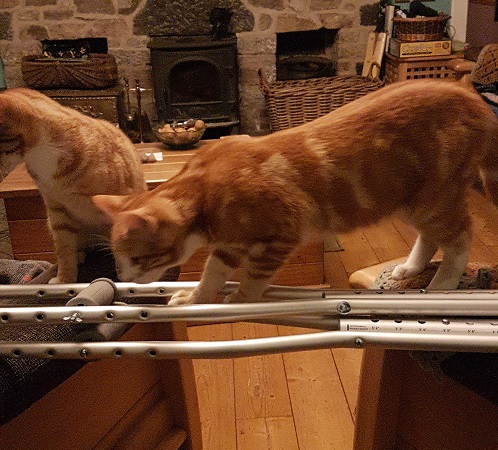
Fringe benefits: 1. Gas and air! Happy memories (?) of childbirth! 2. From the Xrays, my knee “is like that of a young woman” said the doctor. No osteoarthritis yet! 3. The kittens like tight-rope walking on the crutches more than I like using them. 4. Time to write my blog, which I signally failed to do before Christmas. Too late for Christmas greetings, but have a good Hogmanay and new year when it comes…..everyone, but especially two doctors (one of Philosophy with heavy metal expertise), all the happy walkers in Tentsmuir Forest, three firemen and a firewoman, four paramedics, innumerable NHS staff from the reception desk to the porter, one man with a stick (which I’m keeping unless he wants it back), and a partridge in a pear tree……(imagined.)
Willows are the most curious trees. For a start, there are well over 300 species worldwide, with eyebrow-raising common names such as Eared, Goat, Cricket Bat and Crack, or casually colour-hinting names (black, white, grey, violet, red and purple). The colours usually refer to the young stems, and that’s why willows have long been valued everywhere to make beautiful baskets, hurdles and sculpture – along with their wonderful flexibility which makes them capable of being woven without snapping. A well-made willow basket is strong and lasts a lifetime.
Those hundreds of species readily hybridise promiscuously, making identification a chore, to say the least – even in Britain where only nineteen species are considered native. I think it’s unlikely humans really know just how many species and hybrids there are. Willow – or sallow, or osier (even the names are slippery) just won’t be pinned down.
Willow won’t be kept down either, even when it falls. Put a bunch of willow stems in the rain-butt to soak for basketry, and the next thing you know, they’ve all grown roots. They grow quickly, ferociously fast. Two metres a year is not uncommon for new growth. Coppice them, and they’re back up the next year. Their Lazarus impersonations are all the more improbable given the mind-boggling number of diseases the genus is prone to – black canker, blight, powdery mildew, scab, watermark disease, root rot, heart rot and willow anthracnose, to name but a few. They are pioneer trees, kicking off the cycle of colonisation in open ground that is damp or downright boggy, and no one fairly expects them to last for centuries.
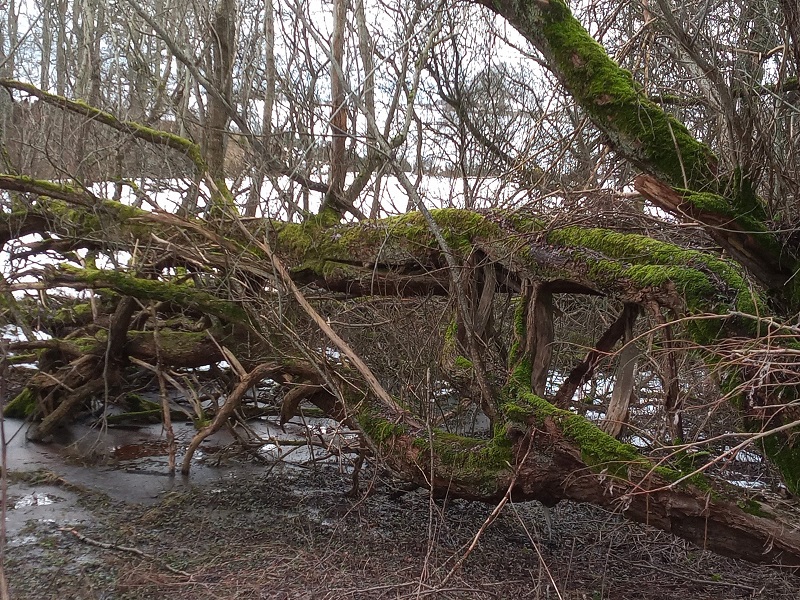
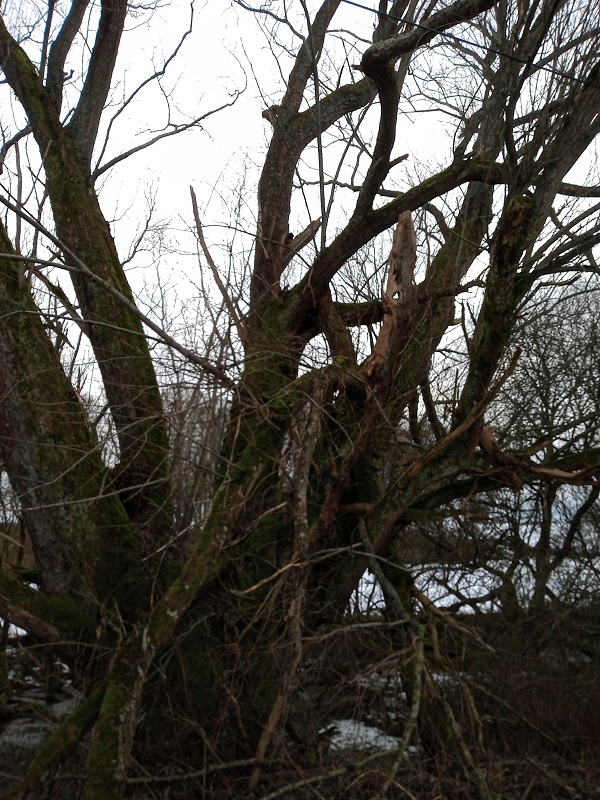
By what remains of the old Back Mill millpond in Bankfoot, there are some death-defying willows. I don’t know the species. One monster of a tree, often pollarded in the past, still stands erect – outrageously enormous, ancient, decrepit. As the millpond has steadily drained of its water and silted up, the roots of these massive willows have been exposed. A flood of heavy rain then washes away the soil, until eventually the whole tree comes crashing down.
Old Man Willow
End of story? No way. In falling, the wood, being watery willow, ripped asunder, cracking and splitting in a hundred fibrous places. Some trunks, now horizontal, appear shredded and mashed. Branches poke up out of the devastation akimbo, some dry and decayed, some clinging to life.
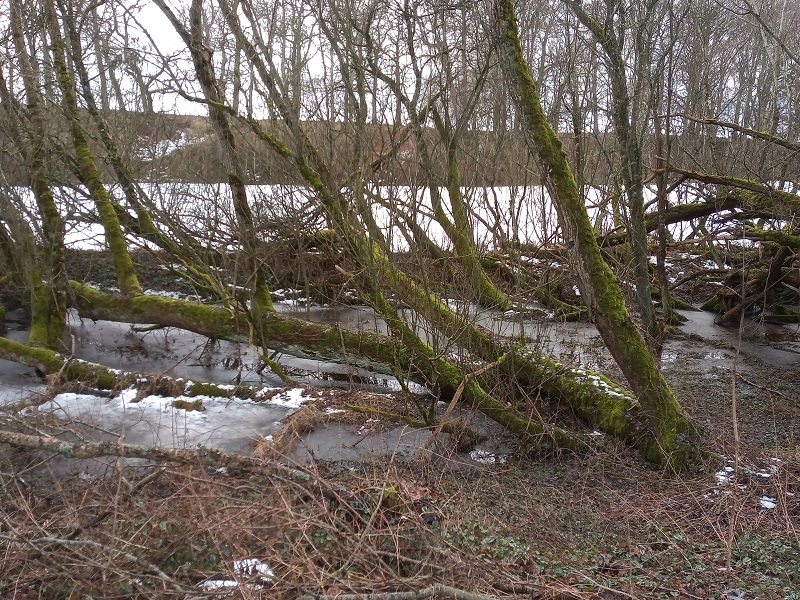
Make no mistake, these willows fell a long time ago, Birds have nested in the crevices where they toppled onto each other. Mosses, algae, lichens, ferns have been succeeded in places by other woody plants, growing out of, and contributing to, the accumulation of soil and organic matter. The trees are alive, but they are a substrate for life also.
From the felled boles and wrecked structures, arrow-straight, insolent shoots clamber skywards. They are making new trunks from the old,even where the original tree has scarcely more than a twisted root in soil or water. A veritable willow plantation arises from the un-dead.
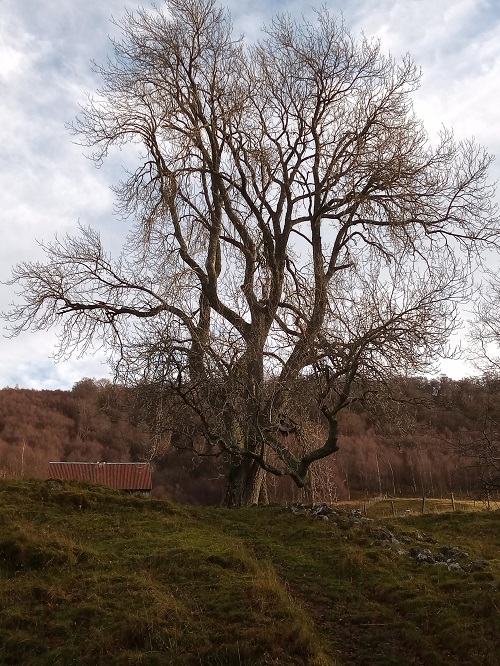
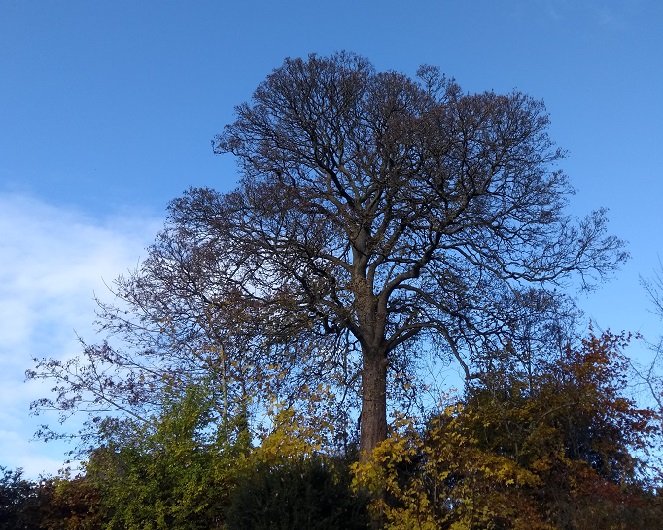
The ash tree, with its distinctive black, pyramid-like winter buds that sit defiantly opposing each other, was the first native tree I learned to recognise in winter. From the grey, ebony-tipped twigs I stood back to take in the whole glorious form of this tree at maturity: the grace and strength of the downward-sweeping branches, the solidity of trunk and main frame, and the artistic flourish with which the ends of each branch skip briefly skywards following their downward plunge.
Like all deciduous trees, the beauty of its structure is revealed annually at leaf-fall. We may love and appreciate our trees in summer, but in winter, we can truly see them. I never tire of looking at trees in winter.
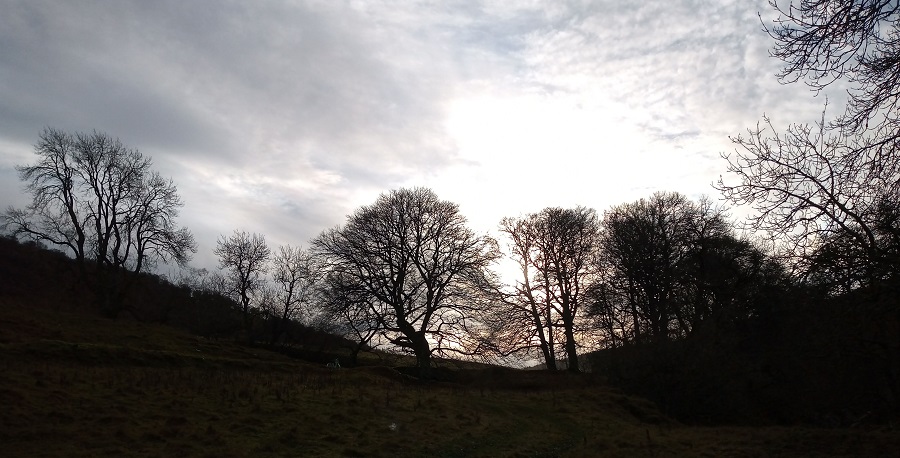
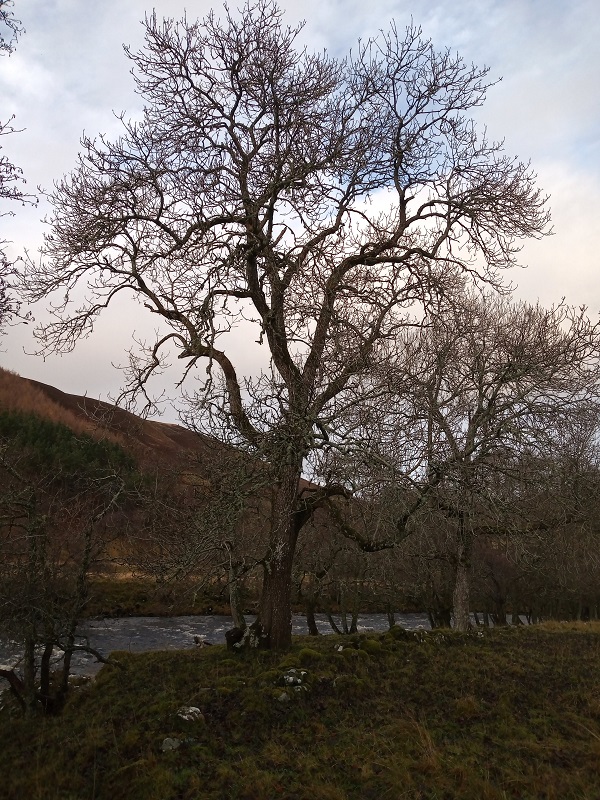
Sadly, the monumental frozen-motion glory of the mature ash is a sight less and less available to us. Ash die-back disease is caused by a fungus (Hymenoscyphus fraxinea) which attacks and infests the bark, leading to wilting of leaves and die-back of those optimistic, sky-seeking terminal twigs. Jaggy, stunted branch-ends and lesioned bark are more often what we see today. The spores are wind-blown, and so it has spread inexorably through Europe. There seems to be little point in felling affected trees, since the fungus spends part of its life cycle proliferating in leaf litter. In pockets where old ash trees are isolated from larger populations, such as Glen Tilt in Highland Perthshire, the majesty of the winter ash can still be seen.
There will be resistant trees, and much is being done to find these, identify their genetic codes, and breed from them. We can only hope the ash tree’s absence from the landscape is temporary.
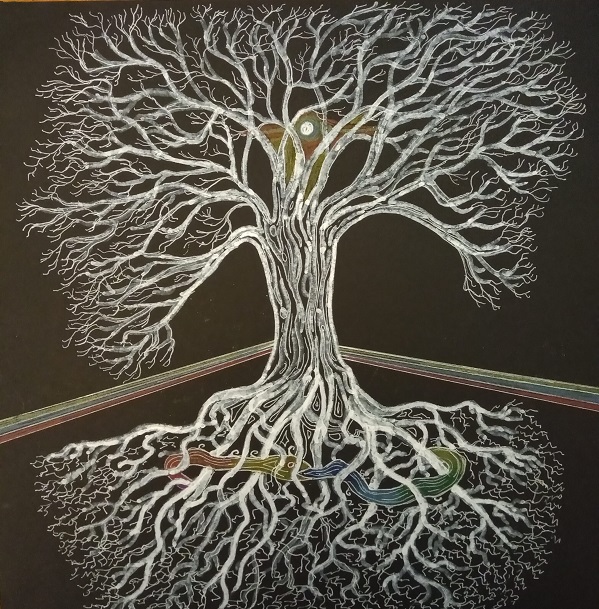
But the Ash Tree has an existence outside the biological. It is – and long has been – a symbol, a magical entity, a talisman. In Norse and Germanic mythologies it is Yggdrasil, the World Ash Tree. Its branches reach into and hold up the heavens; its roots delve deep into the dark caverns of the underworlds, where the serpent-dragon Nidhogg gnaws at its roots. Between the two lies everything we know, and much that we don’t. Three women, the Norns, sit below its mighty branches, tending the World Tree and spinning, spinning, spinning the fates of gods and humans.
The Tree of Life and the Tree of Knowledge are other expressions of Yggdrasil. Odin, father and chief of the Nordic pantheon, presents as a seriously flawed, doubtful and often misguided god. (To be fair, they all do.) Maybe that’s why he disguised himself as the Wanderer, with his wide-brimmed hat (echoed in the character of Gandalf in Lord of the Rings?) and ash staff cut from Yggdrasil, roaming the Earth in search of knowledge and enlightenment. Ultimately, the tale goes, Odin had to hang himself from the Tree, wounded by the ash spear, for nine days and nights, to find the wisdom to save humankind.
Should the Norns cease to care for Yggdrasil, or malevolent forces overtake it, like our blighted ash trees, it will die, and the rooster Gullinkambi will crow from its withering canopy, proclaiming Ragnarok – the Twilight of the Gods.
Will we save our earthly ash trees? Who are the gods whose twilight we would seek in return?
May 2021 bring a sea-change in our relationship with nature, may we all be safe, may Yggdrasil bear new shoots of hope, and may the ash tree survive.
We’ve always felt a sense of ownership of our local bluebell wood. It’s the place we take visitors, a secret to share with loved friends and relations. Over the years, it’s become quite renowned, at least in May, when the ancient oak woodland is carpeted with bluebells. People have always flocked to it then, to capture images on camera, to bring children and grandchildren, or just to stare in amazement, breathing in the scent of bluebells that stretch far and wide.
Maybe not so picturesque, but it’s equally magical in other seasons: when the bracken grows up fresh and green, or in its autumn gold, and in winter, when the silence is tangible, the bracken is tawny-brown and the shoots of bluebells lie just below the soil.
The sun is low and carries no warmth; it pierces the sweet sculpture of bare branches and paints the carpet of mosses under the fir trees with iridescent green and gold. It lights up the crumpled and disordered fern fronds as if with fire.
Every oak tree is adamantine and statuesque, posing in naked dignity. The scattered ancient, crumbling beeches also look invulnerable – but that’s an illusion. Every so often, one of them keels over or dumps half a split trunk. Dark, ponderous yew trees here and there are enigmatic about life and death.
At the top of the rise, my favourite tree is a multi-stemmed silver birch, which stands against the sky as if it were painted there. For me, this is Stephen Hawking’s tree. I was on my way up that hill in March 2018 when I heard that he’d died. I sat by the tree and digested the news, sad, but making a mental salute to a brilliant mind. I don’t have many heroes, but Professor Hawking was probably one.
A few years ago, the landowners put the bluebell wood up for sale. That’s when all the folk who’d felt ownership and connection came out of the woodwork. Suppose it was bought by someone who respected neither its status as ancient woodland, nor the long-established right of access? In the end, although a community buy-out would have seemed fitting, it was bought by the Woodland Trust, thanks to a fortuitous legacy. Sighs of relief were followed by the formation of an enthusiastic volunteer group.
There have been changes, of course. Re-routing of paths to avoid visitors being knocked out by a falling beech branch, a hard line on invasive non-native species that threatened to engulf the bluebells themselves, the eviction of the deer from inside the deer fences to permit oak tree regeneration are just some examples. A car park – inevitable, perhaps, but no ornament… but at least it’s been surrounded by fruit trees.
And a massive planting project of new trees in the adjacent fields that formed part of the sale – thousand of trees, safely behind new deer fencing but accessible via solid gates. Work in spades for the volunteers, for years to come.
In the past ten days, two friends have died. Not unexpectedly, no shocks. A couple of weeks ago, when they were both still alive, everyone and everything around me seemed painfully mortal, and this poem is what I wrote then.
I cross the bridge, but
Midstream, I stop.
So much water, passing under.
I cannot hold it back.
Midstream – upstream – a dipper, Mischievous, concealed among stones and ripples, Bobs, and waits. Midstream – downstream – a fisherman Casts and retrieves, over and over, Silent, focused, amid swirling water.
I, too, have cast,
Over and over.
But now my line diffuses and is lost in movement
And what, now, is left to retrieve?
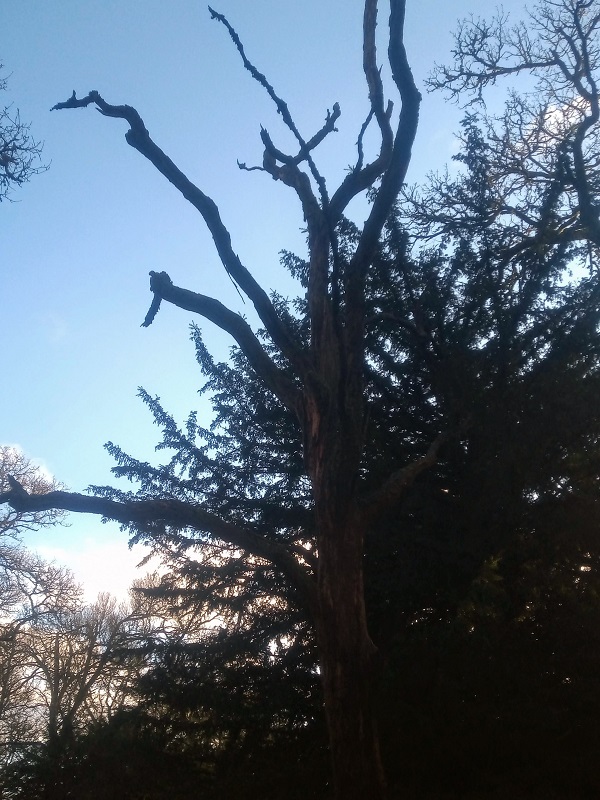
By this great river I sit Beneath the fiddle-tree, A gnarled and feathered oak, gashed By storm, decay and distant ghosts of song. Riverbank trees, like frozen statues, arch and crane, Their token reflections broken
Like dreams in the midstream of sleep.
On dark ripples, tiny sounds of water on water, Midstream, the undercurrent Chases the rain from highland to lowland Into deeper water yet.
Midstream, unseen fish bestir And battle homeward. But I Am snagged, log-jammed, midstream Watching lives flow on and vanish into river, Slippery, elusive as salmon, impossible to hold, Passing, on unfathomed journeys, beyond my sight
In Devon, they say they have hearts of oak. Here, in the sun-baked, heat-islanded south of the County, where the thick-hedged meadows run up and down hills like a lumpy quilt on a badly-made bed, you can see why. Oaks are everywhere, dominating the treescape. They surge out of the deep, dark lanes, they march along tangled, towering verges, and straddle the corners of the fertile fields.
Broad-crowned and rooted like mountains, they are the very epitome of strength. In the minds of humans, they are usually labelled “he” and associated with male-ness. Strong, protective, enduring, courageous …. dominant, powerful, overbearing, masterful? Strange to note (if not surprising) that trees thought of as “she” (such as the Silver Birch, Devon’s “Lady of the Woods”) are graceful, delicate, drooping and indecisive in form. And is it only Devon Men who have “hearts of oak”?
Oak trees, Birch trees, most trees in the British Isles, are hermaphrodite anyway, both male and female. Oak trees are much more than a gender stereotype. They form worlds in themselves: roots, bark, branches, leaves, roots and fruits all playing host to a myriad of organisms, fulfilling many functions. They are home, food source, shelter, entertainment, nursery, recreation ground. Allegedly, but probably only mythically, oaks have even housed the occasional human wearing a silly crown. In their own right and as part of the natural world, they are extraordinary, important and awe-inspiring.
Even when they die, they will take centuries about it, growing steadily more stag-headed and gaunt, silver against the blue summer skies. From a distance, no sign of life is discernible. Get closer, and leaves spurt from odd branches below the hollow, woodpecker-mined, bark-less upper limbs where a solitary crow keeps an avid watch on the meadow. Dismissed as dead, and yet they survive.
People pin not only their assumptions of gender onto indifferent trees, but also sometimes their anxieties and aspirations. They look for reflections of what they’d like to be, and how they’d like to portray others. In Scotland, we pin some of our national psyche on the Scots Pine – another giant of the landscape given to vast and spreading majesty when rooted in Caledonian soil. But also, beneath the surface of the obvious, on the subtle, fey Rowan, reverenced if not revered, the magic totem of croft and byre. What characteristics do we borrow from our trees?
Hearts of Oak– that Kiplingesque phrase so redolent of Drake in his hammock, Queen and Country, the ships that saw off the Armada. Do the men of Devon – and others – who identify with the oak tree incline, as a result, to certainty, strength of purpose and an assumption of their own inevitable survival? Are they made sure of their ability to go it alone, to forge their own paths, to take back control? Are they programmed never to doubt that to succeed against all odds without need for cooperation or compromise, is admirable and right?
What if the oak trees were to fall? What does it take to make people change, to reach out?
Just as assignments of gender onto trees only mean something to humans, so too is attributing nation status to any species. Oak, Pine, Birch or Rowan – none are English, Scottish, Welsh, Irish and neither do they “belong” to any other race. They are not the property of local government. None are even endemics; they are uncaring of borders and boundaries. They follow no human creed, political standpoint or philosophy. They are trees.
Oaks have wonderful heart-wood, but no hearts. Heart are muscles found in a wide range of animal species, including humans. Change of heart is a condition humans sometimes get, too.
The last time I was in Assynt I was nine or ten, on my first visit to Scotland. My big sister and her boyfriend took me camping on a road trip that began in Glasgow and ended at Cape Wrath. For a child from the suburbs of East London, it was nothing short of life-changing. As we returned to their flat in Glasgow, my sister asked me which places I liked best.
“Wester Ross,” I said.
“Not Sutherland?”
I thought for a bit. “I liked it. But I liked Wester Ross more.”
“Was Sutherland too harsh and wild for you?”
I sensed a trick question. My sister always wanted to toughen me up. She reveled in wild and empty open spaces, the complete absence of people. I wanted her approval. But something in her question rang true. It wasn’t that Wester Ross was softer, meeker, but somehow – I couldn’t explain – somehow there were more….
“Trees,” I announced. “I like trees. There were no trees in Sutherland.”
I’ve had decades since to reflect on my response. At that time, the North-west Highlands were remote, empty of people. Settlements were sparse, inhabitants few, and tourists virtually non-existent. But I could see where people had been. The ruins of dry-stonewalled houses and whole villages stood everywhere, a testimony to clearance, plague, poverty and emigration. Crumbled walls, sometimes just foundations, a gable or a chimney pointing here and there to the sky. You couldn’t miss them. Our wild campsites were up the remains of old tracks that led to derelict hamlets. I remember one that I would walk around every morning. A little way from the ruined houses I saw a weird cairn-like structure of four or five strategically placed, flattish stones. I lifted them. Below a deep, dark hole blinked at me. There was a melancholy, metallic splash when I dropped in a stone. I’d discovered the well, and it stared back at me, naked and accusing. The cover stones might have been placed just yesterday. Feeling a sickness and strange fear in my stomach, I tried to replace them exactly as I’d found them – in case someone came back.
I don’t think I’m just speaking with informed hindsight when I say that I sensed there was something wrong about the bleak emptiness and the ruins. The further north we got, the more pronounced it became, perhaps because of the lack of tree cover. Maybe there were trees in Sutherland back then, but I didn’t see them. My guardians preferred walks on bare hills, peat-bogs and wind-blasted coasts.
But last week I was in Assynt again, and if there were many changes, it was the trees I noticed first. It’s nearly 26 years since the first ever community buy-out of land in the area by the Assynt Crofters Trust, and there have been others in the area since. The first trees I found myself looking at were less than 25 years old. I walked in vibrant young woodland at Little Assynt, above the shores of the great loch. Deer fencing surrounded large tracts of land. Birch, rowan, hazel, Scots pine…… willows, elders, hollies and even aspen…… planted by Culag Community Woodland Trust or regenerated naturally within the fences. Outwith the fences, though, trees were also regenerating, especially birch and willow. Sheep, ironically, seem to have been cleared to the coasts. Deer pose for tourists around townships, but their numbers are controlled. Bluebells and primroses are appearing under the bracken.
So, there were woods here before, then.
The Assynt downy birches are wonderful stunted specimens, all arms and legs as they branch and branch again and gesticulate over a landscape of ferns and mosses and blueberries. I saw very old birches in woods up a river valley – huge, shaggy trunks breaking into wiry, angular limbs about three feet from the base, and still sending up new wood. It seemed pretty clear they’d been pollarded for their timber a long, long time ago.
There were woods here before, and they were valued and sustainably harvested.
There’s a native tree nursery at Little Assynt, whose owners work tirelessly among the midgies to produce more trees, all from seed they’ve gathered locally. They’re pretty excited that after last summer, the aspens have flowered – a rare event in a species that prefers to clone itself vegetatively – bringing welcome genetic diversity into the local tree stock. At the Falls of Kirkaig, we bumped into a naturalist friend from near home in Perthshire (Scotland being such a gloriously small country), who had observed the same phenomenon. So, there we were, all getting excited about the future of a tree species in a place I’d remembered as treeless.
Of course, there are other changes. You have to look hard to find any old townships from pre-clearance times. The earth has swallowed them up. The roads are more solid, with no grass through the middle, so there are more motor vehicles and far more people. Mostly (but not all) tourists. A few whizz about, thinking it some kind of achievement to “do” the North Coast 500 in a day, or delude themselves that they can capture the essence of Sutherland from the inside of some huge, self-contained box-on-wheels that couldn’t fit into a passing place even if the driver recognised one. Sutherland could perhaps use fewer of these. But many linger, fall in love with the mountains and the deep valleys, accept the weather, and engage with the landscape – and come back. Sutherland has become accessible to tourists. It has learned to cater for them, and yes, it is busier, less remote, less empty.
In the misty dampness of a cool May morning, the tangled and decaying woodland holds its breath. Falling trees prop up shattered branches and each other, precariously leaning, hanging on by brittle twigs to some semblance of the vertical. Elsewhere, the long archaeology of those that have already succumbed to gravity make the woodland floor uneven, precarious, unpredictable. Some are half-sunken: indistinct mounds of mosses and soft, cushion-like wood, sprouting ferns and small plants – wood sorrel, purslane, chickweed wintergreen – from every crevice. Others, newly crashed in last week’s gale, still carry their leaves, shrivelling, poignant. Between the two extremes, lie trees and logs in every stage of decomposition.
The walker in this wood must learn these stages, and recognise which logs will still make good rafts to lay across the boggy places and ditches she would cross, and which will just crumble when stepped on. She must be aware of what lies overhead and if it would be wiser to go around, rather than under, the hung-up branches. Familiar paths are blocked every month and must be re-routed. New ground is created, explored, and lost again.
Out of the decomposition, new worlds are also born. What is decomposition if not the beginning of opportunity? Spiders re-align their webs in the remaining dead branches of a leaning tree. The breakdown of bark releases nutrients; tree becomes soil, soil claims tree. Single-celled organisms work their way through a sea of bacteria, laying the foundation for others to thrive.
Opportunities are made for beetles that feast on the rot in wood and bark, and the birds and small mammals that home in on the beetles. Shelter, food source, songpost, tunnel, bridge – the creatures of the wood utilise the fallen and falling trees in many ways. On their bodies they bring more soil, seeds, and the elements of fertility to this garden of decay.
And oh, how the garden grows.
It is not death that the walker witnesses, but birth and life. Is this decomposition, or composition? Is it both? Is this the end of the wood, or the beginning of a new landscape? No human cares much for this wood. Children sometimes come and make fires, camp or build twiggy shelters, but you never see them. There is an old tyre swing, hanging neglected. Someone – no-one knew who – used to make sculptures out of stones in the heart of the wood, but not anymore. Dogs are walked, but usually led straight past the wood now that access is trickier. No-one “manages” it. Change, then, seems rapid. Whole trees crash down, leaving soggy craters and towering cliffs of root-ball, but transformation in nature is incremental, and constant. Each year, the populations dwelling on those bare root-cliffs are slightly different. Ground living fungi give way to aerial brackets, rabbits exploit entrances to potential burrows, liverworts, lichens and ferns take hold.
And underground, fungal mycelia move like whispers within subtle, shape-shifting parameters. Today, a downpour of the night is percolating under the moss-covered banks and logs. Soft spring rain, scarcely visible except when the smirr catches a shard of sunshine, seeps into the soil cauldron, fermenting, bringing new elements, new conditions.
Things move unseen.
Everything waits.
The walker in the woods has seen no mushrooms yet. But even a human animal can smell the contents of the cauldron, the warm, damp changes happening unseen below the wreckage of an unmarked wood. When all the boxes have been ticked, the harvest will be rich and golden.







 By this great river I sit
 Broad-crowned and rooted like mountains, they are the very epitome of strength. In the minds of humans, they are usually labelled “he” and associated with male-ness. Strong, protective, enduring, courageous …. dominant, powerful, overbearing, masterful? Strange to note (if not surprising) that trees thought of as “she” (such as the Silver Birch, Devon’s “Lady of the Woods”) are graceful, delicate, drooping and indecisive in form. And is it only Devon Men who have “hearts of oak”?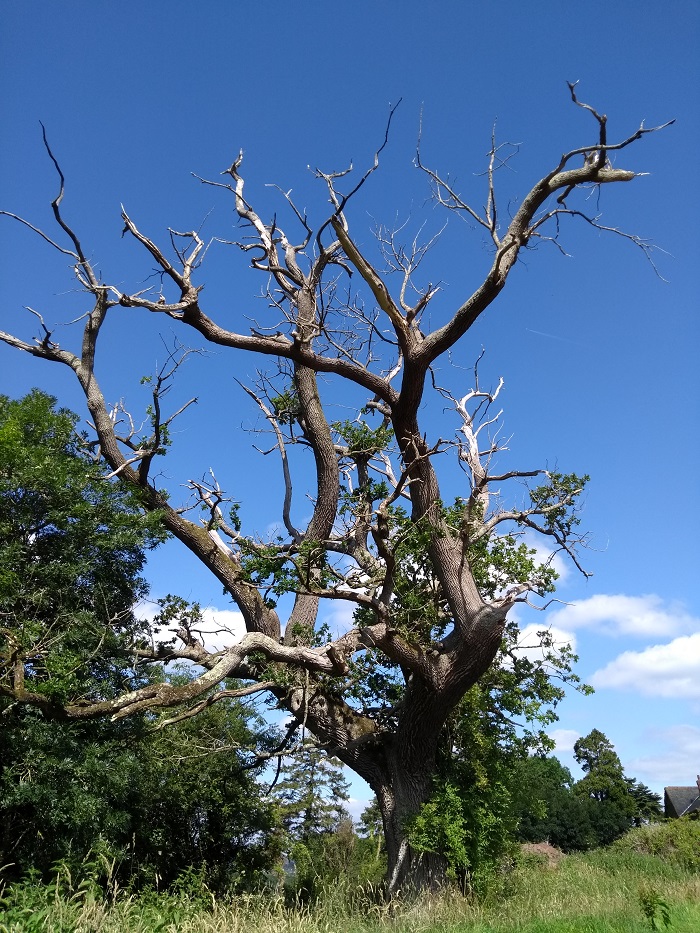
 But last week I was in Assynt again, and if there were many changes, it was the trees I noticed first. It’s nearly 26 years since the first ever community buy-out of land in the area by the Assynt Crofters Trust, and there have been others in the area since. The first trees I found myself looking at were less than 25 years old. I walked in vibrant young woodland at Little Assynt, above the shores of the great loch. Deer fencing surrounded large tracts of land. Birch, rowan, hazel, Scots pine…… willows, elders, hollies and even aspen…… planted by Culag Community Woodland Trust or regenerated naturally within the fences. Outwith the fences, though, trees were also regenerating, especially birch and willow. Sheep, ironically, seem to have been cleared to the coasts. Deer pose for tourists around townships, but their numbers are controlled. Bluebells and primroses are appearing under the bracken.
 midgies to produce more trees, all from seed they’ve gathered locally. They’re pretty excited that after last summer, the aspens have flowered – a rare event in a species that prefers to clone itself vegetatively – bringing welcome genetic diversity into the local tree stock. At the Falls of Kirkaig, we bumped into a naturalist friend from near home in Perthshire (Scotland being such a gloriously small country), who had observed the same phenomenon. So, there we were, all getting excited about the future of a tree species in a place I’d remembered as treeless.
 Comments on The Nature of the Universe