Turning the year, turning the compost

Job done!

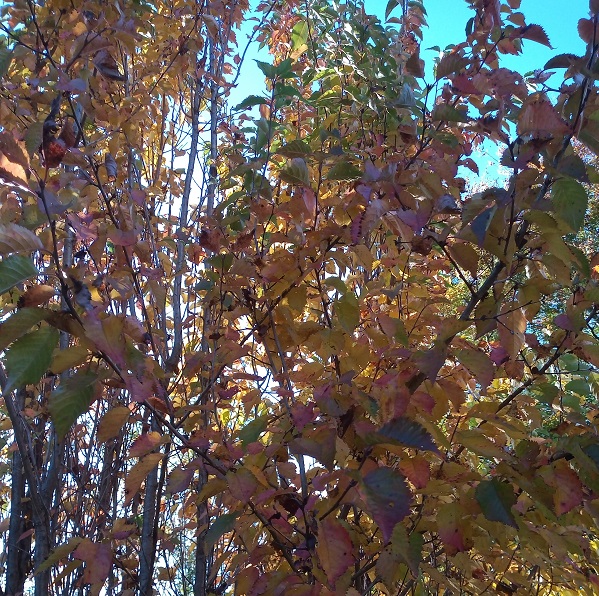
This week my Google Tasks told me I had to turn the compost heap. I assume I told it to tell me that at some point. I have two largish compost bays (minute in comparison to some, such as the magnificent compost-heaps-from-heaven at the community garden at Hospitalfield in Arbroath – you could bury a small house in each of their bays). I also have several bays and bins for leaves, imports of dung, and bulk biodegradeable materials in waiting, but it is the management of these two main piles that coincides with that moment when summer and autumn are subtly but surely dissolving into winter. For many reasons, I see winter as the start of a new year, and turning the compost always signals new beginnings, new plantings.

The first stage, actually, is barrowing and spreading all the finished compost in bay 2 onto beds and borders around the garden. This has been going on in stages for a couple of months, with sticks and undigested material being thrown back into bay 1. Bay 1 is starting to groan under the weight of future compost, as annual vegetable plants, bean and pea debris and a mountain of weeds from tidying up raise the height to almost unreachable. Once bay 2 is empty, everything in bay 1 can be moved over, introducing oxygen and stimulating breakdown. The topmost material is pitchfork stuff – or even just grabbing arms-full of dry debris and chucking it into bay 2. I try to put the most fibrous material in the middle, where the heat will be highest, making it in theory the best place to break everything down. If I can clean out the chickens just after all this top layer has gone on the bottom, the aromatic stew of chicken poo and wood shavings works as an activator.

The middle layer next, and it becomes more interesting. Here the brandling worms that thrive in the warm centre are busy at work, oodles of them, squirming voraciously in the decomposing mire. They are the visible agents of change, but unseen workers include many kinds of fungus and bacterium, at least as important. The middle layer is a seething mass of activity, and I make sure that on transfer to bay 2, the “working layer” maintains most of its integrity. Composter organisms are forgiving, though, and will migrate to the part with the right temperature if they find themselves compromised. Meanwhile, the garden robin and blackbird perch nearby, popping down for a feast of something whenever I pause to straighten and stretch.

Now the two piles are roughly the same height and I get into a rhythm with the pitchfork. The work is easier. I reflect once more how well yoga practice fits me for gardening – turning compost means twisting without injuring your back, and balancing on wobbly compost to reach the stuff at the back and sides of the bay. I work away getting the compost from the cooler edges into the middle and am left standing on a small pinnacle in the middle of bay 1.

Delving down the pinnacle, the number of compost worms decreases, and the ability to combine a twist with a forward bend comes into play…..work is getting harder again and I don’t want to suffer later! I start to turn out large numbers of wonderful centipedes. Centipedes are carnivores, not detrivores – they are not adding to the composting process, but hunting smaller creatures who live on bits of decomposing plant and humus. In the garden they are generally really good news, as they also eat the invertebrates who want to steal our crops. I try to catch one or two for a photo, but they are camera shy, and very, very fast on all those legs – as true hunters should be.

Photo by u0413u043bu0435u0431 u041au043eu0440u043eu0432u043au043e on Pexels.com

So, near the bottom of bay 1, the compost is as complete as it will be, and ready to use without being turned. I start to fill barrows of the good stuff, rejecting some unprocessed bits and pieces but not worrying too much – any unfinished business should happen in situ, over the course of winter. I dump and spread the compost on beds and borders. I don’t dig it in – no need. I have earthworms for that. It isn’t perfect, my compost. Eggshells hang about for ages, for example, and every autumn I dredge up a few well-rooted avocado plants which have grown from stones that never seem to decompose. (Neither do the skins). The heat given off by decomposition enables them to germinate. This year is no exception, and as usual I take pity on one, pot it up and take it into the warm greenhouse, where it will grow into an untidy, straggly, leaf-spotted pot plant with no hope of bearing fruit, and I will start trying to give it away to unsuspecting friends with more optimism than I have about its value.

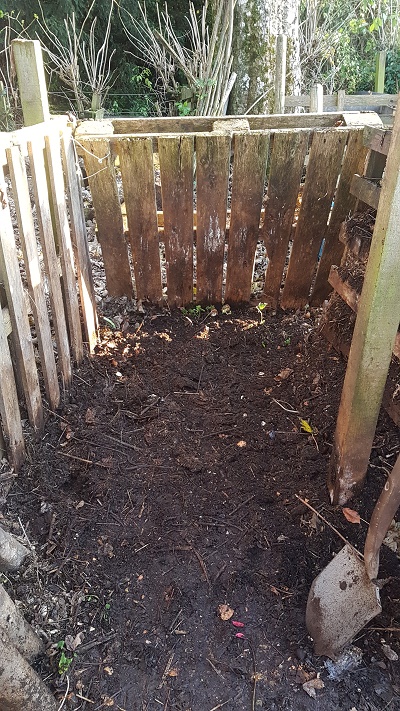
The last few shovelfuls, the final pitchfork-loads, and lo! I discover that the sticks I placed at the base of bay 1 last autumn because in a whole year they had failed to become compost are still there, barely altered….. I spread them across the base, along with the 3 year old thick cardboard tubes from inside the new polytunnel cover… they ARE biodegradeable, and I WILL win this battle….one day! On the plus side, after years of running a nursery here when thanks to lack of time and the vagaries of some of our volunteers, my compost heaps produced more plastic than a supermarket, this year my accidental plastic input and retrieval is minimal – and I can re-use the two ties and labels. And only one unreconstructed plastic-reinforced tea bag, right at the bottom, since we have found plastic-free brands.

Plastic pollution in decline!

I level the top of bay 2, and cover it with carpet. I know that within weeks, heat will build up and by spring it will be less than half the height it is now.All is done, and so am I, yoga or no yoga. And yet I’m incredibly happy with today’s work. Compost-making is the heart of my gardening life, the most satisfying, the most compulsive work, returning to the earth the things of the earth. I hope I have a good few years of compost-turning left!
Yoga for gardeners….or Gardening for yogis?

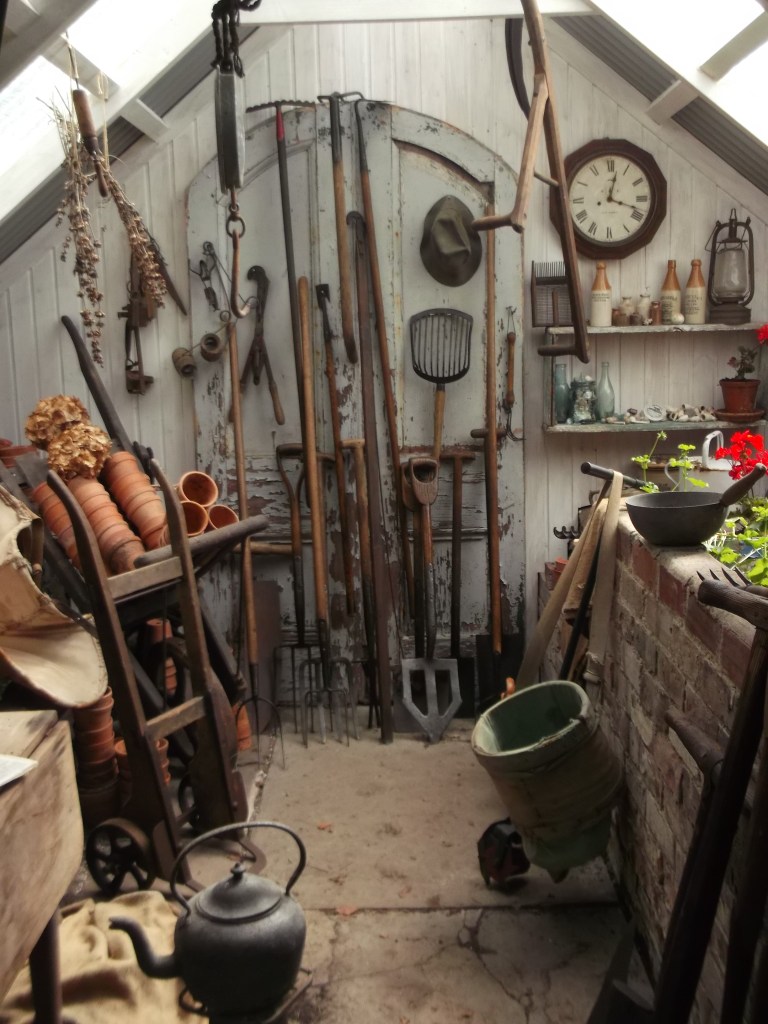
Not my tool shed…but I wish it was!

It has always puzzled me how anyone spends devoted hours to their gardens unless they also practice yoga. I got into yoga well before I actually owned a garden, and when I did get going with the growing, I quickly realised the advantages of being bendable, stretchable, twistable and, most of the time, reasonably balanced. My first proper job in horticulture was in a large Essex nursery producing pot plants and bedding; automation wasn’t a thing then, and heavy, laden barrows of trays of pots had to be pulled to tunnels and glasshouses and the pots set down in neat rows on the floor, precisely spaced for optimum growth. Here the WIDE-LEGGED FORWARD BEND was invaluable. Wide as possible, straight back, good reach – I could set down all the plants in a tray easily without having to get up, move and bend down again. And, unlike some, I didn’t have an aching back by coffee time.

The wide-legged forward bend is the posture I adopt in the garden for jobs like seed sowing in rows, planting potatoes and harvesting strawberries. If I need further reach, it can be extended, via a WARRIOR into a LUNGE – very handy also for annihilating that far-flung weed climbing the beanpoles. When you then find there are more weeds needing removed, or hidden fruits to pick, the lunge can morph into the GECKO. From any position, being able to go into a suitable TWIST again give you more reach. I confess, I usually accidentally forget I’m in these positions and stay too long, so I hear the voice of my yoga teacher in my head warning me to come out carefully! (By which time, it’s too late…)

For the garden, the great advantage of carrying out tasks in one position is that you minimise treading on the soil and compacting it. You also need to be flexible in where you tread, and occasionally move backwards one leg in the air, to avoid squishing your spinach. Various yoga balances, which I’m fairly hopeless at, nevertheless enhance my ability to cope with a jam-packed bed or border without creating too much destruction. It’s also helpful for pruning trees and shrubs, or picking fruit. (No, however appropriate it sounds, I don’t stand in the garden doing TREE pose. My neighbours would get worried. I do it in the kitchen while cooking to keep in practice.)

In confined spaces (of which my garden has many), or for the impulsive weed-blitz as you pass by another small jungle that arose overnight with the moon, it’s very handy to be able to SQUAT and much better for your spine. Very handy for wholesale removal of sawfly larvae from a goosberry bush. too. Coming up from the squat (with an armful of weeds) is a much bigger challenge for me, or for my knees at least, so it’s good that gardening gives me the chance to practice. Even if I don’t appreciate it at the time.

“Old Adam was a Gardener, and the Lord who made him sees
That half a proper gardener’s work is done upon his knees”

Thus spake Rudyard Kipling in his poem The Glory of the Garden.. Well, not half your time, perhaps, if you employ wide-legged forward bends and lunges. But some, of course, and sometimes, quite a lot. I’ve been lucky to largely avoid the “gardener’s knee” up till now and although I do get twinges these days, I still spend a lot of weeding or planting time on a kneeling mat – often one knee, the other breaking out into a GATE pose. While kneeling, I deliberately or inadvertently find myself doing the odd CAT and when I’m done, I’ll come to stand by doing DOG, if there’s space (By summer, there generally isn’t).

If you separated out the time I spend “doing” yoga and the time I spend gardening, gardening would win big time, even in winter. I’m not the most disciplined at making myself practice regularly outwith the class, and there’s far too much weeding, picking and planting to be done to attend too many classes. So my answer is to keep gardening, and stay mindful of every horticultural opportunity to utilise a yoga posture and the flexibility, stamina and good lungs yoga gives me. I’d advise any yogis like me lacking self discipline to take up gardening!

Of course, you need to finish your practice with SAVASANA, or CORPSE, the pose of relaxation. No, that’s not a dead body sprawled over the lawn clutching a trowel in one hand and a bouquet of ground elder in the other. But do take it a cup of tea in ten minutes time!

Always allow time for relaxation…

Zoom Yoga: A Tale of Distraction

Photo by Pixabay on Pexels.com

I roll out the mat and obediently stand, facing the window where the morning rain can be seen drip-drip-dripping from mouldering leaves and a hole in the gutter. I connect my body with the earth. My eyes, however, watch as the blackbird, steadily working his way through all the tiny red apples on the weeping crab, is joined by a song thrush. The thrush hasn’t been seen for months, and is initially more concerned with preening the rain from his wings and tail, until he assesses there to be no challenge from the blackbird, and tucks in heartily.

Lulled into repetitive, soothing xi-gong type exercises, my body goes into autopilot as I watch a long-tailed tit hacking away at a suet block in the bird feeder. Coal tits and bluetits buzz in and out from the communal vantage point of the crab apple, to feed on seed and fat-balls. A dapper wee collared dove paces up and down beneath, hoovering up the fat-ball crumbs the small birds dislodge and drop.

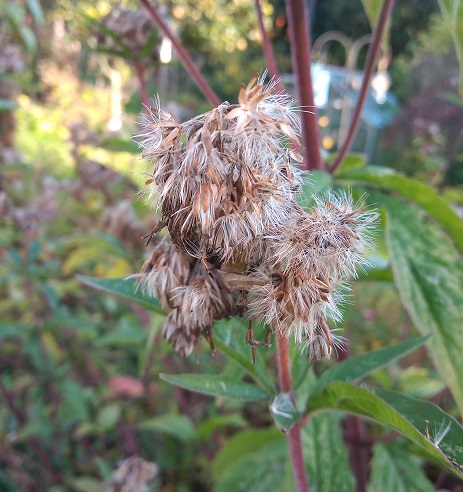
As I breathe, and stretch, and occasionally forget to do either in precisely the right order, I note that the Michaelmas Daisies are soggy, but still going, and there is plenty of seed still on the crystal-spattered heads of Hemp Agrimony. I note also that to human eyes in search of order it’s a mess. Shall I cut it down, or will the goldfinches be back to harvest more seedy meals? Of course, I’ll leave the mess.

I have watched my neighbour across the road leave her house and drive down the brae, but there is something moving around at the bottom of her garden, among the rhododendrons. Who would be gardening in the pouring rain? Ducking temporarily under the watchful eye of my phone, and thus my yoga teacher, I suspend an impossible balance to look more closely. Identifiable by their creamy backsides, two burgling roe deer are gently browsing their way along the hedge-line, looking for a gap in the fence that they know fine well isn’t there. They are bold, flexible, relaxed and insouciant. They have been doing yoga all their lives.

The impossible balance has not become easier in my brief absence.

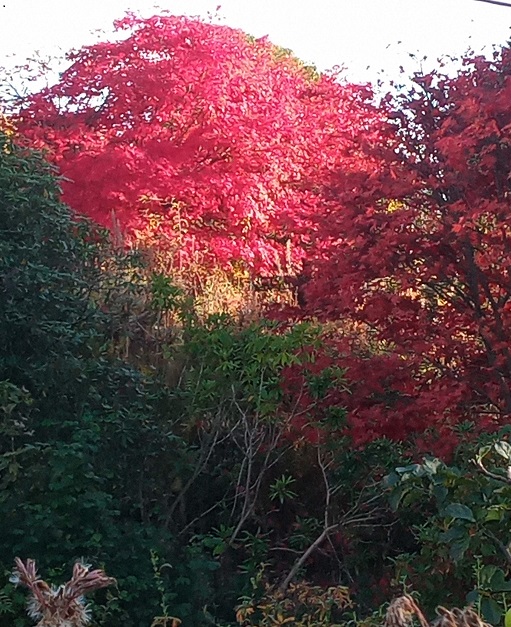
The deer dissolve into the flame-red autumn colour of next door’s maple trees. I hold a lunge a little too long while drinking in the full spectrum of colours of this year’s leaves, the brown of the rowan tree, clear yellow of the golden elder, peaches and oranges and tangerines dripping from a cherry tree. There is no wind, but the weight of water pushes tawny leaves from the russet apple tree, revealing huge, perfect apples still to be harvested.

The class moves happily into a movement called the dipping bird. I enjoy this, and execute a fair number of dipping birds with relish, until I spot an obese woodpigeon eyeing me through the glass with cold contempt. I’d like to see him do it, that’s all.

I wonder where the other birds have gone. Have they spotted intruders? Luckily, we are all muted. I would not have liked everyone to hear the expletive I came out with as the roe deer nonchalantly appeared on MY lawn in front of MY crab apple and began to work their way through MY shrub border. I duck again under the camera, and open the window to shout at them. They don’t even look startled, but condescend to lazily squeeze through the hedge into the no-man’s-land that will take them back to the stubble field. I hope they haven’t eaten my kale.

Relaxation time, and I’m back under the radar, feeling suitably stretched and folded like a good sourdough. Wildlife watching is a secret benefit of online classes. I wonder if, when we met in a hall, my yoga teacher realised how much time I spent watching clouds, the wind in the trees and passing seagulls through the high-up windows?