
A large, traditional primary school on the east side of London. Thirty-four eleven year olds, in their last year before going to the big school. Smart wee souls, most of them, and entranced with learning. Teacher, relaxed, confident, experienced but already thinking of a new career. We’d been talking about grid references, and maps, in preparation for a week-long field trip to the Isle of Wight. Our inspired and quirky maths specialist had entered this preoccupation by introducing them to vectors, what they were, how to define them. To facilitate understanding, I’d abandoned the classroom layout of loose groups and large desk-space and put the single desks, relics from the 1960s, back into rows, forming a grid, with my desk formally in the front by the blackboard. Technically off-grid. Of course. The class thought it was a great laugh.
Simon, in the back row, had some point in his creative writing he wanted my opinion on, so I called him over. We all stopped what we were doing and watched with interest as he took off his shoes, climbed onto his chair, then his desk, and proceeded to step precariously from desk-top to desk-top, preceding each move with a warning for the occupants to lift up their work. It took a while for him to reach my desk, and step off-grid too. Another time, another place, this behaviour might have alarmed both teacher and children. But this wasn’t that sort of class and I wasn’t that sort of teacher. Simon, brainy, cheeky, totally engaged and preposterous, certainly wasn’t that kind of pupil.
“What was that about, Simon?”
“I was walking in vectors. I had to use two different ones to get here because Keeley wouldn’t move her stuff.”
“I didn’t want his smelly feet on my desk!” protested Keeley.
We got Simon to tell us what vectors he’d used to define the straight lines via which he’d reached the front. It seemed a pretty good way to get your head around the subject, so we played about with it. Kids took turns to walk the vectors either I or their classmates suggested, starting from wherever they were.
“Your go, Miss!”
I turned a withering gaze on Simon, and joined in, “walking” to the vector destination he specified. Then they carried on with creative writing until lunchtime. Our maths specialist was very gratified to find the class’s understanding of vectors was now 100%.
**********************
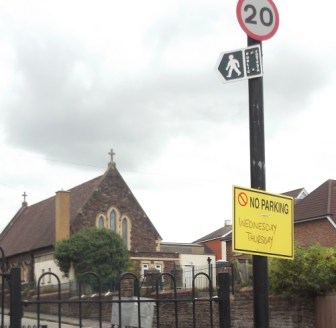 Decades later, I still “walk in vectors” – and remember Simon – in many situations. Getting across tracts of city is one such. Townscapes forbid, direct, coerce the pedestrian.
Who wants to be coerced?
Traffic willing, I take the shortest distance and move in a straight line as far as possible to where I want to be. Car parks are my favourite, the bigger the better, with cars more or less forming the grid that our classroom desks did back then. (I draw the line at climbing the bonnets and walking on the vehicles, though. Even I concede it’s not appropriate behaviour for old women.) The urban environment (with some exceptions) is not, for me, one that I wish to meander in. Walking in vectors is efficient, and gives me something to think about while I’m at it.
In open countryside, or hillwalking, I am reassured by well-defined paths, and fingerposts. I figure they reduce the risk of large bovines, bottomless bogs, and getting lost. I don’t mind if they meander. This is not the place for cutting across fields and fences and the corners of peoples’ gardens, nor those coastal rocks and beaches where deviation from a proscribed route might end with me being cut off by the tide.
But woods are different. They are one of my comfort zones. Paths go round trees and skirt the edges. I make paths. I go through the wood, from tree to tree, or glade to glade, with no final destination but what I may find on the way. About the same time that my primary school class were physically exploring vectors, I was having a relationship with an SAS-type survivalist. Going for a walk with him meant going straight through the bramble thicket, river bed or steep rocky incline that separated us from his destination (usually a choice edible plant, a secret beach or a prehistoric relic). David walked in vectors without noticing; I followed, protesting, and emerged covered in bruises, arms torn by brambles, feet wet and shins muddy and scratched, twenty minutes later.
I slowly got used to it, and began to enjoy the sense of power that came from the determination to arrive at a destination of which most people would remain forever unaware. My senses were heightened by the necessary awareness of the landscape through which my straight lines were taking me. I saw more, listened harder, breathed in scents. Today, when I push through clearings of grasses taller than me, I feel the soft brush of their flowerheads, catch my breath on clouds of pollen. I mind small frogs and mushrooms underfoot, and insects living in the bark of the trees. I hear where water trickles invisibly; I sense and hear the warning aura of the wasp byke. I emerge into sunlight or thunderstorm, on the other side of the wood.
Meandering paths or the allure of straight tracks, ley-lines, history and mystery? It doesn’t really matter, but it’s good to be willing to do both. It’s no coincidence that I am writing this on the Cross Country train between Edinburgh and Exeter. Going via London would not make sense to someone fixated on travelling by vectors.
 Comments on The Nature of the Universe
Ooo you should read Rebecca Solnit’s book on wanderlust! Also, have you read The Living Mountain by Nan Shepherd? I think the Situationists also came up with the dérive (drift) as a method of traversing urban space differently.
LikeLike
Yes I’ve read Nan Shepherd, it’s a classic! I have it in fact if you want to borrow. Do you have the Solnit book?
LikeLike