

Another giant tree that was part of the avenue lining the old carriage drive has come down. Every year, one at least succumbs. They are mostly beech, monumental now, out of scale with the straggle of the village and the low fields that sulk under the weight of rain and ripe barley.
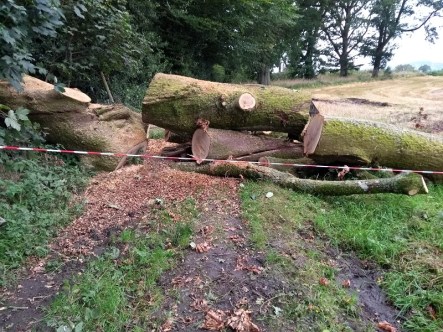
The carriage drive is a ghost of former times, looping importantly around the grounds of the big hoose that now peeps sheepishly out from behind its deer fences and the remnants of redwood trees, the choice rarities, status symbols prized by landowners two centuries ago. Then, it all belonged – carriage drive, trees, big hoose and all – to the Wylies of Airleywight. To be honest, James Wylie probably owned most of the village, and built a fair whack of it too. He owned my house, and, though long dead, may well still own the rough road on which it lies. (Nobody else claims it, despite rumours that it might be the property of the Bankfoot Light Railway, also long dead.)
A footpath follows the line of the carriage drive, side-stepping the remaining beeches. Here and there, minor land grabs seep into it. A corner of field here, children’s dens there, new tracks, sheds and barbecues. A shady allotment of raised beds fingers into it, created by someone in the adjacent scheme with access to Heras fencing and a tendency to self-sufficiency. In the woods beyond the house, where the Garry Burn streams by, a squarish, sunken, shallow bog is still called The Curly by successive generations of schoolchildren, out on bikes and skateboards, building jumps. If you hunt among the rank vegetation, you’ll find the metalwork that filled or drained the pond for icy games enjoyed by residents and visitors to the big hoose at Christmas.
Where the carriage drive seems to end, the footpaths continue, past what’s left of the huge walled garden. Now a forest of self-seeded trees occupies the space where fruit, flowers and vegetables once were expertly raised on the south-facing slope. They tower above what’s left of the crumbling, ruptured walls. Who knows what horticultural sleeping beauties may still lie dormant at the heart of the garden?
The cottage near it lay abandoned save by the swallows for many years, still graced by bursts of surviving garden flowers among the thistles in summer. The butterflies loved both. Was it the gardener’s house? Or perhaps the coachman for whom the drive was made? The village architect has renovated it to picture postcard perfection. It looks content, roofed, aired, cultivated – but not extended. Nearby he built himself a house of traditional, solid materials, that so fits the landscape in style it has become part of it. Already there are lichens on the roof and leaves in the gutters. The swallows and martins nest easily in the eaves and outbuildings.
You get to the big house now by a difference entrance, made significant by statuary, but no carriage drive. Of the latest owner, and what they plan for their gardens, curling ponds and steadily declining avenue, there is no word.
 Comments on The Nature of the Universe
Fecund, as friend Lynn would say. You can feel the depth of many seasons, lifetimes and styles.
LikeLike