
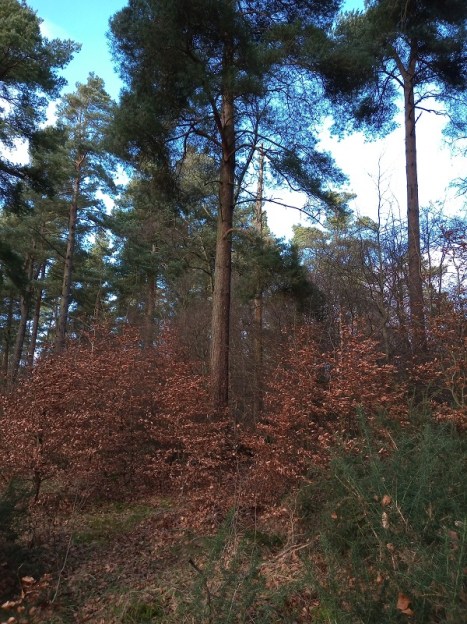
Dreich doesn’t begin to cover it. Weeks of rain, sleet or snow, and the wood is wet, dank, chilly. One storm has passed, another is forecast, and a group of multi-stemmed birches, green with lichen and algae, droop and wait despondently.
I take the rutted cycling path that skirts the woodland edge. Under the tall, fiendishly straight Scots Pines, many scattered beech saplings nestle in their winter boleros of retained leaves. Beech mast is everywhere, but I do not see the older tree from which it has fallen. Beech seedlings tend not to come up near a parent tree, but somewhere there must be a Mother.
Snow lingers crystalline along the clay-bottomed ditches where black, cold water lurks and trickles. There’s a pond under the pines which so looks like it was formed by an explosion I call it the bomb crater. No signs of frog spawn yet. Several tracks and paths meander where animals come down to drink. Duckweed covers a third of the surface; in the increasing rain thousands of ripples intersect and make diffraction patterns over the other two thirds.

Birds – except for a robin – are silent and glum. A flock of pigeons clatters off towards the field; freshly ploughed, it offers them nothing but the stones that lie heaped in the field corner. How many decades or centuries of cultivation have contributed to this pile? This side of the fence, someone a long time ago arranged stones round a favourite tree, where they remain, moss-covered and half-buried. Larger rocks with wavy patterns etched onto their surface erupt in groups from the forest floor, scarcely distinguishable from the stumps of felled trees. Moss, lichens, algae democratically envelop all.

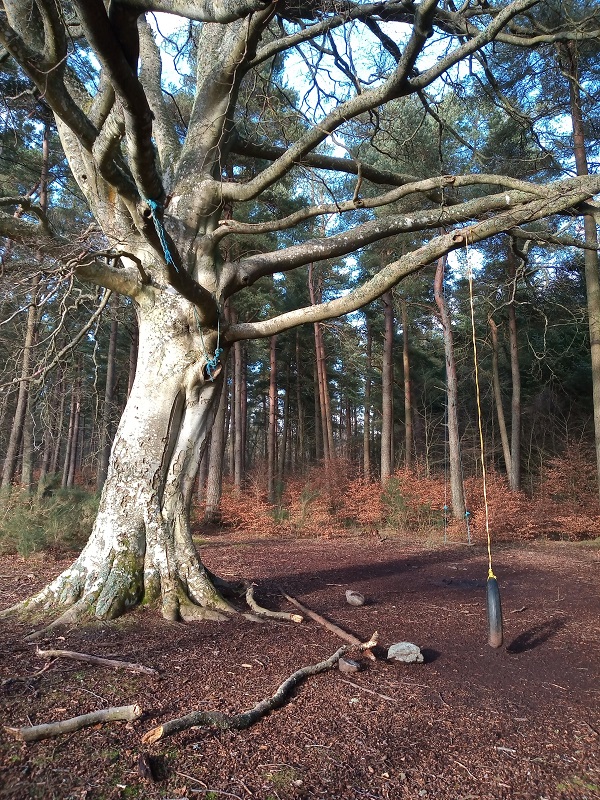
There are charred-looking remains of mushrooms by the path. I think they were Blackening Russulas, an abundance of them. I follow their orbital trail and suddenly find myself under a towering old beech tree, with many spreading branches and a hollowing trunk that makes a chimney of dead wood and fungal rots. Swings hang from two branches; insects and other invertebrates burrow into the soft core of the tree and make their homes. The woodpecker will soon come calling for her dinner, other birds will nest and shout from the canopy. I have found the Mother of Beeches, and of much else besides.
Five Mile Wood and Taymount Wood are former Forestry Commission plantations just north of Perth. They have for a while been transitioning from industrial timber production to a subtle integration with the wild, and people are part of that wild change. The Commission have put them up for sale, and local people have formed West Stormont Woodlands Group. We are hoping to implement a community buy-out. You can find out more about the plans and group activities at http://www.weststormontwoodlandgroup.org.uk Over the coming year, I intend to write a monthly blog post “Words for Our Woods”about the wildness of the woods, in support of WSWG. This is the first.
 Comments on The Nature of the Universe
Beautifully written Margaret, if you can make that wood come alive at the arse-end off such a miserable month then I can’t wait to see what you do with March. All the best with the purchase.
Cheers, Lizz
LikeLiked by 1 person