
(This is the first in a new series of posts for West Stormont Woodland Group. From fear or repeating myself, I thought I’d write about the fact that each month, the woods have a Gift for us. And every month, there is at least one challenge that faces us – whether physical, philosophical or organisational – in contemplation of owning woodland as a community.)

Of course, there are gorse bushes in flower in February in Five Mile Wood. There are gorse bushes in flower in the woods every month of the year, providing pollen and nectar for insects out too early or too late in the season. Some ancient lecher noticed this and spawned the saying “When gorse is not in flower, then kissing’s out of season.”
Gorse in flower in a cold and clenching winter such as this of 2021 is a real gift. It’s too cold to detect the rich coconut smell from them which can be almost overpowering in high summer, but the gold dazzles against the grey landscape of February or keeks through the smothering snow. Gorse has been used for many purposes, from feeding tough-mouthed horses in winter to sweeping chimneys. It’s a nitrogen fixing plant, like all the pea family, and imparts fertility to the soil. Burn it, and the alkaline ash is good for cleaning soiled linen.
The flowers themselves are used to make a yellow dye, and whether it worked or not, some dairies insisted that feeding gorse to milking cows made for a rich yellow butter. I don’t use gorse for any of these, but I do make gorse flower tea. It looks wonderful swirling around a glass teapot and you might catch a breath of that coconut smell. Don’t expect to taste it; it’s a very subtle (or absent!) taste. If you look hard you may find early shoots of nettle in the woods to give the tea some substance.
But don’t pass the gorse on to anyone else – allegedly, making a gift of gorse guarantees you’ll end up fighting. It’s the woods’ gift to me in February, and I will have no quarrel with the woods.
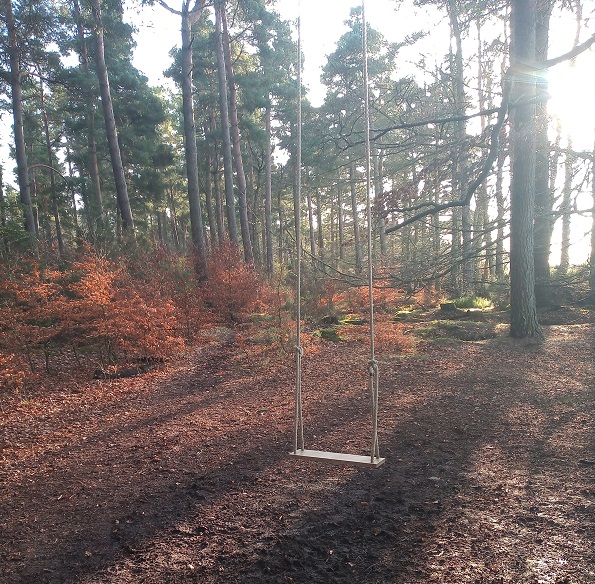
I think the woods are used more now than I remember in over twenty years, Evidence for that lies not just in who you meet, but in new tracks veering off, in small acts of clearance, in scattered pieces of art, in well-maintained articles of recreation like the new swing in the picture. Using the woods implies a sense of ownership, a vested interest, a certainty of relationship. A future.
But are we all buying into this? And will that feeling of belonging translate into an actual belonging? If Five Mile and Taymount Woods are to be taken into community ownership, it’s essential that community identifies itself, makes itself heard and provides the evidence of its existence that will count.
This month, West Stormont Woodland Group will begin a Community Consultation on the proposals the group has been working on for the two woods (or, as it’s widely seen, the one wood with a gap in the middle). Of course, Covid restrictions have forced the consultation to be mostly online, but this shouldn’t be seen as a problem – taking an event online in my recent experience amplifies and multiplies its reach and scope. There is a new website dedicated to the consultation, which launches on 22nd February; details can be found at http://www.weststormontwoodlandgroup.scot ,on Facebook, or by emailing contact@weststormontwoodlandgroup.scot
The challenge is to get you, me, all members, all non-members local to the communities around the woods, all of us starting to think these woods might be ours, to contribute to the consultation. Spread the word!
*Quoted from the opening lines of “Stopping by Woods on a Snowy Evening” by Robert Frost.
 Comments on The Nature of the Universe
Those are warm and comforting words and the woods look so well established and loved. Will some tall trees get felled, thinned or left to grow old? Ownership is an interesting concept… Stewardship sounds more of what you’re describing, but legally in this culture I’m imagining there has to be an owner but the local group culture will prevail. Good work and words, and looking forward to the monthly offerings. Thanks, Rosie
LikeLike
You seem to know a lot (or at least a lot more than I) about nature and the garden, can I ask you some questions about gardening that you may be able to help the OAP at City Park with. I am happy for you to get in touch at my e-mail address. walter.hamilton77@gmail.com
LikeLike
Hi Walter, happy to help if I can. I’ll send an email.
LikeLike