
This post was written for West Stormont Woodland Group as part of the Gift and a Challenge series. To find out more about WSWG, go to weststormontwoodlandgroup.scot
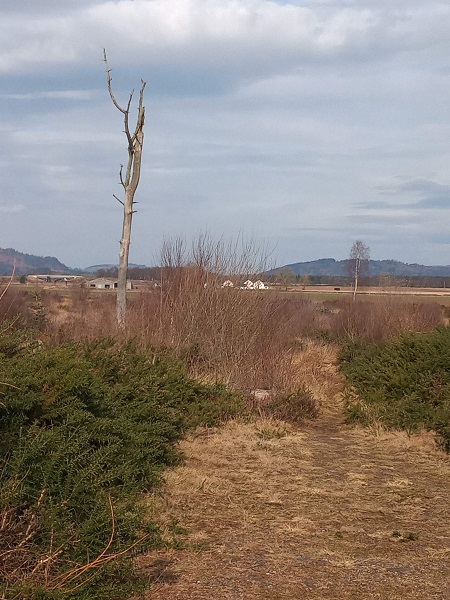
To begin with the challenge – it’s March. The month that can’t decide whether to ally itself with winter or summer, blows literally hot and cold – but blows anyway, more often than not. This March, temperatures have veered spectacularly – almost hot at times when the sun is fully out, only to evoke shivers and a sullen quest for shelter when the sun goes behind the never-far-away bank of clouds.
The track in Five Mile Wood is set high around the hill; the clearance of the windthrown central forest has left only bare, angular, dead or dying thin trees, leafless and affording no windbreak. The wind skitters over the gorse; the tall grasses and herbage of summer still skulk in the earth. Between the grey and ghastly yellow of dead wood, last year’s vegetation lies smashed and parched, husky and brittle, desiccated by months of ice, snow and frost.
There is nowhere to hide. Nothing to distract, punctuate or alleviate the March winds and the wreckage of a long winter.
And so to the potential gift from the woods – one that might, with time, give some respite from the challenge of March. We have few native evergreen trees; apart from the magnificent Scots Pine (which can be poor shelter when most of its branches are way above our heads), there are only holly, box and yew. Holly is an important food source for many birds, especially the blackbird family and the robin from the Christmas card, and into any suitable habitat those birds will pass the seeds from all the berries they devour. Thus, holly will start to appear in snatches of clearing or under bigger trees, the seedlings going unnoticed until the taproots are impossible to get out. It was a relief to see, on the margins of the cleared gap in Five Mile Wood, a couple of well-established young holly bushes. They may have grown from seed from a mature tree decked with twining stems of honeysuckle, that grows beside the track, on the edge of the wood.
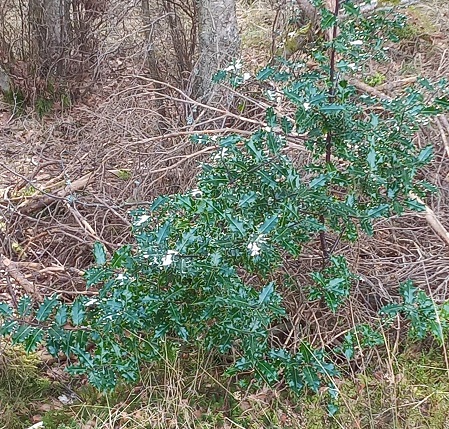
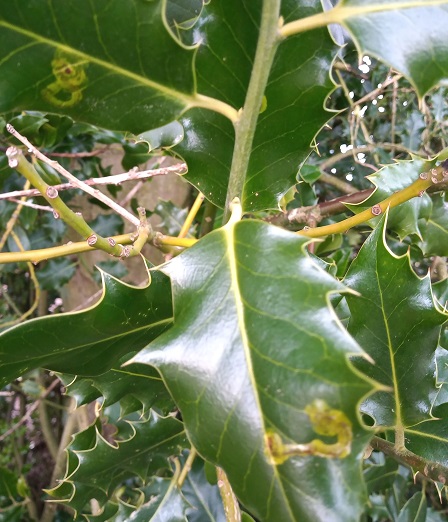
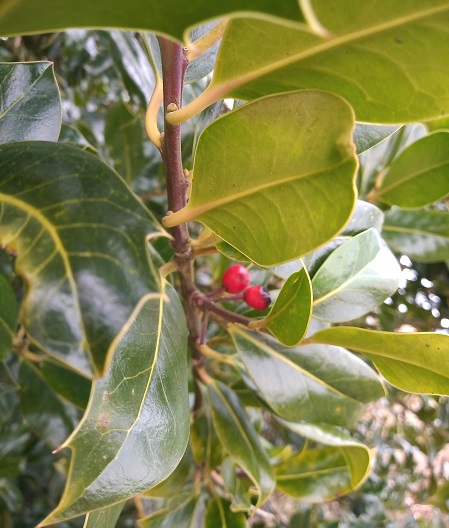
Hollies are dioecious. You get male trees and female trees, and only the females have berries. In March, there are just a few berries left, lurking behind the armoured leaves, while a thrush skulks in the greenery, hunting them out. He is just beginning to try out his repetitious mating call. Aside from shelter from March winds and berries for birds, holly is one of the most valuable wildlife plants and a real gift to have in a wood. Wood mice and other small mammals also feed on the berries, and deer enjoy a prickly snack of holly shoots. The holly by the track is already playing host to the Holly Leaf Miner – an invertebrate recognised by the squiggly patterns of its tunnels, between the upper and lower surfaces of the leaf. They have co-existed with the holly tree for a very long time, and do little real harm to the tree, although the texts of horticultural imperialists will make them sound like the devil incarnate and command the use of an army of chemicals to destroy them.
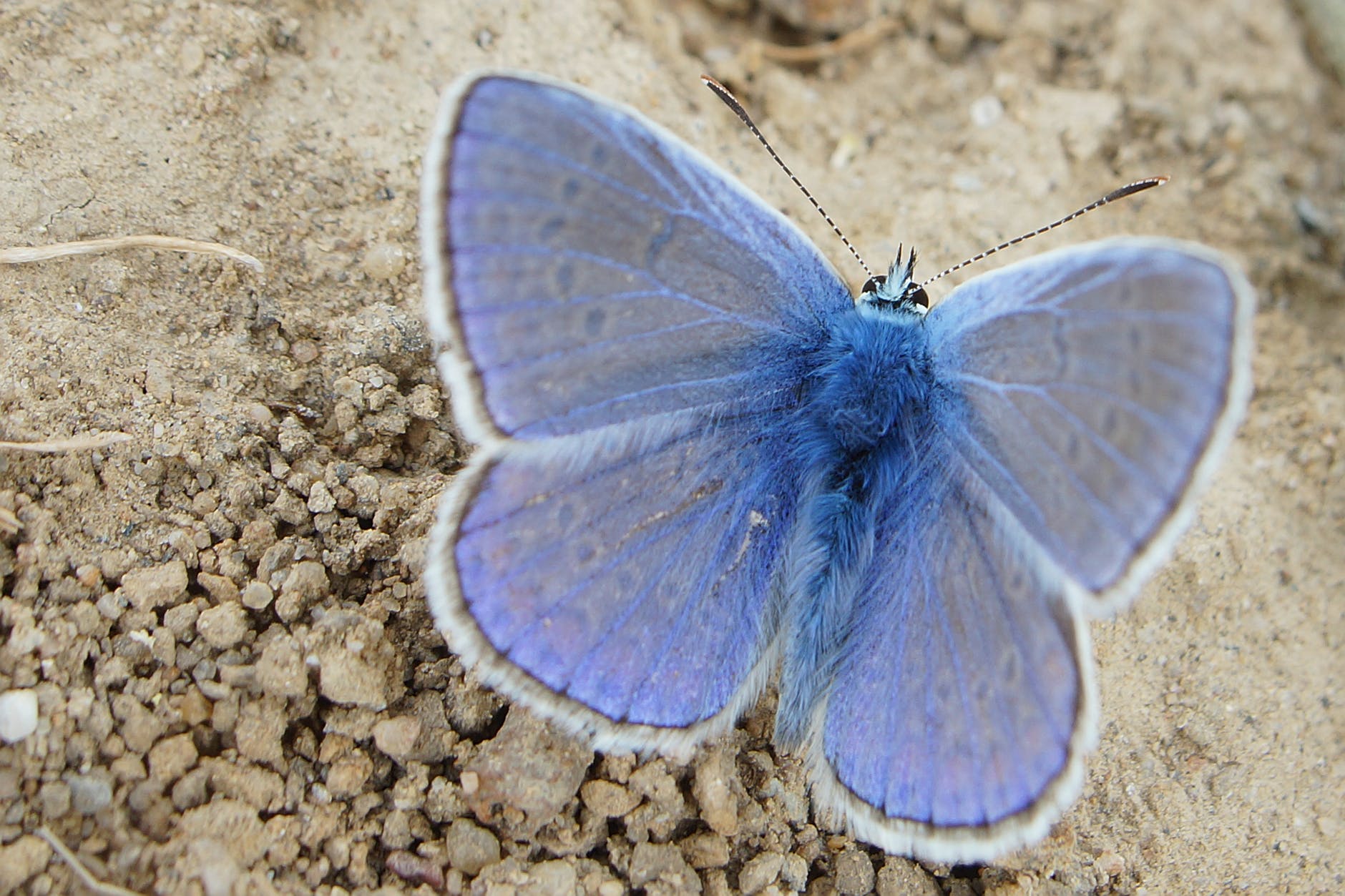
There is a very beautiful butterfly, the Holly Blue, whose caterpillars in spring feed almost entirely on shoots of holly, and later broods move onto ivy. It’s not common in Scotland, although it has been seen dotted around. The looper caterpillars of the holly tortrix moth, as well as many other insect larvae, seek refuge in this prickly tree too.
And like all evergreens, it provides impenetrable debris for hibernating hedgehogs and is a formidable cosy shelter tree for roosting or nesting birds. Not to mention windblown humans in March.
 Comments on The Nature of the Universe
Atmospheric writing again. I love the skulking thrush.
Is it possible to tell a female from a male Holly when they first appear self sown, or is it only the berries that hold the answer? R x
LikeLike
Sadly I think not…the flowers are the giveaway, but it takes a good few years till they come. But of course you need both anyway!
LikeLike
Yes, big problems with wind here in St Andrews. the lid was blown off our cold frame – luckily all the plants survived. not so some of the pot plants they were scattered to the four winds, Spilt milk, move on.
LikeLike
Oh dear. Felt a bit like that when I found the greenhouse heater wasn’t up to the winter freeze as far as my aloes, lemon tree, big jade plant and several pelargoniums were concerned. Propagate on! How’s the garden coming on?
LikeLike