
Willows are the most curious trees. For a start, there are well over 300 species worldwide, with eyebrow-raising common names such as Eared, Goat, Cricket Bat and Crack, or casually colour-hinting names (black, white, grey, violet, red and purple). The colours usually refer to the young stems, and that’s why willows have long been valued everywhere to make beautiful baskets, hurdles and sculpture – along with their wonderful flexibility which makes them capable of being woven without snapping. A well-made willow basket is strong and lasts a lifetime.
Those hundreds of species readily hybridise promiscuously, making identification a chore, to say the least – even in Britain where only nineteen species are considered native. I think it’s unlikely humans really know just how many species and hybrids there are. Willow – or sallow, or osier (even the names are slippery) just won’t be pinned down.
Willow won’t be kept down either, even when it falls. Put a bunch of willow stems in the rain-butt to soak for basketry, and the next thing you know, they’ve all grown roots. They grow quickly, ferociously fast. Two metres a year is not uncommon for new growth. Coppice them, and they’re back up the next year. Their Lazarus impersonations are all the more improbable given the mind-boggling number of diseases the genus is prone to – black canker, blight, powdery mildew, scab, watermark disease, root rot, heart rot and willow anthracnose, to name but a few. They are pioneer trees, kicking off the cycle of colonisation in open ground that is damp or downright boggy, and no one fairly expects them to last for centuries.
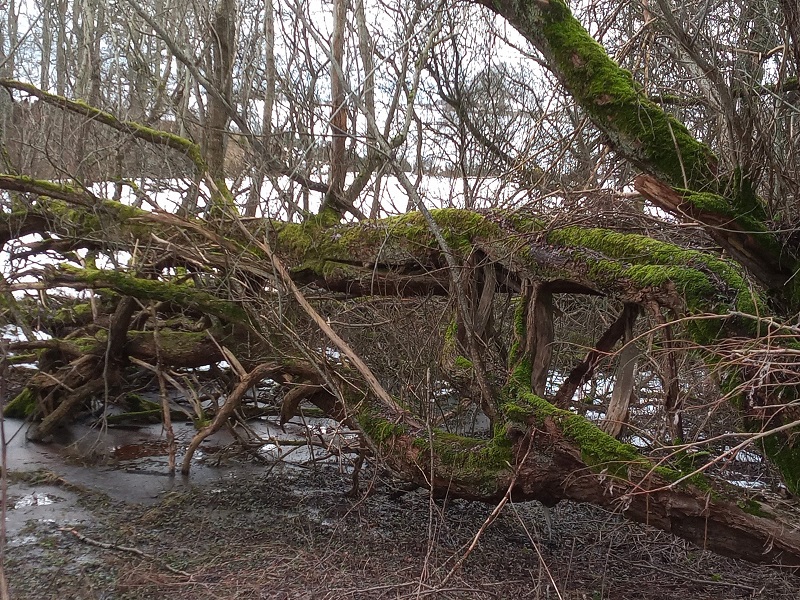
By what remains of the old Back Mill millpond in Bankfoot, there are some death-defying willows. I don’t know the species. One monster of a tree, often pollarded in the past, still stands erect – outrageously enormous, ancient, decrepit. As the millpond has steadily drained of its water and silted up, the roots of these massive willows have been exposed. A flood of heavy rain then washes away the soil, until eventually the whole tree comes crashing down.
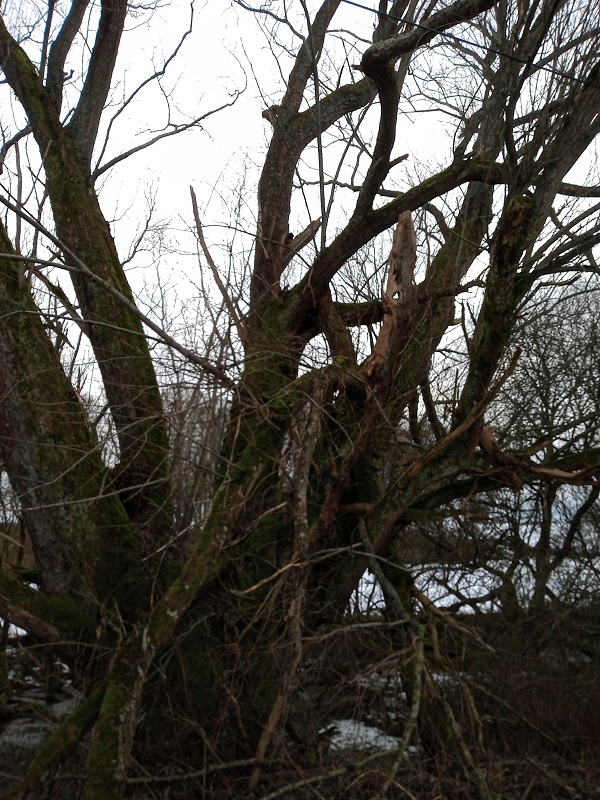
End of story? No way. In falling, the wood, being watery willow, ripped asunder, cracking and splitting in a hundred fibrous places. Some trunks, now horizontal, appear shredded and mashed. Branches poke up out of the devastation akimbo, some dry and decayed, some clinging to life.
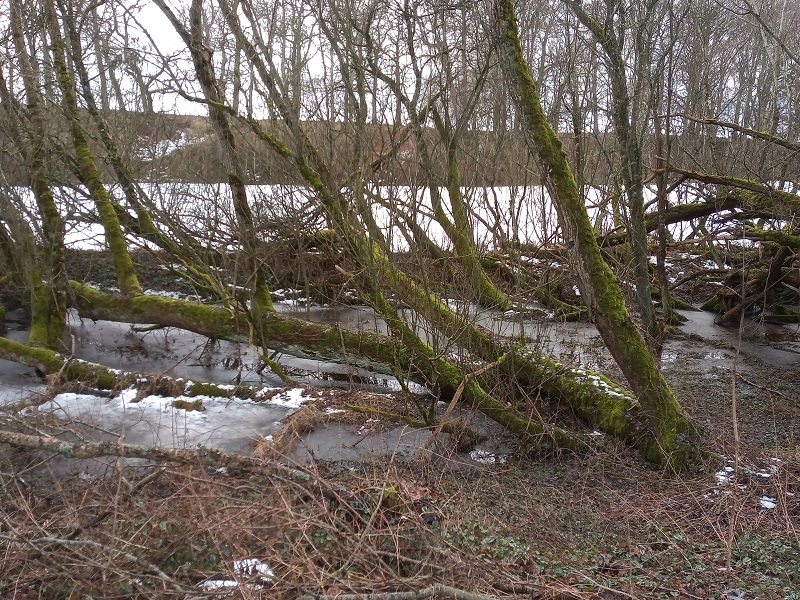
Make no mistake, these willows fell a long time ago, Birds have nested in the crevices where they toppled onto each other. Mosses, algae, lichens, ferns have been succeeded in places by other woody plants, growing out of, and contributing to, the accumulation of soil and organic matter. The trees are alive, but they are a substrate for life also.
From the felled boles and wrecked structures, arrow-straight, insolent shoots clamber skywards. They are making new trunks from the old,even where the original tree has scarcely more than a twisted root in soil or water. A veritable willow plantation arises from the un-dead.


Many thanks for your eye-opening piece. I’ll be looking at Willows differently from now on – “the undead” reaching for the sky despite their toppledness. Hoping you’ve recovered from being phoneless. R x
LikeLiked by 1 person
They also grow deep down beneath the sea in the gardens of mermaids…
“She planted by the statue a rose-colored weeping willow. It grew splendidly, and very soon hung its fresh branches over the statue, almost down to the blue sands. The shadow had a violet tint, and waved to and fro like the branches; it seemed as if the crown of the tree and the root were at play, and trying to kiss each other”.
Extract from ‘The Little Mermaid’ by Hans Christian Andersen
LikeLiked by 1 person
Of course! I need to re-read HCA….
LikeLiked by 2 people
Excellent piece. Did you know that willows also grow deep beneath the sea bed in the gardens of mermaids?
“She planted by the statue a rose-colored weeping willow. It grew splendidly, and very soon hung its fresh branches over the statue, almost down to the blue sands. The shadow had a violet tint, and waved to and fro like the branches; it seemed as if the crown of the tree and the root were at play, and trying to kiss each other.”
Extract from: The Little Mermaid by Hans Christian Andersen
LikeLike
Still phoneless Rosie, but using the old steam-phone. Will send you the number. Ta!
LikeLike
We have beautiful weeping willow, down at the burn, her in St Andrews. Her rich green frock in summer hangs heavy on the bough all the way to the surface of the water. You catch your breath every time you pass it is just so beautiful.
LikeLiked by 2 people
What beautiful imagery! I must hunt out this willow this summer..
LikeLike