

This week my Google Tasks told me I had to turn the compost heap. I assume I told it to tell me that at some point. I have two largish compost bays (minute in comparison to some, such as the magnificent compost-heaps-from-heaven at the community garden at Hospitalfield in Arbroath – you could bury a small house in each of their bays). I also have several bays and bins for leaves, imports of dung, and bulk biodegradeable materials in waiting, but it is the management of these two main piles that coincides with that moment when summer and autumn are subtly but surely dissolving into winter. For many reasons, I see winter as the start of a new year, and turning the compost always signals new beginnings, new plantings.
The first stage, actually, is barrowing and spreading all the finished compost in bay 2 onto beds and borders around the garden. This has been going on in stages for a couple of months, with sticks and undigested material being thrown back into bay 1. Bay 1 is starting to groan under the weight of future compost, as annual vegetable plants, bean and pea debris and a mountain of weeds from tidying up raise the height to almost unreachable. Once bay 2 is empty, everything in bay 1 can be moved over, introducing oxygen and stimulating breakdown. The topmost material is pitchfork stuff – or even just grabbing arms-full of dry debris and chucking it into bay 2. I try to put the most fibrous material in the middle, where the heat will be highest, making it in theory the best place to break everything down. If I can clean out the chickens just after all this top layer has gone on the bottom, the aromatic stew of chicken poo and wood shavings works as an activator.
The middle layer next, and it becomes more interesting. Here the brandling worms that thrive in the warm centre are busy at work, oodles of them, squirming voraciously in the decomposing mire. They are the visible agents of change, but unseen workers include many kinds of fungus and bacterium, at least as important. The middle layer is a seething mass of activity, and I make sure that on transfer to bay 2, the “working layer” maintains most of its integrity. Composter organisms are forgiving, though, and will migrate to the part with the right temperature if they find themselves compromised. Meanwhile, the garden robin and blackbird perch nearby, popping down for a feast of something whenever I pause to straighten and stretch.
Now the two piles are roughly the same height and I get into a rhythm with the pitchfork. The work is easier. I reflect once more how well yoga practice fits me for gardening – turning compost means twisting without injuring your back, and balancing on wobbly compost to reach the stuff at the back and sides of the bay. I work away getting the compost from the cooler edges into the middle and am left standing on a small pinnacle in the middle of bay 1.
Delving down the pinnacle, the number of compost worms decreases, and the ability to combine a twist with a forward bend comes into play…..work is getting harder again and I don’t want to suffer later! I start to turn out large numbers of wonderful centipedes. Centipedes are carnivores, not detrivores – they are not adding to the composting process, but hunting smaller creatures who live on bits of decomposing plant and humus. In the garden they are generally really good news, as they also eat the invertebrates who want to steal our crops. I try to catch one or two for a photo, but they are camera shy, and very, very fast on all those legs – as true hunters should be.

So, near the bottom of bay 1, the compost is as complete as it will be, and ready to use without being turned. I start to fill barrows of the good stuff, rejecting some unprocessed bits and pieces but not worrying too much – any unfinished business should happen in situ, over the course of winter. I dump and spread the compost on beds and borders. I don’t dig it in – no need. I have earthworms for that. It isn’t perfect, my compost. Eggshells hang about for ages, for example, and every autumn I dredge up a few well-rooted avocado plants which have grown from stones that never seem to decompose. (Neither do the skins). The heat given off by decomposition enables them to germinate. This year is no exception, and as usual I take pity on one, pot it up and take it into the warm greenhouse, where it will grow into an untidy, straggly, leaf-spotted pot plant with no hope of bearing fruit, and I will start trying to give it away to unsuspecting friends with more optimism than I have about its value.

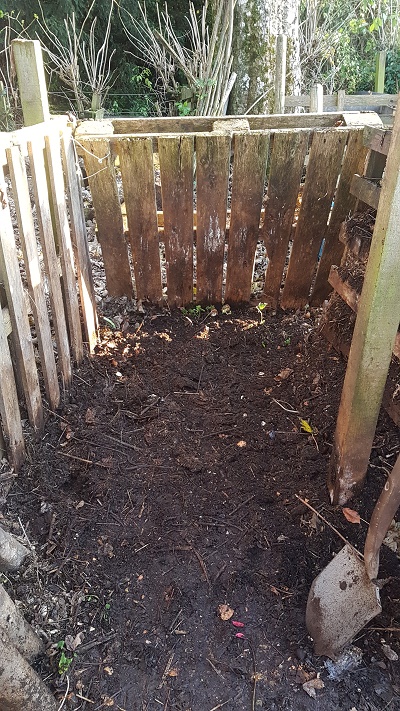
The last few shovelfuls, the final pitchfork-loads, and lo! I discover that the sticks I placed at the base of bay 1 last autumn because in a whole year they had failed to become compost are still there, barely altered….. I spread them across the base, along with the 3 year old thick cardboard tubes from inside the new polytunnel cover… they ARE biodegradeable, and I WILL win this battle….one day! On the plus side, after years of running a nursery here when thanks to lack of time and the vagaries of some of our volunteers, my compost heaps produced more plastic than a supermarket, this year my accidental plastic input and retrieval is minimal – and I can re-use the two ties and labels. And only one unreconstructed plastic-reinforced tea bag, right at the bottom, since we have found plastic-free brands.

I level the top of bay 2, and cover it with carpet. I know that within weeks, heat will build up and by spring it will be less than half the height it is now.All is done, and so am I, yoga or no yoga. And yet I’m incredibly happy with today’s work. Compost-making is the heart of my gardening life, the most satisfying, the most compulsive work, returning to the earth the things of the earth. I hope I have a good few years of compost-turning left!
 Comments on The Nature of the Universe
You are a marvel! I’m exhausted reading of your fruitful antics, including the earth wormy duplication. I hope you’ve rewarded yourself sumptuously. 🤗🍁🍄 Rx
LikeLike
Not yet but big family jamboree arrives tomorrow with the New Doctor, saving myself for that!
LikeLike
How needs membership to a gym when you have a garden and compost heap.
LikeLike
It’s not done much for my cycling legs though Walter!
LikeLike
Great post ! Great images ! I now know far more about compost heaps that I did before 🙂
LikeLike
We take the lazy approach and let the worms do the work. We cap the heap in the autumn and in the spring we skim off the top layer into a new bay. The stuff below is usually ready for spreading on the beds. Our theory is that we don’t lose any heat and don’t annoy the microbes!
LikeLiked by 1 person