
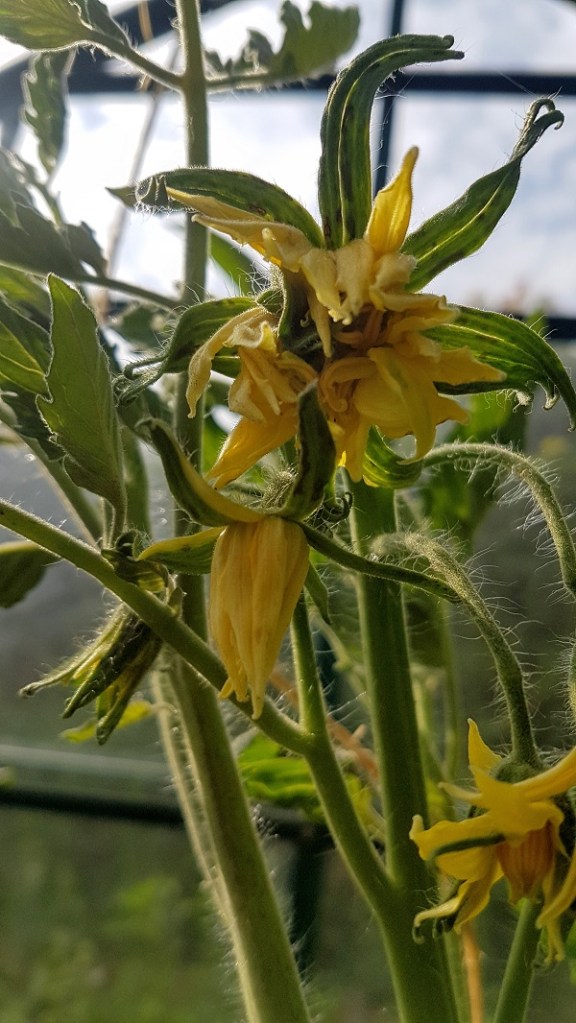
Fresh back from holiday and the torture that was the M6 from Junction 17 onwards, I fairly skittered through the unread emails, merely scanning those of interest. One from the writers’ group: a meeting I’d missed, and a writers’ prompt that had me immediately dashing back to the greenhouse to inspect the Gkousiari tomatoes. Before we left, they had been showing distinct signs of fasciation – had it become more apparent in my absence?
Fasciation is an odd thing that happens to plants, usually affecting stems or flowers. You see a daisy or a dandelion, and it looks like two or more flowers have been fused together….. daaandeellioon…. A mutant! you think, and you’d not be wrong, because it’s a genetic mess going on. Stems look suspiciously chunky or double, shoots flatten and spread instead of actually shooting. It’s like bits of the plant have welded together.

Because fasciation is a trait that can be carried genetically, small fortunes have been made by encouraging it, producing house plants like Celosia, the Cock’s Comb flower (above), or flat-stemmed willows from cuttings.
Anyway. The fasciated look is also adopted by plants that are triploid (having an extra set of chromosomes in their genes) or tetraploid (four sets instead of two). Celosia is tetraploid, and the fasciation is carried in the seed. Back to tomatoes.
You know the massive “beefsteak” varieties like Marmande or Brandywine? The monstrous, flat-bottomed, often split or distorted fruits begin as equally confusing and enormous flowers. They are usually triploid and have way too many chromosomes! ‘Gkousiari’ is an unknown variety, Gkousiari being merely the name of the Greek market gardeners who bred it. It’s one I’m growing out for Perthshire Seed Library to get a locally-adapted strain, so I didn’t know what to expect. When we left for Devon, stocky, slightly flattened stems were leading to suspiciously large and over-stuffed flowers. Now I can confirm a superabundance of chromosomes, and big, beefy tomatoes forming.
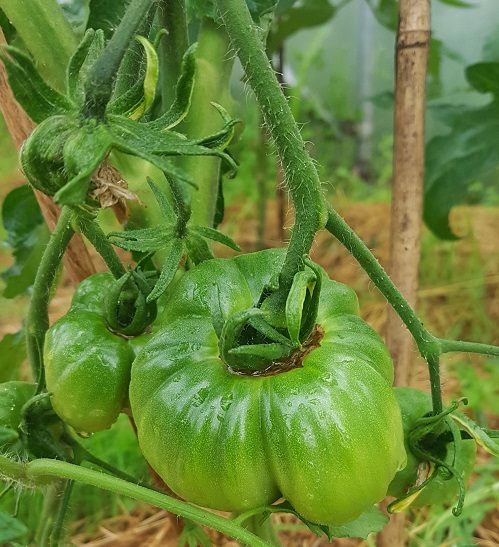
I also re-checked the email. Oh. Ah well, that’ll teach me to read properly. Anyway, fasciation IS fascinating. Isn’t it?
 Comments on The Nature of the Universe
A delightful playful piece and informative as usual. Good pics too,
LikeLike
Thank you Rosie. I suspect the pictures may have been more useful than the readout!
LikeLike
Keep them coming…
LikeLike
It is and was all fascinating, especially seeing the spelling afterwards!
LikeLike