
With implacably good timing, I finished my coffee to arrive at the Holiday Inn on the edge of Perth, seven minutes before the hourly bus home. Bang on time, I saw a bus crawling up Dunkeld Road. I slid to the edge of the pavement. But wait – was it a bus? No Stagecoach livery, a plain white coach, beetling along rather fast. I screwed up my eyes: nothing on the front to say what number – or any number – or destination. The tinted windows didn’t allow me to see if it carried passengers. A private coach, then? I sighed and stepped back.
As it hurtled past, driver not even glancing at the bus stop, I saw, on the side, “23 – Bankfoot”. The air turned blue outside the Holiday Inn, as I gawped in disbelief and watched it sail off without me. What to do? No, I wasn’t going to go for another coffee. I certainly wasn’t going to sit staring at a petrol garage while inhaling the noxious air of Perth’s god-awful motor mile for an hour. One does not get a “pleasant stroll” down Dunkeld Road, but eventually I began to walk towards town, undecidedly, seeking equanimity.
A couple of minutes later, just before the rail bridge, I noticed a tucked-away footpath sign: Lade Walk to Perth/Tulloch. Perth Lade is an historic man-made waterway which fed into the town’s mills. I knew the Tulloch bit, and the bit from the retail park to the City Mills, but this stretch – I never knew it existed. The Lade is grotesquely polluted for much of its length these days, but I know people who have spotted kingfishers hunting there, and the incredibly tolerant mallards of Perth make the best of it, and eat discarded chips. I ducked along a narrow path between the railway and the fenced car park of some tedious car dealer, with little optimism. Surely all I had in store were industrial lots and housing estates? The narrow path broadened as it reached the Lade, curving round from the west, and I heard flowing water and the busy furking-about of moorhens in the thick undergrowth on either side. The irritating groan of the Dunkeld Road traffic had completely disappeared, yet surely I must be not far from, and parallel to, it? To my left, a thick bank of mature trees, mostly self-sown and densely overgrown, had shed small branches and twigs in profusion during the winter storms. Accumulations of litter, initially like glue in the conglomerate of nature’s own debris, were slightly fewer than at the start, though one spot behind the ugly chainlink fence was a veritable carpet of empty beer bottles – either decades’ worth of boozing or the emptying of an accumulation someone didn’t want on their own doorstep.
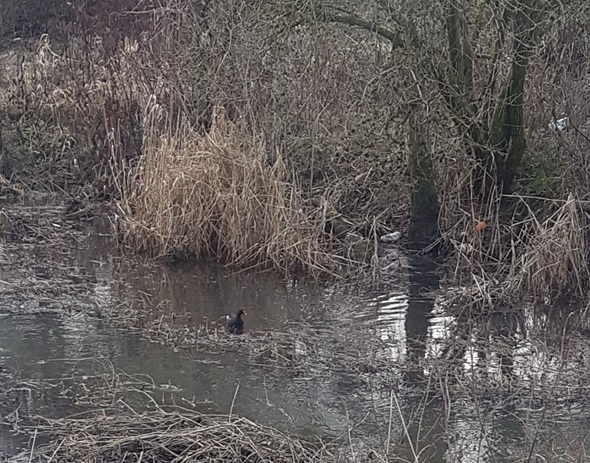
Five sleeping mallards sat camouflaged on the far bank, not moving, until I got my phone out to take their photo, when they all silently uncurled sleepy heads and glided off downstream. Moorhens, in vibrant plumage ready for spring, hung about, quite tame, crossing the path and ferreting in the reeds on their spindly legs. The larger trees thinned to a narrow belt and behind the fence was a huge expanse of derelict industrial land, half-concreted or tarmac in places, but being rapidly colonised by pioneer birch. elder and other young trees. In January, all looked grey, but from the lying vegetation of last summer I could guess at the wealth of wildness that would spring up, laughing at human arrogance, when the season turned again. Bare young trees may look like a delicate screen, but never doubt their power and ability to exploit a vacuum. Nor that of the dandelions, dockens and bombsite weed, all bringing seeds and nectar to wildlife. On cue, a terrible high-pitched squeaking started up in one of the older sycamores – a flock of long-tailed tits on the rampage. I stopped and birdwatched for a while – coal tits and blue tits were weaving between the branches and a cheeping of chaffinches held forth from some bushes by the lade. On the path, first a male bullfinch, then his duller mate, landed and had a good look around before returning to the other side of the lade. Blackbirds and a thrush hopped out and eyed me beadily.
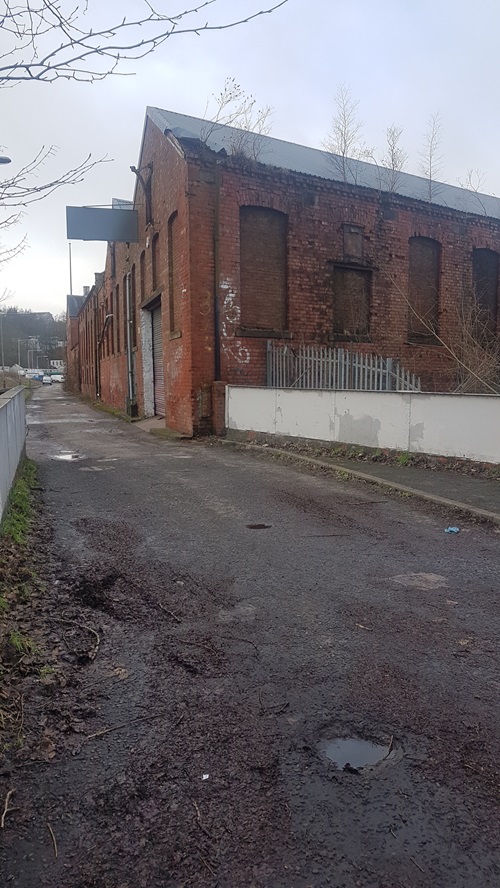
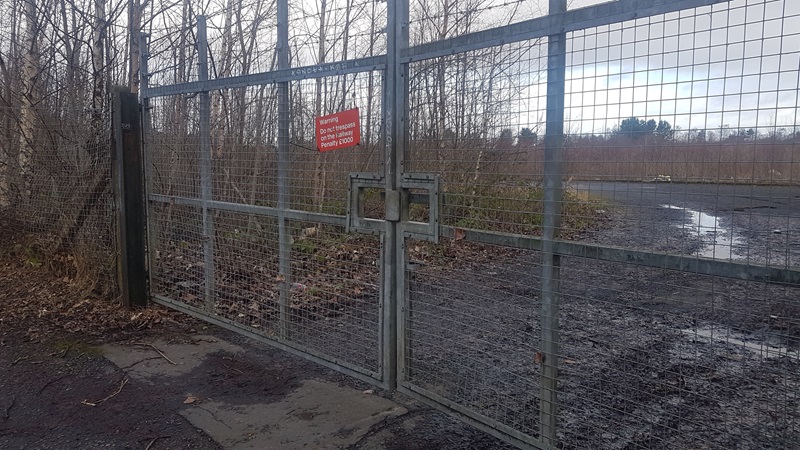
I came to a junction – a path crossed the Lade by bridge, past an old brick building – possibly a former mill but now another garage. It was attractive though, and full of potential nesting sites. Here, there was a sign on the fence – all this derelict land, stretching into infinite distance with no trace of the motor mile, belonged to the railway, which was nowhere to be seen but must be in there somewhere. I hoped it would stay their property, and they would never try to tidy it up or sell it to developers.
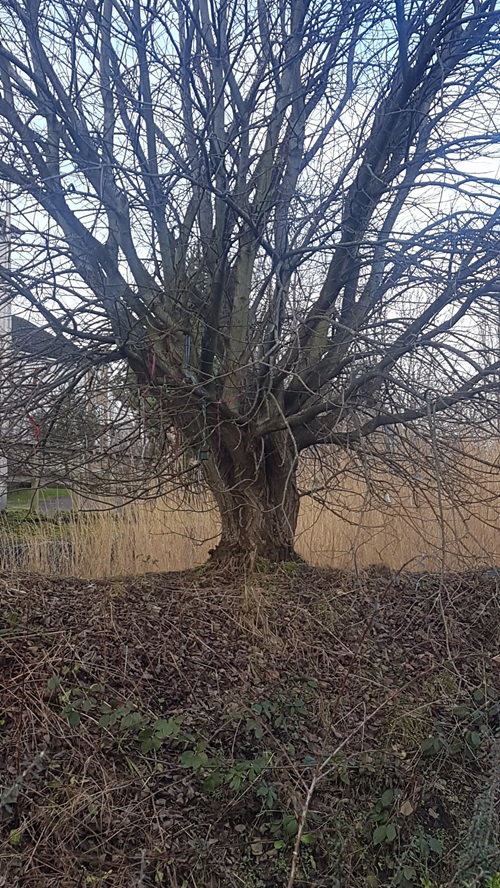
There were houses and flats now on the other side of the Lade, so near, yet curiously far and separated from this unexpectedly lovely and interesting walk. A large willow on the far bank was decorated with ribbons, toys and ornaments, like a wishing tree of old. I wondered who came out of their homes to celebrate or remember there. The ground on my left opened out, seeming endlessly wide. Lade and path swung eastwards and I saw an iron bridge, unmistakably a railway footbridge, just like the one I used to play under as a child in east London.
And over the bridge, where teenaged girls stood discussing the wicked-looking, monstrous-headed dog they thankfully had on a tight lead, Dunkeld Road reappeared. I swerved away from it, passed through some houses and across Crieff Road, where I joined the Lade stretch I knew well, skirting old tenements and road ends, bits of gardens and the ubiquitous smell of cannabis. Passing Stagecoach Headquarters, I surreptitiously made a rude sign. No time to march in and complain, if I wasn’t to miss the next bus as well! But thanks to their rubbish driver, I had discovered a stretch of unofficial countryside that I’ll revisit in summer, I’d enjoyed an unexpected daunder, found equanimity – and, moreover, escaped Dunkeld Road.
 Comments on The Nature of the Universe
Loved your wee story, you are a lot better at spotting birds than I
The lengthening day has us up early these days although still dark O’clock this morning and into the cold dawn; the moon only a slither now glowed resplendent in the clear, unmolested skies. I kept my eye on Tika, or at least on her little yellow light that bobbed at her harness and white bush of a tail she carries like a flag, as we made our way through the park. Like all ladies, she had a mind of her own and would take it into her head to follow some deliciously, interesting new smell.
The gulls rose, almost in unison, from rooftop perches, at the first glow of light in the East, raising in the warm thermals of the town, these masters of flight, circled and cried out at the new morn.
Awake! For Morning in the Bowl of Night
Has flung the Stone that puts the Stars to Flight
And Lo! The Hunter of the East has caught
The Sultan’s Turret in a Noose of Light
The Rubaiyat of Omar Khayyam
Having navigated the Great Circle route and as we returned once more to City Park the gulls were already descending to adorn the rooftops and chimney pots of the old town.
I love to be up and out before the town comes alive with eager-beaver student off to their morning classes.
We see lots of ducks, water hens and our old friend the Grey Heron most days and the big weeping willow at the bank of the Kinness Burn has turned a beautiful spring gold – alas like many of the self-seeded trees along the burn side woodland and old railway line they are buried in ivy – and although ivy is good for small nesting birds and will provide a meal from all the insects that find this a perfect habitat to feed newborn chicks – alas the ivy grows so thick on the trees that it blocks light to their leaves – and many have succumbed.
LikeLike
What a lovely walk Tika gets with you! Sounds like your bird knowledge is pretty good. Love the Grey Heron, always glad to see him, old Nog!
LikeLike
Yes, true but although the Heron looks slow and gives the impression that he would not say boo to a goose – I have seen them gobble down a young Pidgeon (squeakers) and I’m sure the little ducklings that will soon appear on the burn will make a tasty snack for our old Nog.
LikeLike
Indeed, and the way he flies – nothing in heaven or earth so steady, purposeful and determined – indomitable bird! (I expect his diet is more ethical than many humans…..baby pigeon notwithstanding! )
LikeLike
Excellent! Looks like that dozy bus driver did you a favour, and we get the benefit of your thoughtful writing 🙂
LikeLike