Then ‘Twas the Roman….

Trimontium – the Three Hills

I will pursue enthusiastically all traces of the Roman and her/his associated allies, foot soldiers and settlers across a British landscape, quite regardless of whether there is actually anything to see when I get there. It used to annoy my partner, trudging miles up hills and across dubious bogs and anonymous fields, only to have me announce, triumphantly “It was here!”, gesturing at a field of wheat. He is more intrigued these days, and even suggests Roman tracking expeditions of his own volition.
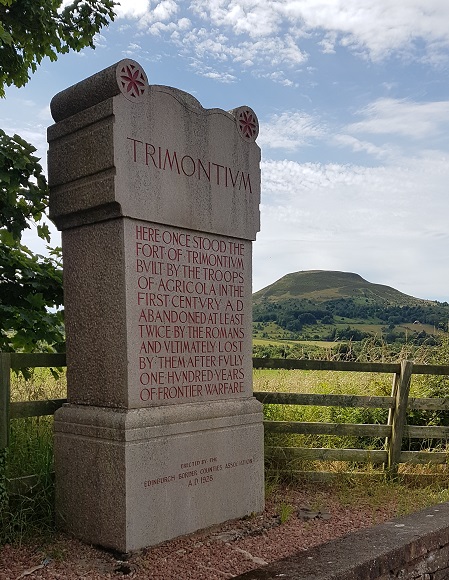
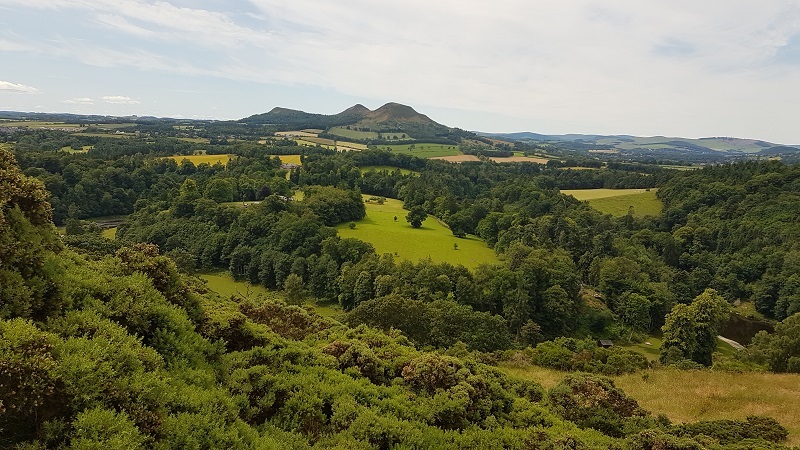
So it was that, once again, we wound up at Trimontium (known more generally as the district around Melrose). The three hills of the name are the Eildons; the Romans didn’t put forts on the tops – someone had already done that – but in this low rolling landscape, the hills must have shouted “home!” to returning soldiers at first sight, and assisted in sighting the meticulous straightness of their military roads. No, the Romans built their camps nearby in the valley of the Tweed, settled, traded, and called it Trimontium.

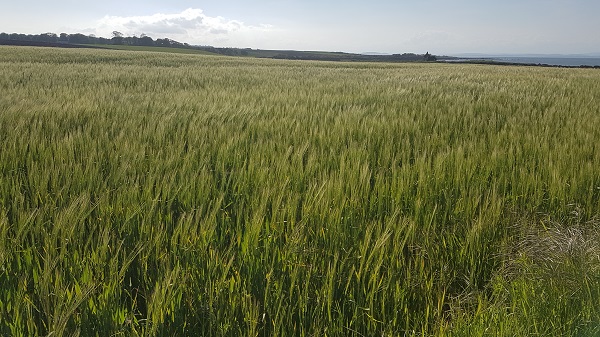
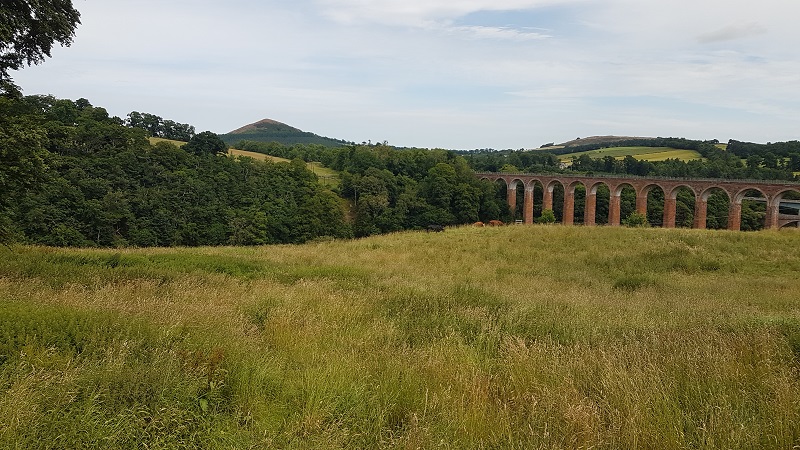
We cycled the length of the old road that cuts through the fringes of the camps, admired the crops in the fields where they allegedly lie buried, passed the site of a Roman circus where nothing could be seen, read the interpretative signs, and felt the whispering ghosts of legions march by. When we reached the site of the Roman bridge over the Tweed, we crossed on the newer one and cycled on to Dryburgh.
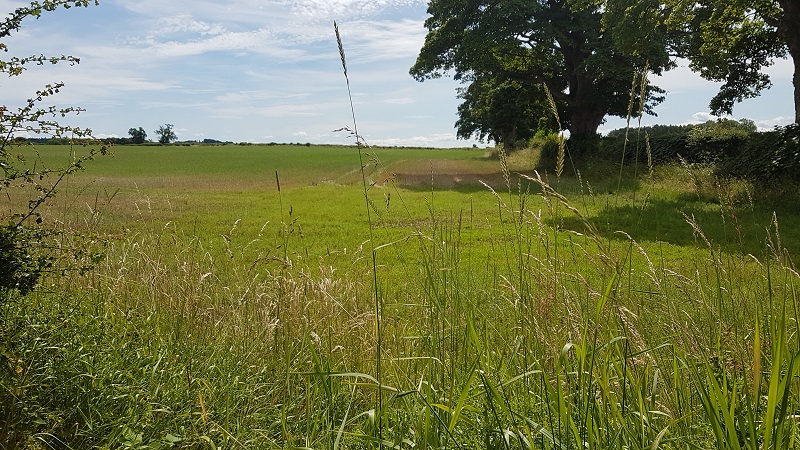
A Roman camp (site of!)
A Roman Circus was Here (Honest!)

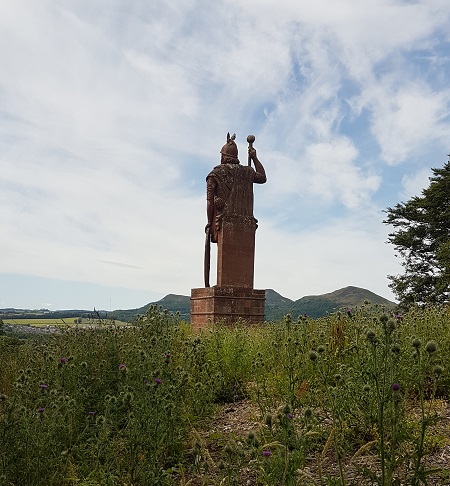
On the way we detoured to see the magnificent statue of William Wallace, a later and better known hero than Gnaeus Julius Agricola. He looks at home, gazing out forever across the valley to Trimontium, the three hills of Roman Scotland, every inch the warrior, rising from a sea of thistles. You could imagine perturbed, defiant, indomitable Caledonian thoughts – the thoughts that once challenged Agricola, and still challenge today. Or don’t imagine; you could think them yourself.

“There, like the wind through woods in riot,
Through him the gale of life blew high;
The tree of man was never quiet:
Then ’twas the Roman, now ’tis I” *

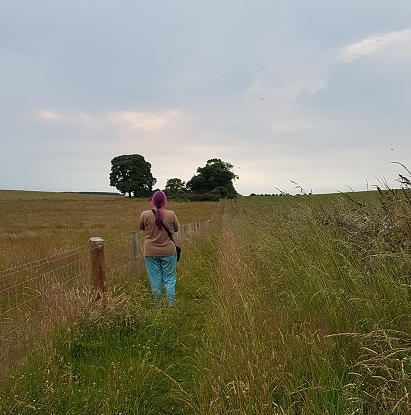
We went on to search for what remained of Dere Street, the road the Romans made from York to end at Trimontium, but which kept on growing to the Antonine Wall in Scotland’s central belt. Tell-tale straight lines jump out of maps; footpaths and tracks link bits of road seperated by farmland or forest. Here and there, we drove along it; the A68 out of St. Boswells was built on top of it. Near Jedburgh, we found a road that crossed it; a long straight footpath bore its way north-west; littered by large stones and rocks – way-markers? – and changes in level we dreamed into being the remains of the vallum, the rampart and ditch that lined important roads, as we marched up it into the dusk and crows took off from dark clumps of trees. In the foothills of the Cheviots, only a few kilometres from the border with England, Dere Street emerged once again, passing close by a set of Roman camps whose earthworks were, in places, still just visible.
Back home, we reminisce over our last visit to Ardoch, the Roman fort near Braco, in spring, and compare how wonderfully well preserved it is, in comparison with Trimontium and these Border camps. Clear are its neat square corners, it’s easy to count and follow the ramparts and ditches, and you can walk into the fort by the original entrances. Luck or design have conspired for Ardoch not be put under the plough too much; no roads have been constructed over it. Trees have grown, that’s all, and even they seem to follow Roman straight lines and military discipline. They tower, wide-spaced, vigorous, energetic.
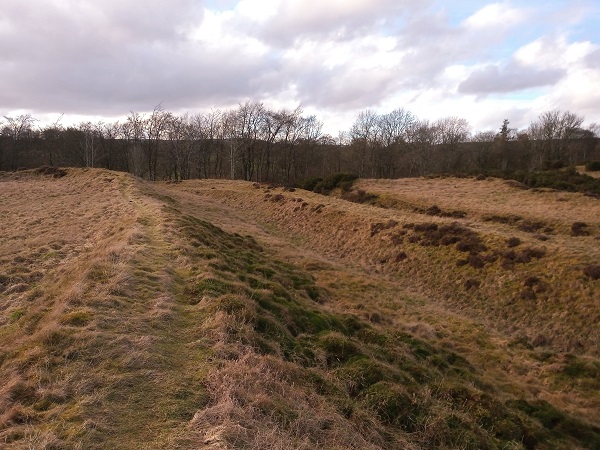
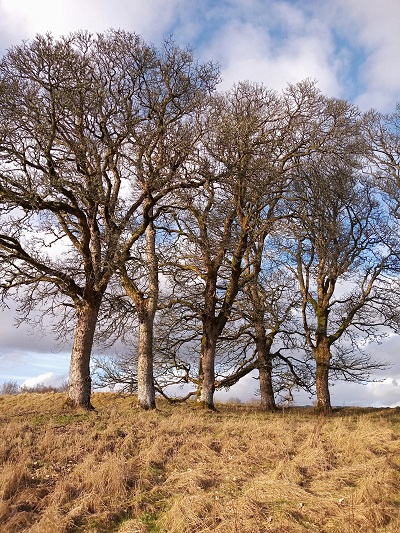
Then twas the Roman, now ’tis trees.

*from “A Shropshire Lad” by A.E. Housman
Yoga for gardeners….or Gardening for yogis?

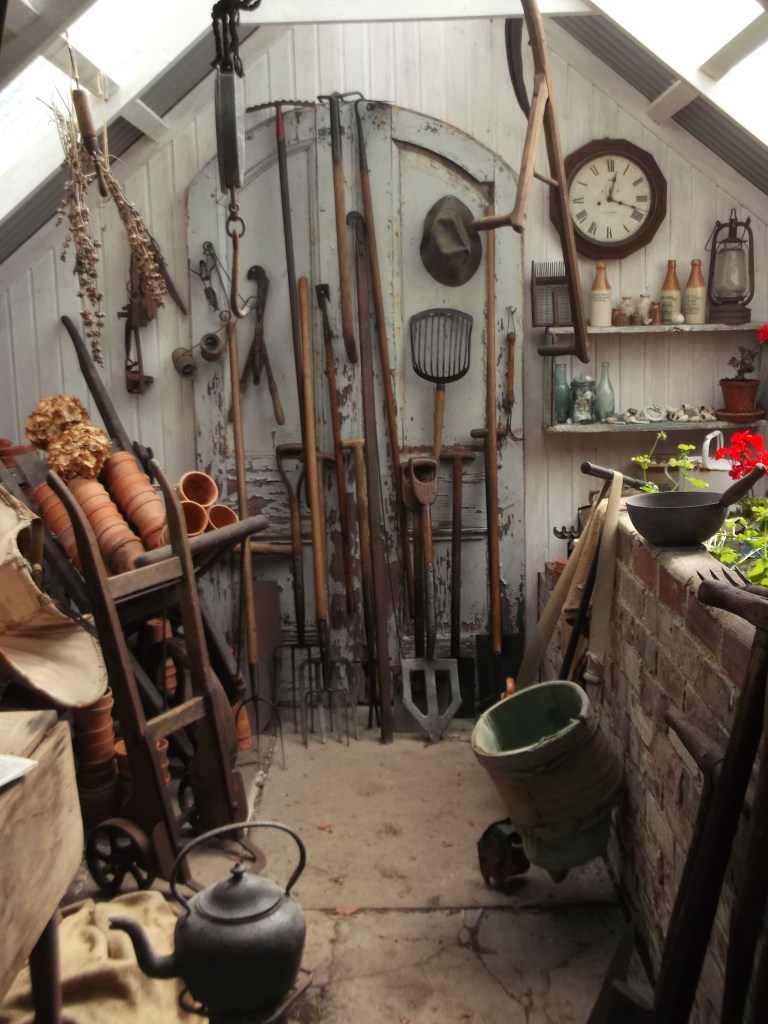
Not my tool shed…but I wish it was!

It has always puzzled me how anyone spends devoted hours to their gardens unless they also practice yoga. I got into yoga well before I actually owned a garden, and when I did get going with the growing, I quickly realised the advantages of being bendable, stretchable, twistable and, most of the time, reasonably balanced. My first proper job in horticulture was in a large Essex nursery producing pot plants and bedding; automation wasn’t a thing then, and heavy, laden barrows of trays of pots had to be pulled to tunnels and glasshouses and the pots set down in neat rows on the floor, precisely spaced for optimum growth. Here the WIDE-LEGGED FORWARD BEND was invaluable. Wide as possible, straight back, good reach – I could set down all the plants in a tray easily without having to get up, move and bend down again. And, unlike some, I didn’t have an aching back by coffee time.

The wide-legged forward bend is the posture I adopt in the garden for jobs like seed sowing in rows, planting potatoes and harvesting strawberries. If I need further reach, it can be extended, via a WARRIOR into a LUNGE – very handy also for annihilating that far-flung weed climbing the beanpoles. When you then find there are more weeds needing removed, or hidden fruits to pick, the lunge can morph into the GECKO. From any position, being able to go into a suitable TWIST again give you more reach. I confess, I usually accidentally forget I’m in these positions and stay too long, so I hear the voice of my yoga teacher in my head warning me to come out carefully! (By which time, it’s too late…)

For the garden, the great advantage of carrying out tasks in one position is that you minimise treading on the soil and compacting it. You also need to be flexible in where you tread, and occasionally move backwards one leg in the air, to avoid squishing your spinach. Various yoga balances, which I’m fairly hopeless at, nevertheless enhance my ability to cope with a jam-packed bed or border without creating too much destruction. It’s also helpful for pruning trees and shrubs, or picking fruit. (No, however appropriate it sounds, I don’t stand in the garden doing TREE pose. My neighbours would get worried. I do it in the kitchen while cooking to keep in practice.)

In confined spaces (of which my garden has many), or for the impulsive weed-blitz as you pass by another small jungle that arose overnight with the moon, it’s very handy to be able to SQUAT and much better for your spine. Very handy for wholesale removal of sawfly larvae from a goosberry bush. too. Coming up from the squat (with an armful of weeds) is a much bigger challenge for me, or for my knees at least, so it’s good that gardening gives me the chance to practice. Even if I don’t appreciate it at the time.

“Old Adam was a Gardener, and the Lord who made him sees
That half a proper gardener’s work is done upon his knees”

Thus spake Rudyard Kipling in his poem The Glory of the Garden.. Well, not half your time, perhaps, if you employ wide-legged forward bends and lunges. But some, of course, and sometimes, quite a lot. I’ve been lucky to largely avoid the “gardener’s knee” up till now and although I do get twinges these days, I still spend a lot of weeding or planting time on a kneeling mat – often one knee, the other breaking out into a GATE pose. While kneeling, I deliberately or inadvertently find myself doing the odd CAT and when I’m done, I’ll come to stand by doing DOG, if there’s space (By summer, there generally isn’t).

If you separated out the time I spend “doing” yoga and the time I spend gardening, gardening would win big time, even in winter. I’m not the most disciplined at making myself practice regularly outwith the class, and there’s far too much weeding, picking and planting to be done to attend too many classes. So my answer is to keep gardening, and stay mindful of every horticultural opportunity to utilise a yoga posture and the flexibility, stamina and good lungs yoga gives me. I’d advise any yogis like me lacking self discipline to take up gardening!

Of course, you need to finish your practice with SAVASANA, or CORPSE, the pose of relaxation. No, that’s not a dead body sprawled over the lawn clutching a trowel in one hand and a bouquet of ground elder in the other. But do take it a cup of tea in ten minutes time!

Always allow time for relaxation…

Not Ugly.

Midsummer, June, and roadside verges, hedgerows and path edges are brimming with life and good things to eat. Well, they should be, if you’re lucky, and some fusser hasn’t gone forth with strimmer or spray gun to transform the riot of green and gold, the effusion of flowers, seedheads and shoots to bare brown, sad-looking blankness or close-mown, stressed-out grass. I can never comprehend the small suburban minds of householders who would rather gaze out on monochrome than the living proof of life on earth. It’s one thing to keep your own verge tidy, and occasional cutting can increase the range of flowers, but it’s galling when people attack verges opposite or near their houses but which they don’t actually own. I confess, I get quite bitter about it.

During the 2020 lockdown, I embarrassed my family by taking to task a poor, misguided woman who was wielding herbicide along the route of a long-distance footpath. Granted, it was a stretch bordering her own property, and right enough, as she protested, she wasn’t killing everything…..

No, she was only killing what she called “the ugly, untidy species” that she had no use for. These were Dockens (have you ever looked at the intricacy of the flower structure in the Dock family?), and Hogweed. That’s where I really saw red.

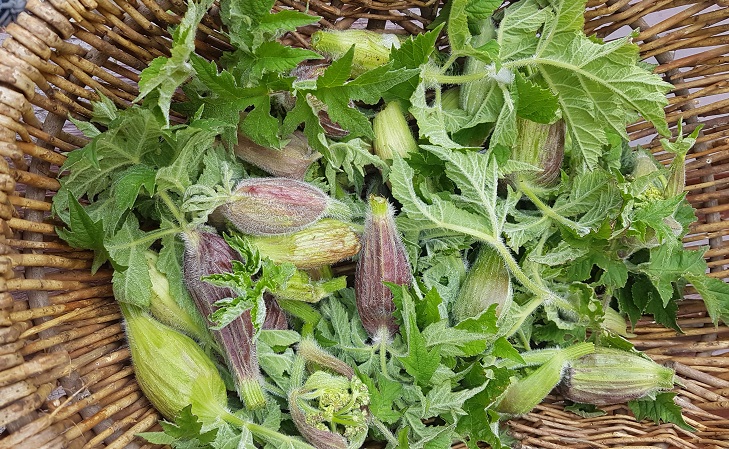
NO!!!! I don’t mean “Giant Hogweed” (Heracleum mantegazzianum), an invasive non-native plant known to cause serious skin burns and out-compete other plant species. Even I acknowledge that’s a nightmare, albeit a spectacular one. I mean Common Hogweed (Heracleum sphondylium ) a soft-leaved, far smaller native plant, with edible leafstalks and, at this time of year, the most delectable “broccoli” or unopened flower heads. Very few people have a skin reaction to this plant (far fewer than do to tomato plants for example), and I look forward to eating the broccoli every June.

“But it’s too tall, too big, too ugly and the bees and butterflies don’t visit it!” I was told. So then, we eradicate all the living things that we personally don’t like the look of, do we? What is ugly, anyway? Do we have to apply our personal prejudices to plants, other animals… humans? Sadly, many people do…..labelling leading to intolerance leading to hate crime leading to… genocide? And if a flower is constructed to be pollinated, not by the human species’ cosy favourites of bee and butterfly, but by beetles, flies or (perish the thought) wasps, does that make them useless, unworthy or ugly?

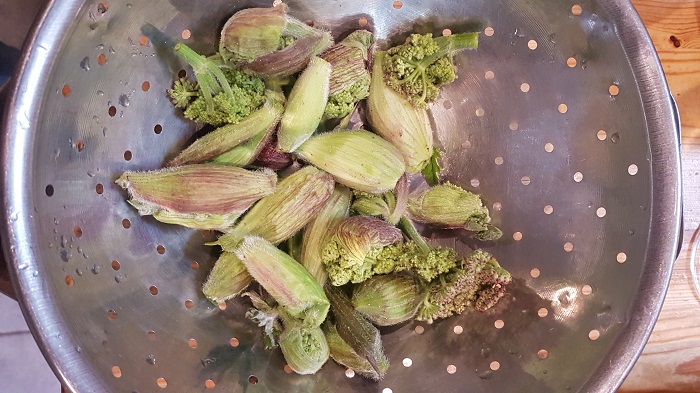
No, it darned well doesn’t. If Hogweed, Dockens or any other species becomes a weed in your carrots or undermines your potatoes, fair enough. It’s not because they’re ugly, they’re just doing what they are supposed to do. But leave them in the waysides that are their habitat. Before anyone gets horticulturally imperialistic ideas locally, I’m gathering hogweed broccoli. Just trim away the leafy shoots to prepare. Sauteed in butter with a little water and sprinkled with lemon juice and salt, they are a summer treat.

All prepared for braising or battering…..

Last night I made hogweed pakoras – coated in spicy chickpea flour batter and deep-fried – to go with the curry. I meant to take a photo for the blog, but suddenly, they were all gone. I need to get some more. Long live hedgerow delicacies!

May: Late, but Pink!

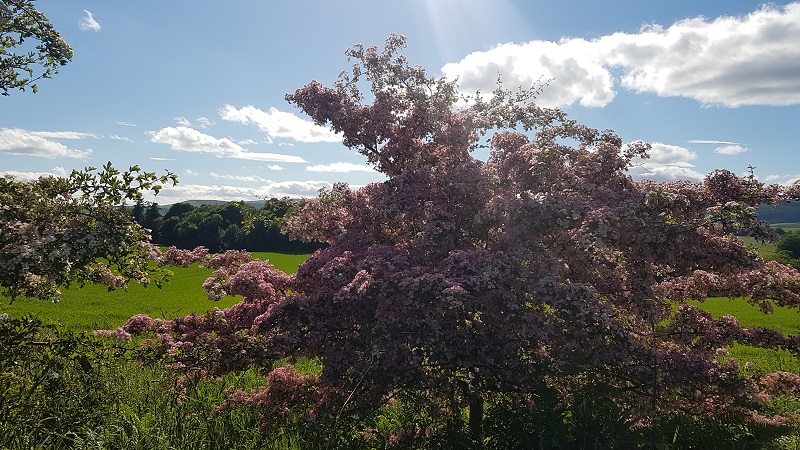
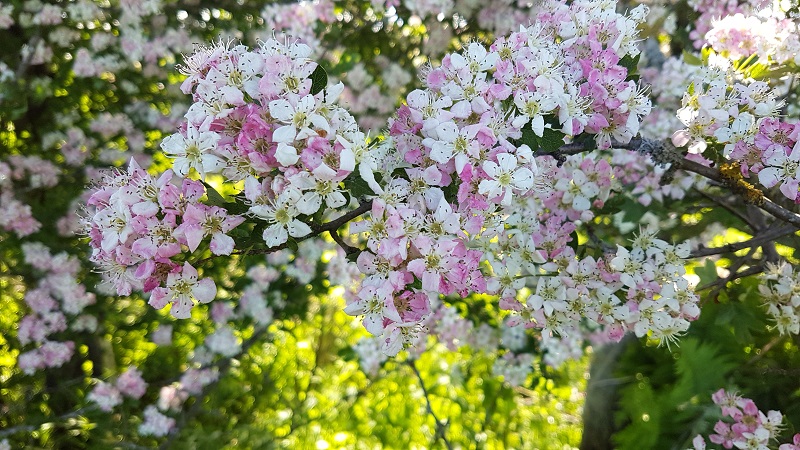
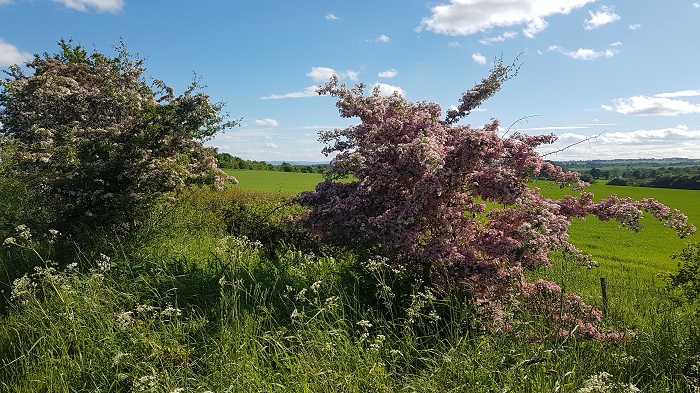
There have always been a few pink ones, tantalisingly rosy in the distance, exquisite in proximity. Hawthorn (Crataegus monogyna), also known as May, the mainstay of the rural hedgerow and the exuberant, wild lace that dominated the countryside in late spring, until money-obsessed agribusinesses ripped out the vast majority of the hedgerows and hammered the rest into stunted wedges that never got a chance to flower – it’s genetically variable when it comes to flower colour. Traditionally pure white – Housman’s “high snowdrifts in the hedge”* – but look closely and the suspicion of pink usually lurks around the outside of the petals.

This year, our local hawthorns stayed tightly in bud all during the cold, frosty and then wet weather of April and most of May. I was despairing of them opening in traditional time and thinking of renaming the shrub “June”. I found a single flower open on 21st May, but it was the end of the month before they felt safe enough to come out of hiding, and already their companion shrub, the broom, was going over. But now….. they astound, they soar, they are alive with insects….and, for whatever reason, they have emerged in all shades of pink. It’s like wading through raspberry ripple ice cream, sneezing with the outrageous amount of pollen and drowning in that pungent, not-quite-nice but not entirely nasty, scent.

What a sight to hold drunkenly in your mind’s eye, until May – or June – comes again!

*’Tis time, I think, by Wenlock Town,
The golden broom should blow;
The hawthorn, sprinkled up and down
Should charge the land with snow.

Spring will not wait the loiterer’s time
Who keeps so long away;
So others wear the broom and climb
The hedgerows heaped with may.

Oh tarnish late on Wenlock Edge,
Gold that I never see;
Lie long, high snowdrifts in the hedge
That will not shower on me.

from “A Shropshire Lad” by A.E. Housman

In the Far East (of Fife)

Sometimes it’s good to change your mind. Guardbridge lurks interestingly at the head of the tidal section of the River Eden. There are sweeps of marsh and mudflat. Having an affinity with mudflats and salt creeks since my youth in Essex, I wanted to walk along this estuary to St. Andrews. But the coast path apparently hugged the main road tediously all the way, so I drove into St. Andrews instead, spent a happy hour in the Botanic Gardens and another meeting up and drinking tea with a fellow blogger (https://threewheelsonmywaggon.com/), talking gardens and travellers’ tales. Then I set off on another section of coast path, starting well south of the town and uninfected by tedious miles of golf course.

I’m so glad I changed course!

Stepping out from the village of Boarhills towards the sea and the cool onshore breezes felt like entering a far and distant land, echoes of the west country of England in the sunken lanes and low-slung cottages, bat-squeak reminders of the Low Countries, and little bits of many parts of Scotland, all rolled up together.

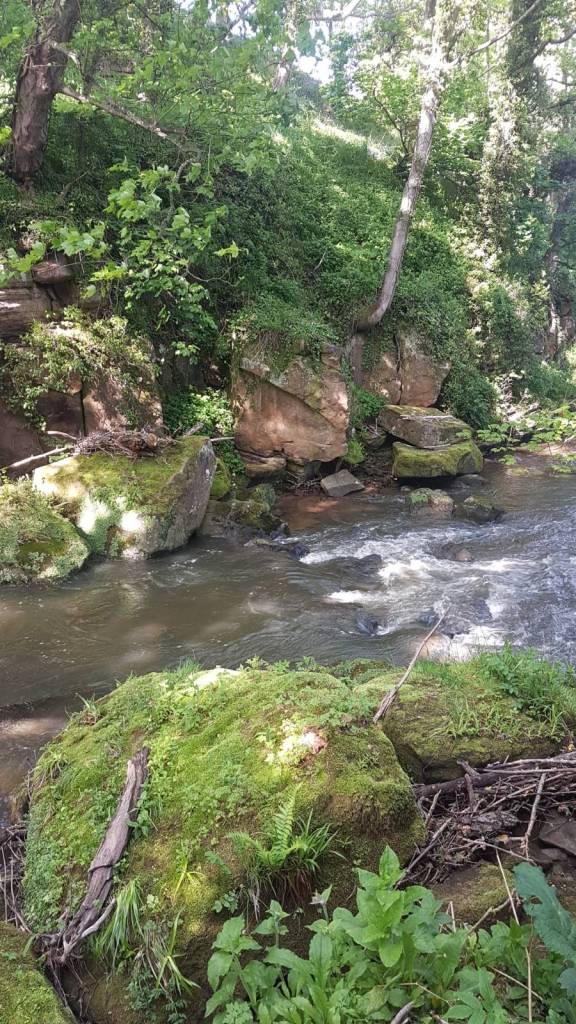
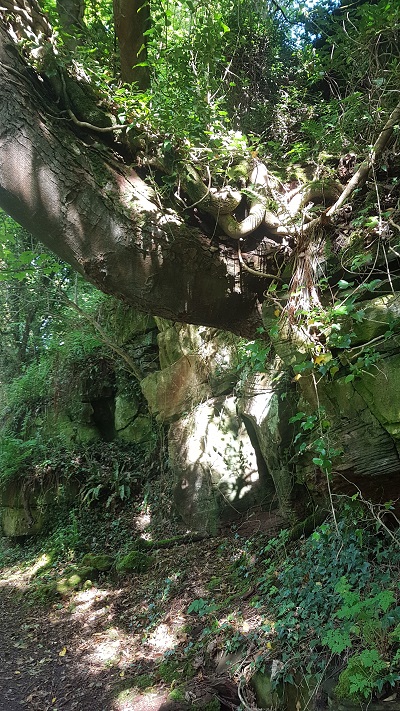
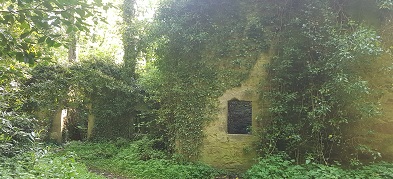
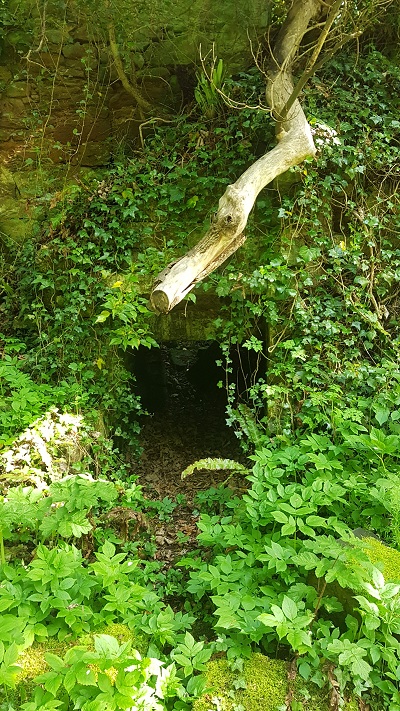
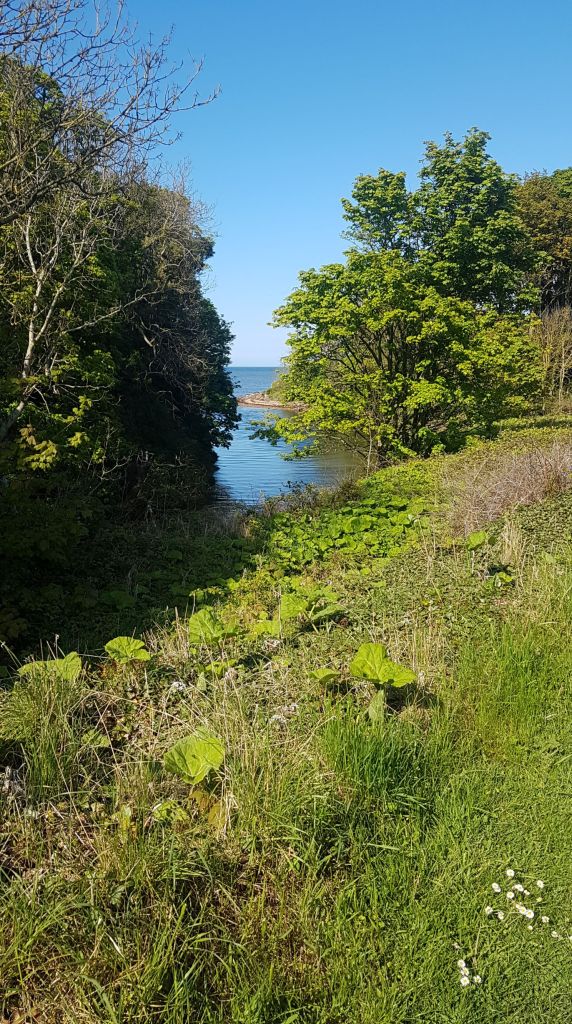
I reached a river, gurgling in a deep valley, heard long before it was seen. Into a wood, the scent of bluebells, another kind of river, blue and shimmering, lithe ferns stretching curled fingers to the far away sky. A riot of vegetation, clambering around rocks and slabs: the relics of buildings, maybe a mill, maybe haunted, reeking of untold stories and secrets. Here and there, dark openings that could have been windows, or tunnels, or perhaps caves in the cliff-like rocks. As I walked and clambered, it became hard to distinguish in the imagination what was human masonry and what was the masonry of geology. Huge tree trunks erupted alike from broken walls and natural crevices.
On and on, the path tagging the rattle and song of the river as it twisted and turned, trees closing overhead, veiling the bright sky with their shimmering new leaves. I began to wonder if this river led, not to the sea, but curiously inland, if perhaps it was one of the anomalies of Fife (there are a number!). Then, it hushed, grew calm, and through a gap in the woods was the open sea. Suddenly I was reminded again of a south Cornwall estuary.
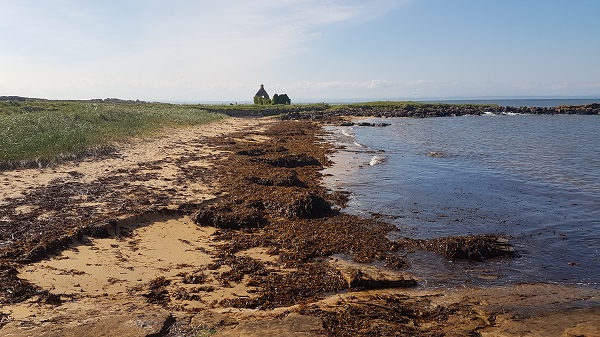
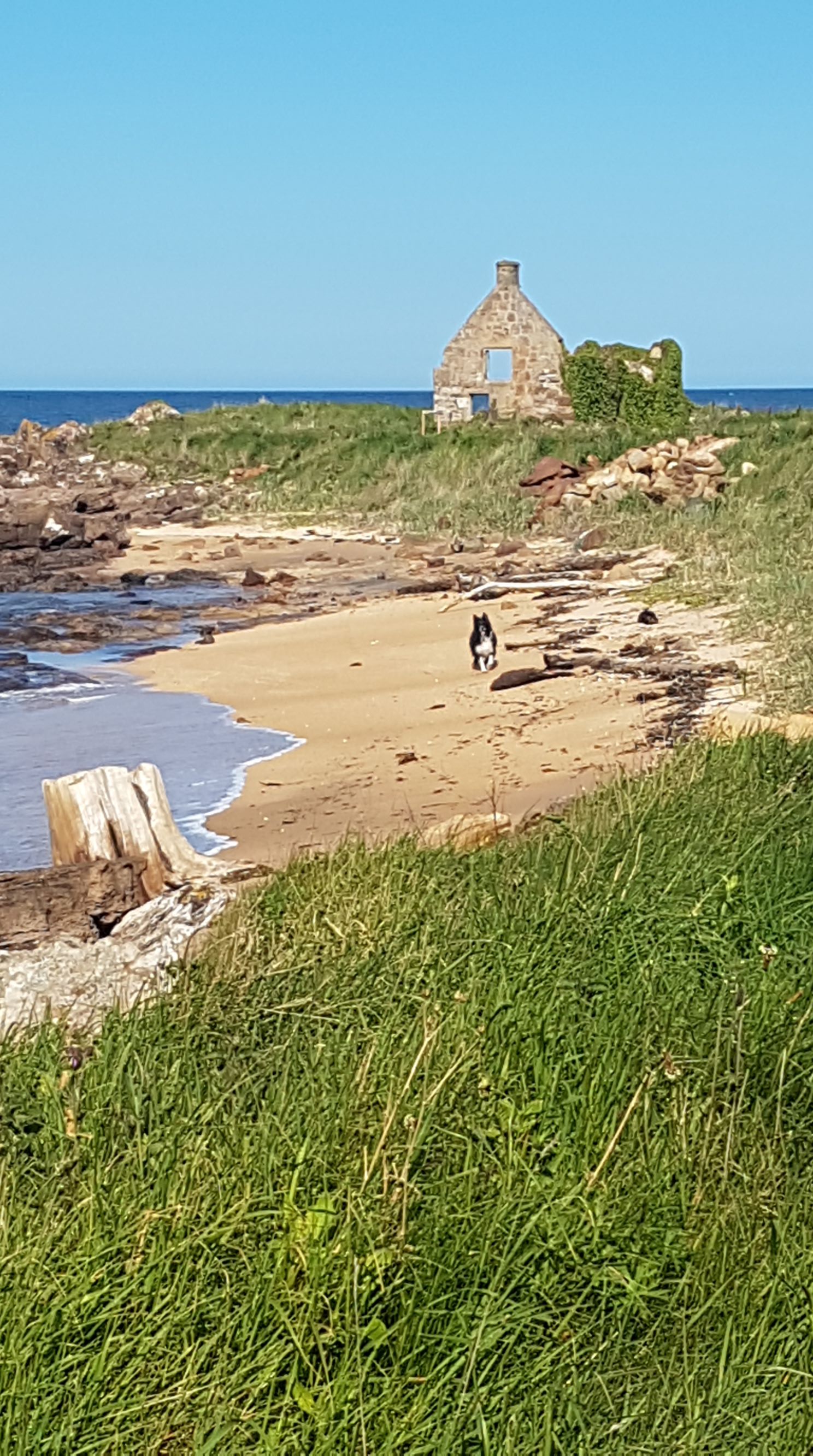
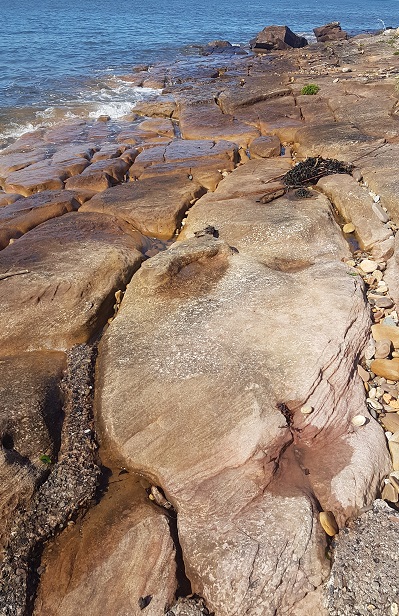
The river subsided into a quiet bay, and the path began to follow the rocky coast; great sandstone pavements hugging small beaches, the excitement of salt and seaweed in the air. Jed, my collie raced off at every little beach, I stretched my steps to embrace the fabulous wind and sky and sea, arms wide, feeling as if I were meeting once more a great and long lost friend. I sang. Luckily, I was alone, bar the dog, who refrained from comment.

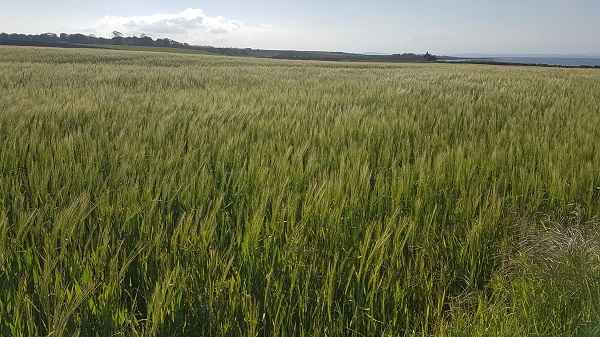
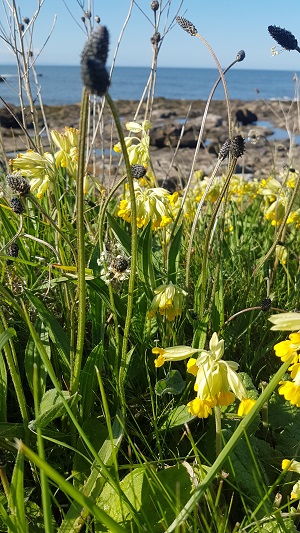
This was the far east of Fife, nothing, bar sea on my left. Cowslips, thrift, ribwort plantain, campion, dandelion – all rampaging like banners and bunting along the path. The heron, ever my companion, in a bay, black-backed gulls skulking on the sand, and skylarks over the barley fields to my right.

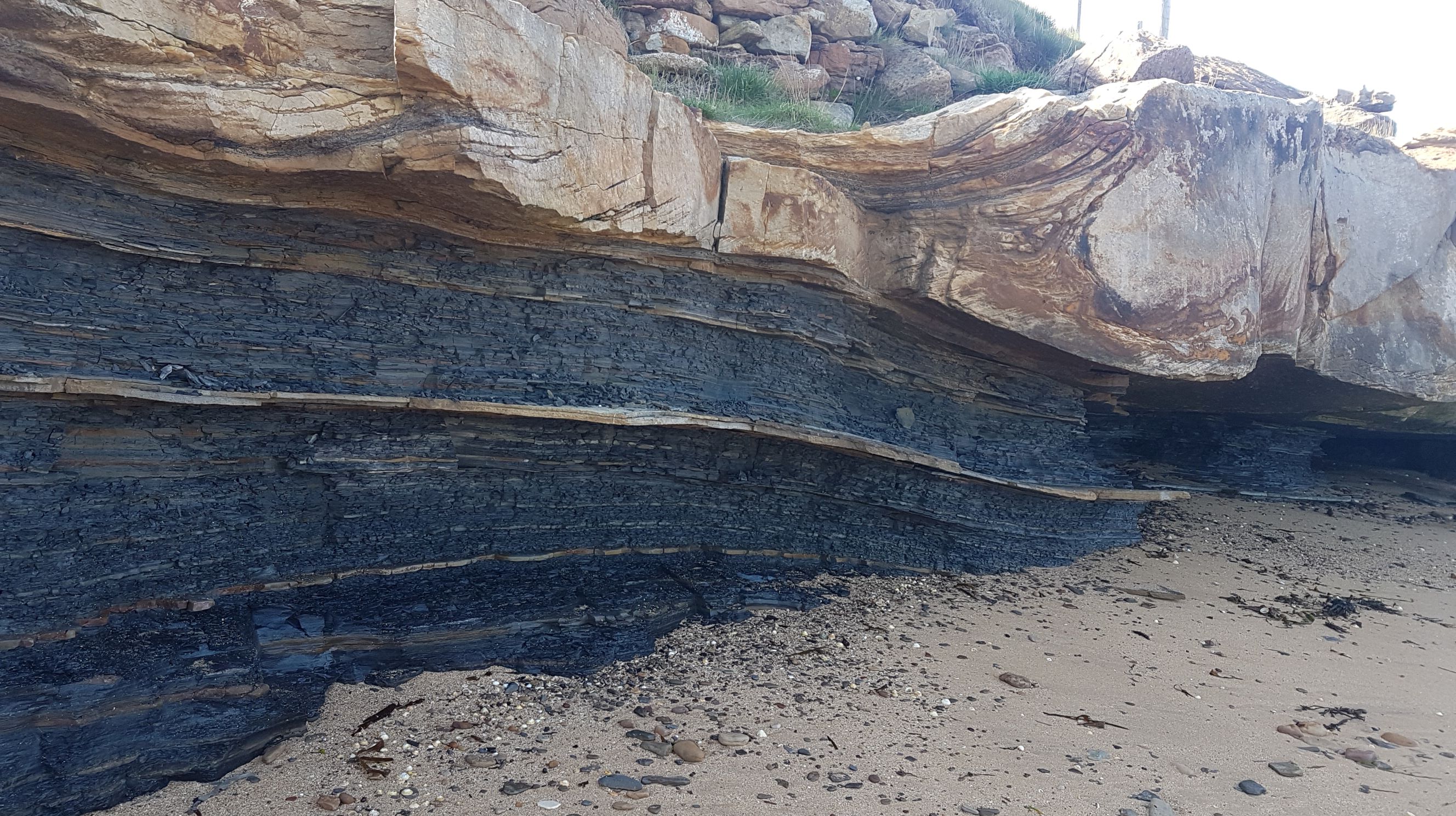
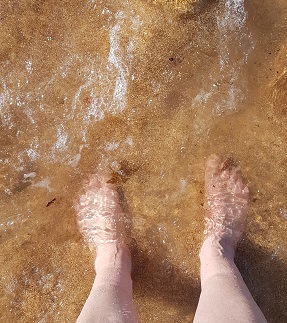
Along a bay which began with the curious black of an exposed coal layer and ended near Cambo, I joined Jed in the water and gave my feet a treat. The walk back to Boarhills in the evening sunshine combined new familiarity with repeated exhilaration. This is a fabulous and unique part of the Fife Coast,. I could have walked on and on, but for the appetite all that salt air had given me……

In Search of….anything but asparagus….

What I aspire to! Grown by J. Neill & Sons

In Catalonia, we stalked shifty looking men in the woods, all clearly trying to avoid being followed, saw them emerging later from the scrub carrying scrawny, dangling wisps of green. The Wild Asparagus. Allegedly, the acme of a forager’s progress. And no-one was about to help us find it.

So, grow your own, I decide. The very first raised bed with which I replaced nursery benches as I journeyed towards retirement three years ago, I planted up with two-year old purple asparagus crowns. They said, you need to be patient to grow asparagus, but it will be worth waiting for. I have waited. I have ladled seaweed, imported from Fife and Angus beaches, over the bed twice a year. I have weeded more meticulously than is my habit, because the asparagus gurus say asparagus cannot tolerate weeds. I have fed the largely invisible plants. Now, it is May again, and still there’s nothing much to see here.

But there are alternatives. In spring the emerging spears of Solomon’s Seal, an enthusiastic wild member of the same family – Liliaceae – provide a luscious alternative; slightly more bitter but I’d argue all the better for that. No chewy tough bases to the spears, either. Their season is but a fortnight, and does not satisfy.

And REAL asparagus, they tell me, is better…. I do not believe them.

I WILL have shoots and spears in spring. I go to the clearing in the hazel copse, where annually the willow herb heaves itself through soil and its own winter debris, in the form of thickish shoots and red-brown, furled leaves. I pick the fattest and youngest and steam them, then sizzle in butter, Now these ARE bitter….and some are like toothpicks. I eat a plateful anyway.

Willow Herb shoots

Back to the garden, where five out of the original twelve asparagus crowns are showing single, unenthusiastic, skinny purple spears. I think, how many new potatoes could I be getting out of that bed? How much chard or broccoli or succulent fennel? A friend donates some asparagus seed, originally collected in Italy but bred in Perthshire over twenty years, to our seed library and puts pictures on Facebook of fists-full of fat, early spears in April. I sow the seed, to back up my shy and retiring crowns, who are now five years old. I discover that my friend’s grows itself, without fuss, in a polytunnel. So shall mine do.

Hop shoots call to me. Vigorous, ornamental, golden hops and the fatter, darker, beery ones, seething with alcoholic promise. All are edible and they taste great. They’re in the nettle family, and, like nettles, the more you pick the shoots, the more shoots come. I find that hops and nettles combined appeases me greatly.

Hop shoots – Golden, Challenger & Fuggles, all good

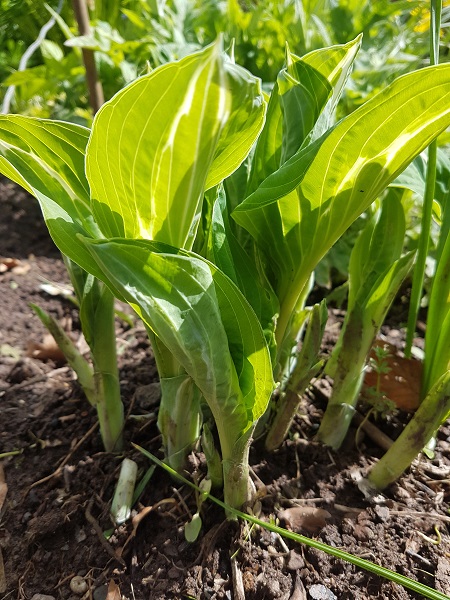
Then up come the hostas. Fleshy, delicious, plumper than any asparagus but shorter too. I cut them before the leaves unfurl, but it’s not crucial: the leaves of this delectable Japanese vegetable are also very tasty and should never be consigned to a flower border. Although the flowers, when they come, are bonnie to look at as well. I remember that hostas are also in the lily family. They aren’t asparagus, but they’re close; and they’re easy to grow, reliable and pretty too.

Hosta spears

After a moment’s thought, I cut two of the pathetic asparagus spears and add them to a dish of hosta. We get one spear each, but plenty of hosta shoots.

(Today I found someone is growing asparagus locally, commercially. It’s abundant, large and not too expensive. I’ve decided, if this year doesn’t reward my patience, that bed is going to be hostas next summer. And maybe the new seedlings in the polytunnel will one day give me payback!)

The Long Way Round to Taymount Wood

The Pathfinder

We met up at the Taymount Wood car park, Linda and I, put on our boots and turned away, not into the gate. This was to be the long road to the woods, a circular walk via the disused railway line which once ran as a ponderous branch from Stanley across the River Tay to Coupar Angus. The embankment is reached from the Taymount Mains farm track, and you then head towards Kinclaven and Ballathie, across open country, under disused bridges and past a little railwaymen’s shed made of sleepers with a brick chimney still in place. Although today’s challenge for us was to find and walk the narrow path through the northern finger of the wood, the line itself offered a few challenges – a chilly wind and stretches of water where the rains of March hadn’t percolated the poorly-drained soil.

You turn north-west away from the line before you get to the grounds of Ballathie Hotel, crossing the road and continuing north up a rough track beside the Old Smiddy. The track goes past several houses and in the past, we’d stuck to it, until it vanishes at a farmhouse. Then we’d scrambled witlessly through fields and fences and bits of scrub till we arrived, somehow, on a track in Taymount Wood. This time, we were determined to find the “proper” path. So, we left the comfy track when it turned the bend and continued up to the edge of the wood. People had been this way, but not many, and it wasn’t clear how far in we should go before we turned left. Google satellite was remarkably unhelpful.

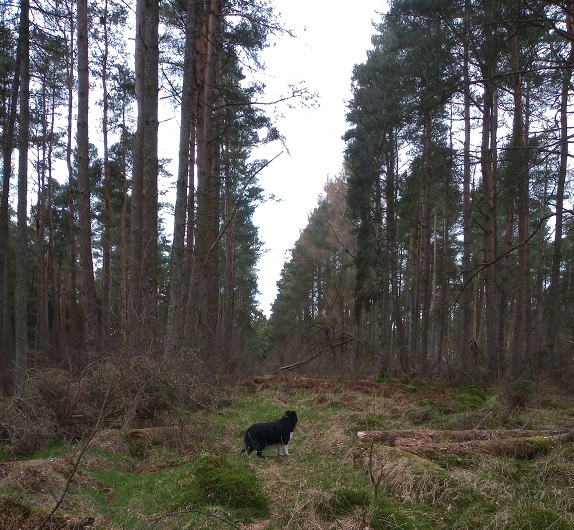
Dogs have many uses. Everyone thinks of companionship, protection and exercise machine, but an intelligent dog is a wonder at Finding the Path. While we stood wondering and wafting around, Jed set off into the unruly herbage with a look of collie dog purpose, nose to the ground. Sure enough, when we followed, there were the vestiges of a footpath. It doesn’t take many human footprints – and barely one canine print – to inform Jed this is The Way to Go. We continued, scrambling after him, and he didn’t lead us into any blind alleys. At times, we were on the point of losing faith, but then the path would reappear, on the other side of a boggy stretch or a tangle of bramble and brushwood.

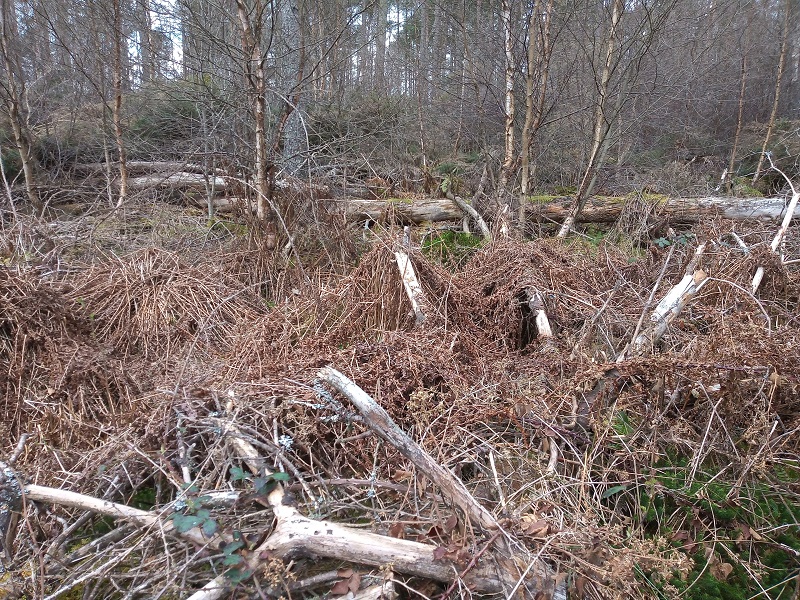
There is a path here somewhere….

Wind-throw had put up many of the barriers that challenged us. I discovered I’m at an age where I’m a bit stiff for limbo-dancing under fallen trees, and my sense of balance (never my strong point) for climbing over them was precarious to say the least. There were points when we even doubted the dog, but then to our great surprise we encountered someone going the other way – an ecologist doing a survey of small mammals for West Stormont Woodland Group no less – who assured us that a. we were on the path and b. it was passable, if a tad wet in places. Well, we certainly found the wet places and finally stumbled out onto the hard forestry track that would eventually take us through the main wood and back to the car park. The challenge wasn’t quite over – several metres of scratchy, mean-minded gorse had colonised the track to meet in the middle, and we suffered quite a few scratches and tears before we were through it – noting jealously how impervious the coat of a collie dog is just about anything.

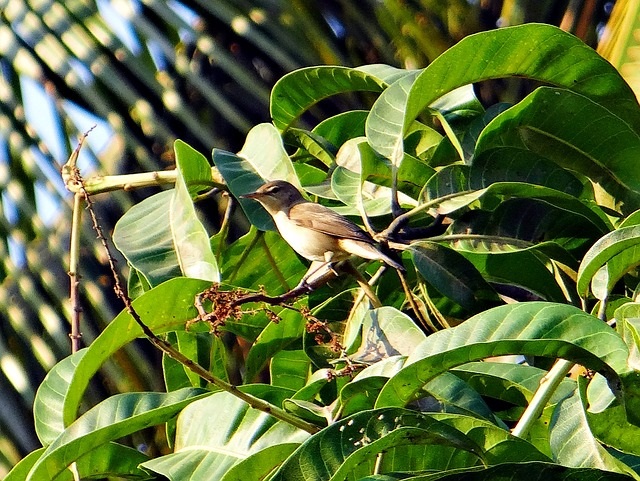
Common Chiffchaff (photo Bishnu Sarangi, Pixabay)

And the gift from today’s walk? There were lots – newly unfurling larch leaves, frogspawn in a drowning bit of track, skeletons of last year’s ferns, the beautiful vertical grandeur of the trees that hadn’t blown down, some chestnut brown bracket fungi left from the autumn. But as soon as we entered the wood on our optimistically rediscovered path, we heard the chiff-chaff call nearby. The earliest of our summer warblers to arrive, this is a small brown job of a bird, indistinguishable from willow and wood warblers unless it keeps still and stays a metre away from you. This one didn’t – they never do – but the call, exactly like the bird’s name, sets it apart. We never saw our little warbler, but the mocking “chiff-chaff-chiff-chiff-chaff” was never far away. It was, I am sure, laughing its little head off, but we chose to find it encouraging. When we found ourselves safely “out of the woods” and into the wood, it went off to scoff at something else. It made us appreciate all over again the wide range of habitats the woods provide for many bird species, residents and summer or winter visitors. I look forward to more birdsong in Taymount Woods this spring.

Find out more about WSWG and out hopes for community ownership of the woods at weststormontwoodlandgroup.scot

The Undefeated Willow

Willows are the most curious trees. For a start, there are well over 300 species worldwide, with eyebrow-raising common names such as Eared, Goat, Cricket Bat and Crack, or casually colour-hinting names (black, white, grey, violet, red and purple). The colours usually refer to the young stems, and that’s why willows have long been valued everywhere to make beautiful baskets, hurdles and sculpture – along with their wonderful flexibility which makes them capable of being woven without snapping. A well-made willow basket is strong and lasts a lifetime.

Those hundreds of species readily hybridise promiscuously, making identification a chore, to say the least – even in Britain where only nineteen species are considered native. I think it’s unlikely humans really know just how many species and hybrids there are. Willow – or sallow, or osier (even the names are slippery) just won’t be pinned down.

Willow won’t be kept down either, even when it falls. Put a bunch of willow stems in the rain-butt to soak for basketry, and the next thing you know, they’ve all grown roots. They grow quickly, ferociously fast. Two metres a year is not uncommon for new growth. Coppice them, and they’re back up the next year. Their Lazarus impersonations are all the more improbable given the mind-boggling number of diseases the genus is prone to – black canker, blight, powdery mildew, scab, watermark disease, root rot, heart rot and willow anthracnose, to name but a few. They are pioneer trees, kicking off the cycle of colonisation in open ground that is damp or downright boggy, and no one fairly expects them to last for centuries.

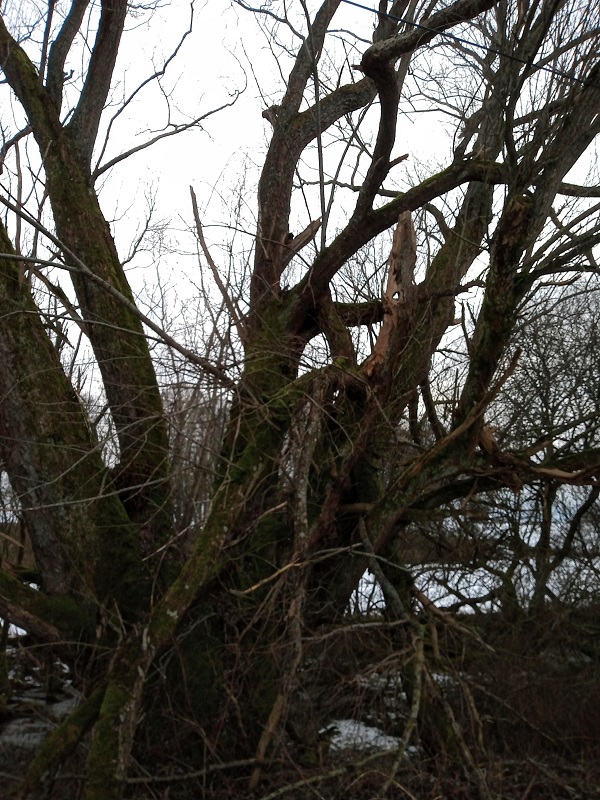
By what remains of the old Back Mill millpond in Bankfoot, there are some death-defying willows. I don’t know the species. One monster of a tree, often pollarded in the past, still stands erect – outrageously enormous, ancient, decrepit. As the millpond has steadily drained of its water and silted up, the roots of these massive willows have been exposed. A flood of heavy rain then washes away the soil, until eventually the whole tree comes crashing down.

Old Man Willow

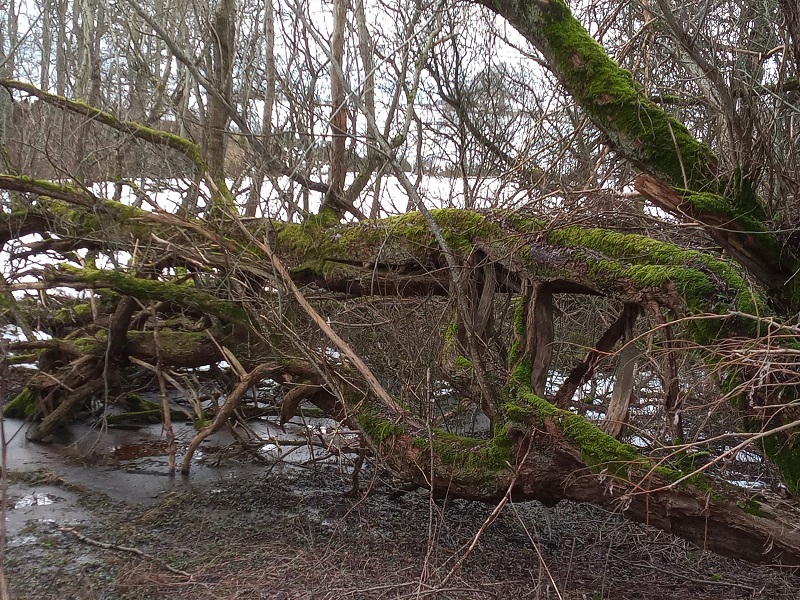
End of story? No way. In falling, the wood, being watery willow, ripped asunder, cracking and splitting in a hundred fibrous places. Some trunks, now horizontal, appear shredded and mashed. Branches poke up out of the devastation akimbo, some dry and decayed, some clinging to life.

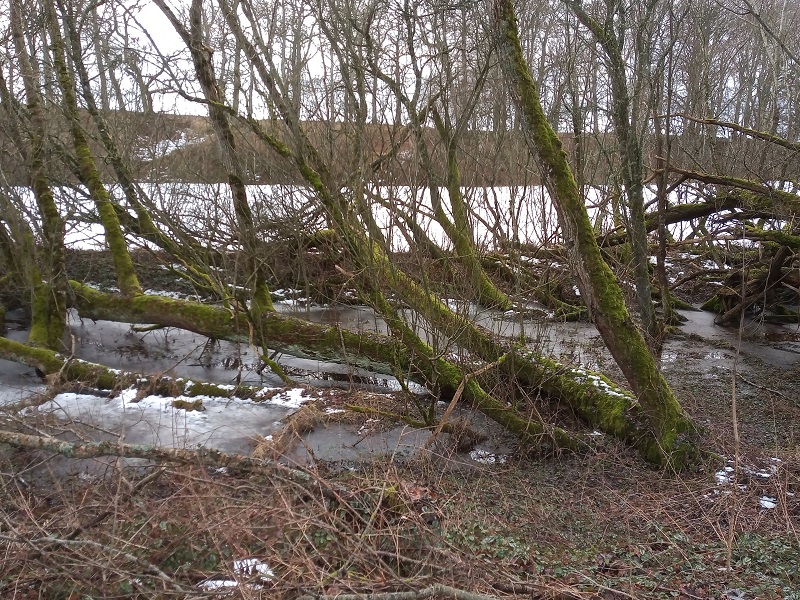
Make no mistake, these willows fell a long time ago, Birds have nested in the crevices where they toppled onto each other. Mosses, algae, lichens, ferns have been succeeded in places by other woody plants, growing out of, and contributing to, the accumulation of soil and organic matter. The trees are alive, but they are a substrate for life also.

From the felled boles and wrecked structures, arrow-straight, insolent shoots clamber skywards. They are making new trunks from the old,even where the original tree has scarcely more than a twisted root in soil or water. A veritable willow plantation arises from the un-dead.

Circular Walk, Spring Morning

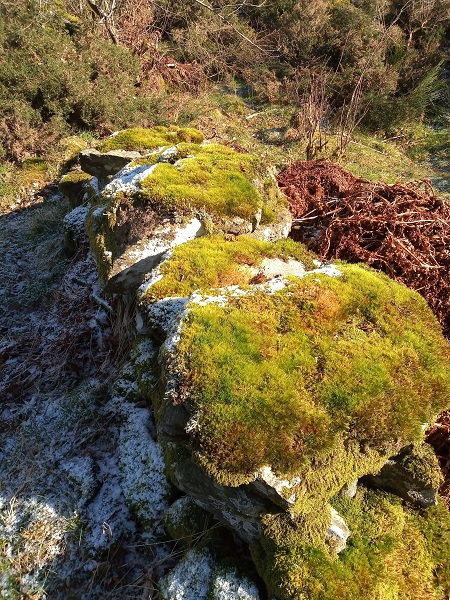
A night of light snow, followed by clear-sky freezing has left
The ground hard and white.
Rapidly the sun, heroic, overcoming all, climbing high,
Melts snow to iridescence at every margin, every edge.

On a single hill, snow is held in thrall. Like a crumpled Mount Fuji, but
No blossom, no art,
The hill holds its ghost-clothes, despite the sun’s triumphal progress.
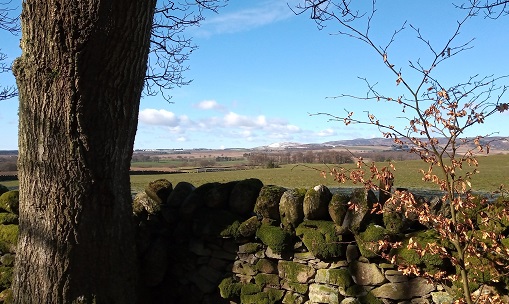
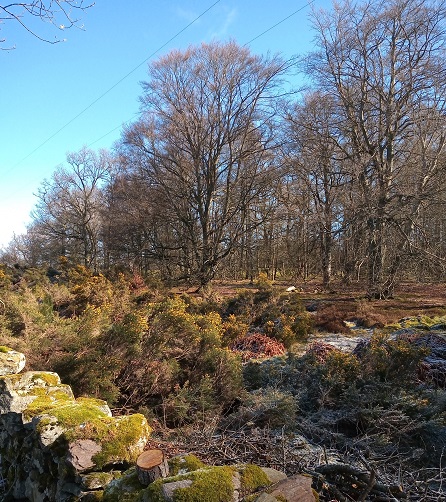
Magisterial old beeches sun themselves among old walls and
Moss-covered stones, dripping, wet, full of temptation.

Birds call, fluting, piping, chameleon-coloured, slipping away like lizards.

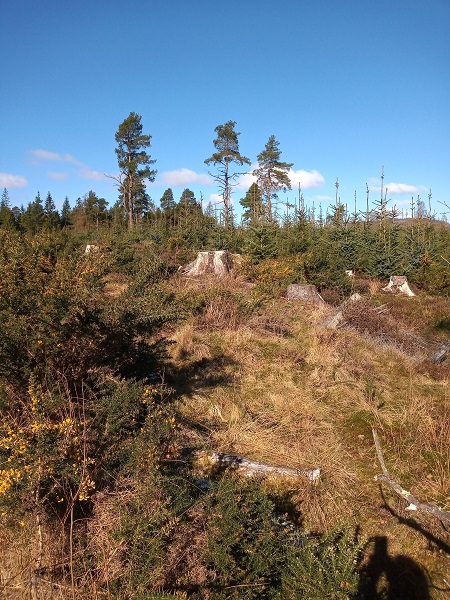
I’ve never understood the detritus of forestry. The wind cuts and dives
In and out of the shambles of stumps and trenches, where startled pines left behind
Look half-naked and vulnerable, hesitantly beginning to stretch arms to the sky,
To each other, united in the icy wind.

I follow the wind. I leave the wreckage, the small shelter
Of self-seeded spruce erupting from glossy gorse and broom. Ahead
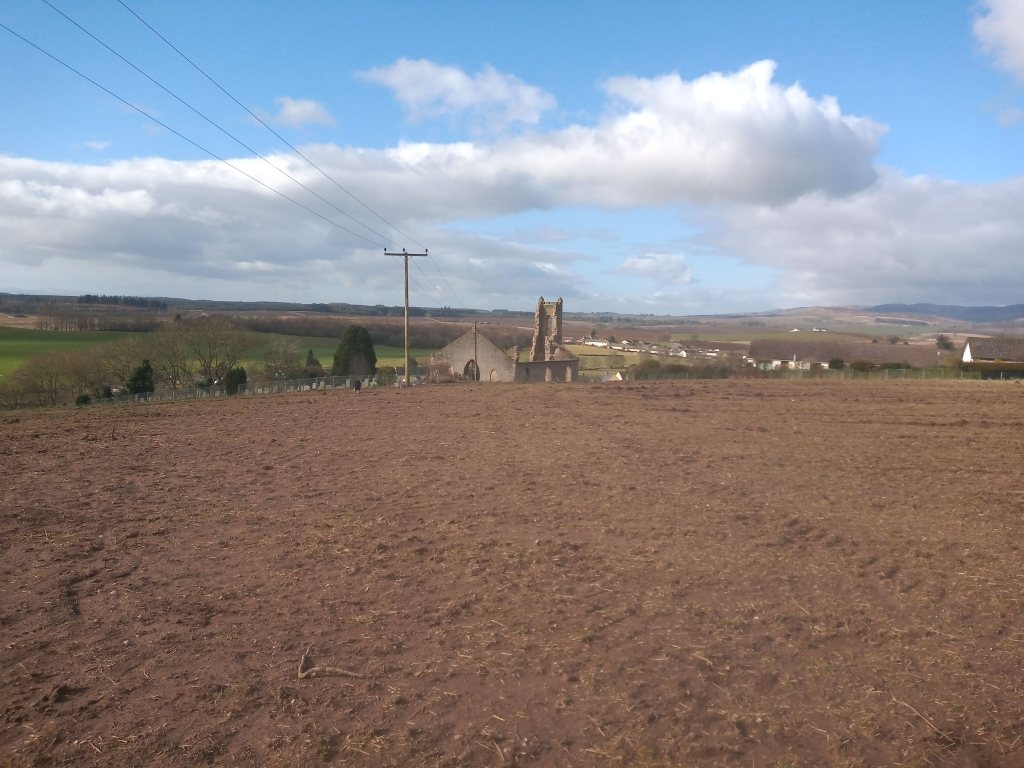
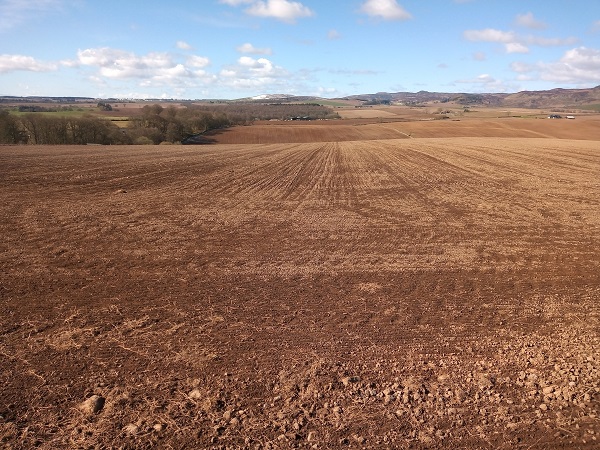
A vast and dreary vista of huge, brown and empty fields,
Unpunctuated by tree or hedge-bank, meticulously ploughed and harrowed.
The dust rises, faintly reeking still of the abattoir, that small, derisory recompense
For decades of soil inevitably lost and life precluded.

Back by road, the first wood anemones
In the deep and shady gulf where children once played canyons,
And a rising stir of sound comes up from behind. Suddenly
A thousand geese are shifting and snaking in the blue, blue sky,
Withering the last frost with their joy.

Bankfoot Church is Falling Down

In February 2004, workmen were burning rubbish on a demolition site. It was a day of gusty winds, when safety procedures should have never allowed a bonfire to be considered. At some point, sparks whirled viciously into a neighbouring building, caught hold, and within minutes a blaze ensued that could not be extinguished before the building was lost.

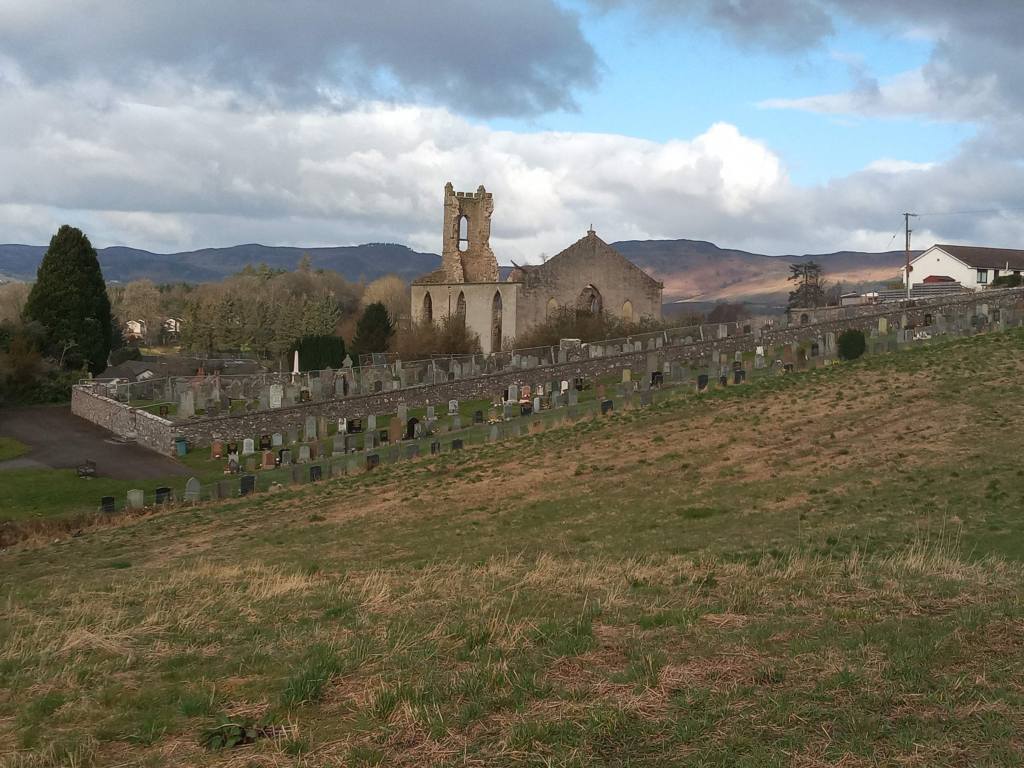
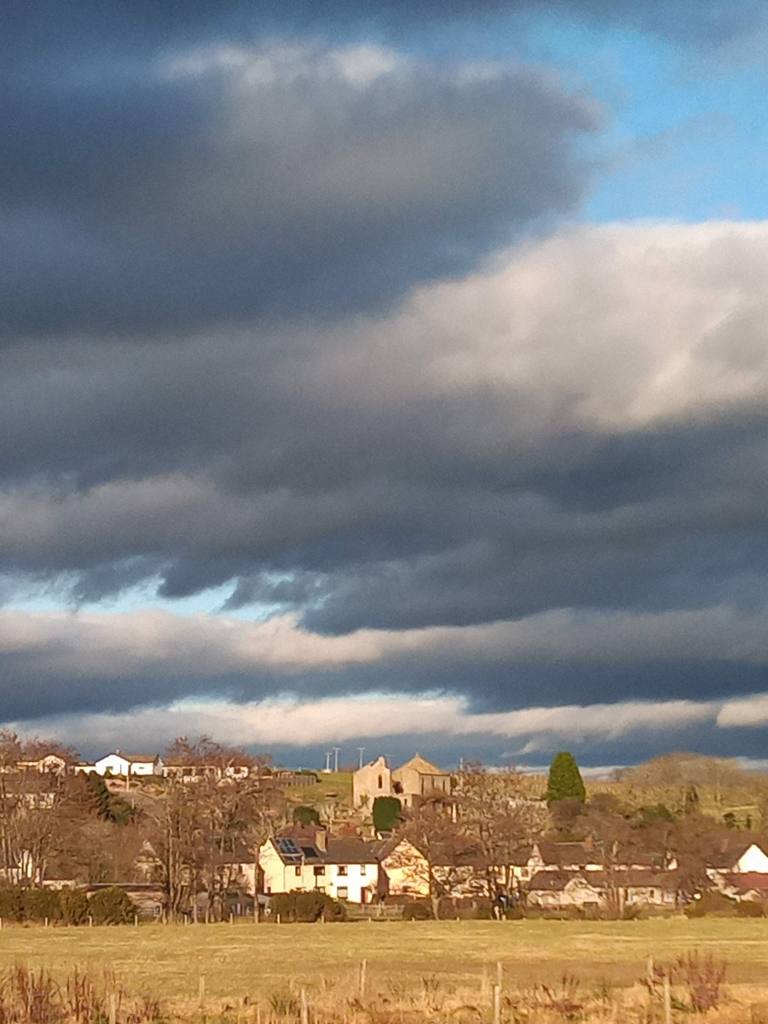
The building was Auchtergaven & Moneydie Parish Church, sited on almost the highest point in the Perthshire village of Bankfoot. It had stood, glowering over the village, for 207 years, its timbers dry, warm and perfect for burning. Not a regular churchgoer, I’d nontheless been there a few times in the seven years I’d lived in Bankfoot, panting my way up the steep path to the entrance, and I’d enjoyed the simple, uncluttered warmth of the wood-lined interior and the sincerity of the congregation. It was a bonnie church, and a landmark for miles around. That day, horrified drivers on the nearby A9 slowed to a crawl, as flames shot to the sky.

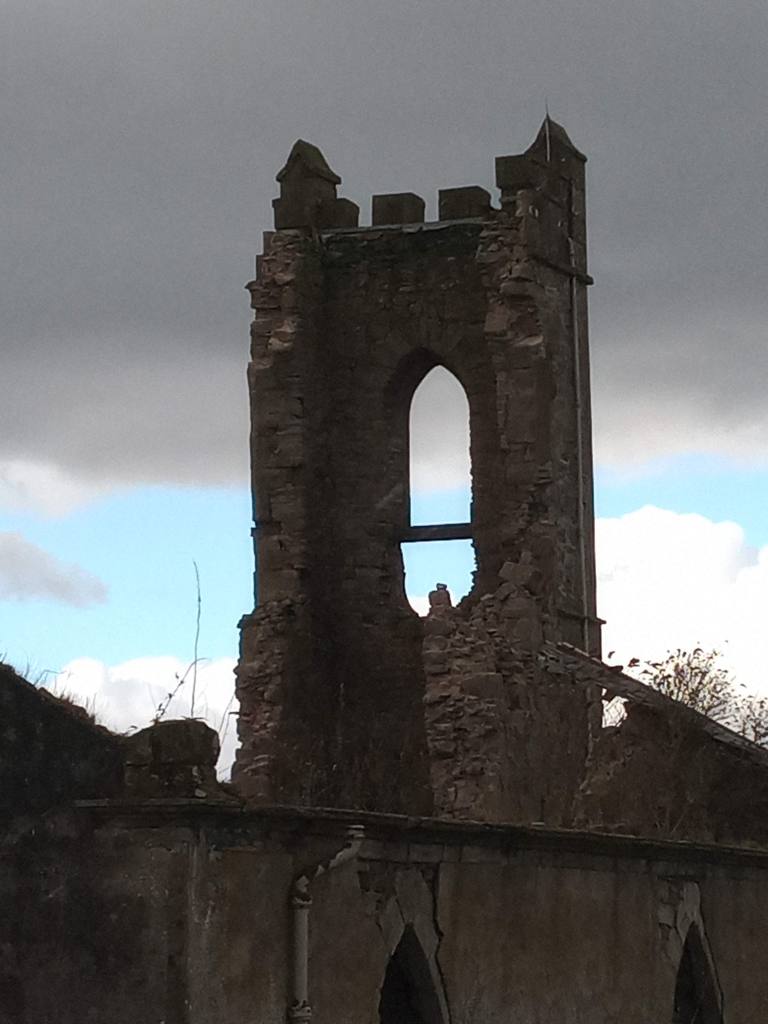
In the aftermath, the old church was not “burnt to the ground” – but it was certainly gutted. From a distance, there were many years when at first glance, you’d never know it was a ruin. The tower still stood, majestic – maybe more so than before – defiant, presiding over a landscape of haphazard hamlets congealed into one village, farmland, people and beasts. After considerable deliberation and assessment of the building’s condition and fitness for purpose, the Church of Scotland, advised by the will of the congregation, opted to build a new church on flat land it owned in the centre of Bankfoot, complete with community facilities and a low carbon footprint. It was a brave and right decision, I think, which offered accessibility and possibilities the old church never could. The original bell, cracked by fire to tonelessness, was rescued and installed as the new font.

But it left little in the coffers to do anything with the remaining structure. Disputes and debates went to and fro for years, between the culprit building firm, insurers, the Kirk, local residents, fundraisers, historians and those with an interest in the surrounding graveyard. Meanwhile, safety fencing went up around the site, the grass grew, and saplings appeared in the smoke-blackened walls. Stone crumbled unnoticed. Blocks occasionally fell; still the tower stood, indomitable. Saplings grew into trees; buddleia, that great exploiter of devastation and demolition, proliferated in the nave and drew in butterflies. Wild flowers and ferns took hold of crevices in outer and inner walls, solitary bees visited and maybe nested in crumbling mortar. Jackdaws and pigeons were regular inhabitants in spring. A garden began to grow in the sanctuary. Who knows what wild creatures found refuge among the piles of fallen rubble? No-one could get in to disturb or identify them.

I know many people found it heart-wrenchingly sad. For me, with an ambivalent attitude to organised religion at best, it was more a change in emphasis. I felt the human-centred heart of the building died with the fall of the final clock-face, never to chime again and remind us of the days and hours. One day, out walking in early spring 2020, I noticed that the tower looked a bit odd. I went closer to see if I was imagining things, and discovered that although the front facade still held fairly intact, most of the sides of the tower had fallen in. What was left looked more precarious than ever, but it hadn’t stopped the jackdaws from building warring nests on each remaining pinnacle, or the collared doves gossiping lovingly in hollowed alcoves. Chaffinches and sparrows bustled about purposefully, hopping between the seed heads, roosting on bits of masonry.

I wondered what God – by any name or none – would make of it all. Inevitably St. Francis came to mind, who would surely be quite at ease to see wildlife frequenting a religious building. I thought of the early saints who taught that Celtic version of Christianity which reveres all life, not just the human kind. Jesus himself (despite an unfortunate show of spite to a certain fig tree) counselled his followers on the great value of seeds and sparrows, and the lilies of the field.

Well, I’m no theologian. Who knows? But now the rest of the tower has finally gone, with a crash in the night that woke up the residents of Cairneyhill. The skyline will never be quite the same. I hope the jackdaws and all the other members of Auchtergaven’s wild congregation hadn’t started to build their nests.