The Hole in the Ceiling

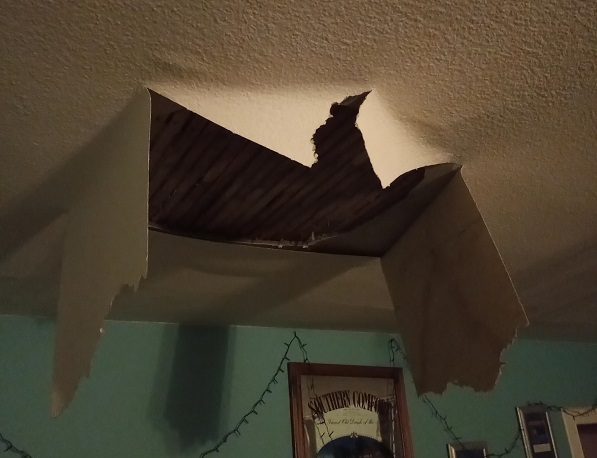
There’s a hole in my ceiling.
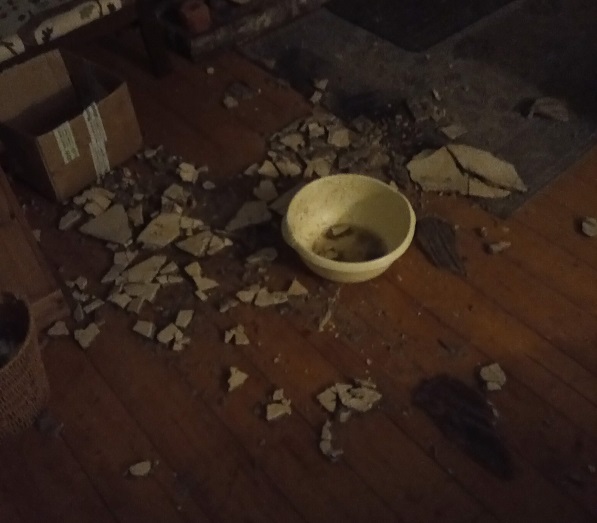
It appeared in a shower of soggy plaster at two in the morning,
thank you, the plumber who couldn’t see the pipework he was soldering.
Now it gapes at me, streamers of ceiling paper ripped apart by weight of water
from such a tiny drip.
I do not know how it will get fixed. Or who will fix it.
Already, I’m in danger of forgetting it’s there.

It’s amazing what you can get used to.

There’s a hole in my planet, a land-slipping crater, the stuff of nightmares. Into it
falls species after species, scrabbling at the edge as the crater gets wider.
Few get out. Few are rescued.
They slip unseen. They fall. Out of sight at the core of the vortex, they join
the bones jangling amid the soup of ruined soil and despoiled seas.
Some measure the crater. They scream
the edge is getting closer and closer
to where this dysfunctional, bipedal, insensate species hovers.
Most look away. The party must go on.
We will not notice the crumbling quicksand.

It’s amazing what you can get used to.

There’s a hole in our lives.
Our patterns and expectations slashed and cloven, our hopes
pulverised. Into this fearful emptiness creeps something tiny and unseen.
It carries fear. It divides us more than it unites us,
provokes discord, brings us down. We look around
to see where our thwarted plans, our comfortable habits, our dreams, have gone.
Where are our friends? Where are our grandparents?
The children we cannot see growing up?
Where is tomorrow? Our bodies are under attack.
Our minds turn backwards, inwards, away.

It’s amazing what you can get used to.

There’s a hole in my ceiling. I sweep up plaster dust.
But it won’t go away.

Muffled in Monochrome

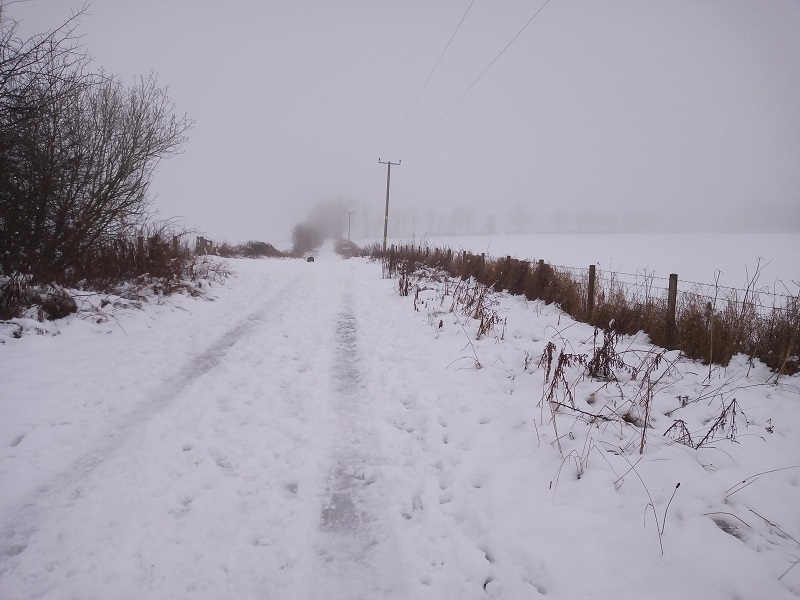
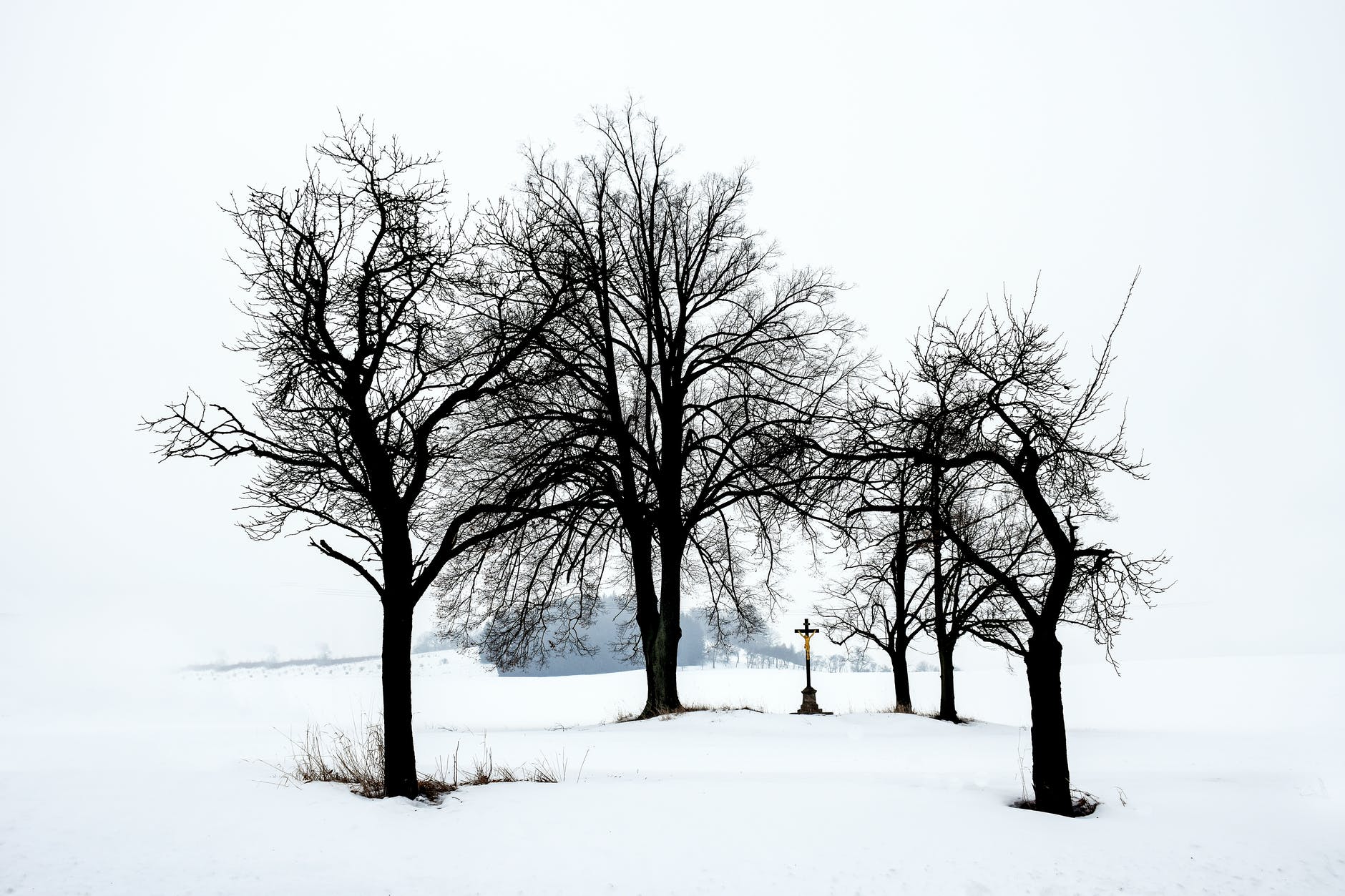
I don’t hate snow, really. It’s just different. It invites us to be indoors, to exclude the cold air, the blinding whiteness, the threats of slip and slide and sink and fall. If it’s around too long, it starts to bug me. Last Friday while reading, I got frustrated by the pinprick of light that seemed to obliterate whatever word I was looking at. Then the pinprick became a ball-bearing, then an expanding ring. A migraine aura. Perhaps going outside earlier when sun on snow had dazzled me caused it. An hour of lying, eyes closed, listening to a dark and frighteningly funny play about the erstwhile president of the USA saw it off but left me uneasy. The sun was gone, and greyness encroached, but I needed exercise, daylight and an antidote to foreboding.

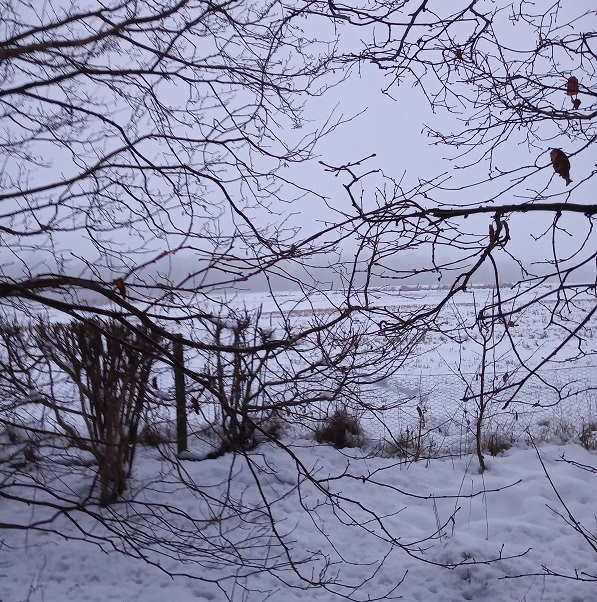
Snow lay thickly on the ground, with an intensity and doggedness that bludgeoned the senses. Dense, white cloud merged into white fields, but it was not easy to know if I was looking at land or air, except where snatches of stubble or deer-scuffed soil peered through a thin, white fog. There were no distant views; everything seemed close, oppressive, heavy and inert.

Vision impaired, a mild headache bleakly persisting, and the opacity of the veil of snow deadening all sound. Small flocks of monochrome birds passed over, silent and anonymous. Solitary grey figures slipped soundlessly across the edges of fields or emerged from woods; we did not acknowledge that we’d seen each other. The sounds I could hear were only in my head; ringing of tinnitus, a faint roaring; result of a year of being virtually locked down and unwilling to self-treat blocked ears after causing an infection with my last attempt.

Seeking light, I went into an open field. The snow immediately came over the tops of my boots and slid down to my heels. I looked for patches of exposed stubble, and followed deer, humans and dog prints to avoid drifts, but they confounded me. The effort of trudging uphill took concentration. I could only see the spot where I would place my next mark on crusty, half-frozen snow.

When I got home in the dim, shrouding dusk, I was surprised to see the hens still out. I stepped into the polytunnel to knock snow off the top from inside. The sight of green, growing plants, brown soil, terracotta pots and little piles of compost waiting to be spread filled me with strange relief. I sat for a few minutes in a garden chair, relishing the last remnants of colour before nightfall. Then I punched the thick layer of snow from the top and sides. It slid off with a rushing sigh. And I saw then that it was not yet dark – the hens were right. Night had not yet fallen, and into this small green space came a brief shudder of light, clarity and hope.

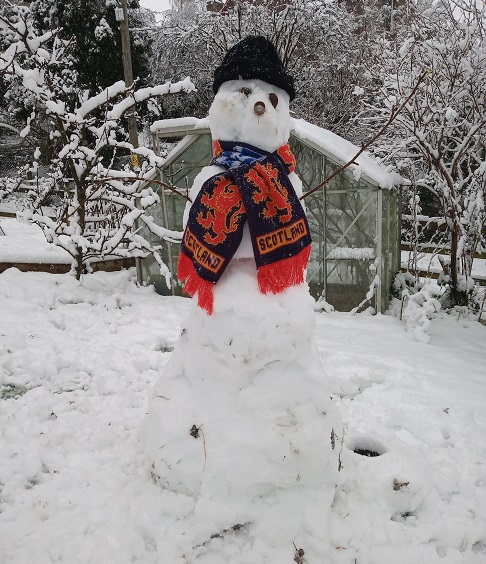
(When I open the curtains onto the first serious snow of January, I am just like any other child.)

Just round the next corner….

How often in the past year have you heard someone say, “You never know what’s around the corner”? Or felt anxiety because you really, really don’t know what is happening or going to happen to you, and the future is obscure? We got caught in the Christmas Covid Car Crash, and are just mentally reeling from a close encounter with coronavirus. We emerge, cautiously and with reluctance from tests and self isolation, while our close family recover from the virus. We emerge into another lockdown, and feel relieved. Self-isolation, let me tell you, can be addictive when you’ve been scared, and realised how ill-prepared you are for dying.

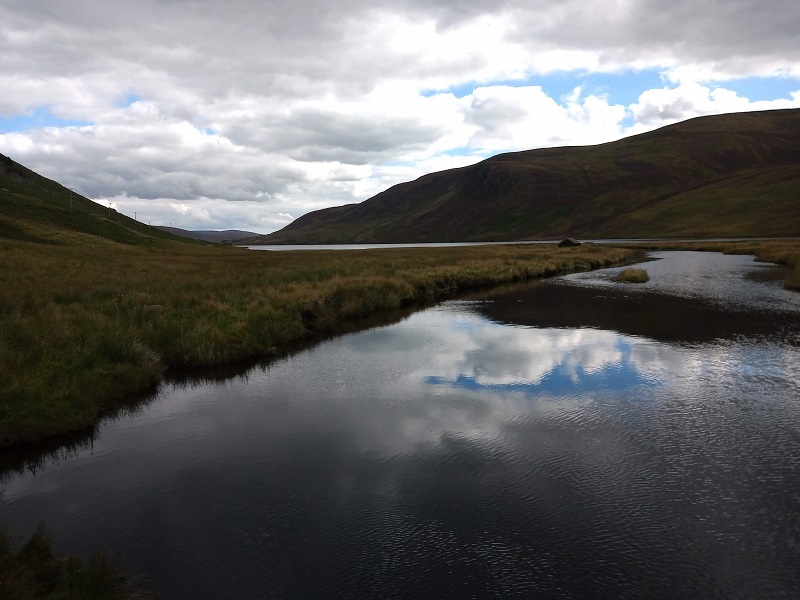
Back in late summer, when such things were still possible, we had a two day camping trip to Glen Esk. On the second day, we decided to take a short and easy walk up Glen Lee. Short, to give us plenty of time to enjoy a cycle down Glen Esk as well. At first, we decided, we’d just go to the start of Loch Lee and turn around. But just beyond the point where the Water of Lee calmly enters the loch, we could see the ruins of a church or chapel by the waterside. “We’ll just go to that and explore.”

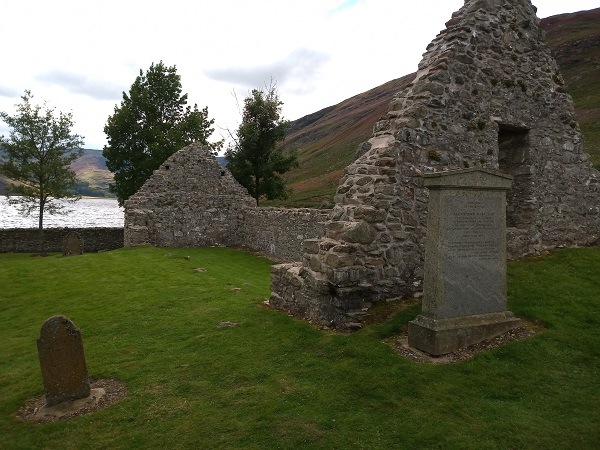
The tiny old parish church of Glenesk had not been used in a good while, but the ancient gravestones, carved with faces and bones and what look like crossed spades, suggested a long history. In fact, a church of some kind is believed to have stood here since at least the 8th century. The sun on the well-tended grass invited a long dawdle and a picnic, and then we ambled along the track by the loch. The other end of the loch wasn’t quite visible, so we thought we’d “just go round the next corner” to see it.

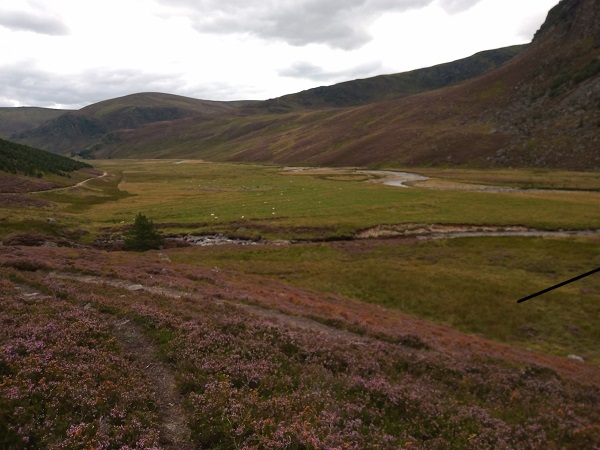
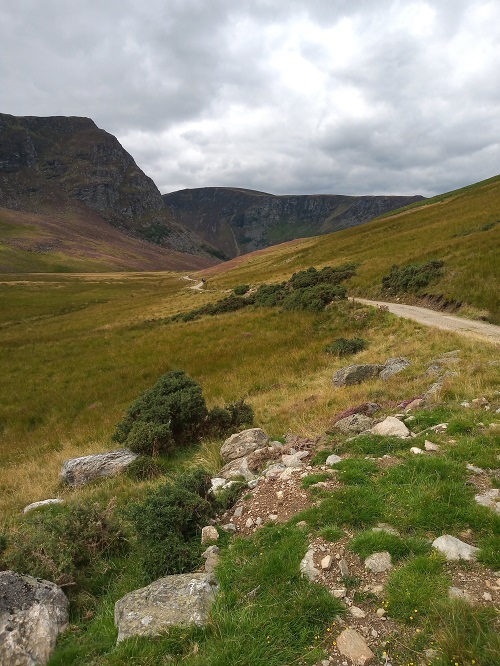
And so we began the inevitable daunder-of-curiosity which besets all walkers in new territory – the drive to see what’s round the corner, or over the next hill. Round and past the far end of the loch, skirting the flat plain where we looked for the signs of ancient habitation, past deserted farmsteads and into the steep-sided valley, up into the purple heather. Every crag we rounded gave us sight of another; we had to know what came next.

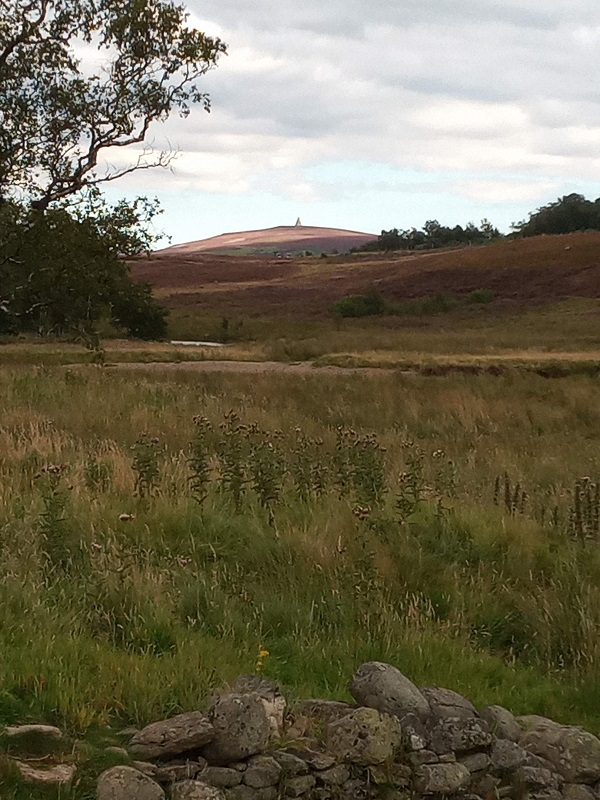
Eventually, we saw the Falls of Unich, where tracks to right and left might have given us a circular walk. But we didn’t have a good enough map, and still wanted a cycle. So we returned the way we came, marvelling lazily at the carnivorous sundews and butterworts in the ditch by the track, stopping to watch a hen harrier swooping low over the crags and rising again, while we, in turn, were closely observed by ravens, shouting harshly at our passing. Before we got the bikes out, we had time to admire the forbidding Invermark Castle and the tempting Hill of Rowan, surmounted by the imposing Fox Maule-Ramsay monument.

On this short walk, we left many corners not turned. Maybe we’ll go back. Maybe we won’t. Truth is, none of us knows, or ever has known, what’s around the corner, even when we succeed in deluding ourselves that we can plan ahead and things will always turn out as we planned. The future’s the un-turned corner, and we can only know for sure about the corner we’re standing at.

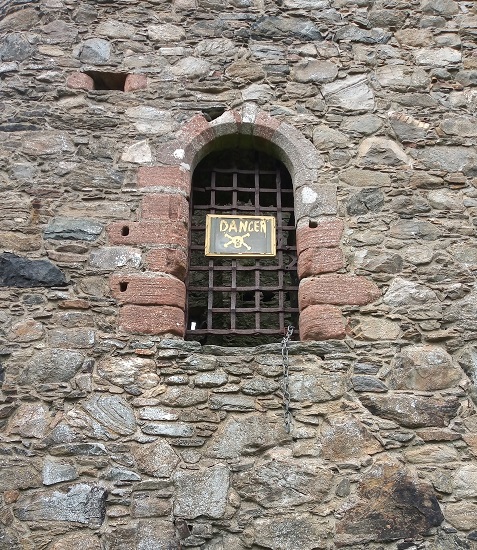
A warning from Invermark Castle

Yggdrasil: The World Ash Tree

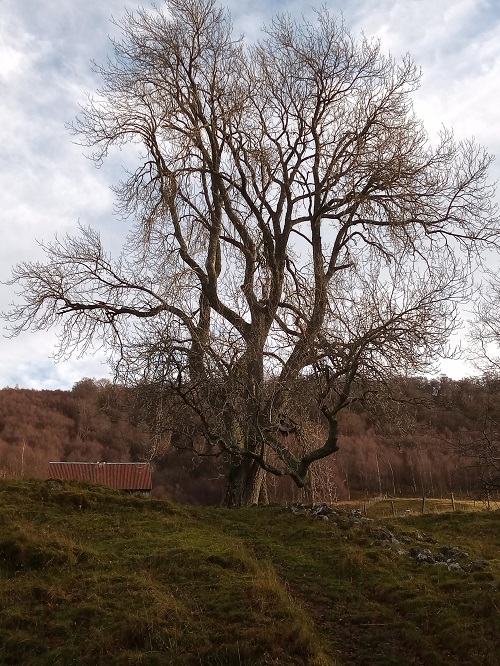
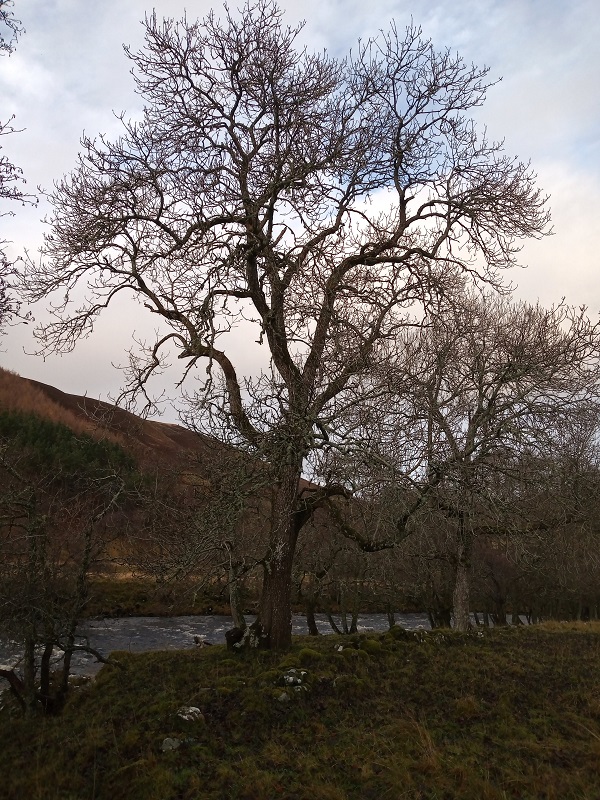
The ash tree, with its distinctive black, pyramid-like winter buds that sit defiantly opposing each other, was the first native tree I learned to recognise in winter. From the grey, ebony-tipped twigs I stood back to take in the whole glorious form of this tree at maturity: the grace and strength of the downward-sweeping branches, the solidity of trunk and main frame, and the artistic flourish with which the ends of each branch skip briefly skywards following their downward plunge.

Like all deciduous trees, the beauty of its structure is revealed annually at leaf-fall. We may love and appreciate our trees in summer, but in winter, we can truly see them. I never tire of looking at trees in winter.

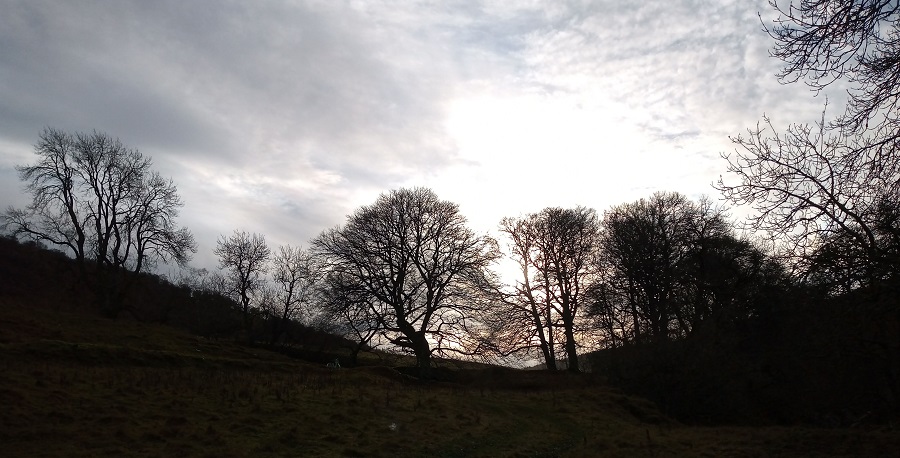
Sadly, the monumental frozen-motion glory of the mature ash is a sight less and less available to us. Ash die-back disease is caused by a fungus (Hymenoscyphus fraxinea) which attacks and infests the bark, leading to wilting of leaves and die-back of those optimistic, sky-seeking terminal twigs. Jaggy, stunted branch-ends and lesioned bark are more often what we see today. The spores are wind-blown, and so it has spread inexorably through Europe. There seems to be little point in felling affected trees, since the fungus spends part of its life cycle proliferating in leaf litter. In pockets where old ash trees are isolated from larger populations, such as Glen Tilt in Highland Perthshire, the majesty of the winter ash can still be seen.

There will be resistant trees, and much is being done to find these, identify their genetic codes, and breed from them. We can only hope the ash tree’s absence from the landscape is temporary.

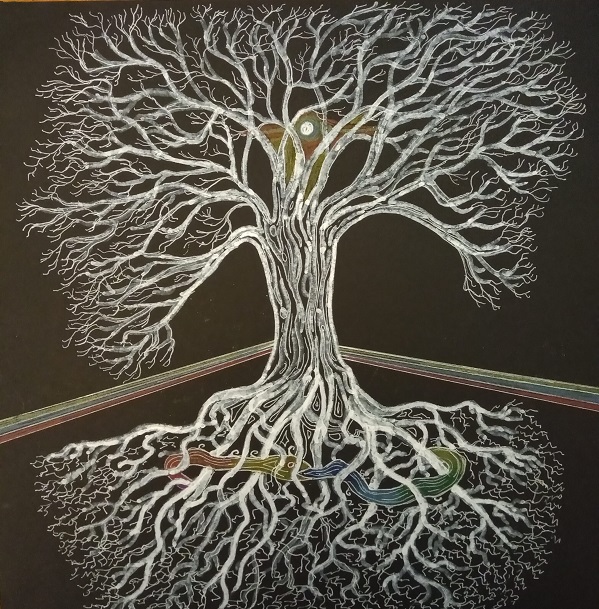
But the Ash Tree has an existence outside the biological. It is – and long has been – a symbol, a magical entity, a talisman. In Norse and Germanic mythologies it is Yggdrasil, the World Ash Tree. Its branches reach into and hold up the heavens; its roots delve deep into the dark caverns of the underworlds, where the serpent-dragon Nidhogg gnaws at its roots. Between the two lies everything we know, and much that we don’t. Three women, the Norns, sit below its mighty branches, tending the World Tree and spinning, spinning, spinning the fates of gods and humans.

The Tree of Life and the Tree of Knowledge are other expressions of Yggdrasil. Odin, father and chief of the Nordic pantheon, presents as a seriously flawed, doubtful and often misguided god. (To be fair, they all do.) Maybe that’s why he disguised himself as the Wanderer, with his wide-brimmed hat (echoed in the character of Gandalf in Lord of the Rings?) and ash staff cut from Yggdrasil, roaming the Earth in search of knowledge and enlightenment. Ultimately, the tale goes, Odin had to hang himself from the Tree, wounded by the ash spear, for nine days and nights, to find the wisdom to save humankind.

Should the Norns cease to care for Yggdrasil, or malevolent forces overtake it, like our blighted ash trees, it will die, and the rooster Gullinkambi will crow from its withering canopy, proclaiming Ragnarok – the Twilight of the Gods.

Will we save our earthly ash trees? Who are the gods whose twilight we would seek in return?

May 2021 bring a sea-change in our relationship with nature, may we all be safe, may Yggdrasil bear new shoots of hope, and may the ash tree survive.

The Duke of Bohemia Part 2

Photo by Johannes Rapprich on Pexels.com

Five minutes later, they left the great hall, passing the grumbling cooks, the supercilious kitchen cat  and the snoring guards, Vaclav pulling the laden sled of logs, wine and pots of cabbage, while Pavel carefully carried the meat and vegetables. There was no sign of Peter.

“Well, Pavel, has he gone home?”

Pavel shook his head, shivering miserably. “I think he’ll carry on along the forest fence to get all the blown down branches. It’s more sheltered that way, Sir.”

The duke nodded. “So, if we cut straight across the fields, we’ll get there first? Well young man, best foot forward. Quicker we walk, the less the wind will nip at our heels.”

On and on they plodded – not a great distance, but with deep snowdrifts and a howling wind which made progress slow. Pavel stumbled often, nearly falling with his load. The light began to fade, making the snow glow with a strange light. The duke puzzled how strange it was that he’d known nothing of the struggles of this old man who worked the fields for him. He wondered how many more were fighting to stay alive, when a stone’s throw away was Duke Vaclav in his castle, feasting every week and wrapped in furs. Why wasn’t I told? he asked himself, and heard another question come back: Did you really want to know?

The snow was falling again – harder, darting out of the darkening sky and blinding poor Pavel, hands numb with the cold and feet that battled with every step. Suddenly, he stumbled and fell into a huge drift, and cried out. Vaclav turned, and hurried back.

“What lad? What’s this? Tired out?”

“No, Sir,,,,but….it’s so cold, the wind is stronger and it’s getting dark.”

Vaclav laid gloved hands on the lad’s shoulders. “We’re nearly there, are we not? Think of Peter, who has to face this every winter’s day. Take my cloak – it’ll wrap round you twice. Oh -and stop trying to make your own tracks. Follow the sled runs, or walk in my footprints. Much less effort and it’ll save the snow running into your boots.

Pavel was encouraged by the duke’s kindness. “Gladly, sir!”

As they went on, Vaclav was careful to take smaller steps, so Pavel could save his strength by stepping in the duke’s prints. The page found the going far easier, and he began to feel curiously excited, even happy.

When they reached Peter’s dwelling, Vaclav’s eyes clouded with sadness as he saw the pitiful way pieces of old wood had been roped together to keep out the weather. Inside, the snow had drifted in and lay unmelted on the earth floor. In the corner, a rough fireplace stood, cold and empty. “First things first,” he said, “lets get the fire going!”

This was Pavel’s area of expertise, and soon a roaring blaze lit up the room. Vaclav swept out the melting snow and started scrubbing vegetables (a skill he’d always meant to learn), while Pavel hoisted the huge joint of meat above the fire to finish cooking. They found Peter’s cooking-pot and Vaclav fetched water. It was starting to boil, and the dumplings had just gone in, when the door opened.

“Who are you – and what are you doing in my home?” demanded the old man, dropping his burden of wood. As his eyes adjusted to the gloom, he recognised the Duke of Bohemia and fell stiffly to his knees in horror and puzzlement.

“Get up, Peter, please,” cried Vaclav, “goodness knows I should be the one on my knees, begging your forgiveness for my ignorance and selfishness. I may be rich, and some call me a king, but all my money and my power have not made me a better man than you.” And he handed the old peasant a mug of ruby wine.

“Wine?” spluttered Peter (who like all Bohemians was first and foremost a beer drinker), “so kind…but perhaps not on an empty stomach?”

“Then let us fill your belly first! Come sit by the fire and feast with us!”

So long into the evening, duke, page and peasant shared a meal, talking and laughing as if they were old friends. Peter told Vaclav of the lives of those who lived around the woods and fields of Bohemia, and Vaclav listened and suggested many ways in which he could help, starting with a new cottage for Peter after Epiphany.

And when the duke stood up to leave, and Pavel, dozing by the fire after all, scrambled to his feet, old Peter suddenly remembered that this was his lord and began to offer his gratitude and allegiance.

But Vaclav brushed his thanks aside. “I should be thanking you,” he said, “for you have given me far more than food or fire. Now I know that my fortunate birth doesn’t give me the right to wealth and comfort while my people starve. And I’ve feasted with kings and princesses and great warriors, but I have never enjoyed a meal so much as I did this one tonight!”

The wind had fallen and the sky had cleared. The snow lay deep, crisp and even, and the air was full of the freshness of midwinter. In the velvet black sky, a single shimmering star shone down upon a silent earth, lighting the way for Pavel and Vaclav as they made their journey home.

Photo by tixler.com on Pexels.com

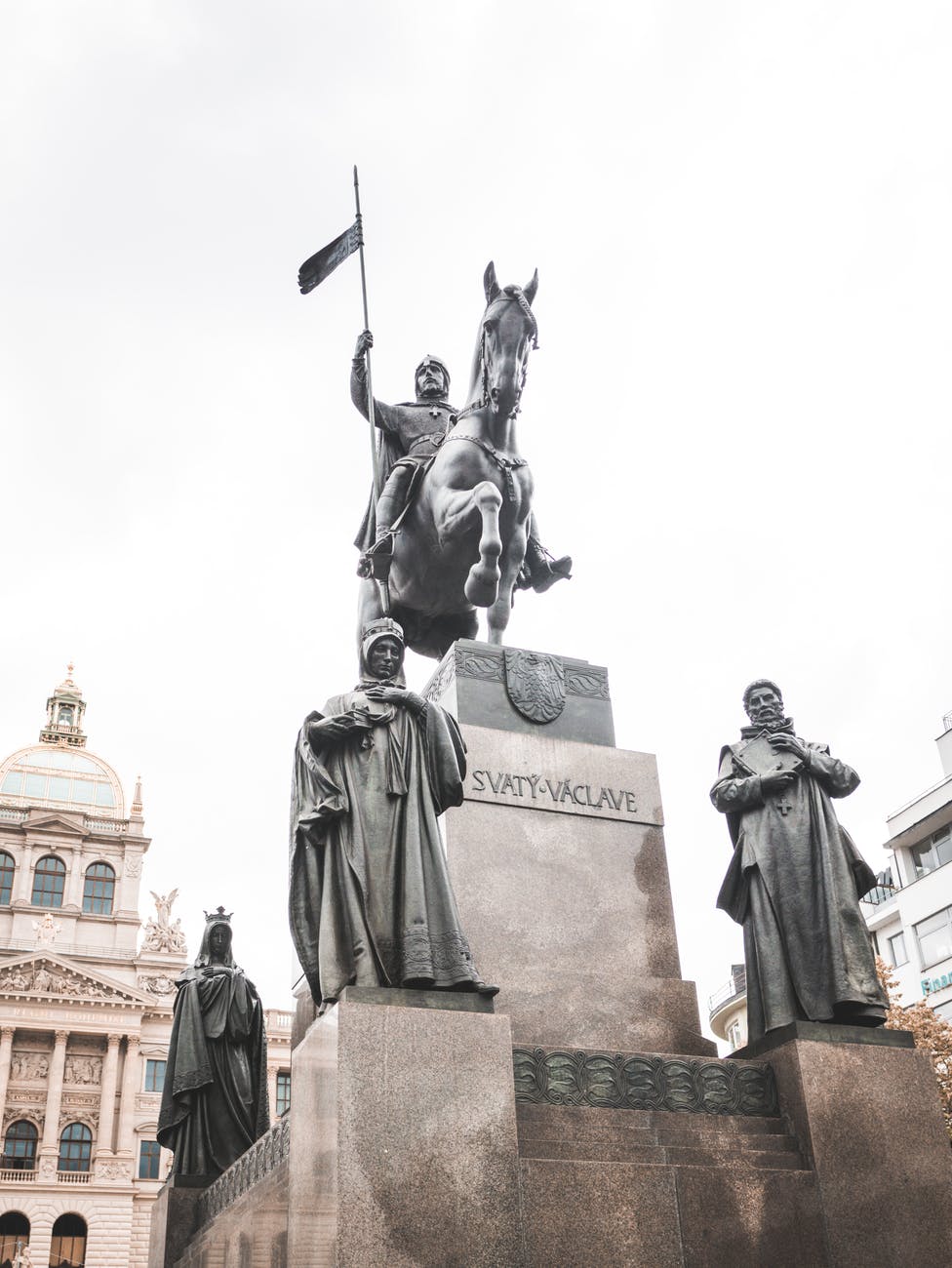
Vaclav (aka Wenceslas) was a real person, Duke of Bohemia 921-935 A.D. They were murderous times, and he was stabbed to death in a plot in which his own brother was implicated. He was revered for his courage, piety – and not least his personally-executed deeds of compassion to the poor of his dukedom. He is considered the patron saint of the Czech Republic, and his statue in the famous “rectangular square” in Prague named after him, has presided over tragedy and joy, winter and spring again.

The Duke of Bohemia: Part 1

A Story for Christmas, that may be Familiar

Photo by SHAHBAZ ZAMAN on Pexels.com

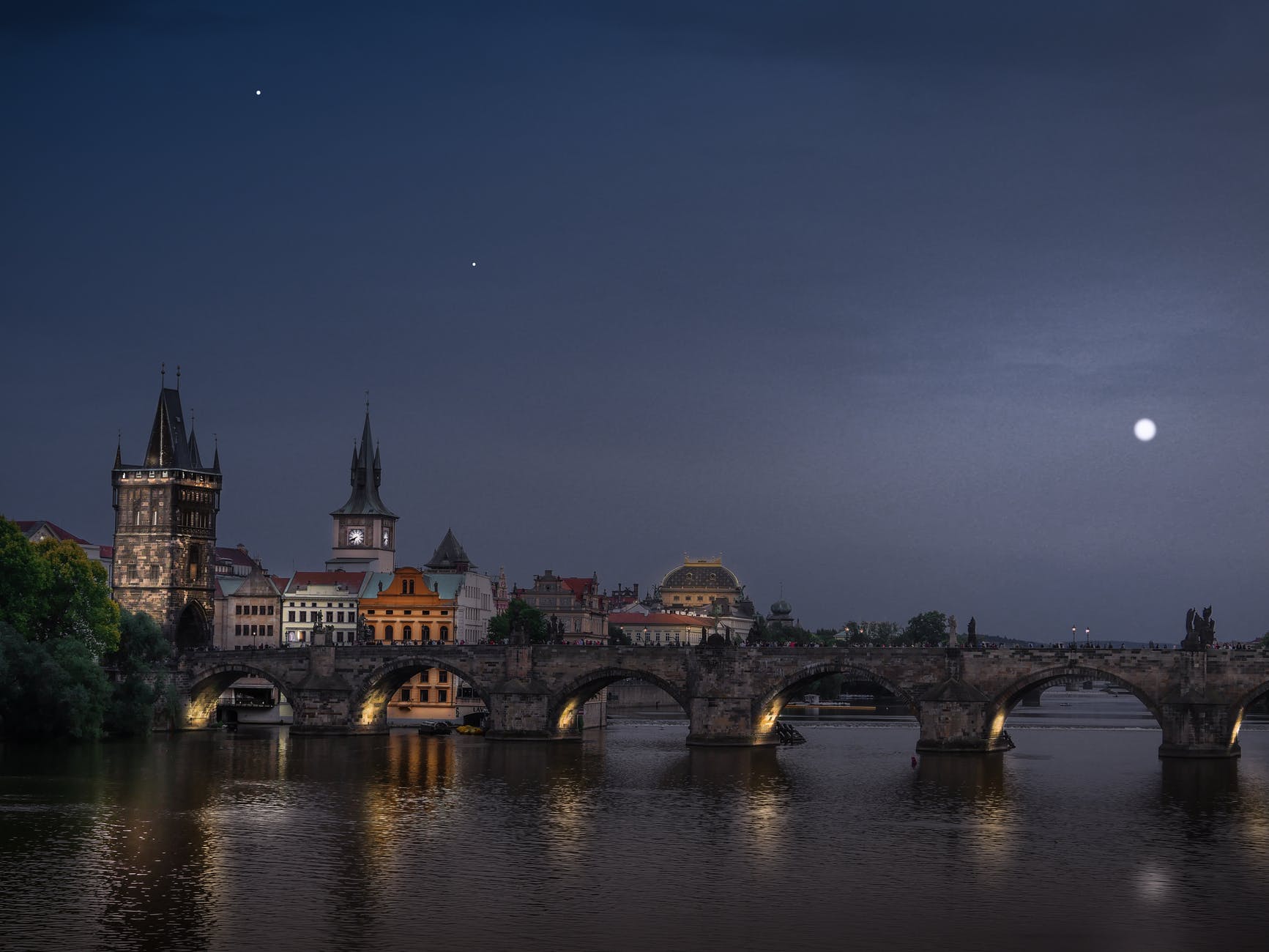
In the year 938AD, it was, as usual, a harsh winter in the Dukedom of Bohemia. Roads into and out of Prague were treacherous with ice, and snow lay deep on the sides of Petrin Hill. Vaclav, Duke of Bohemia, gazed gloomily from the window of the castle, down to Vltava, flowing icily through the town. It was a feast day, St. Stephen’s, and Vaclav could already detect the mouth-watering smells of roasting pork and steaming vegetables rising up from the kitchens.

“Wine,” he muttered, “something red, rich and warming”. He called for his page.

“Here, lord,” came a sleepy-sounding voice from a back room, and a very young man appeared, rubbing his eyes.

“Asleep again Pavel? Cold getting to you too, is it? Run and fetch us a flagon of red, and I might let you have a sip.”

Pavel slipped off, and Vaclav turned his eyes across to Petrin, where he doubted the monks would be very happy in their prayers today. Toasting their toes in the warming house, if they’ve any sense, he thought. Thus, he was surprised – and not a little indignant – to glimpse a small, dark figure, bent against the drifting snow, skirting the edge of the woods that bounded monastic lands.

“Pavel,” he said to the returning page, “Look out there. Is that man insane?”

Pavel gravely followed his masters gaze, then gasped in an astonishment that seemed to Vaclav not a little exaggerated. “My Lord!” he cried in righteous indignation, “a trespasser! What a nerve! How dare he? I’ll get onto it right away, I’ll tell the guards to go and arrest…..”

“No, no, boy, don’t get your tunic in a twist! What’s it to me if he tramples a bit of grass? But do you think he’s in his right mind, going out in this weather?”

“Why, sir?”

“Well, would you be out there today?”

“Certainly not, your lordship, give me a warm fire any day to snooze by. I expect that’s what old Peter is aiming for too.”

“Old Peter? You know him?”

“I know of him, sir. He sometimes helps in the fields in summer.”

“Does he now? So why is he not tucked up by his fire today?”

“He’ll not have one, unless he manages to find a bit of firewood. Old Peter never has wood, he can’t afford it.”

Vaclav peered out again. “Why yes, he seems to have a wood-carrier on his shoulders. But not much in it – the guards will have taken all the wood there.”

“Yes, sir. For the castle,” Pavel put in quietly. Vaclav looked suspiciously at him, but the page’s face was blank.

“Where’s this man’s house then, Pavel?”

“House? He doesn’t exactly have a house, sir…”

“Doesn’t have a house?? What does he have, for heaven’s sake?”

Pavel considered. “Well, there’s a sort of cave, an overhang, near the falls of St Agnes, at the back of Petrin. Peter built a sort of cabin onto the front, and….”

“Do you mean to tell me, boy, that even in midwinter, this man not only has no fire, but scarcely a shelter? What about food? Don’t tell me the man doesn’t eat!”

“Not much, your Lordship. Old Peter doesn’t have much of anything.” They gazed silently out to where the old man struggled against the snow, stumbling in drifts, a pitiful bag of wet, thin branches on his shoulders.

Vaclav silently paced the room, a look of worried amazement on his face. Finally, he turned and seized the page by the shoulders.

“Well today he’ll have something,” he said quietly, “today this man will enjoy St. Stephen’s feast with us. First, fetch that joint of pork I can smell – and some sausages and dumplings.”

Pavel’s face fell, for he usually enjoyed the leftovers from a roast joint himself. But he dared not argue with the determined-looking duke, and went for the food, to the rage and astonishment of the cook.

“Good!” exclaimed Vaclav. “Now, vegetables – a sack of turnips and carrots, and enough jars of pickled cabbage to last a week. Oh- yes – better get a sled ready”. While Pavel busied himself with this task, Vaclav tied up two large bundles of the dry, split logs that were waiting by his fireside.

“There now,” he muttered, that’s all I think.”

“Excuse me sir,” piped up the page. “but what’s he going to drink?”

“Didn’t you say he lives by the waterside?”

“Oh yes. Of course, sir. A peasant couldn’t drink wine like a king…or a duke…” Pavel looked very humble.

“I see,” said Vaclav, screwing up his eyes, “make me feel worse, why don’t you. Alright – go to the cellar, and roll out a cask of the finest port wine onto the sled.

Pavel raced to obey, and by the time he returned, the Duke of Bohemia was wearing his thickest, fur lined cloak, stoutly belted at the waist, and an enormous furry hat that covered his ears and strapped under his chin. The page gasped. “Are you…..”

“Going to deliver? Of course we are! I wouldn’t trust the guards not to scoff the lot the second they got out of the gate!”

“We, my lord?”

“Of course, “we”…. I couldn’t drag and carry all this lot by myself, could I? It’s your lucky day out!”

Photo by SHAHBAZ ZAMAN on Pexels.com

The story will be concluded on December 26th, Boxing Day, or, appropriately enough, the Feast of St. Stephen.

By Riverside to Denmarkfield

Photo by Pixabay on Pexels.com

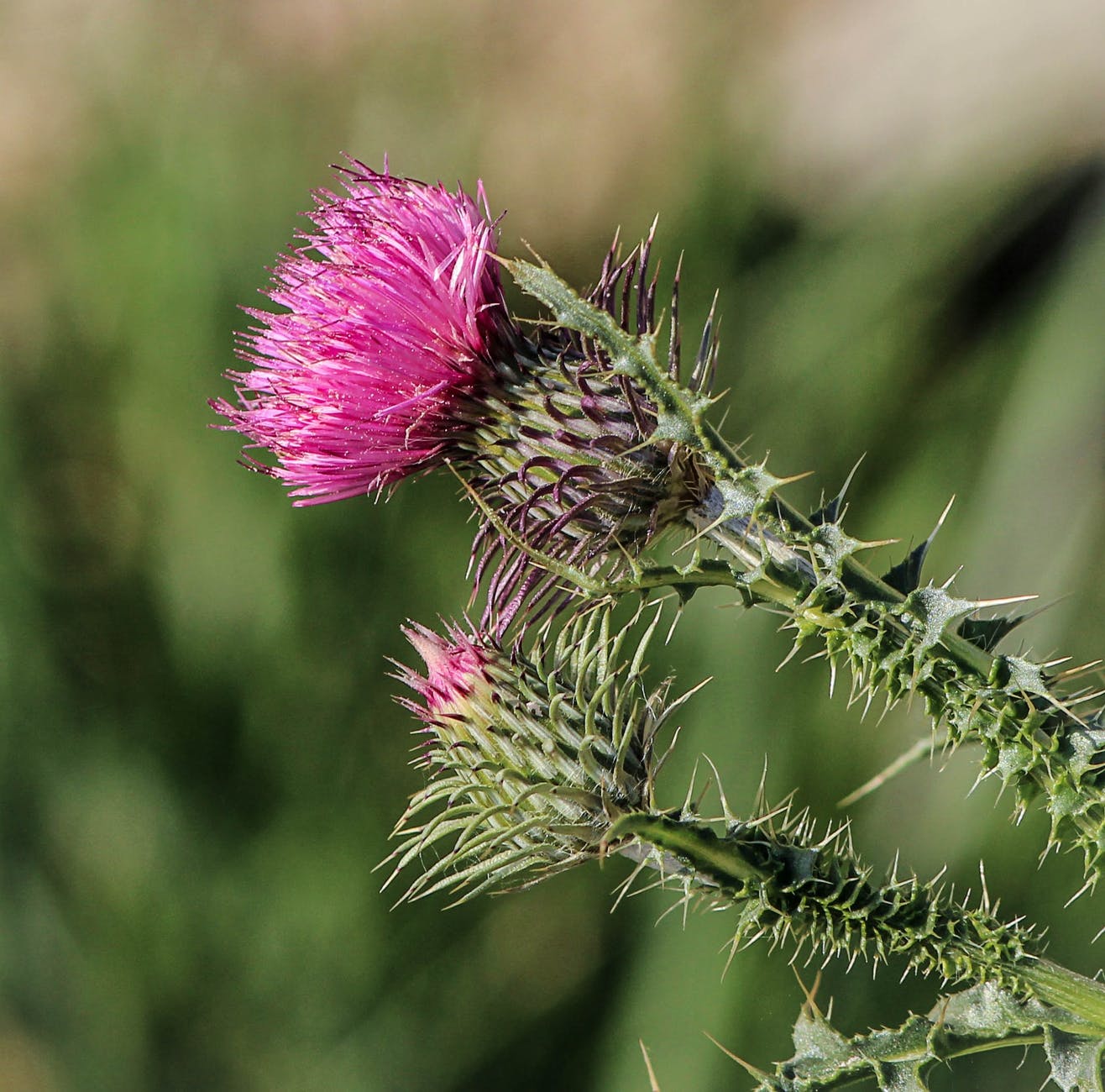
There’s this story in Scottish folklore: A king (Scottish or Pictish) and his army were engaged in a long campaign to repel the Danish invaders who were terrorising the east coast. The Vikings knew that the only way to gain free access to the rich breadbasket lands and the treasures of the religious houses was to defeat the king’s army, which was camped, exhausted, by a river, thinking itself safe for at least a night’s sleep. The Viking spies located the army. and to gain advantage by stealth and secrecy, the warriors began to creep up on foot, swords drawn, and surround them. Thinking their boots made too much noise, the leader ordered his men to go barefoot. Their goal was in sight, until a skull-splitting screech and an unrepeatable Scandinavian oath filled the air. One of the Vikings had trodden on a well-armed Spear Thistle. The kings army were thus warned, and sprang to action to repel the invaders. Since when, the thistle has always been the emblem of Scotland.

*****************************

Last Sunday was the first of the seriously cold days of this winter. It will get colder, but we will have adjusted to it. Nevertheless,it was still warmer outside than in our currently challenged-in-the-heating-department house, so we decided to go for a walk to warm up.

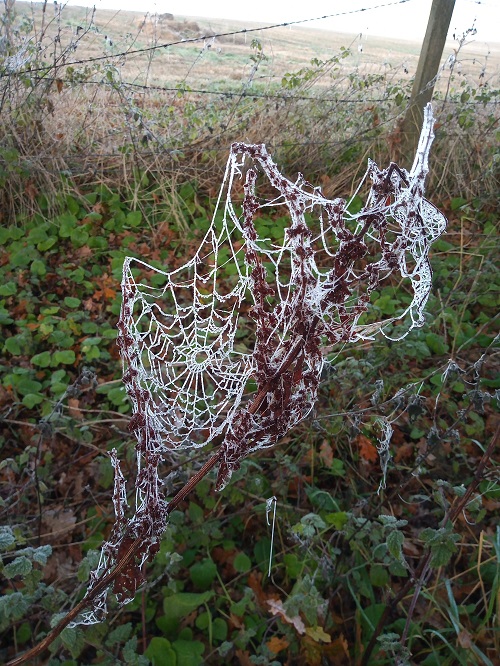
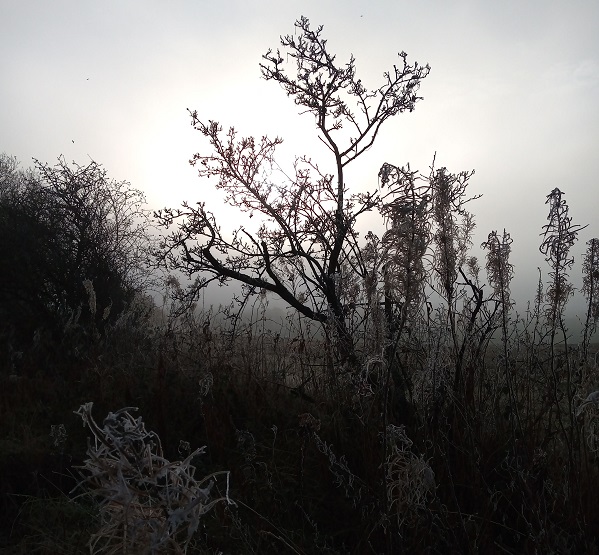
As we sauntered along the footpath from Luncarty to the River Tay, almost a hollow lane, beads of frost and frozen droplets of moisture clung to any material they encountered. Ephemeral, discarded threads pf spider gossamer waved like chilly bunting. Touch one, and it evaporated. Frizzy, curled husks of ice-tipped willow herb seedheads towered as if frozen.

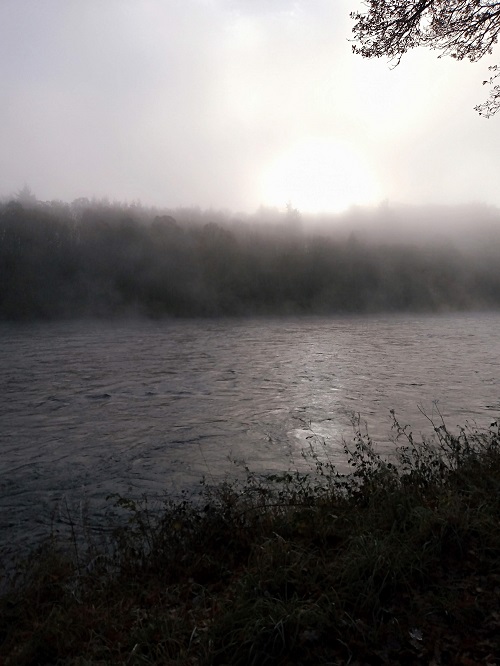
A haar descended. Generally the haar creeps upriver from Perth; today it seemed to come from all directions. Its gloom, exacerbated by the knowledge that somewhere behind it the sun is weakly shining, has the coldest feel imaginable. With wreaths of steam-like fog and mist flowing above the surface, the Tay resembled an Icelandic hot spring.

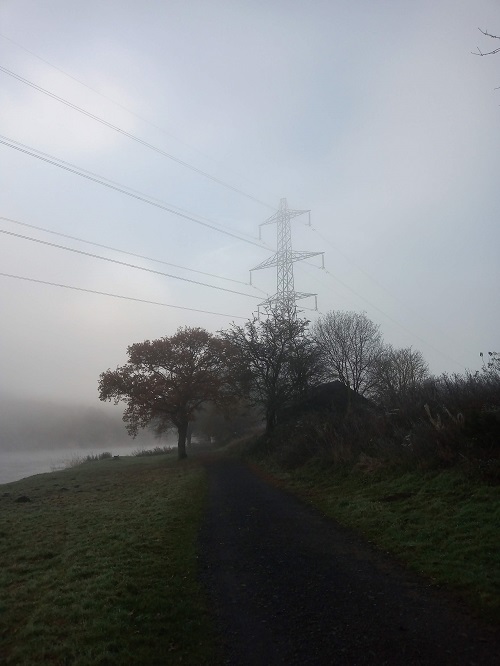
The river path proper starts at the site of the old Waulkmill Chain Ferry – once the only convenient way to cross from one side to the other. It closed as late as 1964, but I think this must have been a crossing point for many centuries before the chain ferry and pontoons were in operation. We headed in the direction of Perth City, watching gigantic pylons loom up from the cold dense air, bringing to mind the Martians from H.G.Wells’ War of the Worlds.

And then we came to the derelict bulk of old buildings beside Denmarkfield Farm, and the unmarked stone that stands in the weedy, thistle-infested ground just above the river. Here, locals say, is the site of that momentous battle that propelled the Scots thistle to prominence, and the stone – called the King’s Stone – marks the spot. That’s why the place, and later the farm, have been called Denmarkfield ever since.

There are plans to build yet another road, the Cross Tay Link Road, from here to Scone on the east bank. The land around the King’s Stone (actually far older than the 10th century) is under a compulsory purchase order. As people speed over the new bridge that will cross the river, congratulating themselves on the ease and convenience, will anyone remember the Waulkmill ferryman, the king who slept by the river, or the Viking with a sore foot?

The King’s Stone

Being Cold

I had thought my days of being torpid and uncomfortable in a cold house were a thing of the past. But an unfortunate tangle with a renewable energy company apparently having major hiccups and losing the plot – at least of our contracts – have found us without heating or hot water for a month and contemplating, in early December, whether this was as bad as other cold houses I have known and loved (in summer)?

First there was the single-brick construction of a bungalow called Berberis, in rural Essex. It boasted single glazed windows in rotting, leaking frames, a total absence of insulation and a rickety “hot” water cylinder perched above a bath, where humans, clothes, linen and everything else had to get washed. There was, of course, no heating – but there was a tiny fireplace in each of the four rooms. The first winter I spent there (1985-6, one of the coldest of the century), I didn’t have the slightest idea how to light a fire in a grate, having been raised as a gas-fitter’s daughter. I was also completely skint, a student, and alone.

I decided I could afford a calor gas heater, which did wonders for increasing the condensation and mould on the walls. As the winter progressed, good friends and relations rallied round, taught me how to light fires, brought me logs (which I cut up with my father’s carpentry saw), and helped rig up clingfilm double glazing over all the whistling windows and their holey frames, draught-proofing for the doors, and thick material for curtains. I slept in the warmest of the bedrooms (the one which didn’t have rattling French doors), in a woolly hat, under a mountain of inherited blankets, with an axe by my side and a tiny fire in the grate.

The second winter, after a summer of falling in love with the house and with my own self-sufficiency, I wasn’t alone, and we spent a good deal of it roasting chestnuts and making babies in front of a roaring fire of logs scavenged from local woods.

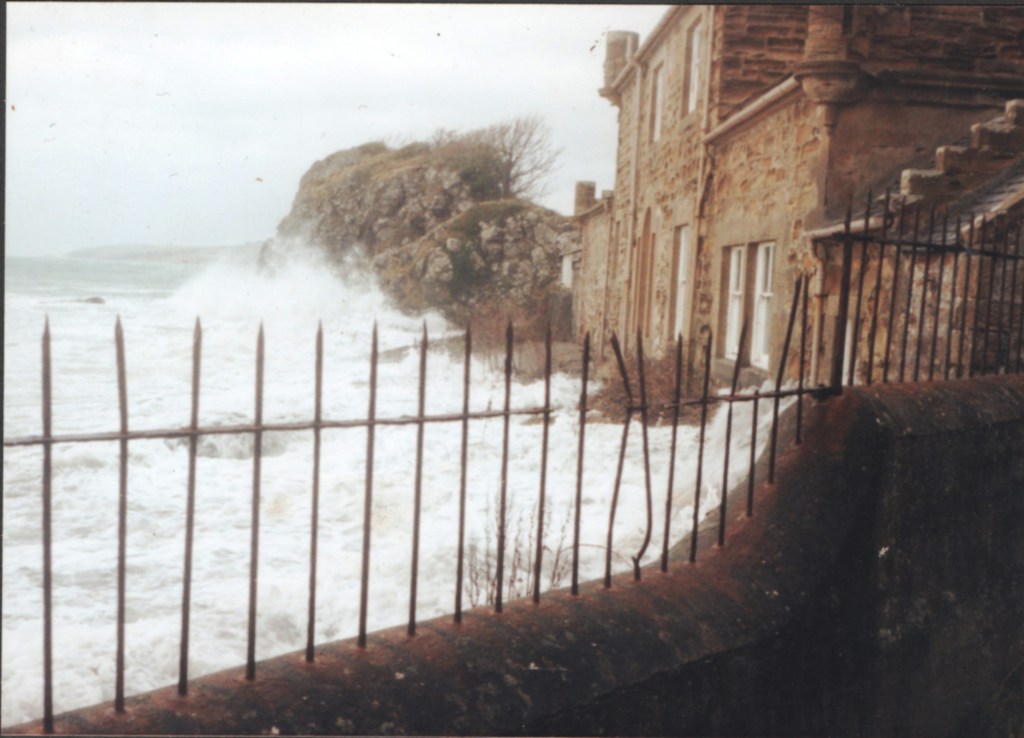
Berberis was certainly challenging, but perhaps the challenges were easier to combat than those of the huge, high-ceilinged “tied house” that was our first home in Scotland a few years later. Did I mention that it literally sat on the beach? And that at spring tides, the waves actually broke onto the walls and windows? It was an impressive building, designed by Robert Adam, and an incredible joy to move to in April from the claustrophobic and embittered south east of England, and to live in with our two babies all through the summer. But Adam never intended it to be a home. It was a rather ornamental, converted laundry. Most of the massive, single glazed windows looked onto the sea (amazing views of sea otters and Arran). There was one wood burning stove in the cavernous living room, and a couple of gravity fed radiators up stairs by the lukewarm-and-no-more water tank.

The house on a beach

As winter approached, the shortcomings of the stove became apparent. The biggest problem was fuel. Part of the tied-house deal was that the estate foresters supplied all the tenants with wood for burning. They weren’t our biggest fans on several counts. One, we had English accents, full stop, and were seen to be in cahoots with the higheidyins (also English). This wasn’t justified, but hey. Two, said higheidyins had asked my partner to put forward his ideas on the ornamental trees on the estate. He took them at their word and (never the best diplomat) incensed the head forester who saw all trees as under his sole jurisdiction. Three, and worst of all, to accommodate the arrival of a family of four, one of the forestry team had been moved out under protest from this house where he’d lived alone for several years. Thus, it was that, when we asked for logs, they took a long time to arrive and were the wettest, greenest, least calorific bits of spruce that could be found. Whereas everyone else got them ready split and chopped, we had to process them ourselves (reasonable enough, given we had the equipment – but they were also impossibly knotty).

Appealing to the Trust for help with heating led to the delivery to the kitchen of a second-hand solid fuel range. It turned out to be cobbled out of an oil fed system, and wouldn’t work. The kitchen floor was concrete, with no floor coverings, and we couldn’t afford to buy any. With only one of us earning a gardener’s wage, and the occupancy of a tied house being reckoned to make our income double what it was, thus making us ineligible for any benefits, we were snookered. I began to get chilblains, and had to stand on a pad of old newspapers when washing up or cooking. For a while I tried cutting the dead meadowsweet stems from by the burn for floor coverings, but though they smelt nice, they didn’t really help. Our small daughter wet the bed. Our son, eighteen months old, developed sleep problems and would wake us all every night. For some reason, we didn’t connect it with the fall in temperatures, but did notice he was kicking off his cot blanket. So, we got him used to a proper bed where the blankets could be tucked in, and moved him into a downstairs bedroom which had smaller windows not facing the Atlantic gales. It also got the morning sun. He still woke most nights to start with, and I’ll never know if the eventual improvement was down to location or the weather just improving.

Meanwhile, I raged at the impossible range and the recalcitrant stove, wore gloves indoors, and spent as much of each day as I could tramping the estate with the babies to keep warm. My partner in a fit of temper one day threw a shovelful of coal into the stove. I assumed the stove would blow up, being a wood-burner, but instead it actually grew quite hot for once. Right enough 90% of said heat disappeared immediately five metres up to the ceiling. For another day, we fed it bits of coal, like feeding an addict tiny amounts of a drug to control its habit.

And guess what? The chimney breast began to roar, loudly, and became too hot to touch. Then flames issued from the 18th century chimney. The days were icy, even at sea level, and the track down the cliff to the house was too dangerous for the fire engine to use, because the estate team had overlooked our track when gritting. The fire-persons (the leader was a woman) descended on a sledge with the firehose and some equipment, and put the fire out in three hours. To do so, they broke a huge hole into the flue, rendering it unusable. It hadn’t occurred to us that the chimneys might not have been swept for years. Who knows, the ineffectiveness of the stove may not have been solely down to the logs.

After that, grudgingly, a better range (still recycled from another property) and a rudimentary heating system were put in by the Trust. By then it was spring, of course. The joys of tied houses. But we left there the following winter, for a remote, off-grid smallholding with a working solid fuel range and a pot-bellied stove where we put up a wind generator and often got snowed in a week at a time. It was positively toasty!

I really hope our energy company’s problems get sorted, that at some point we move up on their list of priorities, and we can achieve, again, carbon neutral hot water and a warm house. I know there are worse positions to be in. In that Adam laundry, ten degrees celsius was a good temperature – not that my study is even achieving that on cold mornings at present. Now, at least, we have a brilliant woodburning stove that never goes out, even when you need it to, to empty the ash. We can afford to put on temporary convector heaters, although it still goes against the grain. Never, ever, undervalue the bliss and luxury of hot water in the tap.

A record low in my study last Sunday

Last Leaves Falling

A Post for West Stormont Woodland Group

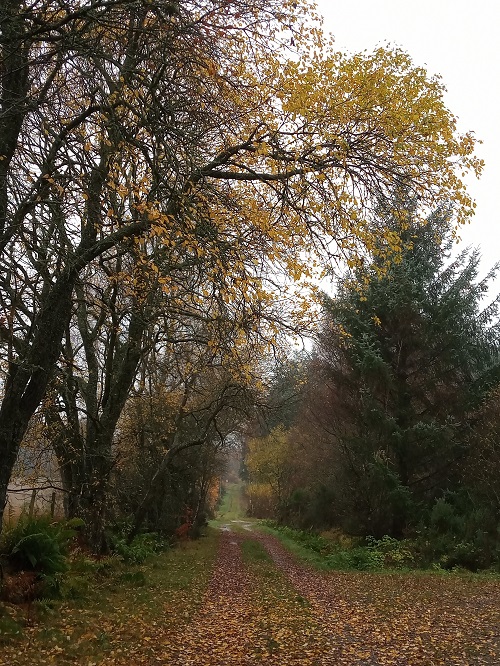
I pause on my way through the woods, quieting my breathing, keeping as still as I can. There is no sound, there is no wind. There should be no movement. Yet within the vascular systems of the broadleaved trees that bound the track, small enzyme changes are at work, invisible changes that lead to letting go, abscission, leaf-fall.

And down they come, silent, slow, like snowflakes in a still winter’s night. There is no flurry, no sound of wind through dry foliage, just the falling. Just the peace. Some trees are bare already. Birches are among the first to blaze golden and lose their leaves. Oaks keep hold of theirs till the last, but then they are usually the last to open in spring. Mature trees abscise before young ones. Young trees, and trees that have been pruned, will produce what’s known as juvenile growth, one feature of which being that the processes of leaf-fall are delayed. That’s why beech trees are so popular for hedges, the dry, crackly leaves slipping from gold to brown and staying in place till spring.

Young beeches, self-sown among the conifers at Taymount Wood’s dark heart, shine like tawny beacons.

They coat the ground, these last leaves, slick with last night’s rain and the condensing sweat of mist that loiters in motionless, tangled branches. Small sweeps of the already fallen lie around sedges and rushes, in hidden puddles and ditches. What else do they conceal?

A small brown toad lurks unmoving as the day, camouflaged among old birch leaves at the path edge. Then he moves, lopes distractedly into the grass, and is visible.

I like the emergence into visibility of the toad, and I enjoy the wood revealing its secrets as the leaves fall. The bizarre jutting side-branch of a fir tree, and the even more inexplicable branch that has fallen over it like a necktie, and somehow grown into an A shape. The filigree, waterfalling twigs of bare birch trees. The holes in trunks and large branches, the red squirrel’s aerial expressway from tree to tree. When leaves fall, I see that some trees are still richly clothed, decked in lichens and mosses so profusely you can’t see the wood, and decorated with the jewels of fruit and fungi. Food, forage and habitat here for small creatures that depend on the woods through the winter.

By the King’s Myre, the stillness of the day is magnified by the strange open vastness of this stretch of water. Reeds and trees and overhanging trees are reflected; birds are absent or silent. In the boats drawn up to the jetty, the leaves lie in rain that’s collected there, the sky bounces back, grey, metallic, motionless. There are no wafting clouds; it is all cloud, all greyness. And more leaves unhook themselves from life, drift down soberly against the small frictions of the early winter air.

On twigs and branches, wherever a leaf falls, a small tight bud, wrapped unnoticed in its winter coat, remains and waits.

A Slow Pilgrimage to Siccar Point

Photo by Dominika Roseclay on Pexels.com

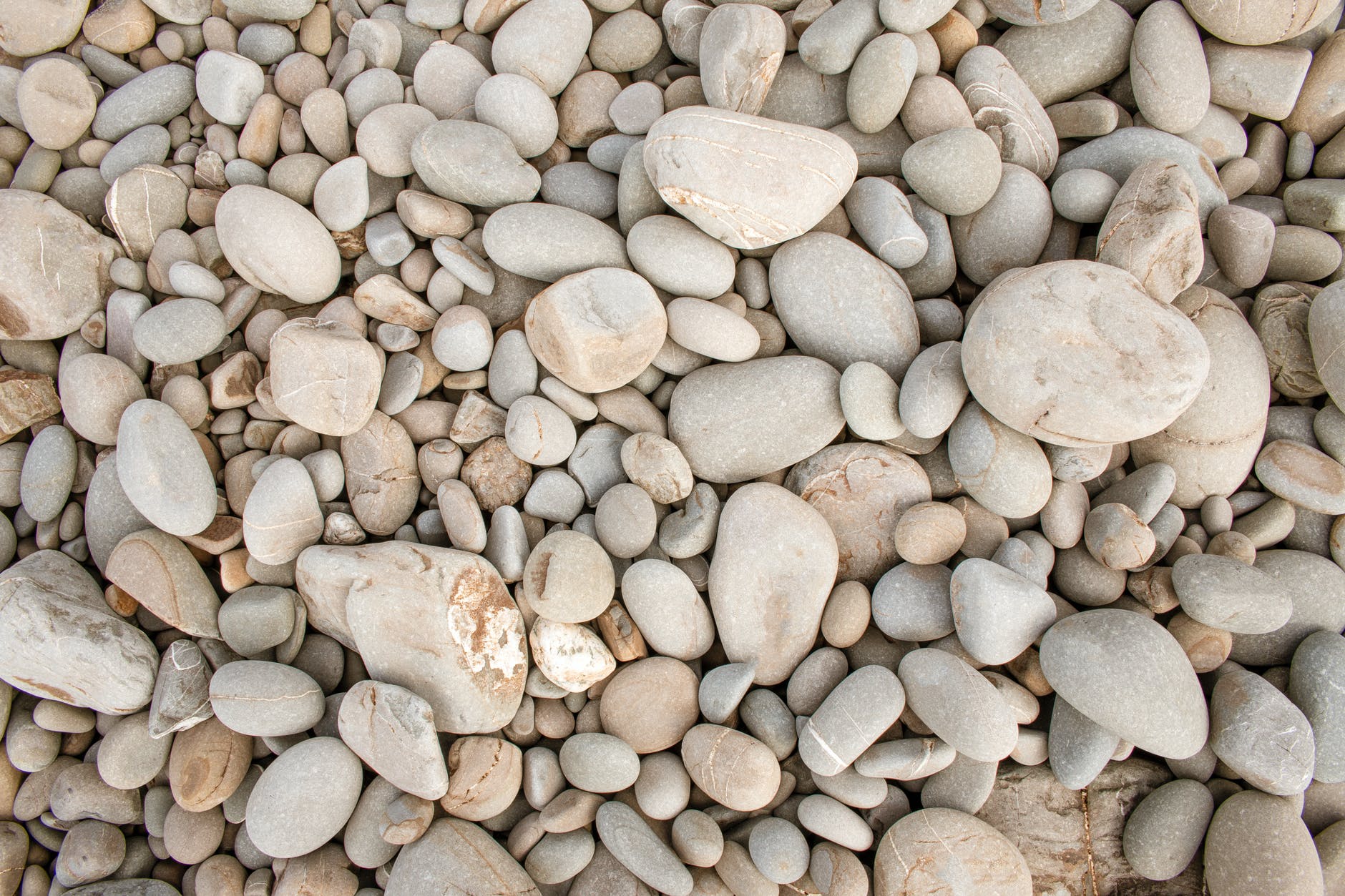
I always liked stones. I collected pebbles on the beach from childhood, and in my teens followed my sister around Ayrshire beaches where the pebbles had magical names – jaspar, carnelian, agate, onyx. I went to the Leadhills in search of galena. I polished stones with carborundum, to little effect.

And, secretly, I developed the habit of having a special stone, of no particular value save that it caught my eye and fitted in my palm, in the pocket of every jacket.

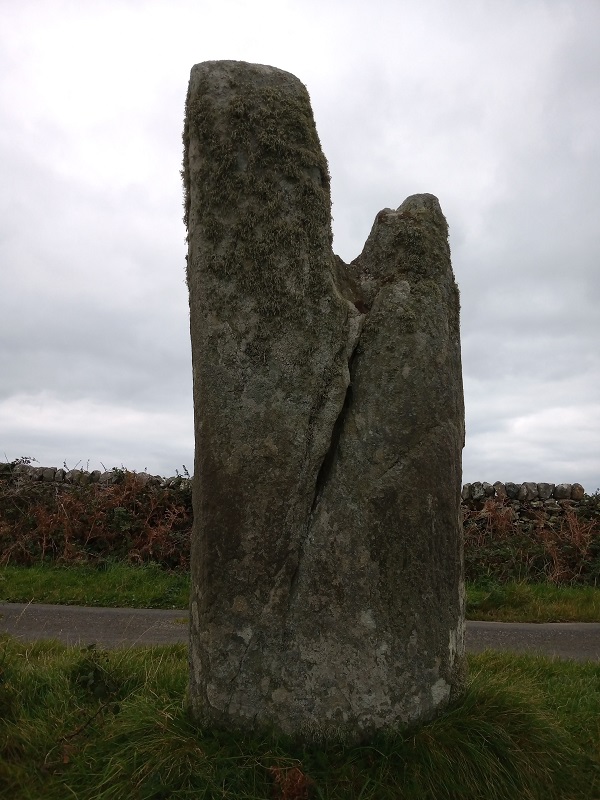
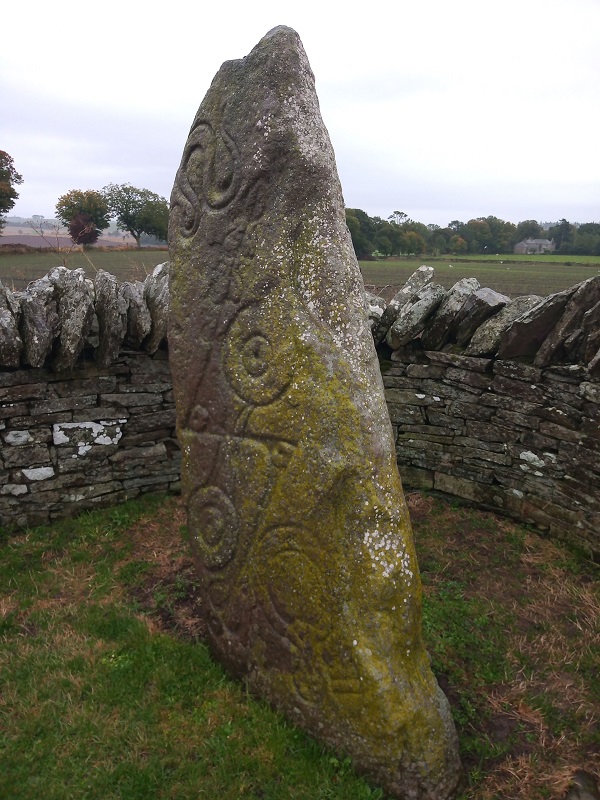
I liked big stones, too, stones with human names and imprints – the menhirs of West Cornwall, the cairns and ring-marked rocks of Mid-Argyll, the carved stones of Pictland. I had no better idea than any expert why they were placed where they were, or what the painstaking sculptures were for. But I knew the people who made stone circles kept pebbles in their pockets, too.

In some kinds of stone, I invested more thought than in others. Granite: shards of feldspar, glittering quartz and the now-you-see-me-now-you-don’t shine of mica. The stone that made up Dartmoor tors, Scottish mountains and an unlikely acid-soiled, heather-clad, craggy-topped park near Leicester. Gritstone: hard-working rock of wind and watermills, a sharp, scraped, glowering edge in the Dark Peak. Quartzite: white, altered stones casting spells on Schiehallion, the fairy hill.

What were these rocks? Where did they begin? How did they get here? Where will they end? Why are they different? Why do they paint different pictures on a landscape? Why did that Leicester park make me feel I was in Scotland?

I found out most of the answers by studying Geology and Environment through the Open University, alongside biological sciences. One day on a field trip as I stood with others sketching outcrops, bedding planes and all the various features before me, I suddenly saw it. The landscape which had left crooked teeth of rock strata from one extreme to the other of my field of vision was once a monstrous anticline – one of scarcely imaginable proportions, like an outrageous rainbow. At some point it had collapsed on ancient fault lines. Before these rock strata had formed the bow, pushed up by plutonic forces, they had quietly lain flat and growing, at the bottom of a deep and ancient, long gone sea. I had found a new dimension to reading a landscape – one that underlay all the others.

 As I moved towards completing my degree, two options loomed. Rocks? Or plants? Geologist or gardener? I chose plants, but continued to collect stones, embrace menhirs and mentally compute the past from the present view wherever I could.

And so, one wet, unwelcoming day, we walked the coast path in Berwickshire to Siccar Point, in the footsteps of James Hutton, Hugh Miller and all the great Scottish fathers of geology who had embraced with reluctance or excitement truths about the age of the Earth and the forces behind its formation, all revealed in the inconvenient truth of rocks not being where they were supposed to be.

Hutton’s Unconformity.

The wind was fierce and uncompromising. I trembled on the famous cliff, and understood why Hutton had gone by boat. Deposition, uplift, volcanic forces and metamorphic sleight-of-hand. Readable by some, wondered at by many, denied by others. I collected no pebble, no souvenir. Just the imprint of the wind, cold as stone, mutable as stone.