Reeds, Rushes and the Spaces between Trees

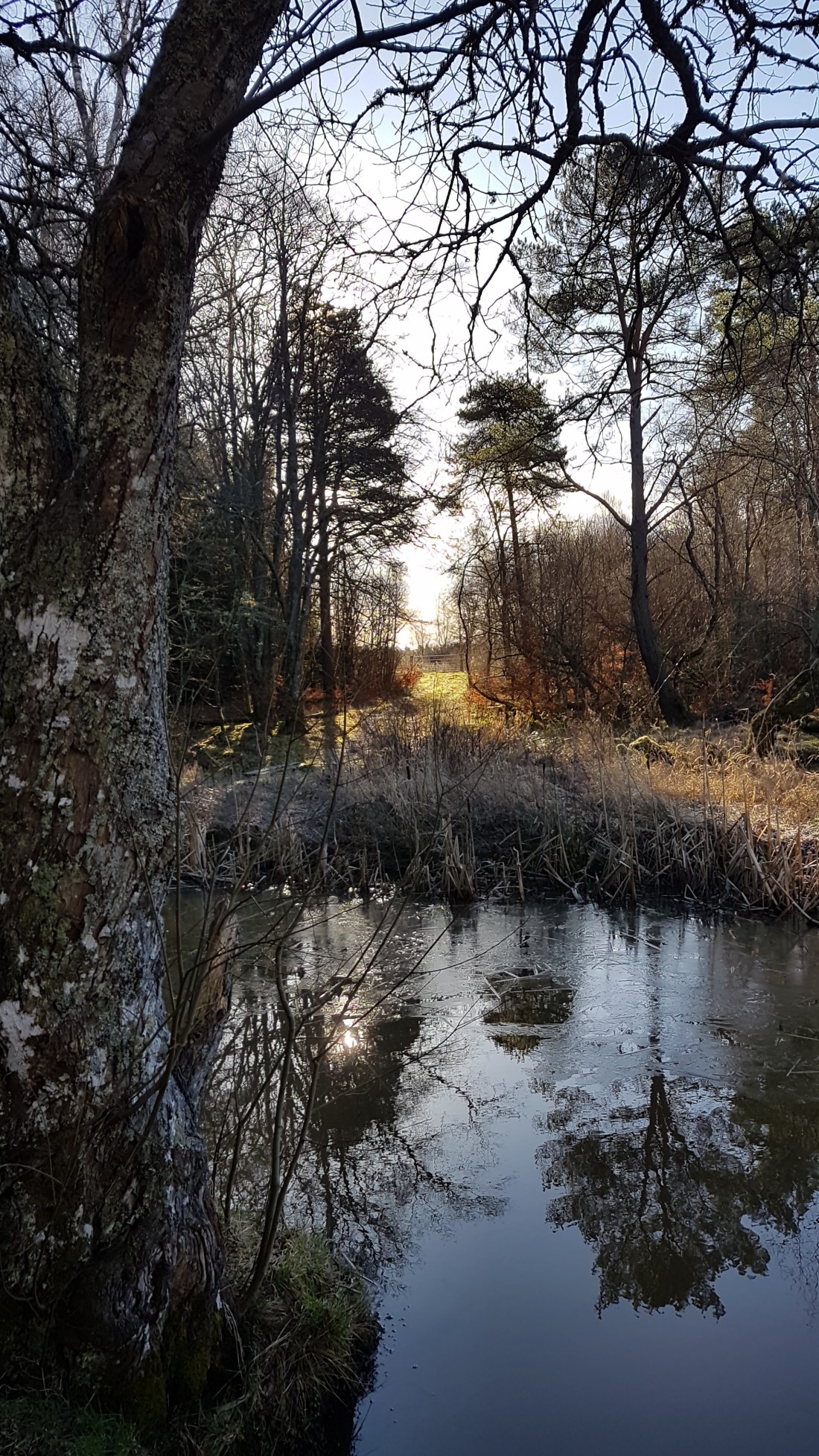
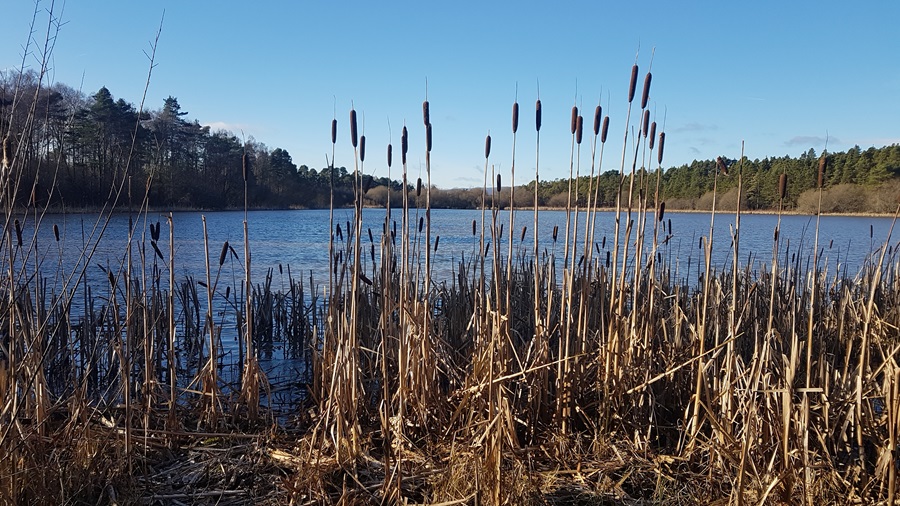
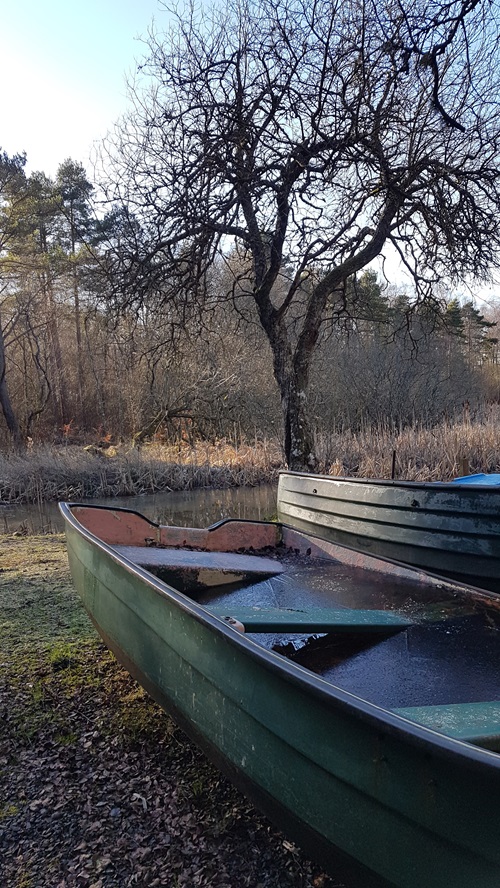
On a quiet day of winter sun and muted activity from woodland birds, I arrive at King’s Myre again. Reed Mace flowerheads from last year cluster around the watery margin, clogging the channel by the little jetty where the boats wait and fill with rain. We used to call them “bulrushes” where I grew up, and it wasn’t till Mr. Illesley, in Rural Studies, enlightened us all about the differences between reeds, rushes, sedges and grasses that I ever learned their proper name– or that Reed Mace is related, but none of these anyway!
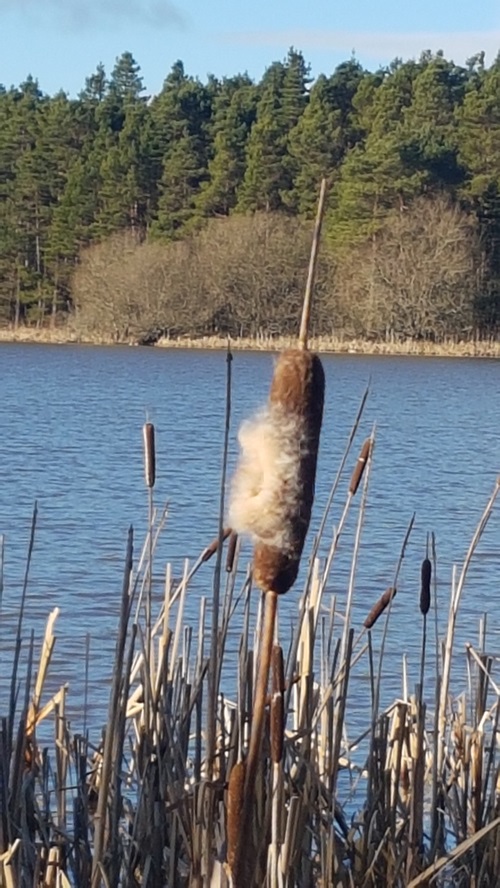
It is the same plant known as cattails in America, and valued throughout its distribution for its edibility. The rhizomes – root like underground stems, or underwater ones in the case of this plant – are starchy and filling when baked. They can also be dried and ground into flour, though I never have. The pollen from the male flowers can be used as flour too, or to thicken sauces and soups. It has many medicinal uses. But the best part is the emerging shoot – which will be appearing above water level any time now. Cut, cleaned, steamed, baked, sauteed – it is a lovely spring vegetable to rivals asparagus or bamboo shoots for flavour and versatility. You can keep eating the shoots until the flower spikes start to emerge, you don’t need waders to forage it, and, as Reed Mace is actually quite an invasive plant, it’s pretty sustainable to nibble bits off the clump! Last year’s flowers are starting to burst apart now, revealing the dense, cottony-fluffy seedheads inside.
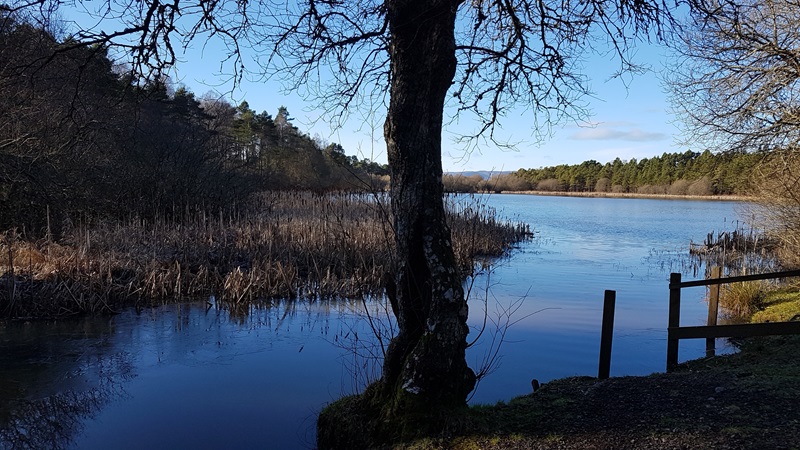
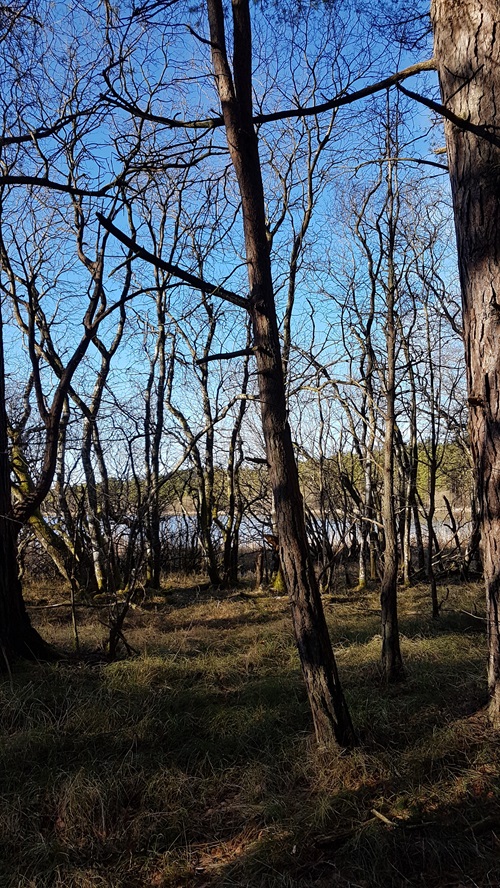
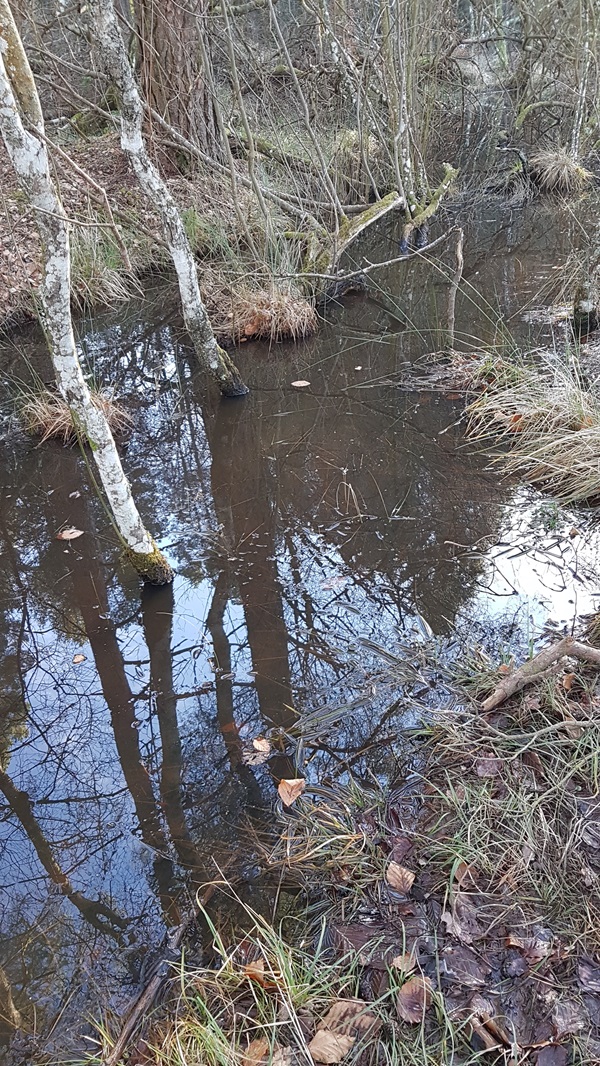
I creep through the spongy, saturated margins of the little loch at the heart of the King’s Myre, to peer through the cattails to see what wintering birds are on it today. Goldeneye, a few gadwall, mallards, a coot, typically swimming against the tide of the rest, intent on his own adventure. No sign of the swans, too early for the osprey to be home yet. In the damp woodland, waterlogged alcoves and scrapes, from which spiky, angular trees grow erratically, wait for frogs and toads to arrive for spawning. Between bare branches, multiple trunks and stems and a storm of tiny twigs, the blue sky seeps as if caught in a vast, arboreal net, reflected in patches of water.
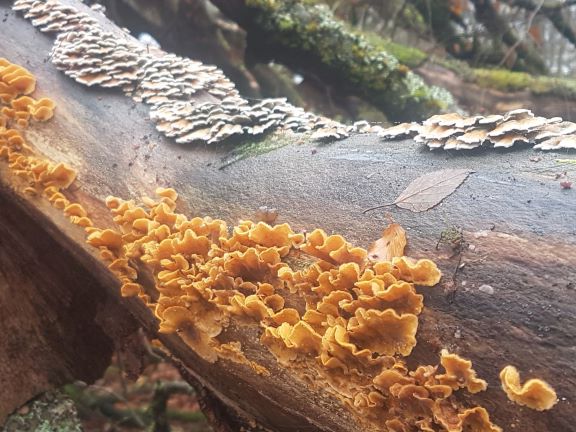
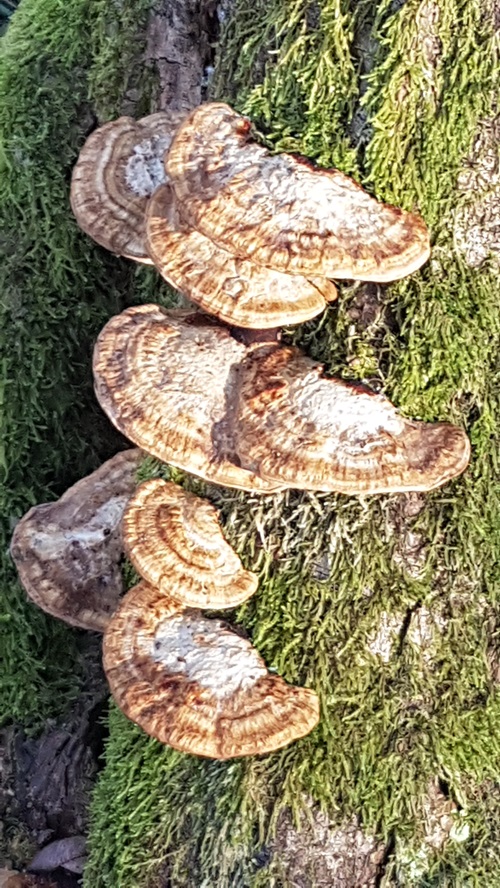
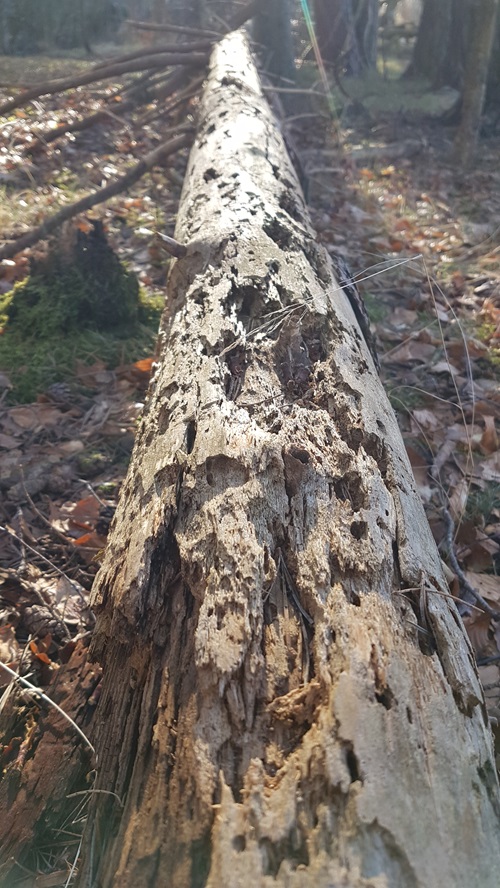
Bracket fungi show off their smug Cornish-pasty smiles of concentric bands, on wood they share with moss and lichen, and a thousand invertebrates. Spread across the leaf-carpeted floor, long-dead logs, un-barked, silvery, yielding, are home to thousands and thousands more, riddled with holes and channels and hidden tunnels in the fungus-softened wood. On cue, somewhere in a dead tree, a woodpecker begins his first tentative drumming and drilling.
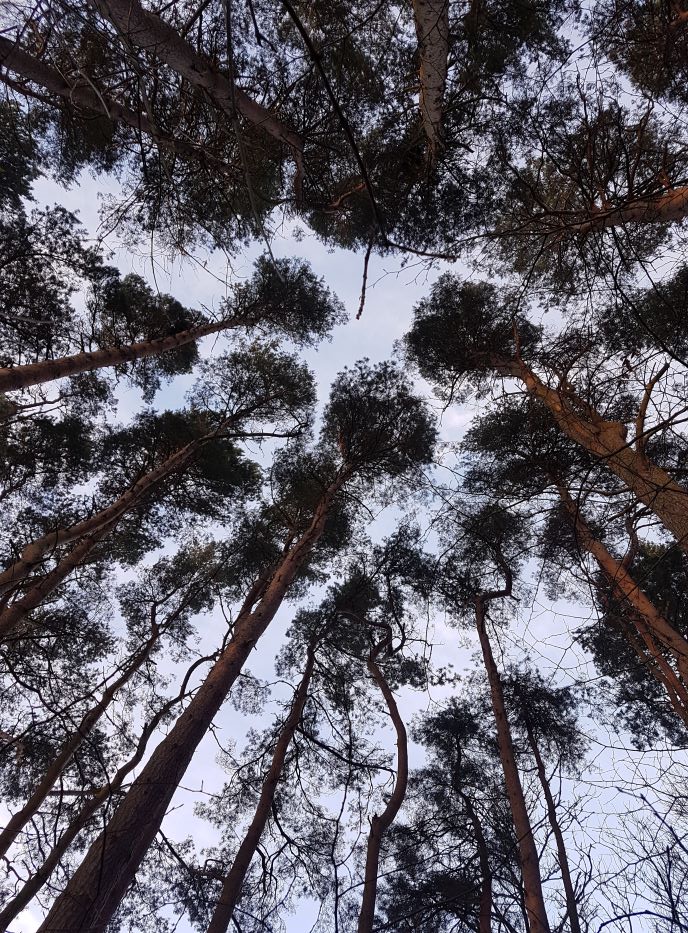
I look up into the Scots Pines, their narrow crowns dancing around each other like polite or nervous teenagers, and see the shapes of jagged sashes of sky, so clear, so blue….
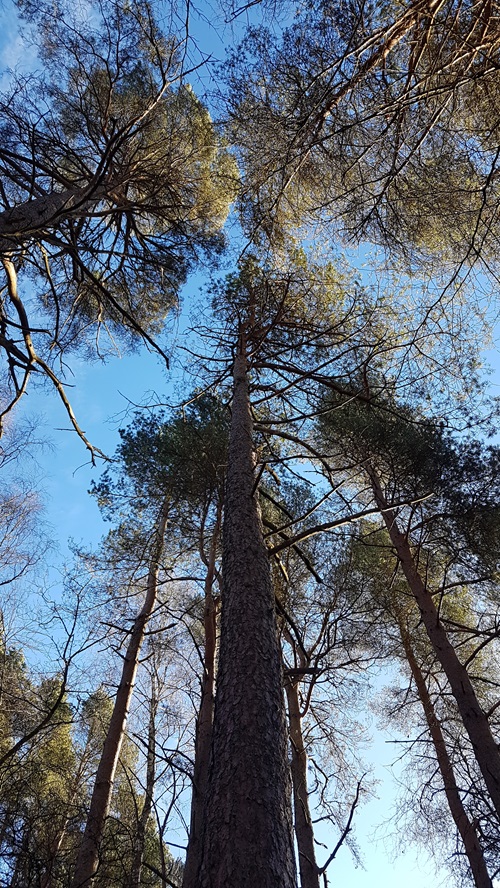
Look up, look through, look between – there is much to see. Or is there only sky?
The Countryside Code Fungal Appendix

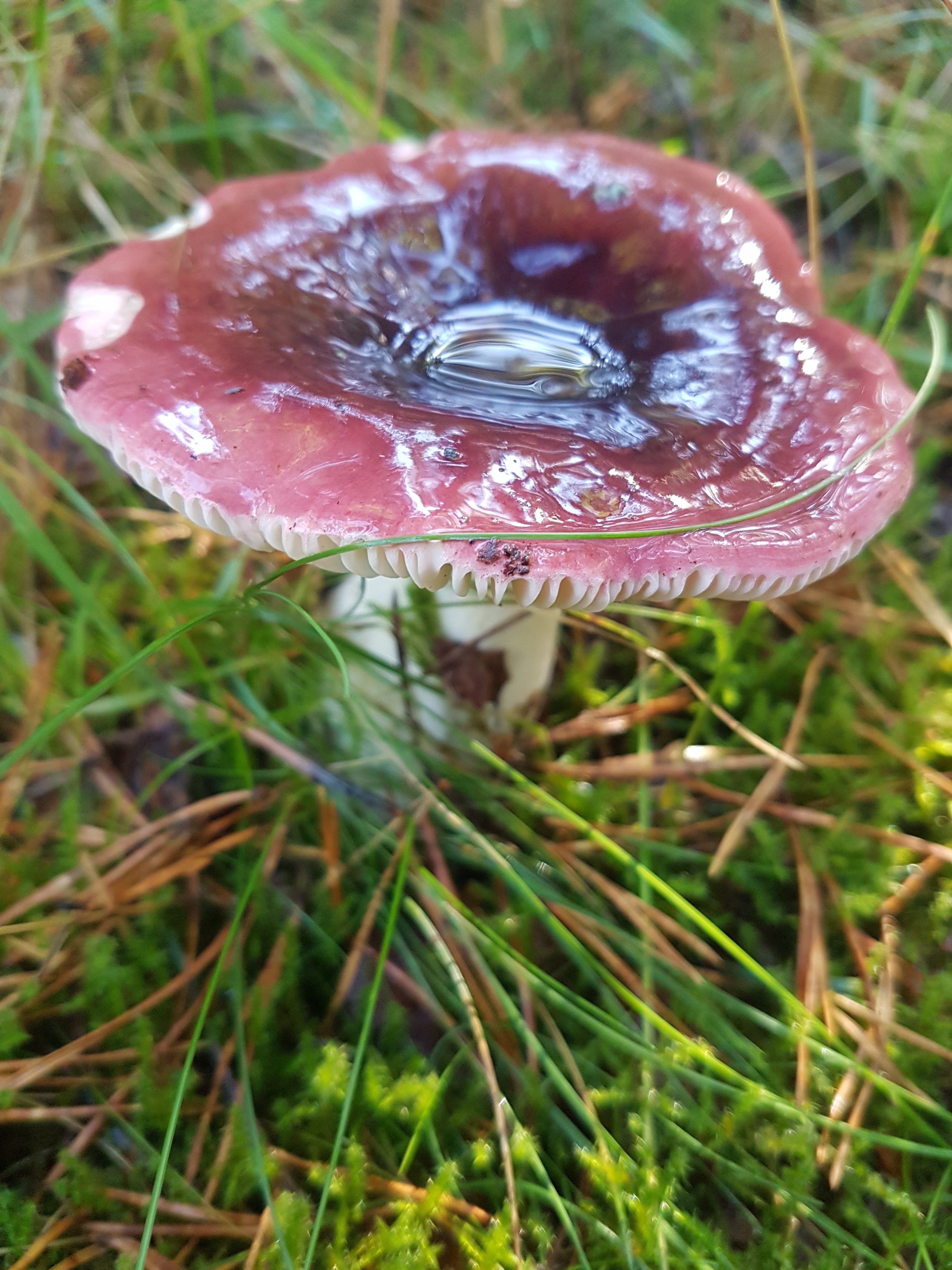
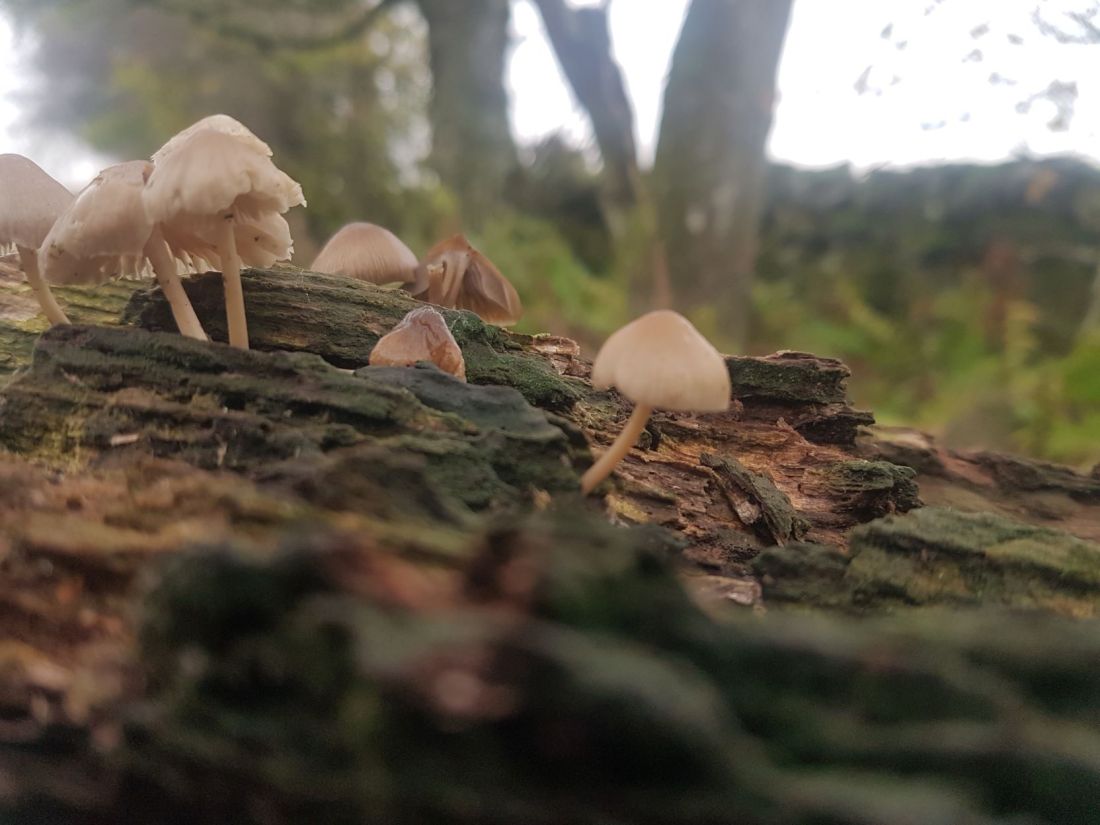
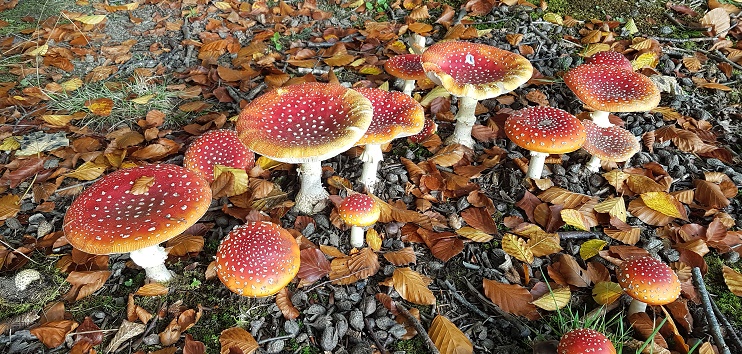
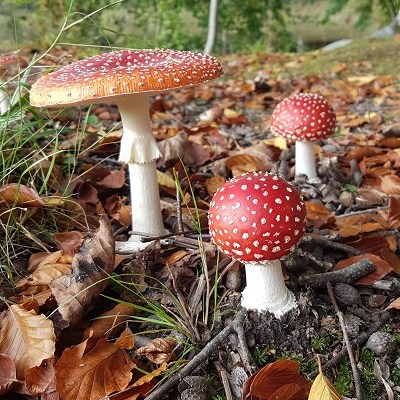
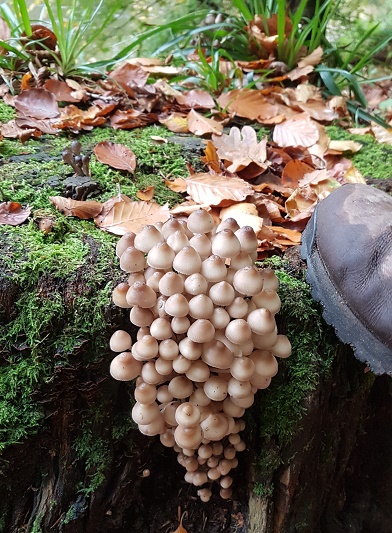
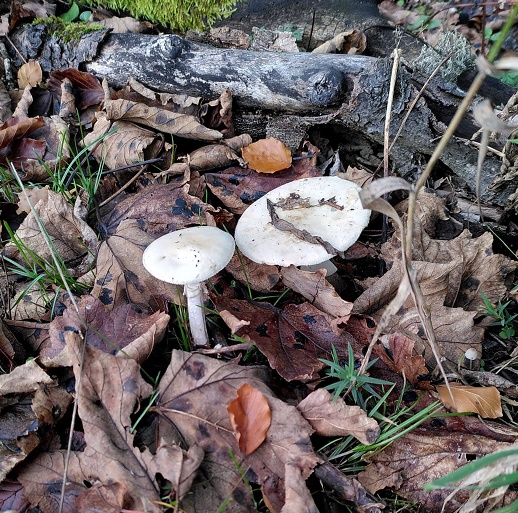
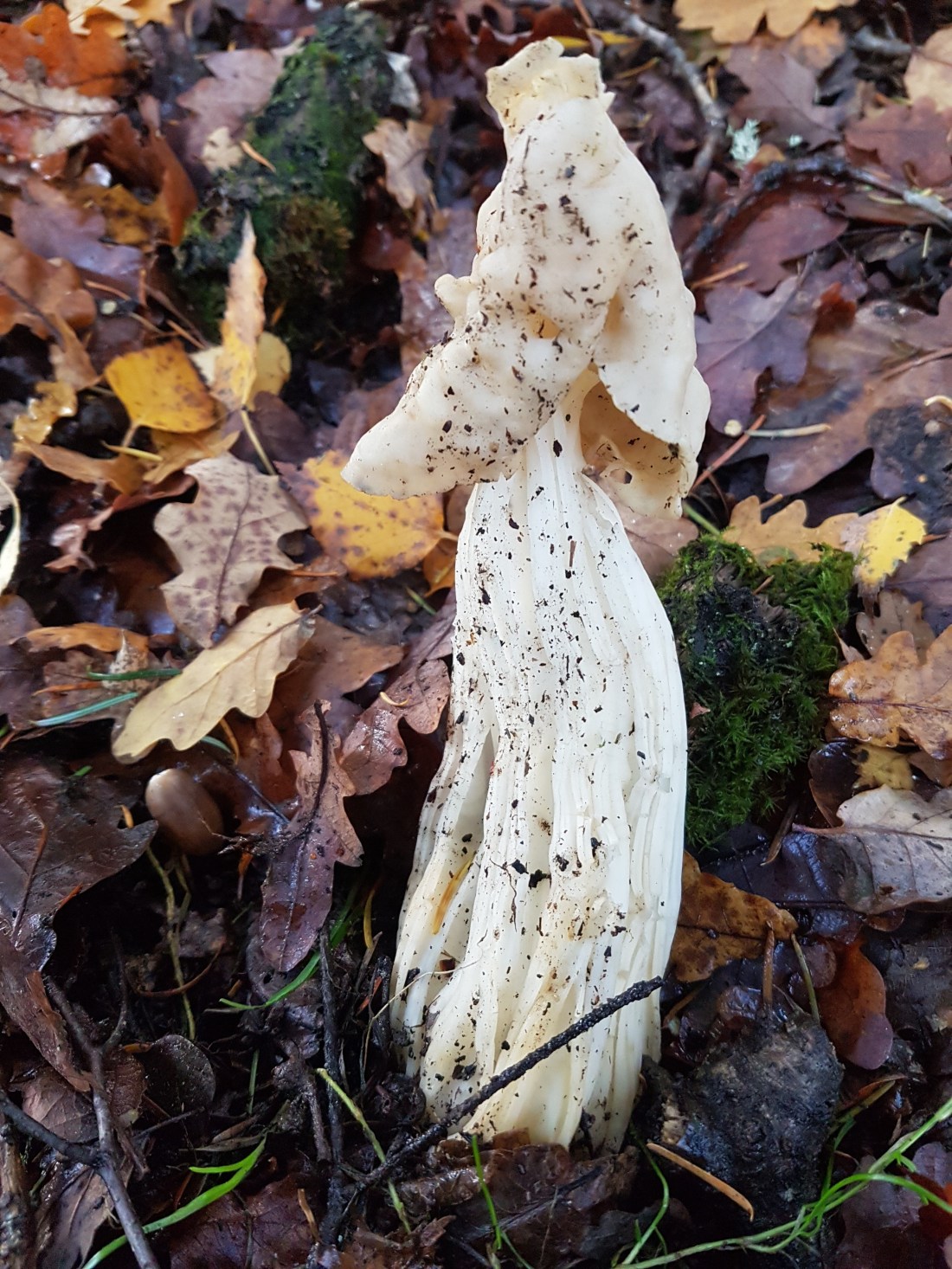
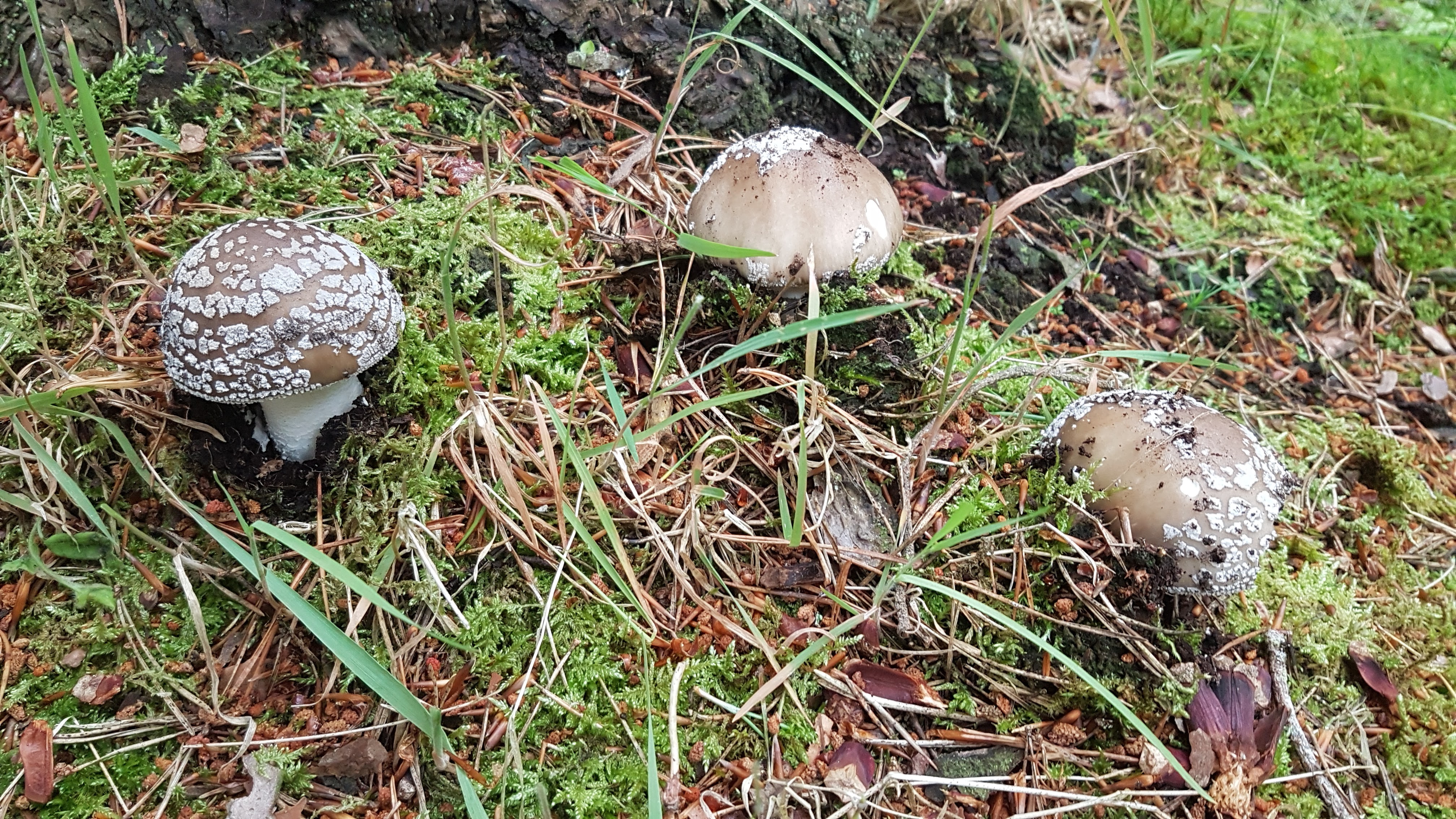
  1. If you are out in the countryside and find a mushroom you think is poisonous, do not panic and trample or kick it to ****. It cannot kill you unless you eat it. It doesn’t even want to kill you and it cannot chase after you either. It is a beautiful organism trying to reproduce itself. Leave it alone. (Oh – and do not eat it) (Photo above is an example – isn’t it lovely!)
  2. If you find a mushroom and you don’t know what it is or if you can eat it or not, see 1. The same applies. If you want to identify it, take a photo and maybe one specimen.
  3. If you find a mushroom, that you 100% know you can eat and you want to, pick – but adhere to these sub-directives:
    * Don’t pick the whole blooming lot – never more than your personal needs
    That includes large mushrooms like Chicken of the Woods growing on trees – never take it all
    * Always leave plenty of young and old (reproducing) specimens behind
    * If there’s only one or very few, leave them for others to enjoy, including other fungus-eating species such as deer
    * Keep your big feet from trampling the site and all the ecosystem it holds to bits. Tread lightly and avoid damaging vegetation
    * If you carry an open-weave basket, your dinner will arrive home in better shape and may even shed some spores along the way
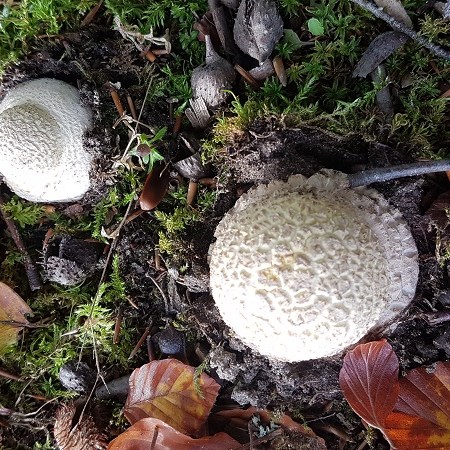
  4. With particular reference to Giant Puffballs: these are not footballs – they are not spherical. Nor are they rugby balls, golf balls, cricket balls or any other species of ball. Therefore, do not treat them as one. If you would like to eat one, pick it carefully, take it home, and share it with like-minded friends before cooking it. This is because if you try to eat a full-sized Giant Puffball on your own, you will be feeling nauseous by day three. They are way too big for one forager.
  5. If you have children, take them foraging and teach them why fungi are so important to life on earth. Let them learn what’s safe to pick and what to leave alone as you do. Introduce them to this appendix to the Countryside Code.

(If you don’t know yet why fungi are so important, Entangled Life by Merlyn Sheldrake is a good read.)

Equinox: A Hiatus

One day to the equinox; officially the first day of spring. It rains, a sullen, dreich miasma and the horizon is drowned in mist and low cloud once again. No cloud of cheery celandines yet line the ditches; no coltsfoot flowers; no green dazzle of new growth erupting from the tired, forlorn and hang-dog leavings of winter stems of grass.

There was a start to spring, a couple of weeks ago, when the sun was gentle and warm and the birds practised their calls. A blue tit inspected a nest box, and rooks set-to in earnest up in the rookery tree. Today, the only sound is the drip-drip-drip of rain. And even that’s muffled.

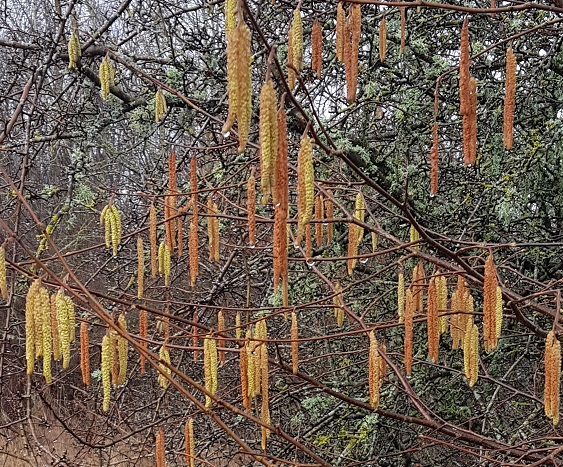
In the soggy brown fields, where the cover crop was optimistically ploughed in a fortnight ago, soil trickles away downhill in the empty furrows. No fuzz of pink from swelling buds tints the distant birch trees, no lighter hues on the sycamores and maples. On the hazels, the merry festoons of bright yellow and cream catkins are turning brown, but no buds are opening to take their place.

Spring’s not here. I rake in the squelching soundscape of a muddy woodland walk for the chiff-chaff, first of the warblers to arrive in March, but he is not here either. I wonder if this is the day I have for so long dreaded and feared – the “what if” day. What if the the birds of summer do not return? What if I never see another swallow? What if the flowers of spring are, finally, poisoned to death? What if nests fail and nestlings starve for want of insects and worms?

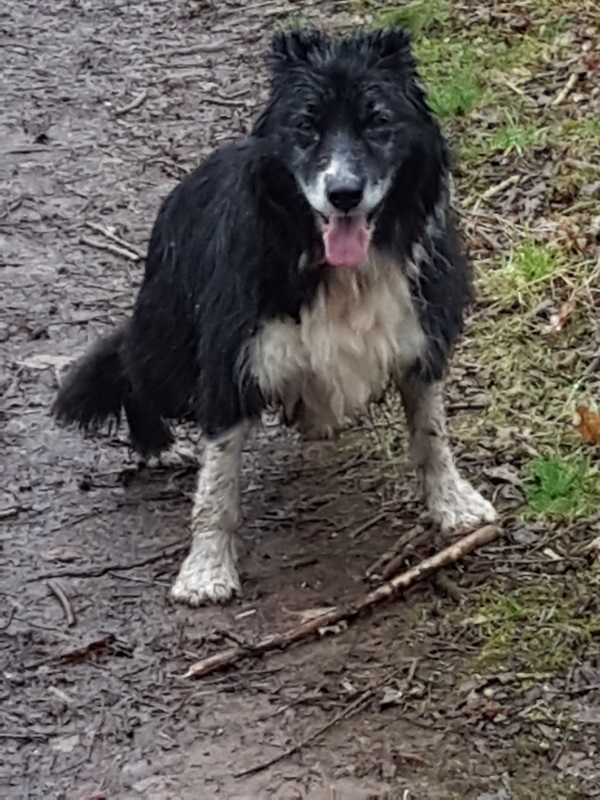
I do not want to follow this thought. Spring is late and it makes me weary and anxious. My elderly dog plods on, keen to get back in the dry, tired, arthritic legs dragging, stumbling at times yet still showing interest in sticks, at least on the way back. I think, will spring come in time for him to enjoy it, to sit in the healing sun and watch the world go by, an old dog at the end of life but still game?

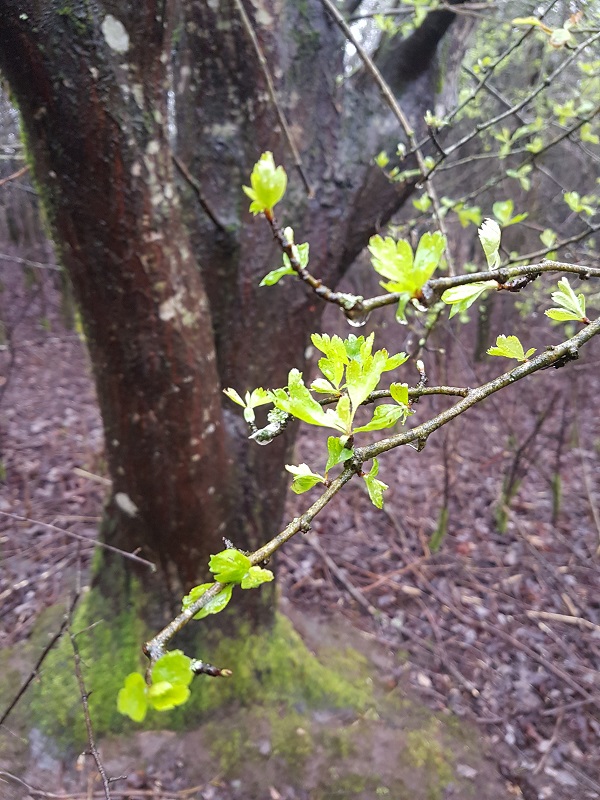
On the way home, I find some of those precocious hawthorns in the depth of the wood which always burst into leaf prematurely and give me my ritual mouthful of hedgerow “bread and cheese”. Today it tastes of even less than usual, but I chew away, get in the door, dry off the dog and put on the kettle.

At least there’s tea.

River Tay, January

Early morning, sunny and dry. Silence, save for the mutterings of a river almost out of its banks and racing to reach the sea. Ground solid, unyielding – the type of hardness where you trip up on embedded clods and frazzles of vegetation hiding in the whiteness of a fourth consecutive deep frost – on ground already frozen solid by over a week of snow-half-thaw-freeze again.

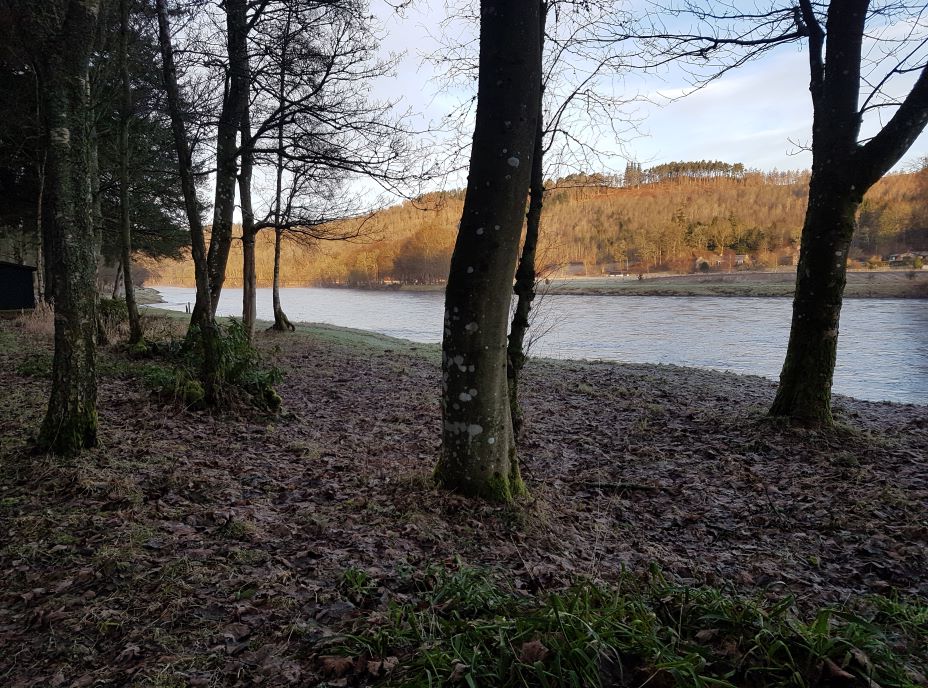
Walking along the south shore of the Tay on a winter’s morning kind of ensures you won’t be in the sun very much, no matter how it dazzles the eye. In any case, the river has merrily engulfed the lower fishermen’s path that hugs its margin, so we walk, me and the dog, on the higher ground beneath the limes of the castle drive. Where are all the birds? I wonder. Not even the ubiquitous wood pigeons are out braving the cold. We pass an eroded river gulley and went down the steepish bank to the lower riverside path, joining at the point where it rises above water level and becomes what must once have been an elegant stroll for visitors to the castle. Fishing on the Tay is big business, and not affordable by ordinary people (unless you live in Perth and have the right to fish the stretch within the city boundary). We pass fishing huts on both banks that would make acceptable homes for small families. All locked up, today. No one but me and the dog.

Now I’m closer to the water, I start to notice a large number of white birds swimming rapidly downriver. What are they escaping from? Then I realise the white birds are actually lumps of ice, breaking away from the frozen banks and joining the ice and snowmelt that, with extended periods of rain, has made the river so massive today. A couple of gritty black-and-white ducks obstinately battle upriver, against the flow. What strong legs they must have! They veer off into a little eddying backwater on the opposite bank, and I see other water birds lurking there, taking a break from morning chores.

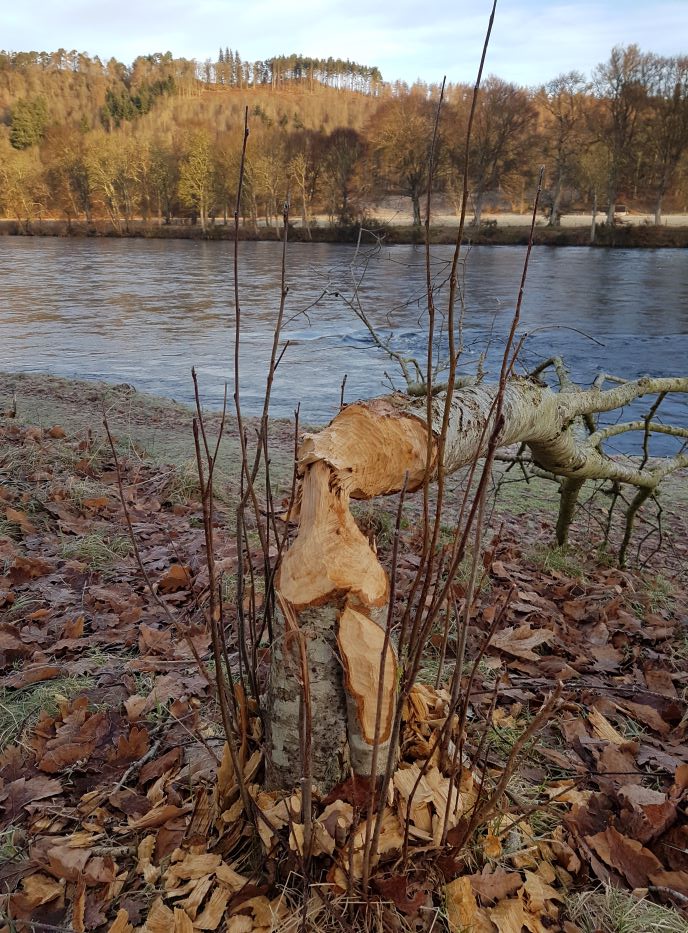
Beaver have been along here recently, but I struggle to fathom their purpose in felling one solitary tree, up the beach from the tumbling water. Maybe just hungry, or doing a bit of coppicing for future regrowth food supplies. I think the water birds could use a few more beavers to create respite backwaters.

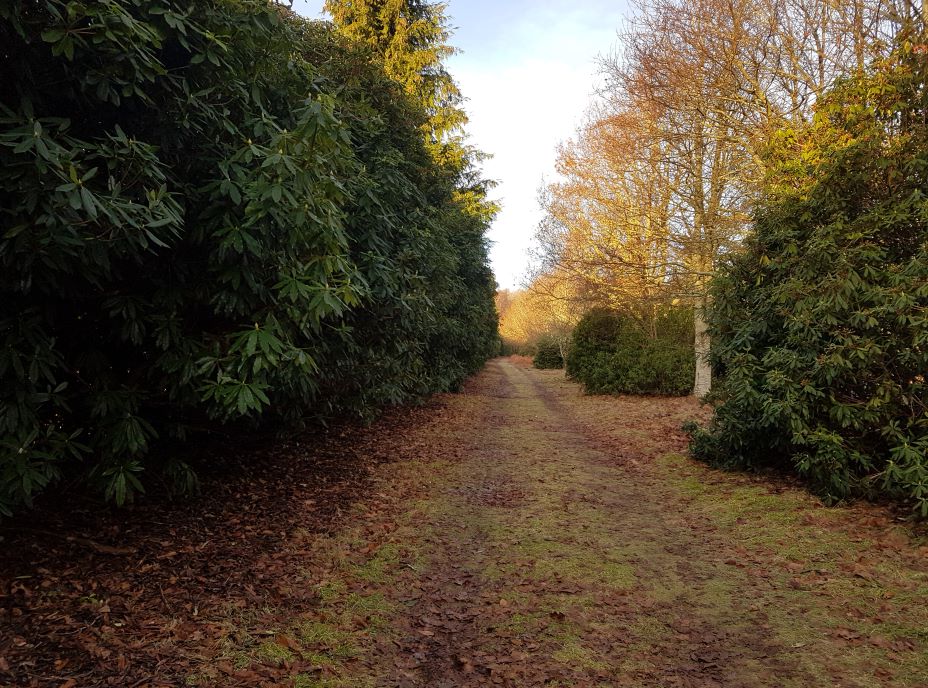
Skirting a long curve round the back of the castle, I pass between forbidding walls of rhododendron bushes. Although they provide some shelter and a small stretch of unfrozen path. they block the view. I spend too much time trying to eliminate them from an ancient oak wood to appreciate their aesthetics. I guess they may provide good roosts for birds, though I still don’t see any.

The core path takes a long, curving route by a bend in the Tay, high above the river and nearly to Birnam before it joins the castle main drive which will take me back to the start if I go left. Closer to the castle, the trees are less scrubby and include many spectacular examples of exotic species, such as Noble Firs, Coast Redwoods and towering Pines. It becomes a landscape of avenues – tottering rows of limb-dropping beeches, stately Sequoias in orderly, sentry-like placings, frowning yew trees in sombre ranks, new avenues planted in recent decades to replace older ones that refuse to lie down and die. Best of all, to me, are the ridiculously shaggy and spreading avenues of old lime trees – each hiding in its own twiggy skirt of epicormic growth. In spring, they provide me with juicy, tender leaves for salad, and intoxicatingly sweet-smelling flowers in summer to dry and make into a sleep-inducing tisane.

As I walk between and under these vibrant specimen trees, I suddenly realise birds have started to chatter, and mixed flocks of finches, secretive tree-creepers and purposeful, hopping blackbirds are awake and accompanying me. Gazing up through the close pine trees, I can just see avian silhouettes flitting busily.

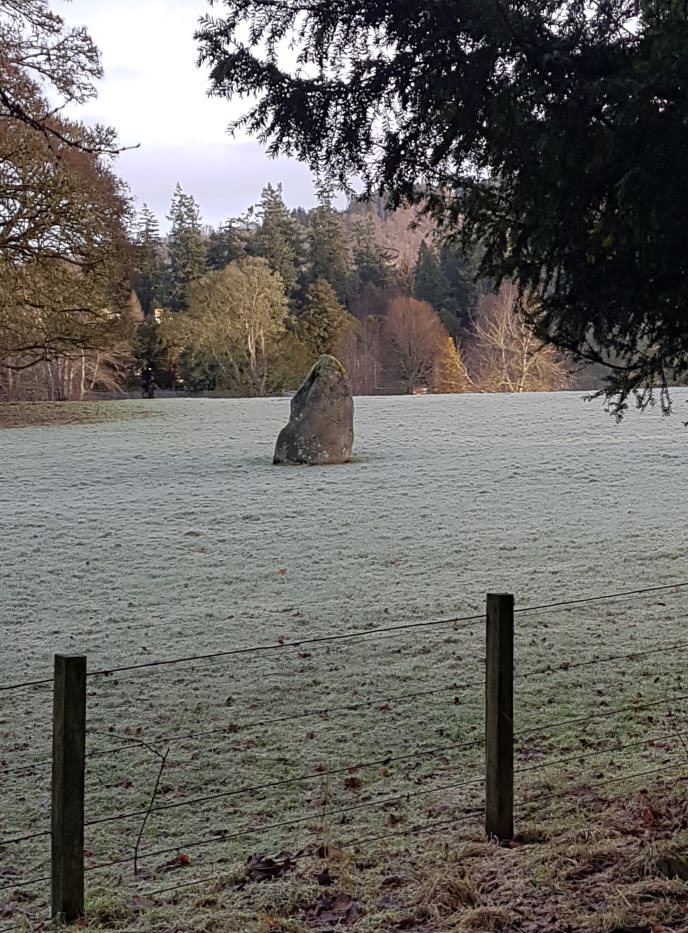
There are paths that could be taken to make a short-cut through the castle garden. Scottish access laws, some would say, give walkers a perfect right to take them, and no doubt some do. I’ve lived in a tied house on an estate where summer visitors frequently asserted this right to take a short cut to a beach through our garden, where we had small children playing and hens free-ranging – and on at least one occasion, hens were killed by loose, uncontrolled dogs. So personally, while I’m proud of our access laws, I think we should respect the privacy of residents and remember those laws also require the walker or cyclist to act responsibly. I’m fine with taking a long way round. The core path eventually passes in front of the castle at a distance (more avenues!), and I note the large, standing stone nearby, like an iceberg itself in an open, frost-enveloped field. It has no name. Does it link with other, less ancient perhaps but curiously-named stones in the area? One day I’ll hunt down the Witches’ Stone (well, this is Macbeth country!) and the Cloven stone….. but not today.

Today, I dawdle back under the limes to the gate, salute the mighty Tay with its miniature ice-packs, and begin to think about breakfast.

Scene of Construction

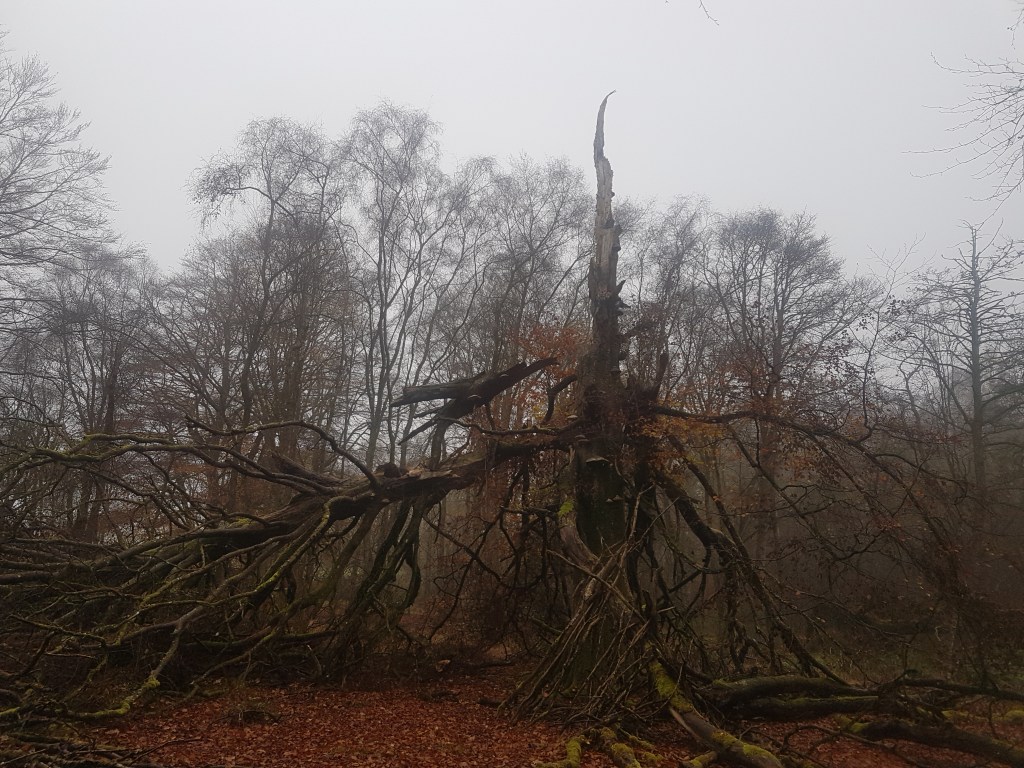
It began by shedding branches in every storm, this multi-stemmed beech tree. Being a beech, whose toxic leaf-litter successfully manages to put off any tree or shrub (even its own offspring) from growing under its canopy, there is plenty of space for the branches to lie. For a few years, it was my go-to place to harvest the beech-specific, edible, incredibly slippery Porcelain Mushroom in late autumn. This year, the fungus appears to have exploited all the suitable fallen branches and moved elsewhere.

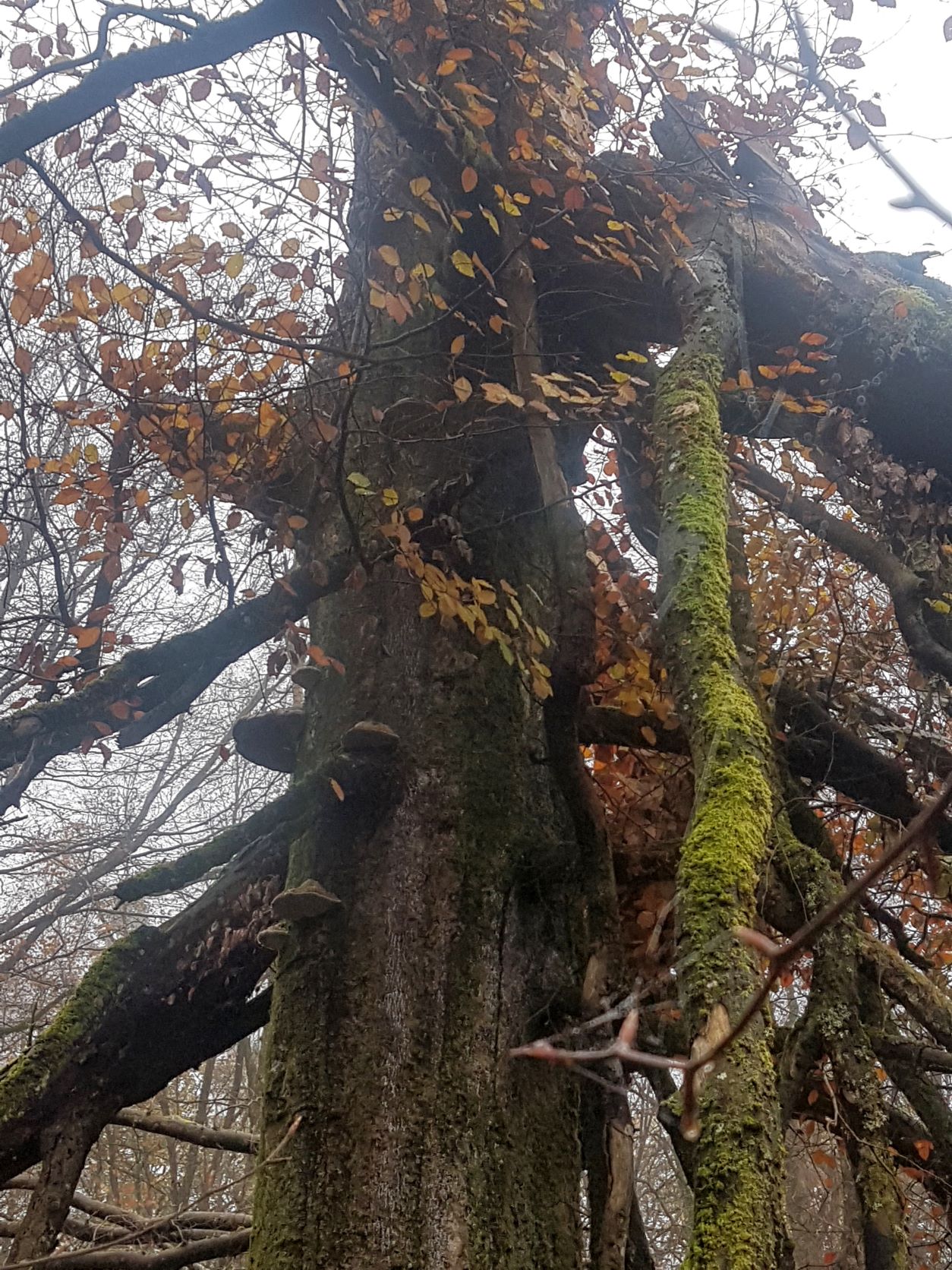
No shortage, though, or other fungi. They peer from behind the remnants of bark, congregate on dead wood, splash colour over the domain of the doomed beech tree. Now, whole trunks are falling, large brackets appear near the snaggy top of the one remaining trunk, piles of branches and fallen debris cover the ground. Meanwhile, leafy twigs still emerge from parts of the tree – it’s not dead yet!

Is a tree ever dead? Though branches crash down, timber decomposes, bark is shed, these are all the signs of a massive construction programme. The mushrooms and bacteria are building soil. The mosses, lichens, ferns and flowering plants are taking hold and creating gardens. Invertebrates in their thousands are moving in, chip-chipping away, getting in, getting under, uprooting, making a tree metropolis. Birds and small mammals home in on the seething busy-ness as if to an urban food-market, finding homes in the piled deadwood and tree-openings. Human foragers like me, and other large animals such as roe deer, visit for breakfast mushrooms. In spring, chickweed wintergreen and wood sorrel will cautiously return to woodland lighter and less toxic.

As the tree slowly, and apparently, dies, it shouts louder and louder with life,

Going to the Larder

The little wood that lies an easy walking distance from my house is juvenile. It was planted maybe twenty-five years ago, mostly with hazel trees that have grown with multi-stemmed enthusiasm, peppered with birch and rowan, interspersed with tall sycamores and oak trees, now starting to muscle their way above the copse. Blown-in elder, and suckering blackthorn garland the woodland fringes. There are literally thousands of small ash seedlings covering much of the woodland floor; few-to-no surviving older ash trees. I wonder how these babies will fare in the aftermath of ash die-back disease. A large proportion are annually grazed out by deer; there are hares and hedgehogs hanging out in the top part of the wood, and I’ve seen red squirrels using the wood as an aerial highway. They, and other small mammals, feast on the hazelnuts in winter. This year, I heard and saw flashy jays on the rampage, and I’m seeing hazelnut stashes which may be their doing.

I’ve always referred to the wood, with unintentional and misplaced territorialism, as my larder. It contained the best patch of nettle shoots for soups, teas and pesto for miles, though these have now shifted as the shade has increased. In early summer, an army of Common Hogweed supplies me with chunky flower-buds to make my favorite pakoras or to braise as a vegetable. One day, I may be obliged to harvest the seeds to make flour; it’s as well the species is expanding its range. About the same time, elderflowers are picked for cordial or champagne, or just to eat. As summer winds on, the patch of feral raspberries in the clearing start to ripen. This year, they were pretty poor though, as are the ones in the garden. I’m not sure why. Competition from the broom, perhaps, whose yellow flower buds go into my May salad bowl.

I harvest the hazelnuts haphazardly; the trees I used to pick from now bear their nuts too high for me to reach – I either wait for the profligate mammalian and avian foragers to knock them to the ground or I gather from smaller trees, self-seeded from nuts none of us ate, or from trees on the edge. When I have enough and they are shedding their frilly petticoats, I shell and roast them to get the lovely chocolatey smell. Usually, about half the shells are empty.

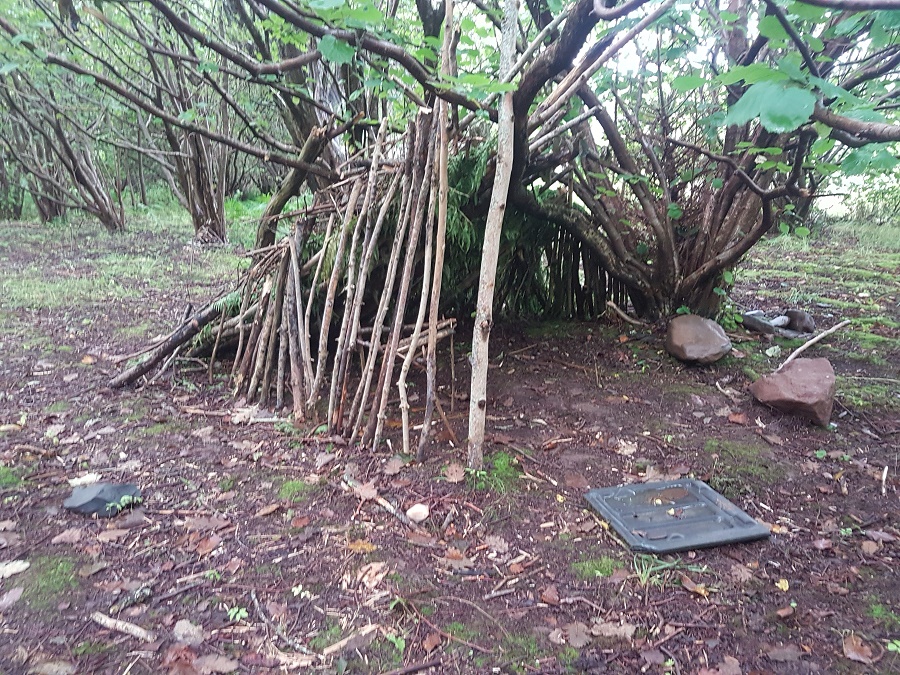
The hazel wood is also the store I visit for the likes of washing-line props, bean-poles, and pea-sticks. No need to cut these poles, as regular storms bring more down; the forest floor is littered with useful sticks for every purpose, not least, lighting the stove. Children collect the long ones and build them into dens.

There are many uses for hazel wands…..

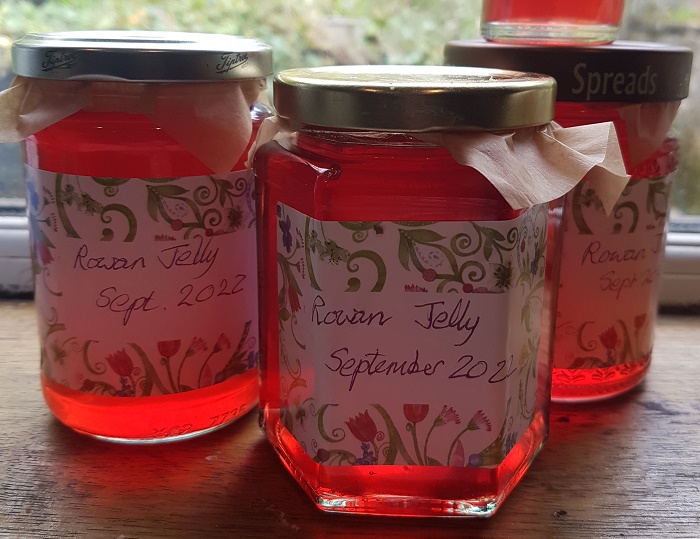
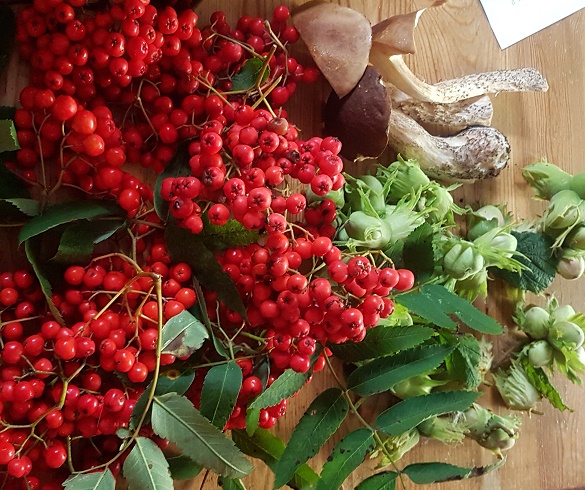
Today, I’m collecting rowan berries for the sharp, rich red jelly we’ve always had as a family to accompany Christmas dinner, and thereafter, everything else. The young rowan trees bear copious fruit, but I have my personal favorite trees, where the berries are larger, a feistier red or more juicy. I note the elderberries are nearly at picking stage, too – a winter essential for medicinal elderberry vinegar, or, mixed with hips from the wild roses along the field edge, a soothing syrup. Likewise, there is a particular hawthorn bush that has fruits large and sweet enough to stop and nibble at while contemplating the sunset or sheltering from a cloudburst. They make good liqueurs.

I gather a couple of Brown Birch Bolete mushrooms as well. It was a fair few years ago now that these edible fungi began to appear around one of the multi-stemmed birch trees. I don’t pick many, and am always watching for new patches of fruiting bodies as the mycelium spreads to other birches. It’s been fascinating watching how the fungal flora in the little wood has gradually established itself as the trees grew, and fungal threads found their roots, to embark on that precious, beneficial relationship that entangles both and is called the mycorrhizae (“fungus-roots”). The species I find have changed over the years, and will continue to do so. I hope more edible species will arrive soon. The Birch Boletes I don’t have for breakfast will be dried for the winter.

Will it be a good year for sloes? There have been crops from the blackthorns on the field edge so fantastic I’ve stopped making sloe gin for a while. Maybe time for another batch. The blossom was there in March, so I’ll check it out. If there are sloes, I’ll wait for the first frosts to make them tingle, and see if the birds have spared me any.

Later, when the leaves fall in tawny profusion, and the rose-bay willow herb from which I selected early shoots in spring for fake asparagus has shed its seeds, when the air starts to nip and my breath makes clouds, I’ll harvest the peace of the woods, the melancholy inertia, the stand-and-stare compulsion of fractal twigs and branches and the patterns on bark.

And perhaps pick curly, frosty old flower-stems of the willow herb to decorate the house for Christmas.

“Wild Flowers of the Woods” – a small selection from Five Mile Wood!

Although I was born and grew up in a London suburb, awareness of nature was hammered into me, partly by my family, partly by primary school, where the “nature table” was obligatory in every classroom and was always piled high with artefacts, and partly by the nature books that lay around the house. It was while poring over these behind the sofa that I began to learn my flowers.

My favourite was entitled “Spring Flowers of the Woods”. To start, I relished the beautiful hand-painted illustrations, and, later, when I read that the woods were full of flowers in spring BECAUSE leaves were off the trees thus allowing light for the flowers to open and the pollinators to amble in, it was my first glimmer of ecology, and the entangled ways of nature. I came to recognise and seek those exquisite, archetypal spring flowers such as primrose, wood anemone, wood sorrel, mercury and violet.

Wood Sorrel and Violets

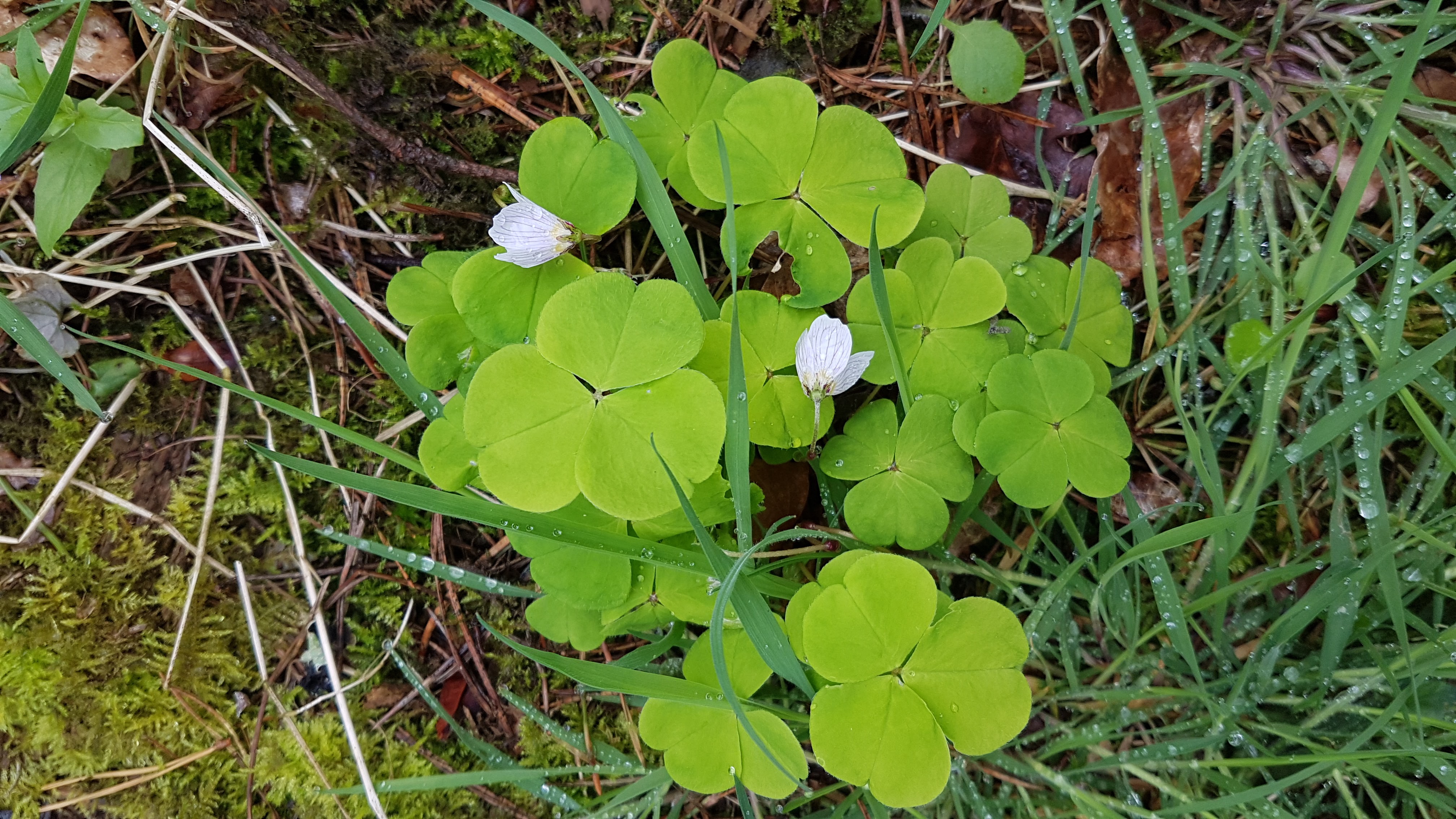
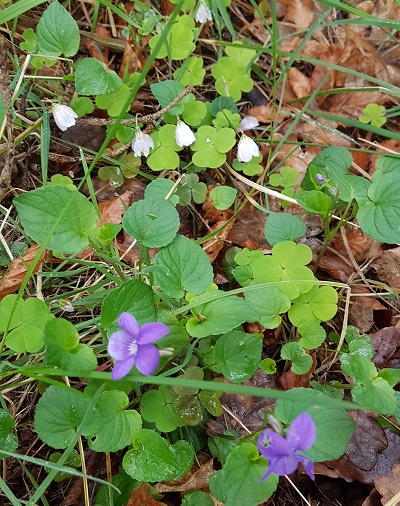
Today in Five Mile Wood, on a damp and overcast day, I greeted some of them. In the broad strip of mixed broadleaved and conifer woodland to the south, violets a-plenty sprinkled themselves over the dead leaves of birch and beech, growing on old stumps and under windthrown trunks. Sometimes they congregate with Wood Sorrel, whose edible, trifoliate leaves draped from spindly stems, and finely-veined, nodding white flowers are one of the (many) most beautiful things on earth. Wood Sorrel grows here only in scattered communities. I have the impression these colonies are networking towards each other, perhaps via the hidden telegraph of soil-fungal communication.

I have not yet found Wood Anemone here, which is surprising, but intriguingly, there is the merest germ of a bluebell wood, if you know where to look, and they are beginning to flower. (photos were horribly blurry, and I shan’t burden you with them. Everyone knows what bluebells look like.) Bluebells are said to be a sign of ancient woodland (which Five Mile probably isn’t) or at least a settled woodland ecology. I do not wish to unsettle them!

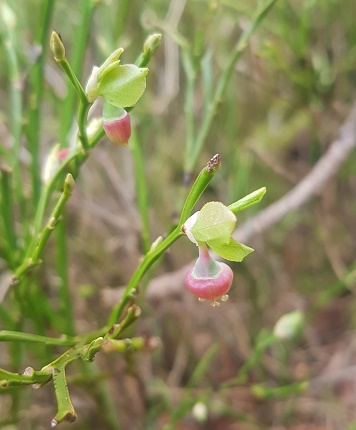
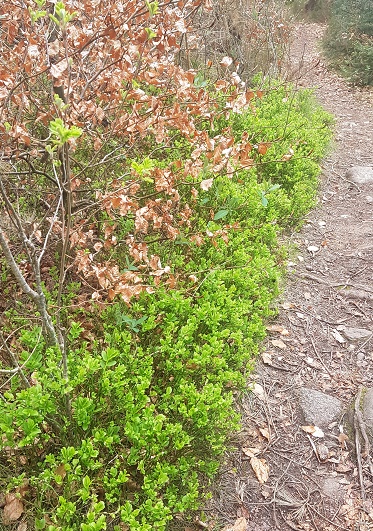
As the ground rises, that ecology morphs into something more akin to acid heath (there are certainly signs that at least part of the central area once held deep peat, signifying raised bog, perhaps). Two flowers in this habitat – not stars of “Spring Flowers of the Woods” – gave me great pleasure. One was the blaeberries that line the paths and snuggle up to trees here. They are now in hard-to-spot flower. Tiny, beautiful dull reddish bellflowers (look closely!) which will turn into the fruit of this our native blueberry and provide good walking snacks in the summer. It’s a treat to see this wild harvest crop doing so well; it was somewhat decimated by the last clear-fell. (Do we understand well enough the changes we force on a landscape by our actions? Do we care enough?)

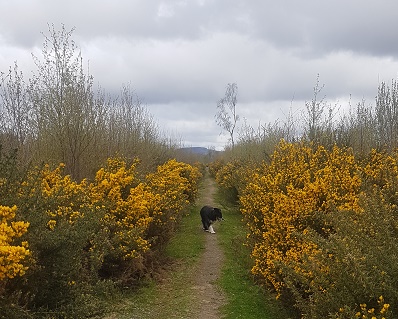
The other is gorse. I have a very soft spot for this riotous, prickly native shrub. So many plus points does it have: nitrogen fixing, baby tree protecting, wild tea providing and a redoubtable habitat for spiders (see here) among others. What’s in a few scratches? A week ago, cycling round the wood at speed (to be honest, anything over 6mph is “at speed” for me even on an electric bike), I did incur a few scratches….. but it was like moving through a mist of warm coconut, the delicious gorse flower smell made powerful by the bright sunshine and muggy air. Today, it was fainter – but thanks to the slightly unnerving vigor with which gorse is spreading across the path, I could still catch it. Divine!

Gorse-intoxicated Border Collie

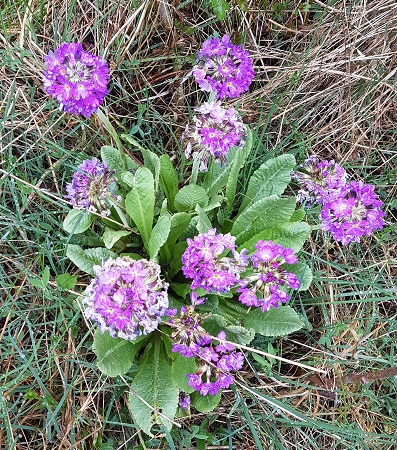
Primroses seem to be absent, as well as the wood anemones, but there was this unexpected relative – Primula denticulata, the Drumstick Primrose or, locally in Angus, the Kirrie Dumpling. Native to Himalaya, this has not, I suspect, got here on its own! If I were a hard-line ecologist, I’d uproot it (and find a home for it in a garden). I’m not, but there might be a good argument for collecting the seed before it spreads itself about. Or not?

Primula denticulata, the Kirrie Dumpling

Not for Eating. Nor Collecting

There are different kinds of walks-with-mushrooms. My first, fifty years ago, were cataloguing walks, an academic exercise that became an obsession. A specimen of each would be removed and bagged (no smartphones then, and my Kodak Instamatic didn’t really cut the mustard, though I did try), taken home, pored over for hours to try to identify it, and then a spore print taken.  This was all in the cause of a college Rural Studies project that I somehow never grew out of.

When I began to differentiate the ones I could eat from the poisonous ones, foraging AND cataloguing walks happened – a basket for the ones I knew I could eat, and another for the unknowns. Many remained – and remain – unknown, something which used to really bother me. However much later when I was regularly leading foraging walks, I realised that so long as I could recognise the “edible and good” fungi and the poisonous and dodgy ones, most people were happy if we could pin the “small brown jobs” down as far as a genus.

I still take huge interest in identifying weird or remarkable specimens that I’ve never seen before, but these days I’ve discovered the pleasure of walks-with-no-purpose-with mushrooms. This walk, meandering along the River Tay from Dunkeld, had no particular object but to be captivated by the surprise and beauty of the fungal kingdom – so often misrepresented, under-valued, the importance of which is not understood by the majority of humans.

First came a phenomenal display of Fly Agarics, the mushroom of the shamans, too exquisite to pass by, shouting their wares, nestling in ground which was once birchwood. Their mycelium is always entangled with the roots of birch; from the beginnings of plants on dry land they have needed each other. They start as big white crusty buttons, the red skin of the cap breaking through the veil to leave those fairly-tale white “spots”. The cap expands, the spores fall. One was nearly as big as my head.

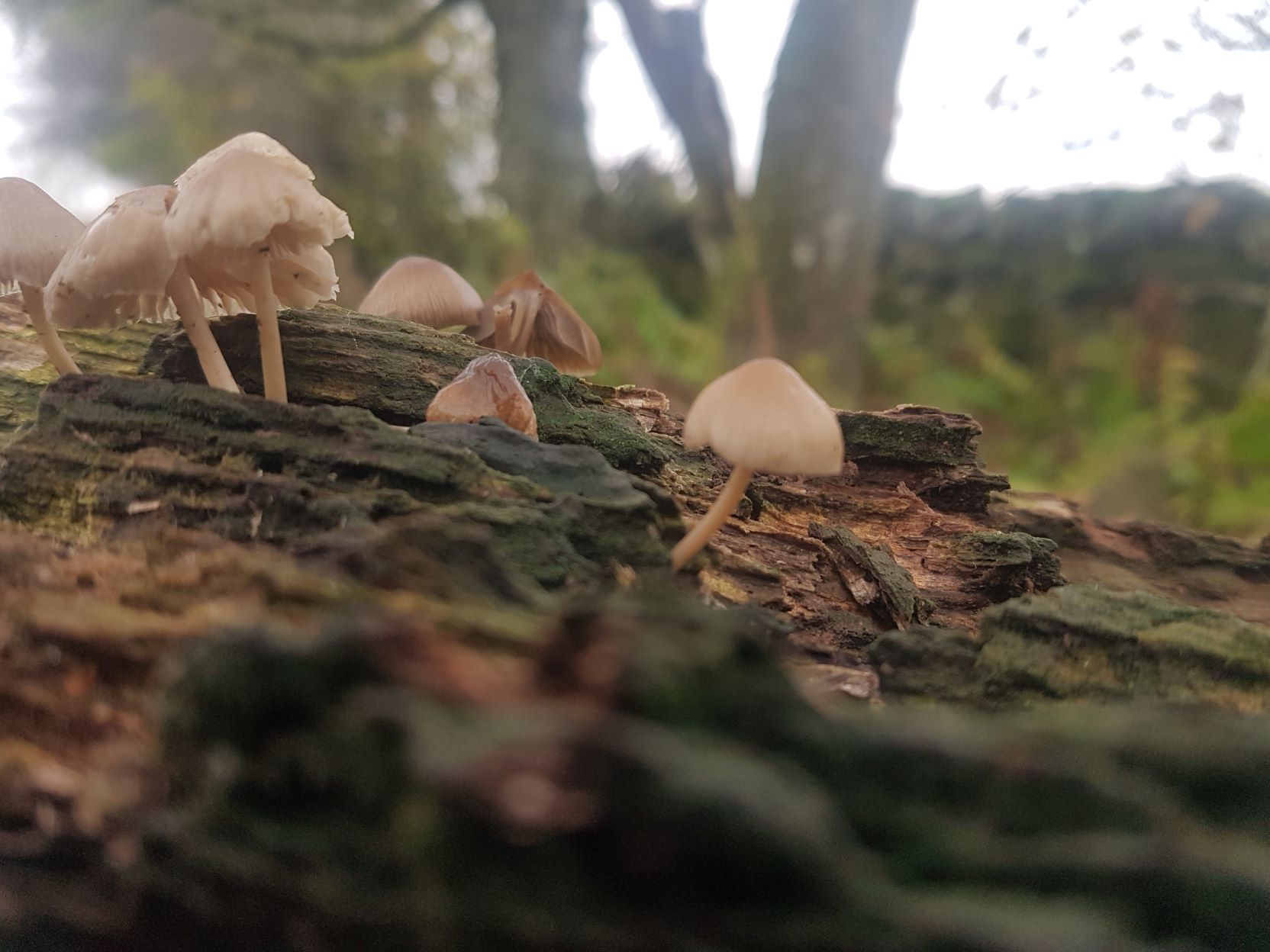
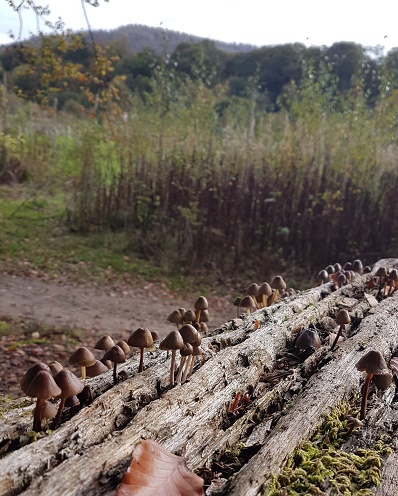
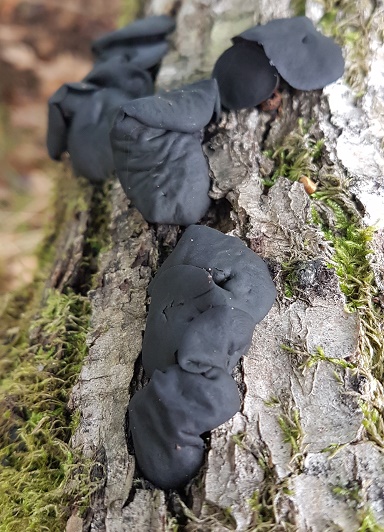
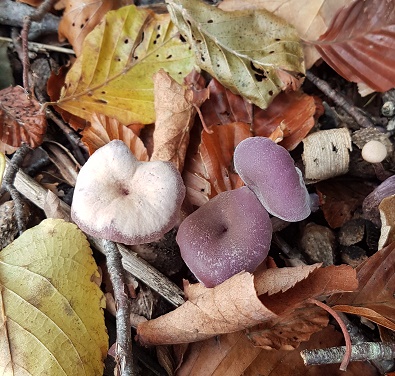
Troops of Bonnet mushrooms, various types, marched over fallen trees and gossiped in crevices of stumps, glistening in the sunlight. Shiny black excrescences of Witch’s Butter erupted from dead wood. Amethyst Deceivers – which I could have picked for eating but didn’t – showed all their colour range from vivid purple to washed-out grey. In the leaf-litter, the Destroying Angel, related to the Fly Agaric but far more deadly, glowed purest white. Such a potent name for a poisonous mushroom!

Giant Funnel Cap (Clitocybe gigantea)

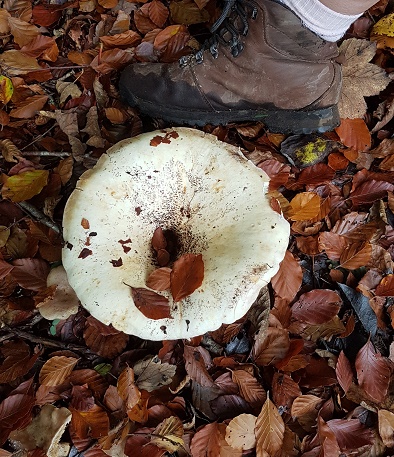
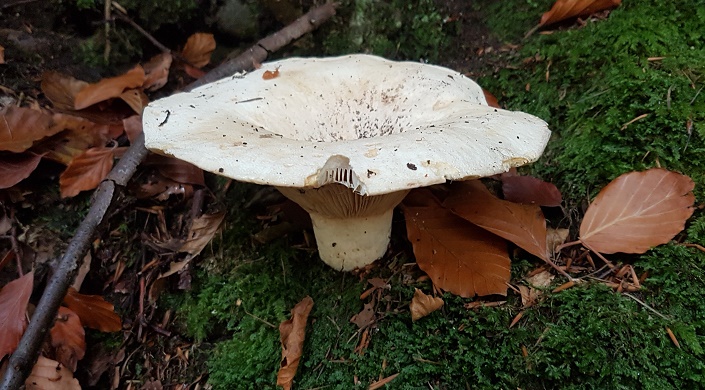
Across the track lay a small segment of a huge fairy ring of an enormous mushroom commonly called the Giant Funnel Cap (check the size 8 boot in the photo for scale). This took me immediately back to those student Rural Studies Days, when I first saw this mushroom in local woods, in a ring that was actually measurable. From the fresh fruiting bodies came a strange, un-mushroomy smell. I took one home, identified it easily and, as the book said edible, fried it in slices. It tasted like its smell – like nothing I’d ever encountered. To this day, I’m still trying to work out if I actually like it! But size-wise, they are easy pickings, and it’s fun to estimate the equally astounding diameter of their fairy-rings and plough through the woods to try to find the mushrooms on the other side of it.

This walk wasn’t for foraging, for worrying about what I was looking at, and I haven’t bothered to tease apart the various fairy bonnets. Old habits die hard, but really, I don’t need to know!

When you know winter is coming…

The turn of the season is felt, not so much as a drop in temperature or the way the need for warm socks and waterproofs creeps up on you, but in the way the woods smell different. Decaying leaves, leaves still on the trees but for whom decay is imminent: the smell, for me, of being 11 years old and at a new school, where our introduction to Biology was the invitation to compile a Biology Scrapbook over the course of a year. Diligently, I collected all those leaves on the point of rotting, pressed them in encyclopedia volumes, and learned, when I next opened the books to mount them, the subtle distinction between the smell of sycamore, poplar and oak leaves in autumn.

Today, a soggy Saturday in October, Five Mile Wood smells again of the Biology scrapbook. Weaving in and out of the olfactory hamper of autumn comes the odour of wet grass, heavily trodden, and the varied aromas of dozens of species of fungi, seen and unseen. It is raining, softly but insistently, the rain bringing its own subtle influence on how each smell is perceived, like a wash applied over a freshly executed painting. Beech leaves, nowhere near inclined to fall, glisten with rain. I am challenged to keep the rain from running down my neck, challenged by the chill in the air, challenged by the distraction of mushrooms, all of which breathe of magic, and the resulting lack of time that cut this walk a wee bit short.

I won’t bore you with more gratuitous gloating about the basket of edible mushrooms I took home to dry or make into fungus and ale pies, nor with more photos of the ones I can identify! But today, the woods presented me with an excitingly unknown fungus, the likes of which I’d never encountered in decades of mushroom-hunting.

(Actually, the woods do that every time I go foraging, for there are many, many mushrooms I cannot differentiate. But as I know they’re not on the “edible and good” list which is tattooed into my brain, I indolently dismiss them as “small brown jobs”. Which they usually are.)

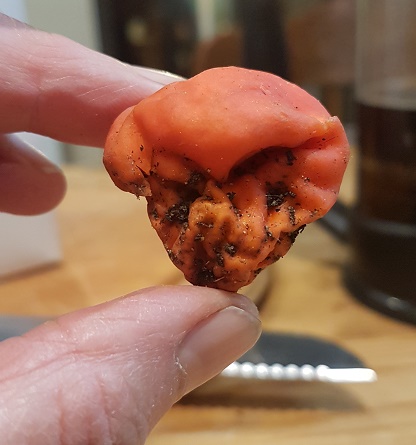
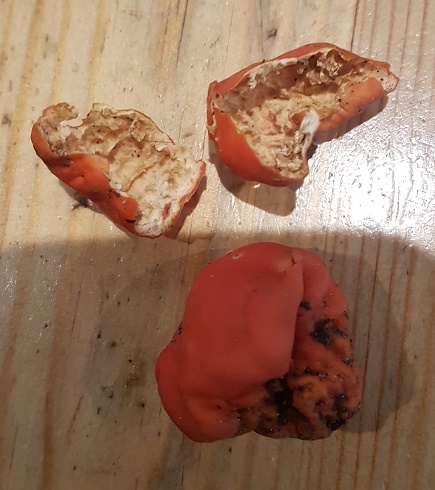
Today’s find was different, a real unknown unknown, to quote Donald Rumsfeld. Bright orange-red balls popping up through the grassy banks between the path and the ditch; I first mistook them for discarded tomatoes. But they were fungi, no question, and when I cut one open to help identify it, it was hollow, with pale coloured ribbing inside. I had never seen anything like it, but as it was so distinctive, I expected identification to be straightforward.

So far, I have not found this species in any of my books, and have drawn a blank from the social media mushroom groups from whom I begged enlightenment. Someone said they’d once seen something similar, but yellow, only got distracted by all the edible ceps nearby. Easily done! I have contacted the Tayside & Fife Fungi Group, and wait in hope. I will find out…. Perhaps someone reading this will have the name, and be laughing at my ignorance?

Inside and out….

Not Ugly.

Midsummer, June, and roadside verges, hedgerows and path edges are brimming with life and good things to eat. Well, they should be, if you’re lucky, and some fusser hasn’t gone forth with strimmer or spray gun to transform the riot of green and gold, the effusion of flowers, seedheads and shoots to bare brown, sad-looking blankness or close-mown, stressed-out grass. I can never comprehend the small suburban minds of householders who would rather gaze out on monochrome than the living proof of life on earth. It’s one thing to keep your own verge tidy, and occasional cutting can increase the range of flowers, but it’s galling when people attack verges opposite or near their houses but which they don’t actually own. I confess, I get quite bitter about it.

During the 2020 lockdown, I embarrassed my family by taking to task a poor, misguided woman who was wielding herbicide along the route of a long-distance footpath. Granted, it was a stretch bordering her own property, and right enough, as she protested, she wasn’t killing everything…..

No, she was only killing what she called “the ugly, untidy species” that she had no use for. These were Dockens (have you ever looked at the intricacy of the flower structure in the Dock family?), and Hogweed. That’s where I really saw red.

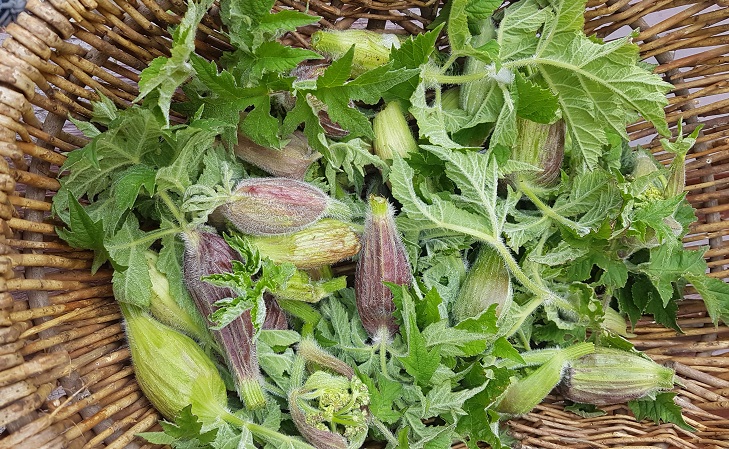
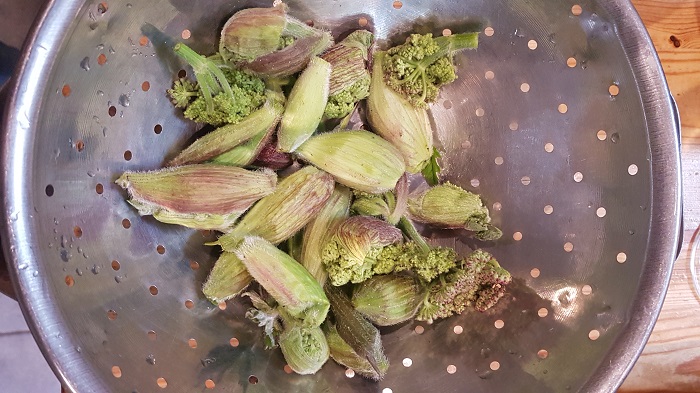
NO!!!! I don’t mean “Giant Hogweed” (Heracleum mantegazzianum), an invasive non-native plant known to cause serious skin burns and out-compete other plant species. Even I acknowledge that’s a nightmare, albeit a spectacular one. I mean Common Hogweed (Heracleum sphondylium ) a soft-leaved, far smaller native plant, with edible leafstalks and, at this time of year, the most delectable “broccoli” or unopened flower heads. Very few people have a skin reaction to this plant (far fewer than do to tomato plants for example), and I look forward to eating the broccoli every June.

“But it’s too tall, too big, too ugly and the bees and butterflies don’t visit it!” I was told. So then, we eradicate all the living things that we personally don’t like the look of, do we? What is ugly, anyway? Do we have to apply our personal prejudices to plants, other animals… humans? Sadly, many people do…..labelling leading to intolerance leading to hate crime leading to… genocide? And if a flower is constructed to be pollinated, not by the human species’ cosy favourites of bee and butterfly, but by beetles, flies or (perish the thought) wasps, does that make them useless, unworthy or ugly?
No, it darned well doesn’t. If Hogweed, Dockens or any other species becomes a weed in your carrots or undermines your potatoes, fair enough. It’s not because they’re ugly, they’re just doing what they are supposed to do. But leave them in the waysides that are their habitat. Before anyone gets horticulturally imperialistic ideas locally, I’m gathering hogweed broccoli. Just trim away the leafy shoots to prepare. Sauteed in butter with a little water and sprinkled with lemon juice and salt, they are a summer treat.

All prepared for braising or battering…..

Last night I made hogweed pakoras – coated in spicy chickpea flour batter and deep-fried – to go with the curry. I meant to take a photo for the blog, but suddenly, they were all gone. I need to get some more. Long live hedgerow delicacies!