A Shadow Crossed my Window…

So today is Samhain. A Celtic festival to mark the end of summer, and the important transition between two parts of nature’s cycle. Because it is a cycle, it’s hard to know if its an ending or a beginning, both, or neither. But it’s a turning. mentally and physically, seen in the falling leaves and the settling of seed, heard in the song of the robin and the wild geese, smelt in the richness of fungal mould and felt in the night chilling of the air. We move with the season, from one place to another.

It’s also called Hallowe’en, or All Hallows Eve, and marks another transition, between the world of matter and the world of spirit. Some corners of the Earth are known as “thin” places. Some of the Hebridean islands are very thin. You go there, and time slows, the present meets past and future, you see things you’d never notice usually. You react in a different way. Hard to describe, but it’s like another world is almost tangible, separated from this by a filmy veil. Go there. You’ll get it. Well, at Samhain, that veil allegedly gets thinner everywhere, and people see things they didn’t know were there.

I’m not talking about plastic skeletons and vampire costumes and all that crap. The only vampires at Hallowe’en are the retail gluttons out to make a killing out of gullible, competitive parents intimidated by their offspring. Neither am I talking either about the demonisation and demeaning of innocent wise people (women mostly) into caricatures to hang in your window. Jamie Sixt of Scotland (James I of England) has a lot to answer for. And I’m certainly not interested in who has the biggest pumpkin! But yes, I am up for a good ghost story…..

Not, thanks very much, those overblown, ludicrous, gory “horror” stories that just make me laugh or go back to a good book. I like the kind which are incomplete, lack a dénouement, are based on real experience, and for which it’s perfectly possible to find a rational explanation…. And yet…. There was the “haunted house” in Cornwall my family rented when I was 4 years old. All I truly remember was being terrified by strange noises coming from behind the wall, and not being able to sleep. A damp, underheated holiday home is highly likely to house rats, bats or other beasties in its cavities, who moved about at night. The tapping on the bedroom window my sister heard could be explained by an overactive teenaged imagination. The footsteps approaching the back door when no-one was there may have had something to do with my mother’s penchant for telling a good story. And we’ll never know now if, that morning when we came downstairs to find all the furniture moved about, my father had been up in the night playing a never-admitted scary joke on us. And yet….

And there’s our “ghost” here at the cottage we’ve lived in for over 22 years. I used to see it a lot, but it’s been quiet the last couple of years. Avoiding Covid, no doubt. Just a figure, quickly scuttling along past the kitchen window, glimpsed out of the corner of your eye. Never does anything else, never knocks or makes any sound and never inside the house. It isn’t remotely scary. I never mentioned it to anyone for years, and then one day I started as usual as it went by and Andrew, sat in the kitchen with me, said, “Oh, was that her again?” Andrew is the most resistant and sceptical person I know who scoffs at anything remotely “supernatural” (while being secretly scared!), but he “sees” the figure as distinctly female, head covered in a shawl. “Like the Scottish Widows advert”, he says.

Easily explained! any one of a number of “tricks of the light”. I tried to pin it to our reflection in the glass when the kitchen light is on, and yet it appears in broad daylight when there’s no reflection as well. Anyway, we have missed it/her in this period of absence, though we both saw her one afternoon last week. Maybe tonight, when the veil thins, and the world turns……?
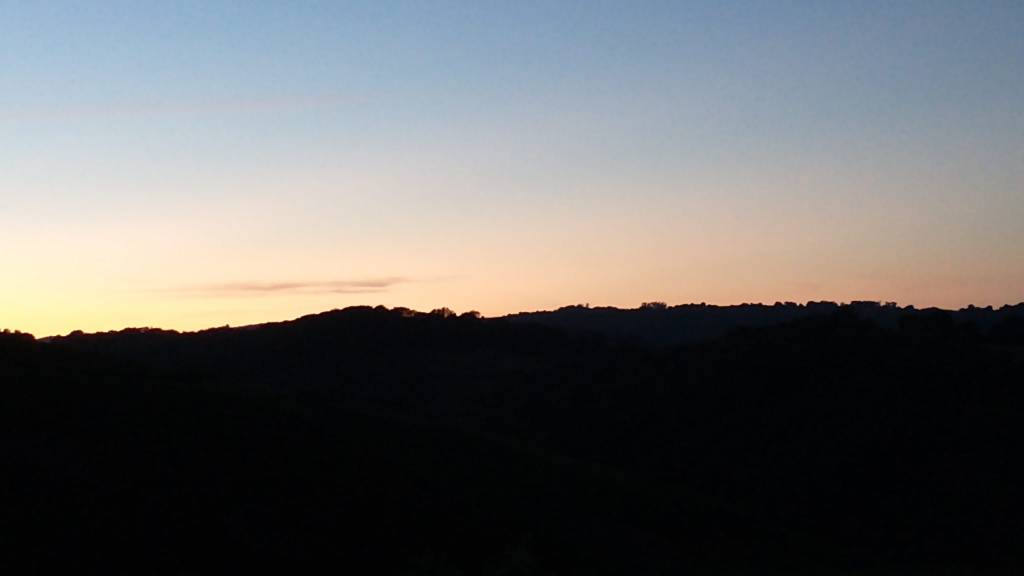
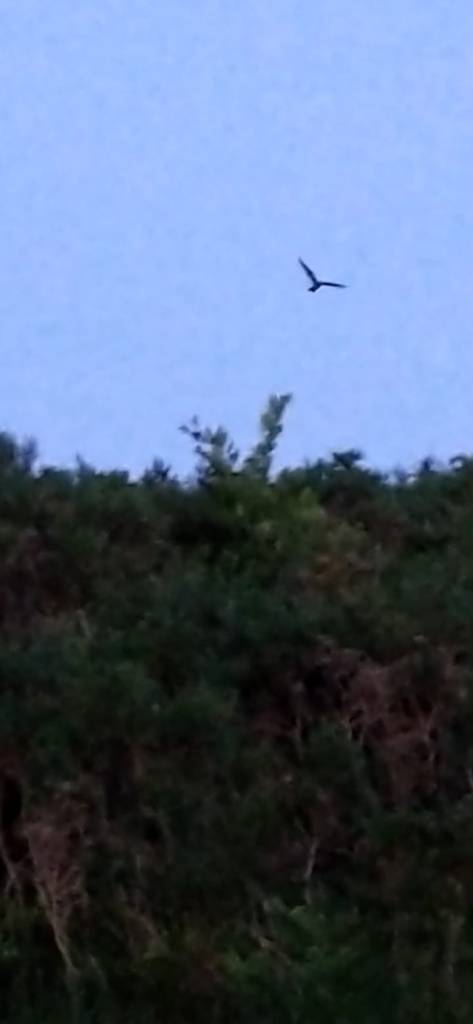
Night jars

Day descends
As we descend the
Stumbling hillside, dark
With gorse and broom.
Voices lower, whisper, cease, as steps
Grow cautious, hover, become still.

Wait. Listen. Breathe.

White orchid, luminous, rises out
From the gloom of dusk, distracts
From the strain of aching to hear.
So, unsought, barely registered, 
A faint new sound creeps from shadows .

They move invisible up from the valley,
Calling unseen from scrub and bracken.
They thrill the air. We are caught;
Transfixed, alert,
Skewered by sound.

Against a sky that reels
From peach to turquoise,  wrapped in night,
One arcs upward, coasts, swoops,
Swings and folds to right and left,
Dives into darkness, rises to light:
Swirling master of the night air.
Magician of dusk, and all the spaces
Between night and day.
Flash of white. A call that
Seeps in like the shiver of cold air.

Night falls.
Night bewitches.
Night jars.
Nightjar, edge of Dartmoor.

Thanks, Jo Lear, for the photos. I don’t know how you did it!

Here be Dragons

If you take the road from Perth to Dundee, you skirt the edges of an explosion of geological delight known as Kinnoull Hill. Sheer cliffs soar up from sea level on your left. In autumn they are swaddled in the glorious golds and browns of beech woodland at the base; in spring and summer studded with the gold of gorse and broom. Dilapidated towers seem to teeter on the edge of the cliffs looking like something Germanic from a Grimm fairy tale (they were put there fore that very purpose).

These dramatic cliffs are the result of volcanic activity some 400 million years ago when a monstrous intrusion of magma elbowed its way through the older rocks in an enormous seam and solidified. Much later, the Kinnoull Hill geological intrusion was part of other monster-scale earth movements – the folding which left us with the Sidlaws on the north side of the Tay and the Ochil hills on the other (it’s called an anticline; think of a rainbow….). Subsequent faultlines and erosion removed the top of a rainbow and created the deep valley through which the Tay now marches triumphantly to the sea.

If, however, you approach these cliffs from the other side, the ascent is appreciable, but mild and steady, the slow, back-door rise of the escarpment. I went that way in April, and parked in the Corsie quarry, where volcanic dolerite and basalt is exposed, and from which it was taken for building for centuries. Up a steep bank, and a variety of paths are on offer, taking me first to the trig. point on Corsie Hill and fine views north over the small city of Perth and the vast breadbasket of Strathmore, to the mountains of the Angus glens to the east and the Obneys, marker-hills of the Highland Boundary Fault, slightly west. Up through roads and sheltered by woodland I went on winding tracks. Oak and birch dominate in places, in others, beech and non-native conifers stake a much-contested claim. Areas of heath and rough grassland house woodland sculpture in this popular spot.

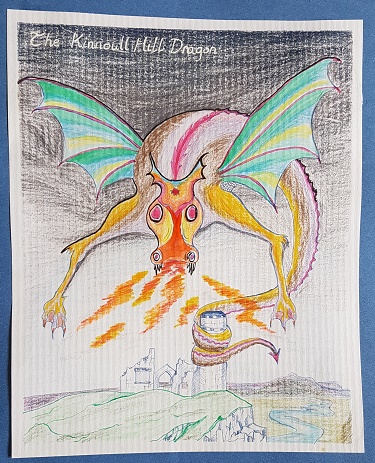
Sometime between all that geology and now, we are told, a dragon arrived on Kinnoull Hill. It glided along the unassailable cliff edges until it found a crevice, leading into a large enough cave for a small dragon to set up shop. This cave, called the Dragon Hole, is high on the cliff and allegedly could hold a dozen adult persons, so it wasn’t luxury accommodation for a dragon. What the dragon got up to, to upset the people of St. Johnstoun (as Perth was then known), I have no idea, but as is the way with relationships between human animals and animals either good to eat or a tad scary, someone was said to have “slain” it. It could have been St. Serf (what IS it with saints and dragons??), commemorated as a dragon slayer in the old church at nearby Dunning.

But my bet is Serf made it up, and the dragon’s still about, somewhere. There is a record that in the late 13th century (first) wars of independence, none other than William Wallace “pressed by the foe, occasionally betook himself to the retreat of the Dragon’s Hole.” In the 16th century, it was the local custom for a procession of youngsters from the town to clamber up to the Dragon Hole on May 1st (the pagan feast-day of Beltane), with garlands of flowers, musical instruments, and what may have been a Green Man. Or was it a dragon, representing the sun god, Bel? Whichever, it certainly cheesed off the local minister. In 1580, the congregation of the Kirk were forbidden to “resort or repair” to the Dragon Hole, on pain of a £20 fine (quite a fortune in those days) and repentance in the presence of the people.
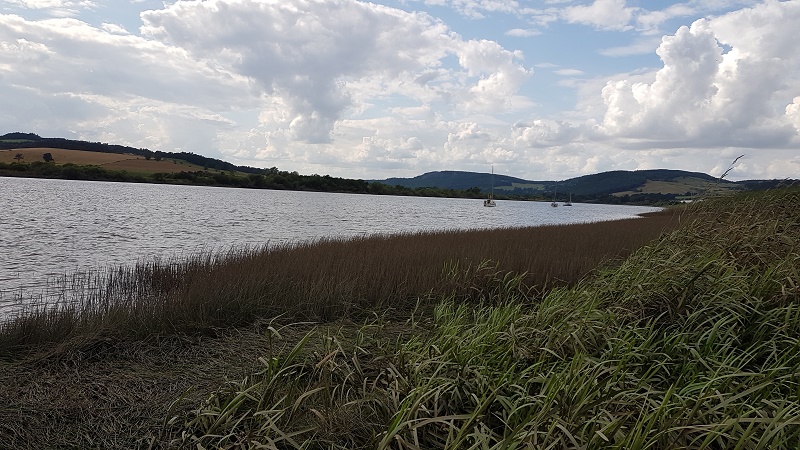
You might think that was the end of it, and the Dragon Hole, together with its occupant, faded and disappeared from local knowledge. I used to teach about landscape character and interpretation, among other things, to Countryside Management students at the local college, and used Kinnoull Hill as a case study. One year, a couple of the lads got quite excited about dragons (can’t think where they got that from), and vowed to find the Dragon Hole. But here’s the thing: their colleague Arlene, a local girl, told us she used to go there as a child and had been let into the secret of its location by an older relative. She also had the good advice that they should not attempt to climb up to it, but abseil down. They went off in cahoots. Term ended before I ever heard if Ryan and Hamish were successful. Knowing them, I wouldn’t be surprised.

That’s Dundee in the distance…

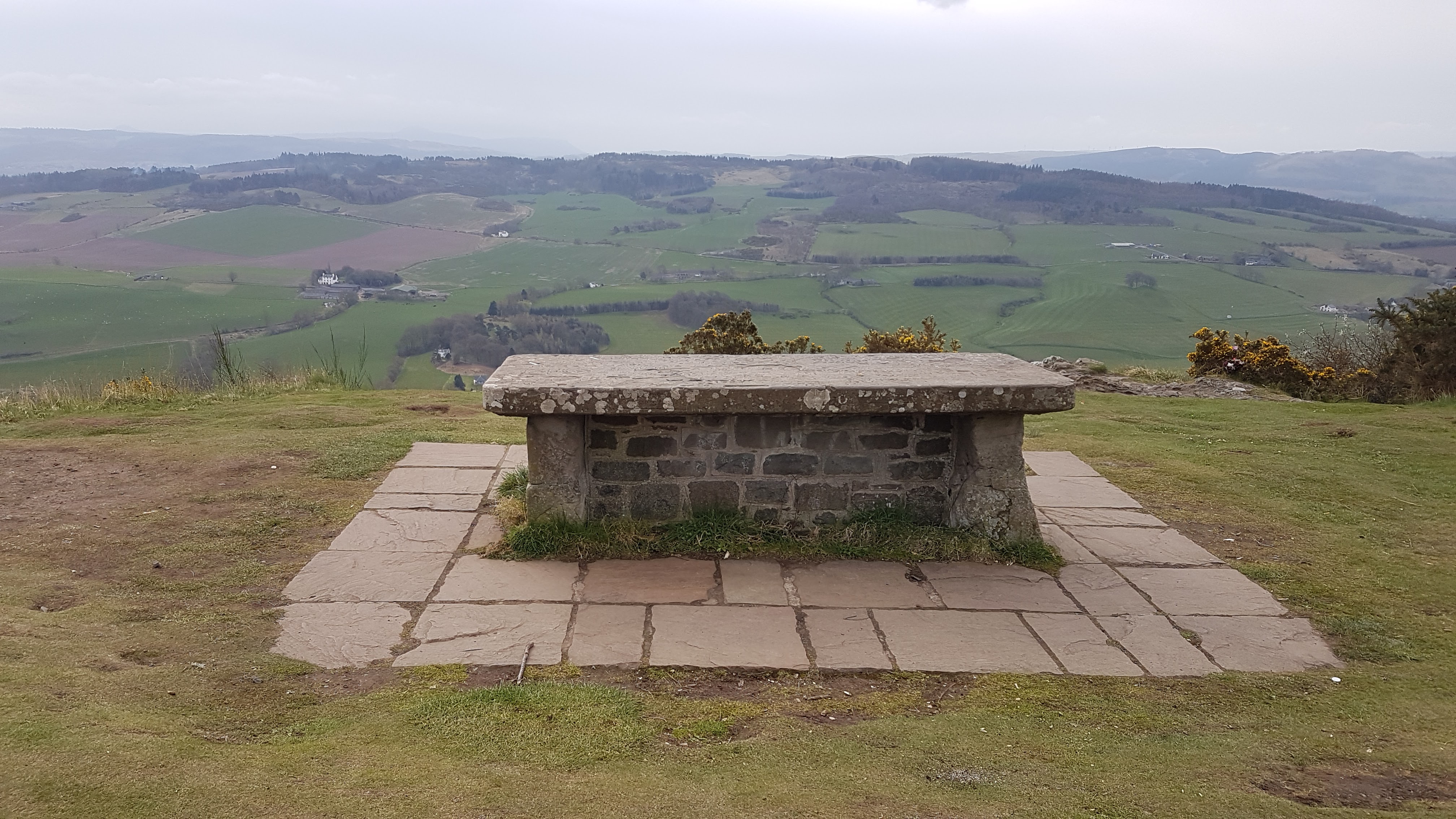
Back to my walk. I came out to the viewpoint on the edge of Kinnoull Hill cliffs, where the ground suddenly ends, and bunches of flowers tell sad stories and remind us of human misery. The views downriver, with Dundee sparkling in the distance, and across to the greens and golds of Fife, with it’s own matching quarries and volcanoes, were more than worth the uphill slog. Everything, especially life, seemed precious to me then. I remembered the tales of the dragon’s hoard of treasure, the enchanted “dragon-stone” which James Keddie found in the Dragon Hole in 1600, the “Kinnoull Diamonds” that are said to sparkle by night. And I came right back to geology. Around volcanic intrusions, mineral-rich deposits hold many semi-precious and maybe precious stones – on Kinnoull Hill, it’s garnets and agates that are best known.

Back down to Earth, in every sense!

“Wild Flowers of the Woods” – a small selection from Five Mile Wood!

Although I was born and grew up in a London suburb, awareness of nature was hammered into me, partly by my family, partly by primary school, where the “nature table” was obligatory in every classroom and was always piled high with artefacts, and partly by the nature books that lay around the house. It was while poring over these behind the sofa that I began to learn my flowers.

My favourite was entitled “Spring Flowers of the Woods”. To start, I relished the beautiful hand-painted illustrations, and, later, when I read that the woods were full of flowers in spring BECAUSE leaves were off the trees thus allowing light for the flowers to open and the pollinators to amble in, it was my first glimmer of ecology, and the entangled ways of nature. I came to recognise and seek those exquisite, archetypal spring flowers such as primrose, wood anemone, wood sorrel, mercury and violet.

Wood Sorrel and Violets

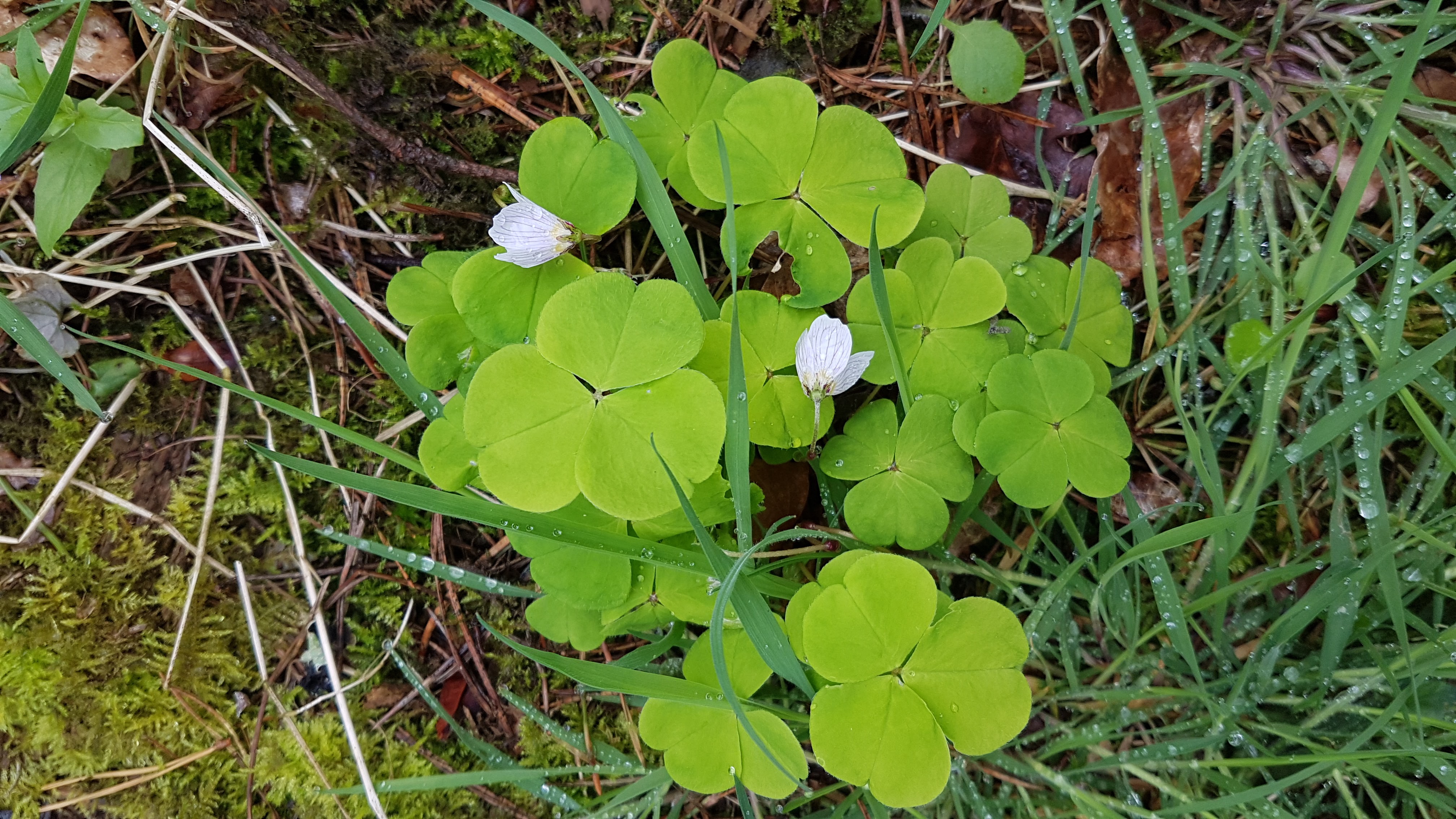
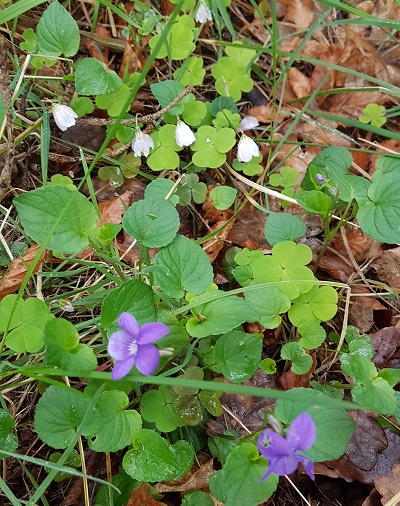
Today in Five Mile Wood, on a damp and overcast day, I greeted some of them. In the broad strip of mixed broadleaved and conifer woodland to the south, violets a-plenty sprinkled themselves over the dead leaves of birch and beech, growing on old stumps and under windthrown trunks. Sometimes they congregate with Wood Sorrel, whose edible, trifoliate leaves draped from spindly stems, and finely-veined, nodding white flowers are one of the (many) most beautiful things on earth. Wood Sorrel grows here only in scattered communities. I have the impression these colonies are networking towards each other, perhaps via the hidden telegraph of soil-fungal communication.

I have not yet found Wood Anemone here, which is surprising, but intriguingly, there is the merest germ of a bluebell wood, if you know where to look, and they are beginning to flower. (photos were horribly blurry, and I shan’t burden you with them. Everyone knows what bluebells look like.) Bluebells are said to be a sign of ancient woodland (which Five Mile probably isn’t) or at least a settled woodland ecology. I do not wish to unsettle them!

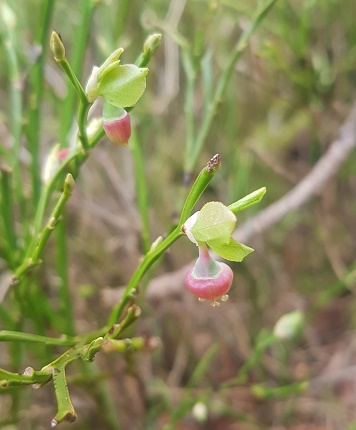
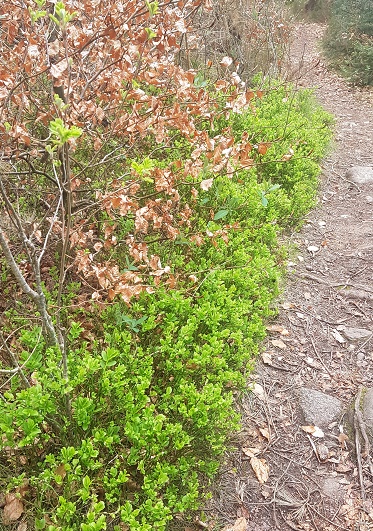
As the ground rises, that ecology morphs into something more akin to acid heath (there are certainly signs that at least part of the central area once held deep peat, signifying raised bog, perhaps). Two flowers in this habitat – not stars of “Spring Flowers of the Woods” – gave me great pleasure. One was the blaeberries that line the paths and snuggle up to trees here. They are now in hard-to-spot flower. Tiny, beautiful dull reddish bellflowers (look closely!) which will turn into the fruit of this our native blueberry and provide good walking snacks in the summer. It’s a treat to see this wild harvest crop doing so well; it was somewhat decimated by the last clear-fell. (Do we understand well enough the changes we force on a landscape by our actions? Do we care enough?)

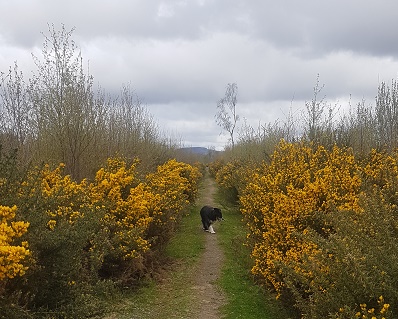
The other is gorse. I have a very soft spot for this riotous, prickly native shrub. So many plus points does it have: nitrogen fixing, baby tree protecting, wild tea providing and a redoubtable habitat for spiders (see here) among others. What’s in a few scratches? A week ago, cycling round the wood at speed (to be honest, anything over 6mph is “at speed” for me even on an electric bike), I did incur a few scratches….. but it was like moving through a mist of warm coconut, the delicious gorse flower smell made powerful by the bright sunshine and muggy air. Today, it was fainter – but thanks to the slightly unnerving vigor with which gorse is spreading across the path, I could still catch it. Divine!

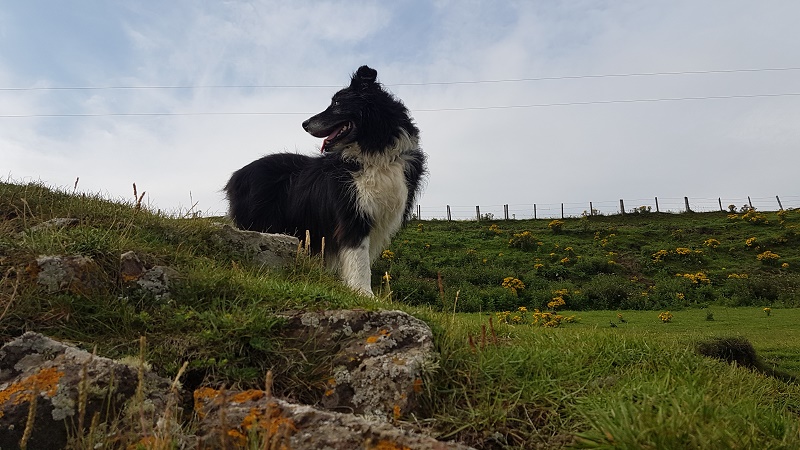
Gorse-intoxicated Border Collie

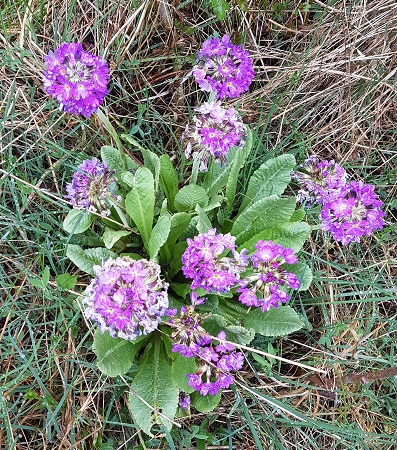
Primroses seem to be absent, as well as the wood anemones, but there was this unexpected relative – Primula denticulata, the Drumstick Primrose or, locally in Angus, the Kirrie Dumpling. Native to Himalaya, this has not, I suspect, got here on its own! If I were a hard-line ecologist, I’d uproot it (and find a home for it in a garden). I’m not, but there might be a good argument for collecting the seed before it spreads itself about. Or not?

Primula denticulata, the Kirrie Dumpling

Tayport, Tentsmuir, & the Dance of Death

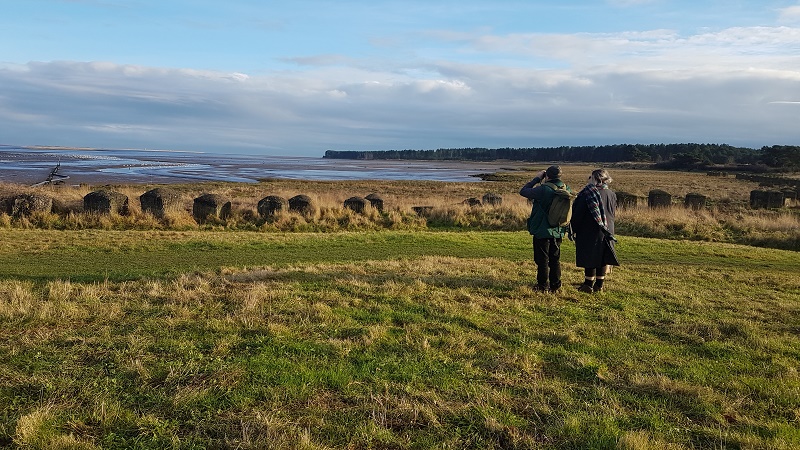
Three days of Christmas torpor, punctuated by food, beer and Irish cream liqueurs, two days of damp murk – what happened to the pretty snow that began falling so seasonally on Dunkeld Cathedral at midnight Christmas Eve? – then Tuesday dawned with clear-ish skies and a watery sun. Finally, an opportunity for a decent walk, and a collective itching for sea air drew us like a magnet to Tentsmuir Forest.

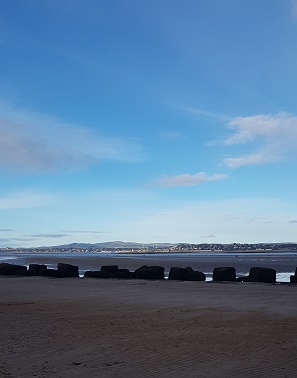
I consulted my knee, which has been challenged by non-specific pain since I fell onto it while raspberry pruning at the end of October. My knee said in no uncertain terms that those strong anti-inflammatories from the doctor had worked miracles in the preceding week, and it was quite sure any torn ligaments, lumps of cartilage etc. were virtually mended. It also said forget the looming possibility of the onset of osteoarthritis, let’s not even go there. The beach calls. So we drove – no, I drove, another possibly poor decision – to Tayport and marched across Tayport Heath with a head-clearing north easterly behind us, and the sun making Dundee all sparkly. Tide was out; wide sands, gleaming waters, massive blue skies splashed with the long brush-strokes of brazen clouds.

Sun always shines on Dundee…

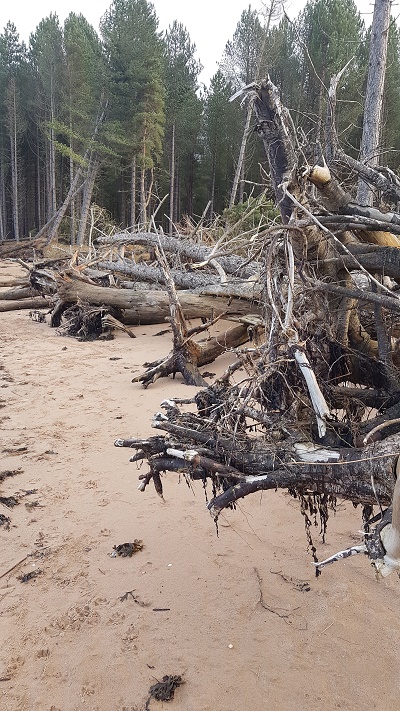
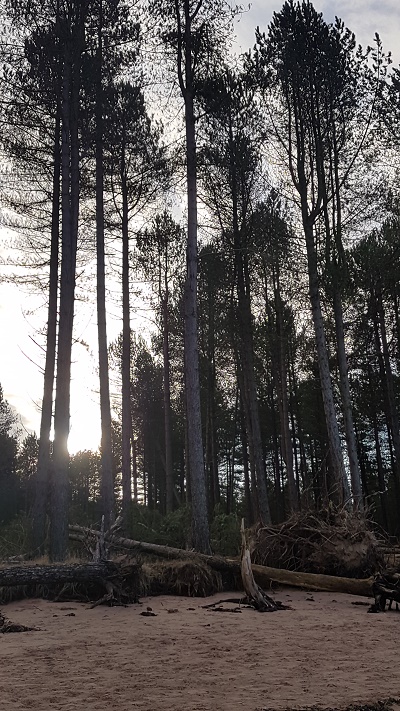
Getting to the forest, we saw many of the pines that cling to the edge of the sand had been toppled by recent storms. In a hollow of dunes, the trees had fallen in to the centre. The upended roots, with the sandy soil washed or blown off them, were a fierce tangle a-top the weathered trunks and skeletal remains of earlier storm victims. It became clear that the parallel forest track  inland, which would have been our easy and shorter return route, was blocked.

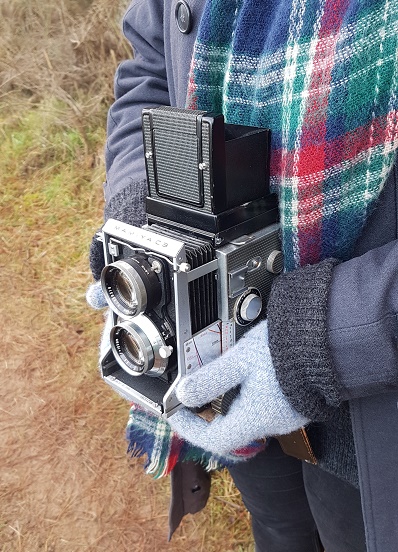
Rowan spent an age taking black and white photos with an antique film camera, unloading the film and loading a new one. I took photos of the camera on my phone in an instant, and was glad to wait and rest a slightly uncomfortable but not yet painful knee, while reflecting on the different mental input and rewards of each method.

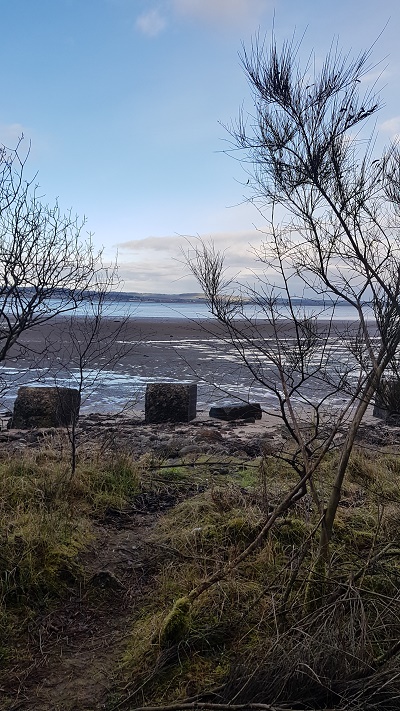
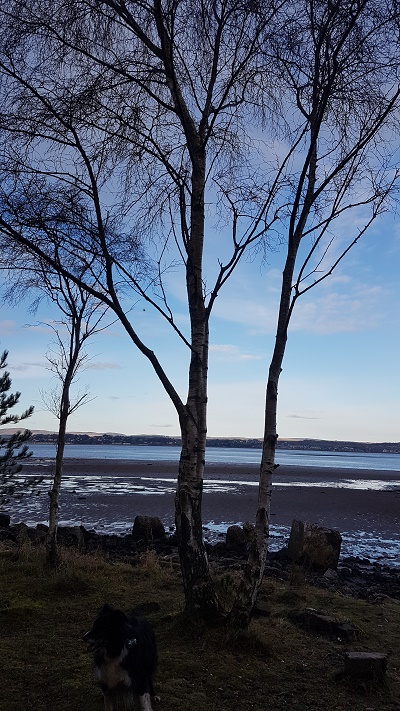
Afternoon light on the estuary emphasized the form and movement of the bare birches and broom in silhouette, as the tide turned. When we reached Tentsmuir Point, the knee was starting to think maybe it should not march on to Kinshaldy Beach as planned, but turn around now. After all, that would still be 5km of exercise and fresh air in total, though I dearly wanted to paddle in the distant, sparkling waves. Pausing to decide, I stepped down a 45cm bank, bad leg first.

There was an audible explosion in the knee, and I was no longer standing up. Actually, I couldn’t. We sat for a while, till I felt the pain might just be away, but that I should definitely head back. When I tried to walk, that became “we should all head back”. Various efforts at walking supported by one or both of my familial companions were not very successful on the uneven, up-and-down path – someone was always either the wrong height or moved at the wrong time, and any sideways movement, flexing or bending of the knee was pretty agonising. We minimised such movement with my new Christmas walking socks and a filthy and disreputable Tay Landscape Partnership buff, belonging to Andrew. (I wash mine.)

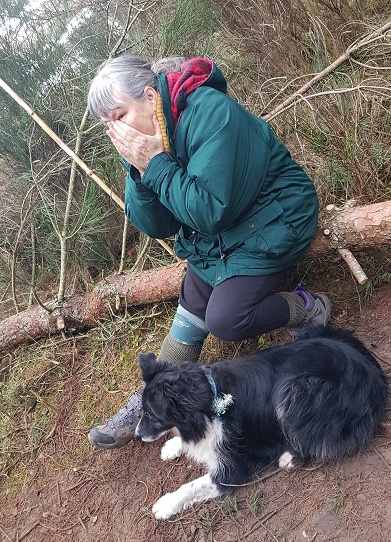
Infinitely helpful collie dog

There were lots of folk out on that path (all others being closed off), and many of them were wonderful. Jolly Fifers and Dundonians with sympathy, but a strong sense of the ridiculous kept my spirits up with their black humour and all kinds of offered help and advice. To the lovely man who had collected a polished peeled pinewood stick and surrendered it to me before going off to see if there was any way he could get his car into the forest to pick me up, my grateful thanks. That stick (pictured above, behind) was a real help and enabled me to avoid the shifting sands of human support. People, so often, are just brilliant, something we forget too easily, confronted as we are by insensitive, heartless, mindless acts – not infrequently by politicians.

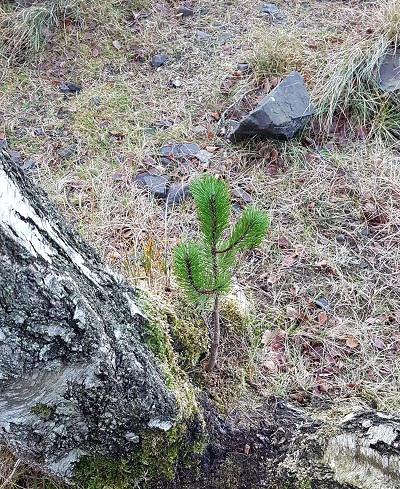
However, light was starting to fade, and progress was slow. I had to keep stopping to recover. One long stop was by a heart-searingly beautiful birch tree on which I leaned. Tucked between its twin trunks was a little pine seedling. I wished it every success, while Rowan rang 999 and Andrew marched off to meet the emergency services back at Tayport.

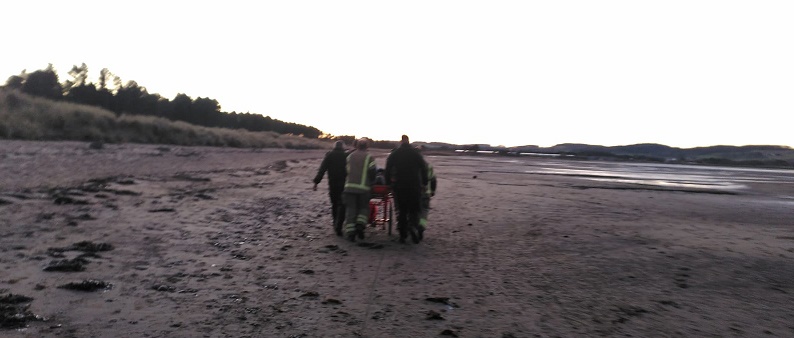
Getting an ambulance in to where I was proved impossible because of the windthrown trees. The ambulance people called on the fire service who have the keys to the gate at Lundin Bridge, and on their colleagues in Edinburgh to come up to Fife with an all-terrain vehicle to get me. Meanwhile, two paramedics and 4 fire-people set off with a narrow-wheeled stretcher trolley, while Rowan kept everyone updated with a brilliant App called Three Words which can pinpoint location accurately.

It took a long time. Wistfully, I dreamed of a helicopter air-lift (which was considered, I learned later, but they said it couldn’t land on the estuarine sands) or a Bond-style speedboat rescue. The tide was visibly rising and although still a way off I knew that at high tide the sea washes the track. And it was getting cold. So, when I could, I kept moving on, in the crab-walk sideways step I’d almost perfected, leaning on the stick for dear life in front of me, dragging the damaged right leg up to join the poor, put-upon left. (It was ever thus.) We noticed that the movement was in waltz time, and tried humming the Blue Danube by Strauss for encouragement. That was too corny, so Rowan found Iron Maiden on her phone and I crab-danced along quite the thing for a good while to Dance of Death…..

“Feeling scared I fell to my knees
As something rushed me from the trees
Took me to an unholy place
That is where I fell from grace”
(lyrics, Iron Maiden)

Appropriate, or what?

Getting carried away…

When we met the brilliant team of combined emergency service people (yes, I know, but they bloody were), I opted to be carried on the jolting trolley (apparently a wheel came off at one point) till we met the ATV. The ATV got lost (“Edinburgh folk” tutted a Dundee fireman, as if he’d not really expected anything better), so didn’t arrive till we were out, but I enjoyed passing under the overhanging pine branches, set against a darkening sky, and the vivid sunset over the flat and increasingly wet estuary. There are worse settings for being a casualty.

The two Edinburgh paramedics transported me to the car and thence off to A&E. Five hours later, and more hats off to the NHS, I left, with a pair of crutches, a fractured or chipped shinbone in the knee joint encased in a massive Velcro-assisted immobiliser, and a probable  torn-asunder lump of cartilage called the medial meniscus. Which came first, and whether one caused the other, I hope to learn next Wednesday at the fracture clinic!

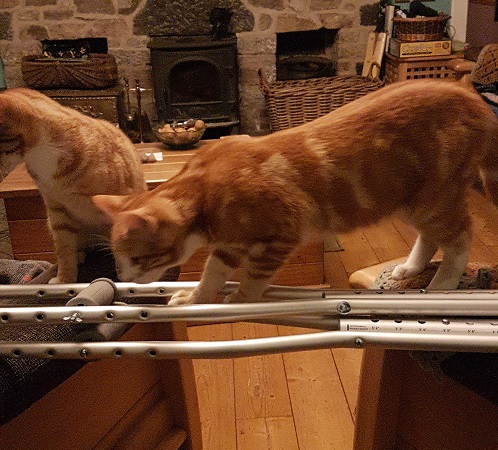
Fringe benefits: 1. Gas and air! Happy memories (?) of childbirth! 2. From the Xrays, my knee “is like that of a young woman” said the doctor. No osteoarthritis yet! 3. The kittens like tight-rope walking on the crutches more than I like using them. 4. Time to write my blog, which I signally failed to do before Christmas. Too late for Christmas greetings, but have a good Hogmanay and new year when it comes…..everyone, but especially two doctors (one of Philosophy with heavy metal expertise), all the happy walkers in Tentsmuir Forest, three firemen and a firewoman, four paramedics, innumerable NHS staff from the reception desk to the porter, one man with a stick (which I’m keeping unless he wants it back), and a partridge in a pear tree……(imagined.)

Kitten appropriates the crutches…

When you know winter is coming…

The turn of the season is felt, not so much as a drop in temperature or the way the need for warm socks and waterproofs creeps up on you, but in the way the woods smell different. Decaying leaves, leaves still on the trees but for whom decay is imminent: the smell, for me, of being 11 years old and at a new school, where our introduction to Biology was the invitation to compile a Biology Scrapbook over the course of a year. Diligently, I collected all those leaves on the point of rotting, pressed them in encyclopedia volumes, and learned, when I next opened the books to mount them, the subtle distinction between the smell of sycamore, poplar and oak leaves in autumn.

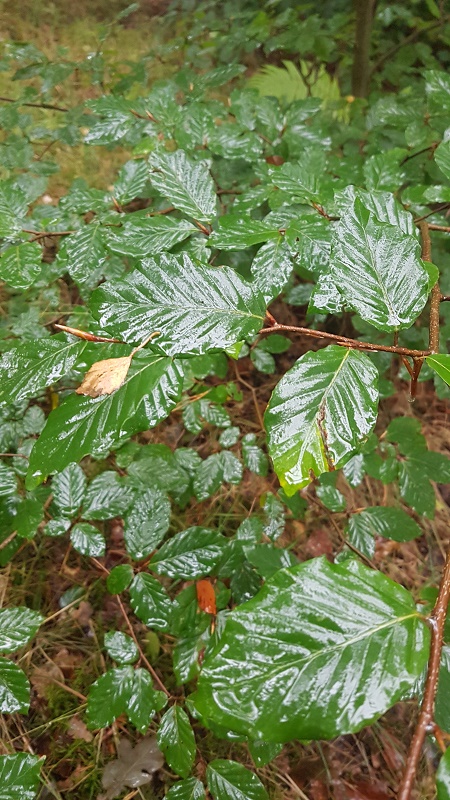
Today, a soggy Saturday in October, Five Mile Wood smells again of the Biology scrapbook. Weaving in and out of the olfactory hamper of autumn comes the odour of wet grass, heavily trodden, and the varied aromas of dozens of species of fungi, seen and unseen. It is raining, softly but insistently, the rain bringing its own subtle influence on how each smell is perceived, like a wash applied over a freshly executed painting. Beech leaves, nowhere near inclined to fall, glisten with rain. I am challenged to keep the rain from running down my neck, challenged by the chill in the air, challenged by the distraction of mushrooms, all of which breathe of magic, and the resulting lack of time that cut this walk a wee bit short.

I won’t bore you with more gratuitous gloating about the basket of edible mushrooms I took home to dry or make into fungus and ale pies, nor with more photos of the ones I can identify! But today, the woods presented me with an excitingly unknown fungus, the likes of which I’d never encountered in decades of mushroom-hunting.

(Actually, the woods do that every time I go foraging, for there are many, many mushrooms I cannot differentiate. But as I know they’re not on the “edible and good” list which is tattooed into my brain, I indolently dismiss them as “small brown jobs”. Which they usually are.)

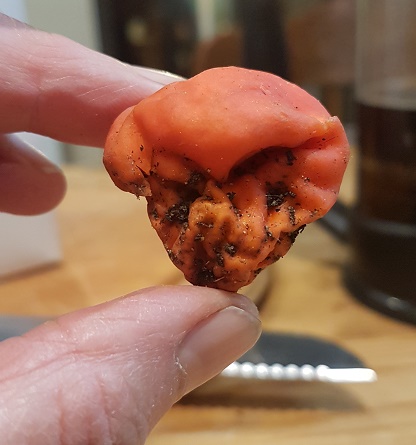
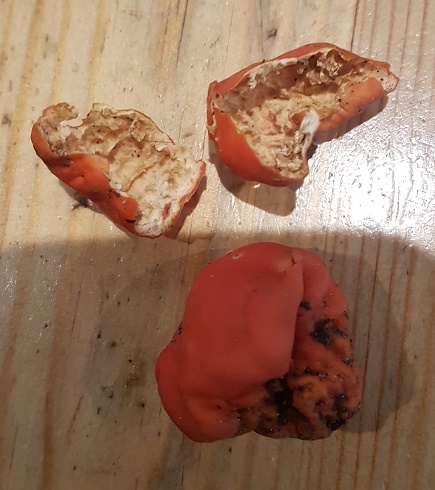
Today’s find was different, a real unknown unknown, to quote Donald Rumsfeld. Bright orange-red balls popping up through the grassy banks between the path and the ditch; I first mistook them for discarded tomatoes. But they were fungi, no question, and when I cut one open to help identify it, it was hollow, with pale coloured ribbing inside. I had never seen anything like it, but as it was so distinctive, I expected identification to be straightforward.

So far, I have not found this species in any of my books, and have drawn a blank from the social media mushroom groups from whom I begged enlightenment. Someone said they’d once seen something similar, but yellow, only got distracted by all the edible ceps nearby. Easily done! I have contacted the Tayside & Fife Fungi Group, and wait in hope. I will find out…. Perhaps someone reading this will have the name, and be laughing at my ignorance?

Inside and out….

Reflections from a Narrowboat

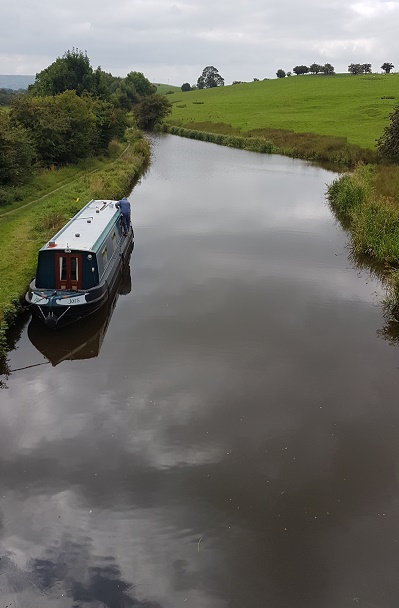
Somewhere on the Liverpool-Leeds Canal

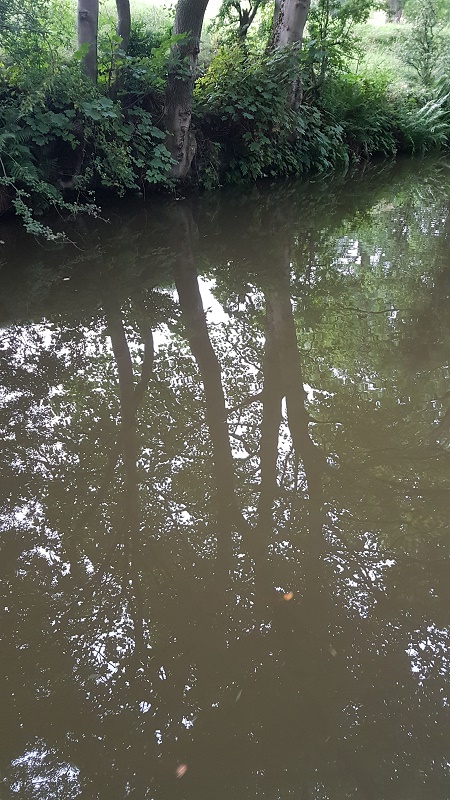
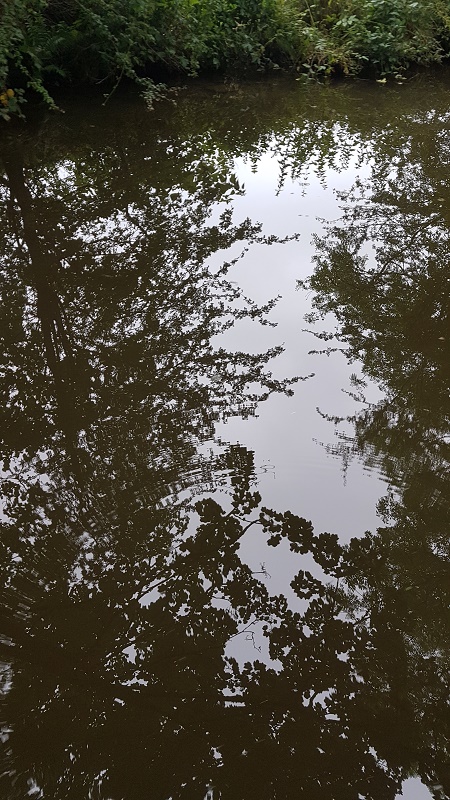
Moving – scarcely as we are – at something slower than walking pace, the beech trees at Farnhill this early morning are reflected with precision in the still, opaque water. Here in the bows, the faraway engine cannot be heard, and barely a ripple anecdotes the boat’s gliding passage. Gnarled, knobbly roots cling to sandy banks, equally above and below the waterline, making dense and mysterious holes of darkness and nudging great trunks upwards and downwards at matching speed.

Though we pass each tree at a ceremonial pace, none bow, none scrape. There is no concession, no acknowledgement. The suspended branches scarcely move. Body of tree fires into its mirrored trajectory skyward and earthward, as if all its electrons had simultaneously collided on the grey-brown meniscus of the canal.

Into the open, and we hear the awakening traffic on an adjacent trunk road. But the commuters and their noise are from a different universe. A shimmering sleight of time and speed separate them from us. Thistledown and tall spent grasses, immobile, catch the light, all shades of cream and grey.

And that most imperturbable of birds, the heron, cranes his long neck to the minutest degree from the bank, but also declines to move.

Aliens invade Tayside?

I wanted to walk from Cairnie Pier near St. Madoes west to Inchyra on the Tay estuary. My old map (old being the operative word) said there was a path, but it says that about a lot of stretches of the Tay along the Carse of Gowrie that it would be nice to walk, and it’s often mistaken. Google Maps hinted that if you got really, really close to the ground, there might even be two paths, but it wasn’t committing itself. At Cairnie, the existence of a small car park looked promising, and I found the great river hiding among its own reedbeds as usual, lapping quietly at a little inlet whose stones oozed mud. Fishermen’s paths trailed off in both directions.

Cairnie Pier

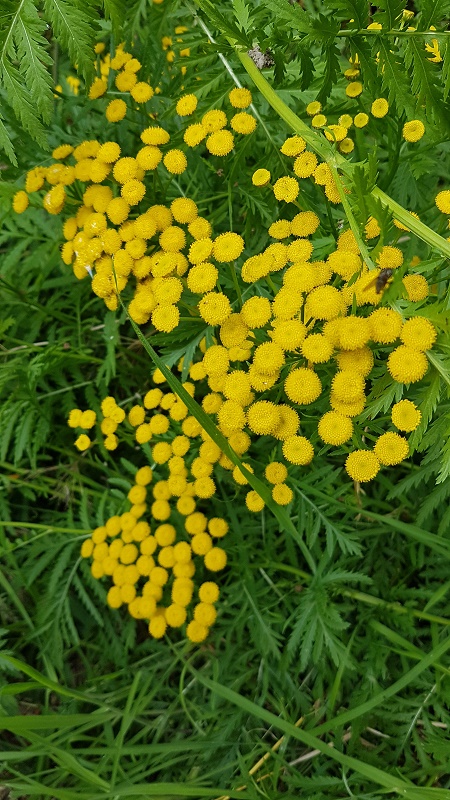
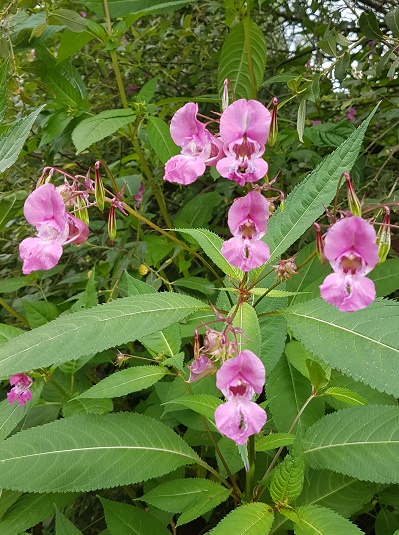
It was drowsy-hot, an afternoon of hoverflies and docile wasps, intent on the many flowers that lined the path. The river is a conduit for all kinds of unexpected vegetation, which thrive in the tidal mud and lovely untidy, unsanitised, hedgebanks and verges. The yellow buttons of Tansy pop up everywhere along the Tay, together with the silvery Mugwort, a long-ago Roman introduction, allegedly a cure for sore feet. Warm and spicy, the scent of Himalayan Balsam over-rode the scents of native flowers, and its spectacular flowers trumpeted a welcome to pollinating insects. This “alien invader” has been around a good while, anywhere near to water, and it’s a Marmite plant. Speak to any beekeeper and she will wax lyrical about the “ghost bees” who return somnolent and satisfied to the hive, covered in its dense white pollen. Speak to most mainstream ecologists and they will say it’s invasive, outcompetes “our” native flora and has no place in “our” countryside. I love its other name – Policemen’s Helmets – does anyone remember when policemen wore helmets? The top and bottom lips of the flower are encased in a helmet-like fusion of the other petals. I’ve happily pulled it out of ancient oak bluebell woodland, but I can’t say it bothers me too much today. I munch a couple of the peppery-pea tasting unripe seedheads, out of duty.

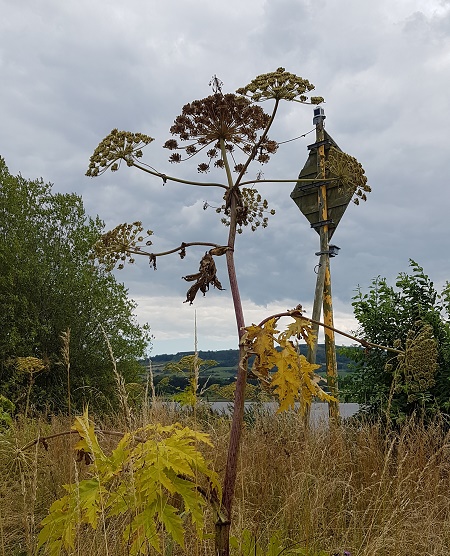
But then arise the forbidding, towering structures of a harder-to-love alien. Giant Hogweed, introduced by gullible and novelty-obsessed Victorians to adorn their fancy gardens. Apart from its spectacular, H.G. Wellsian-Martian structure (still being extolled by lecturers when I learned garden design), it is low on redeeming features. It is truly rampant, flowers and seeds everywhere and delivers serious burns to anyone brushing against it in sunny weather. It’s a property called phytotoxicity, and today the sun was shining and I passed gingerly.

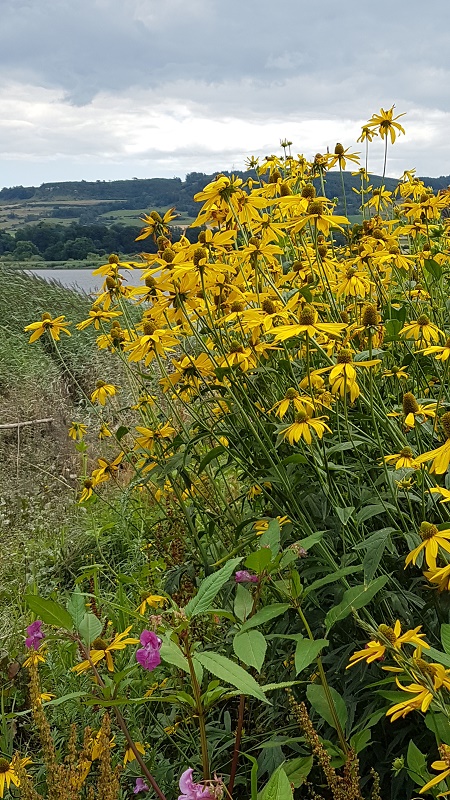
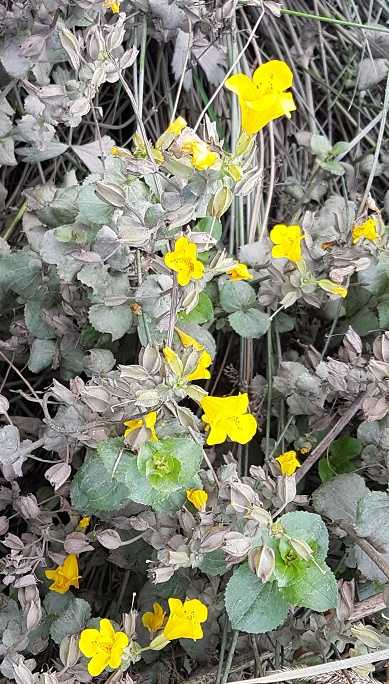
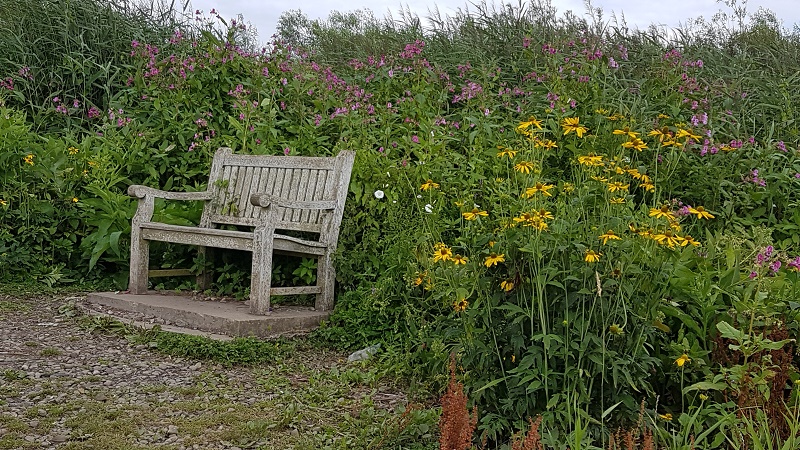
Far more attractive, and indeed glorious were the bright yellow, sunny Monkey Flowers, coated in tidal mud, and the clumps of tall Rudbeckia, both garden escapes, that sway gently in the breeze up the river. They are dotted all along this stretch of the Tay. I remembered another sunny day talking with David Clark of Seggieden – a great botanist and a man who so loved this river – about whether they “should” be there and what exactly was native anyway, since both of us could be labelled aliens ourselves. We agreed that neither of us were fanatical about racial purity in plants or anything else, but weren’t fond of Giant Hogweed, nor the next invasive alien to show its face on my walk, the Japanese Knotweed. This monster would out-compete the miles and miles of Norfolk Reeds themselves…..oh wait, did I say Norfolk Reed?

Yes that’s right, the incredible Tay Reedbeds, home to rare marshland bird species and a complex, life-affirming ecology, are the result themselves of the introduction of a “non-native”.

My fishermen’s path had petered out, and an attempt to reach Inchyra along the edge of a field also met with failure, so I drove back towards St. Madoes and took a side road left. Thus I reached Inchyra, a beautiful little village of low houses, pretty gardens and derelict farm buildings looking, as they always do, as if a quick afternoon’s work would put them back into service. From this hamlet, crouching among tidal lands as if in terror of sea-level rise, I found a wild garden overlooking the estuary and across to Rhynd, and small moored sailing boats bobbing in the rising tide.

Here was a seat, to the memory of a daughter of a local family, and I sat in complete peace among the reeds, with flowers – native, non-native and all the gradations in between – blessing the air with scent and colour. Even the busy tractor across the water hummed to itself. Rain was forecast; I watched silver-lined thunderclouds pile up on themselves, shift and mutate, and then dissolve again into the blue sky. It was so good to be here.

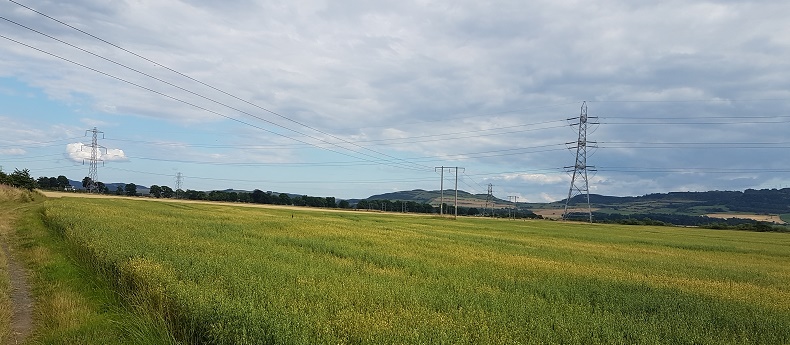
When it seemed the clouds were getting serious, I found a path that ran beside Cairnie Pow, giving me a good circular walk back to the village. The pow is a local name for a drainage channel, often of ancient origin, that was created to free the fertile soils of the Carse of Gowrie from being marshland. They litter the Carse, and give a sense of being neither quite on dry land nor in water. This one tracked parallel to the path I didn’t find earlier from Cairnie Pier, and then swung left at the point I’d almost got to, where a host of overhead power lines had got together for a gathering. They sky darkened, and the air, hot and still full of the damp scents of flowers, smothered the senses. Young trees, planted by the nearby farm, gave welcome shade. A big, old house rose out of the marsh with no obvious gateway or entrance. It looked dark, empty, full of tales and secrets. I wondered, made up stories in my head, began hearing things and holding imaginary conversations with people who did not exist. Perhaps it was as well that heavy, ponderous raindrops deterred me from more exploration that day.

Finding Ferryden

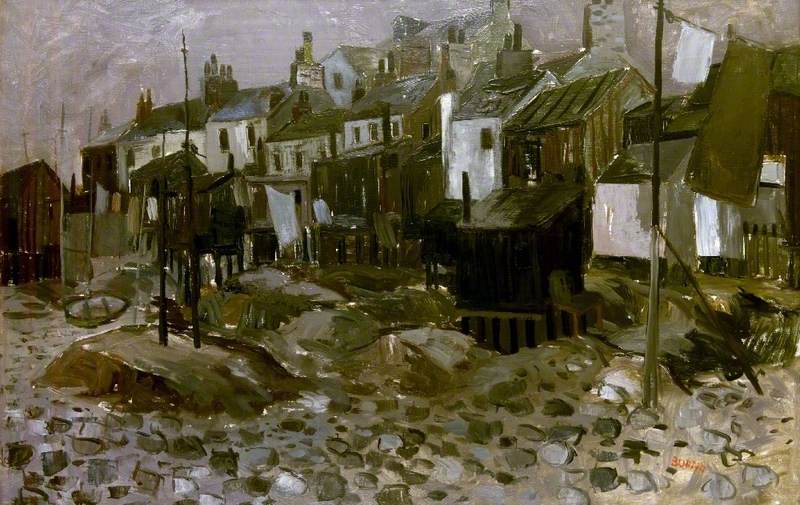
Ferryden by William Alexander Burns (1921-1972) Photo: Glasgow Museums

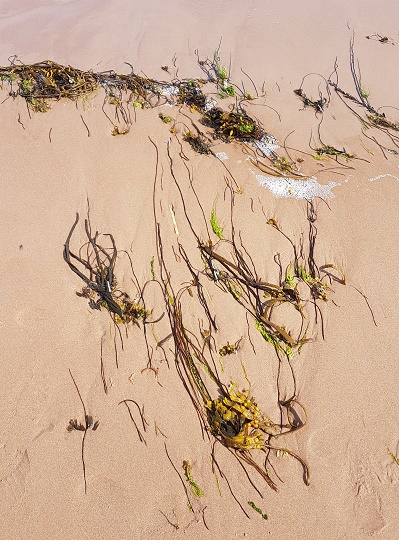
It’s often the places you didn’t mean to visit that become the ones you will always remember. It happened to me this weekend. Dropping our daughter off in Arbroath for a summer school gave us the perfect opportunity for a weekend mooching around Angus, camping overnight, visiting favourite haunts and exploring ones we didn’t know so well. So, out from Arbroath (reluctantly missing one of the favourites, the pie shop, on account of a planned visit later to another, the chippie) and a  bask and paddle at Lunan Bay, my number two go-to beach for restoration of equanimity and sea watching. The tide was higher than I’ve ever seen; words were spoken of exceptional lunar activity sooking the sea up high then dropping it again, along with torn up seaweed and the corpses of seabirds. Less beach than usual then (and therefore more people per square kilometre); the dog confused by reaching the water’s edge so soon, but gratified to find long tangles of bootlace weed which he proceeded to bring to us to hurl into the surf. Heaven knows how much seawater he guzzled retrieving them, but he was happy.

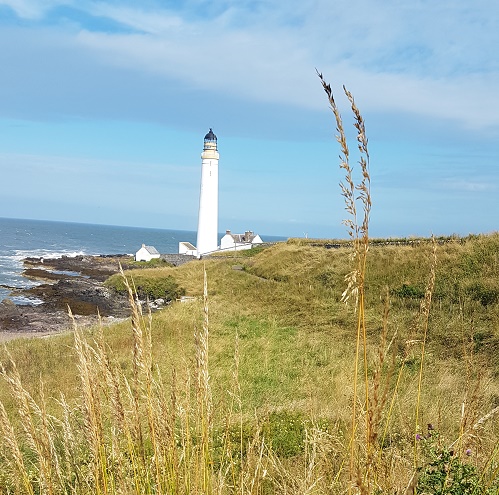
Heading vaguely towards Montrose, because that’s the way we always go, unravelling a dog-eared and out of date Ordnance Survey map and checking the terrain on Google maps, we took a notion to go to see the Stevenson lighthouse at Scurdie Ness. To get to the coastal path which would take us there, we decided to park at Ferryden. Lying on the estuary of the River South Esk, opposite the unappealing industrial sprawl of waterside Montrose, it wasn’t a place we’d ever bothered to visit before. But what a lovely surprise – who knew!

Crouching three or four deep, back from the harbour wall were the small, varicoloured and practical houses that once belonged to fishermen; front doors on the first floor and accessed by stone stairways up the sides or fronts of the cottages. The roadway between the first row and the water was a free for all – someone was in the middle of chopping wood, children played and neighbours gossiped. Pots and planters of flowers and vegetables spilled out from house to road, and there was clearly some neighbourly competition in the landscape design and artistry of the stretches of wall belonging to each house along the harbour. Almost every house had a seat, table, bench or furniture of some kind marking their spot. Ramshackle sheds and crumbling huts rubbed shoulders with homes and bits of old boats. From the wall, washing lines extended out over the water, children’s clothes, bright towels and lines of smalls bouncing like bunting in the sunshine. The washing was reeled out and later retrieved by a pulley system which I’m guessing was once used to dry nets, and I suppose they have sturdy storm pegs to avoid knickers blowing out to sea in a gale.

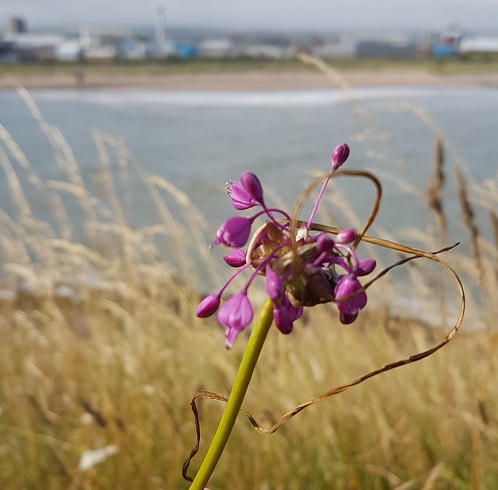
If we’d been in the East Neuk (of Fife), or a Cornish tourist honeypot, I suppose I’d have taken photos. Ferryden doesn’t present as “quaint” or a tourist attraction, despite the inevitable interpretive boards, and it would have felt rude. So sorry, no pictures! We guddled our way up to the coast path and had a lovely walk to and beyond the lighthouse, which got bigger and bigger as we approached until it was overwhelming. The hot sun released the scent of thistles, while ragweed and clumps of Keeled Garlic jostled in flower. Down on the little rocky beaches, my mother joined me in my head to exclaim, as she ever did on seaside holidays, at the winkles, periwinkles, limpets and small darting creatures in rock pools, and to gently tempt the waving tentacles of plump sea anemones and feel them sucker briefly onto my little finger. I collected pocket stones, which I did not add to the wonderful collection of painted and decorated stones on the wall by the path, left by residents and visitors.

Back to the old fishing village of Ferryden and its quirky charm, we had a campsite to find and it was past six o’clock. Was that really the smell of salt and vinegar wafting over the South Esk? Montrose this time for the fish suppers!

Then ‘Twas the Roman….

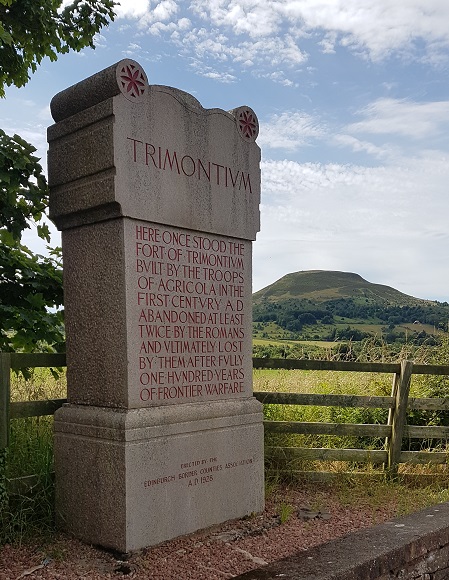
Trimontium – the Three Hills

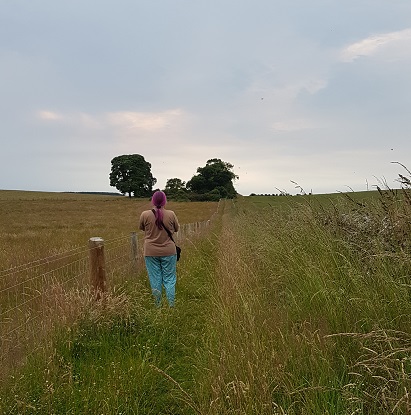
I will pursue enthusiastically all traces of the Roman and her/his associated allies, foot soldiers and settlers across a British landscape, quite regardless of whether there is actually anything to see when I get there. It used to annoy my partner, trudging miles up hills and across dubious bogs and anonymous fields, only to have me announce, triumphantly “It was here!”, gesturing at a field of wheat. He is more intrigued these days, and even suggests Roman tracking expeditions of his own volition.

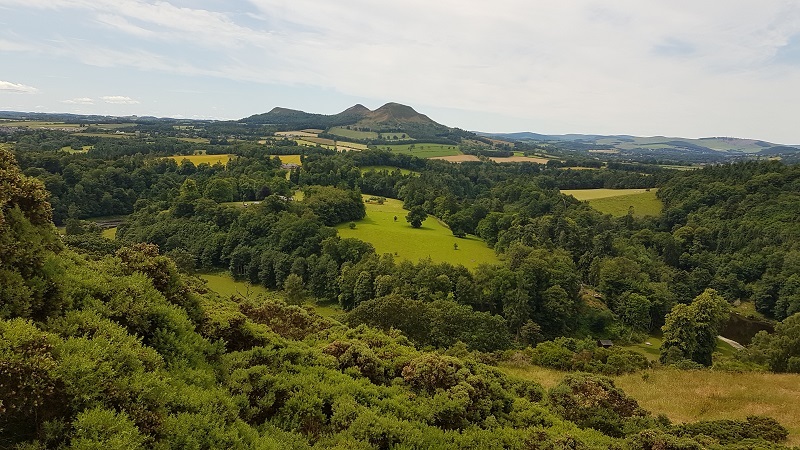
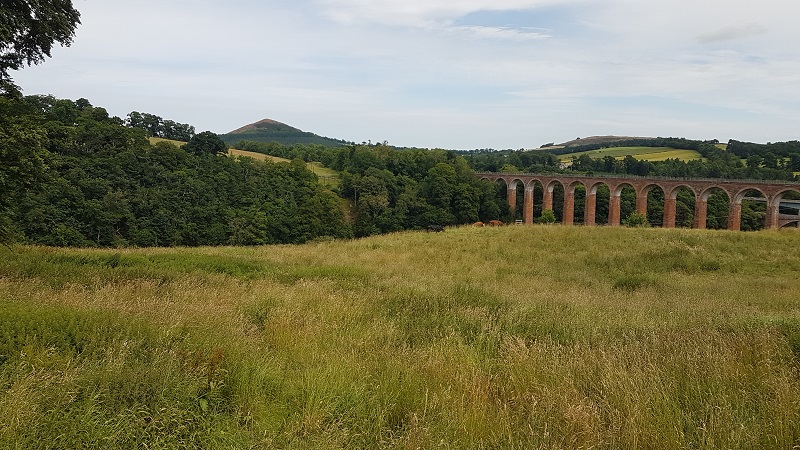
So it was that, once again, we wound up at Trimontium (known more generally as the district around Melrose). The three hills of the name are the Eildons; the Romans didn’t put forts on the tops – someone had already done that – but in this low rolling landscape, the hills must have shouted “home!” to returning soldiers at first sight, and assisted in sighting the meticulous straightness of their military roads. No, the Romans built their camps nearby in the valley of the Tweed, settled, traded, and called it Trimontium.

We cycled the length of the old road that cuts through the fringes of the camps, admired the crops in the fields where they allegedly lie buried, passed the site of a Roman circus where nothing could be seen, read the interpretative signs, and felt the whispering ghosts of legions march by. When we reached the site of the Roman bridge over the Tweed, we crossed on the newer one and cycled on to Dryburgh.

A Roman camp (site of!)
A Roman Circus was Here (Honest!)

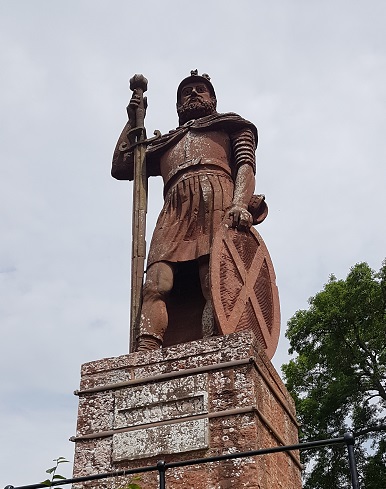
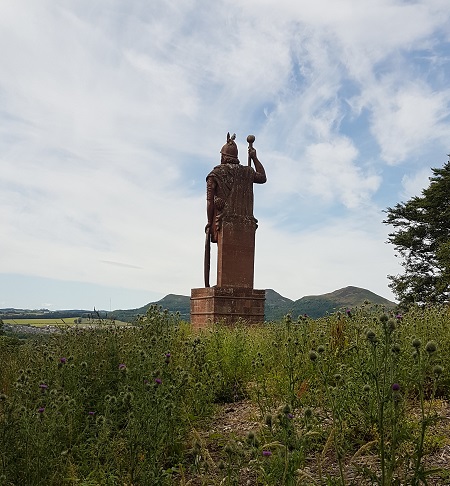
On the way we detoured to see the magnificent statue of William Wallace, a later and better known hero than Gnaeus Julius Agricola. He looks at home, gazing out forever across the valley to Trimontium, the three hills of Roman Scotland, every inch the warrior, rising from a sea of thistles. You could imagine perturbed, defiant, indomitable Caledonian thoughts – the thoughts that once challenged Agricola, and still challenge today. Or don’t imagine; you could think them yourself.

“There, like the wind through woods in riot,
Through him the gale of life blew high;
The tree of man was never quiet:
Then ’twas the Roman, now ’tis I” *

We went on to search for what remained of Dere Street, the road the Romans made from York to end at Trimontium, but which kept on growing to the Antonine Wall in Scotland’s central belt. Tell-tale straight lines jump out of maps; footpaths and tracks link bits of road seperated by farmland or forest. Here and there, we drove along it; the A68 out of St. Boswells was built on top of it. Near Jedburgh, we found a road that crossed it; a long straight footpath bore its way north-west; littered by large stones and rocks – way-markers? – and changes in level we dreamed into being the remains of the vallum, the rampart and ditch that lined important roads, as we marched up it into the dusk and crows took off from dark clumps of trees. In the foothills of the Cheviots, only a few kilometres from the border with England, Dere Street emerged once again, passing close by a set of Roman camps whose earthworks were, in places, still just visible.

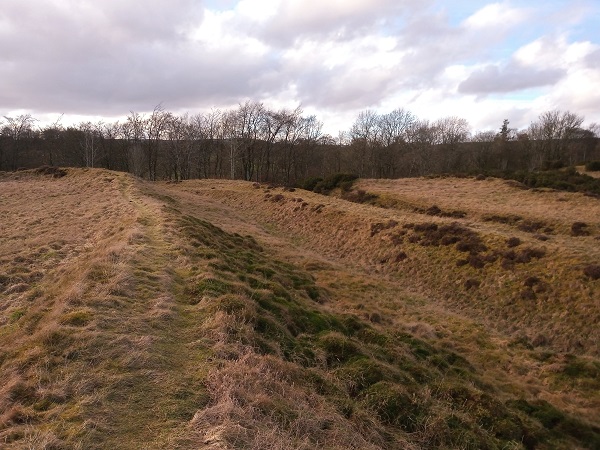
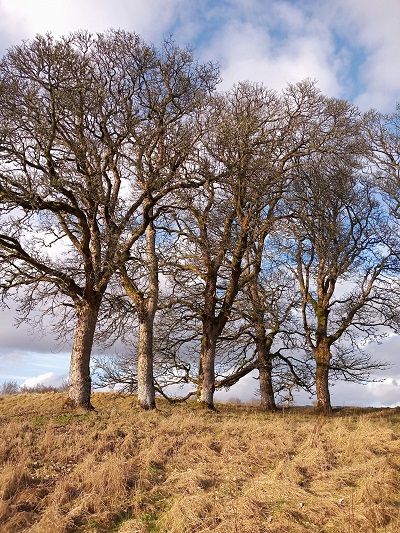
Back home, we reminisce over our last visit to Ardoch, the Roman fort near Braco, in spring, and compare how wonderfully well preserved it is, in comparison with Trimontium and these Border camps. Clear are its neat square corners, it’s easy to count and follow the ramparts and ditches, and you can walk into the fort by the original entrances. Luck or design have conspired for Ardoch not be put under the plough too much; no roads have been constructed over it. Trees have grown, that’s all, and even they seem to follow Roman straight lines and military discipline. They tower, wide-spaced, vigorous, energetic.

Then twas the Roman, now ’tis trees.

*from “A Shropshire Lad” by A.E. Housman