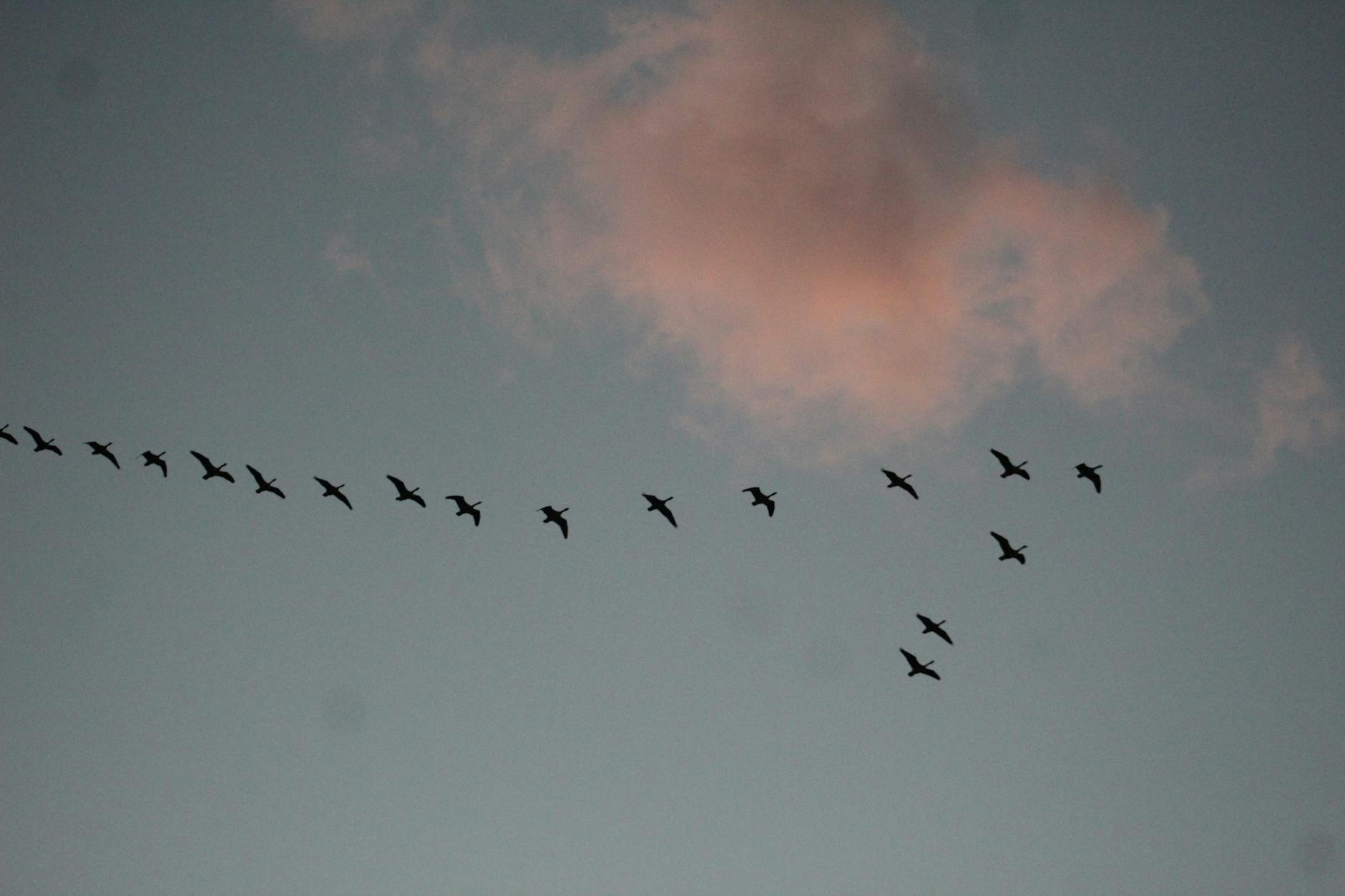
They will be here soon flying through the night piercing the muffled silence as stars punctuate darkness’s depths. They are coming, converging, greeting each other, flying alongside and ahead.
Battalions with no borders to defend no wars to fight no points to score.
To the stirring fields of autumn to the flat black water to the margins, they approach.
Let’s meet them there.
I was on a bus between Perth and Edinburgh last week. As it swung into Kinross to pick up passengers, I glanced up at the amazing Kinross Gateway sculpture of three pink-footed geese alighting (David F. Wilson, https://dfwilson.co.uk/1371-2/). I thought, ah yes, the pink-foots. They’ll be on their way now. In my mind I could see them sweeping the skies, could hear their incessant babbling on the wind. The poem above got written before the bus had even got to Kelty. By the time I go to the end of it, I wasn’t only writing about geese. The last line references a famous poem by the 12th century Persian Sufi poet, Rumi, which goes like this:
“Out beyond ideas of wrongdoing and rightdoing there is a field. I’ll meet you there.
When the soul lies down in that grass, the world is too full to talk about. Ideas, language, even the phase “each other” doesn’t make any sense.”
The little wood has become tangled, and the paths vague and meandering in the past few years, since Jed our collie died. Few people walk them, and even when it was a regular walk for me and Jed, they tended to shift and change, as blackthorn grew to block one route, or trees, felled by the wind or growing with vigour, made another way more attractive.
But always, there have been certain way-markers:- the overgrown guerrilla-planted Christmas tree, the gap in the field boundary where the wire’s trampled down, a patch of brambles, the fallen birch that still produces shoots…. Today, alone, I beat the path out again, lost in thickets of gorse and thorn, disoriented by the sound of traffic, unsure of distances among an understory of fern and broom. As so many times before, when coming from diverse directions, my brain unconsciously looks for you to reset my compass. I know I must pass you on my left to regain the path downhill and out of the wood.
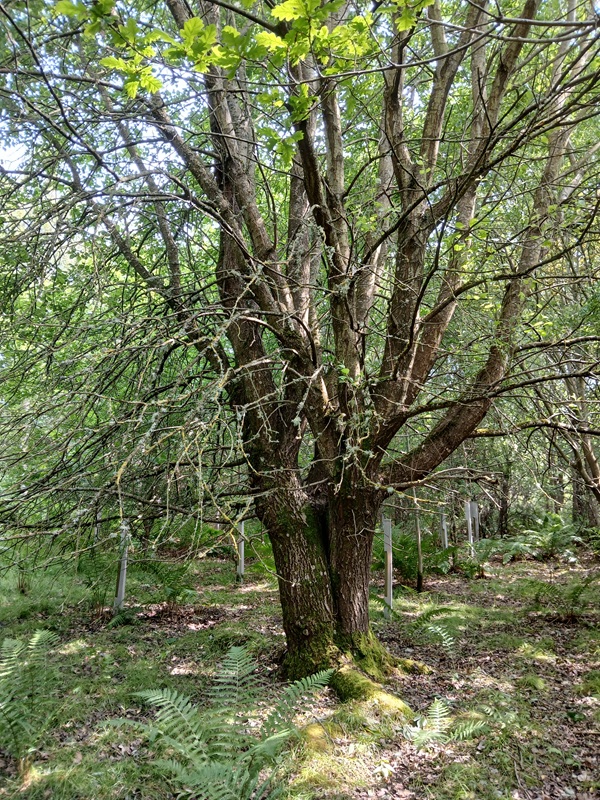
You are the biggest, broadest, in the wood, though perhaps not the tallest or the oldest, and certainly not as old as me. With two feet firmly planted, you stand fast and firm among the rest who bend and break in the wind, and you spread your many solid arms in all directions, and to the sky.
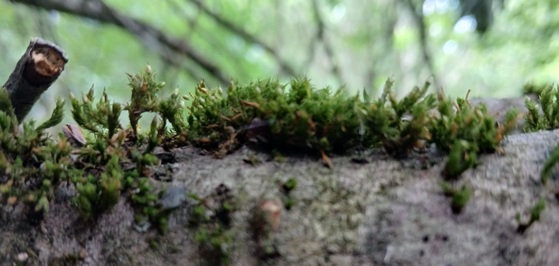
Here you are. Now I know my way way. But wait – have we ever truly met? Have I ever really seen you, Mr. Standfast? Today I approach with awareness, pausing in stages, taking you in. A rush of warmth, of joy… joy or recognition, joy at being recognised. When I reach close enough to touch, my gardener’s – my orchardist’s – eye notes dead, stiff and black lower branches and itches, for a second, for loppers. But then I watch the beetle’s progress through the moss and lichen upon them; the moist droplets of old rain sustaining the beings on the branch, and recognise, it’s none of my damned business.
We are together for a good while, without words, unified by our alikeness, as your very own warbler comes to join us, bursting into that fitful exhuberance of song that wears itself out in a twittering, grumpy-sounding mutter, then kicks off a few minutes later to try again. I feel the healing nature of your skin, the questing stability and strength of your roots, the air you breathe, I breathe, we breathe. For a moment, I know we are one, with the lichens and beetles and warblers and the things unseen.
I know my way now. As I rejoin the ghost of a path, my palms carry the imprint of willow bark, like a memory, like a gift.
In the weak, blinking sunshine, wind-chilled and watery, The top fields swarm with detectorists from West Lothian, Thinly spread, rigorously spaced, slowly they move, like cautious extra-terrestrials, each has a rigid, but fluidly-swaying trunk, held just above the ground, all wear rucksacks or cloth bags that sport spade-shaped antennae.
Every so often, a detectorist drops to his knees and starts to dig, carefully refilling each hole before moving on. I greet a smiling pair of them at the gate. “I only get Sunday off, but I wouldn’t be anywhere else,” says one. Do they find treasure? Laughter rings – “be better off buying a lottery ticket for that!” But…. each has a tale to tell, of tobacco tins and Victorian pennies; last weekend, a Bronze Age spearhead – “in this very field!” And anyway, “it’s this I enjoy best,” – throwing an arm towards the hills, the grazing geese, the spruced-up-for-spring yellowhammers in the hedge – “being outside. The scenery. And the people are all lovely.”
They are. I admire their hi-tech gear, wish them luck…. And off they go again. Watching their measured tread, I know (whether they do or not) detecting’s a walking meditation, just as anglers sit and meditate on water, fish or no fish.
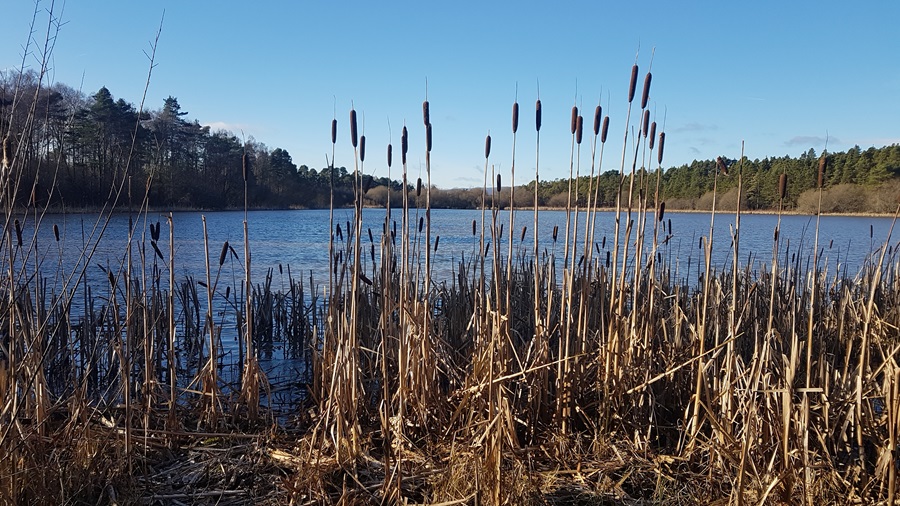
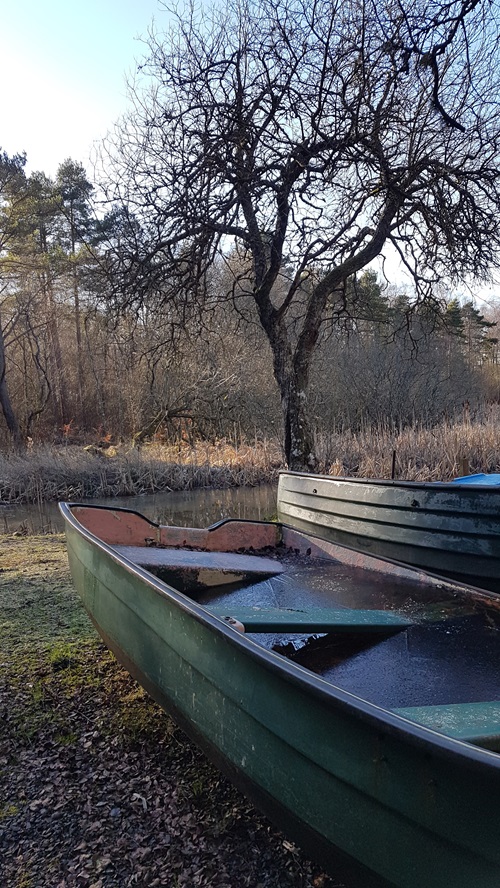
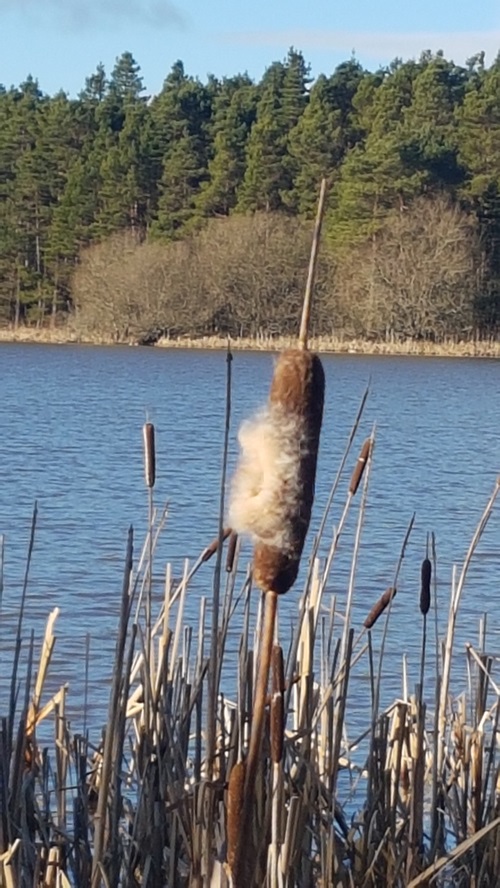
On a quiet day of winter sun and muted activity from woodland birds, I arrive at King’s Myre again. Reed Mace flowerheads from last year cluster around the watery margin, clogging the channel by the little jetty where the boats wait and fill with rain. We used to call them “bulrushes” where I grew up, and it wasn’t till Mr. Illesley, in Rural Studies, enlightened us all about the differences between reeds, rushes, sedges and grasses that I ever learned their proper name– or that Reed Mace is related, but none of these anyway!
It is the same plant known as cattails in America, and valued throughout its distribution for its edibility. The rhizomes – root like underground stems, or underwater ones in the case of this plant – are starchy and filling when baked. They can also be dried and ground into flour, though I never have. The pollen from the male flowers can be used as flour too, or to thicken sauces and soups. It has many medicinal uses. But the best part is the emerging shoot – which will be appearing above water level any time now. Cut, cleaned, steamed, baked, sauteed – it is a lovely spring vegetable to rivals asparagus or bamboo shoots for flavour and versatility. You can keep eating the shoots until the flower spikes start to emerge, you don’t need waders to forage it, and, as Reed Mace is actually quite an invasive plant, it’s pretty sustainable to nibble bits off the clump! Last year’s flowers are starting to burst apart now, revealing the dense, cottony-fluffy seedheads inside.
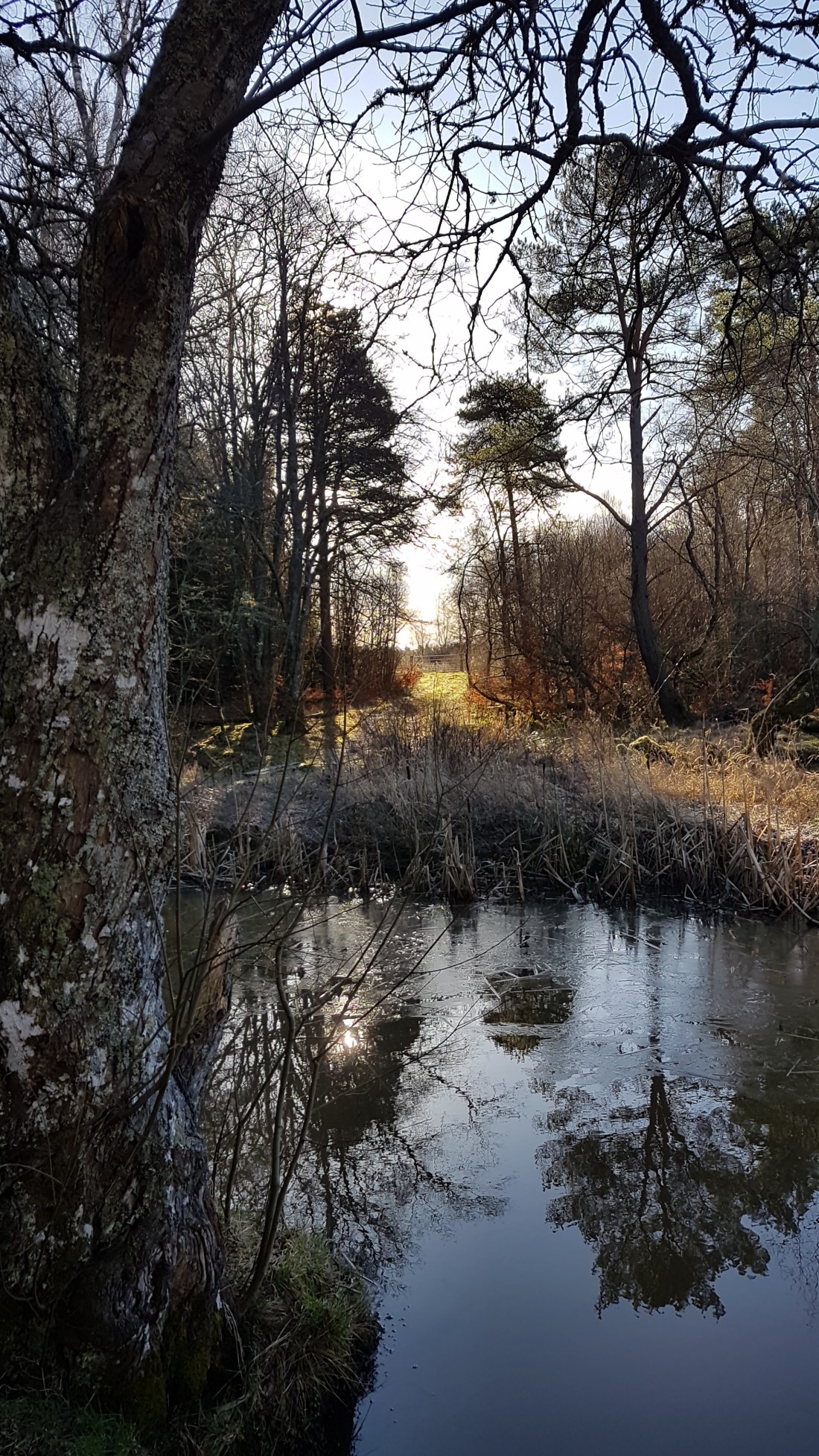
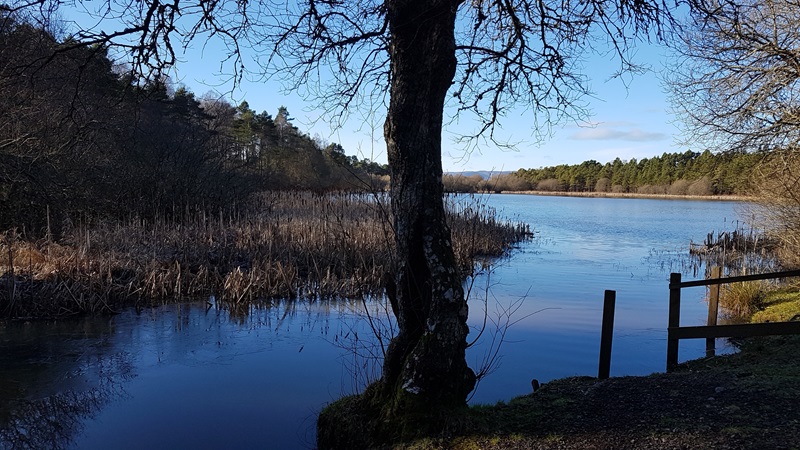
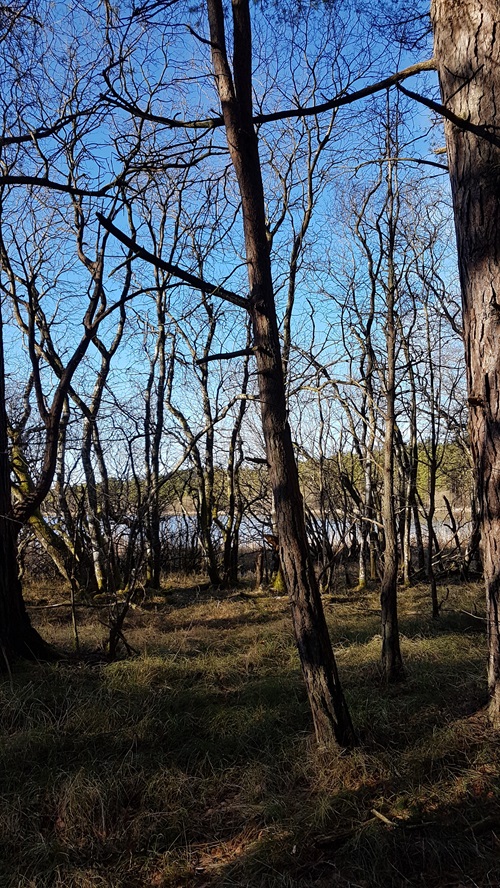
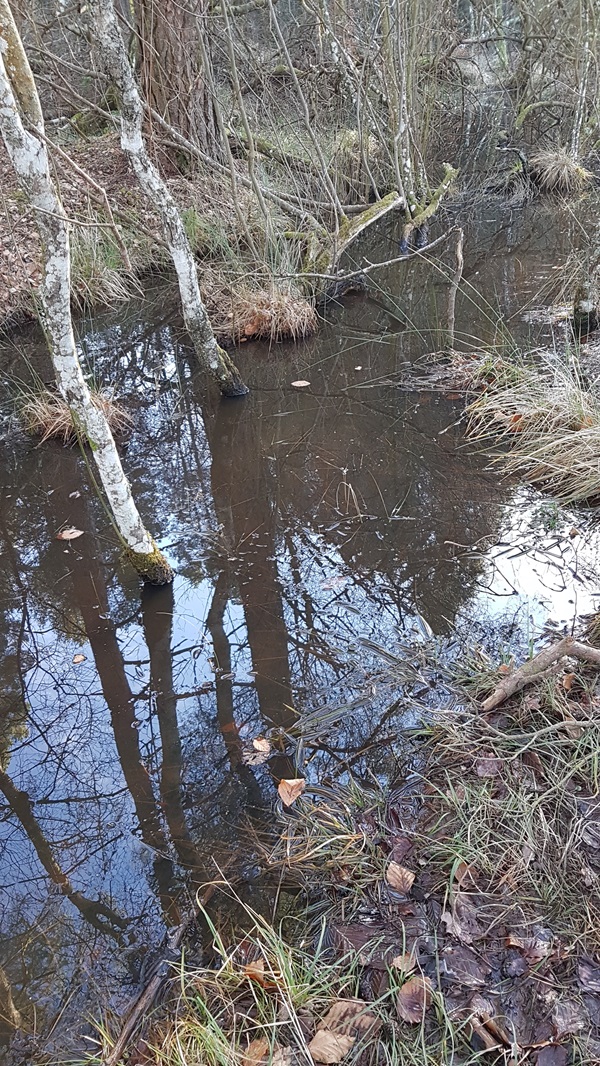
I creep through the spongy, saturated margins of the little loch at the heart of the King’s Myre, to peer through the cattails to see what wintering birds are on it today. Goldeneye, a few gadwall, mallards, a coot, typically swimming against the tide of the rest, intent on his own adventure. No sign of the swans, too early for the osprey to be home yet. In the damp woodland, waterlogged alcoves and scrapes, from which spiky, angular trees grow erratically, wait for frogs and toads to arrive for spawning. Between bare branches, multiple trunks and stems and a storm of tiny twigs, the blue sky seeps as if caught in a vast, arboreal net, reflected in patches of water.
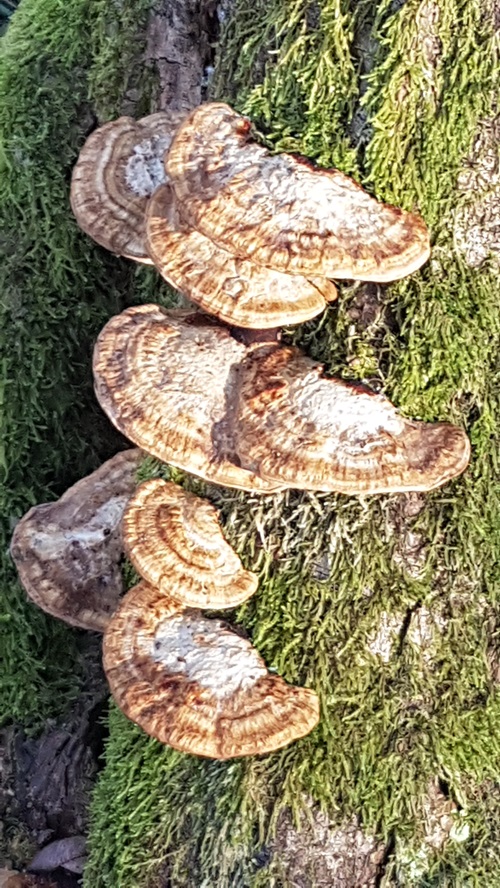
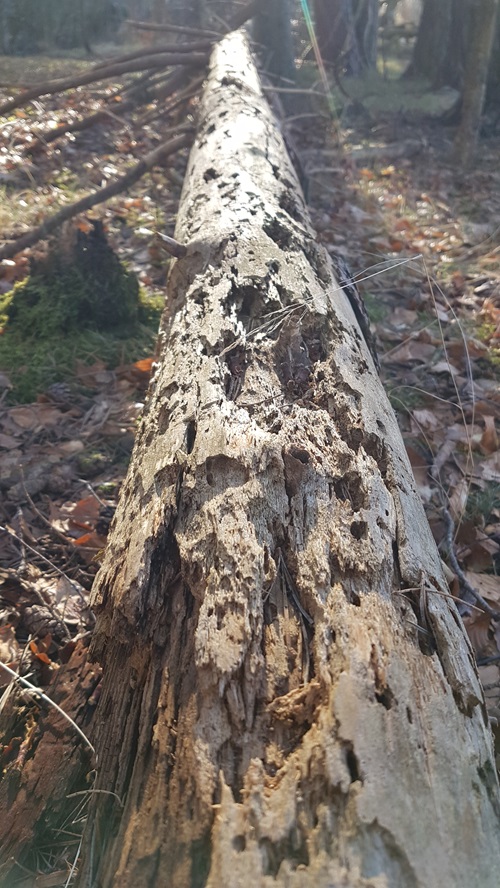
Bracket fungi show off their smug Cornish-pasty smiles of concentric bands, on wood they share with moss and lichen, and a thousand invertebrates. Spread across the leaf-carpeted floor, long-dead logs, un-barked, silvery, yielding, are home to thousands and thousands more, riddled with holes and channels and hidden tunnels in the fungus-softened wood. On cue, somewhere in a dead tree, a woodpecker begins his first tentative drumming and drilling.
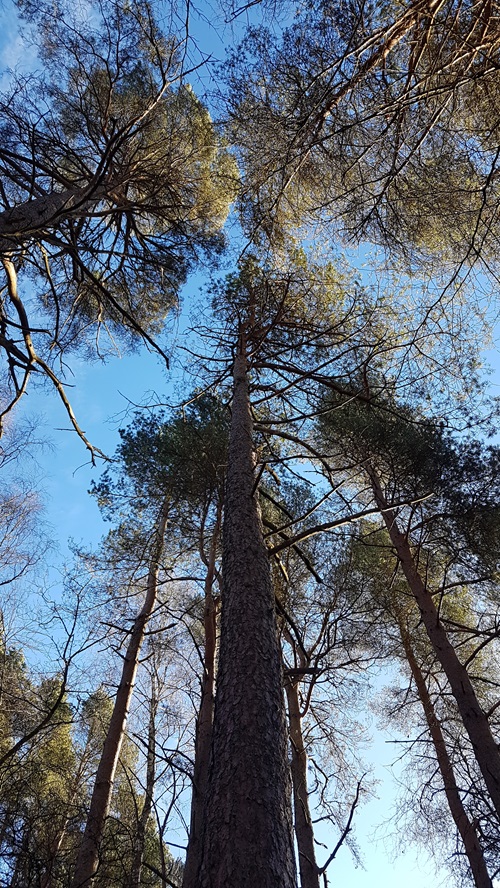
I look up into the Scots Pines, their narrow crowns dancing around each other like polite or nervous teenagers, and see the shapes of jagged sashes of sky, so clear, so blue….
Look up, look through, look between – there is much to see. Or is there only sky?
With implacably good timing, I finished my coffee to arrive at the Holiday Inn on the edge of Perth, seven minutes before the hourly bus home. Bang on time, I saw a bus crawling up Dunkeld Road. I slid to the edge of the pavement. But wait – was it a bus? No Stagecoach livery, a plain white coach, beetling along rather fast. I screwed up my eyes: nothing on the front to say what number – or any number – or destination. The tinted windows didn’t allow me to see if it carried passengers. A private coach, then? I sighed and stepped back.
As it hurtled past, driver not even glancing at the bus stop, I saw, on the side, “23 – Bankfoot”. The air turned blue outside the Holiday Inn, as I gawped in disbelief and watched it sail off without me. What to do? No, I wasn’t going to go for another coffee. I certainly wasn’t going to sit staring at a petrol garage while inhaling the noxious air of Perth’s god-awful motor mile for an hour. One does not get a “pleasant stroll” down Dunkeld Road, but eventually I began to walk towards town, undecidedly, seeking equanimity.
A couple of minutes later, just before the rail bridge, I noticed a tucked-away footpath sign: Lade Walk to Perth/Tulloch. Perth Lade is an historic man-made waterway which fed into the town’s mills. I knew the Tulloch bit, and the bit from the retail park to the City Mills, but this stretch – I never knew it existed. The Lade is grotesquely polluted for much of its length these days, but I know people who have spotted kingfishers hunting there, and the incredibly tolerant mallards of Perth make the best of it, and eat discarded chips. I ducked along a narrow path between the railway and the fenced car park of some tedious car dealer, with little optimism. Surely all I had in store were industrial lots and housing estates? The narrow path broadened as it reached the Lade, curving round from the west, and I heard flowing water and the busy furking-about of moorhens in the thick undergrowth on either side. The irritating groan of the Dunkeld Road traffic had completely disappeared, yet surely I must be not far from, and parallel to, it? To my left, a thick bank of mature trees, mostly self-sown and densely overgrown, had shed small branches and twigs in profusion during the winter storms. Accumulations of litter, initially like glue in the conglomerate of nature’s own debris, were slightly fewer than at the start, though one spot behind the ugly chainlink fence was a veritable carpet of empty beer bottles – either decades’ worth of boozing or the emptying of an accumulation someone didn’t want on their own doorstep.
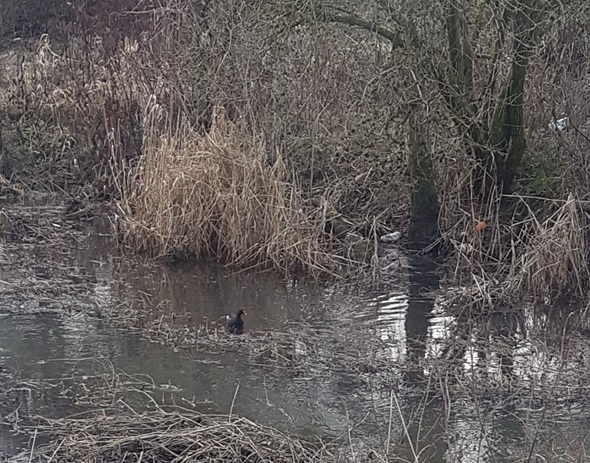
Five sleeping mallards sat camouflaged on the far bank, not moving, until I got my phone out to take their photo, when they all silently uncurled sleepy heads and glided off downstream. Moorhens, in vibrant plumage ready for spring, hung about, quite tame, crossing the path and ferreting in the reeds on their spindly legs. The larger trees thinned to a narrow belt and behind the fence was a huge expanse of derelict industrial land, half-concreted or tarmac in places, but being rapidly colonised by pioneer birch. elder and other young trees. In January, all looked grey, but from the lying vegetation of last summer I could guess at the wealth of wildness that would spring up, laughing at human arrogance, when the season turned again. Bare young trees may look like a delicate screen, but never doubt their power and ability to exploit a vacuum. Nor that of the dandelions, dockens and bombsite weed, all bringing seeds and nectar to wildlife. On cue, a terrible high-pitched squeaking started up in one of the older sycamores – a flock of long-tailed tits on the rampage. I stopped and birdwatched for a while – coal tits and blue tits were weaving between the branches and a cheeping of chaffinches held forth from some bushes by the lade. On the path, first a male bullfinch, then his duller mate, landed and had a good look around before returning to the other side of the lade. Blackbirds and a thrush hopped out and eyed me beadily.
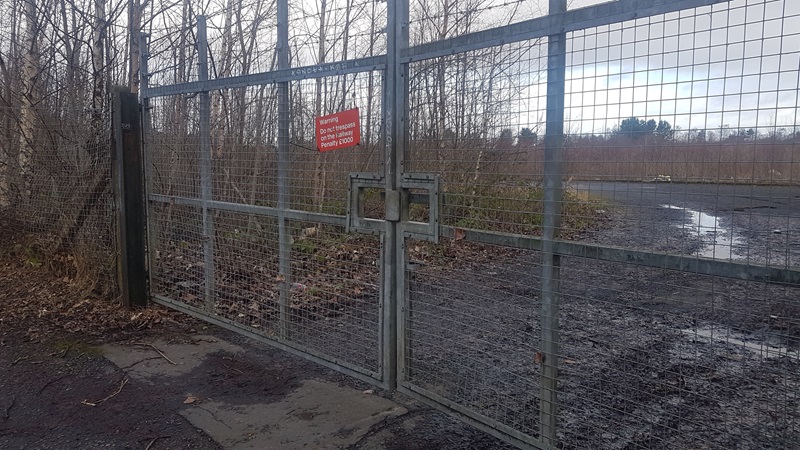
I came to a junction – a path crossed the Lade by bridge, past an old brick building – possibly a former mill but now another garage. It was attractive though, and full of potential nesting sites. Here, there was a sign on the fence – all this derelict land, stretching into infinite distance with no trace of the motor mile, belonged to the railway, which was nowhere to be seen but must be in there somewhere. I hoped it would stay their property, and they would never try to tidy it up or sell it to developers.
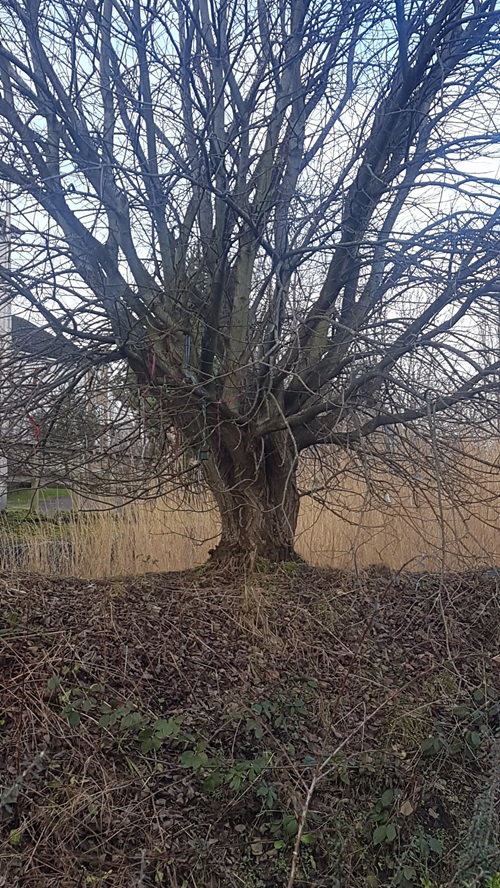
There were houses and flats now on the other side of the Lade, so near, yet curiously far and separated from this unexpectedly lovely and interesting walk. A large willow on the far bank was decorated with ribbons, toys and ornaments, like a wishing tree of old. I wondered who came out of their homes to celebrate or remember there. The ground on my left opened out, seeming endlessly wide. Lade and path swung eastwards and I saw an iron bridge, unmistakably a railway footbridge, just like the one I used to play under as a child in east London.
And over the bridge, where teenaged girls stood discussing the wicked-looking, monstrous-headed dog they thankfully had on a tight lead, Dunkeld Road reappeared. I swerved away from it, passed through some houses and across Crieff Road, where I joined the Lade stretch I knew well, skirting old tenements and road ends, bits of gardens and the ubiquitous smell of cannabis. Passing Stagecoach Headquarters, I surreptitiously made a rude sign. No time to march in and complain, if I wasn’t to miss the next bus as well! But thanks to their rubbish driver, I had discovered a stretch of unofficial countryside that I’ll revisit in summer, I’d enjoyed an unexpected daunder, found equanimity – and, moreover, escaped Dunkeld Road.
(It’s taken me a while to write this walk. I did it the day the clocks went forward, end of March, and today they went back again. My 14 year old collie died in early summer, and this was the first walk I decided it would be unfair to take him on, so it was a bit poignant; and weird not to have him beside me all the way.)
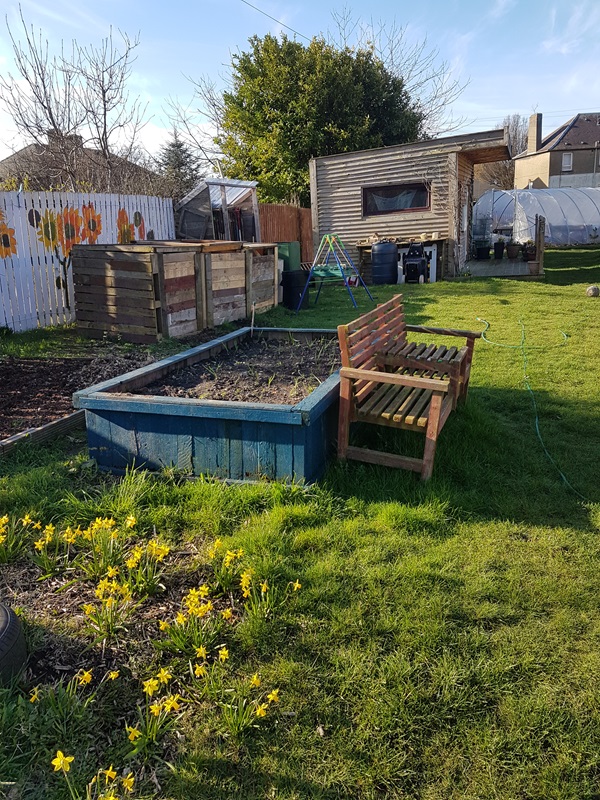
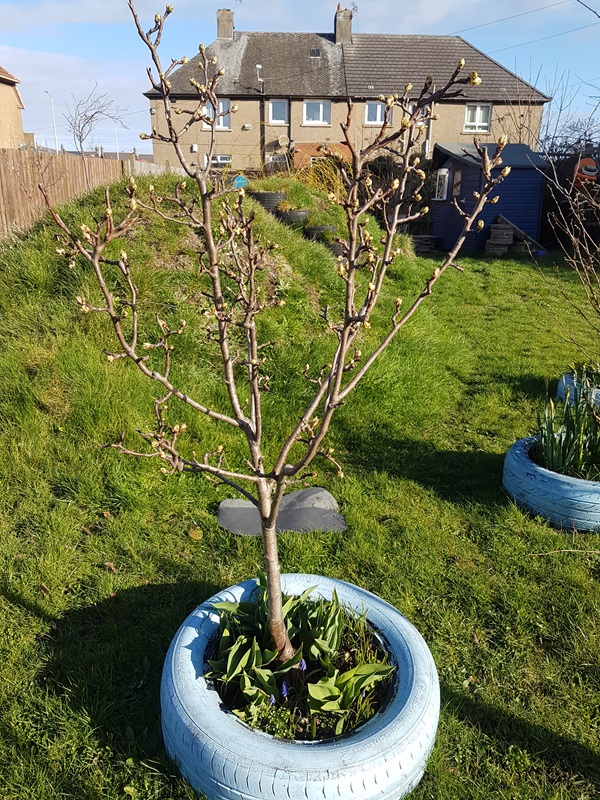
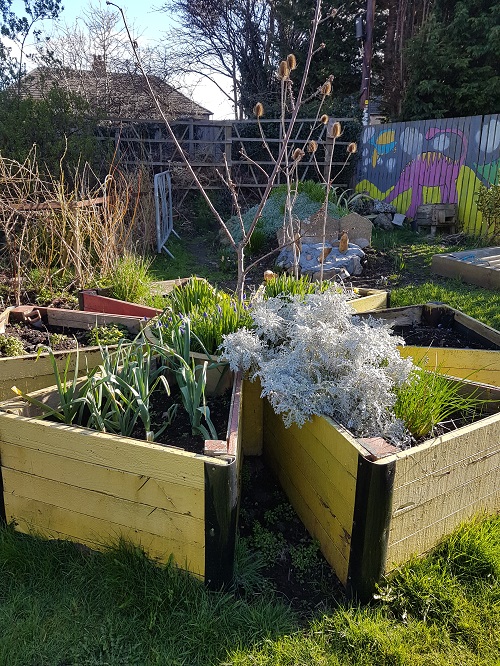
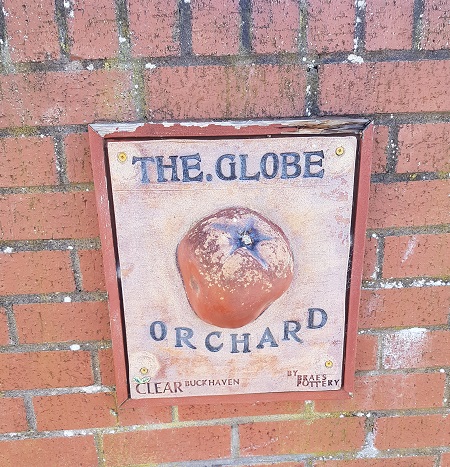
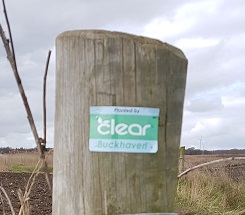
It began at the CLEAR Community Garden in Methil where I left Andrew to deliver a workshop. CLEAR stands for Community-Led Environmental Action for Regeneration, and is a very active charity whose stamp is all over the former mining towns of Methil and Buckhaven in Fife. We’ve worked with them a lot over the years – their compulsion to fill every available space whether roadside or cliff-top with fruit trees was one of the inspirations that got us into orchards in the first place. The Methil garden was pretty stunning; I had a good look round to admire the recycled materials, the superb compost bays (I do love a good compost heap) and pear trees about to blossom, before heading off into the cold, breezy sunshine.
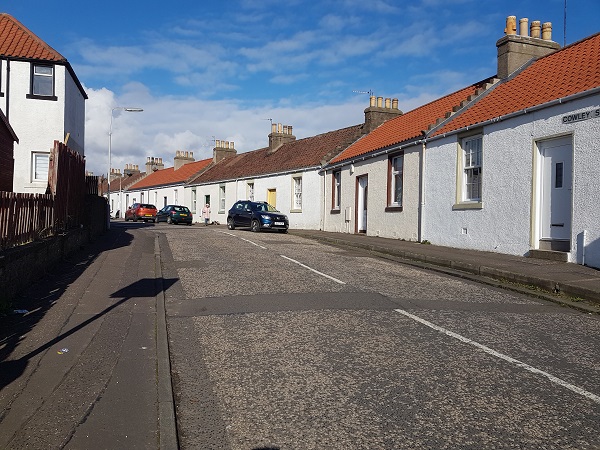
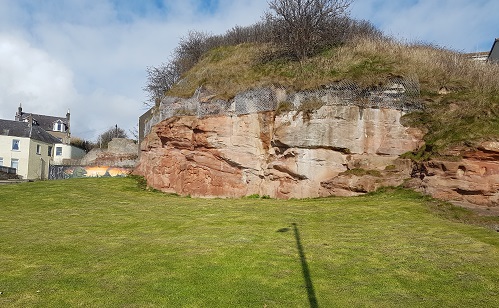
Zig-zagging through Methil, side-stepping CLEAR plantings on the edges of parks and in vacant plots, till the town had morphed into Buckhaven, or Buckhyne if you like, the place of superlative pies and hidden histories, from the extravagant exposure of Fife coast geology, the sturdy cottages of Cowley Street and relics of the long-disused mine railway – all explained in panels erected by CLEAR and Fife Council.
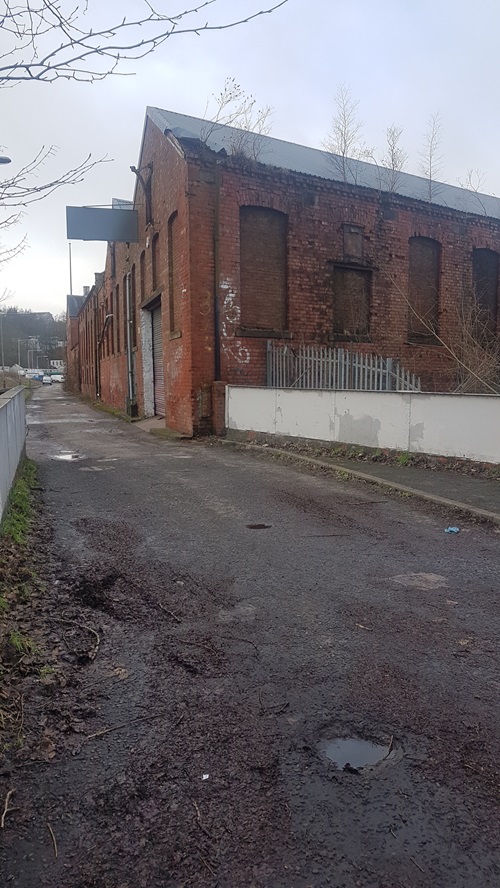
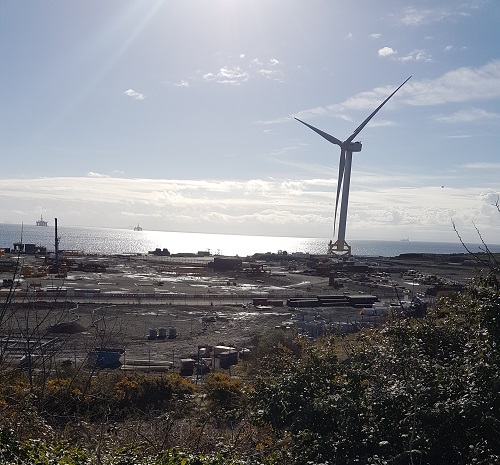
I’ve become rather fond of urban walking lately, for the unexpected quirks of history, and opportunities to see the extraordinary hiding behind the mundane. Here, I learned of the “lost village” of Buckhaven Links, which grew, mushroom-like, on the shore when the Church of Scotland had one of its fallings-out and mislaid a large part of its congregation. Buckhaven Links did not survive too long, and is now buried under the Buckhaven Energy Park, a darkly towering set of anonymous edifices over the wall from the street.
Buckhaven Energy Park
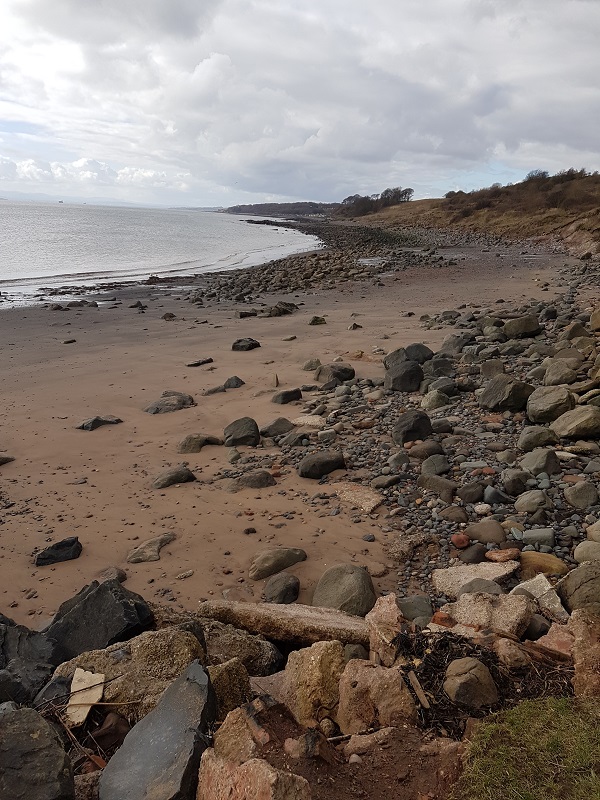
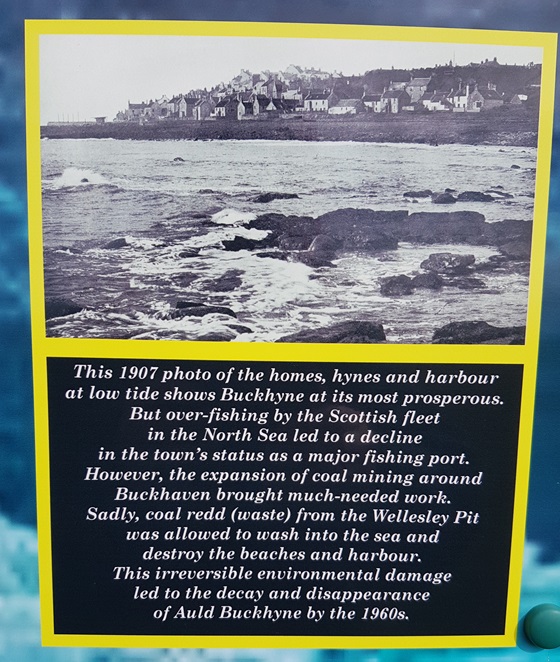
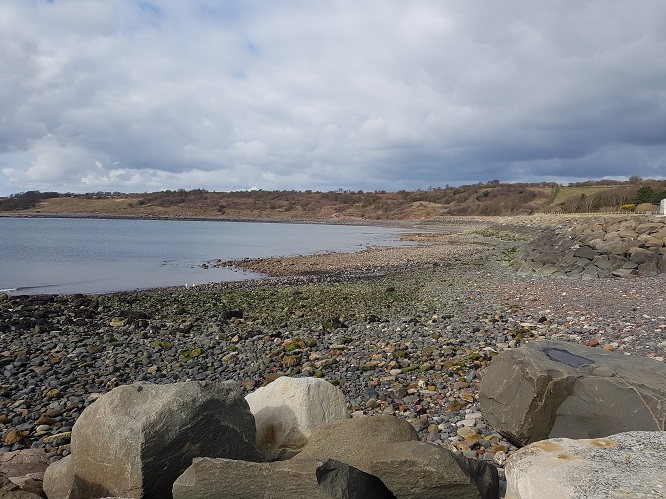
That road took me past rows of houses with signature Fife/East coast crow-stepped gables to where Buckhyne Harbour once was, until it was abandoned due to over-fishing and used as a repository for mining spoil. Beyond the harbour site, a scramble through rocks and there was the beach, for a while and pre-pollution a popular holiday and day trip destination for Fifers and those beyond the kingdom.
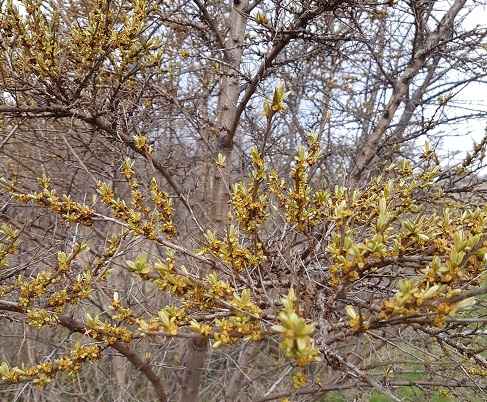
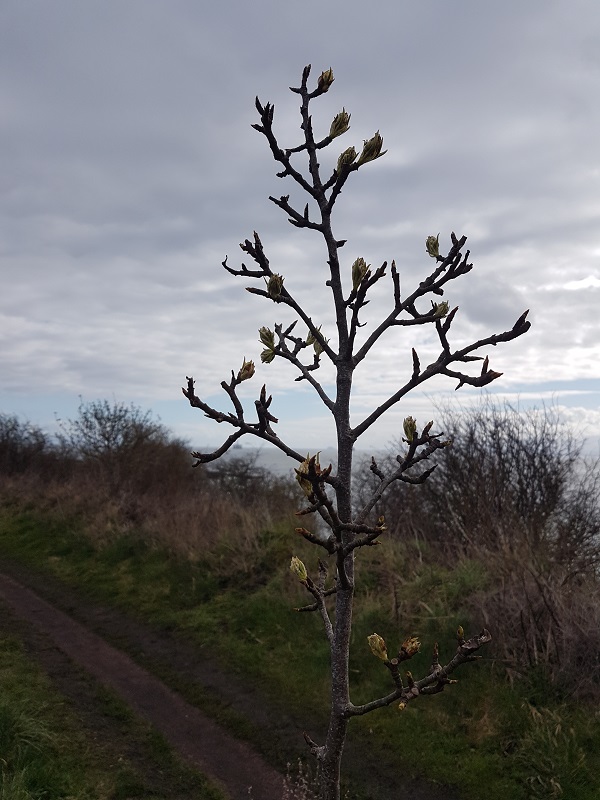
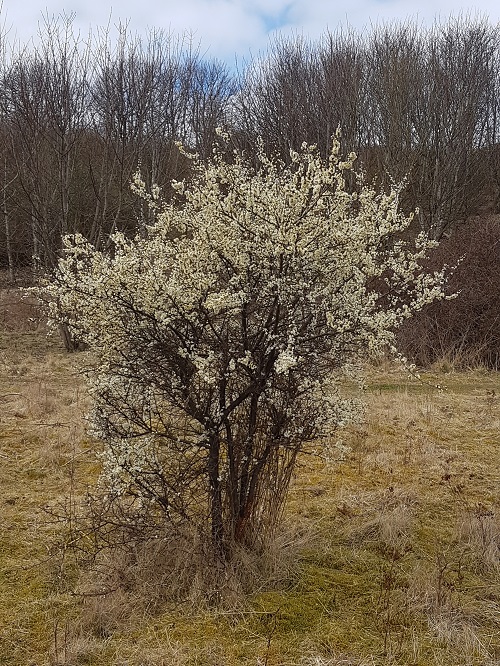
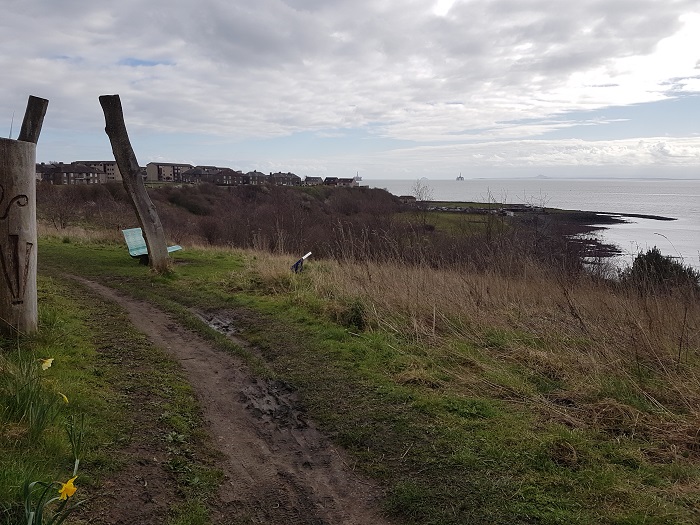
Up, then, climbing skyward the Buckhaven Braes, lit by the silver of blackthorn blossom and the gold of Sea Buckthorn, peppered with orchard trees, all labelled, all immaculately pruned and protected, the coast path lined with daffodils in flower, until this extraordinary little town was behind me and I marched along westwards towards East Wemyss.
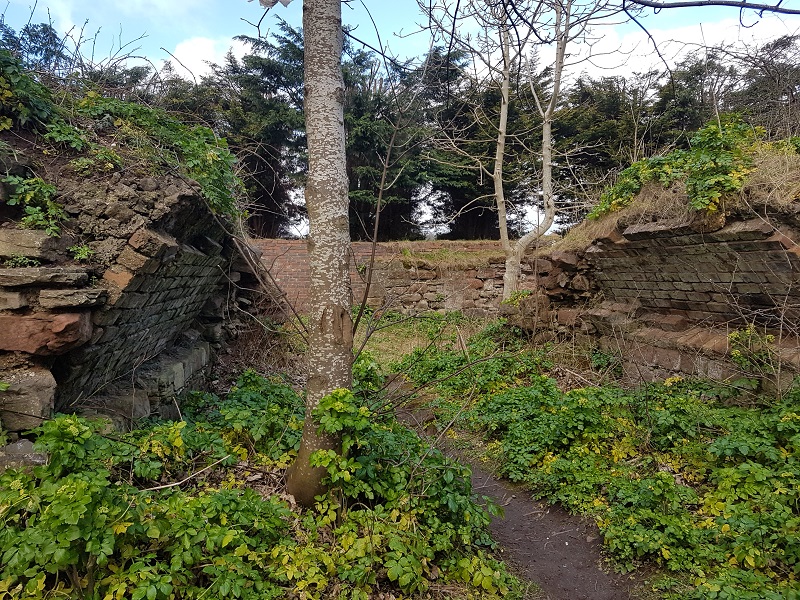
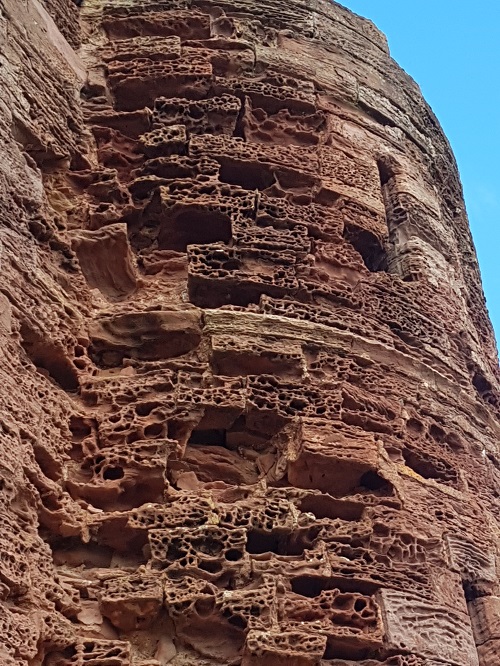
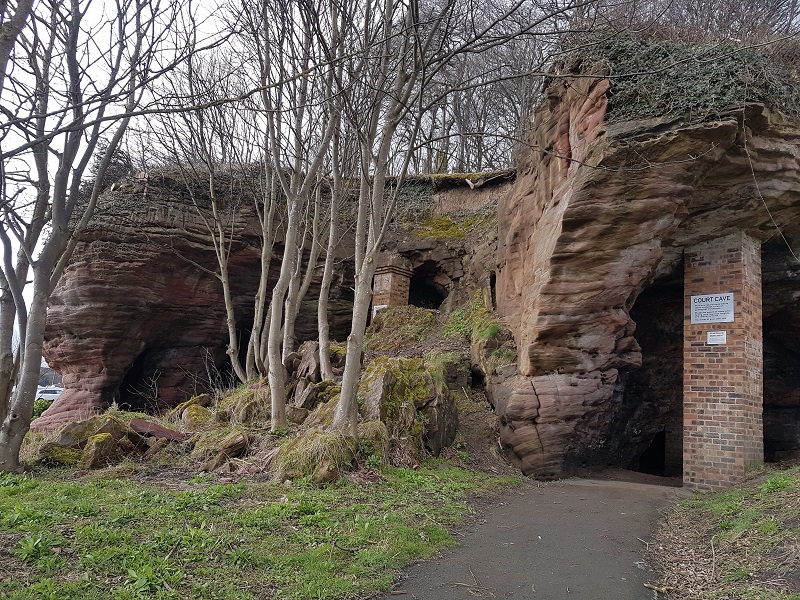
It was the East Wemyss caves that had been bothering me ever since reading that Val McDermid novel; not just to imagine fictional murders, but to see where Picts had carved strange images in bygone centuries, where people had dwelt, sheltered, hidden, picnicked and stored precious things. But first, when I passed through the woods, I came upon Macduff’s Castle – an impressive ruin whose stonework exhibited all the artistry of a carving, it is so tastefully eroded. All around its roofless vaults grew great clumps of Alexanders, a shiny-leafed, celery-like edible plant not native to these parts, but where it takes off, it does so with enthusiasm. I circumnavigated the castle before heading down the cliff to the caves.
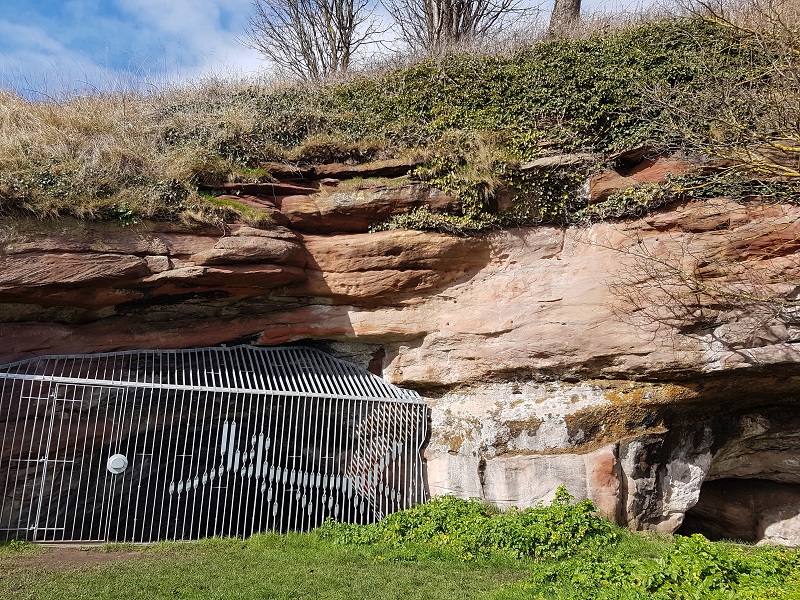
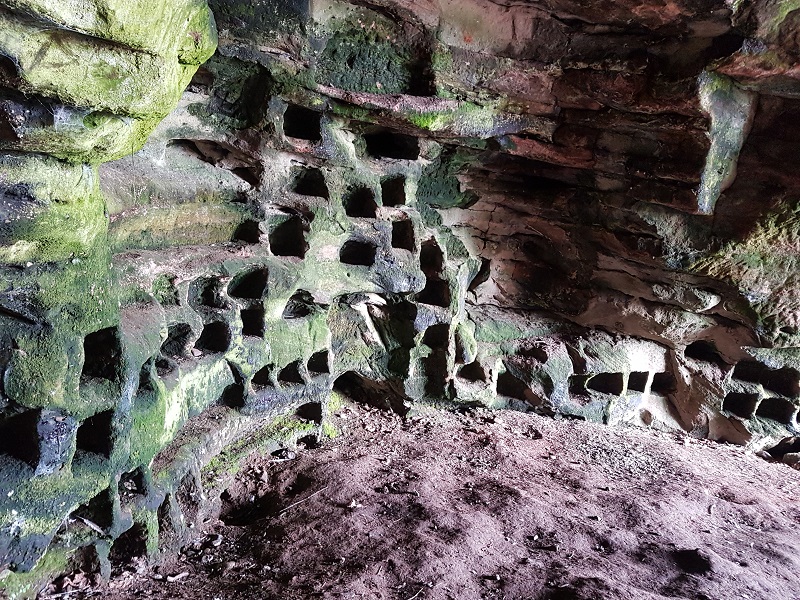
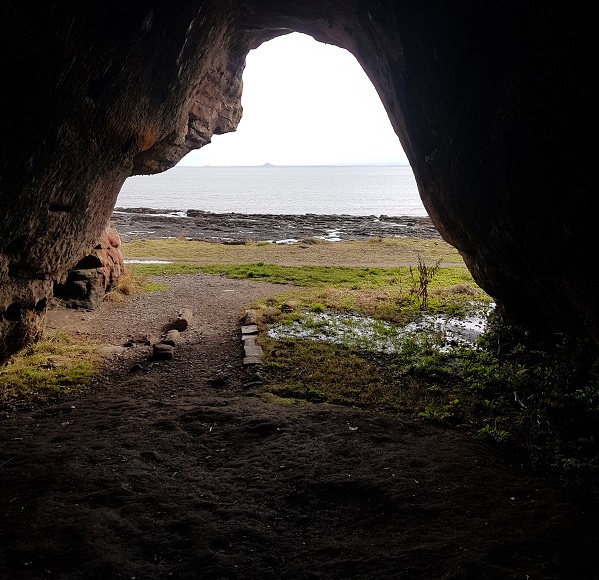
I had been warned that the best bits of the caves were gated off by substantial railings, in order to protect the ancient carvings. You can get a guided tour of them if you go to the museum in East Wemyss, but I didn’t want that today. So I stood outside Jonathan’s Cave and used my imagination instead, then stood inside the Doo Cave, where dozens of little cubicle nest holes have been carved out of the soft red sandstone to accommodate the doos, kept for meat and eggs in years gone by. At the large Court Cave, I did my exploring along with other visitors until my excitement subsided.
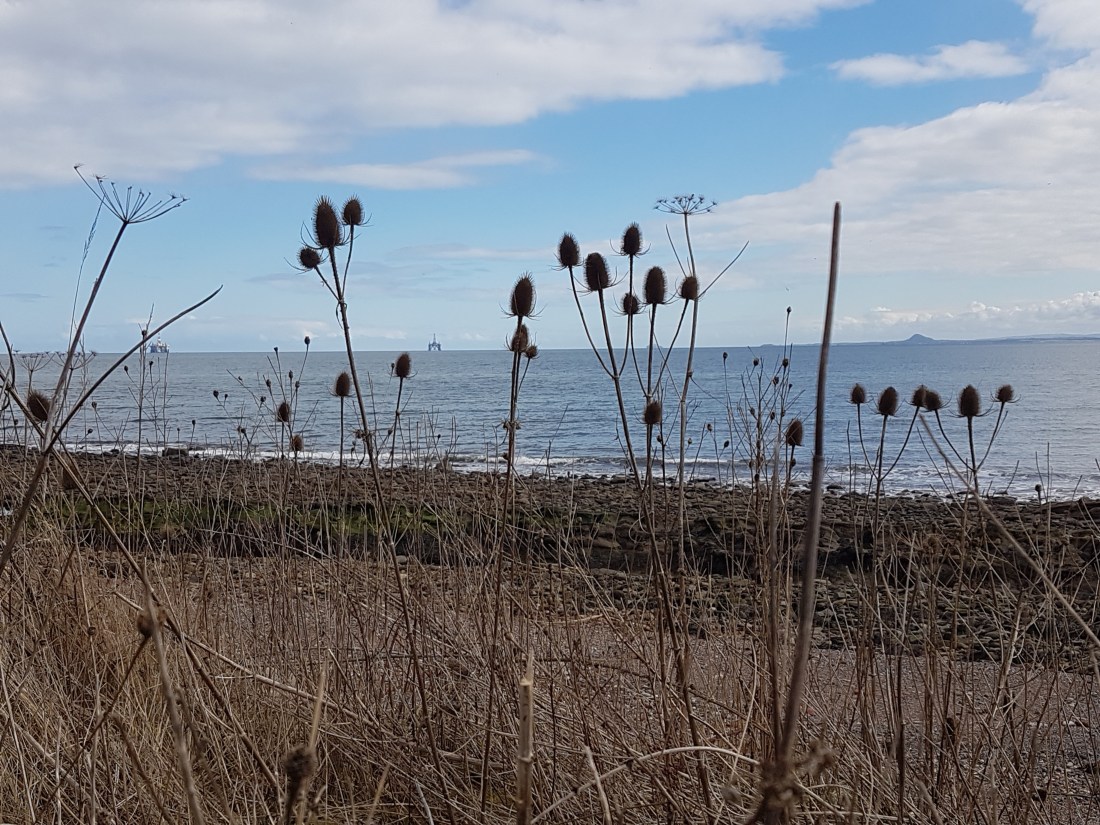
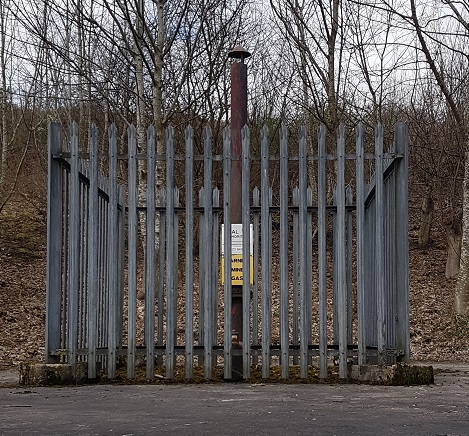
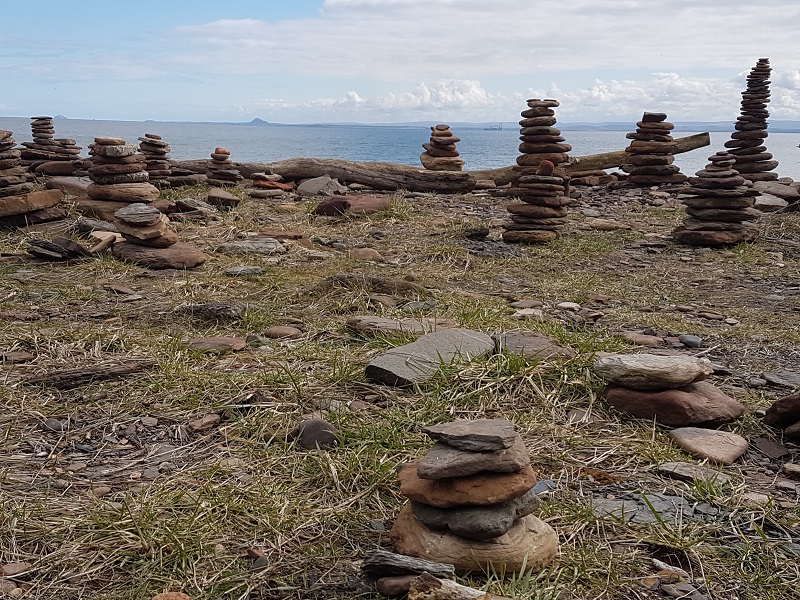
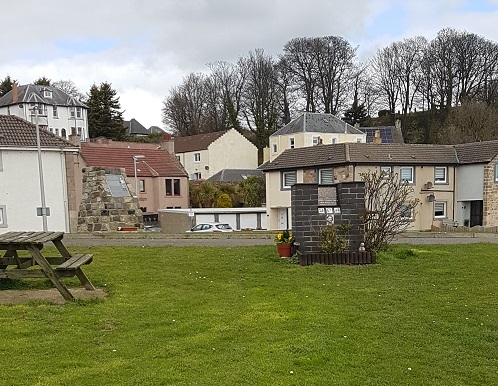
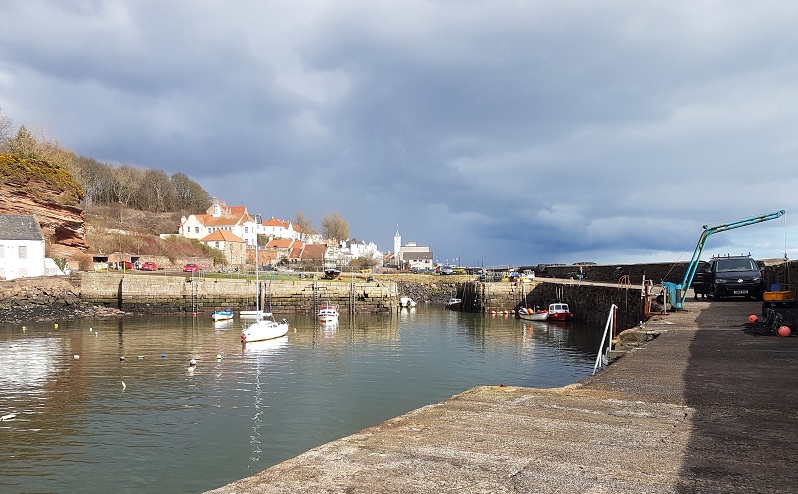
Then I walked on, the sunshine now spring-warm, past a gaggle of East Wemyss monuments and memorials, side-stepping mine ventilation shafts, to re-join the path by the sea. Rafts of eider ducks sailed by, making their weird, cooing, gossipy calls, and cormorants lined up on rocks. Strange but recent sculptures in stone arose against the skyline like sentinels; I added to them, noticing how the stiff uprightness of last year’s teasel seedheads mirrored their form. Under the precipice on which the relatively modern Wemyss Castle teeters, and I was into happy little West Wemyss, basking, and its lovely cafe for tea and a well-earned salad.
Looking forward to the next Fife coast exploration!
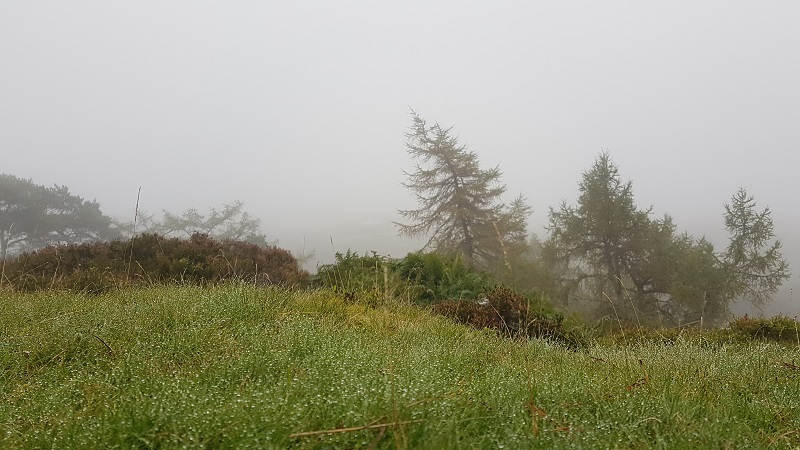
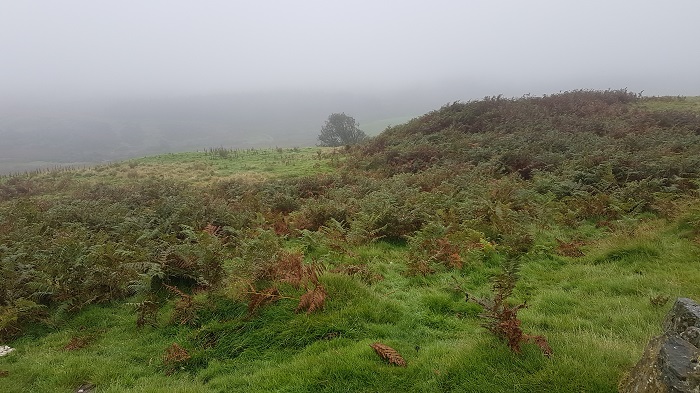
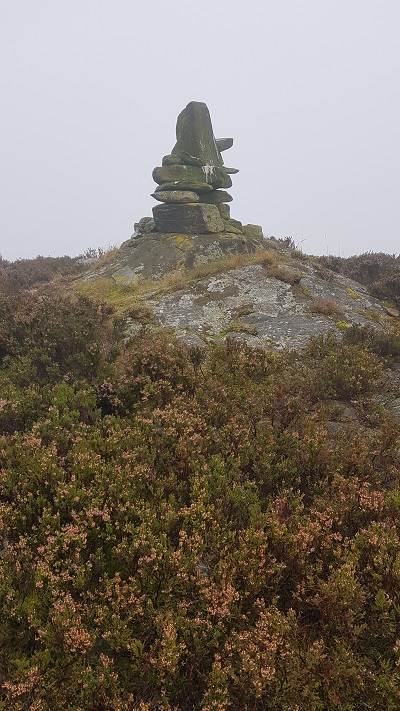
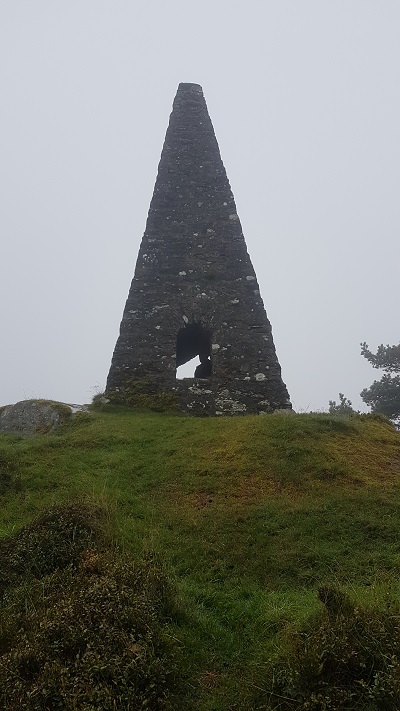
Sunday looked a bit damp from the bedroom window, but we wanted a walk, and we wanted to be in the hills, so with beginners’ minds, not choked with assumptions about walks in bad weather not being enjoyable, we set off to Little Glenshee, to walk the Obney hills to the Obelisk on Craig Gibbon that overlooks Glen Garr. As we neared the ford, we realised we were not going to get any fantastic views from the Highland Boundary Fault over the flatlands of lowland Perthshire. The cloud base, already low, was decidedly sinking like a lead balloon. I wondered where Wordsworth was actually wandering when he spoke about “a cloud that floats on high”. It is not in the nature of any self-respecting cloud to float. Sink, envelop, infiltrate, surround, creep into you…. Not float. Anyway, we donned the waterproofs and walked.
And this is what came of it.
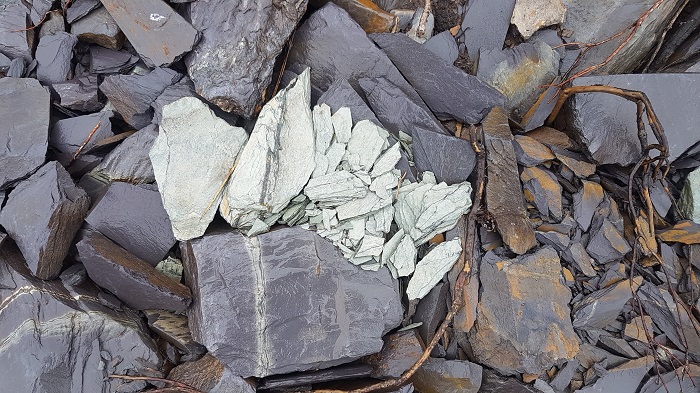
First came the rocks; a stony uphill path; clear water running over the blue slates, the shambles of old quarries. Upthrust from the plain, the sudden rise of hills unseen but felt in thigh and chest, heartbeat thundering in swaddled air; stones shiny, metamorphic, tale-telling, momentous.
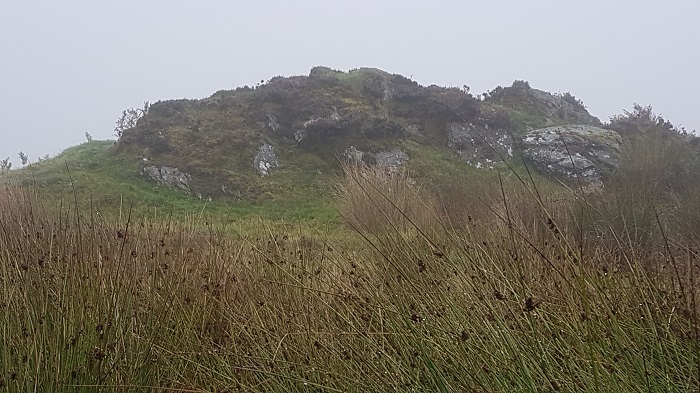
Stones too, marked on the map, rearing through a drenching mist: “Cairn (remains of)” – markers, unknown burials or merely outcrops – “Pile of Stones”: piles which shrink as you approach across heather and fescue grass.
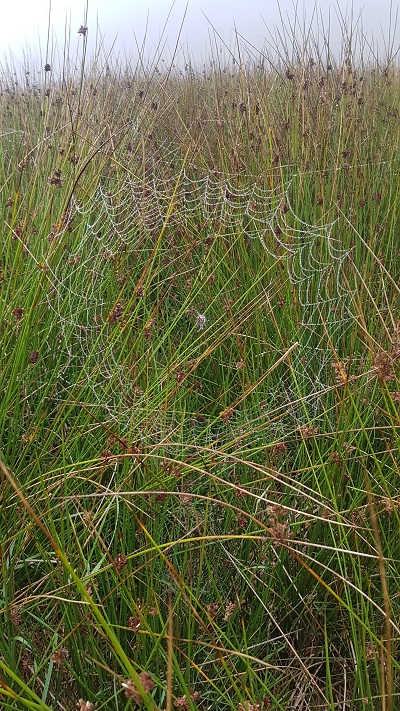
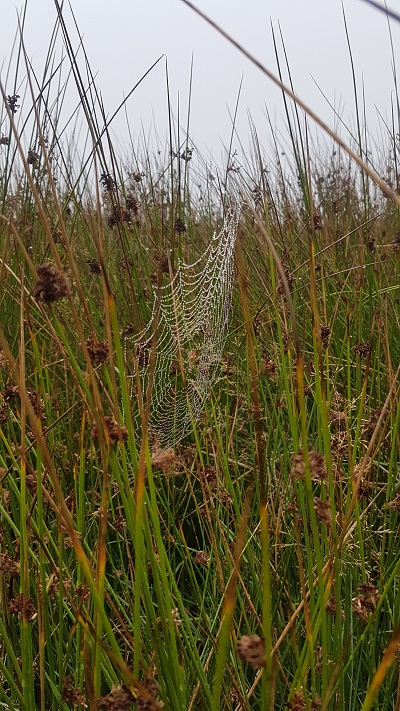
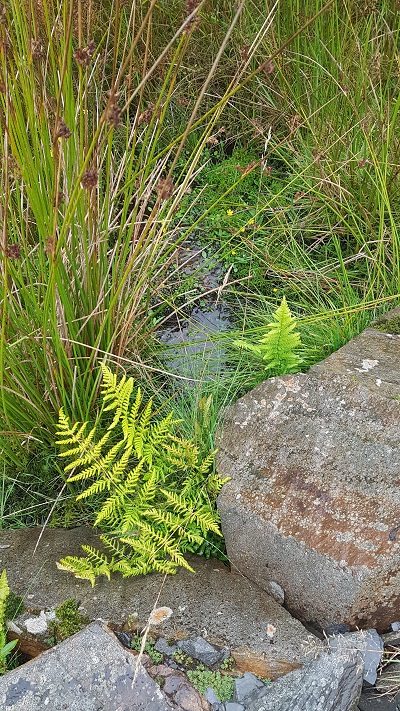
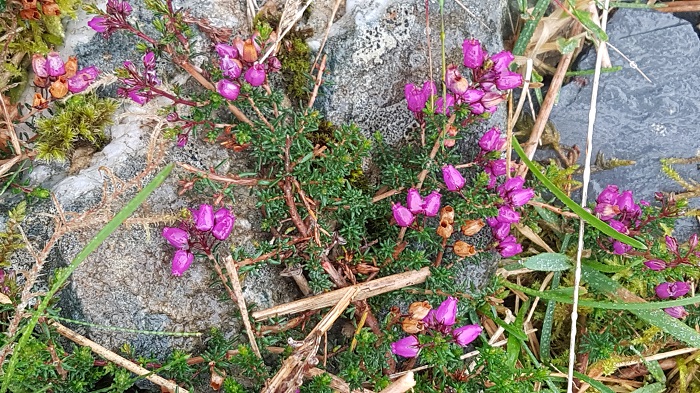
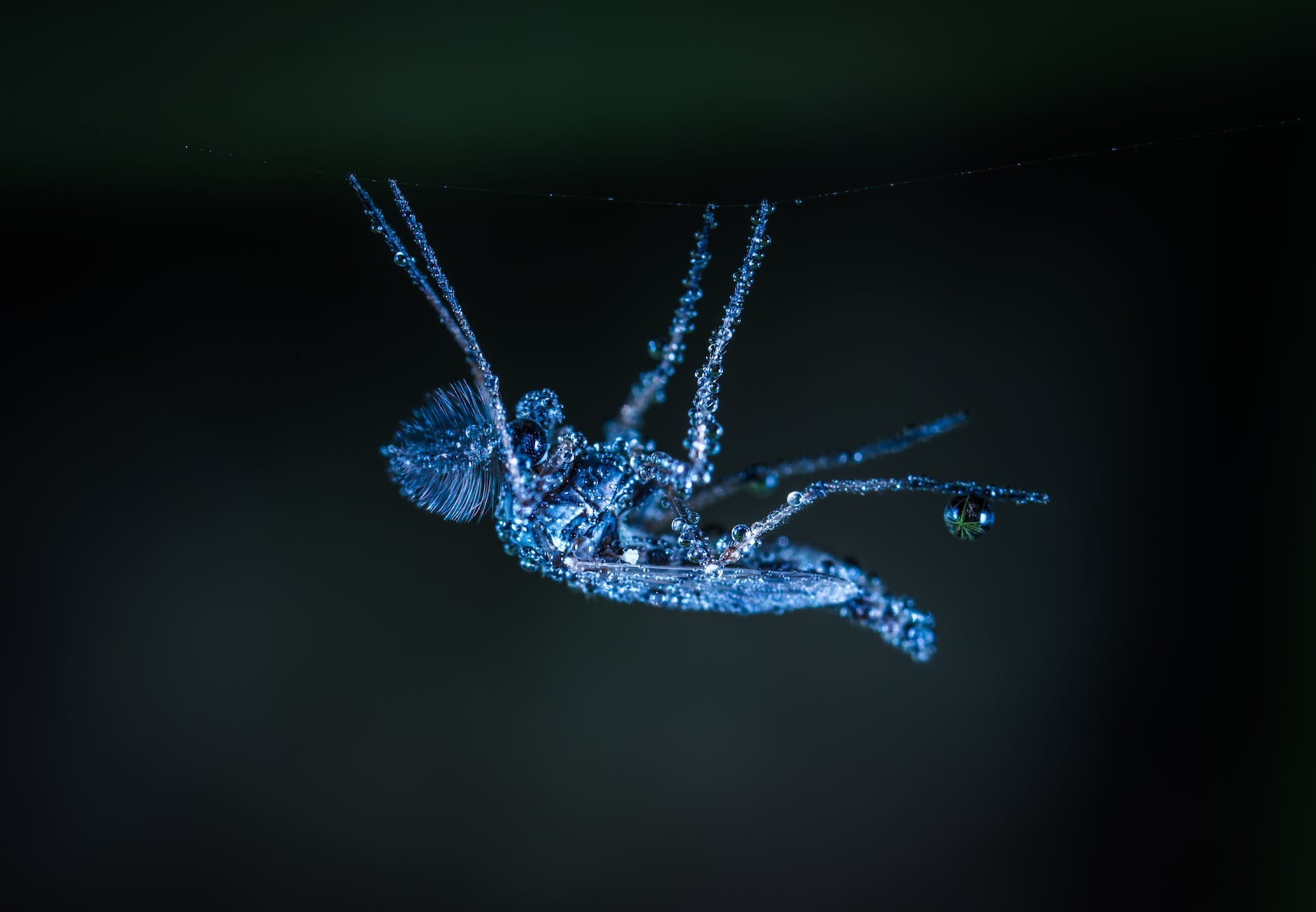
Then, the little things that lie beside the track: startling pink of late-flowering heaths pounce on you from the greyness of descending cloud; tiny water buttercups, iridescent ferns. And the spiders! Stalwart and smug in their jewel-encrusted orb webs, Waiting in pole position even though there’s Building still to be done. Every stem, every firework explosion of rush and moor-grass holds a magical web. Higher up, orb spiders fade away, their places taken by crowded, ill-designed but functional hammock webs, their makers hiding from shame or cunning, or just from the rain. The democracy of glistening crystal water-gems adorns them all.
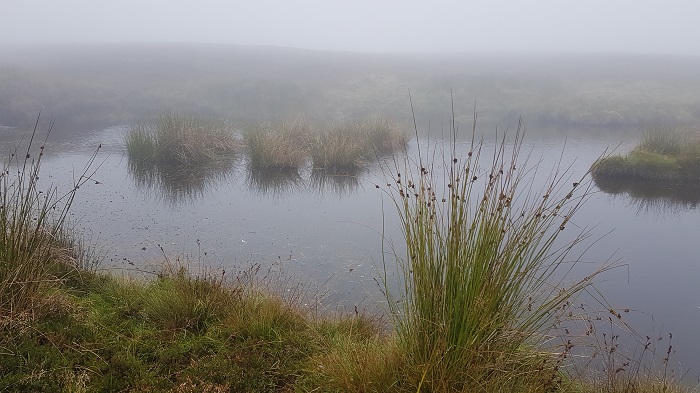
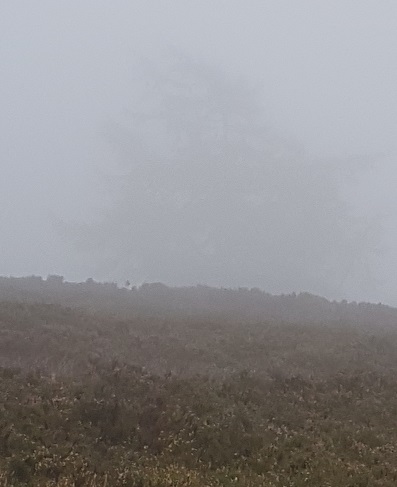
And so, the water: the cloud paints every surface, you included, wet without knowing how. A little pool, no more, stretches in the mind… Arthurian legend, told by the poet: “…and fling him far into the middle mere. Watch what thou see-est, and lightly bring me word….” No arm today “clothed in white samite, mystic, wonderful” rises to catch a sword, no lady in this lake. Just the mist weaving between the rushes and the ripples. Mist magnifies the shade of a ghostly tree, Tall as a mountain, shivering in and out of focus -is it there, or is it just your eyes?
And finally, the Obelisk….
The track seemed to go on forever. We had no way of knowing how much further it was to the Obelisk, since there was no chance of picking out landmarks with visibility only 20m or less, and the risk that the map would dissolve if we got it out. We waved in the direction of the much-vaunted views that weren’t there. But I was happy having my vision curtailed; there was so much to see close by, so much that surprised and intrigued. The cloud muffled sound: occasionally, red grouse materialised and flew off – “go back! go back! go back!” – or a plaintive meadow pipit called damply.
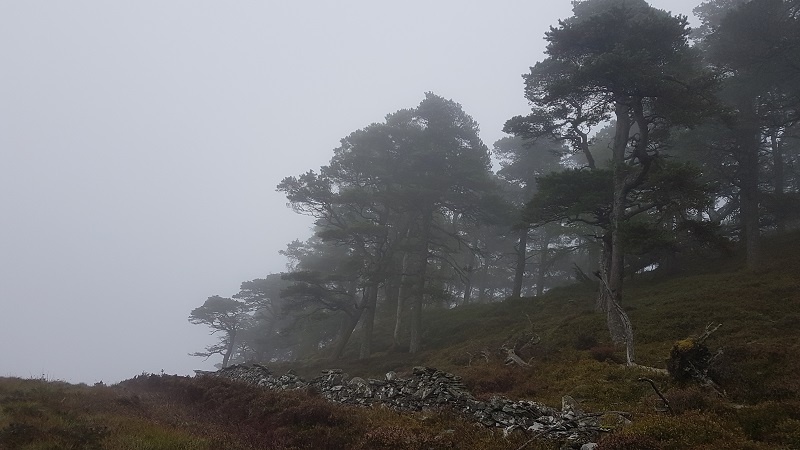
Then on our right, where the view would have been, a monstrous hill seemed to rise sheer from a deep valley we knew wasn’t on the map. But no, it was surely a bank of darker cloud – there are no hills that high here. It faded in and out of sight, until the penny dropped – it was the start of the trees in the midst of which the Obelisk stands. But so tall! And so far away, across a great canyon of a valley. “Not going there,” we said, as the track ended abruptly and we ignored ourselves to head south towards the top of Craig Gibbon. I don’t know how mist and cloud so trick the eye, but the great gulf was actually just a slight dip in the terrain, and the supernaturally gigantic trees were but mature pines and larches clustered on top of the little summit.
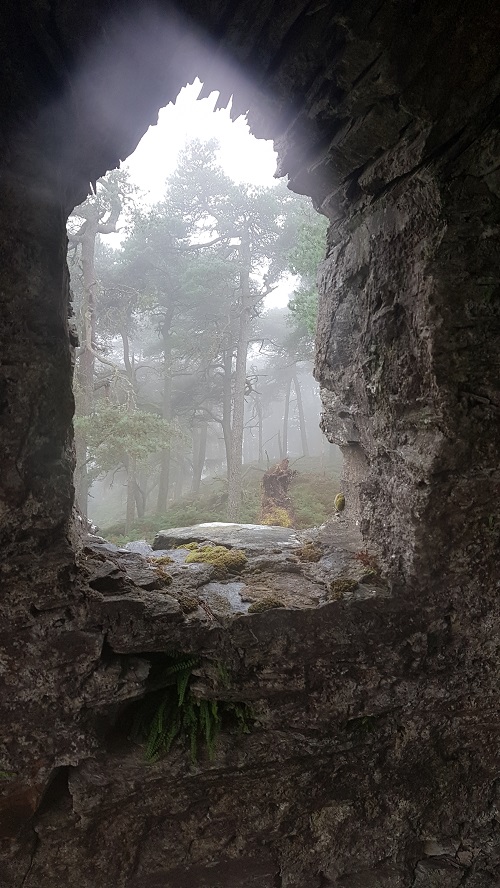
The Obelisk itself, looming like an ancient pyramid from the foggy tangles of tree and heath, was a wonderful thing that day. Its history is rather pedestrian – just an expression of a 19th century landowner’s ego who wanted everyone to see how far his land stretched. But the cloud slithered into its window-spaces; ferns flourished on the wet grey stone. Tiny frogs hopped among the slippery, exposed pine roots, and there were wild blaeberries for lunch.
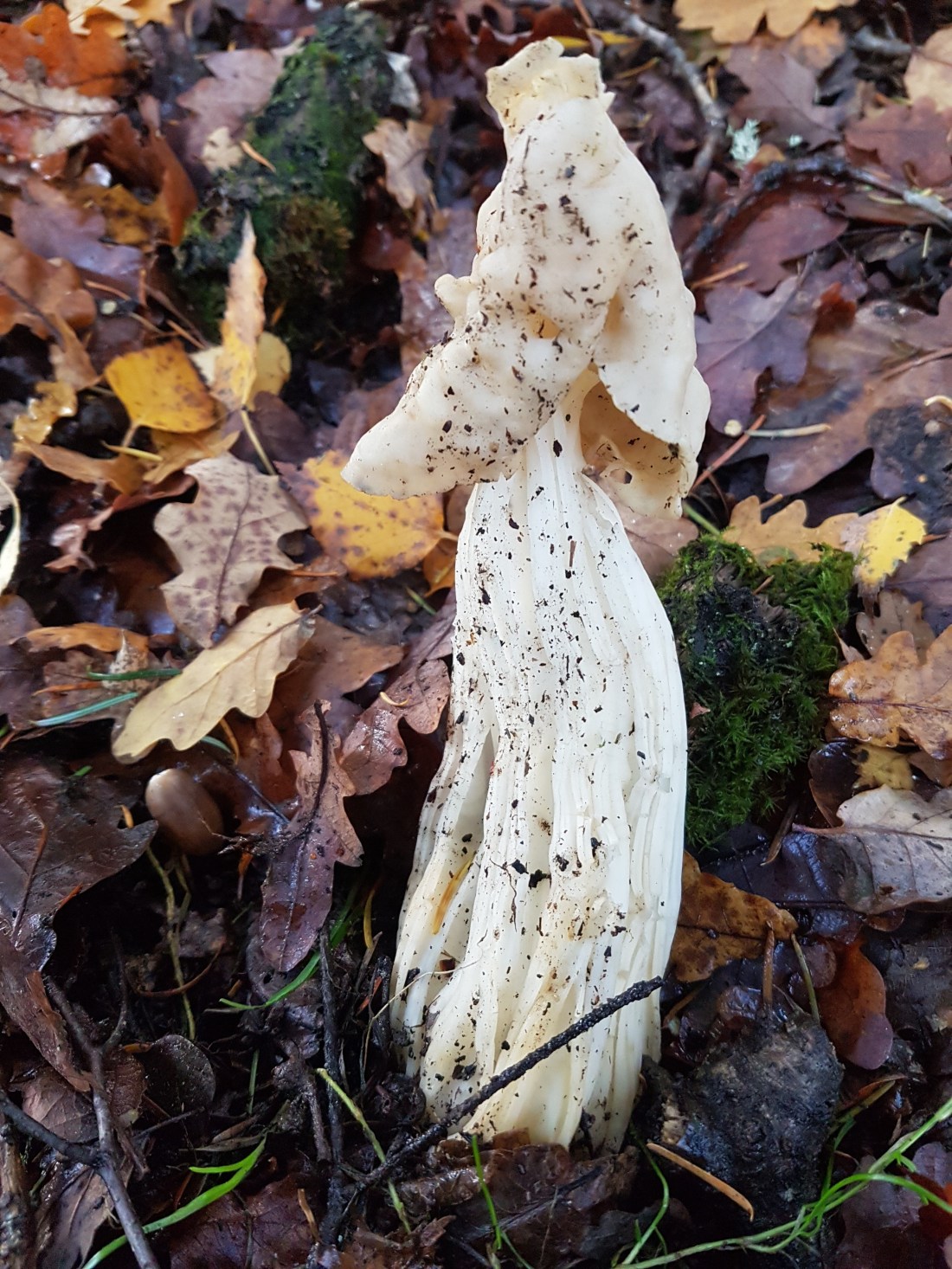
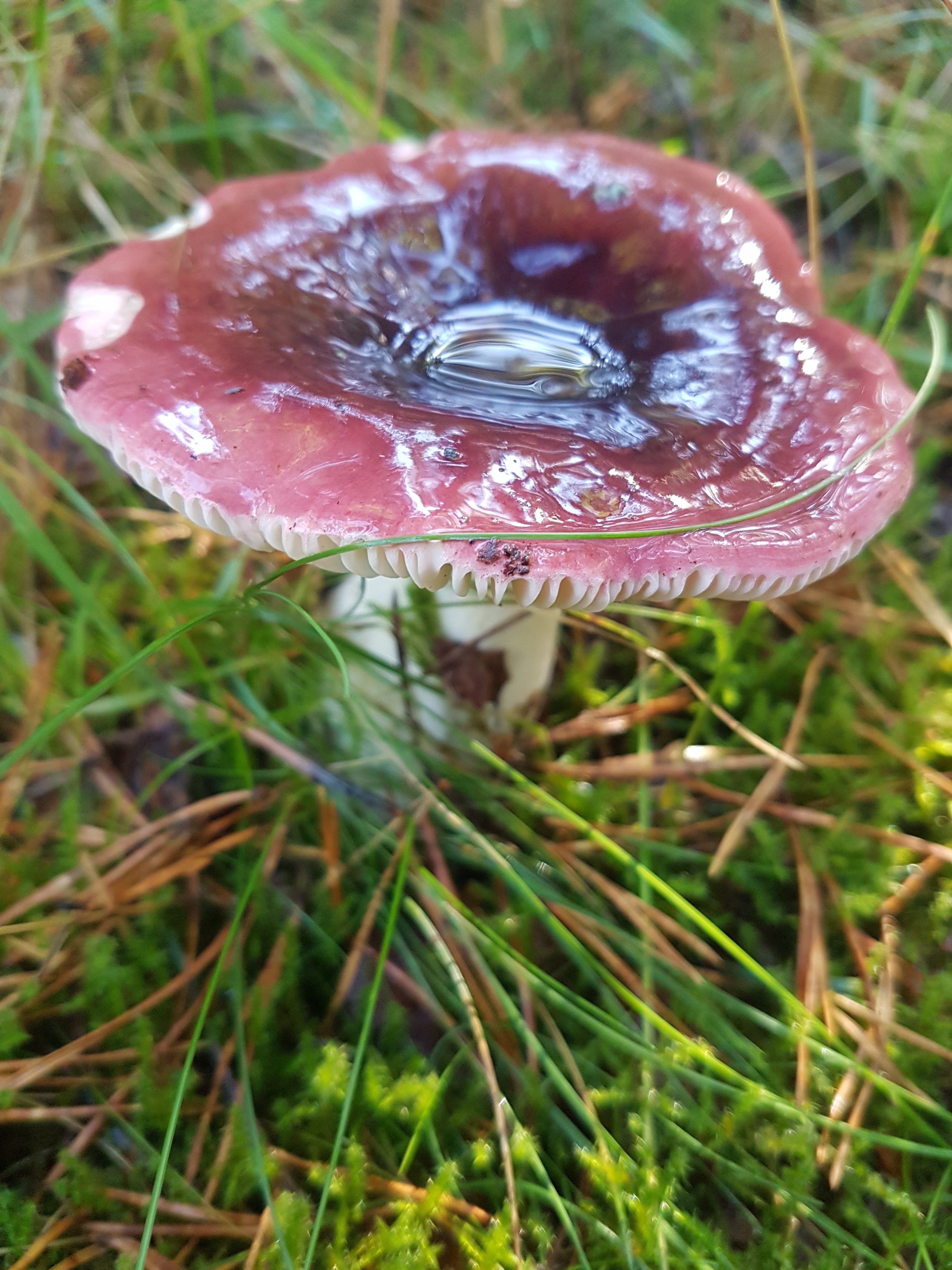
If you are out in the countryside and find a mushroom you think is poisonous, do not panic and trample or kick it to ****. It cannot kill you unless you eat it. It doesn’t even want to kill you and it cannot chase after you either. It is a beautiful organism trying to reproduce itself. Leave it alone. (Oh – and do not eat it) (Photo above is an example – isn’t it lovely!)
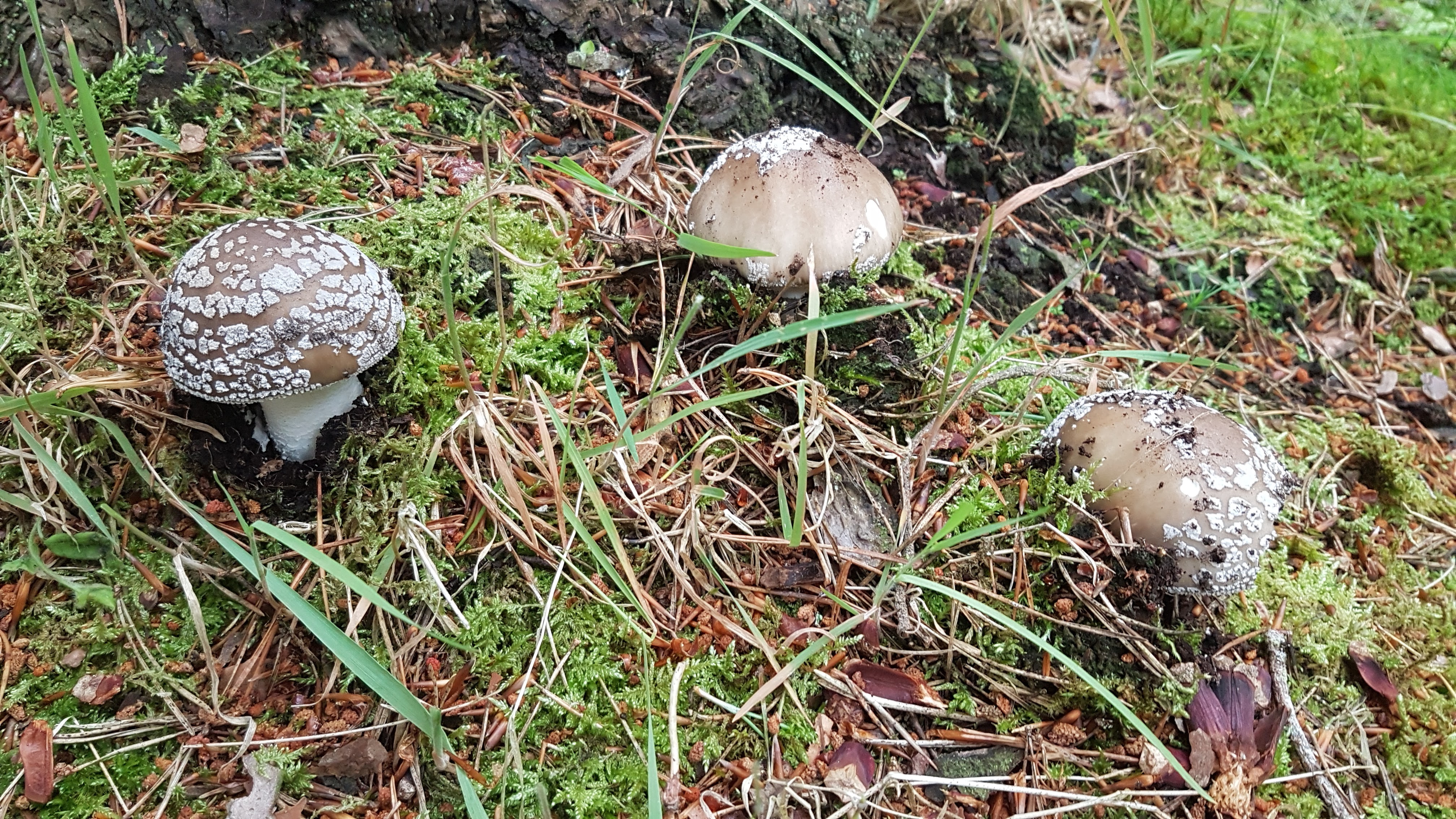
If you find a mushroom and you don’t know what it is or if you can eat it or not, see 1. The same applies. If you want to identify it, take a photo and maybe one specimen.
If you find a mushroom, that you 100% know you can eat and you want to, pick – but adhere to these sub-directives: * Don’t pick the whole blooming lot – never more than your personal needs That includes large mushrooms like Chicken of the Woods growing on trees – never take it all * Always leave plenty of young and old (reproducing) specimens behind * If there’s only one or very few, leave them for others to enjoy, including other fungus-eating species such as deer * Keep your big feet from trampling the site and all the ecosystem it holds to bits. Tread lightly and avoid damaging vegetation * If you carry an open-weave basket, your dinner will arrive home in better shape and may even shed some spores along the way
With particular reference to Giant Puffballs: these are not footballs – they are not spherical. Nor are they rugby balls, golf balls, cricket balls or any other species of ball. Therefore, do not treat them as one. If you would like to eat one, pick it carefully, take it home, and share it with like-minded friends before cooking it. This is because if you try to eat a full-sized Giant Puffball on your own, you will be feeling nauseous by day three. They are way too big for one forager.
If you have children, take them foraging and teach them why fungi are so important to life on earth. Let them learn what’s safe to pick and what to leave alone as you do. Introduce them to this appendix to the Countryside Code.
(If you don’t know yet why fungi are so important, Entangled Life by Merlyn Sheldrake is a good read.)
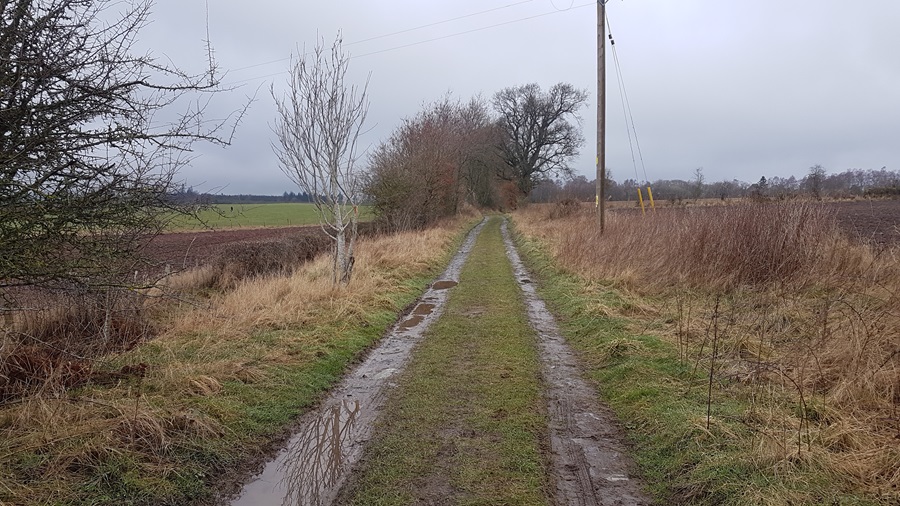
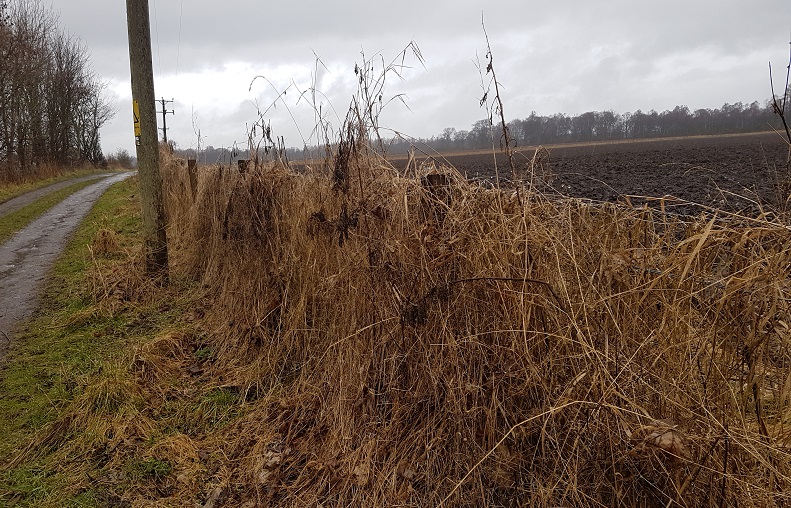
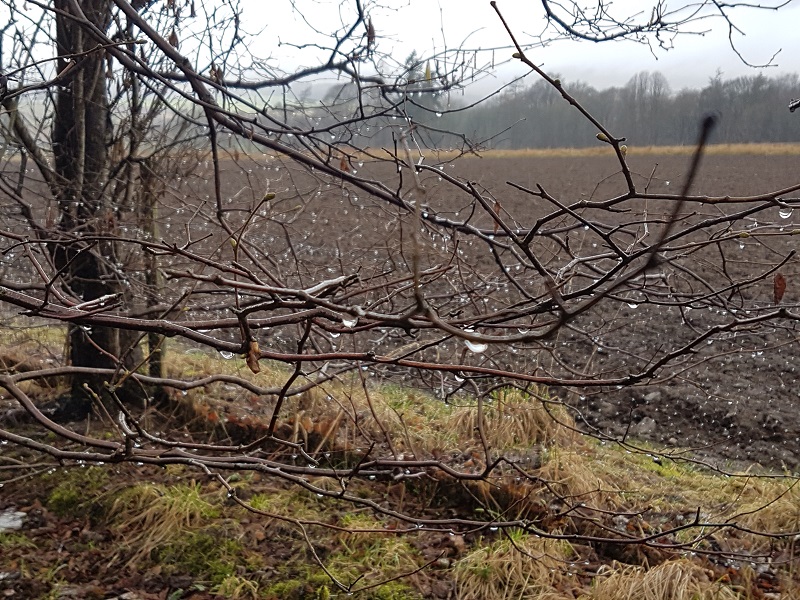
One day to the equinox; officially the first day of spring. It rains, a sullen, dreich miasma and the horizon is drowned in mist and low cloud once again. No cloud of cheery celandines yet line the ditches; no coltsfoot flowers; no green dazzle of new growth erupting from the tired, forlorn and hang-dog leavings of winter stems of grass.
There was a start to spring, a couple of weeks ago, when the sun was gentle and warm and the birds practised their calls. A blue tit inspected a nest box, and rooks set-to in earnest up in the rookery tree. Today, the only sound is the drip-drip-drip of rain. And even that’s muffled.
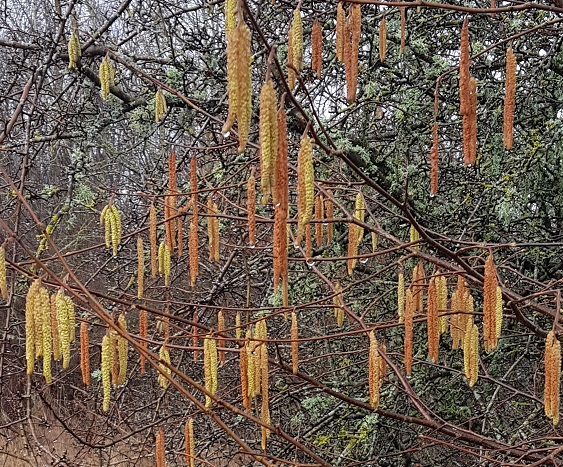
In the soggy brown fields, where the cover crop was optimistically ploughed in a fortnight ago, soil trickles away downhill in the empty furrows. No fuzz of pink from swelling buds tints the distant birch trees, no lighter hues on the sycamores and maples. On the hazels, the merry festoons of bright yellow and cream catkins are turning brown, but no buds are opening to take their place.
Spring’s not here. I rake in the squelching soundscape of a muddy woodland walk for the chiff-chaff, first of the warblers to arrive in March, but he is not here either. I wonder if this is the day I have for so long dreaded and feared – the “what if” day. What if the the birds of summer do not return? What if I never see another swallow? What if the flowers of spring are, finally, poisoned to death? What if nests fail and nestlings starve for want of insects and worms?
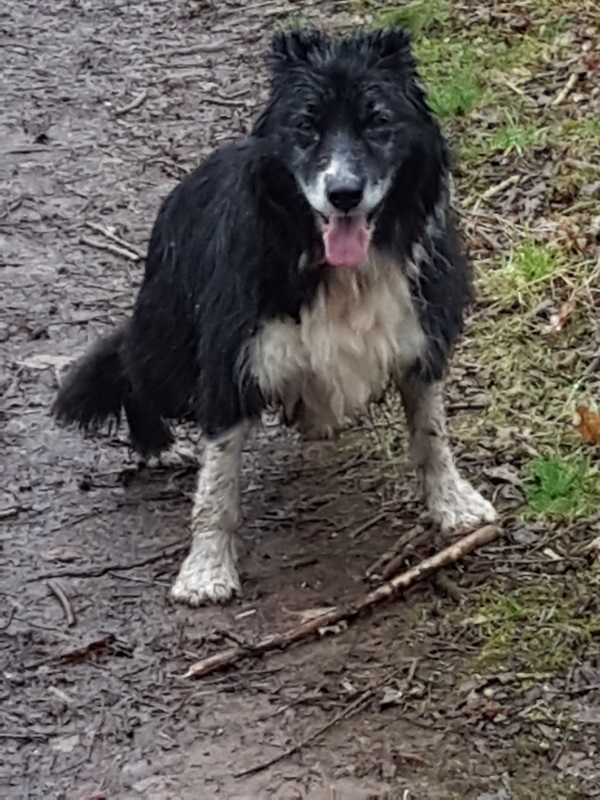
I do not want to follow this thought. Spring is late and it makes me weary and anxious. My elderly dog plods on, keen to get back in the dry, tired, arthritic legs dragging, stumbling at times yet still showing interest in sticks, at least on the way back. I think, will spring come in time for him to enjoy it, to sit in the healing sun and watch the world go by, an old dog at the end of life but still game?
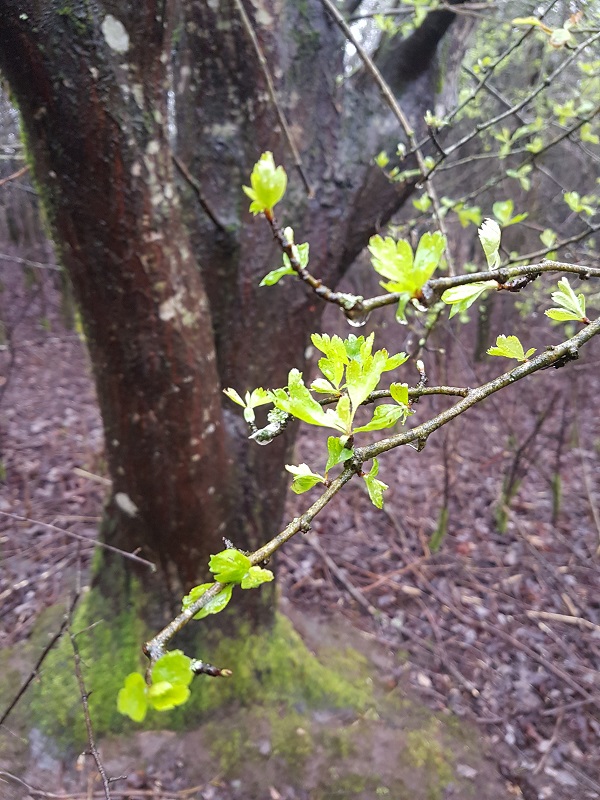
On the way home, I find some of those precocious hawthorns in the depth of the wood which always burst into leaf prematurely and give me my ritual mouthful of hedgerow “bread and cheese”. Today it tastes of even less than usual, but I chew away, get in the door, dry off the dog and put on the kettle.

 Comments on The Nature of the Universe